The five-time Olympic medalist discusses his work as a strategic adviser to The Zone, a new platform designed to support athletes with their mental health and wellness through a range of programs and modules.
Main Photo: Getty Images

You can’t have a discussion about sports technology today without including athletes in that conversation. Their partnerships, investments and endorsements help fuel the space – they have emerged as major stakeholders in the sports tech ecosystem. The Athlete’s Voice series highlights the athletes leading the way and the projects and products they’re putting their influence behind.
* * * * *
Gatlin retired in 2022 and has found a new role in the sports tech space: he was named a strategic adviser last month for mental health platform The Zone, which offers mental health and wellness support to athletes through a collection of programming and modules.
The startup works with more than 200 teams across all levels of college athletics, along with some collegiate conferences and youth sports.
On connecting with The Zone and its founders, Erik Poldroo and Ivan Tchatchouwo, through a mutual friend…
“He said, ‘I think you’d be great for this program.’ So I did a little more research on it, and I actually liked it a lot because I think mental health, especially in the sports and athletic space, is the next frontier.
“Athletes are becoming stronger. They’re becoming faster. Obviously, recovery helps them stay in the game of play longer, helps extend their career. But going through the research of what The Zone represents and what it brings, it kind of tapped me on the shoulder to realize that I operated around a lot of athletes, and I saw a lot of athletes who had performance anxiety. Athletes who did very well at practice but couldn’t really cross over into the game of play.
“And that could be a whole array of things. It could be the fact that you’re not controlling your environment like you do at practice, or the fact of stage fright and competing in front of a certain amount of people, or even from a professional level, if I don’t get this job done, that means a reduction instead of a bonus. So I think it’s a really taboo and hush-hush area. And I think what The Zone brings to the table, it helps uncover that, but in a way to where athletes have a tool.”
On how The Zone could’ve supported him during his running career…
“From a collegiate aspect for me, my first year, I was constantly the bridesmaid to my teammate. To give you perspective — how you do in other sports like basketball, football, baseball, it’s very team-oriented. And you’re working with your team to better each other so you can go out there and win together. But you also have to remember, in track and field, the people you’re training with, it’s almost like those are the people you’re going to compete against. I’m training with other 100-meter runners who are trying to beat me to be able to get that one gold. And that goes from a collegiate aspect to the professional realm as well. So you’re always in that state of alertness.”
On his post-retirement life…
“Right now, I’m learning to slow down because being a professional athlete, especially in the track world, it was always like go, go, go, attack, attack, attack. … One thing for me was taking the time to calm myself down and know exactly where I am as a person and a human being, and that’s what I love about the retirement aspect of things. Now I can slow it down a little bit. I don’t have to feel like I’m in a rush all the time, and I get to enjoy my sons, who are growing up — I’ve got a 15-year-old and a 4-year-old — and tackling other things that I have a passion for, which is going out and doing speaking engagements, speaking to certain type of audiences, and also aligning myself with companies like Erik and Ivan’s with The Zone.”
On the tech that boosted his career…
“I think for me, Normatec, the cryochambers, the Whoop — those are the things that we used that helped me understand where my athleticism was at and gauge it, especially from recovery level. When I was still competing, recovery was that thing that was going to make sure you stayed in the game. … I think now the name of the game is mental. Because a lot of athletes are always searching for how to be able to be better physically. No one coaches you and teaches you how to compete. They just teach you the nuances of your sport: how to shoot a correct jumper, how to be able to hit a home run. But no one teaches you how to be able to mentally be in the game, and what it looks like to be in the game at a high level.”
This article was brought to you by SBJ Tech, a Leaders Group company. As a Leaders Performance Institute member, you are able to enjoy exclusive access to SBJ Tech content in the field of athletic performance.
In this edition of SBJ Tech’s Athlete’s Voice, British triple jumper Naomi Metzger discusses how data and AI are transforming her recovery.
After narrowly missing the Tokyo and Paris Olympics, Metzger is documenting her goal of qualifying for the LA28 Games on the blockchain. Cudis was founded by UCLA graduate Edison Chen, and it targets Gen Z athletes, having also secured partnerships with UCLA athletics and individuals competing for Lamborghini Racing (Cam Aliabadi), in Ironman (Patrick Schilz) and in Olympic rowing (Kate Knifton, a two-time NCAA champion at Texas who was Big 12 Athlete of the Year in 2023).
On how she learned about Cudis…
I actually found it on X. I was scrolling through, and I’m always having a look at what the next thing in crypto is — and then Cudis popped up. I saw wellness, web, crypto all combined — own your data — all these words that I’m thinking, ‘This sounds really interesting.’ So I shot them a message, and I was like, ‘Hi, I would love to be an athlete ambassador.’ I got talking to Edison, and then they made it happen. So I got sent the ring to test out, and then I got sent the version two ring. For the past six months, I’ve been playing around with the ring and really got to enjoy using it.
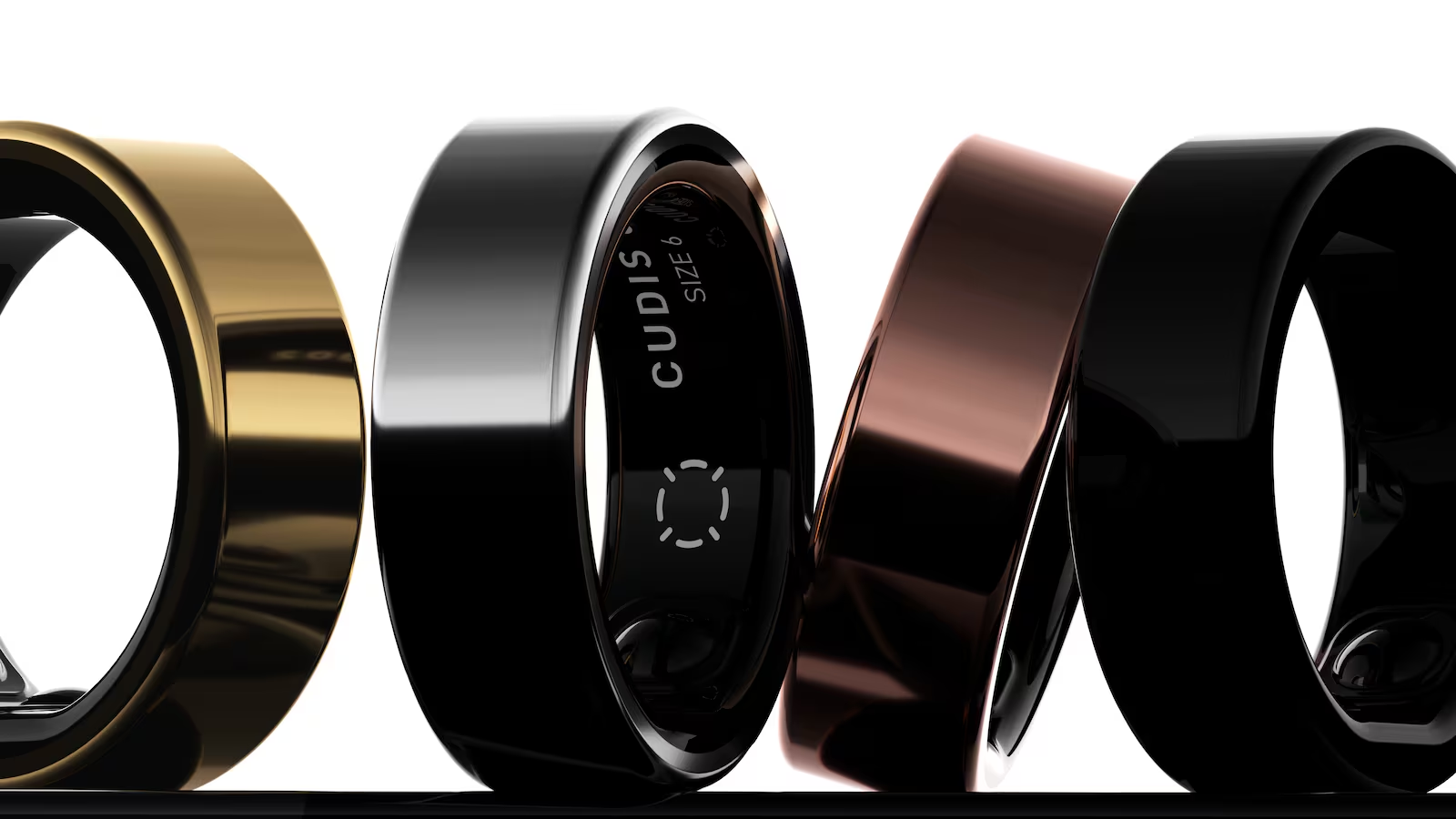
Cudis rings add a new layer to the wearable experience with their Web3 features that can transform real-time data into valuable points redeemable for exclusive rewards. (Image: Cudis)
On her interest in crypto…
Kind of out of desperation because I got dropped by my sponsor in 2021, so I wanted to find a way of how I can fund my athletics. I was on TikTok and stumbled across a Gary Vee video talking about NFTs. He was really passionate. So I was like, OK, let me just see if this works. So I created my own NFT collection in 2021 and stuck around since then.
On her prior use of wearables…
I used the Apple Watch but never to monitor my sleep because the problem I found with the Apple Watch is that you constantly need to charge it, and then when I’m sleeping, I might forget. So I never really tracked my sleep. A lot of athletes were using a Whoop, but they have to pay a monthly or yearly [fee] — it is a subscription-based model.
I don’t really like to pay monthly fees. I’m an ambassador, but I knew Cudis is a one-off payment. And I was like, OK, that appeals a little bit more to me. Since getting the ring, I’ve started to track my sleep as well, and that’s been pretty helpful.
On what she’s learned about her sleep…
I basically learned that I wasn’t getting as good of a sleep as I thought I was because I’m always quite proud of the fact that I get eight hours, but a lot of that was very light sleep. It wasn’t deep sleep, and I realized that once I got more deep sleep, that meant spending longer time actually in bed and trying to aim for a bit more than that eight hours, I felt a lot better, and the more I started tracking that, I realized that training was better when I well rested, my mood felt better. So that’s something that I wouldn’t have learned if I wasn’t really tracking it and looking at the data.
On how she tried improving her deep sleep…
I Googled, and I was asking people, “Do you have any tips?” I went with magnesium before bed, and that seemed to really help. A colder room and weighted bed sheets. I literally tried everything because, even though I was getting those hours, I really wanted to maximize my sleep because I know that’s super important for recovery.
On her analysis of daytime metrics…
It was the stress levels that I found really interesting with the ring. Although I’m pretty in tune with my body and what aches and pains, because I’m at 100% all of the time, whether that’s training or I’m doing the crypto things or making videos, I didn’t realize how stressed that I’m actually becoming when doing that. So when I started to have a look at the ring data and seeing that way the stress levels are pretty high, that told me to maybe rest a little bit, self-care, and prioritize my mental health a little bit more. And it sounds silly that I wasn’t in tune with my own brain, but I feel like the ring almost helped me to figure that out a little bit.
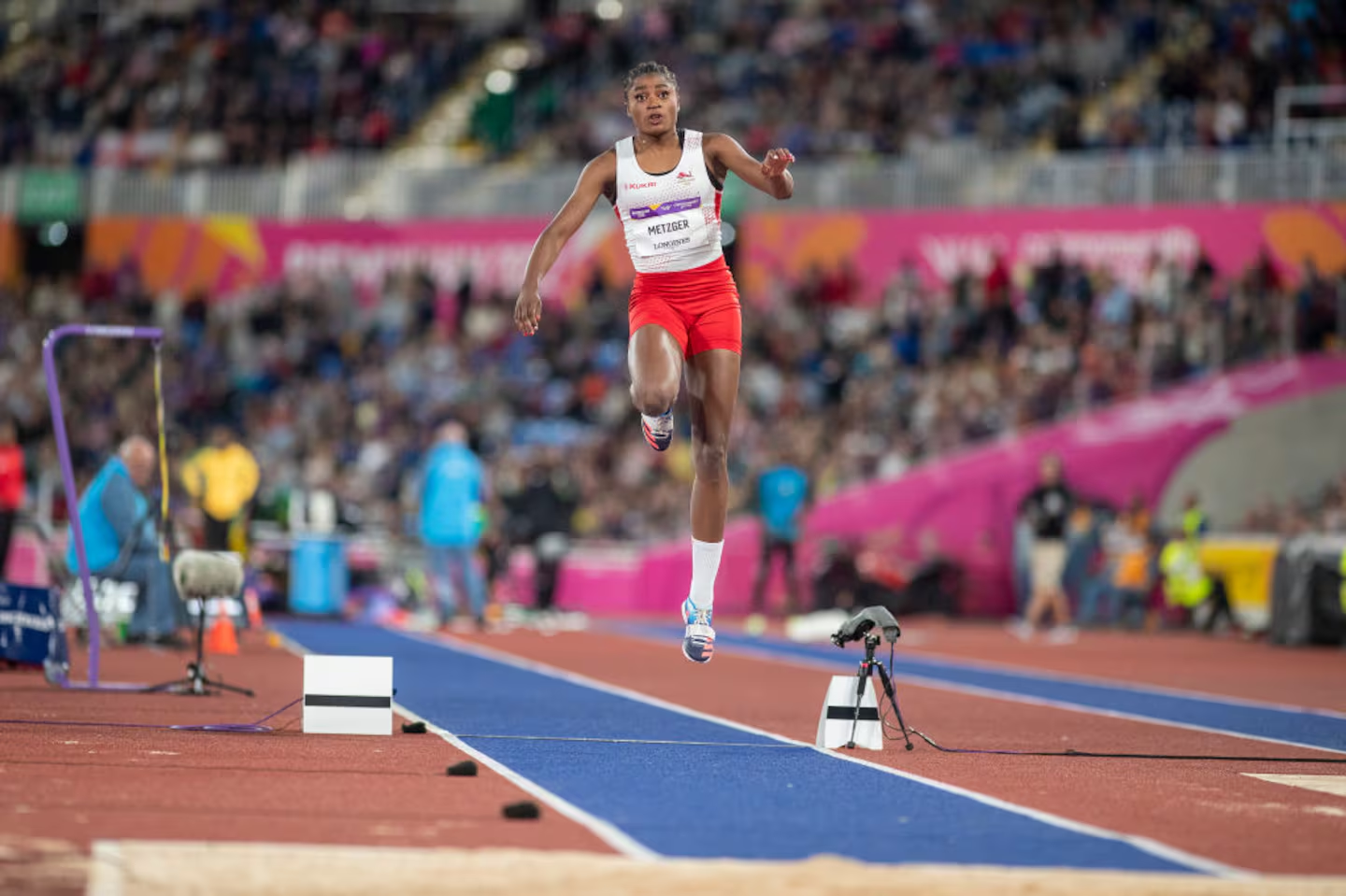
Naomi Metzger is an athlete ambassador for Cudis, a wearable ring technology with a Web3 component. (Photo: Corbis via Getty Images)
On using Cudis’ AI coaching functionality…
It really helped when I was looking at my sleep and looking at that deep sleep. When I first got the data, it was almost so much data, and I didn’t quite know what to make of it, so I asked the AI component, the coach, ‘Can you have a look at my sleep data and let me know what needs to improve and what’s the average and that type of thing?’ It was able to feed back [info] using my data what I should aim for, and I found that really helpful.
I also sometimes just ask for a little bit of advice. It sounds weird to speak to AI for advice, but sometimes I’m like, ‘Hmm, is it okay do you think to have a coffee now? Or do you think I should wait till maybe a bit later?’ And then it would be like, ‘This is the optimal times of having coffee.’ It’s quite cool to use AI in these ways, when I’d normally, I guess, be a bit too embarrassed to ask my actual coach.
On the ring’s Web3 component…
I’m really incentivized by rewards. As athletes, we’re obviously aiming for medals and things like that. The idea that your fitness gives you points, and those points can add up, and soon, I think, it’ll be able to be monetized, which is really cool. It’s a really good way for me to make sure that I’m tracking my workouts, sharing them, to get other people to, I don’t know, give them a bit of a boost — but it also just holds me a little bit more accountable.
You have a vitality score, and I’m always trying to aim for that 100 score. But sometimes I can be like, I don’t really need to do this rep, and I remember I’ve got the ring, it’s tracking me. I’m like, Okay, let me just do it. So I think, especially because I train on my own quite a bit, it’s a good way to hold me accountable.
On how much she continues doing her art…
I actually feel like I don’t have the time but definitely something that I want to get back into a little bit more. That was something that calmed me down. As I said, I’m always at like 100 but drawing was a way of calming me. And when I was doing the NFT collection, I was drawing a lot, and I had a really good athletic season. And also, when I was injured, I was drawing a lot as well because it was keeping my brain active when my body couldn’t move.
This article was brought to you by SBJ Tech, a Leaders Group company. As a Leaders Performance Institute member, you are able to enjoy exclusive access to SBJ Tech content in the field of athletic performance.

The Olympic gold medalist is sits down with the Athlete’s Voice to discuss her new venture with Always Alpha
Main photo: Always Alpha
A Data & Innovation article brought to you by
You can’t have a discussion about sports technology today without including athletes in that conversation. Their partnerships, investments and endorsements help fuel the space – they have emerged as major stakeholders in the sports tech ecosystem. The Athlete’s Voice series highlights the athletes leading the way and the projects and products they’re putting their influence behind.
* * * * *
The Los Angeles native competed in the 100, 200 and 400 meters, with an individual gold at the 2012 London Games in the 200. Felix also won 21 medals in the world championships before retiring at the end of 2022.
Felix has been active across a wide range of interests in recent years, as an advocate for Black maternal health, as the Co-Founder of women’s footwear brand Saysh and, as of today, the Co-Founder of Always Alpha, the first talent management firm exclusively dedicated to women’s sports.
For Always Alpha, Felix partnered with her brother, Wes — a former elite runner who has served as his sister’s agent — as well as former Wasserman executive Cosette Chaput and Dolphin Entertainment CEO Bill O’Dowd. Always Alpha is a subsidiary of the NASDAQ-listed Dolphin and will work with women athletes across all sports and support them in a variety of ways, including brand partnerships, media production and entrepreneurship.
On the motivation to start Always Alpha…
What led to it really was my experience in my career. My brother managed me, and we really had to kind of piece things together. There wasn’t really a cohesive strategy starting out to bring all the things that I was interested in and make all the work seamless. And so we had missteps and struggles, and when other athletes would come to me and ask, ‘How did you do this or that?’ Or how to start a company, or if they were interested in writing a book — whatever the thing is — where do I point them where they can do all the things and show up as themselves?
That was the inspiration — that it didn’t exists — and especially something focused on women’s sports, obviously, with all the momentum that we have now, but I think there’s just a unique way that you show up for a woman, and so we are excited to do that at Always Alpha.
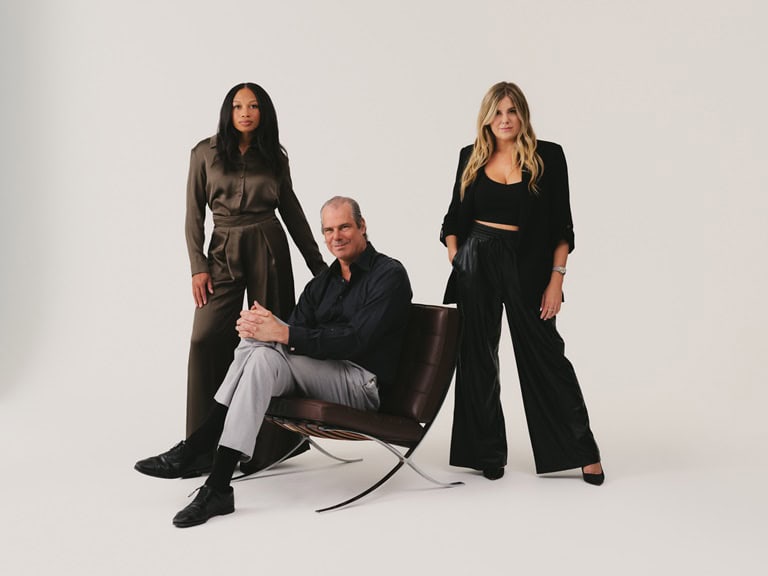
Photo: Always Alpha
On an example of the marketing challenges she faced…
It was an idea of always wanting to get outside of track and field and break through to the mainstream. That was always the big fight. I felt like, through my career, we learned so much, and I always told Wes, ‘I wish we could do it again.’ Now we have all the pieces, and we have the things to take advantage of, the relationships and all of that. That would have made that path so much easier, as I was interested in business, and it just wasn’t there.
Now that I understand things so much clearer, I feel like a big piece of this is this legacy and mentorship. And how do I give back? And I really see this as a vehicle, also, to be able to do that and to say, ‘Let me help you avoid some of the hardships that I went through.’
On connecting with Dolphin to launch Always Alpha…
Cosette and I met working on the LA bid in 2016. Then we met Bill from Dolphin [earlier this year], and he really just shared the vision. He understood that what we were trying to create didn’t exist and that we needed to have something fully focused on women.
It was just being aligned — Wes, myself, Cosette — and talking to Bill. He got it. And that doesn’t always happen. So to be able to bring this into the world at scale, and to be able to have amazing resources that Dolphin provides is a unique experience.
On Allyson’s daily role with the agency…
It’s really that piece of guidance and [having], conversations with athletes and coaches broadcasters about, not only my experience, but what are their goals and what would they like to achieve? Being that piece of it, but also on a personal level, being available, being an open book and transparent about my journey and how I can help others with theirs.
On the roots of her entrepreneurship…
It’s funny — growing up, Wes and I used to collect things around our house, and then we would create a store and actually sell back our family’s items to them. And so we’ve always had that bug. We had a lemonade stand — it was actually a Kool-Aid stand — on our lawn. So we always had that spirit in our family, but we also weren’t really exposed to it in a real way. We didn’t know people close to us who had done it, and so being two kids from the inner city of LA, it didn’t really ever seem like a real possibility.
It wasn’t until right before starting Saysh [that we found] the confidence. I struggled with imposter syndrome, all those things, but getting the courage to just go for it. Launching Saysh was like, ‘OK, we can do this.’ To me, this is the next step in that journey that I’m on, just to make things better for women and make it an easier path.
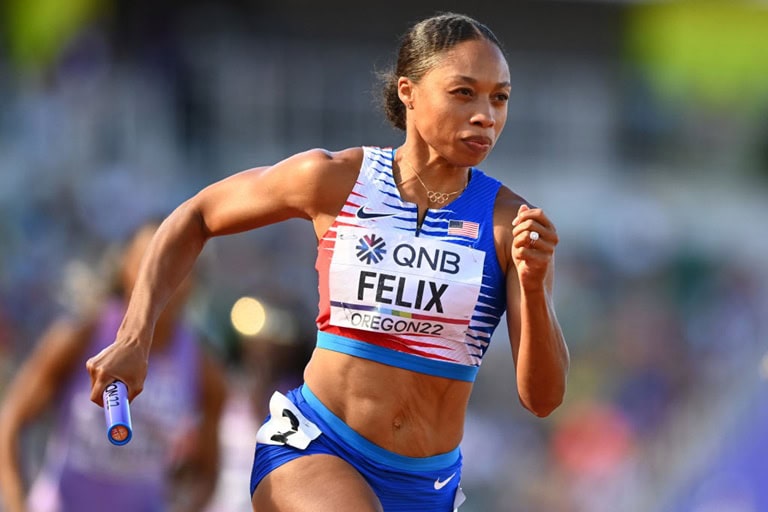
Photo: Hannah Peters/Getty Images for World Athletics
On preparing for a post-competition career…
It was such a natural progression with Saysh because it happened organically. At that point, I wasn’t really focused on what was the next thing. It was, ‘Well, I don’t have shoes, and I need them, and so we’ve got to build this thing.’ Throughout my career, Wes was always really hounding me on, ‘You need to make these connections and these relationships, and we don’t know what it’s for, but it could be useful later on.’ And so I was really heavy into that and into mentorship. I wasn’t sure what the thing was going to be, but I was constantly trying to prepare for my next move.
On her mentors…
Jackie Joyner-Kersee has been my athletic mentor, and she’s been incredible. Mary Erdoes has been someone who has been really just transparent — one of those relationships that I didn’t know where it was going, but she’s provided so much business advice to me through the years, but early on in sport, she’s just shown up for me.
Yesterday, I was speaking at the NASDAQ Forum, and Fawn Weaver was one of the other speakers. Fawn has also been incredible in my life, helping me with that confidence piece, as someone who’s built an incredible business with Uncle Nearest, but just showing up in my real life and being that sounding board for me. I’m huge into mentorship. I think that if you haven’t done something before, talk to someone who has.
On the tech that she and coach Bob Kersee used to help her training…
That’s another one of those ‘I wish that I was at my prime now’ because I think there’s so many more tools, but we used a lot of filming and models — overlaying a model on top of the film that we take. You can set those models to like a world-record pace, and you can look at all of your mechanics. You can learn so much and adjust your [joint] angles and different things from that. So that was a huge piece while I was training that was helpful.
This article was brought to you by SBJ Tech, a Leaders Group company. As a Leaders Performance Institute member, you are able to enjoy exclusive access to SBJ Tech content in the field of athletic performance.
The Canadian also relied upon a metabolic cart and EMGs to ensure she is best-equipped going into next week’s race.
Main image: Saucony
A Data & Innovation article brought to you by
Saucony staff affixed 80 motion capture markers to her body and shoes to detect her movement to sub-millimeter accuracy in front of two Vicon camera systems. They placed a mask and air tube over her face to measure oxygen intake and exhalation. And then they asked her to run 11 miles per hour on an instrumented treadmill that can collect force data — and do it four times, each while wearing a different pair of sneakers.
Ultimately, the best fit for Elmore proved to the Endorphin Elite 2, which Saucony bills as its “most aggressive race-day performer” thanks to a carbon fiber plate and responsive foam cushioning.
“We saw how her body reacts, and we saw how much of a percent decrease in energy she uses per shoe,” Saucony Product Performance Analyst Andrew Lynch said.
Saucony Performance Engineer James Allen described that as her “metabolic savings” and explained that the preferred shoe was determined by a combination of Elmore’s biomechanics and physiology, her subjective feedback and the shoe’s mechanical response.
“One thing we try to do here a lot is trying to match subjective opinions to actual objective measurements,” Allen said, with Lynch adding that, in Elmore’s case, the two lined up well.

Ultimately, the best fit for Elmore proved to Saucony’s Endorphin Elite 2, which features a carbon fiber plate and responsive foam cushioning. (Photo: Saucony)
The eight Vicon Vero cameras track the motion of the reflective markers. That data is processed by Vicon Nexus software and syncs to the force data from the treadmill, which is considered alongside the VO2 datapoints of energy expenditure — which quantifies the effort needed to sustain that 11-mph pace. EMG wearables monitor muscle activation.
A separate markerless motion capture system from Vicon is easier to use and, with advances in computer vision and processing from Theia3D, its accuracy and usefulness is growing closer to the gold-standard marker-based mocap.
Elmore, a Stanford All-American who competed in the 1,500 meters in the 2004 Games and will have run the marathon in the 2020 Tokyo and 2024 Paris Olympics, holds the Canadian national record in the marathon with a 2:24:50, which equates to a pace of nearly 10.9 mph for the full 26.2 miles.
“Testing shoes is really a fun and rewarding process, seeing the changes over time and getting on the treadmill,” Elmore said in a video shared by Vicon. “You’re trying to understand the nuances between the different shoes and what the small, subtle changes are that could make a big difference over the course of a marathon.”
In this case, Saucony used its Innovation Lab to fit Elmore, a service available to all its brand ambassadors, although she is the lone Olympian among the group. But the high-tech data collection is also used to make improvements in shoe design.
Allen and Lynch noted that innovations in foam to reduce impact and preserve energy have been a big focus for the Wolverine Worldwide-owned company. That’s been beneficial as they ensure the sneakers serve all wearers and not just the elites.
“In testing those foams and trying to match and see, if we exert a certain additional amount of force, does that change the foam’s mechanical property, looking at the duration of that force, trying to match it to how much time the foam is under compression during a gait cycle,” Allen said. “Of course, that’s going to be different for everyone. But just testing these various things to see how the mechanic properties will change for different variables.”
This article was brought to you by SBJ Tech, a Leaders Group company. As a Leaders Performance Institute member, you are able to enjoy exclusive access to SBJ Tech content in the field of athletic performance.
In this recent edition of SBJ Tech’s Athlete’s Voice Series, Johnson discusses how training has evolved since his retirement and how it has influenced athlete development.
Main image: Omorpho
A Data & Innovation article brought to you by
You can’t have a discussion about sports technology today without including athletes in that conversation. Their partnerships, investments and endorsements help fuel the space – they have emerged as major stakeholders in the sports tech ecosystem. The Athlete’s Voice series highlights the athletes leading the way and the projects and products they’re putting their influence behind.
* * * * *
Johnson, 56, has worked as a media analyst for track and field, mostly in the United Kingdom, on air for the BBC and in print for The Times and Daily Telegraph. In 2007, he opened Michael Johnson Performance, a training facility in Texas that has worked with Olympians, amateurs and Arsenal FC’s youth academy, among others. The physical building recently closed as the curriculum has moved into a fully digital model.
Recently, Johnson met Omorpho CEO/Co-Founder Stefan Olander and learned about the company’s “gravity sportswear,” micro-weighted apparel to improve the results of training. A connected app offers on-demand workouts for the proprietary MicroLoad products. Johnson recently became a brand ambassador of Omorpho, which in November announced a $3 million seed funding round led by KB Partners & Thirty-5 Capital, LLC, bringing the total investment to date to $16 million.
On his introduction to Omorpho…
I met Stefan, the founder of Omorpho earlier this year through a mutual friend, and as soon as he started telling me about what he was building with Omorpho, I was immediately interested. I’ve always been interested in training. After my athletic career, I started Michael Johnson Performance, my sport performance training and advisory organization, so I’ve been in and around sports performance and innovation over the years since my own retirement.
There have always been weighted vests and that are kind of cumbersome. And I’ve seen myself with the athletes that we would train, and you put it on them — it’s not comfortable, they want to get on with the training. It was really interesting to hear from Stefan how they were approaching this with the vest but also with apparel as well, which I’d never actually heard that before with weighted apparel.
On trying out the product himself…
Stefan said, ‘Okay, well, I’d love to send you some stuff,’ which I wasn’t going turn down free stuff. People are amazed — even when you’re an athlete and you’ve got the endorsement deals, which I had — you still get excited about free stuff. So anyway, he sent me some, and I was immediately just hooked on it and loved it.
I live near Malibu and do a lot of hiking. I’m always looking for ways to challenge myself more. I loaded up with everything I could — the gear with the vest as well — and just immediately loved it. So that’s how I got involved. Then we started talking about how I could help with what Omorpho was trying to do and getting this out there and helping athletes and people in the fitness industry to understand the benefits of weighted training.
On prior alternatives…
You’ve seen the parachutes for, not necessarily adding weight, but adding resistance. There’s all sorts of rudimentary ways in the past that people have done that sort of thing, to try to create more load when you’re training to increase the effect of whatever that activity is that you’re doing. The problem in the past has been, it’s always been adding stuff that doesn’t actually fit and that may not be intended for that particular purpose. Even though the parachutes are built for people to run with, parachutes aren’t for running. So even in that, it’s very cumbersome.
And at the end of the day, with what people are training, it doesn’t matter whether you’re an athlete, or whether you’re a fitness enthusiast, or you’re training just for weight loss, or whatever it might be, you just want to focus on the training — he movements themselves and the endurance that it requires and all of the athleticism that it requires to actually train. It’s hard enough and more difficult when you’re adding all of this stuff.
On how he added load in his sprinting career…
I just looked up on one particular ability for me to add load in my training. I had a chronic Achilles problem about the middle of my career, which caused me to not be able to use spikes, which don’t have a heel are very, very tough on your Achilles and all of your lower extremities, but good for training to actually hit the times that you need, to lighten the load and provide all of benefits that you do with spikes. And it simulates racing as well. But I wasn’t able to wear spikes because of the Achilles issue. So I had to run in regular shoes with a heel and with a little bit more support. Initially, of course, my times in the reps were slower because I wasn’t wearing spikes. So then that became my goal is to, wearing the heavier shoes, to be able to get down to the same times I was when I was wearing spikes.
It obviously creates a situation, when you’re actually able to put that load on, where physiologically now, you’re obviously getting stronger, no doubt about it, when you can hit the same sorts of times with that load. But it’s a huge psychological benefit as well. And so for me, then I never went back to the spikes. In fact, my coach, and I just decided, ‘Let’s go up to a heavier shoe, the same shoe I would do on my warmups.’
We decided just up the ante and go ahead with the with the heavier shoe that I would wear in my warmups so I already was very familiar with this loading effect before I even joined Omorpho. And I believe in it, and I’ve applied the same sort of thing to what I do now in my training when I’m hiking. Of course, I time everything. I’m just kind of obsessed with that, and I’m getting back to my same times when I was able to do it without the weight.
On improper added-weight training…
It affects your biomechanics. It affects your movement, which is really, really important for most training, regardless of what you’re doing. Let’s just say you’re doing plyometrics: obviously landing, it’s really important to land in the right position, otherwise, you’re much more susceptible to injury. And if you’re wearing some weight or something that’s not designed to move with you, then that’s going to create some counterbalance movement, and you’re now not focused on executing the actual plyometric movement.
Your focus now is on trying to make sure that you counteract whatever that piece of equipment you’re wearing is doing. Your body knows and will protect itself to try to make sure that it actually counterbalances that [extra weight], but then you may be off-balance and more susceptible to injury. and then mentally you’re just not focusing on the actual movements that you need to be and the workout was designed for —and that becomes frustrating. What we find is ultimately people just take it off and stop wearing it because it’s just not working for them.
On the evolution of his Michael Johnson Performance Center…
We closed brick and mortar, so we’re all digital now. We license all of the programming, all of our coach education courses and all of our youth programming to other organizations that actually are selling those types of programs and providing those services either to their own teams and athletes. Or they’re actually providing it through an app or something like that. Most of it is white label, but some of it is still our brand.
I’ve never actually been a coach. I’m an entrepreneur. I have the greatest respect for coaches. I know what it takes. I’ve hired more coaches than I could possibly imagine — over 100 coaches — as a big part of my business is coach education and we train coaches. So I understand coaches and what makes them great, and I don’t have that skill set.
On helping coaches with innovation…
I could certainly see [incorporating Omorpho]. Every coach has their own program, and it depends on what they’re trying to achieve. But there certainly are workouts for athletes of all sports and in fitness as well that benefit from loaded training and could be beneficial to the objective of the training program. So I certainly recommend it. Our clients are always looking for what’s new and more effective ways and more efficient ways that we can train. It’s just making them aware because a lot of coaches are scouring for what’s new out there.
On getting athletes on board…
You have to get buy-in from athletes. It’s really, really important, and it’s really difficult to do that when — whatever it is that you’re wanting them to do — is going to be disruptive to the training and it’s going to be cumbersome. Athletes are willing to do a lot of things, but at this point with technology and all of the innovation in the world, especially young athletes who grew up with this stuff, their position is like, ‘Why should I have to do something? There has to be a better way.’
We didn’t question it back in the ‘90s. There wasn’t all of this innovation that we have now. But young athletes are much more likely to question that there has to be a better way and there’s no reason for me to be putting myself through this. And that’s why I think you can get buy-in from athletes on Omorpho as well. It looks cool, which is pretty important now. Most people post their training on social media. It’s not behind the scenes anymore. So they want to look good — you look good, you train good. You train good, you compete good. So that’s another important factor. And I think, again, from a coach’s standpoint, that helps get buy-in.
On his use of Oura and what role modern tech would have played in his own career…
This Oura ring provides some great data to inform me about my sleep. If you have the latest one, it actually also tracks metrics throughout the day as well. It informs a lot that helps me make better decisions about my training, better decisions about what time I go to sleep, better nutrition decisions – all of those things, which helps me be better. If I’m competing and I have that, if everybody else has that, then it’s all the same for everybody. If only I had that, then yeah, I have a huge advantage. But that’s never been the case. Never will be the case. Everybody has access to the same technology.

Are you ready to take your team on tour? Or are you adequately prepared for your next major competition? In answering those questions we seek to give you something to ponder in this Performance Special Report, brought to you by our Main Partners Keiser. In this pages, we explore how training camps can be used to capitalise on a team’s collective knowledge and how trips can be used to develop a team’s sense of belonging. We also turn our lens to contingency planning on tour and the considerations that make for a smart debrief afterwards.
Complete this form to access your free copy of Navigating Your Way Through Major Competitions, which features insights from Swimming Australia, the Lawn Tennis Association, Wales Rugby, Athletics Australia and Hockey Ireland. Each has teams competing in major tournaments this year, and all are bound to give you something to think about in your future projects.
Victoria Moore
Head of Performance Support & Solutions
Athletics Australia
Ty Sevin of Keiser says that coaches often overcomplicate performance.
A Human Performance Article Brought to you by our Main Partners

Ty Sevin, the President of Keiser Corporation, was speaking at a lunchtime masterclass at the 2022 Leaders Sport Performance Summit at London’s Twickenham Stadium.
The session, which was titled ‘Engineering Human Performance: utilising the principles of elite sport and bringing them to the boardroom’, placed Sevin onstage with Matchroom Boxing’s Head of Performance Dan Lawrence as they discussed their favoured high performance pillars, bridging performance gaps, and taking the standards of elite sports training into everyday life.
“[Performance Coach and Professor] Andy Galpin said ‘methods are many and concepts are few’,” Sevin continued, “and I feel like there’s a fundamental lack in the understanding of concept – basic fundamental principles that guide us in human performance – and more performance coaches [are becoming] dogmatic about their methods.”
Sevin, a former athlete and coach with three decades of experience at Olympic and collegiate level, was addressing the question of why coaches often overcomplicate performance. “The method is the means to the end but they don’t focus on being dogmatic about the concepts, they focus on the methods. So you have to understand what kind of engine you’re building and that totally depends on what the requirement of the sport is. And once you can simplify that, evaluate the athlete, evaluate what they have to perform on the field, it doesn’t matter what they do in the weight room if it doesn’t transfer on the field of play it’s a total waste of time.”
Physical-tactical-technical-mental
What sets apart podium-potential athletes from the rest? “There was not a physical gap between the people who won and who didn’t: it was the extreme ownership and it was the passion that they had – the soft skills,” said Sevin, perhaps reflecting on his time as the Director of the Track and Field Residency Program at the United States Olympic Committee’s Olympic Training Center in Chula Vista, California. “It’s the relentless pursuit in many cases of going where no one had gone before.”
He highlighted specific traits: belief, consistency, compliance, hard work and dedication. In underlining his point he referenced the reflections of British Olympian Dina Asher-Smith, who spoke onstage earlier that day. “You have to have a team built around you,” he added, suggesting that community may be the most important factor behind those traits.
They all provide the foundations for Sevin’s winning “triad” of an athlete’s physical capability, tactical and technical ability and mental competency. The coach’s role is essential at that intersection. “You’re trying to address each one of those things individually and then going back to your basic concepts of ‘what does this athlete need? What are their strengths?’ Doing a simple SWAT analysis on an athlete, which is something that came from the business world that I incorporated at a very young age. You’ve got to know the strength of an athlete and what their weaknesses are; and within those three pillars you can address almost anything that happens as long as the principles are being met on top of it.”
Better coaches are better guessers
Sevin was immersed in the traditional coaching ethos of being athlete-centred, coach-driven and science-based. However, he prefers to switch ‘science’ for ‘results’.
“Science seeks answers and training seeks results,” he said. “If you look to science, you have to have pragmatic experience. The reason that coaches I think do well over time is not that the coach is so much better than the coaches they’re competing against, it’s because they have the opportunity to work with athletes over a long duration of time where they learn knowledge and they see all these different holes that athletes can have. So if you’re a young coach and you’ve got no mentor or progress and you see a hole or a deficiency in an athlete, you’re practically guessing; and as you become more experienced as a coach you become a better guesser.
“Someone asks: ‘how do you get to that level?’ It wasn’t because I was a better coach, I got involved with really good coaches at a really young age and you learn from the athletes. There’s nothing you can learn in a university setting that will help you on the field; and that’s the art of coaching.”
Sevin, who also worked as a stockbroker upon leaving college, feels that the lessons he learned in that world were readily applicable to his future coaching. “I had that foundation of understanding of how to do strategic operations planning and I applied it to an athlete,” he said. “And when you identify every criterion that’s necessary for whatever they’re competing in and you have a pretty good idea of that athlete. [You have to] test, evaluate, prescribe.
“So I test. I’m matching that test up against what the demands are of that position, that body type, that skillset, that metabolic need; what are the limb speed requirements? What are the power output requirements? What do they have to do to become resilient? That all falls in that onion of the human capabilities. You test, you evaluate, and then based on your education, based on your pragmatic experience, you implement.”
Sevin explained that he sees himself more as an educator than a coach, that he focuses heavily on the ‘why’ with an athlete. “I like it because a lot of coaches don’t know the ‘why’. They really don’t know the why, they just do it because that’s the way they were trained or that’s how their mentor did it and that’s where the dogmatic approach comes from.”
Education and communication are the coach’s trump cards. “It’s an evolution of understanding the athlete, how is your relationship with them, how do you communicate with them, but if you can identify the problem, tell them why this is hurting their performance, and have a game plan, and be honest about it and say ‘this could work or it may not work’, with the honesty and the communication you fill the gaps in over time.”

Dina Asher-Smith
Sprinter & Fastest British Woman in History
Team GB
Jon Bartlett
Elite Basketball Performance & Program Operations Advisor
NBA
Rachel Vickery
Human Behaviour & High Performance Strategist
Ros Cooke
Physiotherapist & Clinical Fellow
English Institue of Sport