In February, high performance specialists from across the sporting landscape wrote and spoke about a range of topics including performance systems, coach wellbeing and organisational alignment.
The Chinese-American star, who had just won silver medals in the slopestyle and big air at the Milano Cortina Olympics, had been asked at a press conference if she saw those medals as “silvers earned” or “golds lost”.
She chastised the journalist for his “ridiculous perspective” but her wider comments were more telling.
“How do I say this? Winning a medal at the Olympics is a life-changing experience for every athlete. Doing it five times is exponentially harder because every medal is equally hard for me, but everybody else’s expectations rise, right?” she said.
“I’m showcasing my best skiing. I’m doing things that quite literally have never been done before. So, I think that is more than good enough, but thank you.”
It called to mind the Milwaukee Bucks’ Giannis Antetokounmpo, who was similarly exasperated in a press conference when he was asked about the Bucks’ ‘failure’ upon their elimination from the 2023 NBA Playoffs.
“There’s no failure in sports,” he responded. “There’s good days, bad days, so days you are able to be successful — some days you’re not. Some days it’s your turn, some days it’s not your turn. That’s what sports is about. You don’t always win — so other people are going to win, simple as that. We’re going to come back next year, try to be better, try to build good habits, try to play better.”
Gu, it must be said, won gold in the halfpipe just days later (making it three golds and three silvers in two Olympics) but she and Antetokounmpo (who won the NBA Cup with the Bucks in 2024) hinted at how unhelpful it is to frame high performance as anything less than first place or a gold medal.
Setbacks are inevitable, but as Gu and Antetokounmpo show, athletes, coaches and programmes can choose how they meet the moment. Those that prepare smartly, with the right focus and guidance, can give themselves improved chances of success.
These ideas came up time and again at the Leaders Performance Institute in February. Here is a flavour of what was said.
Insight of the month
The Winter Olympics are on the agenda across the Performance Hub, with high-performance specialist Richard Young telling us what happens when teams stray from their mission:
As the event approached, small adjustments began to appear. Plans were refined again. Extra conversations were added. Senior leaders checked in more frequently. None of it seemed dramatic, yet the clarity that had carried them started to dilute. The athletes felt it before anyone articulated it. The system became busy, and when the moment came the performances were close but the medals did not follow.
The issue was not effort; it was the absence of a shared and protected standard. When everything feels important, the essential things lose their edge. The debrief circled around marginal gains, yet the real margin had slipped much earlier. At some point the team stopped asking whether each decision truly met gold medal quality.
Read more here.
Quote of the month
This month its Peter Hodgkinson, who wrote of his time working as Build Operations Manager for the INEOS Britannia sailing team during the 37th America’s Cup.
Given the youth and inexperience of his build team, psychological safety and intent-based leadership were the order of the day. He wrote:
Surprises are for birthdays and Christmas, in my book. I wanted this young team under pressure to speak up. I wanted them to feel that it was wrong not to say something if they were concerned about a part or a process or were having a problem. I wanted to hear what they had to say, I was desperate to hear what they were thinking, and it was important that I responded productively when they did bring me bad news.
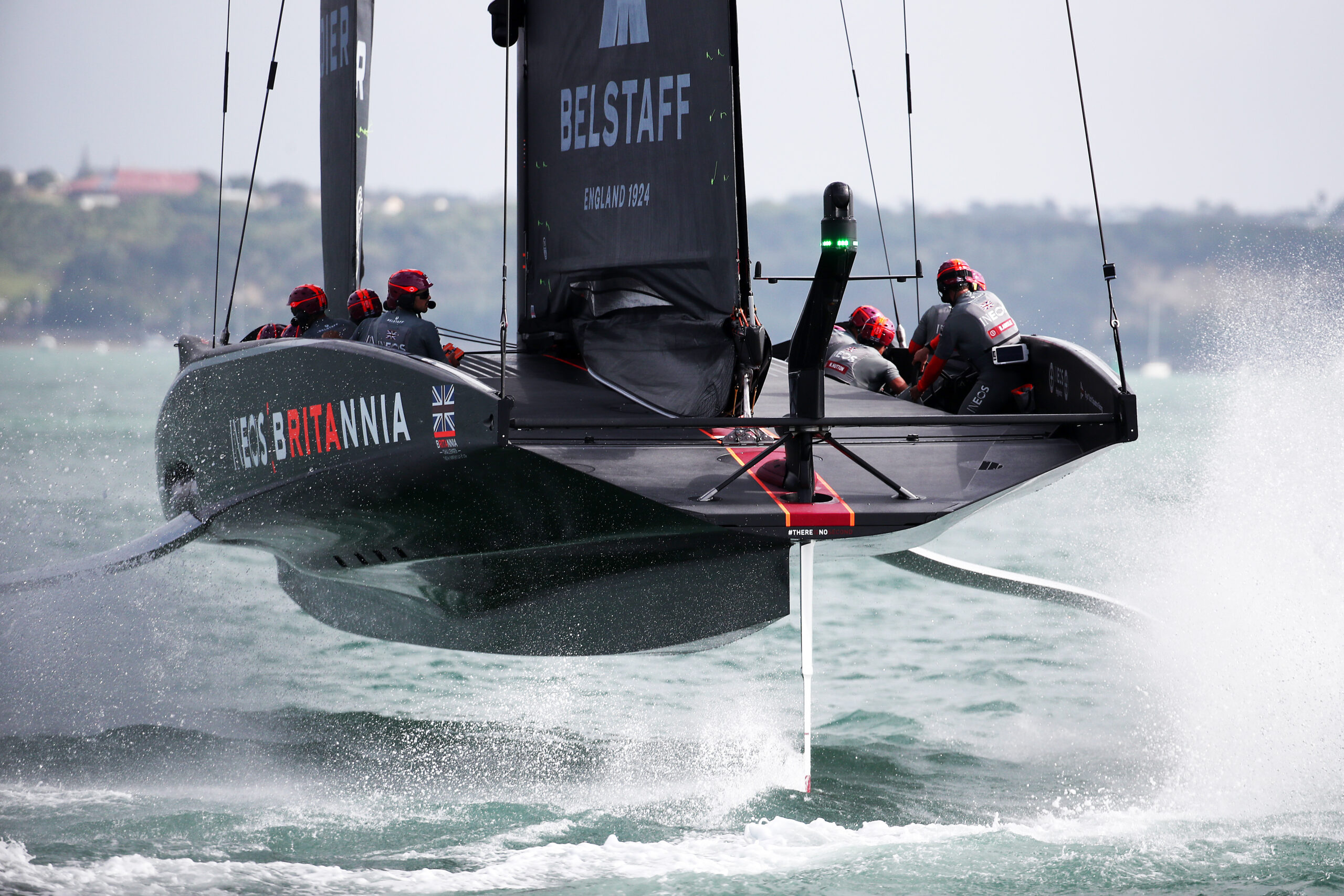
INEOS Britannia in action at the 37th America’s Cup. Photo: Getty Images/Fiona Goodall
Good to know
Pressure doesn’t make you better, but it does reveal what is already here.
That is according to high-performance specialist Rachel Vickery, who led a virtual roundtable for members looking at how they can reduce their athletes and coaches’ allostatic load – that is the cumulative ‘stacking’ of stressors over time that erode the amount of physiological ‘space’ an athlete has between their current arousal level and their personal stress threshold.
The stressors in question can be personal (e.g. a lack of sleep), organisational (e.g. misalignment), performance-based (e.g. being outside your comfort zone), or physiological (e.g. reduced ability to hear or absorb information).
Crucially, as Vickery explained, “as long as your arousal state stays below your threshold, your negative performance will not show up.”
Read more here.
Coach wellbeing
Though often neglected, members of the Leaders Performance Institute gathered to share ideas on how they can better support their coaches.
In one particular World Cup-winning environment, when athletes wanted specialist help, they were asked to book appointments. There was no 24/7 service.
This, their former manager explained, not only developed the self-reliance of the players, but also served to protect coaches and staff members who were all too ready to put themselves out, whether for out-of-hours appointments or “2am emails”.
Read more here.
Aussie rules
In early February we welcomed many of you to Brisbane for Leaders Meet: Australia, where organisations including the Brisbane Lions, Cricket Australia and World Rugby tackled the challenges of the day.
Chief amongst those was the ever-pressing need for alignment.
The Lions’ Senior Coach Chris Fagan favoured strong relationships with senior management; Australian all-rounder Ellyse Perry espoused the value of psychological safety in cricket; and World Rugby Chair Brett Robinson, as an executive, emphasised trust built on clarity from the top.
We picked out five elements for your consideration.
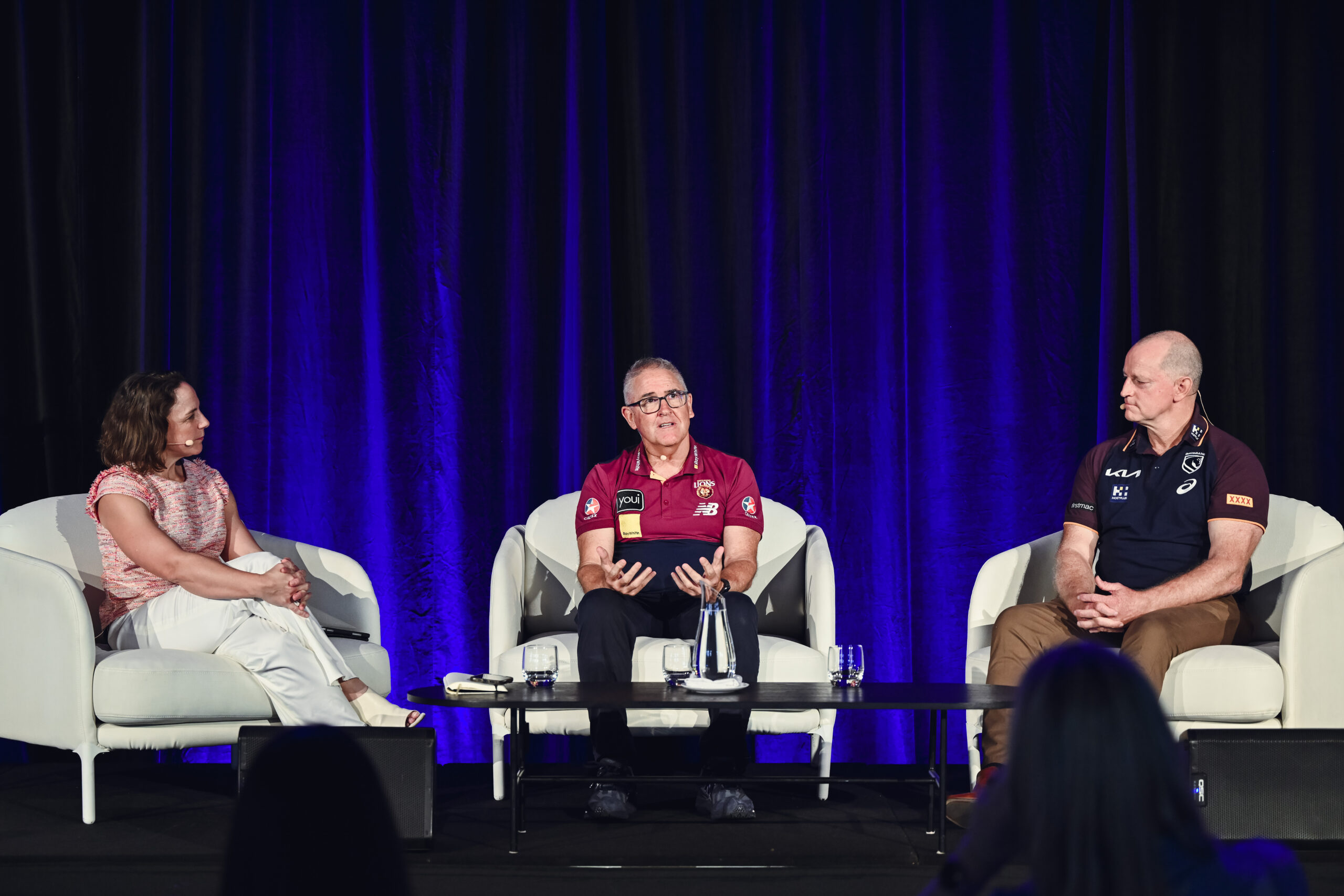
Chris Fagan (centre) in conversation with Michael Maguire (right) and moderator Rachel Vickery. Photo: Albert Perez
One you might have missed
Ben Ashdown and Dr Mustafa Sarkar of Nottingham Trent University pondered the behavioural elements of resilience in young players at football academies in this exclusive interview.
Their research has identified six resilience behaviours:
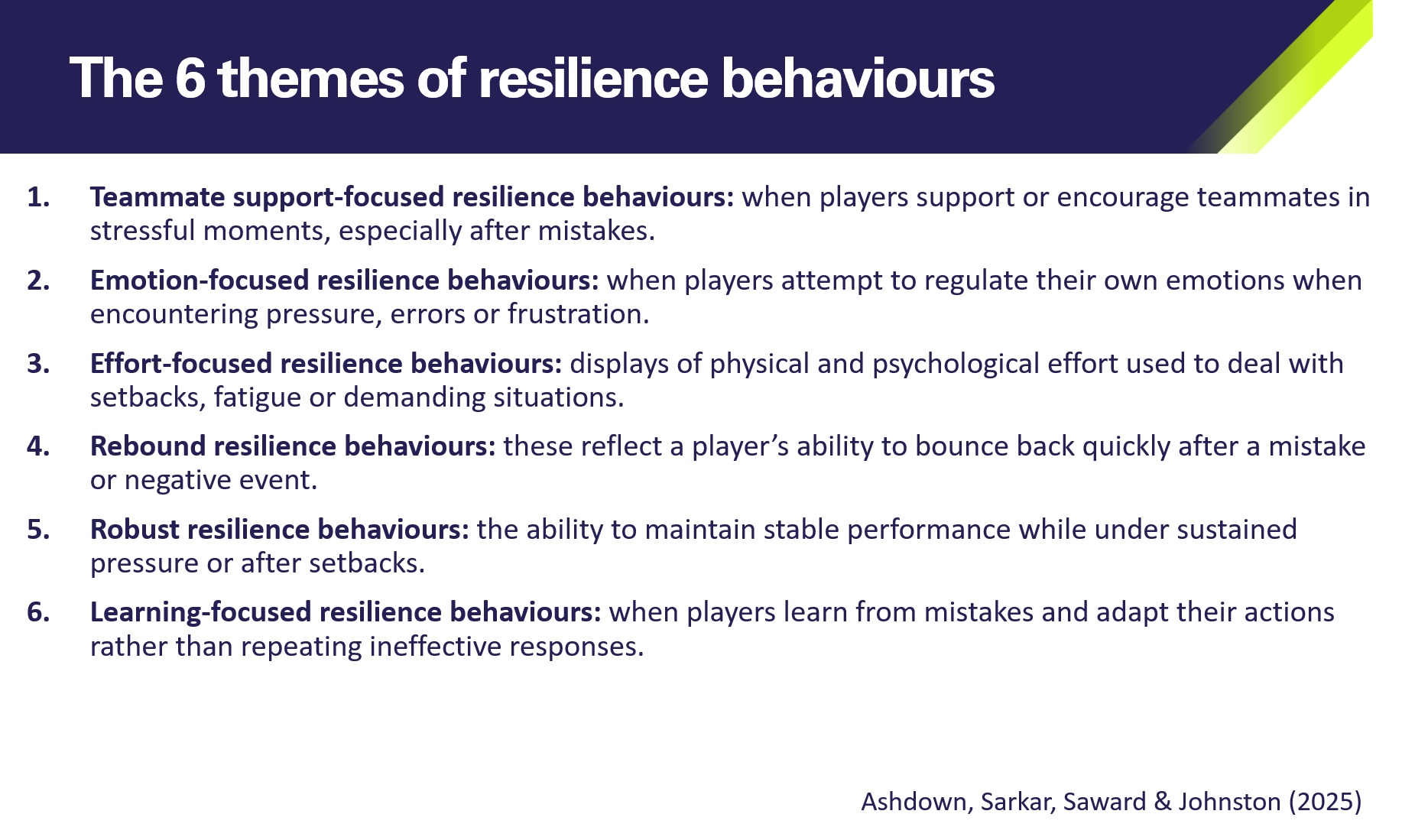
Their hope is to use these six to fashion a tool to help academy staff identify and develop resilience behaviours in their young athletes.
Read more here.
What’s coming up for members
The theme of alignment was high on the agenda at February’s Leaders Meet: Australia.
The Shepmates – Australian identical twin brothers Archie and Miles Shepherd – have become internet stars due to their viral videos depicting their high-energy and comedic reinterpretations of dramatic moments of sports commentary.
“I’m not going to pretend like we probably should be offering you guys advice. You’re the best at what you guys do,” Miles told a room of Leaders Performance Institute members at Rivershed in Brisbane. “But hopefully we can inspire you guys, or you take something from our story.”
Their dedication to their art and their fans has taken them to places they never expected. “We’ve found ourselves in a pretty niche part of the internet,” said Archie.
On top of it all, the brothers’ obvious chemistry, as well as their ability to finish each other’s sentences, hinted at the theme of alignment that ran through both days down on the River Brisbane (and it’s a performance trend we’ve tracked for some time).
They were not alone. Others who took to the stage, including the Brisbane Lions, World Rugby and the Queensland Ambulance Service, spoke of their efforts to ensure everyone within their walls is on the same page.
Based on the insights shared onstage across both days, the Leaders Performance Institute highlights how alignment shows up in the work of high-performing teams in at least five ways.
1. Smart coaches who can manage up
In sporting terms, there has never been a better moment for the city of Brisbane, with the Lions defending their AFL premiership and the Broncos winning the NRL in 2025.
Lions Senior Coach Chris Fagan and Broncos Head Coach Michael Maguire have built winning machines in this corner of Queensland, and both were on hand to tell Leaders Performance Institute members how it was done.
Key to their approach is an ability to manage the executives within their organisations. As Fagan said, “I always said to myself, if I was going to be a head coach, that I would make sure I would manage up to that group of people.”
Over the past nine years, Fagan tried to dine once a week with Lions’ CEO Greg Matthews as well as the team’s senior-coach-turned-executive Leigh Matthews.
Chris Fagan
Maguire has adopted a similar approach to prevent any noise or confusion emanating from above.
Michael Maguire
Chris Fagan (centre) in conversation with Michael Maguire (right) and moderator Rachel Vickery. Photo: Albert Perez
2. They seek ‘spine alignment’ too
While coaches can do what they can to ensure information is flowing in all directions, there is a role for both board members and heads of performance on the sports science side too.
Onstage, Peter Horne, the Performance Director at Rugby Australia, made the case for “spine alignment”, of which he said, “if we get true spine alignment of what we’re trying to achieve from a strategy, business and the deliverables [perspective] then we’re more likely to be able to execute.”
Crucially, as he admitted, it is not about agreement on every decision.
Peter Horne
“For the spine to work, you need everyone operating at the right level,” said Brett Robinson, the Chair of World Rugby, who joined Horne for the session. He included himself in that assessment.
Brett Robinson
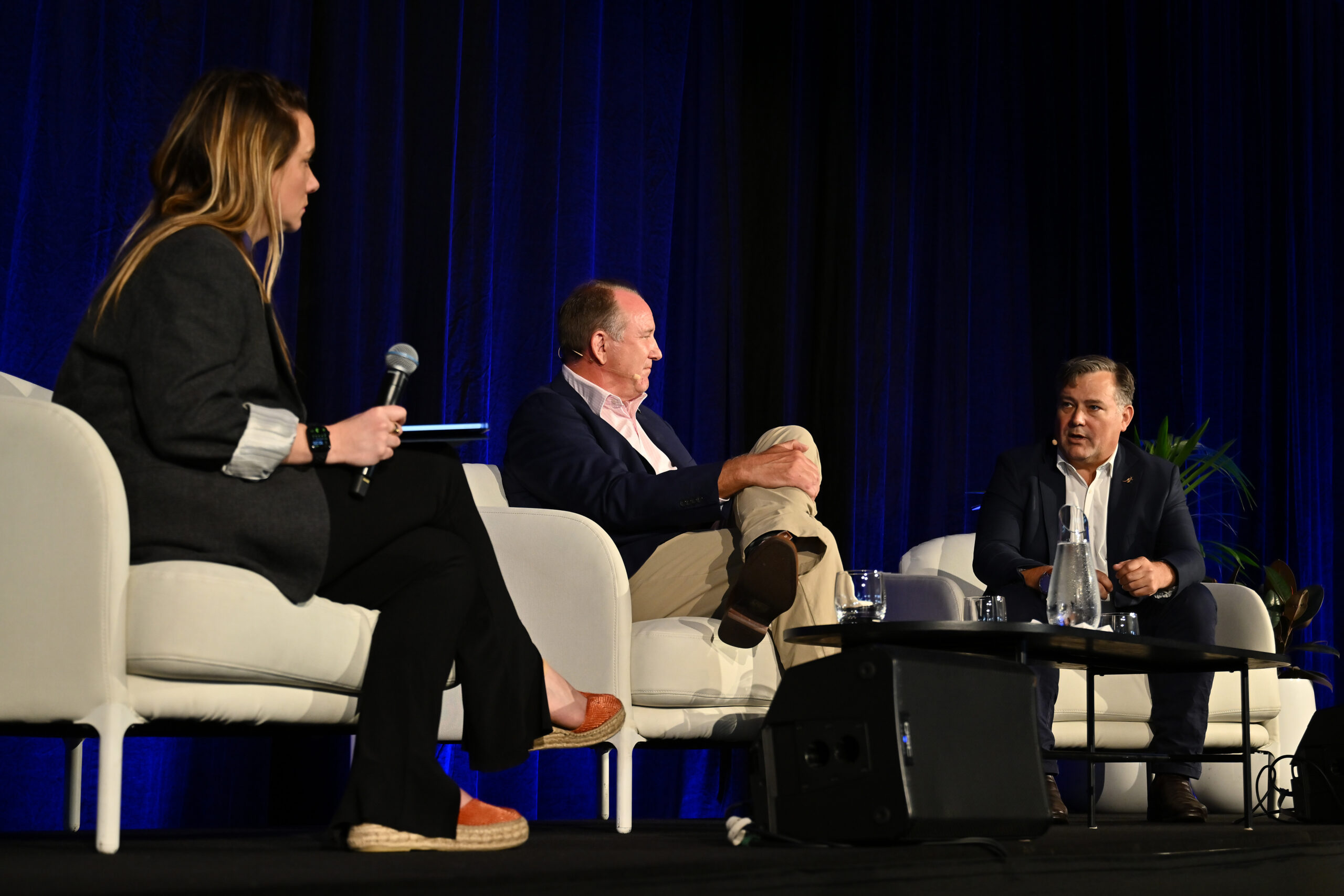
Peter Horne (right) makes his point onstage with Brett Robinson (centre) and Leaders’ Laura McQueen. Photo: Albert Perez
3. They bring their frontline people onboard
Few individuals are as well placed to discuss the concept of a culture driven by a shared purpose than Dr Stephen Rashford, the Medical Director of the Queensland Ambulance Service.
He is proud of his team’s “no excuses” approach too. “When we do our audits, everyone’s in the room, and there’s no making fun of anyone, there’s no bullying. We have honest, open discussions because we all just want to get better.”
Critically, their culture starts with their paramedics.
Dr Stephen Rashford
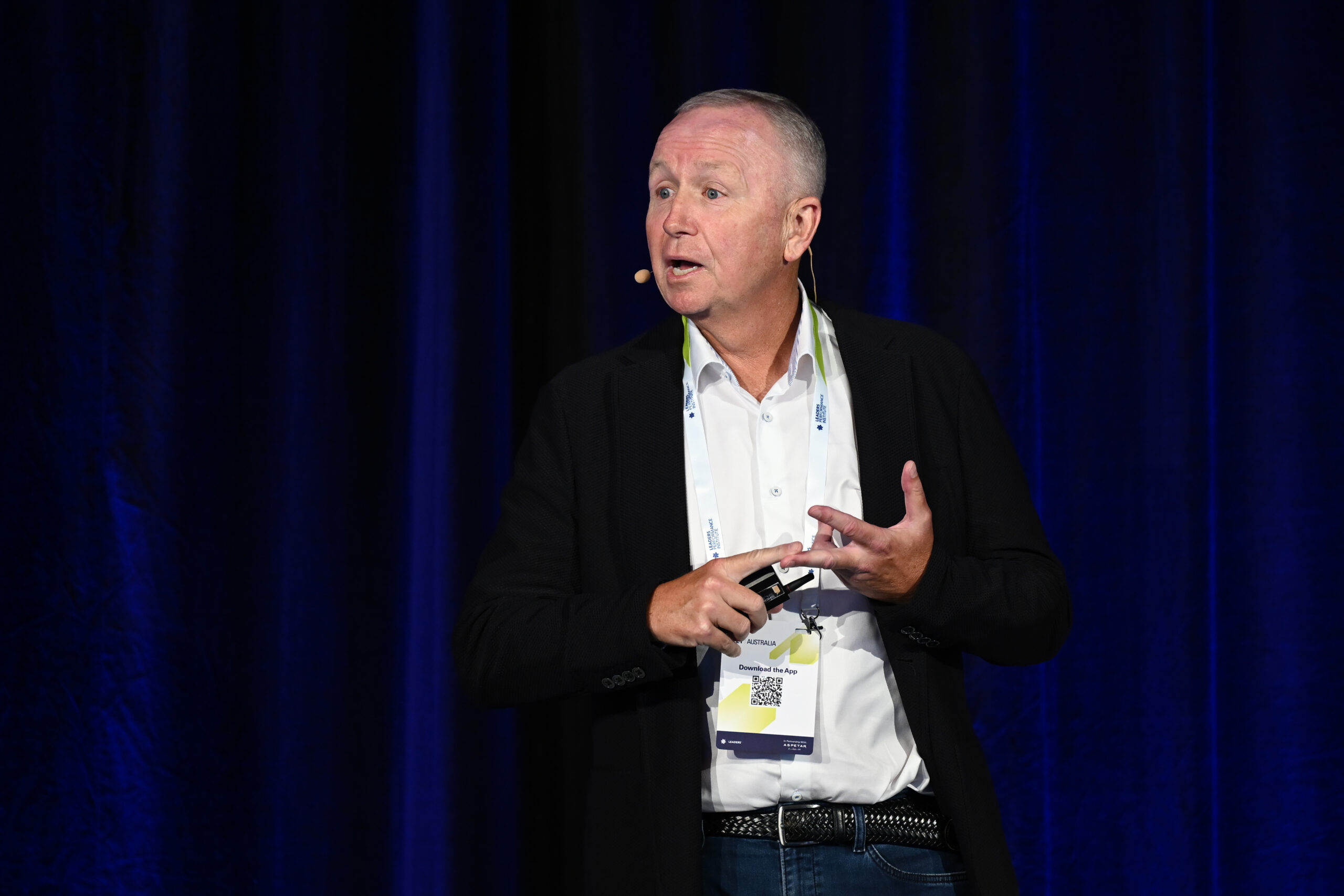
Dr Stephen Rashford mid presentation. Photo: Albert Perez
4. They have leaders who give their people psychological safety
Australian all-rounder Ellyse Perry is one of the greatest female cricketers of all time (then there’s her career as an international football player to consider). Her career has been underpinned by psychological safety. “When there’s a lot of support around that and real alignment on wanting to grow and improve, that makes a big difference,” she said.
Ellyse Perry
“No matter the position you hold, you don’t know everything, so be open-minded to learning,” said Anna Meares, the double Olympic gold medal-winning track cyclist who served as the Chef de Mission for the Australian Olympic Committee at the Paris Games. She spoke onstage alongside Perry and fellow Olympic gold medallist, the BMX cyclist Saya Sakakibara.
As Chef, Meares decided that open displays of vulnerability from early in the cycle would help to bring athletes and their coaches onboard.
Anna Meares
Psychological safety is just as important in individual sports, as Sakakibara told the audience. The Red Bull athlete won gold in Paris but recounted the story of her awful crash three years earlier in Tokyo and how it encouraged her to start placing her trust in others.
Saya Sakakibara
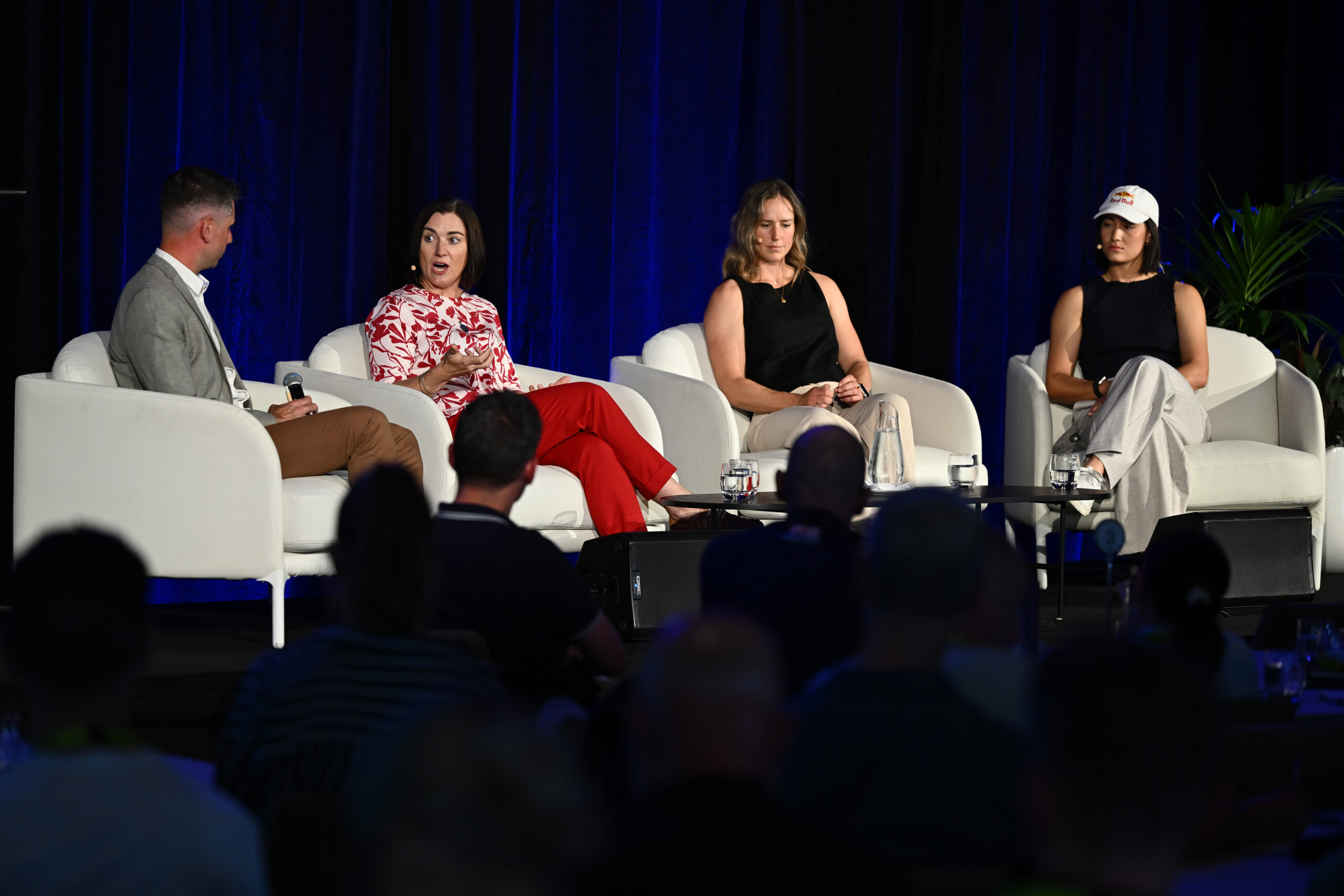
Anna Meares (second from left) makes her point to session moderator Fabio Serpiello in the company of Ellyse Perry (second from right) and Saya Sakakibara (first on the right). Photo: Albert Perez
5. They use process as a tool of alignment
In his presentation, Scott McLean, an associate professor at the University of the Sunshine Coast, explained that leaders must be aware of how things are connected in the complex systems of sports performance.
Scott McLean

Scott McLean from stage right. Photo: Albert Perez
Interventions should be governed by the performance need rather than results, according to James Thomas, the Performance Director at Warwickshire CCC, who made this case when he spoke onstage.
James Thomas
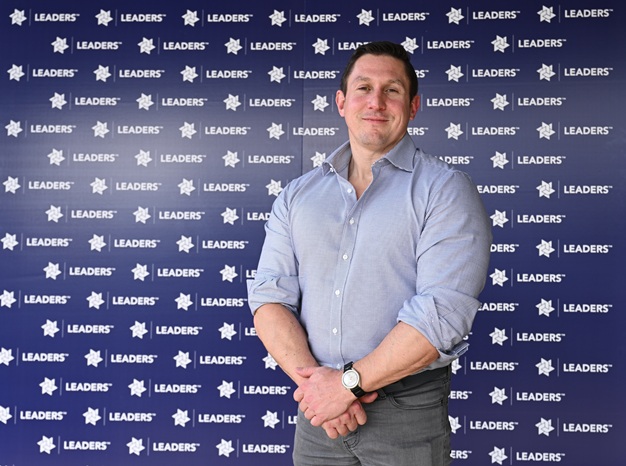
James Thomas onsite at Leaders Meet: Australia. Photo: Albert Perez
Where we’re going next
Head Coach Chris Fagan laid the foundations for the Brisbane Lions’ 2024 AFL Grand Final success with three big steps.
Their premiership success was not a bolt from the blue – they had reached the Grand Final a year earlier – but it was a far cry from the 18th place finish the Lions managed in 2017, which was Fagan’s first campaign at the helm.
He appeared at the 2023 Leaders Sport Performance Summit in London – just weeks after Brisbane narrowly lost the Grand Final to Collingwood.
There were no guarantees that they would make the decider again in 2024 but Fagan, who had his doubters in Australia, transmitted confidence from the Oval stage. “Last year [2022], we lost the preliminary final by 71 points. A lot of people said we wouldn’t recover from that,” he said. “This year, we made a Grand Final and lost it by four points. I said to the players, ‘we’re getting better, we’re getting closer. We’ve been the most successful team over the last few years. Be proud of that. The team we played in the Grand Final is older and more experienced, so that’ll be good for us.”
So it was to prove. But the focus here is those early years, when Fagan worked to turnaround a faltering team. It was only in year three, when the team jumped from 15th to 2nd in the AFL ladder, that his methods were vindicated by points and victories.
There were three factors that underpinned Fagan’s approach.
In 2017, Fagan arrived with his vision for a high performance culture. In outline it bore some familiar features:
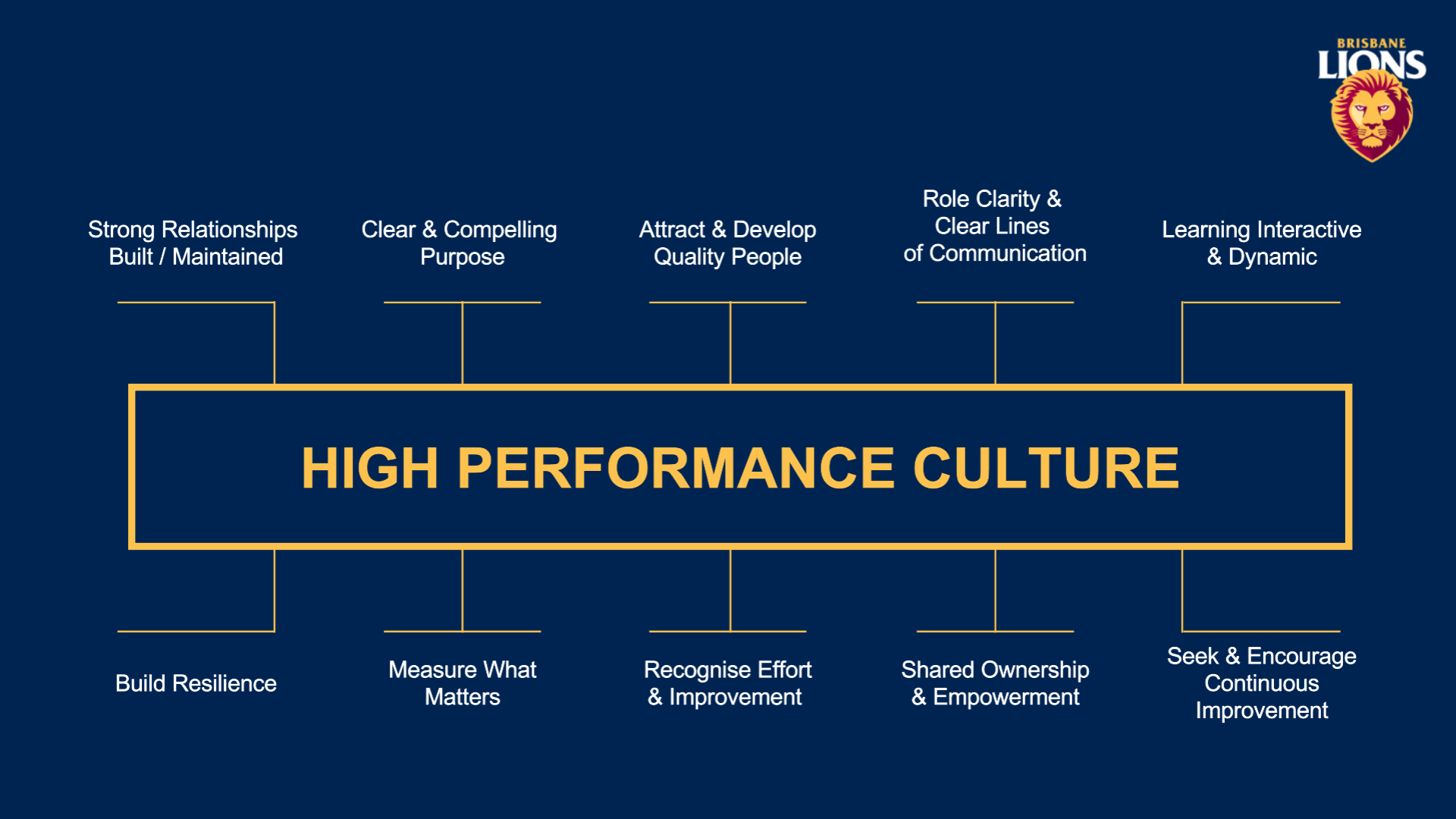
But in order to deliver this through a strategic plan, Fagan needed everyone onside. It wouldn’t be easy in what had become a “poor bugger, me” environment. “I discovered that many of our players preferred to be in rehab than to be actually playing – it was safer there,” he said.
Over the course of four weeks he solicited the views of every player and member of staff. “I wanted to send a message to everyone at the club that they would be listened to, that it wasn’t just me coming in and telling them what was going to happen,” he added. “I wanted to find out what they thought the club needed to do to become better because they needed to be partners with me in the process. I think they appreciated that because they hadn’t had a process for a long time. They’d just been told what to do.”
This brought him trust and credibility during those first two seasons when there was barely a flicker of improvement in scoreboard terms.
Fagan is a big believer in high challenge, high support for players in pursuit of their goals. The challenges were plain to see in 2017, and the first measure of support came from Fagan himself. “I see myself as the chief energy and psychological safety officer,” he said onstage. “I want to build an environment where the players and staff feel trusted and motivated, because that certainly wasn’t the case when I turned up.”
Even as the poor results endured, the team’s morale did not falter. “You’d have said we were the happiest bunch of losers during the early years,” says Damien Austin, the club’s High Performance Manager. “We celebrated everything because we were such a young team.” That included winning quarters of games, strength gains or running PBs in training. “We were always striving for progression,” he continues. “And if there wasn’t progression there’s a reason why, and I think like any young kids today, you’ve got to take them on a journey.”
It chimes with Fagan’s emphasis on growth mindsets and, as a former teacher himself, the importance of learning day in day out. As ever in a Fagan team it comes with a human face. His list has a WhatsApp group chat called ‘Moments of greatness’ where players celebrate examples of their teammates setting new standards.
AFL veteran Luke Hodge joined the Lions’ journey for Fagan’s first two years. The new coach’s first big recruitment decision was to bring in the man he regarded as “the greatest captain to ever play the game” from Hawthorn, the club from which Fagan himself had joined Brisbane.
“He was well and truly at the end of his career,” said Fagan of the four-time premiership player. “But I just wanted somebody to come in and role model great leadership to a young group of players.”
Additionally, Fagan worked with leadership consultant Simon Fletcher to devise a leadership development programme for senior and emerging leaders. “The first thing he did was establish a trademark, which was a reference point for leadership.”
To this day the Lions’ trademark is built around the concepts of ‘brotherhood’, ‘heart’ and ‘selflessness’:

But Fagan knows as well as anyone that these are just words on a wall without the behaviours that drive and sustain these ideas. “The players come up with those and we drive it,” said Fagan of the Lions coaching staff.
“After a game, the players have to send me a text the day after and one of the things they need to rate is their compliance to the trademark for that game.” Usually, the better the result and performance, the higher the rate of compliance. It can go the other way when the team loses. In any case, “we have a vision of it being done well and we also show a vision of when it’s not so good”. Additionally, the Lions hand out a ‘brother of the week’ award, where players are invited to vote via WhatsApp for the player who best demonstrated the trademark behaviours that week.
In summary…
Fagan understands that if your environment is highly demanding then it must also be highly supportive. He has clear ideas on what motivates people that go back to his days as a teacher:
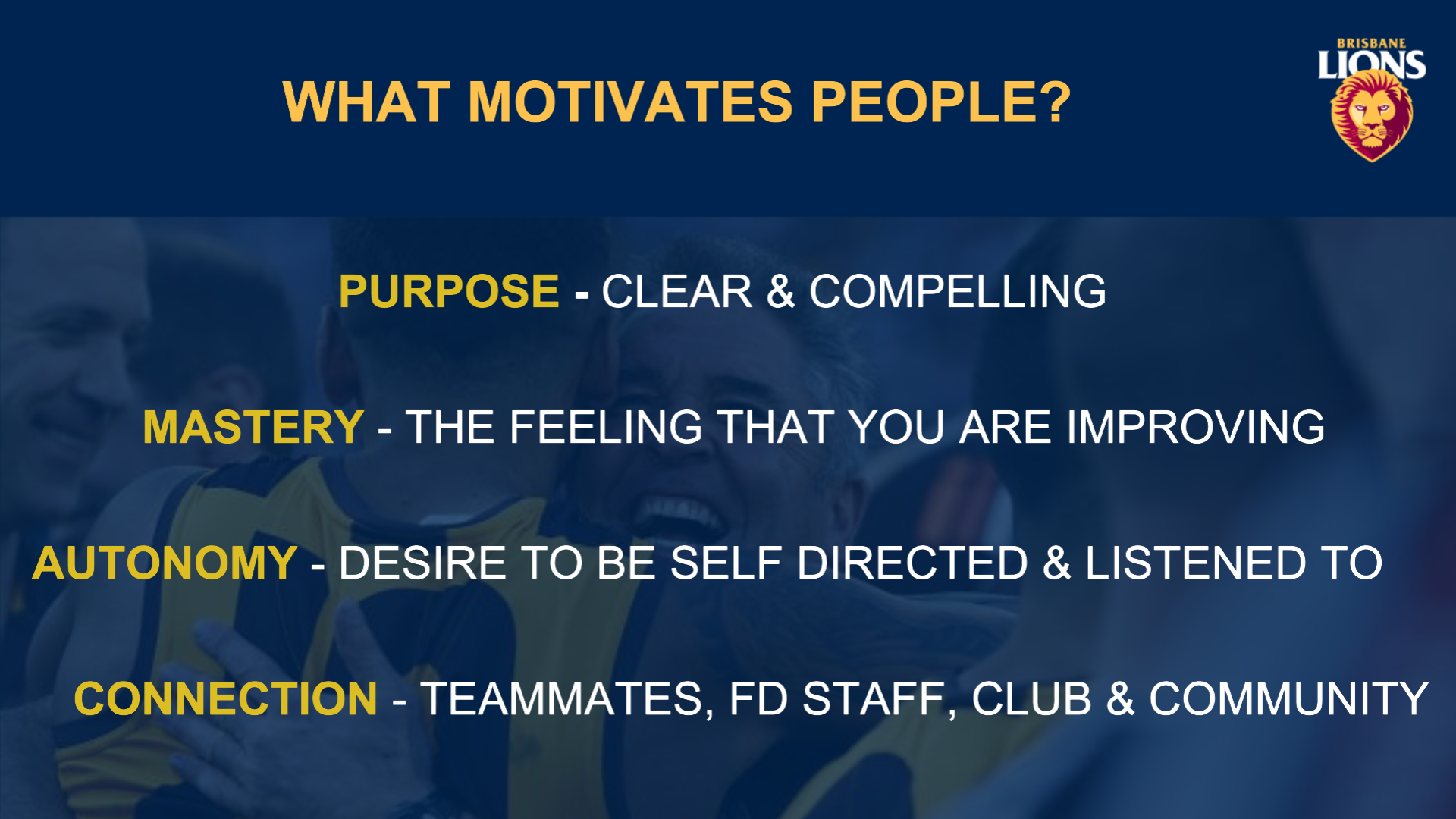
He said: “To be motivated, you have to have a clear purpose, that feeling that you’re improving, which I think our guys hadn’t felt for a long, long time. There is a desire to be listened to and to be a participant in your own growth and development; and that connection with teammates, staff and community.
“I put that model up as areas we would spend a lot of time on over the next few years, trying to grow our culture and team into a better place.”
What to read next
Nurtured and sustained excellence sat at the heart of proceedings at the 2025 Leaders Sport Performance Summit in Melbourne. Below, discover the insights to help propel you to greatness courtesy of the worlds of medicine, academia, the military and, of course, the world of sport.
Brought to you by our Event Partners

“There are parts of your game going well at a particular time and other parts of your game that are not going well,” he told Fox’s Face to Face in 2023.
“You’re trying to improve these things without sacrificing the things you’re doing well.”
He and Collingwood span those plates with alacrity during the 2023 season, his first as captain: they won the AFL Grand Final. Today, they remain one of the league’s finest teams; and Moore has been praised for his leadership abilities both on and off the field. It was to great acclaim that we welcomed him to the stage at the 2025 Leaders Sport Performance Summit at The Glasshouse in Melbourne.
“Good player leadership is organic and comes from natural respect based on competency, status and character in alignment to the team’s values,” he told an audience of Leaders Performance Institute members.
In addition to Moore, across two insight-laden days, we hosted a range of speakers from organisations including Melbourne FC, Leinster Rugby, the Royal Melbourne Hospital and Royal Australian Air Force. The overarching theme was the approaches one can adopt to give performers the best chance of success.
There were six approaches that stood out.
The athlete-coach relationship is pivotal, whether it’s a long-tenured coach setting up a new leader for success or, conversely, a senior athlete taking steps to put a new coach at ease.
Craig McRae, the Senior Coach at Collingwood, demonstrated the former with his public endorsement following Darcy Moore’s appointment as captain in 2023. “Be yourself, forge your own journey, and take a swerve at what that needs to be,” he told Moore. “Lead from the front and lead your way.”
Across town a year later, Rebekah Stott, a hugely experienced New Zealand international defender with more than 100 A-League appearances under her belt, went out of her way as captain of Melbourne City FC to ensure incoming Manager, Michael Matricciani, felt at home.
“From day one when I signed for the club, from the first conversations I’ve had, she’s only welcomed me with open arms,” said Matricciani. “She’s been a great support and she’s an excellent leader off the pitch.”
Neither Moore nor Stott, who spoke onstage together, believe they’re the finished article. Both spoke of their need to work on confronting teammates and having difficult conversations. In that regard, it helps when the on-field leader feels both comfortable and supported.
Rebekah Stott, Melbourne City FC
Darcy Moore, Collingwood FC
Moore and Stott’s concern with confronting people in emotionally charged environments is a daily feature of life at the Royal Melbourne Hospital, where Brian Le serves as Director of Palliative Care at the Peter MacCallum Cancer Centre. “Preparation is really important,” he said. “I formulate what needs to be spoken about and what my agenda is. But once with the patient, I adjust to what I’m hearing and the clues I’ve picked up in relation to their context.”
Timing is critical too. “Not addressing the situation has its own cost,” said Le, adding that delays are regrettable when the patient likely knows that an emotionally-wrought conversation is coming anyway.
Brian Le, Royal Melbourne Hospital
Data-informed decision-making is preferable, but where does the balance sit between objective and subjective sources? Additionally, what of the balance between disruption and stability? The topic was tackled by Kate Hore, the captain of AFLW team Melbourne FC, who spoke alongside Marcus Wagner, the club’s Chief Innovation Officer & General Manager of Football Operations. The Demons have been using Teamworks Performance as they look to strike that balance.
“You can get a flag from your monitoring that helps a discussion, but the impact really comes from your relationship with the athletes,” said Wagner. “Baseline information helps, but understanding the person is most important.”
When you understand the person, you can ask the right questions (either in-person or via questionnaires) and, if something needs to change based on something that happened in training, staff can swiftly make adaptations (supported by data).
As for the balance between disruption and stability. “It’s fine balance,” added Wagner. “You need to ensure you don’t lose your identity by going too far either way. How we measure is by looking at overall performance internally and externally, how we communicate, and the quality of our data.”
Kate Hore, Melbourne FC
Approximately 95 per cent of Nobel Prize-winning scientists emanate from the same cluster of labs or have enjoyed the proximal influence of past winners. Why? It is their higher minimum standards or greater openness to new (and often bad) ideas?
David Burt, the Director of Entrepreneurship at the University of New South Wales, delivered a presentation in which he lauded the value of exploring ‘terrible ideas’. His rationale was sound: it reduces the negative emotions that can cloud creativity and reduces the impact of power dynamics in a team environment.
He recommends an ‘accountability loop’:
David Burt, University of New South Wales
What must we do to sustain excellence? That was at the centre of Dave Walker’s appearance at the summit. The former naval pilot, who works for the Royal Australian Air Force, spoke of PBED:
PBED, he explained, is a continuous improvement process to table improved error recognition, error reduction or correction, which enables the creation of efficiencies that lead to improved performance. It is an essential tool in an environment where students must learn quickly.
“It’s the quality of interaction in each event that ultimately turns a team of experts into an expert team,” said Walker. “We often find that members do not know how to work or operate as a team – just following a framework does not make a team.”
David Walker, Royal Australian Air Force
Leinster Rugby, one of Europe’s most prominent teams, has a squad that is 86 per cent homegrown – what is the secret to finding and nurturing supreme talent in your region? As Simon Broughton, the Academy Manager at Leinster, explained, the team benefits from a group that has played and developed together in the youth ranks. They have travelled, won and lost as a collective. “So many experiences that strengthens their connection,” said Broughton.
The club has adopted a variety of approaches, including proximal role modelling, which sees younger players spend 80 per cent of their time integrated with older players. Proximal role modelling is “integrated organically into different aspects of their training week, from walking the pitches, to session design, and into analysis rooms.”
Leinster have also latched onto the ‘goldilocks principle’ as 33 per cent of their players are neurodivergent. “This has led to changes in how messages are delivered,” Broughton added. “There are slides, but also video and walkthroughs, and time for reconnecting and breaking mental circuits.”
Simon Broughton, Leinster Rugby
This month we touch upon the power of flexibility, relatability and collaboration in leadership and what you need to know to be better in each area.
Ideally, you found time for both and, here, we highlight a selection insights from the first month of 2025 that may help you to consider a problem in a different way or enable you to identify the right people to whom you can turn.
We hope to see some of you in Melbourne later this week for the Leaders Sport Performance Summit.
And, whether or not you can make it to the Glasshouse, here are five thoughts for all leaders to ponder.
If you can find new ways to consider your problems, it can open up new ways of thinking.
In this article, John Bull of Management Futures used the example of an elevator. Perhaps your goal is to make the elevator go faster, but what if your aim was to make the wait less annoying?
“Most hotels will put a mirror beside the elevator,” he said. “That seems to kill time when we’re looking at ourselves in a mirror.”
Bull suggested we “think of at least three different ways we could define our goal, to help open up new ways of thinking about the problem”.
He also share the STOP process for creative problem-solving:

In November, John Longmire called time on his 14 years as Senior Coach of the Sydney Swans. He has taken a new position as the Swans’ Executive Director of Club Performance but, before doing so, he reflected on his tenure as Senior Coach, which brought two AFL flags and four Grand Final appearances in total.
You can read his thoughts here, but here is a snapshot of his desire to remain “connected and relatable” to his players and staff. As he said onstage at November’s Leaders Sport Performance Summit in London, “the coach is no longer looked upon as being bulletproof” whatever their standing may be within the game.
His final speech to the players and staff as Senior Coach attested to that belief. He weaved in personal stories and his voice cracked at times. He wiped away tears too.
It called to mind the weekly ‘storytelling’ sessions that Longmire made a key feature of the Swans’ environment. He told the Leaders audience that players and staff share stories or complete a series of tasks for discussion each week. Recent examples included writing ‘a letter to your 16-year-old self’. These sessions are popular with players and staff alike.
“Sometimes it’s a photo of something that mattered to you and quite often there’s tears involved,” he said. “The way I looked upon coaching 25 years ago is completely different now – these 18, 19, 20-year-olds need to be able to relate to you. If you can show that you’re human, you get a lot more back.”
The question of team dynamics sits at the heart of The Social Brain: The Psychology of Successful Groups by Tracey Camilleri, Samantha Rockey and Robin Dunbar. The trio has spent decades observing the worlds of academia, business, and government as they look to better understand the workings of high-performing teams.
Camilleri and Rockey came to the summit in London to discuss how their research has its applications in the world of sport. Decision-making was one such area:
For decisions made at speed, you’ll count on five people.
Five is the number of intimate relationships a person can have. Rockey said: “These are the relationships that protect us, make us thrive, and ensure that we go through life in a joyful way. They protect us from ill-health and from some of the psychological challenges that we might have from feeling insecure.” They, of course, occur in intimate spaces.
For more complex decisions, you’ll count on 15 people (including your original five).
The ‘pain’ comes when you look to insert new thinking into complex decision making in a group space. “We spend about 60 per cent of our social time with just 15 people,” said Rockey. “With the 15 in the workplace, they would have built long-term relationships and loyalty to you over time – that’s how we work as humans – so breaking up those people to bring in new thinking is painful.”
According to Dunbar, the upper limit on the number of social relationships we can enjoy is 150
Dunbar suggests that people can have no more than 150 social relationships at any one time. “It’s a very stable number across all societies and cultures,” said Rockey.

From The Social Brain: The Psychology of Successful Groups by Tracey Camilleri, Samantha Rockey, and Robin Dunbar.
Young athletes are bolder in stating their desire for belonging and connection than their forebears, but this comes with a paradoxical demand for more personalised training and attention. There are clear implications for the time coaches spend on team dynamics in an era where the power has shifted to the athlete. The topic was discussed on a recent virtual roundtable. “Staff and coaches are more vulnerable,” said one participant, who pondered where the balance needs to sit. “Give the athletes a voice and a choice, give them ownership, have the consultation, but there is a line too.”
Another participant with experience of coaching in European football, highlighted that individual work will mean different things to different people and can be dependent on team selection. They argued that there is room for better management of expectations and, more broadly, a consensus for coaches and athletes alike on what constitutes ‘individual’ training.
In February 2024, the England & Wales Cricket Board launched its Insight 360 platform, which adopts a data-driven approach to athlete and performance management.
Ahead of the launch, the ECB gathered input from practitioners and coaches across the English game. “This means Insight 360 is bespoke for women’s cricket,” said Anna Warren, the Head of England Women’s Science & Medicine. Players, she said in this article, are happy with an app that allows them to review their own data in as much detail as they like. “This is good for player buy-in, which is always a challenge in relation to athlete monitoring.”
There is also the power of a co-designed project. UK Sports Institute have found as much with their Project Minerva. Dr Richard Burden, the UKSI’s Co-Head of Female Athlete Health & Performance, said: “Get the practitioners involved, get athletes, get the teams and bring them along with it because if they’re onboard you get easier access to them and you’re going to produce something that’s more translatable, meaningful and applicable to them.”
Warren is on the same page with Insight 360. “You can link loads of different data sources together and start to answer some key performance questions – we’re not looking at everything in isolation.”
Female athlete health, mental performance, data-informed recruitment and leadership were foremost in conversations across the Leaders Performance Institute in December.
There was plenty on offer on our Intelligence Hub in December and here we bring you four key thoughts from the final weeks of 2024 to set you up for success in the months ahead.
Before we get into it, remember our first summit of the year takes place at Melbourne’s Glasshouse in just under four weeks’ time. More info here. We hope to see as many of you there as possible.
If there’s an upcoming virtual learning session that takes your fancy, please let a member of the Leaders Performance Institute team know.
Right, back to the matter at hand. Here are four themes that stood out in December.
That’s not really news and, to be fair, is not entirely representative either. We have sought to address the fine work being done (as well as the enduring iniquities) in our latest Performance Special Report, titled A Female Lens on Performance: what it takes to help women and girls thrive in elite sport.
The report, which is brought to you by our Partners Keiser, features Garga Caserta, the Head of Performance at NWSL side the Kansas City Current, who discusses the best ways to balance challenge and support for players.
He also touched upon his reluctance to chase ‘low-hanging fruit’ in women’s sport performance, particularly where data is lacking:
Elsewhere in the report, we spoke to:
We also pondered the potential implications of the gendered environment for female athletes and coaches.
Download A Female Lens on Performance now.

Be careful how you answer that question. If you feel that your mental performance coach never quite fulfils their remit, perhaps you’re not setting them up to be successful. It could be, as mental performance coach Aaron Walsh argues in this exclusive column, that you’re viewing their work from the wrong angle.
Walsh wrote:
Read the full article here.
Even if you are, you probably feel that you can tighten up processes here or look at things through a different lens there.
It was a theme that ran through our Kitman Labs podcast series where the Leaders Performance Institute was joined by Kitman Founder Stephen Smith to chat to a range of guests from across the world of soccer.
These included Dr Karl-Heinrich Dittmar, the Head of Medical at German Bundesliga champions Bayer Leverkusen. He spoke at length about the club’s efforts to use data to outmanoeuvre their rivals when recruiting:
During the course of this Kitman Labs series, we also spoke to:
It’s an age-old question, but no-one has really nailed it. Dan Jackson, the General Manager of Player Development & Leadership at the Adelaide Football Club is no exception.
“I can’t teach leadership,” he told the Leaders Performance Podcast. “I can help unlock what’s already in there.”
Jackson feels that leaders can be created. “Leadership is 100 per cent made, but it’s made from a very young age.”
Beyond the origins of leadership, Jackson also spoke about the importance of prioritising others in a team environment.
“Great sustainable teams are built in environments where everyone’s looking to help someone else out,” he adds. “When you fill someone else’s bucket, it fills yours.”
It’s well worth your time. The same can also be said for these other guests, who all joined our three-part Keiser Series podcast in December:
The Adelaide Football Club’s General Manager of Player Development & Leadership reflects on his journey with the club.
A podcast brought to you by our Main Partners

“I can’t teach leadership,” he tells the Leaders Performance Podcast. “I can help unlock what’s already in there.”
On that note, he is certain that leaders are not born. “Leadership is 100 per cent made, but it’s made from a very young age.”
Beyond the origins of leadership, Dan spoke to Henry Breckenridge and John Portch about the importance of prioritising others [10:40]. “Great sustainable teams are built in environments where everyone’s looking to help someone else out,” he adds. “When you fill someone else’s bucket, it fills yours.”
Also on the agenda were the importance of humour and enjoyment [22:00]; the argument against ‘refreezing’ culture [48:30]; and the practical steps that help leaders to manage team operations [32:00].
Henry Breckenridge | LinkedIn
John Portch | LinkedIn
Listen above and subscribe today on iTunes, Spotify, Stitcher and Overcast, or your chosen podcast platform.
