The human and AI-powered basketball analytics lab is able to provide an array of insights within 15 minutes of the final buzzer.
A Data & Innovation brought to you by

Synergy, the human and AI-powered basketball analytics lab that was acquired by Sportradar two years ago, has evolved into such a coaching resource that every D1 men’s and women’s program subscribes to their scouting service just for the sheer nuance and volume of it all.
A breakdown of every possession from every college team all season? That’s available. What plays the team ran on each possession? Available. Who passed the ball to whom and then to whom and then to whom? Available. Who shot the ball and from where? Available. Don’t believe them? They’ll gladly verify it on their proprietary video. Synergy has 1,000 human data collectors… to go with an automated camera tracking system in 250 D1 arenas… to go with their own shot quality algorithms themselves.
They literally monitor 75,000 basketball games a year — from high school to DI to DII to DIII to the G-League to the EuroLeague to the NBA — and estimates it has 50 million tracked shots in its database since its inception in 2004. But when it came specifically to this year’s March Madness, Synergy has logged every game in real-time and then distributed a data-video report 15 minutes after every final buzzer.
Considering teams sometimes have just 30 hours to prepare for an NCAA Tournament opponent, Synergy will also conveniently diagram every opponent’s play calls and supply APIs for more expert level coaching staffs that have their own analytic departments for additional game-planning.
“I don’t have [any stories] for this year’s March Madness, but, [in 2012], we had a 15-seed, Norfolk State, beat a 2-seed, Missouri,” says Mark Silver, EVP, Sports Performance, Sportradar. “And immediately after that game, the [Norfolk State] coach called and thanked us for everything we did and said, ‘The only reason we won was the fact that we had the Synergy scouting report.’”
One of the company’s first coaching clients in 2006, in fact, was a then-relatively unknown Jim Larranaga of George Mason University — who leveraged the platform all the way to a shocking Final Four run that season. Now, Larranaga’s back in the Final Four with Miami and again with Synergy.
The product helps coaches on multiple levels, the first being game prep. Synergy will provide an opponents’ innate tendencies such as which direction a post player tends to spin to the basket — off of his right shoulder or left. Or if a player turns to the baseline from the right block 100% of the time or dribbles first 95% of the time.

Photo courtesy of Synergy
The info is so nuanced, Synergy can tell a coach if an opposing player, or his own player, is superior driving right or left or better shooting off the dribble or off- a-screen or better pulling up or finishing at the rim. There are stats and videotape to support it all. “Advanced scouting,” Silver says.
Another new activation is quantifying the role of every player in this year’s NCAA tournament. Through machine learning, Synergy’s software can determine the positional characteristics of any player, leaning on a database that contains every college player’s shot since 2014. For example, Synergy classified Miami’s 6-foot-7 Norchad Omier as a “Rim-Finishing Big”, Gonzaga’s 6-10 Drew Timme as a “Post-Up Big” and Alabama’s 6-9 Brandon Miller is a “Playmaking Wing.”
By using artificial intelligence to categorize every player, Synergy has perhaps become the technological centerpiece of the transfer portal. Coaches can search the company’s database for “Slashing Wings” or “Spot Up Shooting Wings” or “Scoring Ball Handlers” or “Stretch Bigs,” and the names come spitting out.
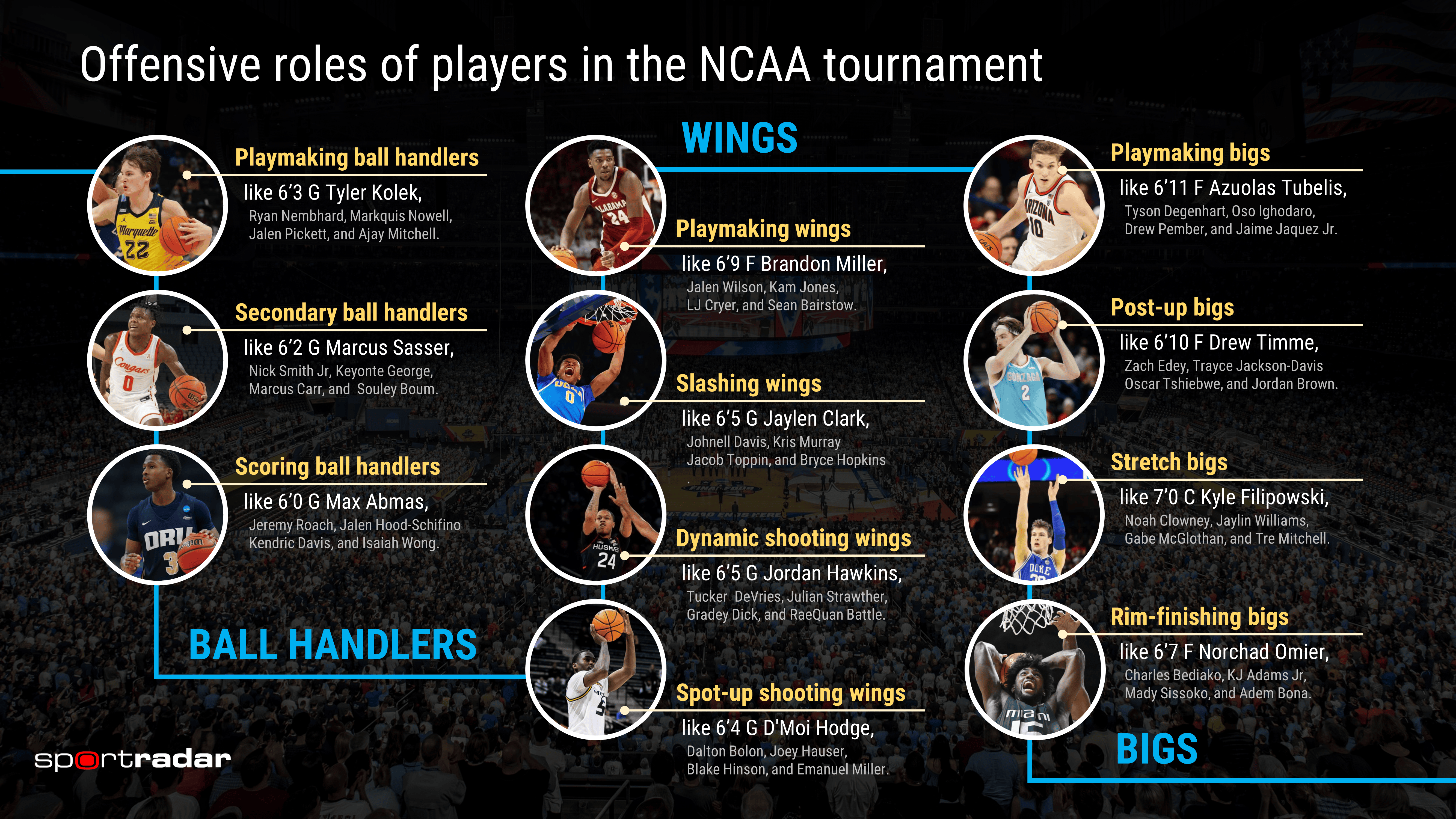
Photo courtesy of Synergy
“We undoubtedly play a huge role in the transformation of the transfer portal because you can go into our system,” Silver says. “And if you’re looking for a type of player or a player in a certain class, whether they’re playing in JUCO or D1 or D2 or D3 — or if you already know about the player — you can easily go and find every game that player has played. Since high school, most likely.
“Or if you just need to fill a spot, you can actually look and query the system to try to find a player that’s most fitting what you’re looking for. So recruiting, scouting, transfers: that’s one of the big ones for us.”
The Synergy Automated Camera system is another high-tech advantage, considering its camera vision tracks shot quality and team/player tendencies while also providing coach’s film and video confirmation. Hawk-Eye’s cameras handle that for the NBA. But when it comes to the college level, Synergy is more or less holding down the tracking landscape.
With all of these NCAA coaches bought in, the company has to try to stay neutral — which may be a little tricky at this weekend’s Final Four.
Especially when Larranaga starts winking at them.
This article was brought to you by SBJ Tech, a Leaders Group company. As a Leaders Performance Institute member, you are able to enjoy exclusive access to SBJ Tech content in the field of athletic performance.
The Zone is designed to integrate with a team’s wellness initiatives to improve the access and options available to users.
The Zone’s platform is an innovative and proactive approach to student-athlete wellbeing. (Main image: The Zone)
A Data & Innovation brought to you by
Those social repercussions persist, as do new pressures related to name, image and likeness (NIL) opportunities — and all the other stressors that come with being a college student and competing in a sport at a high level.
The Zone, a mental wellness app catered toward the specific demands of college athletes, has gained traction and today announced its largest deal yet, a multi-year, conference-wide deal with the Big East. The app will roll out slowly to start, with 100 student-athletes at Georgetown and Marquette onboarding this spring, before a similar number of app licenses will become available to all other Big East schools thereafter.
“Our student-athletes have reported some of the most significant challenges center around the pressures of being a Division I student-athlete and the need to make your life seem perfect on social media,” Big East Senior Associate Commissioner Katie Willett wrote in an email. “Additionally, student-athletes have struggled with the reintegration following Covid and successfully managing academics, athletics and community service.”
The Zone encourages users to complete regular check-ins in the app, answering questions about mood and academic and athletic updates in a gamified way. Through machine learning, the app offers advice, connections to on-campus resources, suggested activities like meditation and even the ability to book appointments with a counselor or therapist.
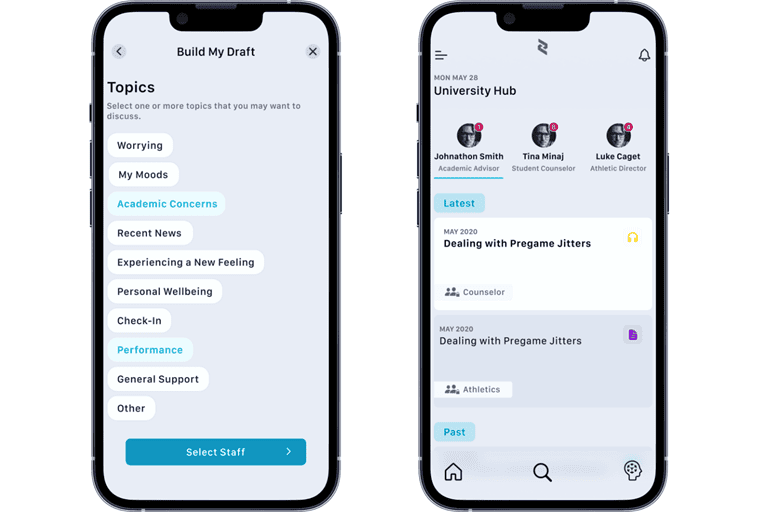
The Zone makes reaching out for mental health support easier for student athletes through the platform’s accessible and streamlined process (Image: The Zone)
“Performance anxiety is the biggest trigger we’ve seen over the last two years,” said The Zone Co-Founder/CEO Ivan Tchatchouwo, a former Division II basketball player whose own experiences with mental health challenges informed the founding of the app. “And it shows up in different ways. It’s not just performing on the court, right? It’s performing through the anxiety of being a first-generation college person on campus. Your parents pressure on you, or fans, friends and family. NIL pressure is causing performance anxiety because now it’s like, ‘I want to get paid just like a teammate.’
“Time management is another huge one that’s causing a lot of stress and anxiety for young people. And then also, lack of community. They’re in teams, but those two years have taken them away from knowing how to communicate correctly.”
Lehigh, Seton Hall University and St Francis-Brooklyn are all early adopters of The Zone; Memphis and Stony Brook previously used it as well. Former America East Commissioner Amy Huchthausen became such a strong supporter that she joined the company’s board of advisors. The Zone first connected with Big East leadership when hosting its fourth annual Student-Athlete Well-Being Forum at the University of Connecticut in June 2022.
Tchatchouwo says about 4,000 student-athletes are enrolled in the app, of which 2,800 remain active. Monthly participation is almost 25% whereas recent peer-reviewed research estimated that industry average for digital mental health apps is 3%.
“We spent the whole last year testing what works, what’s sticky, what doesn’t work. We’ve added a whole new content strategy,” Tchatchouwo said.
“That experience has to consistently be fresh for them, to want to go through it,” he added. “It also gets daunting to just see all the time, the same kind of inundating stuff. We’re getting creative on how we push that up. Machine learning is a big thing that we’re jumping bigger into and really understanding what it is that your data is saying. What is your storyline? What are your trends? And how do you the trends play out the life? And then what are the next steps for you?”
Tchatchouwo is quick to emphasize that The Zone is not a replacement to existing mental health services or professionals but rather a complement to or conduit for those options.
“The Zone is a state-of-the-art mental wellness platform that integrates perfectly into our institutions’ wellness programs,” Willett wrote. “It will make our services more effective by enabling a culture that prioritizes mental wellness, an important topic this day and age for our student-athletes. Our goals are to provide our student-athletes with a safe space and easily accessible resources to complement the amazing services being provided by our institutions when it comes to mental wellness.”
Other universities might try to buttress students by hiring additional psychologists to counsel student-athletes, but Tchatchouwo said that approach can suffer from inefficiency. Often the ratio of students-to-psychologists remains overwhelmingly high. Even then, the students need help discovering and accessing those resources. It’s important to have layers of defense, and The Zone seeks to drive awareness through content and to make specific referrals within the app to help maximize the use of what’s already available.
“You still need to educate the people that are on the forefront of what it looks like for their athletes,” Tchatchouwo said. “So we want to launch that education series for the coaches and the staff and administration, so they’re also educated, which makes the mental health investment even that much better.”
This article was brought to you by SBJ Tech, a Leaders Group company. As a Leaders Performance Institute member, you are able to enjoy exclusive access to SBJ Tech content in the field of athletic performance.
The South Carolina forward discusses NILs, sports science, and her deal with Six Star Pro Nutrition.
A Data & Innovation brought to you by
* * * * *
Aliyah Boston is, without question, the most decorated player in women’s college basketball. In 2022, the South Carolina forward became the first male or female athlete to win the Naismith Trophy as overall player of the year as well as Naismith Defensive Player of the Year. She was named the Honda Cup Collegiate Woman Athlete of the Year, joining a list of recent winners that includes Katie Ledecky, Breanna Stewart, Brittney Griner, Maya Moore and Candace Parker — as well as her coach, Dawn Staley, who did in 1991.
Boston, who is 6’5”, has rewritten South Carolina’s record book for just about every permutation of stats related to rebounds, blocks and double-doubles. She averaged 17 points and 17 rebounds in last year’s Final Four, as she led the Gamecocks to the program’s second NCAA national championship. She is the expected No. 1 overall pick in the 2023 WNBA Draft.
A native of St Thomas in the US Virgin Islands and a graduate of the Massachusetts-based prep school, the Worcester Academy, Boston has struck a number of NIL [name, image and likeness] deals with Under Armour, Bose, Bojangles, Crocs, Octagon Basketball, Orangetheory Fitness and, most recently, Six Star Pro Nutrition. When NIL deals became legal on July 1, 2021, Six Star Pro Nutrition announced three at midnight with women’s basketball twins Haley and Hanna Cavinder as well as then-Illinois player Edgar Padilla Jr South Carolina women’s basketball players are also all estimated to be earning about $25,000 per year through the Garnet Trust and NOCAP Sports.
On choosing to align with Six Star Pro Nutrition . . .
First of all, their want to partner with me was just something truly special because I know how big their brand is. But I also love their protein powder and their 4th Quarter Energy supplements. I really think that they do really well when it comes to training and recovery. They’re just a great partner, and I’m just super excited about it.
On when she began to emphasize nutrition and recovery . . .
It’s definitely been a major focus since I got to college because the pace of the game is just so much faster than it was in high school or anything that I’ve ever done. And so definitely in college I really started to focus on that, especially sophomore year going into junior year was definitely my key time to lock in and focus on that.
On college level training . . .
It’s definitely intense, but I feel like, as the time has passed, I’ve been able to adapt really quickly and I think I’ve done that pretty well. It was different because in high school I didn’t really have that focus — the strength coaches or the nutrition pieces that I needed. Now when I got to college, that was a major difference, definitely beneficial.
On sport science devices . . .
Definitely [we use] technology to track a lot of it. We have the Kinexons that we use [for load monitoring]. We have a jumping machine [force plate] that tells how fast or how hard we land and jump and how quick we get up and down.
On tracking sleep . . .
We actually used to do an Oura ring where it would tell us our sleep, but then I got a little nervous before I go to sleep at 1:00 AM and then my strength coach sees that and she’s like, ‘Why are you not in bed?’
On having Dawn Staley as a coach . . .
She understands the game very well, and so her IQ of the game has just helped us because she just directs us. She tells us really how things should go, and then when we really like look at it, she’s right. It makes it a lot easier because she never second guesses, she never questions. She’s always like, you know what? Like, ‘This happens, [then] this.’ She has a solution for every scenario that could possibly happen, which I just think is really cool.
On what she looks for in a brand when making NIL deals . . .
I look at them trying to help grow the game, which I think is definitely a priority. And I think Six Star is doing that well, especially, like they’re offering the trip to go to the national championship game, whether it’s the girls’ or the men’s game, which I think is something truly special because there are probably so many fans out there that might not ever get to get the chance. They can apply on the website, try to get in and they have a great chance to win.
On why growing the game is such a passion for her . . .
There’s a lot of attention on the women’s game specifically right now. I think we have a lot of talent, and I do think there are a lot of younger people looking up to us. If they could come to a game, they would love it, they would probably talk about it a lot more. But also [I want] to help grow the game in the future. When our time is done in college and we get to the league, we want people to continue to watch us — the same fan bases that we played for years and years or even a fan base that we competed against — and to say, ‘They’re no longer in college, let’s see how they do in the league.’
On her message to young girls who might be interested in basketball . . .
I would tell them to set high goals for themselves. Don’t think anything is untouchable because that’s what I did — a little girl from the islands trusted God, set high goals to go to college, play in the league. And so I’d definitely tell them to also do the same thing, no matter what, whether it’s not basketball, but something else. Make sure they set their goals themselves and surround themselves with people that support them all.
On her rebounding . . .
All the coaches I have in South Carolina have definitely helped, but I just track the ball and then I’m just like, ‘I need to go get it.’ Rebounding is a big part of South Carolina basketball, and Coach Staley emphasizes us rebounding defensively and offensively. And so it’s really just the will, the want, to go get the rebound to give yourself your team another possession or to help them push the ball in transition.
On taking pride in playing the post . . .
Everybody wants to now shoot the ball, dribble. Everybody’s a big guard. But playing the position that I play, having my back to the basket, I truly enjoy it because I feel like not a lot of people right now like the contact, like to bang, but I do. And so I think it goes to my advantage. But I also want to be growing my game as an individual, so definitely being able to knock down that jumper, take people off the dribble is definitely a priority, but I also think it’s important to be able to go and bang down there and score through contact or even get a stop defensively.
On how she views brand-building. . .
Social media is definitely a crucial part of it all because that is where you get your fan base, your followers, and partner companies. They look at that, your social media engagement, how you get along with fans.
At first I wasn’t a big social media girl. I had to be convinced time after time after time by my parents to post a simple post on Instagram. Before NIL started, my mom was like, ‘Aaliyah, you need to lie build a following.’ And I was like, ‘OK, sure. I’ll try. I’ll post the beach picture, let me post this.’
But now I really enjoy it. I enjoy posting, I’ll TikTok, I’ll post on Instagram, Twitter. So I definitely think it is an important role, though, because this is how you build your brand, who you are. So companies can see this and be like, ‘Oh, I like this, I like that.’
This article was brought to you by SBJ Tech, a Leaders Group company. As a Leaders Performance Institute member, you are able to enjoy exclusive access to SBJ Tech content in the field of athletic performance.
Leaders Performance Advisor Dr. Lorena Torres Ronda calls on her own experience to provide some steps that all organizations can take to create inclusive performance environments.
Definitely yes – and it’s not just me saying it.
There is growing support from the scientific community as well as empirical evidence from a range of different fields that diverse work environments are more innovative, creative and rich in productivity.
As Chris Hirst points out in his book No Bullsh*t Leadership, ‘a 2015 McKinsey report on 366 public companies found that those in top quartile for ethnic and radical diversity in management were 35% more likely to have financial returns above their industry mean… Diverse teams outperform those that aren’t.’
It often feels easier said than done, as creating or fostering a work environment rich in diversity requires that we know the sociological foundations of inclusion to really be successful in attaining an effective high performance environment. Firstly, let’s define and clarify some basic concepts.
Diversity means that “everybody is invited to the party” – you hire diversly, regardless of gender, race, skin colour, social background, physical ability, sexual orientation, religion, ethnicity and so forth. But being invited to the party doesn’t automatically mean you feel seen, heard and valued – all characteristics of feeling included – but the ultimate feeling of inclusion is the feeling that you belong. ‘Belonging’ means that you are in an environment where you can be your authentic self and everybody accepts you as you are. In order to foster an environment of belonging, you need to treat people (and be treated) with equity, with fairness, where everybody is given what is necessary to achieve similar or the same results.
Treating people equally (equality) means treating everybody the same, and while it might sound counterintuitive, treating people as individuals – which often means treating them differently – and providing an environment of security and support, where there is a sense of acceptance, inclusion, and identity of the members in a certain group, is fair.
A final point on this topic, as I wrote elsewhere, if you were intentional in your efforts to hire, say, female or African American staff but it turns out that those individuals attended the same schools, learned from the same professors and mentors, went to the ‘same book clubs’, or people who surround themselves with people with the same ideas or who will support them in their ideas (people enjoy being reinforced in their own ideas!), probably won’t bring functional, cognitive diversity to a group, but superficial diversity.
Diversity can come from the traits listed above, but also importantly from deep-level diversity: personality, values, abilities or beliefs. These characteristics might be accompanied by challenges and biases that must be taken into account and managed when conflict emerges.
What helps to create an inclusive environment? What is needed? What is the correct strategic approach?
We don’t want it to be a box-ticking exercise. There is increasing awareness that we live in a professionally more globalized world. Today the geographical location is not a barrier, you can find an Australian in America, a European in South America, an American in Asia, and all possible combinations. Finding women in high performance is already more difficult, especially in certain jobs or leadership positions. Unfortunately, the promotion of inclusion of races, gender, sexual orientations or religions in a community traditionally dominated by white males is not a norm yet. And sometimes the driver of diversity is reduced to a box-checking exercise. But if we work in an organization that is going to bet on diversity and innovation, what helps to create those inclusive environments?
An inclusive environment promotes the idea that everybody is heard and we all have a voice. We listen and we learn; and in those conversations there is a room for productive disagreement and free exchange of ideas. But in order to facilitate this, it is imperative to create a trusting and safe place, be open to different approaches, and understand that different people feel safe in different ways.
One exercise one can do, before thinking about tools to approach diversity and create an inclusive environment, is to do an exercise in establishing your awareness of your unconscious bias. What does this mean? Influences from our background, cultural environment and personal experiences we might have can lead to subtle, even unintended (unconscious) judgments. But they are there, they are the product of learned associations, social and cultural conditions. Therefore, practicing being self-aware of those possible biases, and being aware of how our words and actions might affect others, or even raising awareness of others biases, is a first step towards creating an inclusive environment. ‘Practice being an advocate to encourage open, candid, and respectful conversation to develop relationships built on trust. An inclusive leader is self-reflective and attendant to the feelings of others. They’ve also “done the work” – they’ve attuned all manner of different intelligences (gender, cultural, generational) that helps them understand difference’ (ADP, 2022).
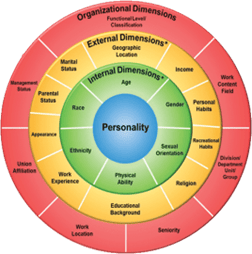
Gardenswartz & Rowe, Diverse Teams at Work (2nd Edition, SHRM, 2003). Internal Dimensions and External Dimensions are adapted from Marilyn Loden and Judy Rosener, Workforce America! (Business One Irwin, 1991).
Steps that can be taken to increase the number of female coaches and practitioners
I want to bring to the table something that has happen to me, when applying to a job or even when I had to hire people while working at an NBA franchise. To cite Chris Hirst again, ‘diversity is an undoubtedly desirable outcome, but when considering any individual hire or promotion, you have a duty, even moral responsibility, to hire the best possible person for the role, irrespective of who they are’. I have used almost the same exact words with my supervisor when expressing doubts about three candidates for a specific position, an argument that can be perceived as a less diverse team. On the one hand, we want the best candidate possible, and on the other hand, how are we ever going to get jobs that have been traditionally held by white males if we are never going to be given or give the first chance?! How do we know if a woman can be head coach in the NBA, or the performance director in a LaLiga team, if no one is given a chance to any women?! Of course we don’t have the experience – it’s almost impossible to obtain the experience! And the few that are sometimes afforded that opportunity face the pressure to excel, which is fair in itself, but are we being treated and evaluated as fairly as our male peers? How can we increase the number of female coaches or practitioners? Just give them the chance! And then, create an environment of fairness, and protect that environment, leaders, management, and staff. And the elephant in the room: remove those who are in the way and are the biggest barrier to change. Eliminate nostalgia from your organization. Make decisions to promote a diverse and inclusive workplace. Period.
How can teams better understand the atmosphere within teams – what data or feedback can you collect? Focus groups? One-to-ones?
I read the following in a book, and I thought ‘well, I wish my former supervisor, an apparent leadership expert, had read this sooner’. It read: ‘what you need to achieve change is for every member of your audience (AKA staff) to spend ABSOLUTELY NO TIME AT ALL thinking about how others need to change and to think only of the change they themselves will make’. I have experienced myself the huge damage that can be inflicted when people are given the opportunity to anonymously rate your colleagues. Rather than that, work to promote safe environments for having difficult conversations if needed. This enables everyone to be clear on what everybody else needs to do better.
Behavioral change happens when the individual grasps the need for them to change, and understands the benefit of that change. It is true that change is a challenge for most people; getting out of our comfort zone, the feeling of losing power or even fear of what might come, the feeling of being threatened by others’ success (huge in our sector!) – all are barriers to overcome on the path to future team success. Rather than allowing themselves to be inspired by others, some people puts barriers to new forms of thinking and behaving. If you are brave at heart, embrace the change rather than fear it. If you are able to adapt to challenging personalities, such as some players and coaches, why not be open to promoting diversity for the greater good of your team or your organization?
Lorena is one of six Leaders Performance Advisors, a group of leading performance thinkers providing more subject expertise to our member-only content and learning resources. To find out more about all our Performance Advisors, click here.
The Seattle-based startup discuss the technologies that can help basketball players improve the mental side of their performance.

World’s shortest elevator pitch: “We focus on training the mental side of basketball. It’s a part of basketball we think is undertrained.”
Company: VReps. “The goal of the company is to give virtual repetitions of your sport, primarily basketball right now. That’s the impetus behind it.”
Location: Seattle, Washington
Year founded: 2015
Website/App: https://vreps.us/; Google Play app; Apple Store app
Funding round to date: “We are Pre-Series A. It’s all Seed funding.”
Who are your investors? “We are all angel funding and have raised roughly $2.5 million.”
Are you looking for more investment? “If the right investors came, yes.”
Tell us about yourself, CEO and founder Shawn Cooper: “I was studying computer science at the University of Michigan and was a scout player for the women’s basketball team. I’m 6-foot, I was 190 pounds and athletic, so as a scout player I could play any of the five positions. For an upcoming opponent, we would be given the scout team playbook and we’d have four or five plays we’re supposed to simulate during practice. That means during a span of 48 hours I was supposed to memorize 20-25 plays because I’m learning all five positions and it’s just a paper playbook, that was the best way to learn. The idea behind the company was initially making NBA 2K for playbooks, that’s really where we started–a video game version of playbooks. We’ve since broadly expanded to preparing the mental side of basketball, so how do you play basketball? What’s the chess match that happens? When you go through a ball screen, what are the reads? Why are there different ways you defend a ball screen? That’s the idea that came out of it. My senior year, I dropped out for a year and a half and started the company. I did graduate, went back, but that was the start of it.”
Who are your co-founders/partners? “I don’t have co-founders but have some really important leadership to the company in Mike Greenman and Matt Stewart-Ronnisch. They are both supremely talented in the worlds they occupy. Matt, our CTO, is a very talented engineer. Met him in college and he joined pretty quickly after we started, probably a year after we started. Mike Greeman is our Director of Basketball and joined us two years ago after it became clear we had potential to impact the NBA. I have no connection to the NBA, I don’t know enough about basketball to chase that market. We hired him and he has the connections and the expertise. He is a very talented basketball mind. He’s the one that trained Chet Holmgren before the draft and Jalen Williams. We had three first-round picks (Holmgren, Williams and Christian Braun), three second-round picks (E.J. Liddell, Kendall Brown and Jabari Walker) and one player picked up on a Summer League contract (Jermaine Samuels). Chet was our highest draft pick at No. 2.”
The 2022 No. 2 overall draft pick Chet Holmgren had signed an NIL deal with VReps while playing for Gonzaga.
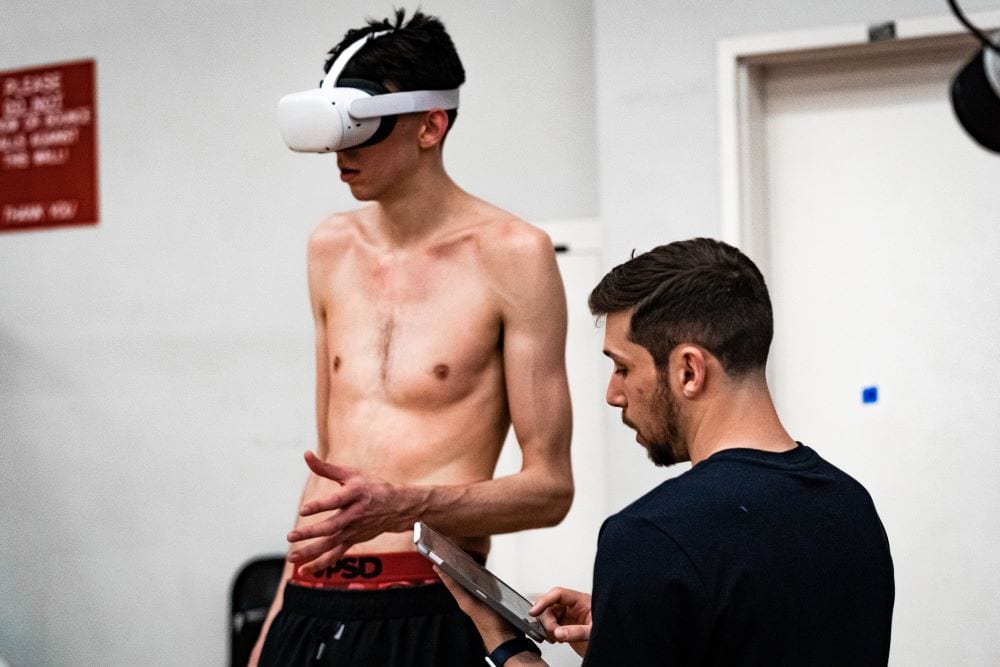
How does your product/service work? “The product is technology at the NBA level. We recreate NBA games as they happen, any NBA game from the past five years, and we’re able to put players in virtual reality in the shoes of any player during that scenario. That’s the product and that’s available for any NBA team to purchase, and we’re working with a handful of NBA teams. The service is the player development training that Mike does utilizing that product. He actually trains players and trains them on how to prepare for the NBA using previous NBA scenarios as examples. So, before Chet got drafted we put him into the shoes of any player in the league. After he got drafted, we put him into Oklahoma City’s offense to prepare to play with the team. So before he ever steps on the court with Oklahoma City, he’ll have been in their offense for almost an hour in virtual reality.”
What problem is your company solving? “Basketball training is very focused on individual skills–shooting, ball handling, weight lifting, vertical, speed. There is an entire segment that is mostly ignored, which is the development of your mental understanding of how basketball works and why those things are that way and the strategy behind it. We’re filling the gap between how a player gets from a really good college player to an exceptional NBA talent. A lot of that growth is on the mental side and we are accelerating that mental growth, which is traditionally learned almost exclusively through game time.”
What does your product cost and who is your target customer? “Our product costs $10,000 to NBA teams as an initial offering. There are more expensive layers. The service to the NBA players, there are two tiers. One is $20,000 per year and the other is $60,000 per year. For the product, our target customers are the NBA teams. For the service, it’s NBA players or players that are preparing to be in the NBA. It’s not just NBA players.”
How are you marketing your product? “It’s entirely word of mouth right now and direct connections with those teams or players.”
How do you scale, and what is your targeted level of growth? “The technology we built has meaningful potential at nearly every level of basketball. It’s training the mental side of your brain in terms of the strategy aspect. Our growth will come, depending on what markets we want to grow into. Our growth from here, after we successfully enter the NBA market a little more, will be high-level international basketball and probably going into the college level in the U.S. We may also pursue other sports like the NFL. This technology has the same value in the NFL. We can do virtual reality training for NFL players. That’s another way we can grow. Depends on how much cash we get and from whom.”
Who are your competitors, and what makes you different? “Our nearest competitor would probably be Strivr. There’s also a company that does hockey simulations. Nobody, as far as we know, recreates historical games to relive that from the perspective.”
What’s the unfair advantage that separates your company? “Our unfair advantage is our technology expertise. We have 10 engineers working at the company. Very few companies our size are that heavily invested in their technology. We also have a few proprietary partnerships that give us access to the data streams we rely on. The recreation of the NBA games, for example, is through our partner, Sportradar. As of now, we are the only company that has access to those data feeds for player development purposes.”
What milestone have you recently hit or will soon hit? “We just trained the second overall draft pick. That was a huge accomplishment. We also trained a player that wasn’t on most draft boards through the draft process and ended up being drafted 12th.”
In what ways have you adapted to the Covid-19 pandemic? “NBA teams are very focused on in-person relationships, as are NBA players. Trying to create a business where we could work with NBA teams and NBA players remotely has been a challenge. I don’t think we’ve done it super successfully but we’ve managed to get through it and now we are growing on the other side of the pandemic, now that it’s mostly gone back to normal in how the NBA operates. We’re growing into the normal sales processes.”
Beyond the pandemic, what obstacles has your company had to overcome? “It’s a very slow market to adapt. For example, the idea of relying on analytics took almost a decade to catch on. Now, every team is heavily relying on analytics. The NBA moves very slowly and negotiating that very slow-moving market has been incredibly challenging. I’m not saying we haven’t been successful in it yet, because the company is still growing and trying to enter this market, but it’s an extremely challenging thing to overcome. ”
How has your company been affected by the current economic situation, and how are you dealing with it? “The current economy isn’t positive for startups and inflation has also made it more challenging, but I don’t think we’re doing anything special or noteworthy to mitigate those problems other than trying to reduce our spending as much as possible.”
What are the values that are core to your brand? “The values are engineering excellence and content excellence. We have a very talented basketball expert and a very talented engineering team and having a high-quality product that is impactful, it’s not just something to talk about, it actually does make players better. The impact we have is really a core tenant of the company itself.”
What does success ultimately look like for your company? “Success on a small scale is players that want to get better come to us as a way to mentally prepare and mentally enhance in any sport. Success at a big level is changing the culture around the importance placed on the mental side of basketball. If more people started to focus on the strategy behind their sport, that would be–on a broader scale–a lot more success from our perspective as a culture shift from just individual skill training to the broader picture of the strategy behind sports.”
What should investors or customers know about you—the person, your life experiences—that shows they can believe in you? “What gives me the best shot of making an impact in this market is my ability to build a very talented team. The team we have is exceptionally talented from an engineering and basketball perspective. I feel confident I can grow the engineering team as we need to, and also grow into deeper levels of basketball or build into new sports and build a team necessary to enter those markets.”
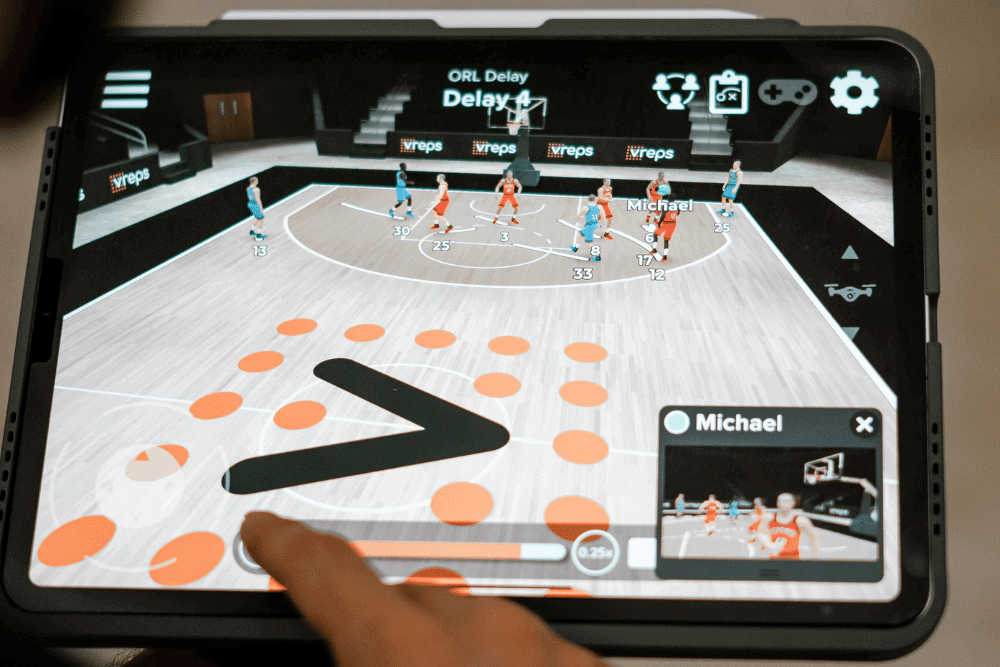
VReps allows players to create and watch plays through their app in 3D.
What made you start with basketball for VReps? “My true sports are lacrosse and ultimately frisbee. I was a very talented lacrosse player in high school but didn’t play in college because it’s really hard to do computer science and play a varsity level sport, so I decided to pursue a career. Now, I play at the highest level of ultimate frisbee. I play on a world-level team. Basketball is one of the easier sports to monetize and has one of the bigger markets and is a sport that has a very clear strategy to teach. Soccer is a little more fluid in the way strategy works. Basketball is a pretty ‘rock, paper, scissors’ type game where if they do this, you do this and they are going to do this and you do this. It’s not scripted in a football sense but more of a read-and-react sense, and it’s teaching that read-and-react decision making that is core to our business and what we can do. Basketball is the perfect petri dish for us to really prove our technology can grow in these sports.”
Do you have a favorite quote about leadership? “‘Knowing what you don’t know is more useful than being brilliant’ from Charlie Munger. The best leaders are those that build world-class teams around them. As an entrepreneur, you usually have very limited resources, so you need to be able to identify your biggest weaknesses and hire talented people to fill those gaps first.”
Question? Comment? Story idea? Let us know at [email protected]
This article was brought to you by SportTechie, a Leaders Group company. As a Leaders Performance Institute member, you are able to enjoy exclusive access to SportTechie content in the field of athletic performance.