The tech organization’s innovative wearable technology adds sensors into fabric by weaving circuitry into clothing or other material.

“I thought giving them a sleeve would be a no-brainer: ‘I can tell you your perfect free throw form,’” Sun says. “But they’re more interested in ankle injuries, so that’s why they opted in for socks.”
What Sun has developed is IP around imbuing textiles with electronic properties so that the fabric looks and feels like normal athletic attire while managing to collect data on movements, forces and even biometrics.
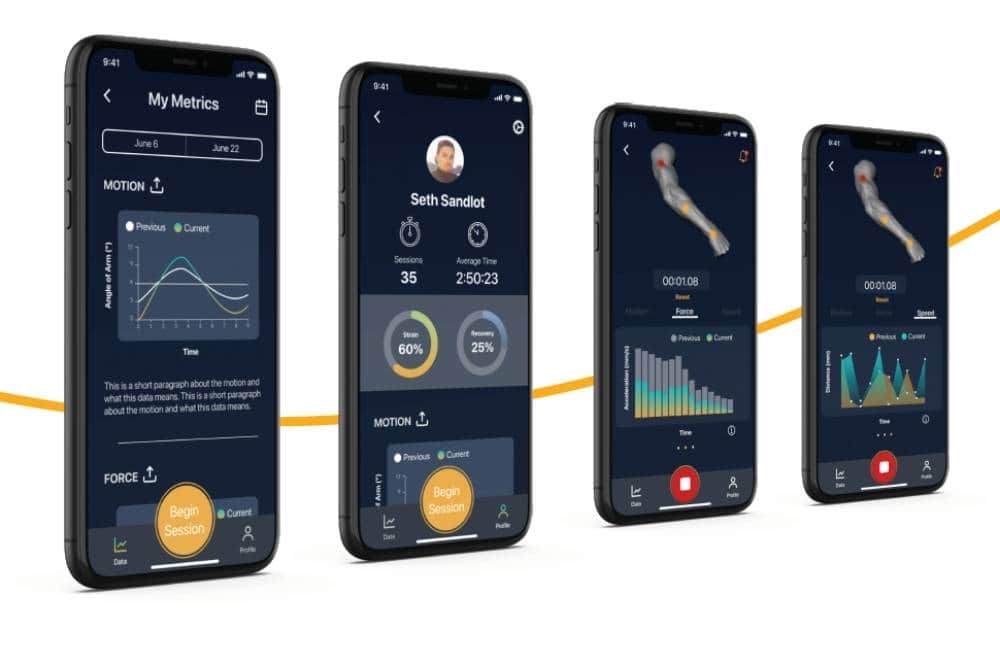
Users can view detailed biometrics tracked by Nextiles’ sensor-laden apparel.
The NBA example is a perfect case study of Nextiles’ B2B2C approach: develop innovative technology and let strategic partners guide the development of features and interface to meet their needs. Since the league selected Nextiles for its inaugural Launchpad startup program, the NBA has become a validator, a customer and now an investor.
Nextiles has raised a $5 million seed round led by Drive by DraftKings and joined by the NBA, Madison Square Garden Sports Corp., Alumni Ventures, SmartSports, Phoenix Capital Ventures, Newlab and Olympic hockey medalist Hilary Knight. Among its other early business partners are baseball training company KineticPro Performance, a tennis company and the US Air Force. The KP Sleeve, which monitors pitching workload and form, is expected to be available late summer.
“We’re not really in the business of guessing and saying, ‘Hey, you need to wear this.’ It’s more of you tell us what you want,” says chief business officer John Peters. “We have the form factor fabric, we have the sewing infrastructure, we have the supply chain set up, everything’s ready to go. And it’s really plug and play at this point.”
When Nextiles first stitched its socks for the NBA—technically, an outer layer to be worn over one’s usual socks—they quickly received more feedback: they foot covers are too small for the basketball player population. Peters laughs as he holds up the new product, which is befitting a man with a size 16 shoe. “So we have a new definition of ‘large’ after that,” he says.
Nextiles received that feedback and turned around the new product quickly. Its core team works out of NewLab, a hardware-focused workspace in the Brooklyn Navy Yard, and its product sewing studio is in New Jersey. The team shares communal resources at NewLab that enable rapid turnarounds.
“I want to ideate really, really quickly—as in, have a drawing, have a sketch and then print it out and touch and feel it to see if it’s the right geometry, the right fit,” Sun says.
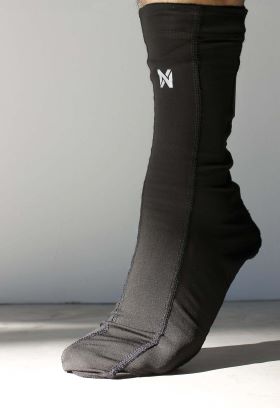
Nextiles stitched socks for the NBA because the league was interested in tracking data related to ankle injuries.
On a recent afternoon, Sun leads a guided tour of the 20th century shipbuilding factory that last decade was transformed into a prototyping studio. The first stop was to a room of 3D printers where, rather than order and shape mannequins to specific needs, Sun will use computer-assisted design to render the precise geometry of a body part he wants to clothe.
Most of the smart textiles his team makes include a patch of fabric with conductive materials covering about 5 or 10% of the garment. Sun uses the 3D printed body parts as a form around which to cut and stitch prototypes. His arts and crafts skills are a departure from his childhood spent tinkering with electronics.
“I used to break things—like, really disassemble things,” he says. “It wasn’t until I went to grad school and I worked for Puma that, yeah, I basically I can hand-sew now. I hot glue things together. I can teach kindergarten pretty well.”
Sun then proceeds to the chemistry lab where he experiments with materials of different ratios, combining metals like copper, stainless steel and silver with threads of polyester and cotton. Based purely on its inherent attributes and position on the periodic table, silver is best situated as the metal of choice, but Sun shies away from using because of both its cost and its inability to be reclaimed for a future iteration.
Instead, Sun prefers working with stainless steel. Because it’s less reactive than silver, it can be extracted from materials. It’s water-resistant. It is, however, a bit thicker and heavier.
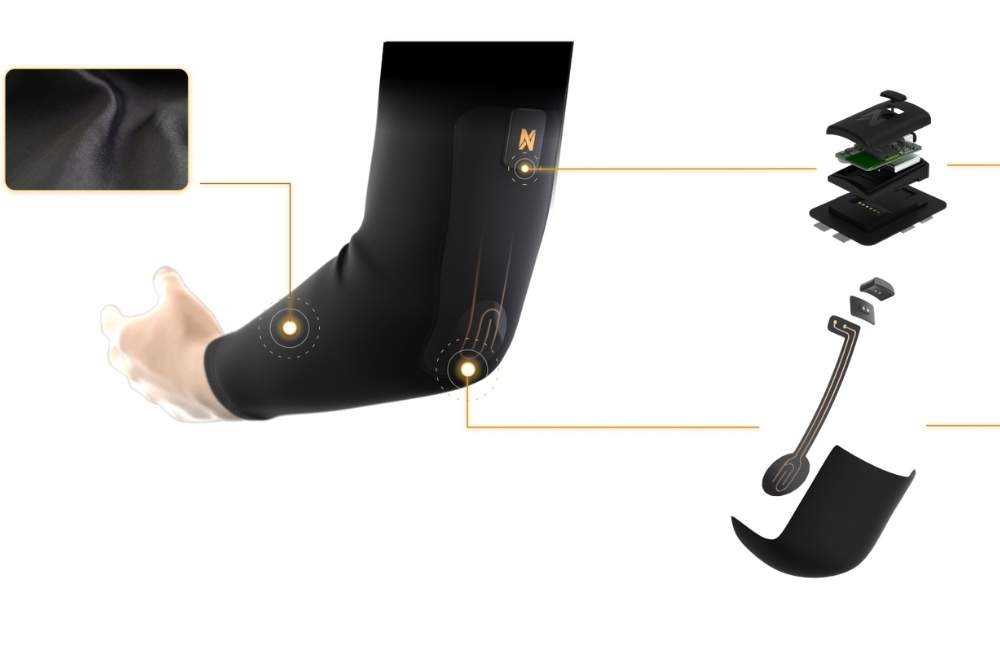
A Nextiles arm sleeve can help tennis players measure torque on their arm and help baseball pitchers manage their workload.
“It has more of a tensile strength than silver, and it’s just easier to sew,” Sun says. Many competitors “have deferred to silver, mainly because you can’t really see it afterwards. It’s so thin, it’s pliable. But for us, we found ways to have some interesting stitching patterns where the stainless steel is not as noticeable.”
From there, Sun walks down the hallway to an electronics testing room. Its benches are lined with soldering irons, voltmeters and the like. Here, he can experiment with signal strength and modulation as based on various twists, bends and folds of the fabric. Once a prototype is complete, one early round of informal testing is done upstairs where Bats-Toi—an MMA-focused mixed reality sports tech company—has a motion capture studio. Nextiles and Bats-Toi work collaboratively on some R&D, Sun says. (Asked to critique his wrestling style, he jokes, “I can’t fight. I go to the fetal position.”)
Back at Nextiles’ open loft space, entrants are greeted by a company nameplate touting a Steve Jobs quote, “Stay Hungry. Stay Foolish.” Inside the space are prototypes, conductive threads and desks for the small but growing team. The software team consists of only two engineers for now—who spend most of their time working on data security and “plumbing,” as Sun calls the encrypted data transmission to the servers—but will likely add at least a half-dozen more in light of the new investment.
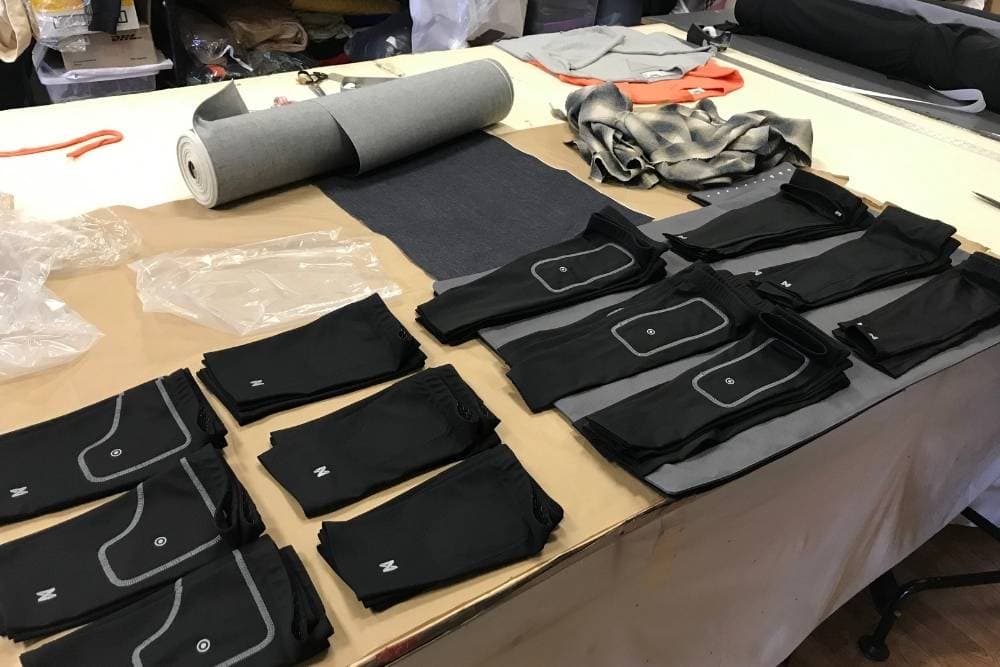
Nextiles uses repurposed sewing technology to merge fabrics and hardware to create a new type of wearable for athletes.
“The next six months is all about developing that software ecosystem,” Sun says. Nextiles still won’t be creating its own user apps, leaving that work for the partners, but much more can be done to organize and interpret the data to help clients gain more insights.
The filtering of all that requires actually quite a bit of analytics on the software and coding side, as well as data science and machine learning to say, ‘Hey, what is actually happening in this range of motion or this muscle movement or activity?’” says CFO Matt Evans. “That’s taking the science and translating it into adjustable outputs? That’s really the key part of what’s going to drive this forward.”
Two black fabric mats lie on the ground. A tablet is affixed to the wall at eye level. Every step or jump on the mats creates Richter Scale reading on the tablet’s digital seismograph-like display. While traditional force plates are heavy and expensive, Nextiles has replicated the concept with lightweight material that can be rolled or folded.
Nextiles created force plates with lightweight material that measure range of motion and muscle movement.
“I used to be a swimmer, so I’m not really a land guy,” says Sun, who swam through high school but stopped upon matriculating to Berkeley for his undergrad degree. “I had to be educated how important ground force was. I was really more about like, ‘Let’s build a body suit, an Iron Man suit.’ But it turns out just two pieces of fabric floor work for that information.”
The value of that data has made force plates a common sight in weight rooms and training rooms across all elite sports. Nextiles wants to deliver it more efficiently.
“We’re not always shooting out datasets that are claiming to be different,” Sun says. “We’re trying to say, ‘OK, our data sets can get the same thing but from a form factor that’s more seamless.’”
The same goes for one of its earliest partners, the US Air Force, who were the second—after the National Science Foundation—to award Nextiles funding (via a grant) following Sun’s PhD work at MIT. What used to be the data-collecting domain of wearable sensors can now be gleaned through fabric.
“The Air Force is looking for more biometrics like skin voltages, heart rate, breath rate, even eye movement,” Sun says. “And so that’s actually a different phase of our company that’s less mechanical and more biometric, and we can do that, actually, just by putting different fabric electrodes on the body, we can actually pick up signals from the skin.”
Eye movement? The human body is essentially a live battery, and the electric currents in the brain, heart and muscle can be detected by EEG, ECG or EMG. EOG, or electrooculogram, can do similar work for the eyes through nodes placed on the surrounding muscles.
The more imminent beachhead in sports will come through noninvasive motion capture and force analysis.
“Our goal is to deliver that experience—like a lab in a box—anywhere,” Peters says.
Nextiles hopes to provide that dataset as a companion to other technologies, all without the need for additional hardware. “Because,” Sun says, “I would hope you remember to wear your clothes.”
This article was brought to you by SportTechie, a Leaders Group company. As a Leaders Performance Institute member, you are able to enjoy exclusive access to SportTechie content in the field of athletic performance.
In the pursuit of success, there is likely to be more than one ‘good’ performance plan. Success can be viewed through a number of different prisms, can be defined in very different ways, and can be achieved through a range of approaches.
Leadership styles can be formal (bestowed through job title or position) or more informal (such as the role of influencers) but it is the leader who sets the values and principles of work that will fundamentally mark the direction of the project. The vision for a project – and the path to success – will be determined by the leader.
The identity of that leader, or leaders, is significant. There are, for example, world-renowned teams whose organizational values outweigh the aura of the individual. These include the New Zealand All Blacks, the NBA’s San Antonio Spurs or, more recently, English Premier League champions Manchester City. They are known for being winners and have what is widely regarded as a ‘great culture’. Yes, they have or have had charismatic leaders, whether it’s players, coaches or managers, but there is no single individual on these teams who is bigger than the team and their pursuit of success.
Of late, however, there are certain organizations where leadership appears to be driven by an individual (often a star player). Are there serious repercussions to this approach in the present and future of these organizations?
Organizational leadership
Who sets the overall vision of an organization? That person should know today’s vision and understand where is it going. That sounds good in theory but, as noted above, this is an era where players have a lot of power – in some cases even more than the coach or the manager. In fact, there are some organizations who deliver the present and the destiny of the organization to the star, or franchise player, of the current moment. This can involve enlisting them to shape the vision and it can also include eliciting the ideas and opinions of the superstar in the construction and direction of the team, which remains paramount. Any team adopting this approach must do so with caution since it may negatively impact the direction of the organization and the individuals that collectively form the team. These people (from managers to interns) will be the ones that, at the end of the day, should promote and act according to the values on which the organization is based.
The leaders who hold the vision, present and future, are the ones responsible for creating and communicating this vision, conveying direction and meaning. Moreover, they also have the responsibility for building the structure of the team, creating the roles, responsibilities or points of interdependence. And, finally, motivating individuals so that they follow the vision (with shared vision, goals and objectives) and support the development of its staff members with a view to retaining talent within the organization (especially in a moment where staff members are willing to leave when working under conditions that do not allow for personal development, professional growth; where there can be a frustrating environment, egos, unnecessary pressure, inadequate remuneration for responsibilities and role, and the like).
Individual leadership
Leadership can derive from formal leadership – the leader’s title or position in the organization – but also from a charismatic personality. As a leader, one has to ask: what kind of leader do you want and hope to be? In management or director positions, dedicating time to others, planning and guiding will be a fundamental part of those roles; a work oriented to the development of others is also part of the mission. Therefore, in thinking about what characteristics are going to define you as a leader, it will be essential to have a base of coherence, that your thoughts, words and actions are on the line.
However, when a leader is at the service of others, a facilitator to accompany, direct, guide, etc., there must be a safe environment. Knowing who is ‘the boss’, meaning who will make the final decision (leadership or players) will be important in the process of building the entity’s vision and mission, for the short or long run.
| Quick leadership checklist | Examples |
| Determine a leadership objective based on specific and strong values. | Personal: Authenticity, empathy, vulnerability
Professional: Collaboration, Curiosity, Creativity, Courage, Communication, Trust |
| Determine what kind of presence you want to project. | Charisma |
| How will you manage your emotions in times of change, stress or difficulties. | Stable, firm and presence realistic attitude; keep calm in the chaos |
| Think about what you say, when and how. | Know the context, be visionary, be strategic |
| Firmness and kindness at the right times. | Radical candor |
| Body language for the different contexts. | |
| Determine key points in conversations. | Asking questions, listening, giving feedback, negotiating authority, linguistic style |
Charismatic leaders can present themselves as true towers of strength, but it is difficult to succeed alone. Create a work team that makes you a better leader, a work team that helps you, advises you, provides perspective and supports and celebrates the moments of success with you. It is also important to let others lead. Natural-informal (non-formal) leaders can have a lot of influence on certain projects, and on people, as they can be very powerful. Detecting natural leaders, guiding them and at the same time giving them autonomy can be a formidable tool for a high performance program.
Strategic leadership
The mission, the vision and the core values should be above those of the individual, although they emanate from a visionary leader, and the management must ensure that the behaviors are in line with these. Defining who in the organization manages and leads the vision of where you are and where you are going should not be dependent on individuals, even if these individuals are strong promoters of the vision.
Now: where does the balance need to sit between meeting long-term goals (such as player development, injury prevention or the future of the organization) and the need to win ‘today’?
There is a trend across pro sports that organizations with less competitive pressure are capable of building projects with medium and long-term visions, working in safer areas, building from collaboration, guidance and delegation, managing egos, innovation, creativity and job security. Stability, trust, protection or support seems to allow talent to develop their tasks in a safer environment, with innovation and creativity and at the same time with room for improvement when things are not going in the right direction or aren’t working well. However, the moment the team begins to have ‘winning’ goals and pressure, or when it builds around a certain core of players, does something then happen? Are those environments more pressured by the umbrella of fear? Does this happen specifically in big markets? Is there a different culture depending on the market (small vs big) in the long term goals? Who is responsible for ensuring the environment that protects the identity of the organization?
In conclusion, it is worth reflecting on the words of renowned American investor Ray Dalio, who said: “An organization is a machine consisting in two major parts: culture and people.” He explained that you need to get the right culture and the right people, and for any organization to function well, “its work principles must be aligned with its members’ life principles”, so that the vision is clear, and the mission is shared.
In the second of two instalments, Jon Bartlett of the NBA explains why learning and development should be daily considerations for leaders and staff alike.
The Leaders Performance Institute sat down with Jon Bartlett, the Elite Basketball Performance & Program Operations Advisor at the NBA, to discuss this enduring trend. “Formal training and degree programmes are all technical in content, it’s all about delivery and performance – there is little content related to leadership development,” he says, in the second part of our interview.
While these may be difficult to change, Bartlett believes that sporting organisations can promote leadership development through better people development and management, a theme he also touched upon in the first part of our interview.
“People management does not always have an emphasis on people learning within their current role,” he continues. “If you shape this in the right way, with the right processes, you can learn and develop in specific areas every day, not just thinking ‘I need to do a course, conference, seminar or webinar to learn – I can learn every single day if I have the right process set up for reflection, review and evaluation.’”
He cites the popular ‘70:20:10’ model, which suggests that 70 percent of learning is done from experience, experiment and reflection; 20 percent is learning from working with others; and 10 percent is learning from formal interventions and planned learning solutions. “Most focus on the 10 percent and organisations support the 10s and the 20s, but how many processes are set up effectively to support the 70 percent?”
Bartlett argues that sport can be better at career planning for staff, including succession planning for departments. “If you’re employed in a role, it’s a given that your time and effort goes into maximising results within your role,” he says, “but how can you impact and influence further without authority and status?
“If you think of it as impact and influence without having the role of ‘leader’, now you’re working on things such as giving direction, accountability, how to support, being empathetic, being a good listener, how to build trust, how to solve problems. Eventually, when you move into a leadership position, all those skills and traits are well developed. You know exactly the different themes and bits and pieces you need to manage people and processes effectively.
“It is a surprise to me that succession planning in sport is not catered for more, especially when change is inevitable. You know there’s going to be change and you can probably guess which roles will change and turnover when things don’t go right.
“If certain staff members demonstrate some leadership traits, you can put these staff members on a career and learning development plan. When the opportunity arises, they’ll be in a great position to step into a leadership role versus those that have no training and have to learn on the job. I think that learning on the job is where other industries are different because they do have development plans for people who say ‘I want to go and spend time in this area or that area.’”
Bartlett readily admits that the concept of self-development, learning and leadership is a passion of his. “This is a piece missing in sport,” he says. “Is there a shared understanding within your organisation of what learning and development is? It sounds like a simple question but it’s actually quite complex when you break it down. The initial thing to recognise is that it’s a shared responsibility between the organisation and the individual staff member. It’s not just the responsibility of the staff member or the responsibility of the organisation. We are responsible for engaging in our own development, but organisations have to take responsibility for investing time and resource into their staff.”
That investment can be budget related and it can also be embedded into performance reviews and management. “Organisations can consistently provide opportunities, tailored towards each staff member, and you can visit progress on a frequent cadence. It could be monthly, quarterly or biannually. Often, performance reviews in sport are done on an annual basis. Now, if you’re just going annually, and you’re on a three-year contract, you basically only have two touchpoints on your development. Some contracts only operate on a 12-month cycle. So how can an organisation focused on the development of their people make it more tangible? Bake the whole process into your system on a daily basis. For example, something as simple as after-action reviews. They have a massive part to play in learning and development. They can be as simple as: ‘what were the intended outcomes? What actually happened? What’s the gap between those two? And how can we bridge that?’ You might have one or two outcomes. We’ve learnt what worked well, we learnt what didn’t, and so we can apply those outcomes next time. We know from adult learning pedagogy that learning takes place through reflection and making meaning of experiences, whether that’s individual or shared. The final hurdle is achieving a critical mass of people who are bought into that process of driving the learning and culture of ‘I want to learn more. How can we have done this better next time?’
“Quite a lot of organisations have someone employed in a people and culture role. However, they’re often more involved in recruitment and HR of the wider organisation, therefore sitting outside the sporting department/front office. And so how can there be alignment throughout the organisation of the philosophies, the ideas that come from a people, and a shared understanding of culture? And how can you have champions within each department within a sporting organisation that drive this daily?
“It’s no good if it just comes from one person and you’ve got 250 people in your organisation because it’s difficult for them to align all the different verticals. Leaders have got to promote this mindset of curiosity and asking questions without feeling threatened because what we want to do is learn together.”
“All in all, that cycle of where we first started, looking at people, process and people management. We circle back and it all starts with that focus on vision, strategy, plan, skills, experiences, mindset; you set up those processes from a leadership point of view and then over time they shape the culture and how things are done thus feeding themselves over and over.”
Within a few minutes, the Elite Basketball Performance & Program Operations Advisor at the NBA explains just how interconnected people development, people management and process development is.
When each is done poorly, there tends to be common themes, such as a lack of investment in people, a lack of clarity, misalignment, and fear of challenging the status quo. These return time and again throughout our conversation and Bartlett cites the distinction between ‘discussion’ and ‘dialogue’ in making his case.
“In sport, we often skip the idea of engaging in dialogue – that is being open to and listening with intent to everyone’s viewpoint, willing to understand their perspectives, place value in their backgrounds and their experience – and instead we go straight to the discussion/debate narrative. Without recognising it, the situation quickly becomes a ‘me versus you’ with the actual problem not being addressed or solved.
In the first instalment of our two-part interview, we explore the steps teams can take to promote better people development, people management and process development.
Jon, what is the first step leaders can take towards creating shared understanding, language, meaning, vision and clarity within their teams?
JB: The obvious one, and it’s easier said than done, is making it visible. Does everyone know what the plan and strategy is? Is it evident within the environment you’re working in on a daily basis? Is there alignment between the owners, the board, the GM, coach, performance director and then all the different verticals underneath? Are there routine checkpoints along the way to determine progress or is it just an annual check-in to see how it’s going against the plan? Are there actual processes and opportunities to review the plan as it’s happening and emerging? Is the work of those who are non-athlete facing and those who are athlete facing aligned to the wider goals? Are the actions and words consistent? It’s easy to put words up on a wall, but are the actual actions and behaviours aligned with those?
How can goals and values be effectively communicated to staff members?
JB: It’s about taking people on a journey. In an ideal world they’re somewhat part of the conversation, or involved some way in developing the goals and values. This way you likely get to the point easily and quickly around how those values are embodied. For big staff groups though where this isn’t always possible there are opportunities through behavioural frameworks. If you’ve got a certain set of values and behaviours in which we’re going to operate, what are the actions that embody those values? And how can you live those on a daily basis? I think in having that shared language and that shared understanding, the co-creation and sharing of that responsibility, you’re then reaching all the different verticals. There are many ways to achieve this but, ultimately, I think the more people involved in the process the more buy-in and engagement there is early on.
What about the role of those below the leaders?
JB: To achieve alignment, the heads of department are critical in sharing the values, the language, and the processes. One thing I’ve thought about hard is giving flexibility to staff on how they do their work and how it contributes to the bigger picture. Empower and allow them to carry out how they do their job on a daily basis, but then collectively identify how that work contributes to the bigger picture. Now you’re meeting them in the middle. That is key to that alignment. If it’s just being told constantly, ‘this is what you need to do, this is how you need to do it’. I don’t want to work like that. Flip it around: the work you want to do and how you’re doing it; how is that contributing to the bigger picture? What piece of the puzzle are you in contributing to the overall strategy? It’s both top-down and bottom-up.
How can organisations track both progress and the development of behaviours?
JB: You always want to be able to track if something is going in the right direction through constant touchpoints on where it’s at, what’s the progress, where’s it getting to, but it’s also a case of tracking what isn’t working as well, what needs to be dropped. So, I like the idea of asking how do we spend our time? And what are we spending our time on? Then you’re almost thinking what’s the problems we’re trying to deal with? Are we asking the right questions? Are we trying to solve the right problems? If you haven’t got the initial plan, vision and strategy, then what are you actually tracking? I think that’s key: you’ve got to have the first part first in order to then track your progress along that lifecycle.
What are some of the signs of poor process management?
JB: This is really talking now to how things are done, the methods in which we account for planning, ideation, creation, implementation, review and evaluation. I think, done poorly, there’s gaps at every stage. Done well, there might be one or two ‘getting there’ stages, which might need tweaking. Done great, there are processes and frameworks contributing to every step of that process, it’s a well-oiled machine and it effectively contributes to decision making. For example, if there’s no review or evaluation of a process, then there’s very little learning happening. And no learning means the same thing is being done over and over; when you want different results and you do the same thing it’s basically insanity. In sport, if you do the same thing over and over, recruit the same, go through the same cycle and expect different results, nothing changes. One of the themes that I think interchangeably gets regarded as poor staff incompetence is just poor process management. Sometimes, it just needs better oversight and better management of the process and then often this can lead to better action plans and development for staff.
Change often comes during losing streaks, periods of staff turnover and other turmoil. How can teams begin to find opportunities in those moments?
JB: You’ve got to ask: what’s the problem? What’s the question we’ve got to ask ourselves? Change is inevitable in sport, it’s a constant. That’s why I think context becomes so important. To get a group of people to work together towards a common goal you have to ask: was there even a common goal established at the start? If there wasn’t, then that’s the problem, not necessarily the people underneath, because they didn’t necessarily know what they were doing. The opportunity is there to ask the right questions and if you don’t know what the questions are then get people in to help ask those questions and find out what the problem is. Subsequent to that, all staff have the opportunity to be a part of something. What do you want your role to be in this and how are you going to contribute to it in terms of turning it around and changing it? Some people will be ‘I’m out of here, I’m done’. Some people don’t have the choice. But in a way, you’ve got to come back to: what is the problem? Poor results isn’t the problem, that’s the outcome. You’ve got to find out what’s leading to those poor results. Context is key and that’s the opportunity.
What is the right way to win over stubborn people within a team?
JB: We are talking here in the context of change, I guess, and with that how you go about convincing someone with a certain mindset and philosophy of practice tweaking how they do things, so they’re aligned to how an organisation or department wants to operate. The first thing is learning about what their perspectives are, what their background and experience is and what their modus operandi is. Gaining understanding of this means building a relationship and respecting that background. Equally it provides the opportunity of asking: ‘how can their background, practice, methodology, philosophy contribute to us trying to answer this problem?’ You want to get to a place where you get them to come up with a solution of how they contribute to the actual problem as opposed to saying, ‘this is where we’re going and this is where we need you to operate.’ Again, it comes down to that ‘dialogue versus discussion’ concept. They might not agree with the vision, strategy and pathway, which might mean a separation of ways, but if they are engaged then for me it’s about identifying with that individual how they align and operate the agreed vision and philosophy of the department.
The starting point is people and culture
So says San Antonio Spurs Head Coach Gregg Popovich. ‘Coach Pop’ caught wind of the organisation’s wish to create a new practice facility and approached Phil Cullen, the team’s Director of Basketball Operations & Innovation on the gym floor. “He goes: ‘I’ve got two things for you: protect the culture and protect the people’,” Cullen later told an audience at November’s Leaders Sport Performance Summit in London. The Spurs have since broken ground on their new facility. “When we talk about design, we talk about influences on design, the human-centredness. It was an approach he really took from day one.”
If you’re building a new facility, be sure your architect listens
Cullen explains that San Antonio had an issue with sports-focused architects whom they consulted. “They try to give you the best rendition of what they’ve just completed,” he said. “They’ll kind of tell you what you want rather than really listening to what you need.” The solution was to partner with an architect that had experience of other sectors. “All of us now are becoming small tech companies; the technology’s integrated in everything we do. Why aren’t we looking at technology companies and how they work to see how it can impact how we’ll work in the future?” The Spurs were left considering aspects and thinking points they may not have otherwise considered.
Who are your athletes’ major touchpoints?
Human-centred design promotes the casual collisions that promote collaboration and creativity. “A lot of times it’s focused on the coaching element, which is extremely important, and player amenities, but how do you facilitate those casual collisions?” said Cullen. “The people that would be in your facility the most and have the most touchpoints are probably not who you think they are. For us, it was our equipment guy. Very often you’ll go back and the players are hanging out with the equipment guy. Why? Because they can just hang out. It’ll be the athletic trainer, it’ll be the guy who’s taping his ankles and helping the guy rehab.” This has been uppermost in the Spurs’ thinking, who have even installed TVs close to the ceiling of their current facility to help take players eyes away from their phones.
Cullen added: “How can we make sure we have the best possible experience so that we’re actually giving them opportunities in their career development; giving them all the resources they want to advance? So that when we go into the marketplace to recruit these guys to have elite talent in our building, we’re not only attracting elite basketball players and elite coaches, but also the staff around them. That’s where collaboration is key. For us, the human-centred design piece is really trying to break down those interactions and it starts when the players pull up into the facility; what’s that experience when they enter in, get out, walk into the parking lot? Who are they walking past when they go to the locker room?”
Future-proof your facility – leave some space free
It can be tempting to throw the kitchen sink at a new facility but the Spurs and Cullen are wary of doing so or being locked into one type of technology. “We’re trying to be intentional about not designing a space for one specific use because it can very quickly become a closet if it can’t be used for more than one thing,” he said. “By far the No 1 thing people tell us is make sure you have enough space. You may not have all the nice designs and be able to finish it all out, be able to brand it, be able to story-tell the way you want, but make sure you get the space because you want to future-proof and you can’t move around in it.”
A Human Performance article brought to you by our Main Partners

A recent study, led by Jan Ekstrand (2021), analysed trends in injury rates among male professional football players across 18 seasons. They identified a decrease in injury trends as well as an increase in player availability in both training and matches.
In the Australian Football League (AFL), recent results seemed to show stable injury rates and missed matches, as the player-salary costs remained stable too (Eliakam et al, 2020). In the National Basketball Association (NBA) recent results showed an increased in injuries (unique injuries) and games missed due to injuries (Torres-Ronda et al, 2022).
Nonetheless, what seems to be pretty consistent across the industry is that injuries cost money, and a few studies are starting to prove (objectively with data) they cost performance (success) too. And from the team and the individual perspective, every time we hear about a main injury in a player it makes me think, ‘here we go again; how these type of injury still occurs so often?’ or ‘why so many occurrences of this injury?’
The first question I want to pose is: what are we doing wrong when it comes to injuries, and are there steps we can take at an organisational level to buck the trend?
If we study the injury data that has emerged from the NBA in the last four years we can see that the occurrences of injury are increasing despite ever greater resource being poured into injury prevention.
It is in everyone’s interest to fix the situation, given that injuries cost both money and success. Beyond the bottom line, there is also the disruption to your team. When important players are absent it can increase the pressure on the rest of the roster and your coaching staff, as well as increase the working hours of your performance staff behind the scenes.
Risk-reward
Firstly, should we use ‘injury prevention’ or (managing) ‘injury risk’? Sometimes semantics can make us rethink what we’re doing. With ‘injury prevention’, we often see more of a focus on strength training exercises, whereas ‘injury risk’ allows an assessment of the likelihood of an injury occurring and enables decisions to be made to reduce that likelihood.
Of course, an opponent could step on a player’s foot at any time. There are things that we can control and others that we cannot. The schedule is not going to change, so could it come down to minute-management? Is it worth a player playing the second night of back-to-back games, with a high cumulative minutes (for his age, experience, strength levels, team’s season performance)? What other factors are coming into play? I believe decisions should be made in a risk-reward context.
With this in mind, what injury trends are you noticing with your teams? How have your internal review processes evolved to manage those trends? The greater investment in injury prevention has created a lot of moving pieces and still the injury numbers are ticking upwards. In the NBA, it is load-related, with tendon and ligament injuries on the rise (specifically, knee injuries).
There will inevitably be differences between teams, which could come down to playing style, the choices of the coach, or simple bad luck during any given campaign, but this tells me that we should be reviewing internally what we’re doing with our athletes.
With frameworks for decision making and tools such as strength assessments, biomechanics, and ultrasounds, among many other assessment tools for internal and external loads, and players’ subjective perceptions of fatigue ratings, we can have information about many aspects of the athletes’ day to day. But how can we use this information and communicate it to coaches and the various stakeholders to make a better decision around whether or not a player plays tonight or for how many minutes?
When staff are making assessments, are they allowed to do their jobs, and by this I mean, how is your player buy-in context and organisation support? Are we doing the right testing, at the right timings, and analysing the right metrics? Are the players using their time in the right way to promote injury prevention? Is it important to track and classify their drills for injury risk as well as for conditioning and performance? Which types of statistics are we using? Are they correct? Should we review deeply our resources, what we can realistically do and expectations about the risk of injury?
The missing piece
It is also important to consider the culture of a franchise. If a coach has been in tenure for three, five or more years they likely have more trust and stability for long-term processes. Such scenarios stand in contrast to some franchises where ‘you lose three games in a row and the coach is fired’, making the environment more unstable, and depending on how it affects the staff, more volatile. For those coaches, it is hard to say ‘we’re going to develop this player and every 20 games he’s going to rest for one game, depending on the opponent or difficulty of the game.’ They need to be successful today and they’re going to squeeze the sponge or play the cards that they have.
Sticking with the NBA, when a franchise is bringing in college players or players from overseas they will inevitably be impacted by the schedule, which is between two to three times the length (or congested fixtures) than the European average season. How should we manage those players and introduce them to their new context?
When the European competition increased the number of games there was also a spike in injuries and severity. The schedules are unlikely to be reduced in any corner of the globe, so the issue becomes: how do we handle that? Do we need bigger squads? Do we need to have greater rotation? Do these need to be enshrined in the rules?
And what is happening in those moments that we can’t control? What are the athletes eating? What are their habits? Their professionalism? Their education in their own bodies and recovery? I think we’re making steps in general in the sports community because we have more professionals, more education, more investment in food, but then why are injuries increasing, or not significantly decreasing?
In addition, I don’t think we have enough good data to know why injuries are happening. The impact of data collection and analysis is another consideration, particularly when considering risk-reward and decision-making. When using that data, are we being too conservative? Are we using the data against our interests? Or are we pushing too much because of pressures (including players’ desire to play)?
It can also depend on the sport or the league. There are some risk management systems that have access to datasets on multiple teams and sports; they might be able to call upon injury or tracking information.
What are we missing in the analysis? We might be getting better at some things with injuries but there’s still the trend of injuries increasing. Should the leagues be more involved? because nobody wants the star players missing, not teams, fans, media or the broadcasters. As a league, how could we have a database where people submit anonymised information that can lead to analysis? I venture to say that injury analysis is way more complex than the way that we’re attacking it, and that we are probably ‘missing something somewhere’.
Lorena is one of six Leaders Performance Advisors, a group of leading performance thinkers providing more subject expertise to our member-only content and learning resources. To find out more about all our Performance Advisors, click here.
From the front offices to the locker rooms via the psychologist’s couch, we bring you ten performance lessons from the Leaders Performance Institute vaults that continue to resonate today.
1. Athletes need to feel a sense of belonging
The WNBA is renowned for its advocacy of social justice issues and one of the its leading lights, the Seattle Storm, have been at the vanguard under CEO and President Alisha Valavanis. Backed by one of sports few all-female leadership groups in Force 10 Hoops LLC, the Storm has won three championships and made every effort to ensure the players find an inclusive, cohesive locker room where everyone is committed to representing the Storm’s vest.
“It starts with establishing personal relationships and building relationships on trust and connection so that players can share with us what their hopes are off the court,” said Valavanis, speaking to the Leaders Performance Institute in 2020. “There’s a real intentional effort to learn all about all of the individuals in our organisation and we certainly have conversations with players on how we can support them and make sure that everyone is clear what it means to be part of this organisation.”
2. Engage your athletes in their development
When athletes feel secure then you can empower them in both their personal development and the collective. “I’m a big believer in getting players to collaborate, present back, research, share with the group, present to the coaching group and vice versa,” said Jess Thirlby, the Head Coach of the England netball team on the Leaders Performance Podcast in 2020. “It’s a good way for me to check understanding from the group and it helps inform how to set direction and invest my energy when I hear the playing group back and they’ve demonstrated really sound understanding of themselves and the opposition and, not only that, but coming up with ways in which we’re going to pit strengths against their weaknesses.”
3. Make space in your schedule for independent development
Thirlby’s emphasis on empowerment is matched by Lucy Skilbeck, the Director of Actor Training at the Royal Academy of Dramatic Art [RADA]. “One of the things we’re looking at is how we can develop a more facilitative relationship with the student and how we make more space within the timetable for the student’s independent development,” she told a Leaders Performance Institute Webinar in 2021. “We’re also looking at how can we foster in them a greater sense of independence and understanding of themselves as artists and actors; as people who can make and create work as well as deliver other people’s work. Pedagogically, how do we work with them to facilitate the growth of their individuality rather than a monocultural process?”
4. Take a step back
Paula Dunn is the Head Coach of the Paralympic Programme at British Athletics. Ahead of the delayed Tokyo Games, where her team claimed 24 medals, she spoke of the perils of micromanaging. “I thought I had to be in charge, I had to be tough, I had to work the longest hours, I had to have all the answers,” she said. “It’s never good to have a decision made by one person, so I’ve tried to work with my team, understanding what their motivations are, and just being honest when I just don’t know something or if I’ve had issues.”
5. Is the athlete’s real competition the challenge of fulfilling their potential?
Anne Keothavong, the Captain of the Great Britain Fed Cup tennis team, is engaged in the development of the nation’s players and knows that no corners can be cut. As she told the Leaders Performance Institute in 2018, the challenges can differ from player to player. She said: “Every player represents a different case, depending on where they’re ranked and how old they are, how long they’ve been playing professionally, and what targets they need to hit. I’m not involved on a day to day basis but when I see them in a training or competition environment I’m looking out for whether they’re improving, consistently working on those goals, and the other things they want to focus on to help make them a better tennis player.”
6. Track athletic development through relevant tests
The best data can be linked to specific tests and Kate Weiss, the Director of Sports Science at the Seattle Mariners, walked viewers through a hypothetical process with a pitcher at our February Webinar. “When they come in, we’re going to test range of motion, we’re going to test movement capacity; how are they going to move in a general sense and a baseball-specific sense,” she says. “We’re going to look at the different components of strength, speed, power, we’re going to look at body composition. All these different things that we know contribute to and help support what they do on the field. Then what we’re going to do is look at the on-field data and link that back and go ‘OK, maybe there’s issues with their shoulder separation on the mound.’ We’re going to look through everything and go ‘OK, is it coming from a range of motion issue? Is it coming from just a movement capacity issue?’ Or if it’s not those things maybe it’s just a coaching issue that we have to work on and come up with specific drills.”
7. Data: spend less time capturing data and more time analysing and feeding back
“For data capture and analysis, we have a mantra at the EIS: ‘we should spend less time capturing data and more time analysing and feeding back’,” said Julia Wells, the Head of Performance Analysis at the English Institute of Sport. “That’s something that’s been rooted in us since the inception of our Performance Analysis team.” She and her team supported Great Britain’s athletes at the 2020 Tokyo Games and, as she told the Leaders Performance Institute in the aftermath, they prioritise harnessing the latest tech and relationships with the end users. “The software available now is immense,” she added. “There’s so much to choose from, which can be a challenge but we honed in on data visualisation and our ability to translate data into usable insights.”
8. Do not attempt to separate emotion from performance
Sports Psychologist Mia Stellberg feels attempting to shut down emotions is counterproductive for athletes. “The more they can understand emotions, they can explain and understand what they are feeling or how that feeling came to occur is the first step,” she told the Leaders Performance Podcast in 2021. “We can never control anything that we are not aware of. So you need to be aware of your emotions, sometimes this is the most tricky part of my work, to talk about emotions to young guys at age 20 who just want to rule the world, play and win the title! Then the second step is understanding how that feeling occurs or what needs to happen before it pops up, so if we want to prevent negative feelings we have to understand what happens before it comes so that we can learn how to control, how to prevent.”
9. Embrace risk, expand comfort zones
Mental performance coach Véronique Richard, who has worked with Cirque du Soleil as well as a variety of sports organisations, attempts to cultivate ‘risk-friendly’ environments. “Risk needs to be part of your environment,” she told the Leaders Performance Institute in 2018. Richard strives to foster the conditions for enhanced skill development in the athletes and performance artists with whom she works. In short, she introduces an element of chaos. “By working through that mess, people actually increase their repertoires of thoughts and actions, which contributes to creativity,” she said. “First, I ask the athlete: ‘what are you avoiding not because you’re not skilled enough but because it makes you uncomfortable?’ There’s all sorts of things we don’t do because of discomfort; it can be technical, tactical psychological, emotional, personal, ego and then, as a leader, your role is to find the right stimuli to bring the person to explore discomfort and bring people to work in this zone of discomfort; and if you manage that successfully you actually expand their zone of comfort.”
10. Do your athletes know where to turn for help?
In 2019, the Australian Institute of Sport established its Career & Education Practitioner referral network, as Matti Clements, the acting CEO, explained in her former role as Deputy Director of Athlete Wellbeing and Engagement. “That is practitioners who can provide high level expertise on vocational pathways. It’s referral-in and we’ll cover the costs of all podium-plus-level athletes and coaches,” she told an audience at Leaders Meet: Wellbeing. The AIS also provides help for the athlete wellbeing & engagement managers with the provision of a personal development programme. “This is so that we can ensure a level of risk management and skillset across those people. What we’ve done is invite the whole system, including professional sports, into that education and we’re creating community practice hubs so that they can actually have some peer support; it’s led by us, but there’s peer support there.”
An article brought to you by our Main Partners

By John Portch
“And the sense of leading or inspiring others to do things they don’t necessarily think they can do.”
Miller is speaking at our latest Keiser Webinar, which was titled ‘Developing the Person and the Practitioner’. He is joined by Duncan Simpson, the Director of Personal Development at IMG Academy and moderator Dehra Harris, who serves as Assistant Director of High Performance Operations at the Toronto Blue Jays.
The trio explored people development on a personal and professional level; what is done well, and what could be done better.
Scaffold your development as you scale
You are perhaps never at a better time to restructure than when you have reached a low ebb. Miller explains that British Fencing currently has just one podium athlete but that he, in his role as Head of People & Culture, is working with the wider team to build elite foundations ahead of the 2032 Olympic Games in Brisbane. He says: “[We want to] create an environment where people learn from whatever lens they’re viewing the programme through – be it a coach, be it an umpire, be it a parent or stakeholder in the journey – we’re building those world class foundations to grow and scaffolding the learning as we go through without having too much expectation placed on the individual athletes.”
The IMG Academy, which is based in Bradenton, Florida, serves 1,300 student-athletes across eight different sports, and employs over 800 staff. It is more advanced than British Fencing in its efforts to scale and support development but, as Simpson explains, there is a constant process of breaking down the silos that form between subject matter experts. For him, the key lies in its structure where the four facets of student-athlete life – school, campus life, sports and athletic & personal development – are given an almost equal footing. “How organisations are structured actually plays a massive role in the processes and how we see collaboration.”
The power of informal learning opportunities
Structures are important but culture also has a role to play and this informs the thinking around the Toronto Blue Jays’ new training facility, as Harris explains. “If we only meet separately then it doesn’t work,” she says of the staff based at the 65-acre Player Development Complex, which opened in Dunedin, Florida, in February 2021. “Having times where we’re socially together across disciplines helped and not just jumping into meeting structure but having five minutes of shooting the breeze where everybody’s just talking as humans. We recognised that we needed to shift from this relentless productivity of Zoom.”
Performance staff and coaches are also brought together through what Harris calls ‘intentional collisions’, a process that is also popular at Google. She says: “Strength & conditioning sitting down with hitting, we’re going through a bunch of players, we’re looking through an S&C lens and a hitting lens and we’re talking about a specific hitting goal. That’s a place where we’re anchoring a goal but maybe bringing people who aren’t always in the same room together.”
Do with not to the learner
“I need to have a ‘see, feel, hear’ sense of what’s going on so that I can, with the rest of the team, support [the athlete’s] learning in a way commensurate and at a tempo which is good for them,” says Miller. “Hearing, and feeling, and sensing what’s going on with the learner and how we build the learning around them in their context is really important.”
He sums it up with a pithy aphorism: “do with not to the learner.”
At IMG Academy, Simpson tells the virtual audience that learning is divided into three buckets: what the individual prefers to improve in, what they’re required to improve in, and where they are actually improving. He says: “It’s getting an understanding of those three elements. The actual development part is ‘maybe I can have a little impact there’, but it’s also getting them to understand that, ‘yes, you want to develop in this area and that’s fantastic but we can have multiple areas that we’re passionate about but your role may have evolved and changed, or the demands have changed, and you’re required to improve in this area.’”
The open conversation around those three elements, which can be scaled from the individual to the wider team, are the starting point for goal setting each year.
Comfortable being uncomfortable (and curious)
Miller wants people at British Fencing to be comfortable being uncomfortable and, for the audience, draws on his experience serving aboard a nuclear submarine in the Royal Navy. “When people join a submarine they’re walking into a learning environment, which is a high performance learning environment,” he says of an experience he and his shipmates called the ‘fourth dimension’.
“The importance of that is regardless of where you are hierarchically, when you walk into a submarine for the first time you are a learner and the philosophy and the culture inside that submarine is that we need you to be the best version of yourself as soon as possible because you might walk past an incident and you need to know how to deal with it because you’re the first person there. You can’t rely on a subject matter expert to come and bale you out, as it were. That sense of learning, that sense of curiosity, is inculcated in every fabric of every human interaction inside a nuclear submarine.
“Everybody takes responsibility for their individual learning but also their collective learning.”
It is an attitude he has taken into his post-military career with England Rugby, the English Institute of Sport and now British Fencing. “If we can help people to flex their curiosity muscle and encourage people to ask really insightful questions and be curious and want to develop themselves, where we get to is a sense where ‘it’s OK to ask a good question. It’s fine. It’s OK to not have the answer.’ But what we’re encouraging is the ability to be hungry for that learning.”
Making learners feel safe
Harris, who previously worked with medical students, recalls a time when she experienced a safety shift when delivering feedback. “A friend helped me to think about the difference between calling someone out and calling someone in,” she says. “When you call someone out there are relationship stakes. I might fire you, I might do something at you; there’s going to be something happen versus if I’m calling you in, it can be very direct but I’ve removed the relationship stakes by saying at the beginning of the conversation: ‘I appreciate that you’re here, I see all the hard work.’ This is potentially a difficult conversation but there are no stakes. This is us being honest about what is happening. I have to give difficult feedback but I want you to be very clear that we’re working on whatever I say.”
In addressing the question of belonging and psychological safety, Simpson cites American entrepreneur Charlie Munger. “He always talks about how much he underestimates the power of incentives,” he says. “When I sit down with individuals, I may have this picture of how great it is to work here, and we’re all pushing in the same direction, but I also need to understand the individual’s incentives. Why do they come to work, what are they here to do, what are they motivated by?”
Time is another factor, says Miller, who stresses the importance of trust and rapport. “Also with the learner, it’s giving them attainable goals in the short-term so that they feel success for themselves. Harris concurs, adding: “Succeeding is cooler than only failing.”
Tracking growth and development
The panel agree that evaluating learning can be difficult and Miller uses the Kirkpatrick Model, which is widely used for evaluating training and learning programmes, to explain why he feels he has fallen short at times.
“Organisations that plan big learning and development programmes often stop at the reactionary phase, the foundation phase i.e. ‘how did it feel? What was the learning like?’” he says. “The next level to that is how you are transferring that knowledge into your context. Then Kirkpatrick will suggest, actually, it’s a bit deeper than that because it’s how are you applying it? This takes time. Where we want to get to is how has it behaviourally made a difference to the organisation?
“When I think about learning programmes now, I think about how I’m going to evaluate it in the first six to eight weeks after the experience; what does the transfer of knowledge into the context look like? I plan that, six weeks out to three months. Three months out is how they’re applying it in their context and then, finally, in a year’s time, if we review and reflect on that learning experience for those individuals, what does that look like and how does it change the human behaviours inside the organisation?”
A human performance article brought to you by our Main Partners

Wendy Borlabi, the Director of Performance & Mental Health at the Chicago Bulls, has spied a noticeable shift.
Less than a decade ago, she says, there was a desire for, “having a coach with the credentials to take you from point A to point B. [Athletes] were looking for coaches who could do that; they hired coaches who could get you from A to B, it wasn’t about the relationship.”
“Now,” she continues, “I see more of the connection with the coach; they want to have that relationship. In my opinion, a lot of it has to do with the age. In the NBA we’re seeing younger players; they’re coming into the NBA at 17 years old. They’re babies, they need that nurturing, they need someone who’s going to take them under their wing that’s going to help them do the everyday pieces, that’s going to look after them, that’s going to ask about them, come and visit them at their house and be there to sit with their parents. They’re looking for that because they’re so young and when that’s there and that trust is there then I think that they’re able to expand on that, that they’re able to ask them to do things outside of their comfort zone and challenge them because now they’ve got a trust and it’s built on more social and emotions than [the question] can the coach move me from Point A to Point B.
“This shift is happening and I know we’ve talked about it that we used to see it a lot with female athletes as opposed to male athletes, but not now I think it’s more age-related as opposed to gender.”
As those coach-athlete relationships shift, so too does the role of the sports psychologist, which was a major theme of Borlabi’s appearance at June’s Virtual Leaders Meet: Evolution of Leadership alongside Kate Hays, the former Head of Performance Psychology at the English Institute of Sport [EIS]. The duo joined moderator Dehra Harris, the Assistant Director of High Performance Operations at the Toronto Blue Jays, to discuss the stability of an athlete’s confidence as well as the athlete’s ability to root confidence in a firm understanding of their strengths.
“For me, there’s been a real shift in sports psychology and how it’s delivered,” says Hays.
“When I think back to when I qualified, the focus was still so much on mental skills training and a lot of work at individual level and there’s certainly been a huge shift now. A lot of the work that the psychologist is doing around the team is facilitating environments that are psychologically informed and working alongside the coaching, sports science and sports medicine team as a collaborative effort; and I think that talks to the culture of people as well.
“It requires an entire sports organisation to be aligned in terms of the mission, behaviours, the philosophy around coaching, whether we take strengths-based approaches etc. when it has worked really well and you have athletes that have given the opportunity to learn, develop and grow, it’s because you’ve got a collaborative group of people that are coming together and working really effectively; and I think these things are difficult to do in isolated pockets.”
Borlabi also elaborated on the ways in which her work has changed. She says: “My role is so different now to when I first started. I need to teach athletes some very basic pieces of socialisation and emotion before we even get to the performance piece, because there’s these things that they don’t even know that.
“Besides working with the Bulls, I have a consulting business on the side and work with [Olympic] athletes as well. I think of so many times I spend the first four sessions just helping them understand that we’re not returning a call or text to their coach.”
Mental skills and learning to problem-solve
Harris asks Borlabi and Hays a question about the mental skills that athletes need to be working on. Both have already discussed emotional intelligence and self-awareness and it is a theme to which they both return.
“In working with younger athletes, it is establishing who they are,” says Borlabi. “One of the things I’ve always wanted them to try to figure out is how they like to be coached. I don’t think that they know that or how can they improve, and when do they listen the most, and what is the aspect they value the most in a coach and teammates.
“You miss that piece when you’re younger, so when they become professionals, I want them to try and think about that. It’s definitely something we learnt with the Olympic [athletes], they’d think about the coach. How are they coached? How will they work with their teammates? And how do they work at their best?
“Another aspect of that is their support system. Wanting them to be able to know who is in their support system and who gives them what kind of support and who do they gravitate towards? Who reinforces what they’re trying to do and who brings them down? I think that’s important because they don’t know that at a young age and it’s helping them to figure that piece out that helps them to grow as athletes.”
Hays shares her own experiences on the matter. “I’ve learnt a lot in diving [she worked with British Diving for more than a decade], which is an early-starter sport,” she says. “You’re quite often working with young athletes, aged 9, 10 etc. Obviously their cognitive ability is not the same as an adult and one of the most important things, very gently and slowly, is getting them to start to self-reflect.
“Quite often, they’ll go in, and the coach will direct them in what they’re doing, they’ll execute the training session, they’ll have a great one, and then they’ll get in the car and tell mum and dad how brilliant it was. But then they’ll go in the next day and the same thing will happen. It’s because they haven’t necessarily taken the time to take a step back.
“It’s a slow process, particularly when you’re dealing with younger athletes, but that process of self-reflection, the earlier that can start, the more robust athletes are in terms of what happened today; ‘why do I think that happened, and what does that tell me about what I need to do tomorrow?’ It encourages that problem-solving, that reflection, and that thought. Essentially, it’s a cyclical process, you get to that point where you’re able to recreate the things that you do well and lose the things that you’re not doing as well.
“With the youngsters, it’s about getting them into the habit of just asking questions around ‘why?’ and then figure out how they’re going to problem-solve and how they’re going to figure out the different things that they could try. So that the failing becomes part of the learning process rather than something to be worried or scared about. It’s that real message around failing smart and learning fast. How you make sense of your experiences and utilise that information. At this stage, it’s not about performance.”
Download the latest Performance Special Report – Winning With Nutrition
Long relegated to the side lines, nutrition is finally getting the attention it deserves when it comes to helping athletes achieve peak performance. Download our latest Special Report, produced in partnership with Science in Sport and featuring NBA champions the Milwaukee Bucks, the NFL’s Dallas Cowboys, and English Premier League club Aston Aston Villa.