Leaders in Business
  • Membership
  • Events
  • Content
  • Virtual Learning
  • Connections
  • Partners
Login
  • Leaders Meet: Innovation
  • Events
    • Leaders Week London
    • Leaders Sports Awards
    • Leaders Club Events
    • Leaders Performance Institute Events
    • Leaders Meet: Innovation
  • Memberships
    • The Leaders Club
    • Leaders Performance Institute
  • About
    • Careers
    • Contact
I’m a sports leader:
  • Off The Field For those focused on the business of the sport View more
  • On The Field For those working with an athlete or elite team View more
  • Login
    • Leaders ClubThe membership for future sport business leaders
    • Leaders Performance InstituteThe membership for elite performance practitioners
  • Newsletters
Performance Institute Leaders Performance Institute Logo
  • Membership
  • Events
  • Content
  • Virtual Learning
  • Connections
  • Partners
Login
Members Only

2 Feb 2024

Articles

‘When I Arrived, There Was No Workshop, No Sled Program, No Runner Program. There Was No One with Knowledge.’

Category
Data & Innovation, Premium
Share
Facebook Twitter Email Copy Link
https://leadersinsport.com/performance-institute/articles/when-i-arrived-there-was-no-workshop-no-sled-program-no-runner-program-there-was-no-one-with-knowledge/

USA Bobsled and Skeleton have hired Marc van den Berg to help them craft a fleet of competitive sleds for the 2026 Winter Olympics.

Main image courtesy of USA Bobsled and Skeleton

A Data & Innovation article brought to you by

sport techie
By Joe Lemire
In her first World Cup season as a pilot, Kaysha Love has taken to calling her bobsled Black Mamba. But it’s the name on the back — M-USA — that might come to drive the success of the U.S. team.

Short for “Made in the USA,” the new sled is the first of many that USA Bobsled and Skeleton is building with large financial contributions of partners that will see the Americans complete a fleet of about two dozen sleds over the next few years.

The M-USA project comes as the organization attempts to keep pace internationally and gain an edge leading into the Milan-Cortina Olympics in 2026.

“I feel our competitive advantage right now is our pool of athletes and our coaching staff,” said CEO Aron McGuire. “We’re lagging behind in sled technology, but that’s where we’re actively working to be on a level playing field with the rest of the world, Germany specifically.”

Indeed, everyone is chasing the Germans. They won seven of a possible 12 medals in the Beijing Olympics, including gold in all but one event and a sweep of the two-man podium. In monobob, where women compete in standardized sleds, the Germans were shut out with Americans Kaillie Humphries and Elana Meyers Taylor claiming gold and silver, respectively.

A team of engineers build German sleds at the government-funded Institute for the Research and Development of Sports Equipment. It has taken on an almost mythic-type quality in the sport, with a reported 80 employees and 7 million-euro annual budget — a total that is spent on other sports as well, but even a portion dedicated to bobsled eclipses many other countries.

To try to keep up, the Americans brought on Marc van den Berg to be their technology and equipment lead. The Dutchman had helped the Canadian team win gold in two-woman in Sochi and two-man in Pyeongchang.

Van den Berg joined USABS in 2020, finding the sleds lagging behind and spending the lead-up to the 2022 Olympics repairing existing sleds. At the time, the U.S. team was buying sleds from Europe.

“When I arrived over here, there was no workshop, no sled program, no runner program. There was no one with knowledge,” he said. “I had to build it from the ground up.

“It’s really hard to fight [the Germans], but I’ve got a lot of experience. There’s a lot of knowledge in the U.S. with racing and stuff like that, so I think we can do it, but it’s not going to be easy.”

Van den Berg started by enlisting partners who could help him rebuild the U.S. fleet. Mooresville, N.C.-based deBotech had long worked with USABS and its athletes on building sleds and signed on to produce the carbon-fiber bodies. Industrial designer Cameron Dempster designs sleds with van den Berg. Advance Mfg. Co., Inc. committed to building the chassis and the runners, or blades the sled rides on.

“We have a phenomenal team right now,” said Hans deBot, founder and president of deBotech.  “This is probably the best and most wonderful opportunity that’s ever presented itself.”

It remains a challenge to effectively replace the Americans’ aging fleet of sleds.

In the 1990s, NASCAR driver Geoff Bodine helped fund and lead a project to get the Americans in new sleds rather than the secondhand European ones they had been using. In the 2000s, USABS partnered with BMW to build new sleds, and Steve Holcomb piloted the Night Train to four-man gold in Vancouver, ending a 62-year drought.

“When we’ve built competitive sleds, the U.S. has a history of being successful,” McGuire said.

The plan is to build 20 such sleds before Milan-Cortina, with a mix of development and competition two-person sleds, plus an additional three four-man sleds. (Advance is also making runners for monobob sleds.)
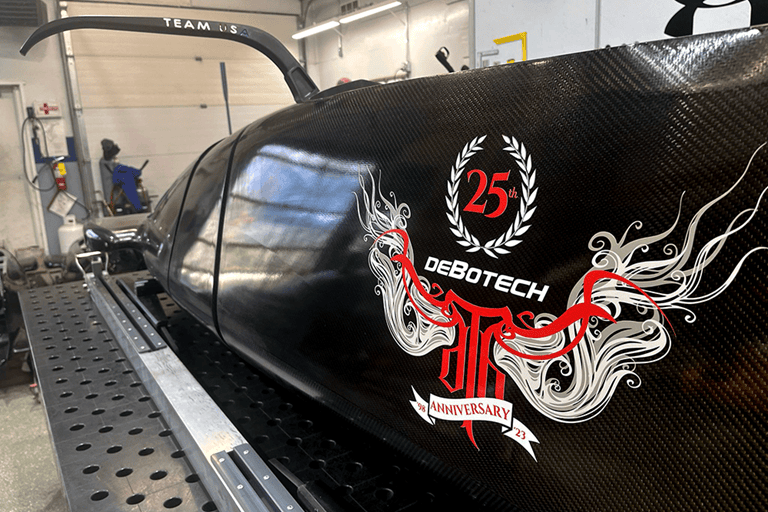
North Carolina-based deBotech is working with USABS and Advance Mfg. Co., Inc. to keep the team competitive with countries such as Germany. (Image: USA Bobsled and Skeleton)

Already, the Americans have four sleds on the World Cup circuit and plan to use feedback from athletes on the composites to tweak going forward.

“I think in 2014, we had the fastest sleds then after Germany got the fastest sleds,” said Meyers Taylor, a four-time Olympian and five-time medalist. “It’s really an arms race, but I think we’re moving in the right direction in terms of technology. To have Marc on board and to have partners on board, it’s really encouraging.”

It’s also the lifeblood of the project. USABS paid about $60,000 for deBotech to create the mold on which the new sleds will be based. But van den Berg estimated that in labor and materials, Advance is contributing around $1 million and deBotech is committed to $1 million to $2 million.

“Without these partners there was no project because we cannot afford it,” he said.

Advance, which had built runners for U.S. sleds for years, signed on to add chassis too. Like deBotech, the company wanted to support the athletes.

“It’s a great morale booster for our company and something that the whole team can root for,” said Jeff Amanti, Vice President at Advance. “Everyone can kind of get behind it.”

Sleds can cost anywhere from $28,000 for a monobob to $100,000 for a four-man. Once the M-USA project is complete, USABS plans to leave development sleds in Europe and Asia to cut down on the $125,000 to $150,000 it pays to ship sleds annually.

Many will be development sleds made on the same mold as the competition sleds. They’re similar enough that Love is competing in one currently as not enough World Cup sleds were ready when she made the team.

“What we did — 20 sleds — no one did that in the world,” said van den Berg. “Not even China with the Olympics with all the money, or Russia.”

Through the first month of World Cup competition, the U.S. team has three medals with the new sleds or runners, and van den Berg has heard from other countries inquiring about what they’re doing.

But the patriotic passion project for USABS and the partners will remain here. The M-USA sleds are not for sale.

This article was brought to you by SBJ Tech, a Leaders Group company. As a Leaders Performance Institute member, you are able to enjoy exclusive access to SBJ Tech content in the field of athletic performance.

Members Only

15 Mar 2023

Articles

Five Essential Areas to Consider When Resolving Performance Problems

Views from GB Bobsleigh, Swimming Australia, Wales Rugby, UK Sport and London’s West End theatre.

By John Portch
What is the best way to define and resolve a performance problem?

It is a topic that comes up with regularity at the Leaders Performance Institute and, here, we present the approach of British bobsledder Montell Douglas; Swimming Australia’s Head Coach Rohan Taylor, Wales women’s rugby union team Head Coach Ioan Cunningham; Jayne Ellis, currently a performance advisor with UK Sport; and actor Dom Simpson, who delivers a view from the world of the performing arts.

We distil their responses into five essential considerations.

  1. How do your athletes approach goal-setting?

“I address my performance gaps through real, basic goal-setting. In the sense that there’s always a process,” says Montell Douglas, who competed for Great Britain in the two-person bobsleigh at the 2022 Beijing Winter Olympics. Previously, she competed for her nation in the 100m and 4x100m relay at the 2008 Summer Olympics, also in Beijing. In completing the switch she made British history. It was something she was aware of in the build-up to the Games and here she gives the Leaders Performance Institute an insight into the continuous conversation she had with herself.

“What does British history mean?” she continues. “I reverse-engineered the goal, looked back and said ‘this means I have to do X’. ‘But where am I now? Well, I’m right here and that means I have to do this’.

“One of the things was ‘what does my sport need? What do you require? Am I reflective of a history-making athlete?’ If not, then I’m making those little adjustments; ‘I need to gain four kilos by this date’, for example.”

Douglas interrogated herself constantly. “It enabled me to make clear targets and goals, with deadlines for all that was needed, because you have to be ready on 20 February 2022 [in the case of the Olympic bobsleigh]. You can’t be ready on 21 February 2022 – it’s too late.”

  1. Engage your athletes in two-way conversations

The coaches have a role to play too. “It’s having a two-way conversation,” says Ioan Cunningham. “Footage is huge and we have individual development plans for players. So if our number nine [scrum half] needs to work on her pass off the base so that it’s quicker  and she needs to get the ball off the deck, that’ll be a performance plan for her.

“How does she get better? Link it to footage and then have constant catch-ups every week or two where you go ‘look, this is better – you can see it’s better. The ball is in the ten’s hands [fly half] much quicker’.

“The ten could then give her feedback as well and say ‘yes, the passing is much better, it’s faster and more accurate’; and then breaking that down to the drills she needs to do to make sure that it gets her passing better.”

Actor Dom Simpson, who stars as Elder Price in the West End production of The Book of Mormon in London, also prefers a two-way discussion in his work. “My agent always describes it as a ‘dance’,” he tells the Leaders Performance Institute. “I can do one thing for a dance but the partners have to be working together to make that work.

“An issue, for example, could be my director coming to me and saying ‘this scene is not quite reading right. Maybe we can try this?’ and a lot of the time that works best when it’s a collaborative discussion – I don’t think anyone works best when it’s ‘do this and it’ll be better’ because unless I have an understanding of why that is it won’t feel like the best way to do it.”

  1. Enable guided discovery to mutually desired outcomes

Simpson also explains that the best directors facilitate the actor’s path to the best agreed outcome. He says: “The best creatives that I’ve ever worked with, they allow that conversation to happen and they facilitate you finding the answer. They ask questions that make you find the answer that they just want to tell you anyway so that there’s a feeling of ‘we both got to it’, whereas the director might be saying ‘I knew that’s where we wanted to get to but I had to allow you to find that for it to feel real’. When we talk about the ‘truth’ in a scene, a lot of the time that’s how we get to the bottom of an issue.”

  1. Where does your multidisciplinary team fit in?

Cunningham tells the Leaders Performance Institute of a hypothetical scenario involving an athlete. “A player may need more power in her lower legs, so that becomes a three-way conversation with the S&C coach,” he says. “[The player will say] ‘OK, if I do this, it’ll make me a better rugby player, it’ll make me more powerful, and it’ll get me picked’.”

The multidisciplinary approach was taken by Jayne Ellis and British Wheelchair Basketball during her time serving as the organisation’s Performance Director. Much like at Wales Rugby, performance questions were generally raised in an athlete’s individual development plan between the athlete themselves and the coach. “They determine what the objectives are and the rest of the staff will work around and towards those objectives,” she told the Leaders Performance Institute in 2021.

Progress was tracked at fortnightly meetings for both the men’s and women’s teams. “That’s when we look at how everybody’s work programme is feeding into that athlete achieving that objective,” she continued. “Then there are different bits and pieces that we do with each practitioner in order to assess where they are with things and where they want to go. That all gets captured so that the player can see their development. Sometimes when you’re an athlete and you’re in the grind, you’re like ‘this is so difficult, I don’t feel like I’m progressing’ but then you’ve got this whole piece here, which helps you see that you are progressing and that’s why it’s important.”

  1. Call upon your network and collective knowledge

At Swimming Australia, coaches and practitioners attend monthly meetings specific to their event or discipline in order to ensure everyone is on track. Head Coach Rohan Taylor will drop into those meetings and is always on hand to discuss performance issues with athletes and their coaches as he travels to the state hubs located across Australia.

“I’ll ask questions; [for example] ‘So you’re having trouble here? Have you spoken to somebody else?’ because I get to see everybody around the country. I might see a solution in Western Australia, in Perth, and I can say ‘have you connected with this person?’ I’m kind of guiding and advising them where to go.

“If I think they’re at a road block, I’d hope that they’ve already done that. That’s the system that’s set up. If not, I’d be saying ‘have you done that? Have you done this?’ I saw a good example this morning [concerning] an athlete who is struggling to absorb feedback around the communication on their skill development; the tasks. I just watched and I observed and I just said to the coach and the biomechanist ‘have you guys tried just letting him watch what it looks like when it’s done correctly by someone else and just letting him go and explore rather than giving him too much detail?’ ‘No, actually we haven’t’. ‘So maybe that’s their learning style?’

“It’s just me bringing what I see out there and asking them the questions.”

8 Mar 2023

Articles

From Sprinting to the Bobsleigh – How My Recovery Needs Changed, by Dual Olympian Montell Douglas

Category
Human Performance
Share
Facebook Twitter Email Copy Link
https://leadersinsport.com/performance-institute/articles/from-sprinting-to-the-bobsleigh-how-my-recovery-needs-changed-by-dual-olympian-montell-douglas/

The first Briton to compete at both the Winter and Summer Olympics shares her thoughts on the growing significance of recovery practices.

A Human Performance article brought to you by our Main Partners

By John Portch
Montell Douglas made British sporting history at the 2022 Winter Olympic Games in Beijing.

In competing in the two-woman event in the bobsleigh, alongside teammate Mica McNeill, Douglas became the first Briton to compete at both the Winter and Summer Games.

She had earlier competed in the 100m and 4x100m relay at the 2008 Summer Games, which were also in Beijing.

Douglas made the switch from the Tartan track to the ice in 2016. A number of the skills and attributes that served her well in sprinting lent themselves to the bobsleigh, although she was told that the sport needed “bigger, faster, stronger girls,” as she told RunBlogRun in 2022.

“It also depends what kind of athlete you are,” she continued. “In an Olympic 100m final eight girls line up but they’re different kinds of athletes – some taller, some smaller, some stronger – each with different attributes. Not all of them would necessarily do well in a bob. It depends on what kind of athlete you are and what you’re bringing to the table. People from the outside look at bobsleigh and say ‘Oh, you are running and pushing’ but there’s more to it than just sprinting behind the bob! I had to work on developing my attributes a lot”.

Douglas spoke about her career transition at the 2022 Leaders Sport Performance Summit in London and, when she came offstage, we asked her a few more questions about her approach to recovery and how it might have evolved.

“‘Evolved’ is the correct word,” she says, with a knowing smile. “My attitude towards recovery has definitely evolved, mainly because of transitioning into different sports, different arenas, but also being a more experienced athlete.

“When you’re doing more high intensity work and probably less volume, the way you can bounce back from a session is really important. For me, I probably take it, not a step back, but a different approach to my recovery. Before it was like ‘ice bath, making sure I’m rested’. I had a lot more free time, but with lifestyle, working, balancing being an athlete also with the time travelling to training and things like that, it was 24 hours already sometimes.”

Douglas combines her athletic career with a day job in the student recruitment team at the multinational professional services firm Ernst & Young.

She continues: “It’s always about finding nuances that I can do so that I can recover better. For me, I guess not being too stressed about it as well and worrying that I’m not recovering the best way and that it’s going to look different to how it looked before. In terms of strategies, for me, it’s about really basic things like what I do next when I’m finishing warming down – I was always really bad at doing that when I was training – but the more I got to train differently I then figured that it’s how I reset for the next session that was really important. It’s not always about that session that I’ve just done, it’s actually like ‘I’ve got to go back and do this session later or that session tomorrow, how are you going to get ready for that session?’

“Recovery is not just about what’s gone, it’s about what’s to come. So my thought process around it has changed and I guess it’s become higher quality as opposed to doing more of it. Across the board, I thought ‘what’s the best way I can recover?’ Rather than doing something over and over again.”

Was there a single experience that changed her thinking around recovery?

“When I originally transitioned into my sport, the one thing that really changed in me, thinking about my recovery, was actually the quality of work I was doing and not being able to train consecutively,” she says. “So before I was training six days per week back to back. That came down to about four or five days; so what I realised was that I was not able to produce really high quality work and I couldn’t come back from it, so I was missing out on some key sessions that we put in place because my coach and my team, we just hadn’t realised that I wasn’t able to deliver that quality in such a short window. ‘I can only give you this kind of quality of work, but then you’re going to need 48 or 72 hours before I can give you that high quality work again.’ So in terms of programming, it’s really important to know what you’re putting where because I wasn’t able to come back the next day, even if it was a mild session. I needed more time to give just what you wanted to get. That’s one of the things that definitely sparked ‘how can we do this better? What am I doing that’s not great?’ And I had to put my hands up and say ‘I just can’t do that, that’s not where I am right now as an athlete, but what can I do? What do we need?’ and then we just tick those boxes.”

When Douglas transitioned, her recovery needs changed and, as she points out, no two athletes in the British Winter and Summer Olympics system necessarily has the same requirements.

“I think it varies depending on the sport but also where you are in your career. So if you are a full-time professional athlete, your dedicated job is essentially to perform. So you’re looking at it from the point of view that all the hours in the day serve you to do X and that’s what you should be looking towards; that means your morning routines, whatever you do before and after training, how you recover. Your nutrition, your physiotherapy. All those kinds of physical components are dedicated to that.

“In a different stage of your life where you may not have that kind of flexibility, you might not have that privilege to be a full-time athlete. There’s considerable variables that you have to look at, whether it’s family life, they might have kids or they may have dependents in other ways; they might have jobs. Those things can get in the way. Even if you’re studying, your energy expenditure is completely different to what it was before.

“I think genuinely, wherever you are at that time in your life, athletes in the British system just go according to where they are, but a lot of the time it’s like the grass is greener for a lot of people. When you’re a professional athlete you’re like there’s so much time in the day but you don’t feel like there is because you are looking at your nutrition, you are looking at your physiotherapy, so you feel like you don’t actually have as many hours as you do. But if you wrote it all down, actually, compared to my peer, who works a part-time job 15 hours but does the same thing as me, I’ve actually got a lot more time to dedicate to recovery or performance, but I’m not utilising my time as well. So it depends on the athlete they are, the sport they are in, whether it’s a centralised system, whether you’re doing your own thing ad hoc, it will determine how you approach your recovery.”

How does she see attitudes to recovery continuing to evolve over the next few years?

“I hope that it’s not an afterthought,” she says. “It’s not always what you can produce, but it’s always what you can recover from. I remember training in the States, one of my coaches said to me ‘we’re going to push you really hard, I’m going to push you almost to breaking point, and then I’m going to give you a day off’. At first I thought ‘what on earth is going on?’ But then I got it because it enabled me to train at a higher quality level but just enough to where my body was like ‘I need the time off to adapt to this work and then go back again’. So I’m hoping it goes to the point where people say ‘let’s do quality over quantity’.

“Are you getting the correct amount of sleep? If you’re going to bed at 2am and sleeping for 10 or 12 hours, is that the same amount of quality sleep as if you were going to bed at 10pm and then waking up at 7am? It’s the same time line, but one is possibly quality over quantity. And if you look at it from a performance standpoint, you have to look at the marginal gains, you have to look at the small percentages of improvement that you make – and recovery is absolutely one of them.”

22 Dec 2022

Articles

Why Are you Optimistic About High Performance in 2023? (Part II)

Category
Leadership & Culture
Share
Facebook Twitter Email Copy Link
https://leadersinsport.com/performance-institute/articles/why-are-you-optimistic-about-high-performance-in-2023-part-ii/

We collected the views of the speakers at November’s Leaders Sport Performance Summit in London and, in this second instalment, we look at the importance of continued learning and development.

By John Portch
As 2022 comes to an end, there has already been some considered reflection upon the last 12 months – but what about the year ahead?

At this year’s Leaders Sport Performance Summit at London’s Twickenham Stadium, the Leaders Performance Institute spoke to a number of our speakers to ask: what are they most optimistic about heading into 2023?

There answers were varied and spanned two articles – Part I can be found here – but learning and development kept creeping up in these conversations.

For example, Neil Saunders, the Director of Football at the English Premier League, spoke onstage about the league’s Elite Player Performance Plan. “We are 10 years since the launch of the Elite Player Performance Plan and we’ll be updating our strategy and setting new aims and objectives for the system moving forward,” he said. “And that’s really exciting because there’s a great opportunity to build on some of the amazing work that’s taking place already but also to address areas of opportunity and try to improve what we’re doing to make sure that our work in player development is not just fit for now but also for the future.”

Joel Shinofield, the Managing Director of Sport Development at USA Swimming, answered the question in a similar vein. “We just launched a brand new technology product, we’ve revamped it completely, we’ve revamped all of our coach education, so those are at their very early launch stages and seeing those become more mature, seeing coaches access the new data we’re going to provide to them,” he said.

“The idea behind our data project and our technology project was to make more resources available to our members; and so what I want to see is the utilisation of that because I know that’s going to be the value of the whole project is that our clubs, our teams, our coaches, our membership has access to data that will help them improve the sport and improve their experience.”

USA Swimming is one of the most mature programs in elite sport and stands in contrast in some respects to a newer sport, such as competitive climbing. “We’re in the process of putting a full-time coaching team in place, seeing them evolve and develop in support of those athletes, and really just continue the learning,” said Lorraine Brown, the Head of Performance at GB Climbing.

“We’ve got a huge amount to learn, not only just about high performance sport but actually more about the sport and what it takes to support these amazing athletes. We’ve got brilliant athletes who despite the system have really achieved some amazing things. So how do we really help to facilitate them to continue to do that and provide some added value to their own environments? And part of that is making sure that as well as the experiences, actually the medical support around them and making sure that they stay fit and healthy as the volume and pressure increases. The pressure can have that negative effect of making them more susceptible to injury and illness. So how do we stay on top of that?”

Beyond performance itself, Jatin Patel, the Head of Diversity & Inclusion at the Rugby Football Union, is optimistic that his work can continue to have an impact on the sport of rugby union.

“I’m really looking forward to having more conversations around and spreading the importance of inclusion from grassroots all the way up to professional,” he said.

“Guiding and advising people how we can do it better, learning more myself, being new to rugby, and ultimately the longer-term aim of bettering the game and future-proofing it and ultimately reaching our objective and wanting to be a sport that’s more reflective of society.”

These sentiments are shared by Patel’s session moderator, Shona Crooks, the Head of Equity, Diversity & Inclusion at Management Futures.

She said: “I’m excited to learn more in this space. I think because I work in DE&I everyone expects you to have all the answers and it’s nice as I evolve, as organisations evolve, as society evolves, and so coming up with new ways to do things, new options, new training, new skills; how I can help to upskill people, how I can bring and move the conversation on. Because, ultimately, the end goal is that I do myself out of a job, that, actually, we’re so inclusive and everyone feels that sense of belonging, that DE&I just doesn’t exist anymore. How do I help each year to chip away at that?”

We then wrap up this two-part series with a reminder that in times of uncertainty, whether that be through growth or a more general sense of volatility, your fundamental principles will be invaluable.

“There’s always the unknown of what’s coming,” said Craig McRae, the Senior Coach of Collingwood FC, who are developing as a team under his tutelage. “That’s an attraction and an excitement in itself. For us, it’s about repeating behaviours. Putting ourselves into a position that we were last year and in our game like any game, you don’t start at the top, you’ve got to work your way up the ladder. I think that’s part of the excitement of our journey.”

Go to home
Follow us on Instagram Follow us on LinkedIn Follow us on X

Contact

Leaders UK

Tuition House
27-37 St George's Road
Wimbledon
SW19 4EU
London
United Kingdom

Enquiries Line: +44 (0)207 806 9817
Switchboard Number: +44 (0)207 042 8666

Leaders US

120 W Morehead St # 400
Charlotte
NC 28202
United States

Enquiries Line: +1 646 350 0449

Leaders

  • Contact
  • About
  • Careers
  • News
  • Privacy Policy
  • CA Privacy Rights
  • Cookie Notice
  • Website Terms of Use

Performance Institute

  • Membership
  • Events
  • Content
  • Virtual Learning
  • Connections
  • Partners

Latest

Intelligence Hub
High Performance Future Trends Research Elite Performance Partners continue to drive the potential in high performance forward through renewed Leaders partnership
Your Privacy Choices

© 2026 Leaders. All rights reserved

  • Privacy Policy

Attendees

x