New Zealand’s Ella Wyllie is leaving no stone unturned as she continues her return from injury – tech included – but, as she explains, it has to be matched by effort.
Main Photo: Getty Images

You can’t have a discussion about sports technology today without including athletes in that conversation. Their partnerships, investments and endorsements help fuel the space – they have emerged as major stakeholders in the sports tech ecosystem. The Athlete’s Voice series highlights the athletes leading the way and the projects and products they’re putting their influence behind.
* * * * *
New Zealand cyclist Ella Wyllie competed in her second Tour de France Femmes, which this year expanded to nine stages. After turning pro in 2023, she first participated in that summer’s Tour de France and finished second in the youth classification and later took eighth overall in Australia’s Tour Down Under. Wyllie, who is also studying civil engineering at the University of Auckland, missed last year’s Tour de France with injury but returned this year to finish 80th and pick up two points in the general classification as a member of Liv AlUla Jayco.
We caught up with her ahead of the race.
On preparing for the Tour de France Femmes…
I’m so excited. I did the Tour two years ago, and it was my first big tour. And last year I missed out just because of injury and everything, so it’s really nice to be in a position this year where I’m happy with my form coming into it.
The Tour is getting longer, which is exciting, and, yeah, definitely the last couple stages, I was lucky enough to go on a recon with the team. We’ve checked them out, and they are looking pretty hard so I’ve been doing some training to replicate that. And there’s a hilltop finish, so I’ve been doing a lot of climbing.
On her training plans…
I have a team coach, Marco [Pinotti], so he’s been really helpful because he just plans the training for me, and I discuss how I think things went or maybe my own feelings about things and where I think I’m struggling a bit more. He just looks at all that and the course demands, and we just plan intervals, VO2 efforts, all the fun things, and mix it in with a bit of endurance riding to get a good base. But yeah, it’s really the spicy VO2 efforts that get the race kick in the legs and hopefully will put me in good form.
On the tech she uses…
I have a power meter on my bike, and also heart rate is another big thing in terms of just seeing how you respond on the fatigue and all those kind of metrics. Lactate testing can also be helpful in certain periods of training and everything. Cycling is just getting more and more technically advanced in all those metrics, but also, at the end of the day, you’re not looking at your power meter when someone’s attacking. You might understand, oh yeah, it’s hard, but I’m not going to say to my competitor, ‘Oh sorry, we’re 100 watts over what I should be doing for three minutes. Sorry, I’m just going to wait.’
At the end of the day, that’s just all to help the training, really, because in the race, it’s actually just all on perceived effort. And you just have to go hard when you need to go hard. Especially on long climbs and breakaway efforts, you’re probably more in tune with, Okay, I’m going to try and stick around this watt range because you know exactly how you can handle fatigue. It’s always a useful tool, but you also have to remember that at the end of the day, it’s a race.
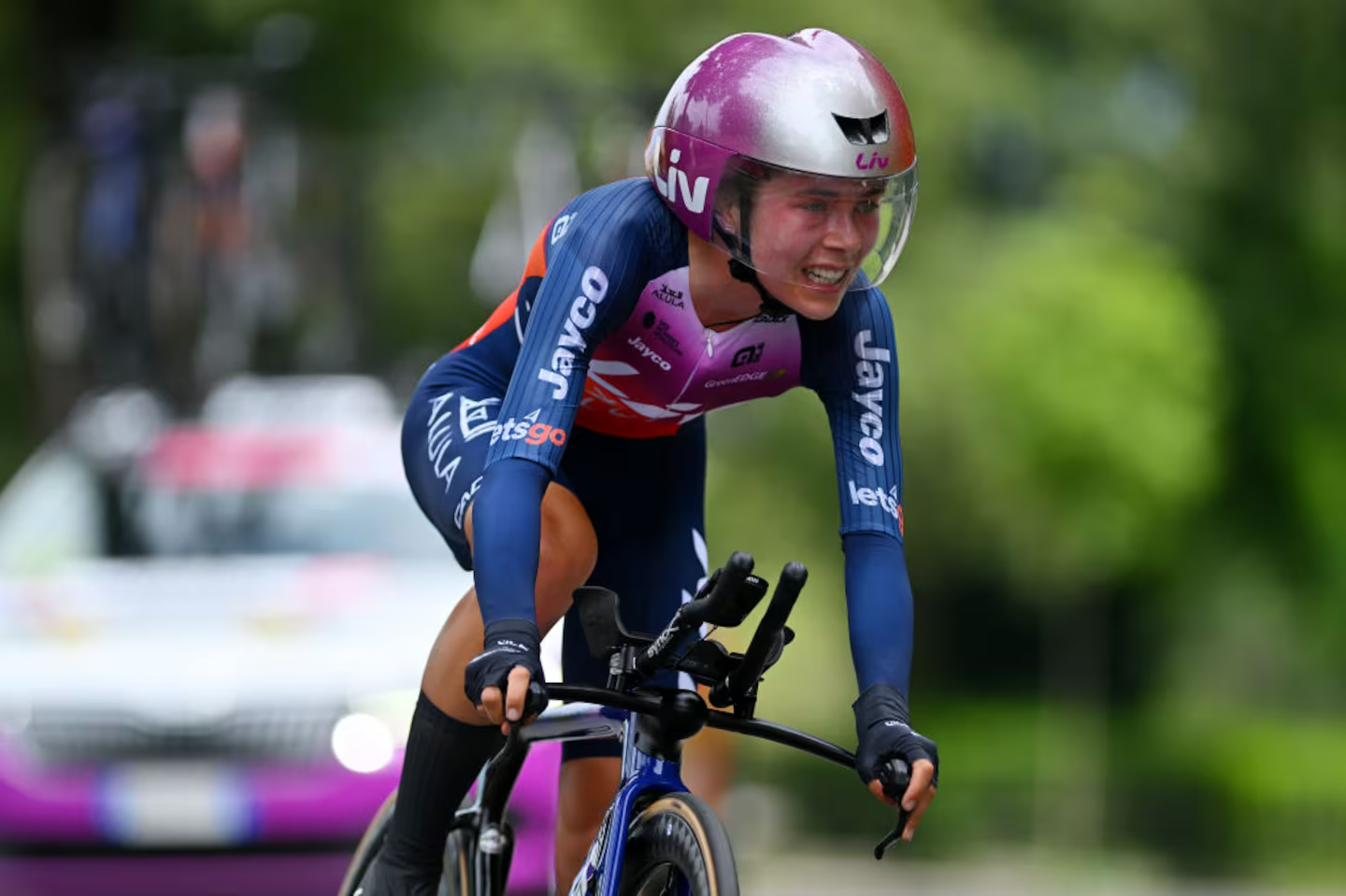
Photo: Getty Images
On what she applies from her engineering studies…
I’m always messaging my coach with, ‘Oh, look, I saw this.’ Yeah, I definitely appreciate all of that stuff. I’m very analytically minded, so if I can notice patterns or see improvements through certain things — I think sometimes it’s not so obvious — but when you do look at all the data, you can pick up the small wins. And to me, that’s motivating too. I’m also known to like Strava.
On evaluating brand deals and supporting her journey in sport…
I’m in probably a bit more of a unique position coming from New Zealand where we didn’t have so much support from our governing body, Cycling New Zealand. They are really great in some areas, and obviously we have the chance to be racing in the world championships, but we don’t have the money, necessarily, to fully fund it. So when I go to a world championships, I’m paying the majority of the fees to go, and it’s expensive because I have to pay the flights, you’ve got to pay towards staff support and accommodation.
So, yeah, I’m definitely reaching out to brands and people that are wanting to invest in my journey and everything. But it has to be the right partnership. I think it has to be mutually beneficial and also things that make sense. I’m not going to go and promote something that’s completely outside of my realm being a professional cyclist.
This article was brought to you by SBJ Tech, a Leaders Group company. As a Leaders Performance Institute member, you are able to enjoy exclusive access to SBJ Tech content in the field of athletic performance.
Here are five tips from Chelsea and the Ineos Grenadiers in their pursuits of future success.
Drawer had just completed his first season as the Performance Director of the Ineos Grenadiers cycling team – a team with whom he enjoyed immense success in their previous incarnation as Team Sky between 2016 and 2018.
In recent seasons, the Grenadiers’ success has tailed off. Drawer’s return is part of the team’s attempt to restore their lustre.
“You look for these elements of when the team was super strong and maybe some of the changes needed at that time didn’t necessarily happen,” he added in reflection.
Drawer was speaking with Chelsea’s Director of Performance Bryce Cavanagh, who also inherited a team treading water in 2023.
“Our situation is probably slightly different as they’ve been through so much turmoil,” said Cavanagh of Chelsea, who underwent a change of ownership in extraordinary circumstances in 2022. It marked the end of an era in which Chelsea’s successes underlined a shift away from the traditional powerhouses of English football.
Back in 2003, Chelsea were disruptors in their field. The same could be said of Team Sky in the 2010s when they transformed road cycling through their innovative approach to performance.
Both have since retreated into the pack, with Cavanagh admitting that entrepreneurial spirit was lacking in Chelsea’s performance department when he arrived. “There was probably a scenario where the change is seen as a threat,” he said. While there was a desire and willingness from the club’s new owners to deliver change, “people saw that as a risk that created vulnerability in their roles.”
The challenge is clear, but Cavanagh combined with Drawer to offer five tips to performance directors charged with restoring the good times.
1. Look for ‘clarity, competence and community’
Cavanagh, who in addition to the more traditional elements of his role has been tasked with a “cultural reboot”, immediately set his stall out at Chelsea with his stated desire for ‘clarity, competence and community’.
He asked two questions as he began to address the clarity piece:
Cavanagh also sought to understand the competence of the system (not individuals) with further questions:
Additionally, Cavanagh’s conception of community is as an outcome of the values, behaviours and definitions agreed by the collective.
“We had to really define where we wanted to go and what the bus looked like because then people ended up self-selecting,” he said.
2. Set standards… slowly but surely
Do not assume that high performance standards are a given across the board. Variations are common and a performance director must be prepared to ask, as Cavanagh did, “what are the things that you walk past? That you are willing to accept?”
Many have been tempted to emulate revered environments such as the New Zealand All Blacks’, but that wasn’t necessarily going to help Cavanagh at Chelsea in the summer of 2023.
“I tend to look at it like an election where you’ve just got to get the majority, and if the majority starts to [behave a certain way], that’s the culture that end up in power and every vote that gets laid is slowly going towards that,” he said.
“We weren’t the All Blacks. They’ve laid down their votes over 100 years and any new person who walks into that environment knows what’s accepted. Our environment wasn’t like that, so we’ve had to slowly and surely create it. We’re not there yet, but we’re on our way.”
3. Pay attention to your people
Drawer craved data insights that demonstrated how the sport of road cycling had developed in his six years away from the sport, but he also takes time to speak to his people – the ones working on the front line.
“Lots of staff wanted to share opinions, ideas or anecdotes in meetings around ‘the sport’s changed, it’s a bit like this’,” said Drawer, who welcomed their views. “Data and evidence is just as much people sharing opinions, ideas and observations as it is studies into how our team may be training, changes in racing patterns, probabilities.” He is “building this wealth of understanding and insight around what’s going on.”
4. Celebrate successes, however small
Cavanagh freely admits that his instinct is to go for the performance gap, but he has had to check himself because he has seen the value in celebrating wins, however small.
That goes for his department, but it also goes for the players. “Every player in our club now has an individual development plan at a first team level,” he said. “They work on that every day that they come into the club, which is quite unique.” When targets are hit, whether in the gym or on the pitch, it is a cause for celebration.
5. Decide the stories you tell about yourselves
No sports organisation can control what people say and think, but they can influence the internal narrative. And the more positive it is the better.
“This is more of an entrepreneurial time for us,” said Drawer. “We have adopted a startup mentality and will say ‘let’s try stuff. If it doesn’t work, what’s the worst that can happen?’ Because we’re not where we want to be at the moment and I think that’s just beginning to happen.
“Hopefully when the season starts we come out fighting in a very different way. We’ve spoken about it last year, but the idea of feeling that you can never crack it is the mentality that we need.”
What to read next
With Practice, Anyone Can Lead a Courageous Conversation… and ‘Skilled Candour’ Can Help
Lasso Safe’s AI-powered software helps sports teams to assess risk and better care for its athletes.
Photo: Lasso Safe

Founded by a pair of retired professional athletes — endurance cyclist Pamela Minix and figure skater Luis Hernández — Lasso Safe has developed an evidence-based, research-validated survey and software to detect potentially toxic environments and unsafe relationships.
Players Health, a sports insurance group that recently raised a $60 million Series C round, will use it to “create safer, more supportive environments that lead to both healthier athletes and more sustainable businesses,” said Kyle Lubrano, Chief Mission Delivery Officer of Players Health.
Minix said Lasso Safe completed validation of its most updated product in October and described it as “a machine learning software that recognizes athletes’ experiences — specifically the areas are mental, emotional, physical and social wellbeing. We recognize them on spectrum from healthy, happy experiences to harmful and even abusive experiences.”
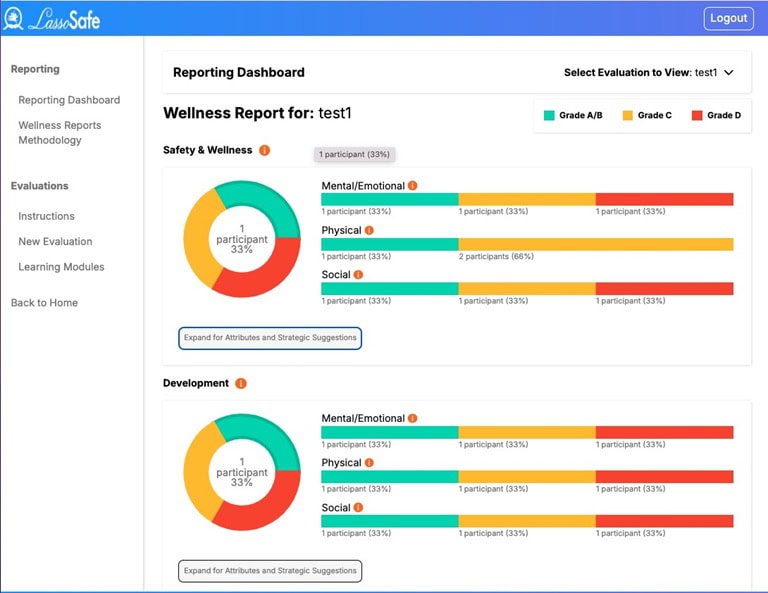
Lasso Safe described the product as “a machine learning software that recognizes athletes’ experiences — specifically the areas are mental, emotional, physical and social wellbeing.” Image: Lasso Safe
It was originally developed for national governing bodies that serve Olympic sports but has been modified for age groups as young as elementary school. Minix noted the increasing pressures at the youth level, in part because of growing expectations from the coaches and the growing financial investment in the space.
“Any level can experience this, not just highly competitive levels, so we focus on youth, but we do all age groups,” Minix said. “The software is designed to recognize even the first step away from that, when maybe those pressures start to come up or any type of misconduct within those wellness pillars.”
The frequency of surveys is at the discretion of each organization. Minix noted that Players Health will typically require them at least once during an application process to the platform, but many groups will administer them periodically or after incidents.
Questions asked of athletes include whether they feel valued by the coach, whether they have adequate access to nutrition and hydration during training sessions and more. Surveys can take anywhere from five to 15 minutes to complete.
Minix said Lasso Safe has run pilots with about 50 universities in the past five years, led by Utah State and Victoria University in Australia. The first adopter of the latest software is Globocol, a case management company based in the UK that offers services for sporting integrity, DEI, health and safety and data governance, among other uses.
This article was brought to you by SBJ Tech, a Leaders Group company. As a Leaders Performance Institute member, you are able to enjoy exclusive access to SBJ Tech content in the field of athletic performance.
Head Coach Jon Norfolk reveals why performance planning was perceived as the programme’s true competitive advantage going into the 2024 Games and beyond.
The ‘marginal gains’ philosophy of Sir Dave Brailsford, who served as British Cycling’s Performance Director between 2003 and 2014, was at the heart of this success throughout.
It was Brailsford’s “daily bread” said Jon Norfolk, the Head Coach at British Cycling, at last year’s Leaders Sport Performance Summit in London.
British Cycling, long after Brailsford had departed, continued to focus on maximising the one percenters – and it worked.
“These were really exciting times for the organisation,” Norfolk continued. “We were quick, we were agile, we were really detailed.” There was, however, a price to pay.
“I think I’m going to call it a ‘cost’. I think a cost of that agility and that speed was that we were moving very quickly. I’m not sure at each point we understood genuinely what created that performance.”
By January 2020, Norfolk and his colleagues had identified that cost and decided that the solution lay in better performance planning. They hoped to implement a change in emphasis after the Tokyo Games but, when the worsening pandemic caused their postponement in March 2020, they could begin that process earlier than anticipated.
Here, we explore British Cycling’s motivations and their rationale for ripping up a way of operating that was working – and still worked – in favour of a new approach weighted in favour of collaborative performance planning.
What was wrong with the ‘marginal gains’ philosophy?
Three factors rendered the philosophy unfit for purpose, even as the team continued to be successful:
Why was performance planning British Cycling’s first port of call?
An internal audit revealed an inconsistent approach to planning across its numerous disciplines that too often did not harness the talent in the building. Some performance plans were good but too often people had little scope for influencing a rider’s plan because it was too protected. Sometimes the plans were downright unclear. “People were struggling to get their handprints on the plan, to make an impact, to improve the plan,” said Norfolk.
What needed to change?
A good performance plan will tell an athlete where they’re going and how to get there; coaches will use that plan to stretch their athletes and be bold in their approach; and, if the plan is clear, leaders will be able to ask how the plan is tracking and where they can support the athlete and the coach. If British Cycling gets that right then the sky’s the limit. Said Norfolk: “I want an environment where coaches can leverage their plan, stretch athletes, and aim for things they may not be able to reach; but as a consequence, we’ll get a lot further because we’ve set clear, brave and long-term targets.”
Was there any resistance?
Plenty. “It’s a really tricky thing to encourage someone to let go of something which has worked,” said Norfolk. Some coaches carried the plan in their head and found it difficult to communicate their thoughts to a multidisciplinary team; others felt threatened and exposed when laying a plan out on the table for others to check and challenge. For some coaches, it was, as Norfolk explained, a “stick”. On top of that, he explained that some environments, such as BMX, were seen as “plan-resistant” given their “free-form”, “pack-like” approach to performance. Any approach would need to consider the environment as well as the demands of the discipline.
What was the answer?
Turn that stick into a carrot. British Cycling chose to encourage performance plans that actively separate the coach from the performance outcome. It made sense. “We’ve all been in a spot where we’ve seen great coaching but the athlete hasn’t performed for a particular reason; and we’ve also seen athletes perform and it’s not really due to the coach,” said Norfolk.
If the coach is armed with a well-considered, clear and powerful plan, it will amplify their coaching. It also makes things easier on the senior management at British Cycling, who are juggling multiple individual performance plans at any given time. “The clearer your plan is, the more people can access it, the more people understand it, and the more people you’ll have back your plan.” It’s also a useful way of removing the biases of an individual in pursuit of a more compelling proposition. “When we’ve got 20 plans in front of us, we’ll back the clearest plan with resource and time.”
Have there been positive outcomes so far?
The proof will be in the pudding in Paris, but Norfolk cited some initial successes, including the greater clarity enjoyed by the British Cycling leadership team and coaches freely admitting to missteps in management meetings. Norfolk and his colleagues can now watch events and the planning is evident in the execution. “It’s not perfect, we’re not finished,” he said, “but it’s exciting because we’re learning, stretching and growing and we’ve got a systematic path towards great performance.”
Emma Trott explains that she can do her best work with her young female riders once she has created a supportive, trusting environment.
Trott, who has since stepped down as Women’s Junior Endurance Coach at British Cycling, was speaking at September’s Leaders Meet: Driving Step Change in Female High Performance at Manchester’s Etihad Stadium.
She had essentially just crossed the road, as British Cycling’s HQ happens to be a stone’s throw from the Etihad.
With a short journey behind her, she took to the stage where she spoke alongside Danny Kerry, the Head Coach of the Canada women’s field hockey team, about coaching provisions for female athletes.
“We’ve spoken about the importance of having female coaches within the organisation,” adds Trott.
The challenge of coaching teenagers continues to evolve. “I think social media is not helping. It [offers] instant gratification of their view; put a picture up and you get a like. Talking to my group, there’s been a massive boom across women’s sport. We’ve got riders turning pro younger and younger.
“That actually creates problems within the rest of the group because they think it’s normal that you should be turning pro at 17 years old but, actually, you still need to develop; and everyone’s developing at different stages. How do you get that across? Then, for me, it’s the parent piece as well. What are they saying? What are they hearing you saying?
“Teams are now set up specifically for the women. They may be connected to the men’s team just as women’s football teams are, but they’re not there to necessarily do the same thing as the men’s team. It’s about how we can get the best out of these people.”
Here, we explore Trott’s approach to coaching young female athletes as she set it out for Leaders Performance Institute members in Manchester.
Ensure their heads are in the right place
Firstly, as Trott explains, British Cycling must reconcile individual and team goals for its riders. She says: “When we’re working as a team obviously we’ve got one common goal and we need to be at the coaching session for that common goal, although everyone is working on different things behind the scenes. That’s where things will deviate. but we also need to make sure their heads are in the right place.
“That’s one of the key things for me, the emotions of the group. I work with 16, 17, 18-year-olds, which can be quite challenging at times; making sure their heads are in the right place at the right times. For riders it’s really hard because who are they? Where are they going?”
It is important for Trott and her riders to understand their mutually agreed commitments. “It means you’re effectively two people at major competitions,” she continues. “Because you are the coach that’s there for those guys, but you’re thinking three competitions ahead for the others.”
‘The others’ to whom she refers are those not selected for certain competitions. “The people at home still have their training and you’re messaging them to show them that they are just as important – because they are – and it might be that their goal isn’t the Worlds. It might be the Euros; and the Euros just happen to be after the Worlds. I always talk about ‘this is the plan, this is what we’re doing, this is why you haven’t been selected for X but you will be selected for Y. I think females work really well with that process.”
Nevertheless, she allows them to grieve when necessary. “I allow them to be upset for two or three days because that’s important. It’s important to express our emotions and allow that to happen. Once we’re over that then we can start the conversation about performance again.”
Tune into the environment, try truly listening
Trott feels that the skill of listening is often misunderstood and undervalued. “People don’t listen all the time,” she says. “We hear what we want to hear and [the reason] we hear what we want to hear is because we’ve already made a decision of how we’re going to impact something rather than listening to what is actually being said.
“And actually taking it deeper as well. It’s that question, isn’t it. ‘Are you OK?’ ‘Yes, I’m fine.’ ‘OK, what does that really mean?’ You really find out more [that way] and that’s the key thing for me. Females and males say a lot but I think you’ve got to dig a bit deeper to understand what the message really is.”
Trott and her colleagues use British Cycling training camps to connect with their riders, but as they are all based in different parts of the UK, they will also hosts regular online check-ins. Each presents its challenges and opportunities. Sometimes in camp the solution is to take a step back.
“The other thing is that I use my group. If you create the environment where they trust you, you build the strength of the group. If there is an issue happening I won’t rush straight to the cause or the person immediately. I would actually use one of my more senior riders, an 18-year-old, to get a snippet of what the problem is. I can them go to that person and use this myself and hopefully help them. The key thing is to listen. I don’t think we listen particularly well.”
It’s OK to fail – so enable clear, honest feedback
Failure presents a learning opportunity and that is never truer than at underage level. Trott will place a lot of trust in her riders as they develop as people and athletes and she promotes the idea that “it’s OK to get things wrong”. She says: “Them knowing that, it comes back to that environment where, if we’ve created the right environment, then they’re not failing – it’s a learning opportunity that then takes them to the next level.”
This learning goes hand in hand with leadership because, as Trott says, “Once I’ve sent them off on the bus it’s over to them.” Inevitably, leadership comes more naturally to some than others but each rider must be given the tools to develop their ability to lead. “If they don’t get the opportunity to [learn] then they won’t perform. They’ll never lead because they’ll be scared to lead, but once they realise they can do that they learn, they grow, not just in sport but in management, business, wherever they end up.”
Know when to cut athletes some slack
The conversation turned towards female-specific issues, such as the menstrual cycle and their impact on training schedules and competition. “It’s something I’m aware of,” says Trott, who recognises the challenge and admits she would not want to have five riders on the same menstrual cycle. “I remember having a conversation with a gym coach around this. If we move certain sessions and decrease certain parts at certain points it just makes the rider feel better.” It has changed the philosophy around a training session. “In essence, in that session, what we’re trying to achieve isn’t 100 percent what we’re trying to achieve but, from a mental stance, it’s actually better for the rider at that point.”
In our latest Member Case Study Virtual Roundtable, James Morton of Science in Sport reviews his time spent helping to develop a winning strategy with Team Sky.
A Leaders Performance Institute article brought to you by our Partners

Recommended reading
The Secrets of an Agile Team: when McLaren Racing Began to Make Ventilators
Framing the topic
Our final Member Case Study of the year was led by James Morton, Professor of Exercise Metabolism at Liverpool John Moores University, and focused specifically on executing performance in one of the most challenging performance environments in sport – the Tour de France. James shared with us his experiences from the Team Sky, now Ineos Grenadiers, environment around how they approach the race and maximising the impact on rider performance.
“Lack of knowledge is not always the problem… it’s the ability to take this knowledge and develop and deliver practical and simple solutions that counts… it’s the detail and final step of delivery that makes the difference in sport” – Sir Dave Brailsford, Team Sky / Ineos
Performance Knowledge & Delivery
This is the concept of it is what you do that really matters not always what you know. How are you taking the knowledge and applying it – execution.
There are four pillars of consideration to this model (Close, Kasper & Morton, 2019):
High-performing teams strive for Transformational Improvements – practitioners who engage in research and practice, constantly auditing and wanting to improve.
The Knowledge Delivery Framework
Developing the programme and athlete performance plan through the performance checklist:
Where can you lose or win this race? What can stop us winning?
Identify the factors that can stop you winning (cycling example):
What can you do from a delivery perspective to optimise performance?
Discussion points
Biggest challenges
1 Sep 2022
PodcastsRod Ellingworth, the Deputy Team Principal of the Ineos Grenadiers talks to James Morton about talent development in modern cycling.
An Industry Insight Series Podcast brought to you by our Partners

“A lot of experienced people have been through life but they’re not perhaps listening to these young people enough. You’ve got to listen to their ambitions and, when they say things, there’s a lot in there. And if you ask the right questions, open questions, getting into the guts of it really, really getting under their skin about how they want to go from A to B, I think you can learn a lot from people.
“Try to follow people’s ambitions and dreams. And as long as you’ve got the programme and the space, you can keep working with people, because the talent will come through.”
Ellingworth is a former cyclist who now oversees talent identification at the Ineos Grenadiers and, in this latest edition of the Science in Sport Industry Insight series, he sits down in conversation with his former colleague James Morton, the Director of Performance Solutions at SiS.
Both men spent five year working together under Ineos’ previous guise, Team Sky, and here they delve into advice for talent spotters as well as:
James Morton LinkedIn | Twitter
John Portch: Twitter | LinkedIn
Listen above and subscribe today on iTunes, Spotify, Stitcher and Overcast, or your chosen podcast platform.

Sir Dave Brailsford discusses how the INEOS Grenadiers have developed into one of cycling’s most dominant teams and we review his insights with the help of Leaders Performance Advisor David Fletcher.
A mixture of continuity and adaptation is key for sustained success
Sir Dave Brailsford, Team Principal of the INEOS Grenadiers (formerly Team Sky and Team INEOS), shared with our audience at the 2017 Leaders Sport Performance Summit in London, how Team Sky first operated and how they became one of the most dominant teams in world cycling. “You can’t be a selection of people doing something in isolation, you have to have certain values and continuity to have sustained success over years and years,” said Brailsford. Right at the inception of Team Sky, the staff sat together and asked ‘what do we want to be about?’ and they realised that in order to succeed they needed to be able to adapt to the ever changing environment but also needed a few anchors and values to stick to through thick and thin. Team Sky, Brailsford added, had a line as a symbol for the team, and it signified continuity, but as he explained, “you’re never dealing with the same problem, it changes all the time and you have to recognise that and adapt.”
Success lies in planning
Everyone in sport, and life, knows that planning is a crucial part of success, with the old saying, ‘fail to prepare, prepare to fail’. However, Brailsford highlights that it isn’t the plan itself that is critical, it’s the planning process, and that “it is the discussions that are crucial.” He expects every one of his staff to have a professional opinion, as he always looks to work from the consensus, and only when this isn’t possible, will he arbitrate. It is important they always understand why, the power is in those discussions, and the team have all been involved in the creation of the plan. This planning is for the overall strategy, but also goes into the minute detail for every rider. “The more you have clarity and alignment, it isn’t that hard to deliver the performance, it’s when there isn’t clarity and alignment and you take a one-size-fits-all approach to every rider, it fails,” stated Brailsford.
Improvement requires change
It is one thing being successful, but a much harder task to be able to sustain that over many years. “If you do the same thing you’re going to go backwards,” explained Brailsford, “all of your competition will be looking to beat you and to improve, so you can’t just do what you did to be successful the first time round, you have to adapt and continually improve. Brailsford stated that the “difference between good and great is someone who does something.” Change requires action, and the people who win and make a difference are the people who do. “The people in Team Sky can be bothered to do the things that maybe people in other teams can’t be bothered to do, and that makes the difference,” said Brailsford. “Improvement requires change, but the problem is not all change equals improvement.” It can be very tempting to change things for change’s sake, so you have to be deliberate about it. You have to understand what interventions are going to give you the greatest reward and do a couple each season. “Being excellent at the simple things is the key to winning,” highlighted Brailsford. If you start to do too much with things which occur on the periphery, you miss the basics, which will be a disaster. You need small scale actionable improvements over time – the ‘marginal gains’ which Brailsford has become so well known for. Finally, he added: “It is all about action, talk about it and do it. It might not work, but at least you know. We don’t wait, we’re first.”
David, do Dave Brailsford’s words still ring true?
A universal truth apparent throughout Dave’s comments is that sport at the highest level is characterised by fierce competition and winning by small margins. Underpinning success in elite sport is the ability to continually raise performance to higher levels. In essence, those who are able to enhance performance sooner, to a greater extent, and/or on a more sustainable basis than the opposition are victorious. This results in goals and standards moving onwards and upwards, which in turn fuels an incessant demand to find new means and methods to stay ahead of the performance curve. It is clear that, as a leader in elite sport, Dave is – and has to be – very focused on what it takes to attain and sustain the highest levels of performance in elite cycling.
How do you feel this space is evolving in sport?
There are two things that I think are particularly fascinating about the innovation required to stay ahead of the performance curve in elite sport. The first is how best to harmonise the latest advances in sports science and medicine together with the art of high-performance coaching whilst remaining sensitive to the uniqueness of every training and competition context. I believe that the best leaders and teams are those who are able to work together to capitalise on each other’s strengthens whilst developing areas for improvement, regardless of whether they are the ‘simple basics’, ‘marginal gains’, or more sophisticated technologically-based advances – it all counts toward staying at the top. The second area relates to the increasing awareness that winning should not come at all costs. Following concerns about the price that some athletes are willing to pay in their pursuit of excellence and about the lengths that some coaches will go to drive their teams toward victory, there is a recognition and desire to find more ethical ways of attaining and sustaining high performance whilst maintaining and enhancing wellbeing. As a consequence, striving for high performance and holistic health has rightly become the focus of most modern day leaders and coaches in elite sport.
A video brought to you by our Partners
Written summary here.
“It’s evolutionary – if you look at how everything started and how we survived – learning is what enabled you to progress and move on. We’re now in a hyper-connected world and there’s more information available than there has ever been,” he says.
“But sometimes the day job is a blocker to that and we need to recognise that to progress and move on, and evolve, it’s a fundamental part of survival.”
Drawer is joined by Simone Lewis, who currently works as a Technical Leadership Expert with Fifa, and Dave Slemen, the Founder of Elite Performance Partners [EPP] to discuss why learning organisations are gaining a critical competitive edge as part of EPP’s Creating Effective Learning Organisations Webinar.
Leaders Performance Institute members logged in from across the globe to hear the trio discuss the creation of learning cultures, tips to ensure your staff are continually engaged in self-development, and useful models of feedback to ensure that learning is captured and applied.
An episode of the Industry Insight Series brought to you by our Partners
“Those first couple of years set me in a really good position to go through some pretty tricky times later in my career.”
White is speaking to the Leaders Performance Institute and Elite Performance Partners’ [EPP] Founding Partner Dave Slemen about his transition from professional rider to management over the course of a single winter in 2007 and 2008.
He also discussed how he has adapted as a leader in the intervening period, particularly in light of cycling’s pivot towards younger riders and an ever more cutthroat development environment.