In the first of a three-part virtual roundtable examining tech-focused innovation, Leaders Performance Institute members discussed how to turn creative thinking into tangible outcomes.
The figure surprised both the Leaders team and Professor Fabio Serpiello, the Director of Sport Strategy at Central Queensland University, because most of the survey’s respondents work for well-resourced professional teams. It was reasonable, we felt, to assume that they’ve progressed beyond such concerns.
“We thought this warranted further discussion,” said Serpiello, who led the first of a three-part virtual roundtable series aimed at exploring the dynamics of tech-supported innovation in sport.
We must point out that none of the Leaders Performance Institute members in attendance contradicted the survey’s findings (which you can read in our Trend Report). Some recounted the type of problems they encounter when it comes to innovation.
“Some problems can definitely be too big,” said one experienced high performance specialist working with military units in the US.
“You may not get support because of the priorities of the major decision makers that control the purse strings.”
What is ‘innovation’?
Serpiello believes the first step is simply to define ‘innovation’.
Even more importantly, he argues that teams should alight on a shared definition; one that does not conflate the concept with ‘creativity’. (Creativity, as Serpiello explained, is the outcome of an ideation phase, while innovation covers the execution and eventual impact of an idea.)
He makes the case that when teams have an agreed definition of what ‘innovation’ means to them then it offers a “clear way to approach and analyse whether the innovation processes in your organisations work or not.”
Serpiello himself likes the definition proffered by Scott Anthony in his 2011 Little Black Book of Innovation: ‘Innovation is something different that has impact’.
He then asked the practitioners and coaches at the table for their definitions. Answers ranged from the refinement and optimisation of processes to the value of novelty and pursuit of greater efficiency.
“These are all linked to a practical outcome,” said Serpiello.
Greg Satell’s Model of Innovation
Innovation, Serpiello argues, comes in several shapes and forms depending on the nature of the problem. To make his point, he introduced renowned change management specialist Greg Satell’s Model of Innovation, which provides a practical framework for introducing innovative practices, encourages strategic thinking about problems and helps to facilitate better collaboration.
He presented a diagram of Satell’s model to the table:
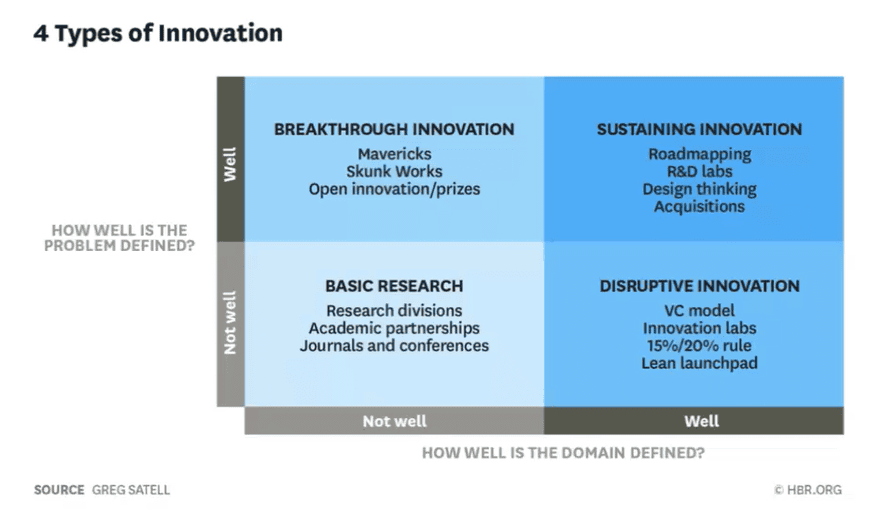
Serpiello then shared his thoughts on each quadrant:
Basic research – a low understanding of both domain and problem: “We don’t really know what the problem is and we don’t really know in which field or area it happens.”
Disruptive innovation – a well-understood domain but poorly understood problem: “In this area you may need something like innovation labs or launch pads.”
Breakthrough innovation – a poorly understood domain but well-defined problem: “This is the reverse of disruptive innovation… the classic example of open innovation.”
Sustaining innovation – a well-understood domain and problem: “The most common form in sport [and often the subject of] continuous research, design thinking or road mapping.”
There were three areas in particular where the table thought Satell’s model could prove useful:
As Serpiello wrapped up proceedings, he set the scene for session two, which will focus on decision-making frameworks in the context of technology-driven innovation.
What to read next
Wars, Pandemics and Brexit. How the European Space Agency Manages Uncertainty
Too often, soccer clubs across the globe fall foul of almost hidden contract clauses. TransferRoom’s Contingency AI is helping an increasing number of teams to navigate that space.
Main Photo: TransferRoom

And in that time, I saw a trend I assumed to be purely anecdotal to a still-fledgling soccer nut: add-on fees in player contracts. I felt like I was noticing a growing population of them. The mechanism accounts for future bonuses due to player on-field performance (appearances, goals, etc.) and fits into a complex ecosystem that also features loan-to-buy options, sell-on fees and more.
Turns out, soccer contingency payments like this have indeed been on the rise. According to the international soccer marketplace TransferRoom, these contract features have increased 5x in the last 10 years. That promptly demanded a tool that fits the landscape for the company’s massive soccer clientele list: TransferRoom’s Contingency AI. Deployed in August, this creation helps TransferRoom football clubs track these potential payments or capital injections to maintain accurate budgeting.
Simon Ankersen, TransferRoom’s Director of Football Relations, highlighted that the company has more than 800 clubs on its platform, which includes the MLS and its 30 teams, and all of them feel varying impacts around this growing contract structure trend. A brutal pain-point combination — the manual and constant contract scanning process paired with the churn inside football offices — exposed a clear need for a monitoring tool.
“Clubs are getting more and more creative with these clauses because they want to de-risk their purchases,” Ankersen said. “The operations are getting bigger, the deals are getting bigger, so therefore you have more people involved in it.”
Ankersen told me the feature has already produced savings for clubs, as well as found forgotten clauses that had been achieved, which helped teams scratch up a little more transfer-room capital to secure player acquisitions.
Beat Flückiger, the CFO for BSC Young Boys in the Swiss Super League, said the biggest risk for a smaller league club is not recognizing the earnings it’s due. He said he used to rely on a large Microsoft Excel file, pulling the figures of each contract in manually. But contracts can vary in terms — one may say an appearance is the moment a player hits the field, while another will dictate a 45-minute threshold.
“[The club was] using different data sources but never came to the point where it’s 100% satisfying,” Flückiger said. “And the clauses are so different in every contract, it’s almost impossible to do this on your own.”
TransferRoom began developing this feature in the spring. Ankersen added that the spin-up time of any project is now dramatically improved from the startup days. The company was founded in 2016 and now has approximately 150 full-time employees.
Expect more innovation from TransferRoom later this year. Ankersen shared that the company is working on another feature that will let teams forecast potential player purchases and how they could affect profit and loss, as well as help Premier League teams navigate the league’s Profit and Sustainability Rules.
“We are just unearthing more and more pain points,” Ankersen said.
This article was brought to you by SBJ Tech, a Leaders Group company. As a Leaders Performance Institute member, you are able to enjoy exclusive access to SBJ Tech content in the field of athletic performance.
PlayerData’s new FIFA-approved GPS and LPS units are a hit across the world of soccer and can be used by athletes in the offseason.
Main Photo: Getty Images
Other strategic investors in the Techstars-backed company include Pentland Ventures, Accelerate Ventures, Hiro Capital, and angels who previously invested in Strava and Revolut.
PlayerData’s new product, the Edge Air Tracker, is about half the size of competitors, and it combines GPS and LPS tracking, the latter an indoor alternative when satellite coverage is not available. The LPS system uses portable beacons that the company says can be set up in less than an hour. The Edge Air Tracker received the higher-standard FIFA Quality certification this summer.
“We had to build it in a PlayerData way: easy to use, fits in a backpack, mobile and affordable,” said CCO Jess Brodsky. “What gets us going is we get to give something to people that is just as elite quality — we don’t sacrifice on data quality — but to everybody.”
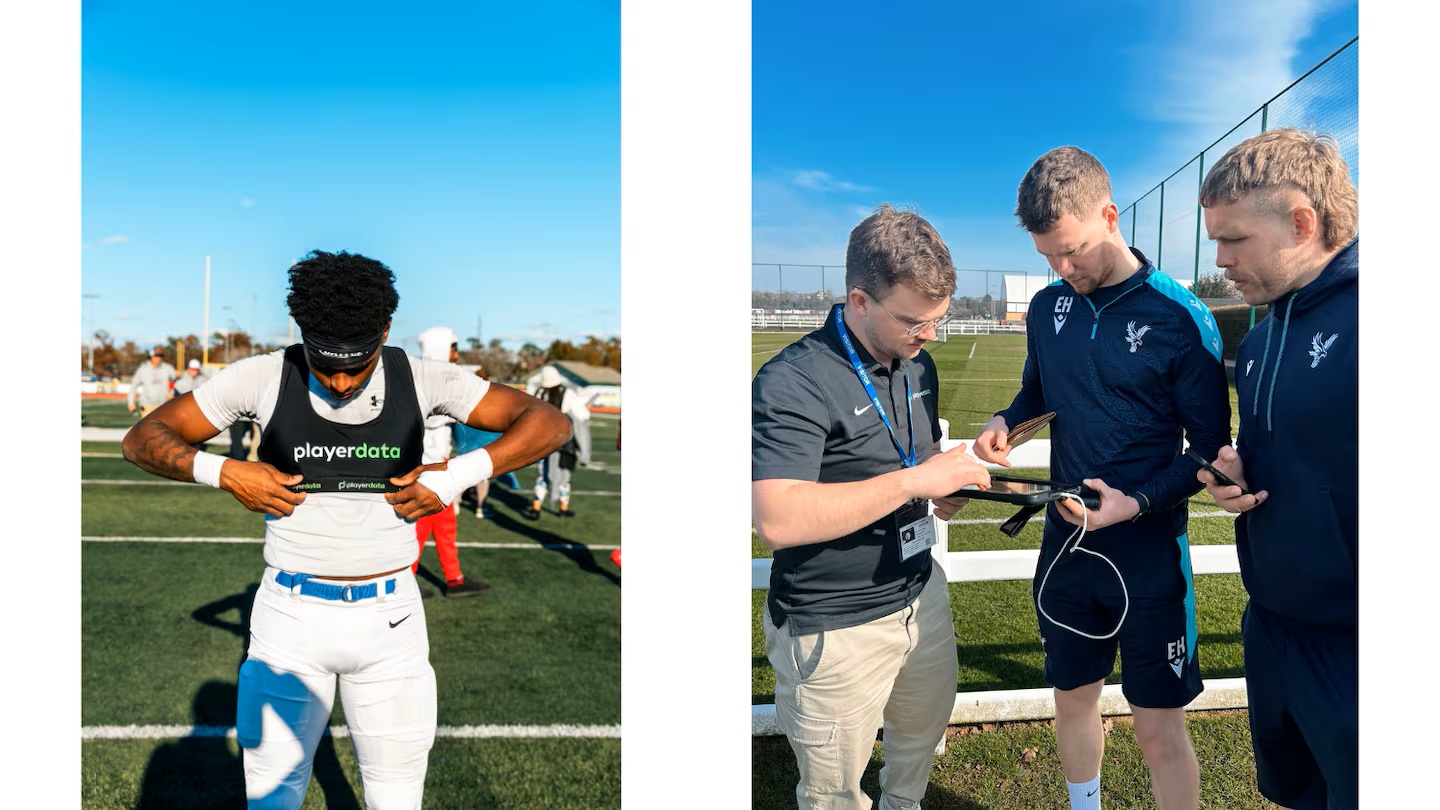
PlayerData’s Edge Air Tracker combines GPS and LPS tracking, the latter an indoor alternative when satellite coverage is not available. (Image: PlayerData)
The founding story is that, a decade ago, University of Edinburgh student Roy Hotrabhavanon had fashioned his own training tech to compete in archery by taking parts from consumer box retailers. Realizing there was little business upside in a niche sport, he sought to build for soccer instead, discovering there was a market gap particularly for grassroots, academy, university and women’s clubs who didn’t have the budget for an incumbent system such as Catapult or StatSports.
PlayerData is ubiquitous in the UK, where it records data from 94% of the country’s soccer pitches, Brodsky said, noting that the total includes the Premier League because its officials wear the monitoring devices during matches. The startup moved into the US market about two years ago, and Brodsky said the company has doubled or tripled its ARR (annual recurring revenue) in each of the past five years, building up to about 60,000 sensors in the market.
One of the biggest recent additions to the client roster is IMG Academy, where nearly 1,000 student-athletes will use the technology. The soccer program will install solar-powered beacons around all 15 soccer fields, and PlayerData and IMG will collaborate on developing and soft-launching sport-specific experiences in the app for volleyball and softball.
Abi Goldberg, an assistant strength and conditioning coach at Rutgers, supports the men’s and women’s soccer program whose seasons are concurrent, meaning she is balancing the training needs of both with little overlap. The use of PlayerData with both teams, Goldberg said, is helpful because the hardware and software systems are “incredibly user-friendly,” allowing her to review the data and communicate it the coaches even if it’s just a short window between their practices.
Often, each team’s director of operations will be tasked with overseeing PlayerData use at road games, but Goldberg said the tech doesn’t require an S&C professional to manage. She has even loaned devices to a few of the athletes for use in the offseason.
“Most GPS systems are in a big heavy briefcase-looking thing — I think there’s some been security nightmares in the airport — but these are way more compact,” she said. “They can put it in their backpack.”
This article was brought to you by SBJ Tech, a Leaders Group company. As a Leaders Performance Institute member, you are able to enjoy exclusive access to SBJ Tech content in the field of athletic performance.
Artificial Intelligence could be making key calls in your sport.
Main Photo: Getty Images
Current automation: NASCAR’s Optical Scanning Station maps the exterior of cars to ensure they comply with the rules. Bolt6 cameras also inspect the underbody of cars and operate the Pit Road Officiating system to flag violations.
Possible on the horizon? NASCAR intends to upgrade existing tech.
Current automation: The automated ball-strike challenge system is used throughout minor league baseball. A full ABS system is used by the KBO.
Possible on the horizon? MLB is likely to adopt the ABS challenge system for the 2026 season. It is also in the early stages of low-minors testing whether checked-swing calls can be automated.
Current automation: The NBA provides enhanced replays augmented with tracking data to assist with goaltending and basket interference calls.
Possible on the horizon? Determining who last touched the ball out-of-bounds and whether a shooter was behind the three-point line are under development, as are shot clock and other timed-based violations. The tech will start in the NBA, but it already is being investigated for the WNBA, too.
Current automation: The NFL will measure for first downs with Hawk-Eye cameras this season and contribute to calls about where punts fly out of bounds.
Possible on the horizon? The NFL and its innovation-minded collaborator, the UFL, are looking into whether the ball can be spotted after each play using technology, as well as making determinations on whether the quarterback is in the pocket (for intentional grounding and roughing the passer calls) or whether there are too many men on the field.
Current automation: The AI-powered Judging Support System is used as one input in the total score.
Possible on the horizon? There has been no report to date that gymnastics would consider full automation of scoring.
Current automation: None
Possible on the horizon? The NHL could use tech to determine offside, goal or no goal or whether a player high-sticked the puck.
Current automation: Rugby balls with embedded Sportable sensors were trialed at international youth tournaments to determine whether a ball was thrown forward, where a ball exited the pitch, whether a ball was touched in flight, whether the ball has reached the try-line and whether a lineout throw was straight. A Touchfinder feature helps Six Nations make boundary and ball spotting calls.
Possible on the horizon? Conversations around possible expansion of the tech are ongoing.
Current automation: Goal-line technology determines whether a goal is scored, and enhanced semi-automated offside technology makes all but the closest calls automatically.
Possible on the horizon? FIFA is researching whether technology can identify the player who last touched a ball before it went out of bounds. Detecting hand balls is also possible.
Current automation: All line calls can be called electronically.
Possible on the horizon? Technology could help determine whether there was a second bounce or a let serve. Electronic line calling will continue to move downstream into college and juniors tennis.
Current automation: AI judging will be one input in the total score beginning with the January 2026 X Games.
Possible on the horizon? Full automation of scoring might be possible.
This article was brought to you by SBJ Tech, a Leaders Group company. As a Leaders Performance Institute member, you are able to enjoy exclusive access to SBJ Tech content in the field of athletic performance.
In the first part of a miniseries exploring complexity in sport, Everton’s Head of Sport Science Jack Nayler explains how a watershed moment transformed his approach to his work.
However, in a truly complex manner, it was the combination of my lived experience to that point, my educational background and the reading I was doing in my own time around the subject that led to my appreciation of complexity and its implications for those concerned with sporting performance.
Over the course of four articles, I want to explain how I see the world of elite sport, the complex system at its heart, and the most effective way I currently see of managing performance within that context.
I will delve into the implications for sports and the operations within teams before outlining what this all means for leaders in this space.
But first, I want define what a complex system actually is and set out its characteristics.
Learning from failure
My real understanding came, inevitably, in learning from failure.
The white paper by the late Dr Richard Cook of the University of Chicago entitled How Complex Systems Fail was instrumental in helping me to understand the ramifications of complexity on the undertaking of performance in a sports setting.
Dr Cook was an anaesthetist and simultaneously and internationally respected researcher. His short treatise is regarded as one of the most influential works in the field of patient medical safety. It was this understanding of how systems fail that brought together everything else I had seen and learnt and began to change the way I saw performance management in professional sports.
Around this time, I was challenged by a friend in the industry to put together my thoughts on building a performance department for a sports team. I found it challenging just to make an org chart and list positions without giving the background and rationale for why and how the department existed in that structure as well as its philosophical construct. This exercise of transferring ideas from my head on to paper forced me to critically confront my assumptions and crystallised my thoughts on how I believe we need to operate in the complex environment of elite professional team sports (specifically football as this has been my professional experience).
So, what do we mean by complex?
Dave Snowden is a researcher in the field of knowledge management and is the creator of the Cynefin Framework that helps us to make sense of the different types of environments in which we operate.
‘Cynefin’, which is pronounced ‘ku-nev-in’, is a Welsh word explaining there are multiple factors in our environment and our experience that influence us in ways we can never understand.
The model contains five domains, all of which can exist at any given moment, and we move between them:

Source: HBR
The clear domain has obvious cause and effect and well-established best practice. There are many examples of this in elite sports, for instance, data hygiene when downloading and analysing GPS data or packing medical equipment for an away match.
In the complicated domain, there are correct answers to problems, but they may take some expertise or understanding to deliver and there are governing constraints within which the answer will lie.
An example from sport would be developing a fuelling strategy for a player in a match. We need learned expertise in nutrition and we need to do some analysis on the demands that player faces in match play, as well as understand how their physiology responds to those demands. There are then governing constraints (carbohydrate is the main fuel source in performance) but within those constraints, the solution will be different depending on the sport and the athlete, but the solution can be determined.
I find the easiest way to consider the difference between a complicated and a complex environment is by using the analogy of a car.
A car is an extremely complicated piece of technology. The first practical automobile was invented by Karl Benz in 1885 and had several hundred components. The modern family car by comparison contains over 30,000 parts on average.
Despite this huge number of component parts, should one of them fail and the car stop working, the defective component can be replaced and the performance of the car restored. The performance of the car in this case is its ability to move with you on board and there is a linear process from depressing your foot on the accelerator to make that car move. A skilled technician should be able to completely take the car apart, rebuild it and restore its performance.
Take that same car and ask it to transport you across a city such as London and it enters a complex system where the performance of the car (the time it takes to transport you from point A to point B) is no longer determined by the car itself (it would make little difference if you drove a Ferrari or a Fiat), but in the interaction of the inter-connected parts that make up the complex system. These include the status of the driver (in how much of a hurry they are and their relative stress level), the other cars and their respective drivers, traffic signals, roadworks, cyclists, pedestrians, emergency services, major events going on that day, the time of day and the weather etc. There are many other potential components to the system, not all of which are obvious when sat in the car itself.
The performance of the car (how quickly it reaches its destination) will emerge from the interaction of all these components and each one is concurrently performing at the centre of their own complex system.
So, the first thing to know is that in a complex environment, performance emerges from between the components an in inter-dependent manner, and not from the summation of the performance of each component in isolation.
The next part to understand about complexity is that it is fractal. Fractals are geometric shapes that contain the same detailed structure at ever smaller scales. This means that complex systems exist at smaller and larger scales and nest within one another. They simultaneously are affected by the scale below and affect the scale above.
Below the scale of our car, the driver is their own complex system, and their performance is determined by (amongst other things) their genetics, upbringing, education, wellbeing, as well as how well they have slept last night, what they had for breakfast and whether they are running late or not.
At a larger scale, the performance of the traffic system designed by city planners is affected by the performance of all the cars on the roads.
The person closest to the action in the complex system has the greatest chance to affect it at any given moment, in this example it is the driver of the car. Each decision they make will create a new reality and alter the course of the complex system (for reference see the film Sliding Doors). The decision to put your foot down to get through an amber light rather than braking in anticipation of a red light will affect the course of the complex system and other components within it.
This person closest to the action may have the greatest chance to influence the performance of the system, but they also have the narrowest focus and least ability to see the big picture. This is where external information can help inform their decision (SatNav, Waze or radio traffic reports). Ultimately though, it remains their decision.
Because performance emerges in real time as we navigate through the city and react to what we encounter in front of us, we cannot with complete accuracy predict what will happen in the future as we set out on the journey, or how good our performance (the journey time) will be.
All decisions taken by the driver therefore contain an element of risk and are (hopefully educated) gambles. These decisions are being made on a moment-by-moment basis are determined in part by what has already happened and will influence what is to come.
As all the components in the system are simultaneously operating in their own individual complex system, agreement between them isn’t perfect. Thus, complex systems are never perfect, they operate in a sub-optimal mode. No route across London provides a perfect path where you will be able to drive without braking or even coming to a stop. The challenge is that we cannot know exactly where the imperfections will lie.
Once we have finished our journey and the performance is determined, the impact of all our decisions is laid bare. With hindsight our choices take on a sequential profile and we can fall victim to a narrative fallacy, where each decision makes sense in context of what came after it. What we need to remember is that at the time we made each decision, we were blind to the future and couldn’t know exactly the outcome. That left turn that led to roadworks suddenly becomes a disaster that caused all our problems, whilst the decision to cut through the backstreets, a moment of genius. However, we will never know the alternate realities of the other options we could have selected.
The last part of complex systems I wish to convey is that the more we try to control the system, the more we leave ourselves open to system errors adversely affecting our progress in the long-term.
By control I mean to attempt to force or determine an outcome. The decision to jump a red light or speed along a section of road can lead to being pulled over by the police, which will cause a delay that greatly outweighs the seconds saved through our actions. The right way to operate in the system will emerge by experimentation, trying different routes, times of day or even modes of transport to complete the journey.
To bring us out of an over-extended analogy and back into the real world I want to emphasise that we should not be fatalistic about complexity. I don’t want to come across like the system will determine the outcome, regardless of what we do to affect it. I believe we are an integral component in any system with the chance to affect its direction and outcomes (just remember they might not be perfect).
If we are also able to step back and appreciate the interaction between systems at larger and smaller scales than that in which we are currently operating, we can be very powerful.
Chaos and Confusion
The final two domains in the Cynefin framework are Chaos and Confusion. Chaos is where there are no clear rules or cause and effect at all, even with hindsight, and it is better to act now and think later, shooting more from the hip.
Confusion is the dark centre of the framework, when you aren’t sure which of the other four domains you are currently in.
Most of the time in elite sports I believe we deal with complexity and thus I think it is the most important to try and understand. In the next two parts I will go on to discuss the implications of operating in this domain for sporting organisations, and what that means for leaders in this space.
Summary
References
Cook, R.I., 2000. How Complex Systems Fail. [online] Available at: https://how.complexsystems.fail/ [Accessed 29 September 2025]
The Cynefin Company (n.d.) The Cynefin Framework. The Cynefin Co. Available at: https://thecynefin.co/about-us/about-cynefin-framework/ (Accessed: 1 October 2025)
The Nxt Level Group’s David Clancy explores how the Dublin-based League of Ireland club seeks to build long-term success through reasserting its culture, defining a clear purpose, and engendering a sense of belonging in its players and supporters alike.
Main Image: courtesy of David Clancy
The murals around their home ground Dalymount Park (which is to be renovated in the coming years), the ‘home of Irish football’, speak of solidarity, diversity and inclusion; the terraces hum with the sound of supporters who are not just fans. They are owners of this proud club. The Gypsies. Bohs. The home where Bob Marley and Thin Lizzy played concerts years ago. A team rich in history, rich in story.
Different, rather than better
In a football economy dominated by multi-club groups, billionaires, private equity firms, and global TV rights, Bohs are a club who stand apart. They’ve become a story about what sport can be when it roots itself not just in performance, but in people that care about the team. Their budget isn’t as large as some other clubs’, so they are creative and intentional with what they do in the football market and community.
They offer something different and offer a surprising strategic case study. They show how sustainability and a long-term engagement advantage can emerge from fan ownership, cultural clarity, and humble leadership. They play differently off the pitch. They are a fan-owned club that has survived 135 years, not through scale or capital, but rather through culture, purpose, and belonging.
They recently commissioned and sold jerseys with ‘Oasis’ emblazoned on the front (building on the hype around the band’s August gigs at the Croke Park stadium). Half of the proceeds from sales supported Bohemian FC’s football and community projects, while the other half was split between Music Generation Ireland, which helps young people across Ireland access music, and Irish Community Care Manchester, who work with the Irish community (from which brothers Liam and Noel Gallagher hail) in that city.
This club truly embodies what category design means. They have effectively practised category design and owning a niche by positioning themselves not just as a football club, but as a cultural and social movement, blending sport with music, art, and activism. By creating and owning this unique space of ‘community-powered club’, they’ve differentiated themselves in the growing League of Ireland, attracting fans from Ireland and abroad, plus partners who share those values – rather than competing solely on wins and losses in the league table.
For leaders in leagues like the NBA, NFL, AFL, and Premier League, ‘Dublin’s Originals’ could be more than just a curiosity. A relative outlier, they offer an example of a model of sustainability for a team, one that challenges the dominant logic of growth in more unorthodox ways. Their underlying structure of fan ownership is worth studying. They are a collective of supporters who refuse to separate themselves from the team. Here, sustainability isn’t a corporate ESG initiative, it’s survival, identity, and continuity.
Alignment over expansion
Bohemians filter every strategic decision through a simple lens. They ask: ‘does this strengthen our bond with the community?’ This clarity allows them to stay relevant without necessarily chasing expansion, although supporter clubs are sprouting up across other continents. These fans want the team’s special edition away jersey featuring Dublin band Fontaines DC, which was released in support of the homeless charity Focus Ireland, or their Guinness-sponsored range of merch, the proceeds of which support Refugee and Migrant Solidarity Ireland.
Purpose alignment can be a sharper competitive edge than market dominance. Bohs remind us that sustainability doesn’t come from infinite growth, but from a cycle of reinvestment. Money goes back into facilities, players, and fan experiences, not siphoned off to distant investors. Fan-owned. Fan-run. Fan-driven.
Bohs pioneered blind football, amputee football and walking football in Ireland, and, in 2021, launched their Disability Supporters Association. They were the first League of Ireland team to take part in the Dublin Pride festival. They have teams and run events for young adults with intellectual impairments. They give back because it’s important for them.
For a team still seeking its identity in some shape and form, here are some inflection points from this club study. Replace relative transactional sponsorships with partnerships tied to a community identity (e.g., environmental groups protecting a part of a region). Give players structured time each season for community immersion, not as ‘charity golf appearances’ but as integral to the team’s ethos.
One could measure impact not just in brand impressions but in school programmes launched, parks built, and neighbourhoods revitalised, for instance. This piece of nurturing culture is not for decoration; it could be for leverage. Fans want their teams to win, but also to stand for something. To build something.
NBA franchises could issue community bonds or micro-shares, giving fans a symbolic stake and reinvesting proceeds into grassroots basketball. The result? Loyalty that outlasts market cycles. Premier League clubs could implement ‘golden share’ protections, ensuring fans safeguard cultural assets such as club colours, logos or stadium names. Food for thought.
Culture and ethos
Since the 2010s, Bohs, bohemian by nature, have adopted a left-wing political identity, which one can see in their club branding, language, public messaging and community initiatives. This resembles the philosophy and ideology of the Hamburg-based Bundesliga side St Pauli.
Daniel Lambert, their Chief Operating Officer, has positioned Bohs in support of causes such as Palestinian nationalism, anti-racism, anti-fascism, LGBTQ rights, refugee and homelessness advocacy. Jerseys carry messages from Amnesty International and the Movement of Asylum Seekers in Ireland. This alignment further builds loyalty and that sense of belonging to something, a movement. When fans and supporters are engaged, they likely will spend more on team merchandise too.
The club doesn’t shy away from social concerns and makes a stance. Volunteers run matchdays. Players show up at community events because it’s expected, not mandated and instructed. This is the culture, and these are not just PR moves but deliberate signals. These micro-behaviours strengthen loyalty and differentiate Bohs in a crowded and competitive sports market.
AFL clubs, many still member-owned, could guard against creeping commercialisation by doubling down on symbolic choices that reflect local identity. Of course, one must look at a P&L and the revenue statements, but this is worth contemplating. NFL franchises could reposition sponsorships not merely as transactions but as cultural alignments (health, education, inclusion, etc.).
A team could link sponsorships to civic identity – environmental causes, education initiatives, small business partnerships. Instead of buying attention, they earn trust. In an attention economy, values may outperform advertising in some peoples’ marks.
Imagine if a big franchise used its platform not just for commercial sponsorship, but as a megaphone for the causes their community cares about most. The return on emotional equity might dwarf the return on traditional marketing.
Fans as stakeholders
Bohemians’ ownership model turns belonging into structure. According to the club’s Social Impact report, as of 2023 they had over 3,100 members, up from just over 900 in 2018. There is a ‘one member, one vote’ rule. Membership is open to anyone and everyone, although there are limited season ticket and membership numbers; between seasons if a member does not renew their membership, it is sold on a first-come, first-serve basis. As well as match access, a member can attend and vote at the club’s AGMs and EGMs.
Once a member has hit three years of consecutive service, they are permitted to run for a board position. Thus, there is no outside control. Clear, values-driven, long-term thinking is encouraged over short-term profits; and growing the club and the community always remains the priority. Fans are shareholders; players feel the weight of representing not a brand, but a people. The ethos at the club is that belonging is the bottom line.
Could a Premier League club, say, recapture that intimacy? Could the NBA, with its superstar ‘big player’ economy rediscover the power of collective belonging? Bohs show us it’s possible, although the scale of operation is, of course, different. A team could give fans voting rights on heritage roundel designs or community projects. When supporters are allowed to co-create, membership renewal becomes almost automatic.
Stewardship, not ego
At Bohemians, leadership is custodianship. Senior management, coaches, and volunteers alike work with humility. The aim is not public visibility but leaving the club better than they found it.
Picture a club, now acquired by a new ownership group, flush with new wealth. They could embed ‘custodianship leadership’ programmes for academy coaches and staff, thereby reinforcing the idea that the club belongs to the city, not just its new owners.
Reframing success: The Bohs Scorecard
Bohs prove that success can be measured differently, and how one can rethink what success is. Yes, they want to win games. Qualify for Europe. Fill the stands. But they care about community impact, inclusivity, and the stories they leave behind.
In the NBA or NFL, where victory is often measured in ring counts, marquee signings or franchise valuations, this can sound quaint. But consider the long arc – which clubs will still matter when television deals shrink, when fans demand authenticity, when climate and social pressures force a rejig of what ‘sport’ contributes to society? Bohemians have already answered that question. They matter because they belong to their people.
This scorecard which, for the record, is not affiliated with Bohemian FC in any way, could unpack:
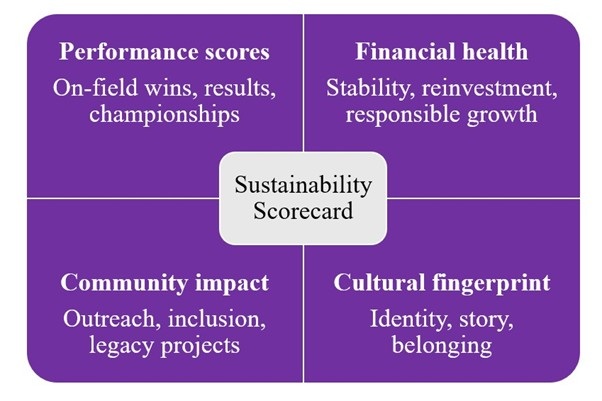
Potential examples of cases in point: cross-league applications
The 4-step Sustainability Playbook for leaders in sport
Why this matters
Front offices, director boards and ownership groups are under scrutiny and pressure: escalating player salaries, volatile media rights, and restless fan bases.
Bohs offer a reminder. Sustainability in sport is not just financial. It can also be cultural. The clubs that flourish in the next era will be those that treat belonging as an asset, culture as leverage, and leadership as stewardship.
David Clancy is the CEO of The Nxt Level Group and host of Essential Skills 2.
One for your diaries
Seán McCabe, the Head of Performance & Sustainability at Bohemian FC, will speak at Essential Skills II at the Irish Museum of Modern Art in Dublin on 28 October as part of a lineup of speakers across high performance sport, business and healthcare.
Tickets are available here.
In the first session of our latest three-part Learning Series, Darren Devaney of Ulster and Daniel Ransom of Manchester United discuss the steps psychologists can take to ensure their smoother – and smarter – integration in a sporting environment.
An article brought to you in partnership with

More than 80 per cent of respondents feel that psychology is ‘very important’ in the enhancement of human performance, yet 43 per cent also feel that psychology is the most ‘underserved’ area of human performance.
The discrepancy chimed with Darren Devaney. “It’s like people know they want it, but they’re not quite sure how to make it happen,” said the Lead Performance Psychologist at Ulster Rugby.
Devaney was co-presenting at the first session of a three-part Leaders Virtual Roundtable Learning Series in partnership with the Chartered Association of Sport & Exercise Science.
The series is entitled ‘How Do we Enhance the Impact of Psychology in Performance Environments?’
His co-presenter Daniel Ransom, the Head of Psychology and Performance Lifestyle at the Manchester United Academy, offered his analysis of the report’s findings.
“What it perhaps highlights is the gap between research and application, as well as the immaturity of psychology as an applied discipline,” he said while also noting the appetite in the sports performance community for psychological services.
When session attendees, many of whom had a background in psychology, were invited to rate their own effectiveness, most answers were grouped in the middle.
“It probably just reflects that it’s not fixed,” said Ransom of the results. “That level of effectiveness will change throughout seasons or cycles, and, I guess we’re hoping to be at the top end but we know at times it’s going to move up and down a little bit.”
Over the course of an hour, the duo discussed the role of the psychologist and the ways they can develop and sustain their work in sporting environments.
The requirements of the psychologist
Together, Devaney and Ransom drew up a list of requisites for a practising psychologist in sport:
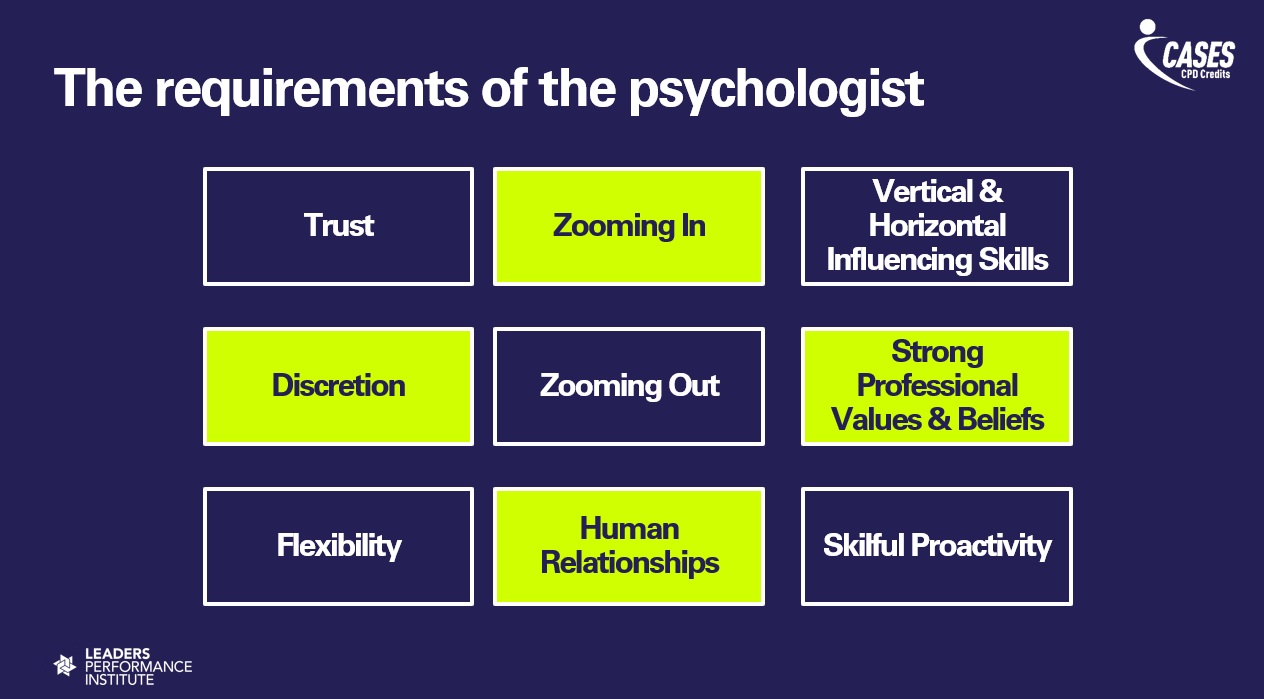
They then homed in on a selection:
Zooming in and out
According to Devaney, the psychologist must “get away from the assumption that we work with the individual athlete only”. Instead, they should ask themselves “is my intervention best targeted at an individual or is this more systemic? And if I’m going to be here for the next five or six years, what’s the most useful way of spending one or two hours on this? Is it working with a head coach? Is it working with all the staff? Is it working with a group of players, or is it the one-to-one with the athlete?”
Vertical and horizontal influencing skills
Psychology is not just the work of the psychologist. “An hour spent with one individual athlete is very well spent,” said Devaney, “but an hour spent with somebody that upskills or shapes them”, such as a coach, brings your work into “exponential territory”. He continued: “it changes how they do their work with 20 or 25 people over the course of the week”.
Ransom added: “If we really want to embed and integrate psychology what we require is other people to take on our ideas and work in ways that are psychologically-informed.”
Skilful proactivity
“We can’t sit still and wait for work to walk in the door,” said Devaney. “I’ve often reflected that this organisation functioned for decades without me in the building, so if I’m not here, this place can keep going. I need to recognise the fact that it might not be every day the main thing that everybody’s thinking about, so how can I do that in a way that doesn’t produce scepticism or kickback?” Nevertheless, “you must be proactive in trying to have an impact.”
Ransom has advice for anyone encountering scepticism. “If people are ready for more in-depth and focused work, then let’s meet them there. If they’re not, and they’re at that sceptical end, how do we try and offer them something which is appropriate to the needs of what they might be open to? If we pitch that wrong and we try and go too hard or move too quickly with those people, I think you can get caught in a potential tug of war where we don’t really make much progress and people hold their position.” With skilful guidance, people can “see the value that other people have, and that can be a way of opening a few windows and doors to them.”
The foundations
Devaney and Ransom set out four foundations:
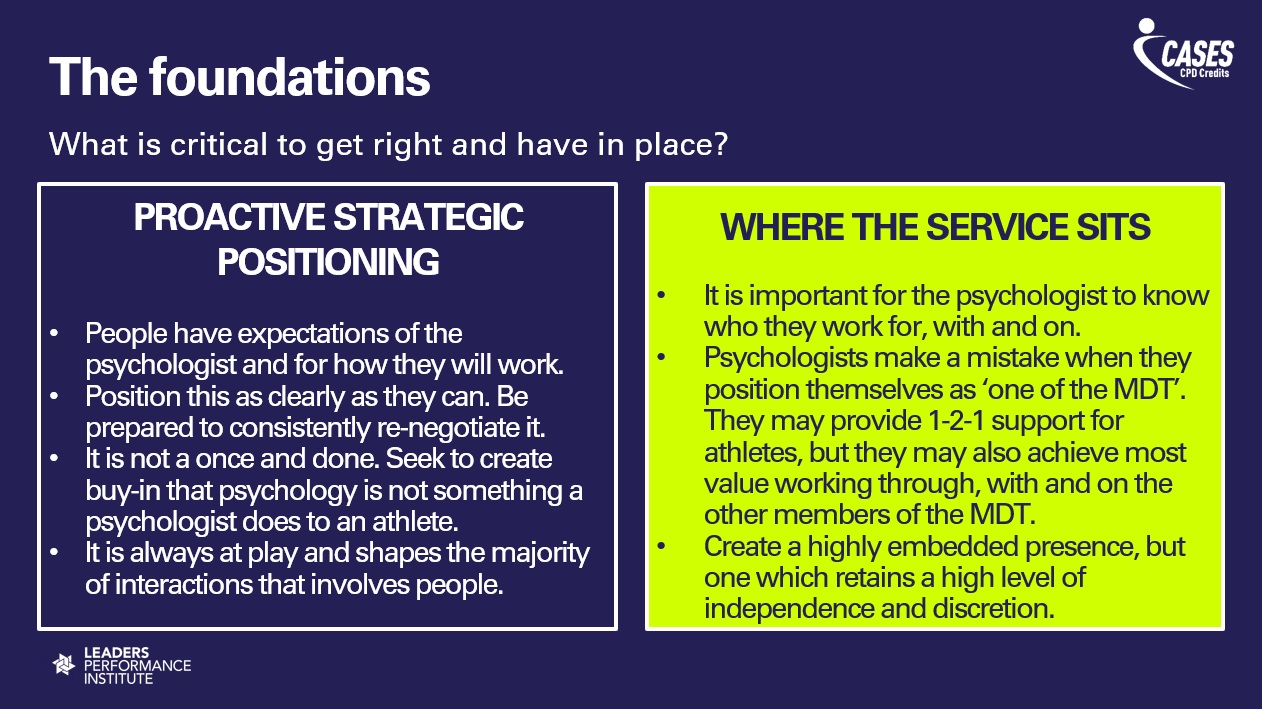
Devaney argued that in professional sport at least, a psychologist’s job can be harder if the head coach is not one of those key stakeholders. “They can really shape what the role can be,” he said. “Like whose priorities do I need to be trying to align with? If I’m running into time demands, and we’re trying to figure out where and when I’m going to do work, who actually has the best steer on that?”
Whether you’re preparing for success today or down the line, the priority needs to be clear. But that’s not always the case. “It sounds pretty straightforward, but you’d be surprised how often those ideas can be misaligned,” said Ransom. “It makes it really difficult for you to work in an integrated, embedded way, with a long-term focus if other people are perhaps expecting immediate impact on individuals when you have a more systemic, broader focus.”
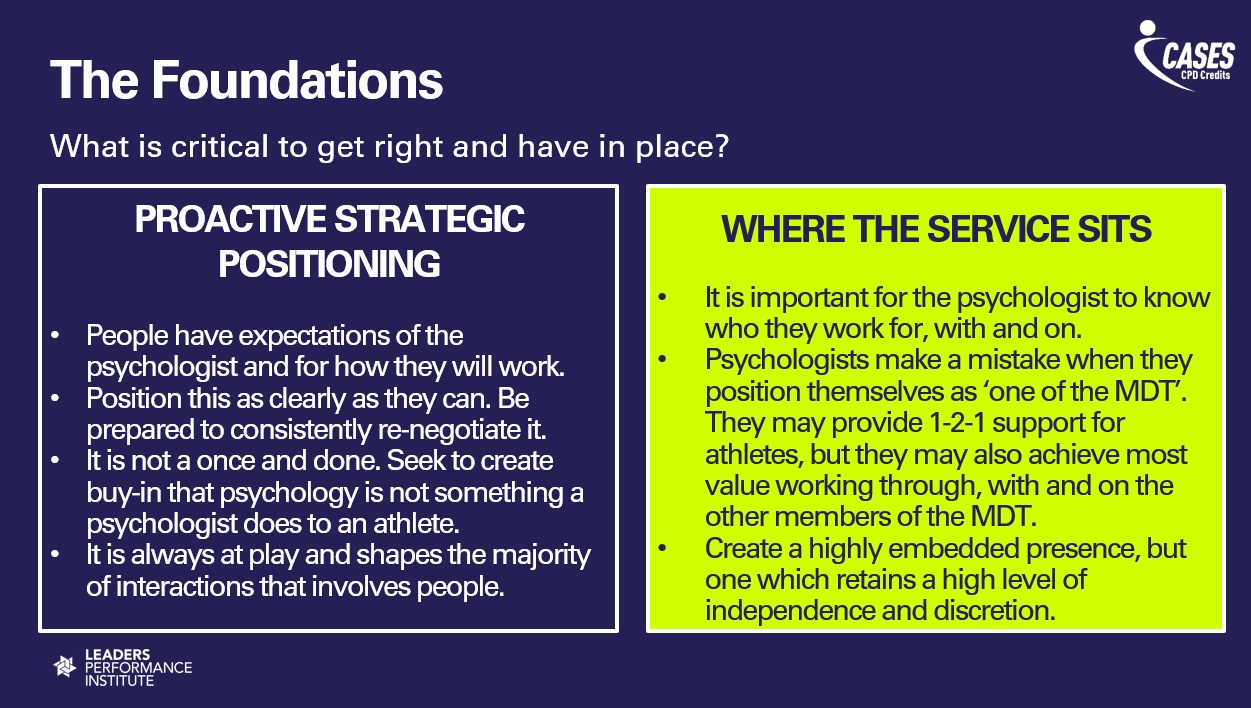
A psychologist’s positioning is not fixed. Ransom argued they must be “prepared to renegotiate the position time and time again”. He has had to “go through a process of having to establish, clarify and communicate boundaries in terms of what my role is.”
“The need to renegotiate is just so consistent,” added Devaney, “and I think there’s a bit of me sometimes that thinks that there’s an arrogance that if I’ve explained it once, everybody will get it and know it all the time and keep it at the forefront of their mind.”
The duo’s point about intentionally stepping away from being part of an MDT, to not be “boxed in”, raised a concern from one attendee about the potential negative impact on the sport psychologists as the conduit into clinical psychology. Ransom and Devaney took the point.
Ransom, who clarified that it was more about not being aligned to a single department of the MDT than not being a member per se. “As practitioners, we have to be flexible,” he said. “So there’d be times where, in my role, I would be positioned as part of an MDT. There’s times where I’d be positioned closer to some of the coaching staff.”
This takes skill, as Devaney said: “If I’m going to sit somewhat outside of the MDT and start to bring suggestions to them about how I can be supportive of their process, I’m going to have to do so very delicately and skilfully to get the impact that I want.”
Keep building
Both men had some advice for the table:
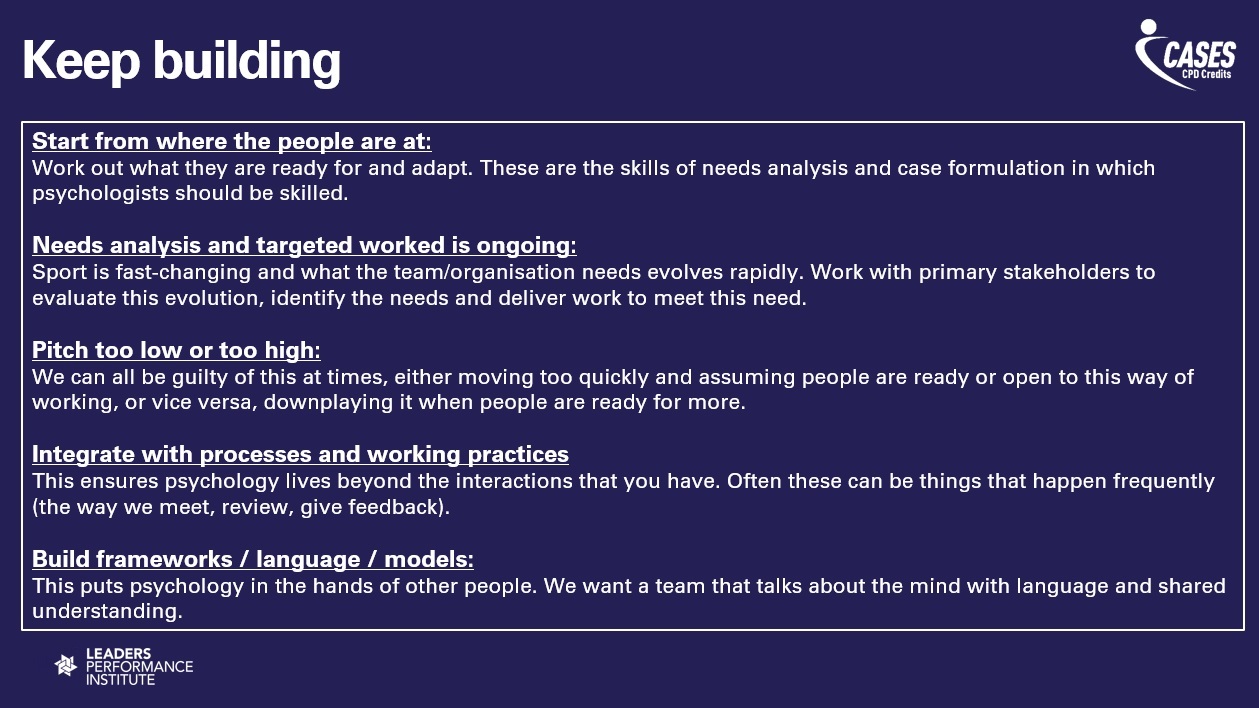
In reflecting, Devaney spoke of a personal experience: “The best question I’ve ever been asked by a head coach that I worked with was ‘what rooms and meetings do you need to be in to be able to be more effective in your job? Tell me, and I’ll make it happen’. That’s such an empowering position.
“He was basically offering an open invite to integrate what psychology is into the different practices of the organisation.”
Devaney also spoke about the importance of maintaining a shared lexicon, particularly in sports with regular athlete and staff turnover.
The finishing touches
Of the finishing touches, Ransom said: “If we think about the foundations through to the building blocks, which were more around the processes, the ways of working, the frameworks, then this bit is more around the actual skills of the practitioner and the key relationships that they have.”
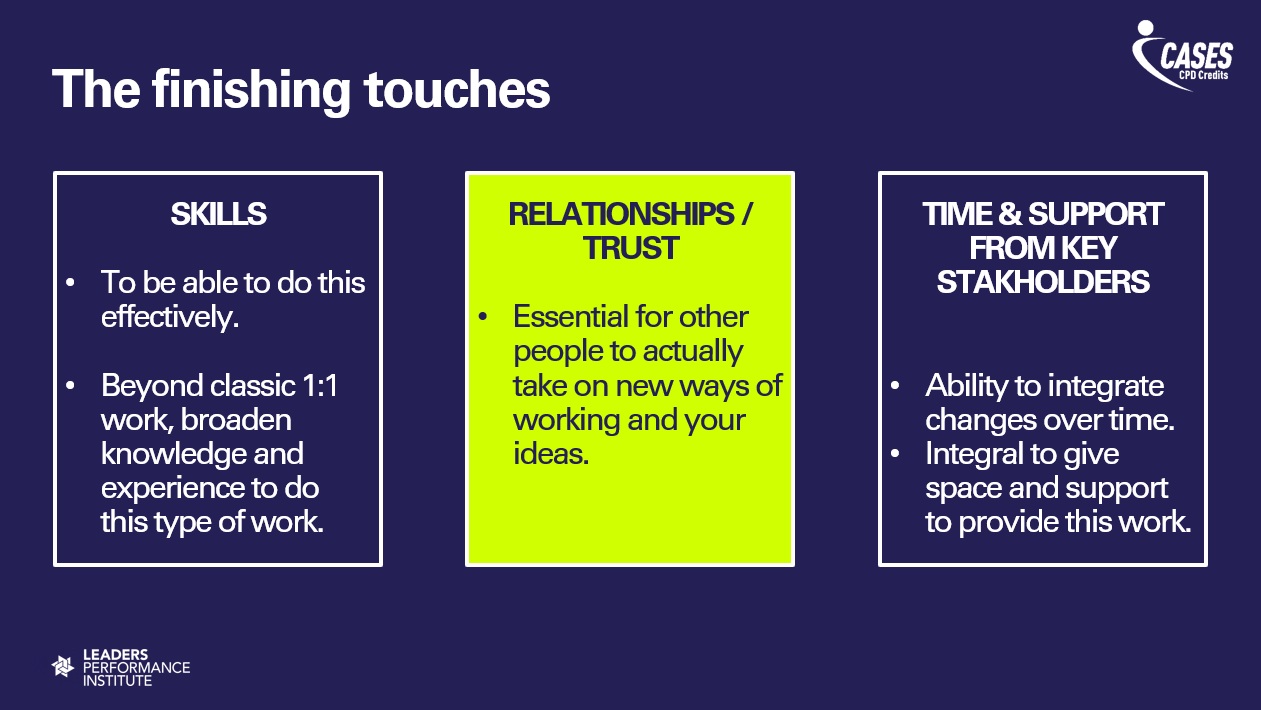
“Here,” Ransom continued, “we’re talking about the importance of having skills beyond the classic ability to do individual one-to-one work, which people might associate with psychologists. So we have the ability to carry out discussions among teams of staff and hold those types of collaborative conversations, which is a skill in and of itself. Do we have the confidence and competence to sit with a team of experts and navigate a conversation in a way, which is encouraging different people to contribute, which is embedding or weaving in some psychology input into that without dominating that conversation?”
Session 2 of ‘How Do We Enhance the Impact of Psychology in Performance Environments?’ is on 2 October. You can sign up to be part of this Learning Series here.