Robin Eager tells us that the team’s development work at St George’s Park is helping to set them up for another tilt at glory.
Main image: England Rugby

In January, the Red Roses’ new Head Coach, John Mitchell, announced a 38-player squad for their first training camp of 2024, which took place at St George’s Park in Staffordshire.
“We had what we call our ‘alignment camp’,” says Robin Eager, the England’s Women’s Athletic Performance Manager, of the week-long camp. “It was an opportunity for our group to reconnect for the first time since November.”
He refers to the end of the inaugural WXV 1 competition, which England won courtesy of comprehensive defeats of Australia, Canada and hosts New Zealand. Mitchell took the reins full-time at the tournament’s conclusion and the team now begins its pursuit of a sixth consecutive Six Nations title.
The Red Roses left no stone unturned at St George’s Park which, in addition to England’s 23 football teams, regularly hosts a range of elite athletes and sports teams at its 330-acre complex. SGP boasts 14 state-of-the-art pitches, which can be configured for a variety of sports, and indoor facilities including a full-size 3G pitch, a multifunctional sports hall, a strength & conditioning gym, hydrotherapy pools and a cryotherapy chamber.
“We could get some early learning done around how we want to develop our game and how we want to play,” Eager continues. “It also allowed us to complete some physical profiling on the back of reviews from the last campaign, which then informed the development plans of individual players.”
He offers an absorbing insight into the world of serial winners. In keeping with others in that bracket, it starts with their environment. “First and foremost, you’ve got to define what you want your culture to look like.”
Eager, who joined the team in June 2022, cites the platform provided by the Red Roses’ values, the specifics of which are kept in-house. “They might not translate to another team but they’re ours that we live by, constantly refer to, constantly judge ourselves by, praise positive examples of.”
The coaches look to create a psychologically safe environment that balances challenge and support. “If we want players to be the best they can be, they’ve got to push themselves to learn. If you push your boundaries then there will be times when you’re going to fail, and if you fail you’re probably going to feel vulnerable. You have to create an environment where players feel like their voice is heard, that it’s OK to feel vulnerable, and they feel safe to push themselves, as this is the only way we will grow both individually and collectively to become the team we aspire to be.”
Eager and his colleagues try to role model the blend of hard work and vulnerability they expect of the playing group. “As a management team, you must demonstrate that you’re also putting yourself in that position.”
Returning guests
The Leaders Performance Institute was at St George’s Park during the Red Roses’ alignment camp. As we strolled through the foyer of the adjacent Hilton Hotel we saw several groups of players and staff relaxing.
“Beyond preparation work, SGP provides a wonderful casual space for socialising, bonding and unwinding together as a group,” says Eager, who is talking to the Leaders Performance Institute on Teams approximately three weeks after the camp.
“We don’t just allow it to happen by accident. A lot of relationships are built on informal conversations – they’re not always built in meeting rooms – you can create environments that allow those incidental coffee and corridor conversations to happen. If you’re in the wrong venue or facility, it can detract from that effort.”
This was neither Eager’s nor the Red Roses’ first time at St George’s Park. They are regular guests and will return in March ahead of England’s first Six Nations match away to Italy. “St George’s Park is a great facility for us because it allows us to put together our best preparation model for how we want to approach a competition. This includes elements such as facilities, flow and food provision, which are absolutely vital.”
St George’s Park, as Eager explains, has a range of training and recovery modalities that satisfies the preferences of an international squad drawn from different clubs. “Having that breadth available so that players feel they have everything they need to best prepare themselves on a week to week basis is invaluable. If you’re used to preparing in a certain way and we can’t provide that then it brings anxiety.
“Ultimately, we want our players to feel like they’re the best-prepared players contributing to the best-prepared team so that when they go out on the field, they can feel confident that they’ve prepared properly to deal with the game when it’s got a bit messy.”
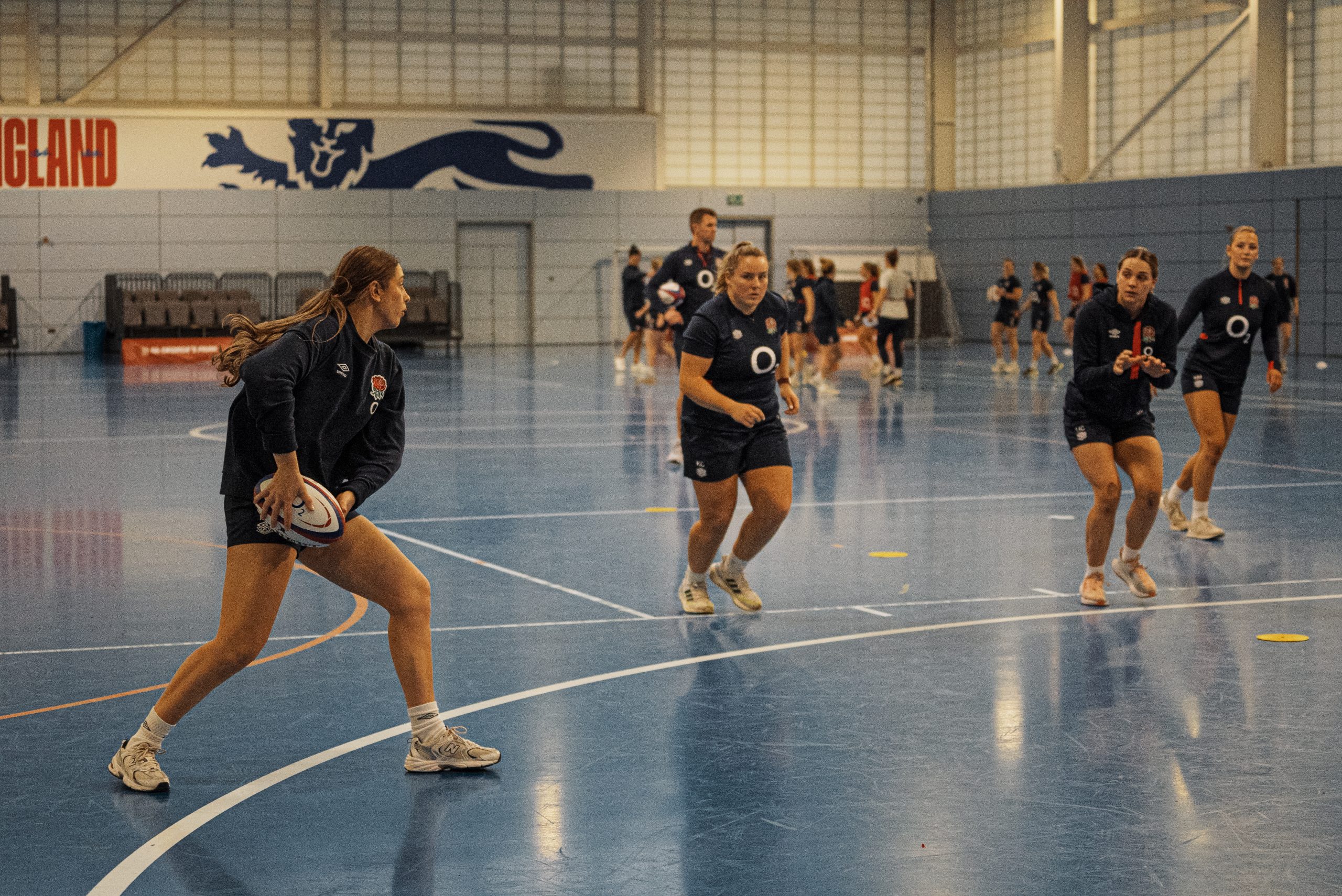
Image: England Rugby
How the Red Roses execute their plans
As Eager points out, in international rugby, there can be relatively large gaps between series and campaigns.
“One of the benefits of international environments is that you have periods where you’re completely on it and you’re executing your plan,” he says. “Then you’ve got time when players are back at their clubs and you can review and plan for the next campaign. We’re continuing to develop how we go about that process and make it as effective as possible.
“Plans enable us to align as a staffing group around what we’re trying to achieve; vision, purpose and clarity. For every session, we have clear objectives and everything in the programme has a clear rationale.”
Events will not always run smoothly but there is a firm idea of the team’s development priorities and so England can pivot swiftly. “Certain sessions can go perfectly to plan, certain other times you have to adjust around what you’re seeing in front of you.” Where appropriate, some elements are gamified. “It is a strategy that ultimately drives energy, competition, intent, memories and laughter.”
England’s plans are aligned to the playing style of Mitchell, who is striving to construct a team capable of winning the 2025 Rugby World Cup and build on the platform bequeathed by his predecessor Simon Middleton.
“We need a clear understanding of how we want to play the game,” says Eager. “Once we define that, what are the key elements that contribute to us playing our best game? For example, if we’re a team that relies heavily on moving the ball, kicking the ball, we’ve got to have the players with the capability to do that. Their passing skills and kicking skills have got to be good. A lot of ball movement comes with a lot more running, so you’ve got to be running fit. So you can see how that starts to layer in.
“From there, we’re able to say where a player’s profile sits from a rugby perspective, a physical perspective, an injury perspective, and ask: is there a gap between where they are currently at and what they need to do in order for the team to perform? And if there is, that ultimately forms their development goals. So there’s a clear link between what we need to do and why that’s important.”
Constant communication
There are key principles in the way England play that enables players to transition smoothly from the club environments to the national team, but equally essential are the relationships the Leaders Performance Institute witnessed first-hand at the Hilton.
“Unless you can connect with people first, your coaching is limited,” says Eager. “You’re never going to have close relationships with every single player, that’s just not possible, but you’ve got to make sure there are some key people within the management group that have relationships so you’ve got most bases covered with most players. You’ve got to take the time to get to know the players as people.”
He cites business professor John Maxwell’s ‘students don’t care how much you know until they know that you care’ and author Maya Angelou’s ‘I’ve learned that people will forget what you said, people will forget what you did, but people will never forget how you made them feel’ as maxims for effective coaching.
Coaches and performance staff will proactively speak to players outside of international camps but, again, there must be a rationale. “There’s a real balance between having contacts and connection with the players at their clubs versus overdoing it,” Eager adds. “That’s their club time, they’ve also got lives to live, but connection is important to continue our growth as a group. We’re fortunate to have a relatively big coaching group, ensuring that there’s always avenues for conversation outside of camp.”
Critically, as Eager says: “you’ve got to be able to connect on a level beyond just a transactional coach-player piece, particularly with the modern player. The players have got to have confidence and trust in you and what you’re delivering because sometimes you’re pushing them to places they may not be comfortable going as part of training. When developing players, you’re pushing them, stretching them and encouraging them to fail so that they can learn. It takes a leap of faith from players to know that they won’t be judged. It’s really important: if you want to stretch players to their maximum potential you work on those relationships.”
Eager has worked with both male and female groups during his career. He notes numerous similarities across men’s and women’s rugby, as well as some subtle differences. “The women’s game is a little bit less defence and kick-dominant. There’s more open play,” he says.
Beyond rugby, some differences are sociological. He is not alone in noting that female athletes tend to ask coaches ‘why?’ more often than their male counterparts. “That shouldn’t be a bad thing. In my role, I’m ultimately responsible for how tired or fresh they feel because I’m the one pushing training loads and physical capacity. I need to make sure that my communication and rationale are on point so that when I’m asking them to go to places where they’re working hard or they’re sore, they don’t lose confidence. They understand the purpose, the benefit, and that it’s going to reap rewards on the back end of tournaments.”
Other differences are physiological, relating to factors such as hormone levels and the menstrual cycle. “That brings differences week to week which shouldn’t be seen as a negative because with that comes huge opportunities as well.
“We’re really trying to work with players on an individual basis to understand what works for them and, ultimately, it’s not a one-size-fits-all approach. At the same time, it’s a team sport, so you try to find the balance of what’s consistent from a team perspective and what flexes from an individual perspective to put people in the best position to perform.”
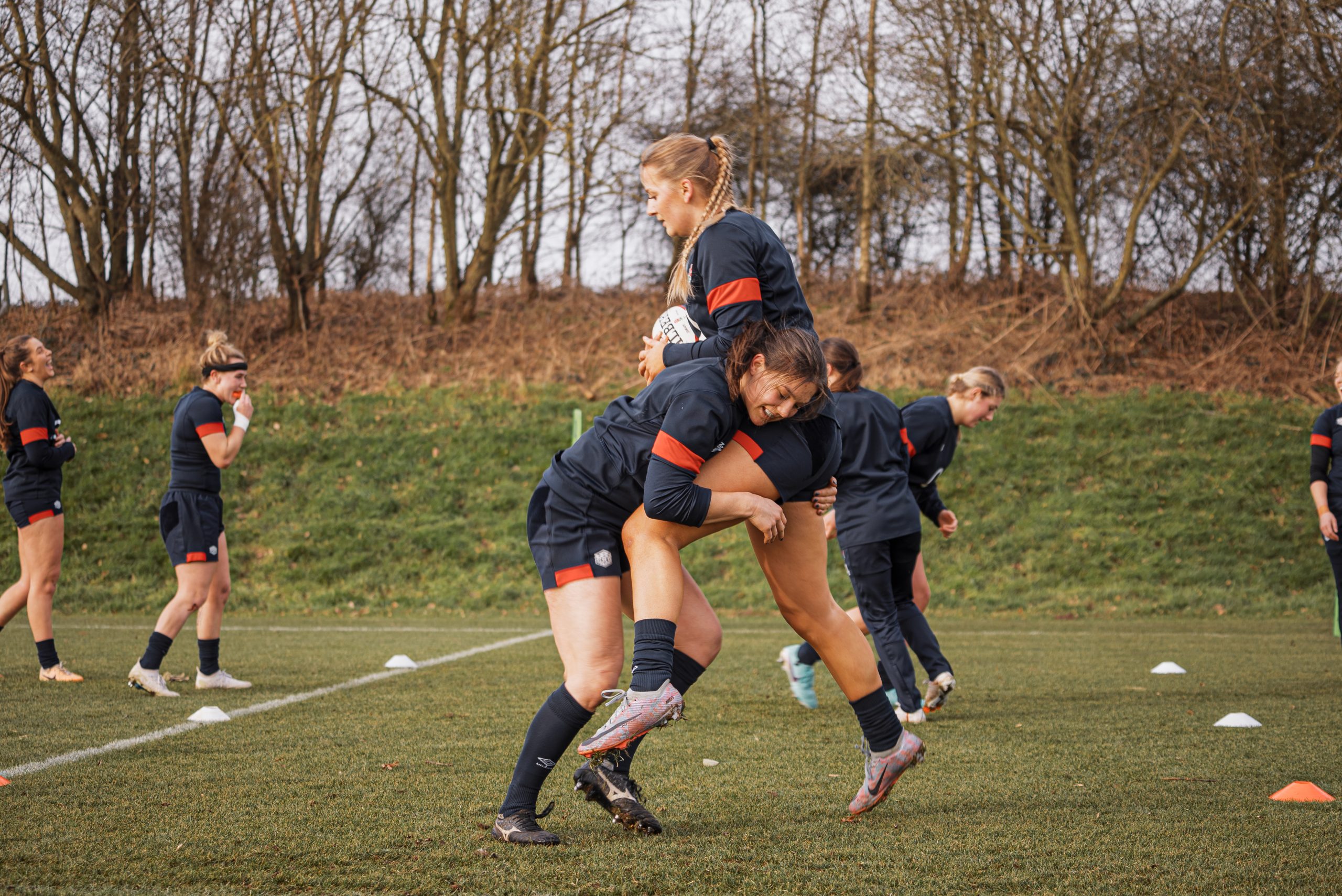
Image: England Rugby
The return to St George’s Park
The Red Roses will return to St George’s Park for a two-and-a-half-day camp in early March. “We’re constantly trying to layer in the developments in our game,” says Eager. “This camp will have a different theme with regards to what we’re trying to develop from a technical perspective, tactical perspective. Physically we’ve got a slightly different objective as well.
“In the alignment camp, we were looking at doing a lot more profiling and testing whereas now we’re trying to get the girls settled into more of a rhythm for our typical training weeks.
“Physically, it’s week one of eight for us. We’re back into running their athletic development programmes, we’re taking on their rugby development for the next eight weeks whereas the alignment camp was dipping our toe in, giving them some of the early information and getting engaged in where players are at. We’re starting to put the meat on the bones now.”
Eager’s excitement is palpable. “Change initially brings unknowns but it also brings huge opportunities. We’ve got a coach who’s got so much experience and we know that from a staff perspective and player’s perspective that’s only going to make us better. We’re going to learn a hell of a lot but what’s also refreshing is that Mitch recognises he’s coming into an environment that’s new for him as well, having predominantly worked in the men’s game. He’s also learning in that space.
“We’re all really excited to be able to continue to build on our last campaign. We have an opportunity to revisit the purpose of the team, our vision, what’s important to us in terms of our values, and how we want the environment to be. That sets the validation for everything else; training sessions, structures. It’s hugely exciting.”
Crucially, when the players return to St George’s Park they will all want to be there. “You can create an environment so players say ‘I can’t wait to get back in, it’s going to be great, I’m looking forward to these eight weeks’. That’s ultimately what we’re after and what we’re working hard on.”
St George’s Park provides a world-class elite training camp environment for any team or athlete wanting to optimize their performance. To find out more click here.
We bring you insights, reflections and a range of tips from the Brisbane Lions, San Antonio Spurs, Melbourne Business School and beyond.
An article brought to you by our Event Partners


The renowned leadership consultant was onstage at the Leaders Sport Performance Summit at Melbourne’s Glasshouse speaking about her book The Leading Edge, in which she proposes a framework for leadership based on notion that when we are able to lead ourselves we are better equipped to steward others through periods of change and development.
An audience of more than 200 Leaders Performance Institute members sat with rapt attention as Ransom joined coaches and leaders from organisations including the Brisbane Lions, San Antonio Spurs and Melbourne Business School, all of whom laid out how they are working to ensure their people can navigate the shifting sands of high performance in years to come.
“Research suggests some of the most in-demand skills by 2030 will be how we work together, connect, and build empathy,” Ransom continued.
Here, in light of those skills, we explore eight ways those who took to the stage are working to future-proof their teams.
The recent renaissance in Australian cricket – the men’s and women’s teams are reigning world champions across four different formats – has not been a happy accident. Andrew McDonald and Shelley Nitschke, the head coaches of the men’s and women’s teams respectively, stressed the need for thorough performance planning, skilful execution and finding the space to pick up lessons along the way.
Andrew McDonald, Head Coach, Australia men’s cricket team
Shelley Nitschke, Head Coach, Australia women’s cricket team
Next steps:
Burnout is a universal problem, with New Zealand and Australia suffering some of the highest rates in the world, according to leadership consultant Holly Ransom. She argues that while stress is inevitable, and can be abated, burnout can be entirely avoided. In her view, the conditions necessary for eradicating burnout stem from empathetic leadership and, when a leader adapts their habits, it gives permission for others to do the same.
Holly Ransom on the notion that we can’t sustain leadership, without leading ourselves first.
Next steps:
1) Complete an energy audit – when are our natural highs and lows in a day, and how are we using them?
2) Establish your building blocks – do the little things that help you build momentum.
3) Set your micro-breaks – take time to get mini hits of new energy.
Kit Wise of the Royal Melbourne Institute of Technology [RMIT] and Budi Miller of the Theatre of Others, an innovative performing arts company, were invited onstage to share their approaches to fostering creativity and risk-taking in their environments.
Professor Kit Wise, Dean, School of Art, RMIT
Budi Miller, Co-Artistic Director, Theatre of Others
Next steps:
The New Zealand All Blacks and San Antonio Spurs are worlds apart in sporting terms but share numerous commonalities when it comes to bringing to life and sustaining a winning culture. Beyond results, both are renowned for creating environments where people and innovation flourish, as the All Blacks’ Mike Anthony and Spurs’ Phil Cullen explained.
Mike Anthony, High Performance Development Manager, New Zealand Rugby Union
Phil Cullen, Senior Director of Basketball Operations and Organizational Development, San Antonio Spurs
Next steps:
New Zealand Rugby have identified five factors that enable their group to flourish:
1) Connection – players take pride in serving their community.
2) Balance – the group looks for learning, stimulation and edge.
3) Fun – a big part of balance.
4) Learning – athletes learn by doing; so what environment will facilitate the best learning?
5) Family – the organisation has worked to bring families in while also helping them to understand the expectations of an athlete in high performance sport.
The Spurs have their three core values:
1) Character, which is based on values.
2) Selflessness, which is culture-focused.
3) ‘Pound the Rock’. A metaphor inspired by 19th Century Danish-American social reformer Jacob Riis. His Stonecutter’s Credo perfectly captures the Spurs’ drive for championships:
“When nothing seems to help, I go and look at a stonecutter hammering away at his rock perhaps a hundred times without as much as a crack showing in it. Yet at the hundred and first blow it will split in two, and I know it was not that blow that did it, but all that had gone before.”
The Stonecutter’s Credo, Jacob Riis
The Brisbane Lions men’s team, under the stewardship of Senior Coach Chris Fagan, have in recent years returned to prominence for the first time in a generation. Amongst the factors responsible for their rise is their ability to out-learn their opponents, as High Performance Manager Damien Austin explained.
Damien Austin, High Performance Manager, Brisbane Lions
Next steps:
Models for change are all good and well – change is inevitable, so perhaps they are entirely necessary – but what are some of the so-called ‘soft’ factors that enable a leader to influence change? Professor Jen Overbeck was on hand in Melbourne to dispense some tips for explaining and justifying change to others.
Jen Overbeck, Associate Dean, Melbourne Business School
Next steps:
Wellbeing and performance are indivisible, yet there is more we can all be doing to ensure our people can flourish. At the Glasshouse, Emily Downes of High Performance Sport New Zealand and Sonia Boland from the Australian Institute of Sport provided an insight into their work helping people to thrive amidst the challenges presented by high performance sport.
Emily Downes, General Manager – Wellbeing & Leadership, High Performance Sport New Zealand
Sonia Boland, National Wellbeing Manager, Australian Institute of Sport
Next steps:
As women’s sport continues to evolve, the system will need the athletes and the coaches to fill the spaces created. Given the hitherto piecemeal approach to developing women’s sport, and the often misunderstood differences between men and women athletes, this is far from a given. Helene Wilson of High Performance Sport New Zealand and Tarkyn Lockyer of the AFL are two individuals meeting this challenge head on.
Helene Wilson, High Performance Sport New Zealand
Tarkyn Lockyer, Australian Football League
Next steps:
Dr Amal Hassan at Harlequins Women explores a much misunderstood aspect of her players’ health and suggests ways in which coaches and practitioners can help.
A Human Performance article brought you by our Main Partners

“What I’ve learned supporting rugby players,” she began, “is that periods can be a barrier to participation in the first place, a perceived barrier to skill and technical development through a season, can have health implications that really impact their performance, and it possibly keeps players from developing at really crucial points.”
Hassan was speaking as part of a panel discussion on the physiology of the female athlete at September’s Leaders Meet: Driving Step Change in Female High Performance at Manchester’s Etihad Stadium. She spoke alongside pelvic health physiotherapist Emma Brockley and Dr Nicola Brown, an Associate Professor in Female Health & Performance at St Mary’s University.
Session moderator Claire-Marie Roberts, who has just been appointed Performance Director at English Championship club Coventry City, homed in on Hassan’s reference to skill acquisition.
“A training season won’t discriminate,” said Hassan in response. “You’ll be needed to train on any given day of your menstrual cycle, if you’re off contraception, for example. So you need to be able to show up the best you can. However, at certain points in certain individuals, it may be that their menstrual cycle fades, where the symptoms or dysfunction they experience may actually be medical and the impact on their ability to train, to show up as the person they want to be to their coaches and the staff they’re working with, and, on game day, you can imagine how that might translate.
“That’s not to say that every day is going to be a different flavour of menstrual cycle dysfunction for an athlete, but there might be really key points in, say, a season or a cycle where they have to be absolutely present and engaged in their training for their skill acquisition to develop at the pace we want it to. If you can imagine not thinking about this component and the effect it has on athletes’ development, we’re just expecting them to be able to cope as long as we control for medical, load and other aspects of sports science, but we don’t consider this other very important aspect that is across the board for all of our female players if they’re off contraception, then we’re missing a trick.
“And what I find interesting is if you ask athletes if they think it’s impacted their skill development, they might say yes and more often than I would expect.”
Hassan noted that it is important to separate menstrual dysfunction and symptoms. “Symptoms could be normal,” she continued. “What we don’t understand fully is what is a normal menstrual cycle for an athlete or not. We’re good at delineating that from their perspective; I can tell you what’s pathology or not according to a certain criteria, but we don’t actually know what’s normal for an athlete. So it could be normal that you do expect symptoms and that’s not dysfunction. That’s just part and parcel of your menstrual cycle.”
In this article, Hassan, who has also worked in ballet, reflects on the support that all teams and organisations can provide for athletes as well as the implications for those female athletes playing collision sports.
Note: Hassan’s responses have been edited for clarity and brevity.
The importance of menstrual tracking…
If you’ve got the resources, tracking is important. And that might be tracking done by your sports science team with the consent of the athletes. In the absence of those resources and that expertise in-house, that might look like the athletes receiving some education and taking it upon themselves to track their menstrual cycles. Ultimately, I believe this should be player-led or athlete-led so that an athlete can come to you with any concerns, but what you want to do is you want to pick up any patterns. It’s going to differ between athletes. It might be that you can pick up some really important trends in sleep dysfunction, in cravings, in core recovery, in back pain in certain parts of the cycle, otherwise it can start working proactively against a team, which is there to support an athlete ahead of time so that it doesn’t become a reactive approach. It becomes very proactive and built into a programme.
The gold standard in supporting athletes with their menstrual cycle…
I don’t think we’ve necessarily reached it anywhere and explored the full capabilities. It must span medical and performance because you might pick up some medical issues but it’s very much aligned with your performance programme or your sport. The gold standard within your team will look like setting out everyone’s roles and responsibilities, in a team environment tracking across the team, getting buy-in from individual athletes, collecting as much data as possible so that you can be accurate about your planning. Now, that might be impractical even in some elite settings in women’s sport but where there’s full professionalisation, athletes are full-time, you’ve got the staff resource to do it.
Steps that all teams can take…
It’s important to recognise where you don’t necessarily have the expertise in-house. So some sports may have doctors as part of their teams, they might be full-time, they might not be, they might be junior doctors in their training, or they may be consultants, they may be consultants in orthopaedics but have no medical training in terms of gyno health or endocrinology. So it’s really important to understand where you’re at and that if you don’t have that expertise in-house you have onward referral pathways in place for any pathology that you pick up. In the middle, you’ve got the option, for example to use a platform like Fittr Coach and be able to access that with the resources that you have; your performance medicine team might be able to do the tracking, involve the athletes in collecting the data, and you can try to pick up any patterns there. At the other end of the spectrum, athletes can use a free app to track their periods, check their cycles are regular, keep a diary of any issues, any symptoms, try and relate that to training, to any recovery, nutrition, their psychology. It can get quite complicated but if you just have a structure around it and you do it every day it becomes simple. You will then want to signpost to that individual’s GP if there are any issues. Obviously a GP is not going to be experienced or qualified at discussing performance but there are quite a few resources available for athletes to read or podcasts to listen to. It’s not going to do any harm for them to consider that the menstrual cycle might be a component in planning their training or their recovery.
The ethical considerations…
If you’re encouraging a practice, there’s got to be a structure around it. So who’s leading on that? Who’s driving the education? Who’s the go-to person for questions and answers? I think you have to be really intentional in the rollout of teamwide services or strategies like this. Everything needs to really be in place so that you don’t come across issues by surprise. I think you could have this problem even within an environment that has a great structure. Ultimately, the big one is supplements. A lot of athletes will think about particular supplements that might help them with symptoms, with recovery, and they just need to make sure they’re not breaching anti-doping guidelines; and that you are encouraging across the board, you’ve got nutritionists, doctors, etc. open communication about anything they want to try. We do want to empower athletes to be the best they can be but just within the realms of safety.
On athletes approaching pregnancy and birth…
This is a space that’s continuing to develop and that development should aid and increase the confidence within the performance medical team and within athletes in approaching training through pregnancy, continuing to be part of your sport during your pregnancy and then return, post-natal, post-partum. If you think about it from a framework perspective, it’s really important that pillars that include HR and contractual factors, the players’ wishes, their psychology during pregnancy, the skillset and experience within your team managing that athlete, your protocols, your emergency action plans from a medical perspective, your forward planning and programming from a rehabilitative perspective towards return-to-play and the facilitation of preparing for birth and the early post-natal phase, which is a really crucial period of time in any woman’s life, are proactively managed. It can seem really overwhelming if you’ve never done it before and I would encourage any institution who has never done it before to not wait until it does happen; to be proactive in building policies and protocols ahead of time and developing the skillset you have in-house, so that you are ready when it does happen, because it eventually will. If you think of the period of life where an athlete’s fertility is peaking, it’s merging with the performance time in their careers generally.
The impact of a collision sport on menstrual dysfunction and symptoms…
What we tend to see in sports that are typically endurance sports or aesthetic disciplines like ballet is that greater maturation is at risk of being delayed because of the energy demands and the chasing of an aesthetic goal from a physique perspective. So in those sports you might see there is a delay that might impact bone health, they might go on to be at risk of stress fractures, broadly speaking. In rugby, what you have to consider is the load, the impact of stress on the endocrine system, and then you’ll swing more towards menstrual dysfunction and symptoms and poor under-recovery impacting their endocrine system. What you also tend to see, and this is really anecdotal from my perspective, having worked in ballet and having worked in rugby, what we see in ballet is a lack of periods and amenorrhea as a risk. What we see in rugby is you’re more likely to be struggling with something like PCOS [polycystic ovary syndrome]. With PCOS, you see higher androgen levels, that will translate into some sport-enhancing metrics in terms of how strong you are potentially. And this is not proven, this is just anecdotal, with that what you get is more menstrual symptoms relating to the hormonal imbalance. So I think it’s down to really understanding our sport. We don’t have that data, we need to understand across the board what the typical issues girls and then women playing senior rugby are struggling with and I guess it’s a call to action for research. I can just rely on my own anecdotal experience at my club. It needs more effort across the board.
Dr Nicola Brown of St Mary’s University explores an unregulated market where anything can be labelled as a sports bra.
A Human Performance article brought you by our Main Partners
“We know that half of schoolgirls drop out of sport because of their breasts,” she added. “One in three adults see the breasts as a barrier to participation. Then we also have that performance aspect. We know that if we change breast support, because the breasts will move during activity, that it will change how an athlete moves, it will influence their confidence, it can change their breathing, it can change their muscle activity.”
In September 2023, Brown was speaking as part of a panel discussion on the physiology of the female athlete at Leaders Meet: Driving Step Change in Female High Performance at Manchester’s Etihad Stadium. She spoke alongside pelvic health physiotherapist Emma Brockwell and Dr Amal Hassan, who serves as Women’s Team Doctor at rugby club Harlequins.
“We know that the majority of women wear the incorrect size bra, and you can have a great sports bra, but if it doesn’t fit properly then it’s not going to be effective.”
In this article, Brown reflects on the sports bra market and the importance of athlete education when it comes to breast health.
Note: Brown’s responses have been edited for clarity and brevity.
Sports bras: a confusing marketplace…
The sports bra market has massively increased, which is a fantastic thing, but it does then make it a very confusing marketplace for women. It may be very difficult to find the right sports bra. There’s no such thing as the best sports bra. What might be the best sports bra for me might be very different to someone else and we know that key issues around sports bras are knowledge of the types of sports bra that might be suitable for small breasts versus large breasts; and also the fit of the bra.
Why athletes should not rely on official apparel suppliers alone…
If there’s a very limited choice of products, particularly if you’re working with a team of athletes, it’s unlikely that those products will cater for the entire team. I think we need to be careful about mandating some kind of product that is actually having a negative health implication on an athlete. Anything can market itself as a sports bra. There’s no kind of criteria the bra has to meet. That’s another thing that makes it quite challenging to find the right breast support.
There are three types of sports bra on the market…
Firstly, a compression bra, which is kind of like the crop top that goes over your head with an elastic bottom. They tend to be better for smaller-breasted women. Larger-breasted women will probably be more suited to an encapsulation bra, which encapsulates each breast separately. The third type is a combination or a hybrid bra, which combines elements of the compression and the encapsulation bra. So you have the separate pockets for each breast and then with a compressive layer of material over the top. You might make the assumption that if we combine both types of bra we’ll get the best one but that’s not necessarily the case. It is again about that individual fit or the person.
Why compression bras are so popular…
Depending on the sport they are playing and the activity that they’re doing, an athlete may choose different sports bras for different types of activity, but the key feedback that we get, particularly from athletes working at the very top level, is that they often use a bra that is compressive because they are trying to look as if they don’t have breasts. They want to compress their breast tissue as much as possible because they’re concerned about what they look like and how people will comment on social media or in the crowd, and they want to be able to focus on the game and not be concerned about their appearance, so they will try and make their breasts look as small as possible.
The importance of education and empowerment…
There’s always that fashion aspect that comes into play but I think the most important thing is education about what a good sports bra can do. If we can try to promote the benefits that will come from that then we’ll hopefully have athletes making more informed choices. I think it’s also important not to assume that an athlete will recognise that it’s a problem. It wasn’t until 2015 that it was reported that the breasts are a barrier to activity – and I don’t think something happened in 2015 that meant breasts became a problem – it’s just the first time that anybody asked women. And so a lot of women will just assume that the issues they experience are just part and parcel of what they have to deal with. But if we can raise awareness of the fact that there is a potential solution in the form of well-fitting appropriate breast support then it just opens up their opportunities to try and reduce those negative consequences of the breast function.
Deciding what option is best…
Make sure they try it on before they buy it. The fit is one of the most important things. You can get it professionally fitted in-store, but I think particularly for sports bra fits, there’s no real regulation or training for those fitters, so I’m very much an advocate of empowering the athlete or any individual to know what bra fits them. Then it doesn’t matter what bra they pick, they know what to check and whether it fits them. And when it comes to the sizing, just not assuming that you’re one size and that you’re that size for the rest of your life. I think that’s something that happens. You get fitted with a bra at some stage of your life and then you wear that bra forever more. But different styles of bra, even the different colour of a bra, if you wear a black bra versus a white bra of the same design, just the colour can make that tighter. Your breasts might change size and shape through various stages of life, through stages of a medical cycle, so it’s making sure that you are aware that you need bras that are fitted and that your breasts may change. And more expensive doesn’t always mean better. It’s very much not the case. So it’s finding what works for you. Then, once they put it on, jump around in the changing room, simulate some movements you’d do during that activity, make sure that you feel supported.
The gold standard in breast support services…
At the top level with unlimited resources and expertise to hand, we could do a biomechanical assessment of an athlete’s breast movement doing a sports-specific activity so we can establish the optimal breast support for them and then design a bespoke bra; and then they can exercise in that. We’ve done that with some athletes and they report that they feel more confident in their performance, that they perform better, reduce pain and so on.
Steps that all teams can take…
We should go right down to the lowest level with something as simple as putting a bra fit poster in a changing room or on the back of a toilet door. Some little nudge, that thought about ‘have I checked my bra?’ or ‘have I changed my bra recently?’ ‘Does my bra fit? Something that might spark that conversation to discuss breast health issues more openly. And then in between offering bra fit assessments, if you can get the expertise on hand. Anything from signposting to educational leaflets. There are educational resources and videos and things available to signpost. Obviously we’re not all going to become experts in all of these areas of women’s health overnight and know everything, but we can at least signpost athletes if they do come to us with those issues to the resources they might need.
Where there is more work still to be done…
There’s been a lot of work done on breast support for different population groups and at different life stages, but very limited work done on pregnancy or breast feeding post-partum. So I think work needs to be done in terms of making sure there is the appropriate breast support for athletes to facilitate breast feeding if needed but also to facilitate the return to sport to ensure the breast support they’re wearing is appropriate and to support their needs. And obviously the anatomy of the breasts is going to change substantially during that period. And again, I would promote education about those changes and how team can best support their athletes. Breast injuries: we don’t really know the long-term consequences of breast impacts. That’s another area where we need to be better at collecting that data. We ask athletes about all sorts of other injuries but don’t necessarily ask about breast injuries and they don’t necessarily report it. In rugby, I know there are steps being made within injury surveillance systems to actually start incorporating breast injury data. I think that will be a really important step forward, to try and understand the prevalence, the severity, the mechanisms of those injuries, whether it’s contact with the player, contact with the ball or contact with the ground, but also the consequences of that.
Pelvic health physiotherapist Emma Brockwell outlines this ‘hidden health’ discipline that remains largely underserved in elite sport.
A Human Performance article brought you by our Main Partners

Symptoms of pelvic floor dysfunction in girls and women of all ages can include issues with urinary leakage, urgency and frequency, feelings of incontinence, and vaginal heaviness.
These examples were cited by pelvic health physiotherapist Emma Brockwell onstage at Leaders Meet: Driving Step Change in Female High Performance at Manchester’s Etihad Stadium in September.
“These symptoms often don’t cause a woman pain but they may have a huge impact on their physical and mental health,” said Brockwell, who has worked with athletes at teams including Chelsea Women and Harlequins Women. She also co-hosts the women’s health-focused At Your Cervix podcast with fellow pelvic floor physiotherapist Gráinne Donnelly.
She spoke onstage alongside Harlequins’ Women’s Club Doctor, Amal Hassan, and Dr Nicola Brown, Associate Professor in Women’s Health at St Mary’s University in London, in front of an audience of Leaders Performance Institute members.
“We think pelvic floor issues are likely to be affecting a female athlete’s performance as well,” added Brockwell. “The reality is that female athletes carrying out strenuous activity are probably three times more likely to experience these dysfunctions than someone who is less active of her age.
“So it’s just recognising that these symptoms occur, breaking down the stigma and taboo that exists around this because we’re talking about the pelvis, we’re talking about the vulva, the vagina. These words are still unbelievably taboo, controversial – women don’t like to talk about them, men don’t like to talk about them – but it’s about educating every one of us that we should be using these words and discussing these symptoms and, I guess, normalising the conversation and allowing it to happen.”
In this article, we explore Brockwell’s work with female athletes and the steps all teams can take to support their women and girl athletes.
Note: Brockwell’s responses have been edited for clarity and brevity.
On her physiotherapy practice…
A pelvic health physiotherapist is just a sub-specialist of a musculoskeletal physiotherapist. So we still screen a woman as you would through a musculoskeletal screening, we look at the whole body but we would typically offer any female athlete or woman a vaginal examination as well. And through that level of internal and external assessment we determine if there are any pelvic health issues. Pelvic health is kind of a hidden health amongst musculoskeletal physiotherapy. In our training we don’t even have much pelvic health training. It’s a post-grad form of training, but it’s really important to recognise the pelvis, the pelvic floor, integrates into the hip, into the back, into the abdominal wall and therefore perhaps with other musculoskeletal issues that might be lumbar, pelvic pain, hip pain, groin pain. Is it something that’s potentially contributing to some of these musculoskeletal conditions and therefore should we be screening pelvic health just to help eliminate some of the potential differential diagnoses of these musculoskeletal issues? It is about opening our eyes but also using this sort of specialism, a musculoskeletal physio, to hopefully make a difference to female health.
The current ‘gold standard’ in pelvic health physiotherapy…
Pelvic health is still quite misunderstood. People aren’t aware that we exist, that pelvic floor conditions can be treated. Ultimately gold standard has to be education at the moment because a gold standard doesn’t exist at the moment. Education is key, collaboration, talking to other healthcare professionals and coaches within the team [at Harlequins] to let them know what I do; and then screening at the moment is ideal because you don’t know what you don’t know. A lot of the players don’t know what they don’t know; the players are asking these questions. So screening is ultimately key. And then getting a consultant in, like me, to then offer one-to-one treatment, if players want to be treated.
What teams with fewer resources can do to support their athletes’ pelvic floor health…
There are apps and you can absolutely still screen and refer into a GP; and the GP can certainly refer into the pelvic health physio system within the NHS or privately. The resources are there and, if I give you an example, the stats show that 84 percent of women who suffer from stress urinary incontinence, if they see a pelvic health physiotherapist, they will improve. So we are effective, it’s just knowing that we exist. And if you can’t access us for one reason or another then use an app like the Squeezy app, the NHS resources. I quite often signpost people to the AIS [Australian Institute of Sport] resources because they’ve got some great educational tools that you can share with players and you can look at yourself and they offer various videos on how to do pelvic floor exercises, blood screening, bladder diaries. All of these things are really helpful if resources are scarce. But I think the key is collaboration, having discussions; and touching base with me and I can signpost you to pelvic health physios in your areas.
On helping perinatal athletes…
That’s certainly my passion area and that’s where you would recognise a pelvic health physiotherapist coming into their own. But what we should be thinking of is how we prevent pelvic floor issues occurring and we can very much prevent the majority of pelvic floor issues occurring before a woman is pregnant. But even when they do fall pregnant, being able to prepare their system for the inevitable changes that the body is going through in childbirth, and then the post-partum recovery. I don’t want to mythologise [this phase] as an injury because it’s not, but it is important to recognise that it needs as much time, thought, care and preparation as any injury that these female athletes are going to experience. And we’ve seen first-hand, if you prepare a woman during her pregnancy and really educate her about what to expect, it makes their post-partum journey so much more manageable and so much easier. I firmly believe that if we offer women this element of rehabilitation, if you like, I think they can return to their sport really stronger than ever before. I think it’s just about – I keep saying it – collaboration and working with other people and ensuring that you’re bringing in these specialisms to help support their journeys.
Rugby union’s world governing body has teamed up with Prevent Biometrics to help monitor and protect players across the globe.
Main image courtesy of World Rugby
A Data & Innovation article brought to you by

The sensor-laden mouthguards track linear and angular accelerations, and when a rugby player endures a blow in excess of designated thresholds, an independent medical professional on the sideline receives a Bluetooth alert. That athlete then enters the HIA protocol to be evaluated for a possible concussion and needs clearance for return to play.
The new HIA policy won’t officially go into effect until January 2024. Participants in the international women’s rugby tournament WXV, which took place in October and early November, trialed the technology. World Rugby is also investing $2.4 million into facilitating the universal adoption of the mouthguards.
“It’s a game changer for our sport — it’s bringing tech into the space where it never has been,” World Rugby chief medical officer Éanna Falvey said, noting the overarching mission is to track each athlete’s overall impact load. “The focus of this is about individualizing care.”
Mouthguards are widely seen as the most accurate solution for impact measurement because the upper jaw is affixed to the skull. Prevent Biometrics outfits athletes across multiple continents, sports and age groups with World Rugby having used the technology extensively over the past three years. The instrumented mouthguards are worn in both training and matches in an effort to collect data not only on diagnosed concussions but also the cumulative impact of sub-concussive blows — the accumulation of sub-concussive hits are the most likely culprit of potential long-term damage such as Chronic Traumatic Encephalopathy (CTE).
The sport’s governing body has funded studies conducted by independent researchers at a number of academic institutions, including New Zealand’s University of Otago. Roughly 600 community rugby players in that country, from the Under-13 age group on up through adults, began wearing Prevent Biometrics wearables in 2021. A year later, the devices were offered to all elite English rugby players and all women competing in the Rugby World Cup that took place a year ago.
In all, Falvey reported that World Rugby has collected data from roughly 300,000 head acceleration events. (Across all sports, Prevent Biometrics has collected more than a million impacts.) That dataset is beginning to inform guidelines for the typical frequency and severity of collisions in the sport. He said 60% of those impacts are under a force of 20g, which Falvey described as not much different than normal physical activity.
To start, World Rugby has set alert thresholds at 70g for linear accelerations for men and 55g for women while the trigger for angular acceleration is 4,000 radians per second-squared for both. Falvey said that, of the roughly 80,000 head impacts per match for all players in an elite rugby game, only 0.3% are above that threshold in men’s matches and 0.08% in women’s matches.
For context, he said that equates to about one additional HIA protocol per men’s match that wouldn’t have already been initiated due to other symptoms — importantly, this new technology is meant to supplement what’s already in place.
“If we set a threshold where there are 10 alerts per game, basically, you’re going to have 10 different players removed, the majority of those will not have any clinical manifestation, will pass their test and will go back on again,” Falvey said. “So very quickly, you’re going to have a group of people who become disenchanted with the process and don’t want to engage with it any longer.”
Prevent Biometrics, whose technology was spun out of research from the Cleveland Clinic, processes the data on the mouthguard — “on tooth,” as Falvey described it — meaning an alert would reach the sideline in less than five seconds because there’s no need for it to be transmitted to the cloud first. The speed is important because research from the University of Pittsburgh Medical Center has indicated that, for every 15 minutes an athlete remains in competition after a concussion, the duration of his or her absence before returning to play is extended by three days because of worsening symptoms.
The mouthguard itself isn’t making the diagnosis but helping identify athletes who may be in need of proper evaluation.
“We’re never going to be in a position where you have something like an instrumented mouthguard telling you about concussion,” Falvey said. “But what you will be in a scenario is, I think, you’ll be able to say, here’s a threshold for your age, and for your concussion history and for your previous injury history that, for you, if you get if you get an impact above this level, you should sit it out.”
Prevent Biometrics CEO, Mike Shogren, said continued the latest iteration of the product have followed the simple remit that head impacts “had to be accurate, and the data had to be accessible as fast as possible.” The company raised $5 million in early 2022 to help develop the 2.0 version of the mouthguard, which has a 60% smaller profile than its predecessor and is better able to discern when the device is properly placed to get the most possible information.
“False positives are the biggest distractors of good datasets, and we realized — and it took us an extra two years to get it right — we have to have really good understanding of when this is on your teeth and when it’s not,” Shogren said.
Prior to the last men’s World Cup in 2019, World Rugby began requiring competing nations to create a load passport for each participant, to ensure proper monitoring of player welfare. This new HIA policy stipulates that all elite rugby players wear the instrumented mouthguards, which includes about 8,000 athletes. But Falvey noted that some 8 million play rugby at various levels, and the hope is this safety provisions permeate downstream.
At a recent meeting with experts, including those from BU’s CTE Center in how contact sports can effect neurodegenerative change, Falvey said there was some range of opinions on the severity of certain risk factors, but there was one overwhelming consensus.
“What all eight of the speakers said was, ‘Limit the number of head impacts that occur in your game,’” he said. “That was very encouraging for us, because we’ve spent the last three years working on how we could accurately measure that. Now that we know we can accurately measure it — you’ve got to measure it, to change it. And our job now is to provide the game with the data it needs to actually change that profile.”
‘Sometimes it is the strength coach that has to bring the energy to a session’
A podcast brought to you by our Main Partners
“You have to be able to read your athletes and know your athletes,” says the Strength & Conditioning Coach, who works with various women’s teams at Queensland Rugby League, including the U19s.
“[You need to] have those relationships with your athletes so you can say the right thing or make the right call in those situations,” she tells this Keiser Series Podcast.
In episode two of this series, we speak to Hall, a proud Wiradjuri woman, about topics including:
Previous episode:
Listen above and subscribe today on iTunes, Spotify, Stitcher and Overcast, or your chosen podcast platform.
What we learned from Leaders Meet: Driving Step-Change in Female High Performance.
A Human Performance article brought you by our Main Partners
That was the question at the heart of Leaders Meet: Driving Step-Change in Female High Performance, our two-day event at the Etihad Stadium in Manchester.
On day one, speakers from organisations including Hockey Canada, British Cycling, High Performance Sport New Zealand, Harlequins and the UK Sports Institute all answered that question in their own way.
This is a snapshot of their responses, four factors pulled from the discourse to illustrate that while female sport has come on leaps and bounds in a relatively short period of time, there is still a long way to go before female athletes, coaches and practitioners achieve parity with their male counterparts.
Male and female athletes are more similar than they are different, but there are differences, such as in bonding dynamics or the need to ask ‘why?’ on the training pitch (this is a trait more widely noted in female athletes than male). The most astute coaches recognise this and adapt accordingly. Danny Kerry, the Head Coach of the Canada women’s field hockey team, has worked with male and female coaches and has, following considerable self-reflection, learned to tweak his approach to male and female cohorts. Emma Trott, an Academy Coach at British Cycling, has called upon her own experience as a rider to inform her work with Britain’s young prospects to develop her coaching style. Kerry and Trott arrived at the same conclusion: when trying to optimise athletes, it is the environment that gets the performance out and that comes down to the coach.
What they said
Danny Kerry on managing team vs individual dynamics:
Emma Trott on listening to athletes:
Next steps
In 2017, Helene Wilson took the reins of a talented but under-achieving Northern Mystics side in the ANZ Premiership, the national netball league of New Zealand. Two years later, they finished bottom of the table but, in 2021, were crowned champions. Wilson, who worked concurrently as a mentor at High Performance Sport New Zealand [HPSNZ, where she works full-time today], realised that her playing group were skilled but their diverse backgrounds, rather than representing a strength, created division and hindered alignment in the pursuit of high performance. That needed to change.
What she said
Helene Wilson on the HPSNZ Te Hāpaitanga pilot programme [launched in 2019, it initially paired 12 emerging women coaches with experienced mentors, giving them guidance through workshops] and how it influenced her coaching at the Mystics:
Next steps
In the afternoon, Dr Nikki Brown, the Associate Professor in Female Health at St Mary’s University in London; Emma Brockwell, a specialist women’s health physiotherapist at PHYSIOMUM, a female pelvic health specialist clinic; and Dr Amal Hassan, the Women’s Team Doctor at Harlequins, took to the stage to explore issues in female physiology, from skill acquisition during the menstrual cycle, being able to show up as best you can, and the risks presented by fashion over function in the use of sports bras.
What they said
Nikki Brown on breast health:
Amal Hassan on the impact of the menstrual cycle:
Emma Brockwell on issues related to female pelvic floor dysfunction:
Next steps
The UK Sports Institute [UKSI] has a major aim: to develop a nationwide programme to advance the science, medicine and application of female athlete health and performance support. However, as Richard Burden, the Co-Lead of Female Athlete Health & Performance at the UKSI, explains, there is a gap between innovation and research and delivery in female high performance environments.
What he said
Next steps
The Parisian club’s new Director of Rugby discusses his work at Leinster and what it will take to replicate that success in the European Champions Cup and French Top 14.
A podcast brought to you by our Main Partners
Stuart Lancaster, the new Director of Rugby at Racing 92, agreed to join the Parisian club last September while enjoying his seventh season as Senior Coach at Leinster. It meant a fresh challenge for the man who also coached England at the 2015 Rugby World Cup.
Says Lancaster: “For the first time, really, my head was turned a little bit by the opportunity to try something new in a different country, in a different competition, the Top 14, and to try and build something as successful as Leinster but in a completely different context”.
He discusses his move at length in today’s episode, which is brought to you by our Main Partners Keiser. During the conversation with Henry and John, he also touches upon:
Henry Breckenridge Twitter | LinkedIn
John Portch Twitter | LinkedIn
Listen above and subscribe today on iTunes, Spotify, Stitcher and Overcast, or your chosen podcast platform.