Volley’s AI-enabled trainer seeks to revolutionize platform tennis, padel and pickleball skill acquisition.
Main Image: Volley
A Data & Innovation article brought to you by

The racket sports training system that uses vision algorithms and machine learning to simulate practice programs was founded by CEO John Weinlader, who crafted the original contraption to refine his platform tennis game – but quickly grew frustrated with the device’s rigidity.
“It was good for certain things. But platform tennis, you’ve got to be able to throw a lob 50 degrees high up in the air,” Weinlader told SBJ. “No tennis machine does that.”
After three years of development and eight prototypes, Volley went to market with its high-tech Trainer in 2023 and now has machines at around 45 platform tennis courts – mostly country clubs in the northeast and Chicagoland area. Its latest expansion comes via a partnership with the American Platform Tennis Association (APTA), which boasts 32,000 members and hosts more than 250 annual tournaments. The partnership will make Volley the presenting sponsor for the APTA’s match livestreams. Volley will also demo its Trainer system at the association’s events circuit.
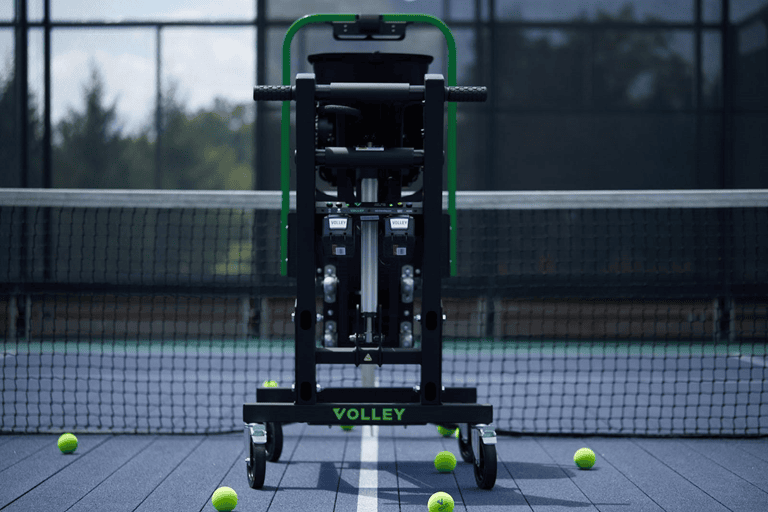
Image: Volley
The Trainer is more dynamic than your typical ball machine. Powered by a rechargeable battery with three-and-a-half hours of life, its height is adjustable up to 87 inches high, and its tilt between 56 degrees up, -38 degrees down and 34 degrees left/right, to simulate a wide array of shot angles for players to train against. It is equipped with multiple stereo cameras and an NVIDIA computer vision system to track player and ball movements, plus an LED screen and speaker to guide workouts. Through the company’s mobile app, players can program the Trainer to execute its desired practice program, watch film, or review play time statistics (i.e. balls hit, time on court).
“We have this model that we’ve built in the cloud of what the platform tennis court should be, where people are positioned, what all the shots might be. And we’ve analyzed through match play based on people at different levels a schema of what they would see at that level. You’re not going to go out there as a beginner and get a 120 mile per hour serve thrown at you,” Weinlader said. “You would go out there as a beginner, and we already have a profile built up, from watching match play, of what beginners typically would hit… That’s the first part of the AI side of this.”
The vision system can also track shots hit towards it, which, in a development coming “very, very shortly,” according to Weinlader, will allow users to play out entire points against the Trainer, with the machine’s return shots timed precisely to when a human on the other side of the net would strike the ball.
The company does not charge clubs anything upfront to carry its Trainer. Users instead can use the system once ($30) or purchase a monthly ($40 per month) or yearly subscription ($300), which is revenue-shared with client clubs.
“It’s all cell phone controlled,” Weinlader said. “The machine lends itself very well to an account-based model. This is a bit of a shift from typical ball machines.
“We give the machine away to the club and then members subscribe to it. In subscribing, they get their own account and that tracks their number of workouts that they did, it tracks their history, it tracks their video clips that they can then share with their pro for virtual coaching.”
As of now, Volley is available for platform tennis and padel, with pickleball coming soon. Weinlader hopes partnerships like the latest with the APTA will raise their profile even more.
“We’re looking to get some experience with customers, interfacing the machine that way, to help build our awareness,” Weinlader said.
The five-time grand slam champion on the evolution of technology in tennis both on and off the court.
A Data & Innovation article brought to you by
You can’t have a discussion about sports technology today without including athletes in that conversation. Their partnerships, investments and endorsements help fuel the space – they have emerged as major stakeholders in the sports tech ecosystem. The Athlete’s Voice series highlights the athletes leading the way and the projects and products they’re putting their influence behind.
* * * * *
Sharapova, now 36, retired from tennis in February 2020 and became a mom in 2022. She also has been active in business, starting her own confectionary brand, Sugarpova, as well as reportedly investing in the UFC, Therabody, Tonal and more. Sharapova recently made an appearance at the US Open on behalf of IBM to discuss its latest innovations and held a small roundtable with a small group of reporters.
On evolution of technology and tactical analysis during her career…
Huge, and also for the teams that are surrounding the player. So imagine you have a coach that looks at the draw, he sees you’re playing against someone and maybe you’ve never faced them before, but he immediately knows how your opponent has performed on the surface against other players. So that analysis is done so much quicker than him having to go out and find videos. ‘What surface did that player play on? OK, well, maybe that doesn’t apply to my player’s match at the US Open.’
Providing tools for your team is also [important]. As a player, you go out there and you play on instinct, and you just become a competitor. When it’s 6-all in the third set, you’re most likely not thinking, ‘Unfortunately, looking back to the analytics, they said I was going to win. It was supposed to be in two sets, and now I’m deep in the third set and we’re in a tiebreaker. This isn’t how I planned my day.’
On key datapoints she sought out…
One stat that was quite good and I was actually very interested in and like to know about: When a player is down breakpoint and they’re serving, what’s their comfortable serve? Are they doing down the T or are they going out wide? And if, down break point, this player goes out wide 80% of the time, as a returner, you take a couple steps to that side to give yourself a chance to not be late to that first serve. So those types of stats really, really helped.
That’s part of the homework that you do with your coach in looking through those tools. But one in particular was second serve percentage. So if an opponent had a weaker serve, you most likely identified it in the stats, so what does that mean? As someone that was quite an aggressive and powerful player, I could maybe take two steps in front and attack that second serve. If a player has a really good second serve, maybe I don’t go for that first ball so much. So there’s absolutely technical aspects [of interest]. It’s one thing to have analytics, but it’s how do you apply to them and what you’re doing that’s most important.
On the timeliness of scouting data…
Recency is really important because the tour is basically cut into almost — I see it, as a former athlete — four parts. You start with the hardcourt season in Australia through Miami, and then you go onto the clay, then you go onto the grass, and then you go back onto the hardcourt. So within those periods, you have sections of success for different types of players based on their weaknesses, based on their preferences. Some players didn’t enjoy playing on clay. They’d skip those four or five weeks of competition and move on to the grass.
It’s a long season, so you have to pick and choose where you believe your game will most likely succeed. So recency, in terms of, what is the surface that this little chunk of time requires you to be on? Are you injured? Have you been competing for the last several weeks? So all that goes into play whereas [the global] ranking most of the time, because it goes back to points on how you performed a year ago, it’s not very relative to today.
On fitness monitoring devices…
I actually didn’t use many wearables. During practice, I would have a heart rate monitor, but [compared to] right now, that’s like nothing. I’d say I was fairly old school in my approach. My team relied on a lot of that — they wanted to know my HRV. But I was more focused on getting out on the court, and that’s why I was emphasizing the team if you can. If you as a player can gain confidence in all these tools for your team, the level of engagement that you will then indirectly have with those tools is significantly positive.
On the growth of fan interest and access…
I remember, the Tour was questioning whether you have fans in the stadium to watch you practice. Right now, as I came to the US Open and I was just flying over here, there was a live feed of the practices. Players are being mic’ed. The evolution of where the game is to where I started — I remember speaking to my manager on whether I needed a social media account.
But there is a part of sport — and then tennis in particular — where it’s down to heritage and tradition. And now I’m on the other side from being a player to being a fan and loving the game so much and wanting more access than just the players playing, the hour-and-a-half or two-hour match. I want more insights, I want to know about their matchups. I don’t see that on a day-to-day basis. So by having these tools in front of me, it’s such a quick way of accessing information and just makes it for a better experience.
On her pre-tournament pick at this year’s US Open…
I hope it’s Coco [Gauff]. If I’m predicting, I think she has an amazing head on her shoulders, I think she has a great vision of the game, and she also has this amazing voice as a young woman for change. She’s created a platform for herself. She’s way above her age in terms of her thoughts and how she speaks, and I find that professionalism so impressive. And that’s hard to find.
On her victory at the US Open in 2006…
The victory here was very special. Besides holding the trophy, in the final I beat Justine Henin, who, when I was growing up, was a huge idol but also the most challenging player that I played against because of her game, just talking about matchups. I think that was my first victory against her was at the finals in the US Open. If IBM was around [with predictions] then, it would have said, ‘Maria has no chance.’
I went into that match just so confident because I was having this great run but also knowing that this opponent in front of me just clearly knew my game so well. And looking across the net and seeing like someone so accomplished, I had only won one Grand Slam, prior to that year’s Open. So there’s a lot going on in your mind. I was only 19 years old. I was still kind of young on Tour, figuring things out. When you are that young — this young success, this fresh success — it is a fresh breath of air because you come from having no experience of these large victories.
[I loved] every little piece of it, I mean, being giddy in the press conference after and like when they offer you champagne, you’re like, ‘Do I drink it?’ When I started, New York was very intimidating. I think for many people, when they arrived in the city, it was overwhelming. And from an athlete’s perspective, when you’re not playing, you’re always recovering, and you’re in a city that never sleeps, so how do I recover? Your mind is always on. And then you just appreciate falling in love with what it brings you, from a fan perspective, from arriving at the US Open and feeling the energy and allowing that to lift you up, especially when you’re having a bad day. As an athlete, it is the best feeling in the world. And there’s no one that does it better than a New York fan.
On the pickleball phenomenon…
I signed up for pickleball, and I’m playing you. You want something? I’m actually I’m playing with John McEnroe in February against Andre Agassi and Steffi Graf. So I have no choice but to get my stuff together. It’s funny how, if you’re a tennis fan, when I mention pickleball, I’m seeing it from the outside because there’s so many racquet sports now. When you’re in Europe, everyone is talking padel. And then you’re in the States, and everyone’s talking pickleball.
So what I like about pickleball is the entry level element of it. Tennis is a very difficult entry level sport. That’s not a secret. For you to feel like you’re competitive, it’s going to take you a few months, so you can get discouraged. Pickleball, you can pick it up and you feel fairly natural soonish. So I love that about it because, thinking from a business perspective with partners and engagement, it’s just easier. It’s also very social.
If I ask my friends to play tennis with me, they’re like, ‘Forget it. Let’s go play pickleball.’ I’m like, ‘I really don’t care [about competition]. I just want to spend time with you.’ They’re like, ‘I’m not going to play tennis with you.’ ‘I’m really not that good anymore.’
Pickleball has become like my entry level with my friends. So yeah, I love the future. I love this future of racquet sports, and it’s another way to engage with the youth. Which when you think about getting children off their screens, and I’m a young mom, so I start thinking about that, how are all the screens impacting my engaging my child to be outdoors and adventurous and having fun and being playful? If that’s pickleball or something else, I’m all for that.
This article was brought to you by SBJ Tech, a Leaders Group company. As a Leaders Performance Institute member, you are able to enjoy exclusive access to SBJ Tech content in the field of athletic performance.
Here are 10 factors that can increase the effectiveness of your recovery practices.
An article brought to you by our Partners

Those two are inseparable as far as Skylar Richards is concerned. He says: “As technology has improved, to allow us to have interventions to help the best they can off the field, that has really given us the ability to look into what’s effective, what’s efficient, and how we can individualise those sorts of treatments to make sure we’re as optimal as possible.”
In Early August, Richards who is an Athletic Trainer with the US Soccer Federation, spoke at a KYMIRA Webinar titled ‘The Evolution of Athlete Recovery’ where he was joined by Mark Pavlik, the Head Coach of the Penn State men’s volleyball team, and session moderator Johnny Parkes, the Lead National Coach at the United States Tennis Association.
“So much in sports science and medicine, we worry not so much about the medicine side of things as much as the optimisation,” Richards continues. “And so really keeping people as healthy as possible is the focus with recovery but also then the art of how to do that consistently within their regime.”
Here, we discuss 10 factors raised during the webinar to consider when seeking to establish optimal, consistent recovery practices with your athletes.
Do you need to prioritise passive or active modalities? Your athletes’ culture of recovery – practices and habits – should tell you. In his time at FC Dallas between 2012 and 2019, Richards noted differences between his younger players, who were happy to visit the recovery lab while they watched tape, and those players in their mid-30s who had families and, frankly, far less time and cognitive capacity. “Those become the tricky puzzles to figure out,” he says. “How can I help them recover in their lives and support them in that? That can be the difference between applying an active modality versus a passive one, a wearable or something like that. It helps them to do it all the time no matter what life throws at them.”
Whatever an athlete’s preferred combination of recovery modalities, there is an important question to ask. “What gives you the biggest dosage of all those things put together in one package, which is easy to manage and to be consistent?” says Richards. “You don’t want them to burn out having to think about stuff all the time.”
A veteran may have a busy life but, as a cohort of largely self-driven individuals, Richards can work with soccer players to “scratch that itch” around self-improvement. “Something that I’ve found I can do well with my older athletes: I’ll say ‘why don’t we try to instal a recovery room at your house? It gives you an hour away from the kids and the craziness to go in, watch some videos, and now read a book. Whatever you need to do justify it as your job’.” Now, the athlete has a consistent pattern of recovery and doesn’t feel the need to, say, go on an evening run that may well clear their minds but has a detrimental effect on their physiology. “We scratch the same itch by helping you rather than sacrificing something.”
The success of Richards’ approach with his veterans has enabled them to take that message to the rest of the team. “Getting them to talk about that approach to the younger players really helps them to buy-in,” he says. With men’s volleyball at Penn State, it sits with Pavlik and his colleagues to educate the archetypal 18-year-old who “doesn’t know what they don’t know yet from a recovery standpoint”. He says: “They’re coming off of club or high school practices at most three times a week, they’re living at home with mum and dad when they wander into our gym, it’s my job to ensure that the educational points that we’re trying to drive home so they can have a longstanding, successful collegiate career, and those that continue to move on through the professional ranks and international ranks with men’s volleyball have something in their background.”
That aforementioned education is best delivered by a friend. In that regard, Pavlik ensures that his student-athletes are surrounded by smart and passionate people who make an effort to build relationships. “We do a pretty good job of getting these people around my team early in their career and, let’s face it, the adage of ‘the team doesn’t care what you know until they know that you care’ [is true],” he says. “When you have these types of experts having relationships with our players; coming to practice, just being around the water cooler during water breaks, being able to just say ‘how’s it going?’ Then when the guys are in a position to listen to what the expert is saying they’re no longer experts – they’re friends, they’re buddies.”
Are there opportunities for you around game day? “It’s always been crazy to me that we control every other variable with athletes all the time, but the one day we completely flip the schedule is game day,” says Richards. “Those older guys love those moments of recovery on the road. For them, it’s less chaotic, it’s easier to focus. So much so that we’ve had a lot of success with having players to stay at a hotel the night before a home game or have that option, so that they can get into that rhythm and we change those practice times to the same as game times so they can get that day before the game rhythm into their bodies and their minds.” The benefits are palpable. “Allowing them to get into that rhythm early on, sleep, get out of that chaos, get their recovery mode early and have time to do any modalities that they want is crucial.”
Customisation is important and, at Penn State, it goes beyond age (i.e. an athlete at 18 versus an athlete at 23). “We look at the age and the experience of the athlete, then we take a look at what their on-court responsibilities are,” says Pavlik. “Some max jump much more often than others on the court during the match or practices. There are going to be some that have to get up the floor a lot more than other guys. What we try to do here is make sure with our training staff and med staff that we understand what we’re asking them to go through.” For Richards, it involves asking better questions. “What is the question for that athlete that we can solve the best? All physiology is too much of a blanket statement,” he says. “Is it overall energy? Is it mental fatigue? Is it truly physical fatigue? Is it something masking as another [marker]? And how can we hit those?”
As moderator Johnny Parkes says, “With all these physical modalities we can use, I think we sometimes forget about the things we can control the most, which is our level of sleep recovery, hygiene and the effect of resetting the body for the next day.” For Richards, good sleep can be an outcome of a holistic approach to recovery. “That’s when you get the most synergistic effect out of all of them,” he says while asking, “Can we create that cycle of measurements to enhance individualisation and effectiveness?” He once again cites the idea of players staying in hotels the night before a game. “It really ties this together in a practical way in terms of ‘let’s get you good sleep in an environment I can go in early and control, make sure the sleep hygiene is there, giving you the time to implement those things well and then tie-in any other recovery modalities you want at the same time’.”
According to Richards, both younger and older athletes are interested in the gamification of recovery, but in different ways. “Younger players thrive for the most part on comparing what they’re doing and being effective versus their peers,” he says. “For an older athlete, I’ve found they’ve passed that point in their life, they’ve been saturated by that already and what you come to is the gamification comes from comparing them to themselves. Can they get a high score? Can they see what’s most effective for them? What patterns help them to be the most consistent over time? Scoring that on a streak becomes the better motivator for them.”
What don’t teams consider as much as they should in recovery and how do we overcome them? “Anything is better than nothing,” says Richards. “We have a huge market for recovery tools and methodologies but I haven’t seen a huge move towards a blend of that. That’s where I’ve been pushing a lot of companies on their research. Can we let the monitoring devices drive the intervention; the duration, the velocity, the frequency and occurrence? Can we use measuring sticks to drive it for individuals; its appropriateness, effectiveness and sufficiency on an individual level? Until we do that I don’t think we’re doing the best we can do to figure out the puzzle, which is an athletic body.”

Are you ready to take your team on tour? Or are you adequately prepared for your next major competition? In answering those questions we seek to give you something to ponder in this Performance Special Report, brought to you by our Main Partners Keiser. In this pages, we explore how training camps can be used to capitalise on a team’s collective knowledge and how trips can be used to develop a team’s sense of belonging. We also turn our lens to contingency planning on tour and the considerations that make for a smart debrief afterwards.
Complete this form to access your free copy of Navigating Your Way Through Major Competitions, which features insights from Swimming Australia, the Lawn Tennis Association, Wales Rugby, Athletics Australia and Hockey Ireland. Each has teams competing in major tournaments this year, and all are bound to give you something to think about in your future projects.
Victoria Moore
Head of Performance Support & Solutions
Athletics Australia
The United States Tennis Association is using data to educate and inform players and coaches alike.
A Data & Innovation brought to you by
This particular maxim may indeed be true more often than not, but two of the world’s top players — reigning US Open champ Carlos Alcaraz and his finals opponent, Casper Ruud — are actually covering a lot more distance, according to data analysis from USTA’s player development team.
“They’re running significantly more because they’re covering more ground to hit the forehand and be more aggressive,” said Geoff Russell, USTA’s Senior Manager for Professional Players. “So maybe, them covering more distance is, relative to the tactical game style that they’re trying to play, that might not be a bad thing. That might be an efficient thing.”
The running habits of the Nos. 1 and 3 ranked players are but one insight gleaned from the Hawk-Eye player and shot tracking data available at every Grand Slam event, including the Australian Open, which took place in January. What the USTA has prioritized in recent years is in-depth assessment of match data in order to inform training. Practice sessions and workouts are tracked by wearable technologies to ensure that players are preparing appropriately to compete and contend at major tournaments.
A key figure in this initiative is Paul Robbins, Kinexon’s EVP of Sports Performance and a member of the USTA Sport Science Committee. Robbins pioneered this type of physical performance monitoring for NBA players as the Director of Elite Performance at STATS, which owned the first tracking system implemented in basketball, SportVU. He continues to consult extensively within the NBA.
Robbins jokes about how impressive the USTA Sports Science Committee is, noting that he’s just about the only one without an MD or PhD. (“I always say I’m the dumbest guy in the room,” he quipped with a laugh.) Now, in conjunction with Russell, Performance Manager David Ramos, medical advisory group member Mark Kovacs and others, Robbins is helping spearhead innovative analysis and training programs in tennis.
“How do these guys actually play? How do we actually then train somebody to play at this level? Their accelerations or decelerations, the loads, the work capacity you need over a two-week period of time in the tournament — things like that,” Robbins said. “It’s basically bringing everything I’ve done for the NBA for 12 years, now, we’re actually at that level for the USTA to be able to do that in our development of our US players.”
During the US Open, the USTA player and coach development staffs introduced the Physicality Index and published a series of web stories using this new metric to describe the intensity and toll of matches. One such piece, discussing the play of the men’s semifinalists, shared the aforementioned insight about Alcarez and Ruud, whose respective 6.9 and 6.6 Physicality Index scores dwarfed Karen Khachanov (5.2) and American Frances Tiafoe (4.8), as did their high-speed distance covered and number of explosive movements.
That public-facing metric was designed to engage and interest fans and, at times, included some sample workouts that competitive players could undertake to prepare for such demands. But the player development work runs much deeper.
Russell and Robbins drove from the greater Phoenix area out to Indian Wells for the BNP Paribas Open in October 2021, and over the course of the roughly eight-hour roundtrip drive, they designed most of the new tech-infused, player development program.
The first order of business was to assess the current practice routines among highly rated junior players at the USTA campus in Lake Nona. Performance Analytics Coordinator Katherine Gonzalez tagged every drill in the data management platform to help develop these baselines.
Early questions raised by Robbins, whose specialty is in metabolics, were about training the necessary energy systems: “Do we need a 15-minute drill? if you’re trying to mimic what’s happening in a match, that’s two minutes. You want to go at a much higher intensity to do that.”
One revelation of this work: several coaches were using mini-tennis — a rally-driven exercise using only the service boxes — early in training session to get their players loose.
“They were calling it their warmup,” Robbins said, “and that turned out to be the highest intensity drill. It’s like, ‘I don’t know if we want to start with the highest-intensity drill.’”
Providing education to the coaches is the important first step, and they’ve been largely receptive to the explanations they’re hearing.
“Coaches have the right intention,” Russell said. “They’re trying to do the right things, but they just need to understand the why — the effects of what they’re doing.”
USTA leadership has been supportive, he added, because every stakeholder in development stands to gain from the infusion of data and video to track not only physical load but stroke volume and heart rate, too. RPEs, the common shorthand for rate of perceived exertion scores, are also valuable data points from the athletes themselves even if they are inherently more subjective.
These sources appeal to tennis coaches, strength coaches, athletes, the medical team and also the mental skills coaches, with Russell noting the applicability of heart rate data as a proxy for pressure management. After all, physical, technical and tactical performance are inherently intertwined. The USTA performance team’s preview of the women’s semifinal, for example, used the data to show how Ons Jabeur and Caroline Garcia minimized their exertion by controlling court position, rarely standing far behind the baseline, by using their strength to return shots from closer in and rallying with powerful forehands.
Every player has his or her own style of play and requisite physical thresholds, but as the data gets collected and analyzed, the USTA can create clusters, or buckets, of player profiles who would all benefit from similar training. That serves as a base for further personalization.
“Going back to Alcaraz, I mean, those accelerations and decelerations that he had — and not only just one or two, he just kept doing it — you’ve got to train for that,” Robbins said. “And that’s what we’re trying to do is understand what the matches are. And then how do we how do we adjust our drills to do that?”
This article was brought to you by SBJ Tech, a Leaders Group company. As a Leaders Performance Institute member, you are able to enjoy exclusive access to SBJ Tech content in the field of athletic performance.
The former US Open champion discusses Hawk-Eye’s use in tennis, using Whoop to further research on women’s health in sports, and how the WTA is supporting the mental health of its players.

You can’t have a discussion about sports technology today without including athletes in that conversation. Their partnerships, investments and endorsements help fuel the space – they have emerged as major stakeholders in the sports tech ecosystem. This series highlights the athletes leading the way and the projects and products they’re putting their influence behind.
A native of Fresno, California, Stephens also returned from a foot injury to win the WTA Comeback Player of the Year in 2017 and was a finalist at the 2018 French Open. In February, she beat Marie Bouzková at the Abierto Zapopan tournament in Mexico to capture her first WTA title since 2018.
Stephens, 29, has earned more than $17 million in career prize money and is currently the 37th-ranked singles player on the WTA Tour. Earlier this year, she partnered with Icy Hot, joining Shaquille O’Neal, NFL tight end Darren Waller and USWNT soccer star Rose Lavelle as ambassadors for the company. She recently promoted the new Icy Hot PRO cream and dry spray pain-relief products while attending a pickleball event in New York City alongside the National Athletic Trainers’ Association.
“If you’ve used Icy Hot, you know what it’s like, but this version is just little bit stronger, it works faster. It’s for that everyday person who’s training, getting massages with their trainer,” Stephens told SportTechie at the John McEnroe Tennis Academy.
Stephens is also a member of the Women’s Performance Collective, the research initiative from wearable fitness leader Whoop to study female athlete performance. She is also a proponent of tennis expanding its use of Hawk-Eye, the electronic line-calling system that replaced line judges at the 2020 US Open and 2021 Australian Open. Hawk-Eye’s camera system remains limited to video review challenges in most ATP and WTA Tour events, and it isn’t used at all at the French Open.
On supporting Hawk-Eye but being conscious of the jobs that could be lost . . .
I grew up with line judges, with referees. Just a few weeks ago in Guadalajara I had a terrible line call against me. We were using Hawk-Eye and the chair [umpire] made a mistake. That was a human error. Hawk-Eye didn’t make the mistake, but the linesperson made an error. We reviewed it on Hawk-Eye, it was a mistake. Then the umpire made another bad call, and I ended up losing the game. There’s a lot of human error element that we no longer need. We don’t want it either, but we don’t need it because there is automatic calling. We don’t need people to be on the court.
Mind you do that does take away jobs, it takes away livelihoods of a lot of people. But I feel like in sport, there’s too much money on the line, ranking points on the line, contracts on the line, for people to be making human errors in the sport where we’ve advanced so much that we can see line calls live as they happen. We shouldn’t have any errors in our sport, especially when you’re playing for hundreds of thousands of dollars, sometimes millions of dollars. That little bit can change the course of a match. And that makes all the difference in the world.
From a chair umpires’ perspective, you have to be ranked super high to be a gold badge level umpire, which people work their whole careers for. And now we’re being like, ‘Okay, we don’t need you anymore, because we have automatic calling.’ So it’s kind of a double-edged sword. You lose jobs, but you gain a lot of clarity in the sport, which I think is important. But obviously, tennis is a very traditional sport, any change is always very hard to make. It’s always something that has to be thought of for like 10 years before we actually do anything. So we’re in that phase now.
On her partnership with Whoop …
It’s great because it’s for sleep, recovery, it’s to track all of those things. There’s been fitness trackers before and all those things before but this one is a little bit more advanced, tracking your menstrual cycle, your HRV [heart rate variability]. In sport, every little bit matters, especially when you’re at the top of your sport, the top of your game. So being able to monitor your sleep and your routines, like if you didn’t get enough deep sleep, or your sleep [score] decreased because you slept more. All those things matter when you’re performing at a high level, especially day in and day out whether you’re training or you’re competing in tournaments. So being able to partner with Whoop is amazing, because it helps not only me, but all of the players — men and women on the tour, it helps everyone.
On data ownership and using Whoop to further women’s health research …
We don’t have a union. We have our Tour, which owns the data because the partnership is with the Tour. But we own I believe all of our own personal data. They can use it and have access to it and can do research on it. But we own all of our own data. We’re all technically independent contractors. So we own all of our stuff.
But obviously, we use it to help other athletes. We use it to help monitor menstrual cycles of top performing athletes and then help people who are just weekend warriors or people training for tennis. And women just don’t have enough data and enough science behind all of these things. There’s not enough research. So being able to contribute to that has been super helpful. Just helping the next generation of athletes because we are collecting data for women in sport, we’re trying to make it more advanced and we’re trying to move the needle a bit. All of these things and all these things that we’re monitoring help a lot
On strides the WTA has made to support mental health….
There’s always work to be done everywhere, but I think the WTA does a great job. We have people on the road, therapists on the road that we can talk to in person and make appointments with. There’s a lot of support on the road just because we are all isolated and by ourselves most of the time. A lot of us do need that little extra support, we travel 40 weeks out of the year away from family, friends, husbands, wives, whatever it is, and it is difficult. The WTA has done a good job to support us to make sure that we do have those people on staff and on hand week in and week out.
And I think that’s been super beneficial, especially because COVID through us all for a loop so we are kind of getting back to normal but in a way that we feel more supported and have more access to things that we didn’t before like Modern Health and the Calm app. All of these things are just extra little things that we can use to help self-soothe ourselves and whatever it may be whatever we need in that moment. So the WTA has done a good job at trying to make that happen for us.
On how she uses Hyperice’s massage and recovery products …
I am an investor in Hyperice. I use NormaTec, all of the Hyperice gadgets — the Hyperice Go, the Hypervolt, which has been super helpful. It’s something you could travel with, be on the road with. I use [Hyperice products] for warmup and then I just use it when I’m sitting in my bed, laying around. It’s good post-match, too, but post-match, I’m getting more manual massage with my trainer, my physio so that’s a little bit different. But you can kind of use it wherever, I just did it on an airplane.
This article was brought to you by SportTechie, a Leaders Group company. As a Leaders Performance Institute member, you are able to enjoy exclusive access to SportTechie content in the field of athletic performance.
