
21 May 2025
ArticlesIn this exclusive column, performance specialist Iain Brunnschweiler outlines how he fights the inevitable nerves with tools he has picked up during a career spent in elite sport.
The anxiety felt almost totally consuming. His legs felt heavy, and he doubted that any words would come out of his mouth when and if he did attempt to start speaking. His brain was scrambled with a hundred thoughts, which seemed impossible to coordinate into anything helpful.
The year was 1995, and that boy was me.
I honestly cannot remember what I spoke about, but I sure remember how it made me feel.
Everyone was looking at me. I felt so insecure and so nervous it was almost unbearable. It felt very different from the sports field, where I felt at home. On the field of play I felt like I had permission to be myself. But I did not feel it there on that stage.
Fast forward 30 years, and I stepped onto the stage at the Royal College of Music in front of more than 120 sports leaders from around the world at Leaders Meet: The Talent Journey. I was privileged to be afforded the opportunity to facilitate the event for the Leaders Performance Institute.
The nerves were there again, however, over the past 30 years, I have developed a range of resources to allow me to adopt a more preferable state to be able to speak in front of people.
Confidence and humility: a tricky balance
Humans are remarkable things, aren’t they. We’re all individual, all experiencing the world in a unique way, all dealing with themselves on a daily basis and simultaneously seeking to demonstrate something to the outside world. We all have varying levels of self-awareness and varying levels of skill in dealing with the questions being asked of us in our own contexts.
Consider some of the situations a sports leader might find themselves in: starting in a new leadership role, rallying your team during difficult times or times of change, seeking to inspire others through your words or actions. Now for those of us who have seen skilful leaders or coaches in practice, some of these skills can seem effortless. However, behind that skilful act is undoubtedly someone who has wrestled with their own feelings of doubt or insecurity and drawn upon their own experiences in order to choose and deliver an appropriate response to their audience.
Being able to speak up with a balance of confidence and humility can be tricky. And it is a skill that may be the difference in the career trajectory or simply contentment of any aspirational individual.
Actors, agents and authors
I remember being shown some research by a fabulous person, colleague and psychologist, Malcolm Frame, called ‘The Psychological Self as Actor, Agent, and Author’. The paper is written by American psychologist Dan McAdams, whose work talks to the developmental journey of any human. My interpretation of McAdams’ work is that the ‘Actor’ is the social self, the ‘Agent’ is the motivated self, and the ‘Author’ is the narrative self.
As Malcolm told me: “Embracing this cycle each day isn’t just self-improvement – it’s building an unshakable architecture of strength, capacity and resilience within our very operating system.”
As a more novice practitioner I was certainly an Actor. Concerned almost solely with how I was perceived and wanting to be liked by everyone.
For example, when I first accepted the role of a national coach within the England Cricket pathway, I was unsure how to be. I struggled to understand what was required of me. Having to stand up and speak in front of some of the most talented young players in the country, as well as the brilliant support staff that I was working with, felt like a huge stretch.
I felt high anxiety when I was ‘on show’ and witnessing the show going on around me. As I developed and became more experienced, I realised that my motivations and aspirations could not be reached if I was not able to override my anxieties and take action towards my desired outcomes. As an Agent, I was able to step onto ‘the stage’ and make choices that were my own.
After more than 25 years of striving in the elite sporting context, I finally feel that I am able to become more of an Author in my own context. I can control the narrative more effectively to serve me in the way I find helpful. It helps for me to have reflected on my past experiences. Successes and failures, taking learnings from them that can help me in the present, as well as support me in the future.
Nerves are not necessarily a bad thing
Having reached a senior role at a Premier League football club, I was interacting with directors and owners and being asked to make major decisions that would affect numerous people. Whilst never easy, I was more comfortable in doing so, having been on such a journey. The moments of bravery earlier in my career which felt incredibly tough, were now serving me in the moment.
The stories that I now tell myself about my past, help me to feel more well-resourced in the moment. I have accumulated a broad range of experiences which I can draw upon now, and allow me to both enjoy it and embrace however I am feeling. Tactics such as self-talk, the use of perspective, and an acceptance that I prefer to be playful rather than serious, all serve me and allow me to accept my emotions. I have certainly not solved this! However I am very clear on the progress that I have made.
So, as I stepped onto that stage in 1995, my nerves were similar to my nerves in 2025. However, I was now more well-resourced to acknowledge and accept them and even use them to my advantage. Being nervous now lets me now that I care about what I am doing. That it is important to me. And that’s OK.
I don’t think any advice would have helped that boy in 1995. It was stepping up onto that stage that he needed.
Iain Brunnschweiler runs the Focus Performance Consultancy. He is a former professional cricketer, has authored two published books, and previously served as the Head of Technical Development at Southampton Football Club.
What to read next
Former netball player Vicki Wilson describes her journey from the court to coaching, high performance and sports administration and offers advice to aspiring female athletes.
In April, Vicki Wilson, Director at the Brisbane Broncos, joined our group call. Women coaches and practitioners from across the globe gathered to listen to Wilson tell the story of her journey from athlete, to coach, to high performance manager, and now a member of the board of directors at the Broncos. Hers is a story we wanted to share more of and to learn from.
What has propelled Wilson’s career?
From Wilson’s perspective, she believes she has an eye for detail and an ability to plan, whilst wanting the best for athletes. She enjoys imparting knowledge, as well as gathering knowledge to extend her perspectives. She has also always been determined to be better. Having been an international athlete herself, Wilson can also lean on those experiences to guide her work. She’s also adaptable and, since her days playing netball, has always asked questions and seeks to understand ‘why’.
A key lesson was when she was dropped at an early stage in her playing career. It came just as she thought she would be made captain. The lesson she took was to never take anything for granted. This has resonated with Wilson every time she has applied for a role since. It also means she will quickly move on to the next challenge.
What drives success?
To help people succeed Wilson shared some tips:
Support your high performance managers
Contrary to instinct, Wilson believes sitting with high performance managers and helping them with their planning is critical. Many will have come from a coaching background and might not know the role fully. It shouldn’t be assumed that they know what’s expected and what needs to be done. Expectations need to be shared clearly before a season starts. It’s about shaping this support around learning, and being their ally and not wanting them to fail, rather than trying to catch them out and needing them to show they know everything already. It really is about eliminating all assumptions.
Wilson’s inspiration
Wilson wanted to mention the women head coaches who were part of the original Australian Institute of Sport. There weren’t many, and they experienced difficult moments. However, they paved the way for others by challenging and contributing when in shared spaces between sports. They were avid readers and learners, many working in academia. They also showed that women coaches can be as successful as men. Wilson has been inspired in particular by Wilma Shakespeare, who was an international athlete, captain, coach, administrator, Queensland Academy of Sport CEO, and eventually travelled to the UK to be the founder and first National Director of the English Institute of Sport [now UK Sports Institute] in 2002. It is Shakespeare that inspired Wilson to explore administrative roles.
Thinking of joining a board of directors?
Wilson spoke about her advice for those who are interested in joining a board. She recommends sitting with someone who has done the role. This will help you fully understand what’s expected, and what’s your purpose in that role. From her experience, it’s about challenging management; making sure they’re doing what they said they would and asking them if it could be done better. It’s also about managing staff and athletes, and getting to know everyone in an organisation at a personal level.
Wilson fielded questions from the group too. They asked about:
Her challenges along the way
Wilson was open enough to share where some of the biggest challenges have laid – fortunately our previous community call attests to changes in ways of working. It has happened that athletes who are closing in on retirement have wanted the decision to be made for them. As you can imagine, that hasn’t made it easier for them to accept said decision. Wilson has also learnt the importance of an administrative team who are supportive and aligned to your values, having lost a role, alongside others, when strong decisions were needed. She is also grateful for the work done by many to have changed the way athlete pregnancy is treated.
Planning for the logistical realities
It’s not always spoke about, but coaches and other staff will make decisions, and have decisions made for them that can leave them unsure of their future and exposed financially. Wilson shared that she has found that when it mattered, things gained positive momentum quickly for her. Small contracts came in, moves to different countries weren’t as terrible as feared. She learnt to be open and once she’d accepted something be all in. Wilson has learnt to not panic, and importantly, to back her own skillset. It helps that she has a positive mindset, and that she’s always been a naturally good connector.
The group reflected on…
1. What their organisations are doing to support them. Answers included:
2. What they would like to see in a dream world:
3. How they’re supporting others:
4. Resources recommended for learning outside of sport:
What to read next
Here are five tips from Chelsea and the Ineos Grenadiers in their pursuits of future success.
Drawer had just completed his first season as the Performance Director of the Ineos Grenadiers cycling team – a team with whom he enjoyed immense success in their previous incarnation as Team Sky between 2016 and 2018.
In recent seasons, the Grenadiers’ success has tailed off. Drawer’s return is part of the team’s attempt to restore their lustre.
“You look for these elements of when the team was super strong and maybe some of the changes needed at that time didn’t necessarily happen,” he added in reflection.
Drawer was speaking with Chelsea’s Director of Performance Bryce Cavanagh, who also inherited a team treading water in 2023.
“Our situation is probably slightly different as they’ve been through so much turmoil,” said Cavanagh of Chelsea, who underwent a change of ownership in extraordinary circumstances in 2022. It marked the end of an era in which Chelsea’s successes underlined a shift away from the traditional powerhouses of English football.
Back in 2003, Chelsea were disruptors in their field. The same could be said of Team Sky in the 2010s when they transformed road cycling through their innovative approach to performance.
Both have since retreated into the pack, with Cavanagh admitting that entrepreneurial spirit was lacking in Chelsea’s performance department when he arrived. “There was probably a scenario where the change is seen as a threat,” he said. While there was a desire and willingness from the club’s new owners to deliver change, “people saw that as a risk that created vulnerability in their roles.”
The challenge is clear, but Cavanagh combined with Drawer to offer five tips to performance directors charged with restoring the good times.
1. Look for ‘clarity, competence and community’
Cavanagh, who in addition to the more traditional elements of his role has been tasked with a “cultural reboot”, immediately set his stall out at Chelsea with his stated desire for ‘clarity, competence and community’.
He asked two questions as he began to address the clarity piece:
Cavanagh also sought to understand the competence of the system (not individuals) with further questions:
Additionally, Cavanagh’s conception of community is as an outcome of the values, behaviours and definitions agreed by the collective.
“We had to really define where we wanted to go and what the bus looked like because then people ended up self-selecting,” he said.
2. Set standards… slowly but surely
Do not assume that high performance standards are a given across the board. Variations are common and a performance director must be prepared to ask, as Cavanagh did, “what are the things that you walk past? That you are willing to accept?”
Many have been tempted to emulate revered environments such as the New Zealand All Blacks’, but that wasn’t necessarily going to help Cavanagh at Chelsea in the summer of 2023.
“I tend to look at it like an election where you’ve just got to get the majority, and if the majority starts to [behave a certain way], that’s the culture that end up in power and every vote that gets laid is slowly going towards that,” he said.
“We weren’t the All Blacks. They’ve laid down their votes over 100 years and any new person who walks into that environment knows what’s accepted. Our environment wasn’t like that, so we’ve had to slowly and surely create it. We’re not there yet, but we’re on our way.”
3. Pay attention to your people
Drawer craved data insights that demonstrated how the sport of road cycling had developed in his six years away from the sport, but he also takes time to speak to his people – the ones working on the front line.
“Lots of staff wanted to share opinions, ideas or anecdotes in meetings around ‘the sport’s changed, it’s a bit like this’,” said Drawer, who welcomed their views. “Data and evidence is just as much people sharing opinions, ideas and observations as it is studies into how our team may be training, changes in racing patterns, probabilities.” He is “building this wealth of understanding and insight around what’s going on.”
4. Celebrate successes, however small
Cavanagh freely admits that his instinct is to go for the performance gap, but he has had to check himself because he has seen the value in celebrating wins, however small.
That goes for his department, but it also goes for the players. “Every player in our club now has an individual development plan at a first team level,” he said. “They work on that every day that they come into the club, which is quite unique.” When targets are hit, whether in the gym or on the pitch, it is a cause for celebration.
5. Decide the stories you tell about yourselves
No sports organisation can control what people say and think, but they can influence the internal narrative. And the more positive it is the better.
“This is more of an entrepreneurial time for us,” said Drawer. “We have adopted a startup mentality and will say ‘let’s try stuff. If it doesn’t work, what’s the worst that can happen?’ Because we’re not where we want to be at the moment and I think that’s just beginning to happen.
“Hopefully when the season starts we come out fighting in a very different way. We’ve spoken about it last year, but the idea of feeling that you can never crack it is the mentality that we need.”
What to read next
With Practice, Anyone Can Lead a Courageous Conversation… and ‘Skilled Candour’ Can Help
What sets apart an effective, efficient and successful high performance team in sport? Smart protocols, for sure. There’s plenty to be said about useful technology, too. But the overriding factor is the individuals who come together in service of the athletes.
“Our goal is to put the athlete in the centre and then we fit the jigsaw pieces around them,” says Simon Rice of the Philadelphia 76ers.
This universal goal has long inspired Teamworks’ efforts to support high performance teams in their delivery of personalised and unified support to athletes. We understand that because the jigsaw pieces often move, practitioners must be able to see the complete picture in real time as they make high-stakes decisions.
High Performance Unpacked delivers a snapshot of that world through the eyes of the specialists who grace this Special Report.
Beyond the NBA, we hear from the worlds of the English Premier League, NFL, WNBA, motorsport, Olympic and Paralympic sports and others.
We explore how high performance roles and structures are evolving; tackle the question of scalability, which often comes down to the ability of interdisciplinary teams to elevate the collective and surmount the growing complexity of high performance environments; we then shift the focus to athlete care and ponder where the balance needs to sit between challenge and support while asking how tech can be best leveraged to meet the athlete’s needs; lastly, we ask how tech and data set the stage for the innovations that deliver efficient and effective high performance programmes.
Complete this form to access your free copy of High Performance Unpacked: Interconnected Performance Teams.
Tips gleaned from a Leaders Virtual Roundtable titled ‘Generating organisational alignment: what to consider and work works’.
Alignment is perhaps more crucial than ever in high performance, yet as this practitioner noted, it is absent too often.
They were speaking at a Leaders Virtual Roundtable that dug into the topic.
“We’ve got a large team of staff, whether that’s coaches, practitioners, athletes, and that starting point of knowing where you’re going or what you’re aiming for is really important,” said one attendee who works for a Premier League team. “Then we build a strategy around that. So what we’re looking to do and the type of things we’re trying to do – and the things we’re not going to try and do.”
“I think the point of making it intentional is a huge one for us,” said another participant who works in the NWSL. “That’s been a huge emphasis with us as a staff this year – just making sure that we are all aligned and all on the same page.”
It takes time and effort and, over the course of the conversation, the participants shared their experiences and offered some best practice tips to help you and your team.
Alignment starts at the top
The consensus was that alignment flows from the top of an organisation. The table said that senior leaders must articulate an organisation’s goals and consistently reinforce them.
“Ownership has come in and been very clear about the goal of the club,” said the practitioner from the NWSL. “We want to be a leading global sports franchise, not just within the soccer space, not just within the women’s football space.” It is a lofty aspiration but all staff members understand the aim.
Find the low-hanging fruit
Next is identifying the obstacles, “the low-hanging fruit”, which means “each department approaching the general structure of practice by identifying what’s important and then identifying how you’re going to measure those things,” as a participant working in Major League Baseball explained. “Then you break that down into its subcomponents and figure out how you’re going to identify where the lowest-hanging fruit is to then solve those problems.”
Frequent check-ins
Find opportunities to check against your team’s objectives. As one attendee said of their team’s meetings, “we started with the end goal for the end of the season and how we are going to break that up.”
It requires “crystal clarity,” as another attendee put it. They said: “do we reduce the amount of interpretation, and then on the back of that, how are we checking for understanding?” It cannot just be a case of the leader “broadcasting” messages of expectation or definitions. “What’s actually being heard and understood? How frequently do we check that?”
Develop a common lexicon
Words are critical in ensuring that athletes are presented with a united front. “That comes with knowing what are the goals, the mission, the vision of the club,” said the same attendee, “and then all being able to speak from a common language.”
“It’s in how we use strategy and try and bring it to life,” said another attendee. “I’ve seen staff buy-in, not only in one-to-one meetings or annual reviews, but day to day. They are using the language that exists in our strategy – we’re talking the same way, and we’re trying to achieve the same things.”
Let staff shape how your vision comes to life
As a leader, it is also critical to understand staff motivations and aspirations. “There’s so many compartmentalised pieces to some environments,” said one attendee with knowledge of the British sports system. “How do we actually align where there are different motivations and aspirations?”
“If you get buy-in from people and input from day one, I always find that more impactful,” offered one participant. When people are invested it leads to smarter ideas and strategies – and everyone understands how they can help to achieve them.
Make accountability the norm
Each department must articulate their goals within the bigger picture. One attendee said: “We all have a vision of what each department is working towards and who’s going to be responsible for those elements.” A team can also ask, “‘this is what this department is working on – is that getting us to where we want to go?’”
Where your values are on the wall, they can serve as a useful conversation-starter. One attendee, who works as a director of performance, spoke of approaching a staff member “standing in front of our strategy and saying, ‘where’s the work you’re doing? Where does it fit in our strategy? The acid test is they say, ‘oh, yeah, I work on this, and I know I contribute to that’. If they can’t do it then that’s on me, because we haven’t made it really clear where their work fits.”
Where there’s progress, you can celebrate the wins. “People get the chance to be appreciated. ‘OK, this is what you’re working on, this is how it’s going’” said the participant from a club in the NWSL, “and we can celebrate the victories where we’ve started to move the needle towards that ultimate goal.”
Be agile in your programmes
Alignment is not fixed, it requires constant revisiting. As one attendee said, “when we start to add more staff and the structure sometimes becomes redundant” as reporting lines change. The risk is “you have people who are tied to titles and roles that may not function anymore.”
Therefore, it is important to move beyond grand gestures of alignment and place emphasis on those day to day interactions. “The behaviour layer”, as one attendee phrased it. “‘If we do this well, we would see this, this and this’. So now you actually have things to hold people to or, if they are demonstrating it, celebrate it. ‘Great! Let’s have more of that’. If they’re falling short, ‘let’s have a conversation. Why aren’t we seeing some of that? It’s taking it from the grand gesture to the day to day: ‘demonstrate it, live it, breathe it’.”
3 Mar 2025
ArticlesFrom integration to performance under pressure, we shine a light on the topics that engaged our high performance community in February.
“The coach knowing their players, having good relationships and understanding what they need – this sets you up for success. They also let talented people around them do their jobs. This is particularly important when the pressure comes and you need to remember that everyone is there for a reason.”
With those words, Moore, a renowned orator amongst AFL players, neatly captured some of the performance conversations happening across the Leaders Performance Institute.
Here, we pose five questions, all of which were answered in some shape or form during February. We hope these to help you on the path to being a better coach or leader.
Dr Robin Thorpe has instant reservations when performance departments describe themselves as ‘integrated’.
“It’s become a new trend or buzz term in high performance,” said the former Director of Performance at Red Bull. “I’d be really interested to see how many self-proclaimed integrated departments and processes actually are.”
Thorpe was speaking at the first session of ‘The Future of Performance Sport’, a three-part Virtual Roundtable series brought to members by the Leaders Performance Institute and Exercise & Sports Science Australia
In a truly integrated department, he argued, there has to be “positive and respectful challenge between staff and then between the disciplines” and he is unconvinced that this is always the case in many environments.
“Not to be controversial, but I would think that in some of the areas or places where true integration is preached, there might actually not be any collaboration whatsoever,” Thorpe added. “And so, without collaboration, there might not be any friction points or any challenge, so it might only be perceived as an integrated process.”
There’s plenty those goes into it, as high-performance specialist Rachel Vickery said during a Leaders Virtual Roundtable.
For one, a coach’s words and actions are critical in high-pressure moments. “As soon as something is set up as a threat – ‘if we don’t win this we’re not making the playoffs’ – the stress response kicks off,” said Vickery. “If we can flip that to opportunity – and I’m not talking about rainbows, crystals and unicorns – I’m talking about intentional language; ‘how clean can we play this?’ The language is really important in those moments.” She also spoke of a Premier League coach who worked to de-escalate his own arousal state before giving half-time team talks. It also important for coaches (and their teams) to not fall prey to the notion or narrative that an undemonstrative touch line figure is somehow disinterested.
Appreciative inquiry is a social constructivist-informed model that seeks to engage people in self-determined change. The model, which was devised in the 1980s by David Cooperrider and Suresh Srivastva, is inherently positive. It focuses on discovering and amplifying the best of what already exists (individually and collectively) within a system or organisation.
The idea was discussed in great detail at our most recent Leadership Skills Series session.
Appreciative inquiry stands in contrast to most change models, which tend to identify problems and seek to fix them.
The generational gap in sport applies to athletes and coaches, but the term just as readily applies to coaching and performance staffs, as was discussed in this Leaders Virtual Roundtable.
One environment, in preparation for the 2026 Commonwealth Games, is asking its athletes and coaches a series of questions as they seek to bridge the generational gaps.
“We’ve been getting athletes into a room and asking ‘how are you experiencing this environment?’” said the attendee who shared the story. “We ask ‘do you feel like you’re developing? And do you feel like you’re successful along with your wellbeing is being looked after?” They ask coaches: “What is your intention in terms of the environment or the experience that you’re trying to create for athletes?”
There has been some positive outcomes. “This insight has led to some activities that coaches and athletes can engage in to bridge that gap and make it more likely that people are collaborating efficiently and effectively on the path to get that goal.”
It may sound counterintuitive, but you really should.
David Burt, the Director of Entrepreneurship at the University of New South Wales, delivered a presentation at the Leaders Sport Performance Summit in Melbourne in which he lauded the value of exploring ‘terrible ideas’. His rationale was sound: it reduces the negative emotions that can cloud creativity and reduces the impact of power dynamics in a team environment.
Burt said: “Terrible ideas allow you to develop new skills and meet different people in the process. There is a surprising amount of value in implementing a little bit of resource in them to drive another layer of growth.”
27 Feb 2025
ArticlesIn this Virtual Roundtable, brought to you in partnership with ESSA, Robin Thorpe and Lyndell Bruce explored four areas where the practitioner of the future will need to excel.
An article brought to you by

“It’s become a new trend or buzz term in high performance,” said the former Director of Performance at Red Bull. “I’d be really interested to see how many self-proclaimed integrated departments and processes actually are.”
In a truly integrated department, he argued, there has to be “positive and respectful challenge between staff and then between the disciplines” and he is unconvinced that this is always the case in many environments.
“Not to be controversial, but I would think that in some of the areas or places where true integration is preached, there might actually not be any collaboration whatsoever,” Thorpe added. “And so, without collaboration, there might not be any friction points or any challenge, so it might only be perceived as an integrated process.”
Thorpe was speaking at the first session of ‘The Future of Performance Sport’, a three-part Virtual Roundtable series brought to you by the Leaders Performance Institute and Exercise & Sports Science Australia. The first session explored the ‘future practitioner of high performance’.
He was joined on the virtual stage by Deakin University’s Dr Lyndell Bruce, who harbours similar reservations when it comes to integration.
She said: “So often we see with these integrated teams that an athlete has poor performance. So they throw everything that’s been working really well out the window to try and solve why we’re not winning – and that suggests that it’s really not an integrated team.”
The future practitioner will need to find the answers and, here, we detail four considerations, including better integration, that will help to stand them in good stead.
Both Bruce and Thorpe believe that the future practitioner will combine technical knowledge and softer skills
“People call them ‘soft’ skills – I like to call them transferable skills, complementary skills,” said Bruce. She also pondered how they might be taught. “It’s challenging because it takes time, it takes effort, and it takes resources. It’s too easy to say students will get that in their work, integrated learning, because we know it’s not the case. They don’t all go to the same environment and we can’t control those environments.”
There are questions to be answered on the technical side too, with Thorpe emphasising the importance of detailed and applied research. “We delve into research articles which might be relevant to what we do, but we also see how they associate with the work that we do,” he said.
Thorpe also believes that generalists will continue to have their place. “Although specialisation will offer a lot more opportunities for younger students and practitioners going forwards, I hope that we don’t lose the more generalist skills that I think are very, very effective currently.”
Thorpe sees AI as a potential time-saver, but with caveats. “I think we know that AI can certainly support us with is enhancing processing times when it comes to using and working with data that we have,” he said. “We’ve come into this era of plug-and-play technology, which means that our ability to cope with data has become stretched.”
However, he added, “I certainly don’t believe it’ll ever be the silver bullet to a lot of our performance problems or challenges or questions.” It is no surprise that he preaches caution. “I think we still probably need to think about some of the principles of why we’re collecting some of that data in the first place.”
At Deakin, Bruce and her colleagues have gotten used to students using AI to craft responses. She said: “The conversations are leaning towards how we teach students to use this in an advantageous way.”
And, as she observes, “many organisations are using those machine learning models to create outputs, look at different tactical and technical elements of match play, to understand the physiological data that they’re receiving, so I don’t think that’s unique; and I think there’s still a way to go in terms of how we use that and how we implement that more effectively.”
Wellbeing – and psychology as part of wellbeing – continues to grow in prominence, with all staff members called upon to play their part.
“It’s not a once-off conversation because they flagged on the wellbeing this week and then two weeks later they’re back in their normal range – we continue that conversation and check-in,” said Bruce of her work Deakin. She also noted the growing specialisation in how psychology is used in sport. “We use psychology from a performance perspective and also a clinical perspective.”
Thorpe was responsible for mental performance in his most recent role. “It was very much a pivotal learning opportunity for me; to understand the continuum of how mental performance operates,” he said. This included performance under pressure, helping athletes to deal with increased mental loads in training and competition, and psychological profiling.
Integration is increasingly difficult in a world of growing specialisation with so many inputs to reconcile, but Thorpe and Bruce both offered some tips.
For his part, Thorpe emphasised objectivity, particularly given the different ‘languages’ that individuals in different fields will speak. He says: “How can we use objectivity as a common language? Good objectivity – not AI-based reams and reams of data – but really solid precision-based objectivity is our vehicle to integrating approaches.”
High performance teams need to understand the desired outcome, then, as he asked, “how do we then fit these experts and specialists to those outcomes rather than coming at it all individually?”
Bruce then argued for consistency. “[The high performance team] operates irrespective of performance, while you might need to innovate and make adjustments along the way,” she said. “But it doesn’t change because of poor performance.”
Further reading:
Sports Science Research: the Strengths, Weaknesses and Opportunities
John Wagle of Notre Dame explains how the question of sleep enabled true interdisciplinary work to emerge at the school’s athletic department.
As you reflect on your team or department, you may be moved to ask a question of your own: what’s the difference?
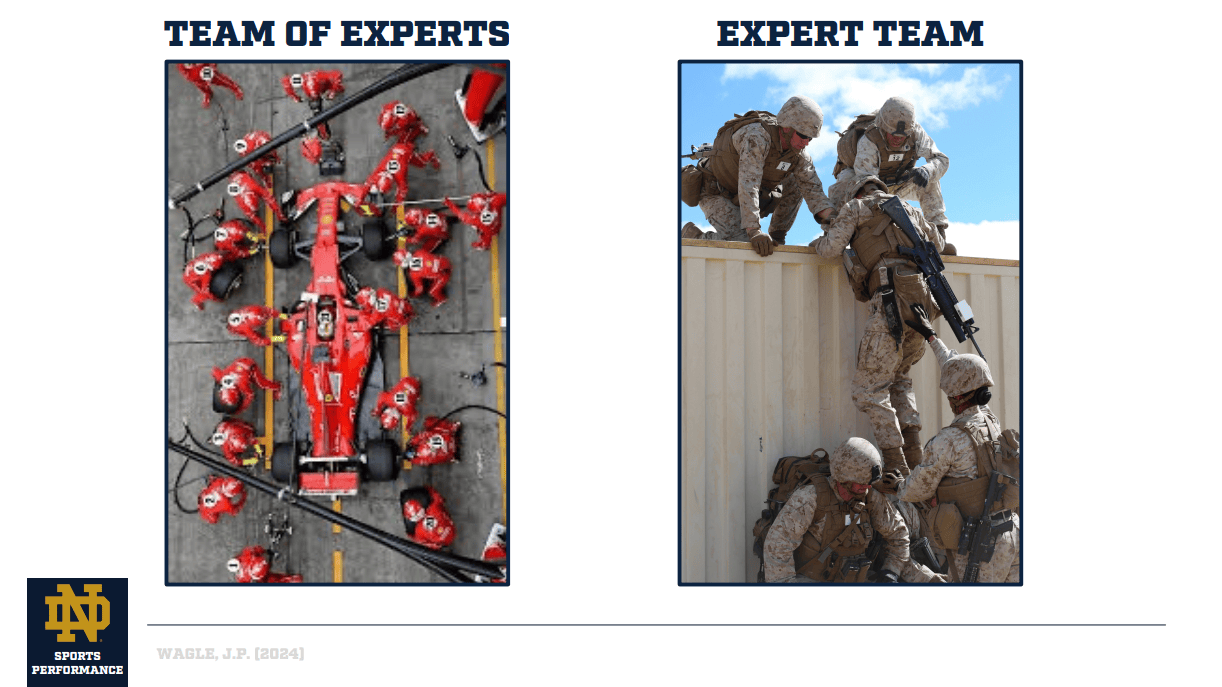
According to John Wagle, in a ‘team of experts’, “everyone has their job, they do it well, and the execution of their role doesn’t directly impact another person”. He cited a Formula 1 pit crew as an example.
An ‘expert team’, on the other hand, refers to groups where “the work of an individual may directly impact that of another person”. Wagle’s example was a US Navy SEALs team.
In illustrating this distinction onstage at November’s Leaders Sport Performance Summit in London, Wagle, the Senior Athletics Director for Sports Performance at the University of Notre Dame, highlighted the distinction between multidisciplinary and interdisciplinary.
Wagle was hired by Notre Dame in 2022 to lead an athletic department that was unable to consistently deliver an interdisciplinary approach despite the best intentions of all staff members.
“We needed a catalyst,” he continued. “The challenge as a performance director is to set the stage to solve a problem at scale in your environment.”
‘Constraints push you into new places’
Student-athletes continuously juggle their sport, academic studies and lives on campus – a situation Wagle described as “suboptimal”.
However, as he said, “these operational constraints push us into new places. They push our boundaries of how we can create solutions and I believe the best way to do that is to bring together two largely opposed ideals: knowledge and belief.”
Knowledge v belief
Knowledge, as Wagle explained, stems from a practitioner’s formal training as well as any external and internal research. He said: “the more common terminology for people in this room is evidence-based practice”.
Belief is different. It is an aggregate of a practitioner’s experiences from working in the field, athlete values and preferences, and the matter of risk tolerance and uncertainty management. “There is an element in belief that you’ve got to harness and steer into uncertainty.”
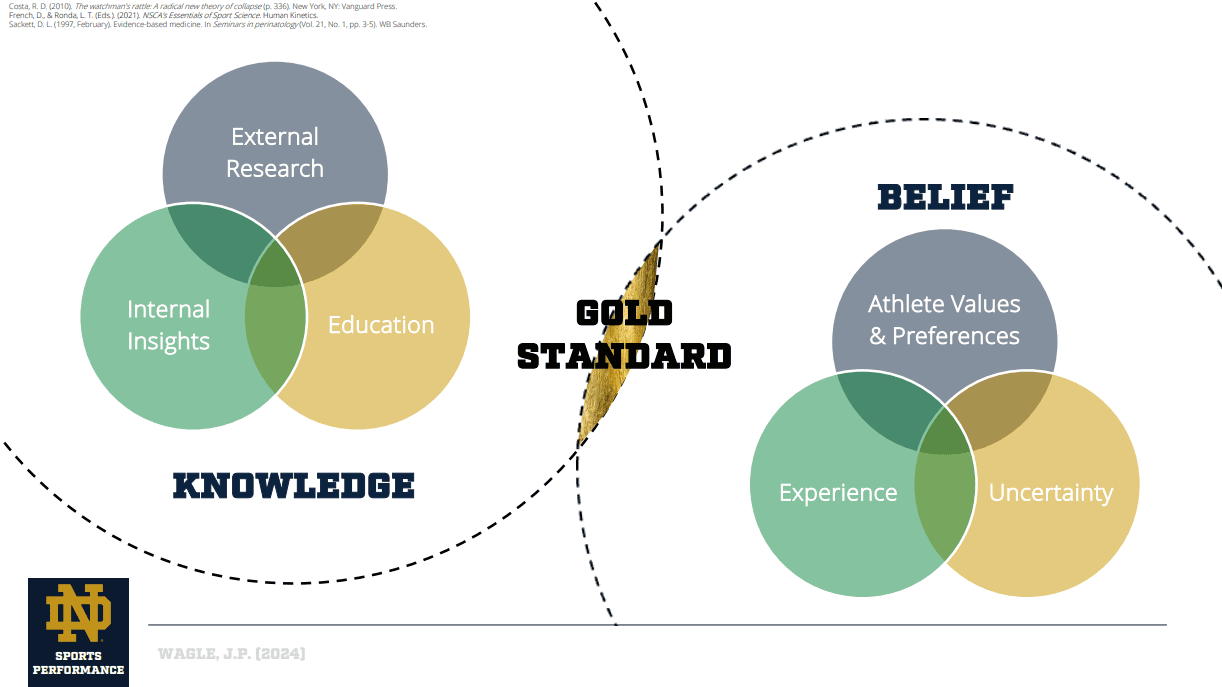
“These don’t need to be opposing viewpoints,” Wagle added, despite admitting that people “gravitate towards their tendency”.
“This is the true power of interdisciplinarity and, if we don’t bring these pieces together, we run the risk of being blind to what a lot of our athletes are experiencing.”
He spoke of the student-athlete being in a “complex adaptive system” where the interaction of different elements leads to either a health or a performance outcome, with the ‘gold standard’ somewhere in the middle.
Sleep = the catalyst
Wagle admitted that Notre Dame’s athletic department oscillated between knowledge and belief despite concerted efforts to bring both together.
“There were members of our team that no matter what the problem was were always on the knowledge side and there were members of our team who were always on the belief side,” he said. “It did not necessarily manifest in conflict – it manifested in avoidance – because I think every problem we tried to solve was inherently biased towards a discipline and it was easier to run away from that problem.”
They needed a catalyst to underline the power of interdisciplinary work and alighted upon sleep.
“We chose sleep because it is inherently lacking a discipline,” Wagle continued. “It can be owned by psychology, by nutrition, by strength & conditioning, by medical. There’s no obvious lead person in that.”
Everyone was able to meet the challenge that Wagle set: to be the best sleep support ecosystem in the whole of college sports. The knowledge people combined their data-driven approaches and devised a sleep screening tool. “We were able to get more granularity on our sleep habits and behaviours.” The belief people “brought to the table the ebbs and flows of the academic year.”
Remember: you could be part of the problem
Notre Dame’s approach to sleep has proven a game-changer in their approach to interdisciplinary work. Staff members recognised their biases, let go when necessary, and committed to collaboration.
Wagle said: “If we don’t acknowledge that ‘we could be part of the problem’, that’s where culture and alignment suffer; and resources fail to be allocated properly.”

Racing 92 Head Coach Stuart Lancaster weighs up the balance between being systematic and ‘authentic’.
Rebuilds take time and, for all his work behind the scenes, Lancaster’s Racing remain a mid-table team in France’s Top 14.
“When things don’t go well it’s very easy to turn around and say, ‘he’s an Anglo-Saxon, he doesn’t fit our culture’,” he told the audience at November’s Leaders Sport Performance Summit in London.
After signing a four-year contact in September 2022, he saw out his last nine months at Leinster; a winning environment he helped to build. Staying was probably an easier option.
“I’ve always had the desire to challenge myself as a coach,” he continued, “and there’s no bigger challenge than going to a French club as a head coach without being fluent in the language.” The Top 14, which is the wealthiest league in rugby, is known for its sink-or-swim nature for players and coaches alike, particularly those arriving from abroad.
A year and a half into his tenure, Lancaster regularly asks himself: “Where do I focus my attention between leadership, management and coaching?”
‘Tiptoe in or smash the door?’
Upon his arrival at the Paris La Défense Arena, Lancaster was mindful that his new boss was his predecessor as Head Coach, Laurent Travers, who had been promoted to President.
Lancaster asked himself: should he “tiptoe in or just smash the door down?” He alighted somewhere in between.
A quirk of the fixture list meant that Racing had played Lancaster’s Leinster twice in the European Champions Cup in the months after he signed his contract. Leinster won both matches, home and away, by a combined 58 points.
He argued that this was to his advantage when being introduced to Racing’s squad. “The players saw what that environment looked like because they had played against it,” he said. “I was pushing on an open door. They were ready for a change and a new working week.”
Out went the long lunches, in came a revamped playbook, but Lancaster has been careful not to separate the club from its roots. On his coaching staff, he inherited former Racing wing Joe Rokocoko (Skills Coach) and former captain and hooker Dimitri Szarzewski (Forwards Coach), both of whom won the league with the club in 2016. He also drafted in former France scrum-half Frédéric Michalak as his Backs Coach.
It was not about replacing Racing’s “DNA” with Leinster’s but laying foundations as the game shifts. “I had to show the players what good looks like and why it’s good.”
The coach’s search for ‘truth’
Lancaster cited Sarah Langslow’s book Do Sweat the Small Stuff: Harness the power of micro-interactions to transform your leadership. It details how one can connect with people and inspire them to perform. The types of ‘micro-interactions’ Langslow discusses are important to Lancaster given his lack of fluency in French (and the inability of some squad members to speak English).
“You can get a sense of the culture in your one to ones,” he said of his individual meetings with players, coaches, and staff. “You’ve got to dedicate time in your working week for one to ones.”
Lancaster revealed that he had made four phone calls to coaches and staff at Racing prior to his appearance onstage. “I was sense-checking the mood in the camp,” he said, adding that coaches and staff have access to information beyond “the manufactured truth that the head coach gets”.
Softening the performance conversation
Key to Lancaster’s approach has been his efforts to galvanise a squad containing French, English, Welsh, Australian, Argentinian, Fijian and Georgian players. Each week, a different player, coach or staff member will share a personal story in front of the group. Once a month, the players organise a themed dinner for the squad, coaches and staff.
Lancaster has also brought with him the psychological profiling tools he used at Leinster. He believes they can help players to better understand their strengths and weaknesses. To kick things off, he initially shared his own profile in a team meeting.
These efforts all help to soften the performance conversation. “You can be both systematic and authentic by using your meetings in a creative way and not just talking about the technical and the tactical. You can talk about life experiences and how you can learn from failure.”
It has been a quick win. “French rugby is an incredible success story but at the same time it’s behind in certain areas.”
Lancaster makes the point that Racing centre Gaël Fickou could win more than 90 caps for France “yet he’d never even thought about what emotional intelligence or leadership looks like.” Until now.
If Racing can raise their performance levels, they will do so while showing their human face; and that also goes for a coach who has been labelled a ‘robot’ in the French media.
“Often the simplest things are the most powerful: admitting your vulnerability, your mistakes, by showing that human face.”
16 Jan 2025
ArticlesFour nuggets of wisdom from John Longmire, who recently signed off as Senior Coach of the Sydney Swans after 14 seasons.
Having fashioned a reputation as one of the finest coaches in the league during his 14 seasons in charge, Longmire has taken a new position as the Swans’ Executive Director for Club Performance. He handed the coaching reins to his assistant, Dean Cox, as the club’s succession plan swung into action.
“I couldn’t get rid of the feeling that maybe it’s time,” Longmire told his players in a moving farewell speech. He had first discussed the idea of stepping away with the team’s management 18 months earlier and returned to the topic midway through the 2024 AFL season.
Longmire’s 333rd and last game in charge turned out to be October’s Grand Final, which Sydney lost to Brisbane. Overall, he took the Swans to four Grand Finals and won one flag, in 2012.
The Swans’ list and performance infrastructure are the envy of most in the league. In fact, few departing coaches ever leave their successor a team in such good shape.
This may have been on Longmire’s mind at the Kia Oval – a ground where, as a 16-year-old back in 1987, he played in an infamous exhibition game for North Melbourne against Carlton.
“It was labelled the ‘Battle of Britain’,” he said while directing Leaders Performance Institute members towards the YouTube highlights. Those that click through can expect a litany of violent fouls.
“It was my first game, and I was absolutely petrified,” he said with a smile.
Longmire then returned to his time as Senior Coach and we’ve picked out four nuggets of wisdom.
1. Don’t become set in your ways
Injury put paid to Longmire’s playing career in 1999 (he won the AFL flag in his final game for North Melbourne) and, three years later, he became an assistant to Sydney’s then Senior Coach, Paul Roos.
Longmire was 31 years old at the time – still young enough to be a contemporary of the players he was now coaching. By 2024, both he and the sport had changed.
“The older we get, the further we get from that age demographic,” he said, “and the more rigid, the more set we can become in our ways and our beliefs – that’s the real danger.”
Longmire consciously moved with the times, but his wisdom would have counted for little if his players did not pay attention. “I know what it takes for a successful organisation to stay competitive,” he continued, “but I am the one that has to bend and move.”
One example was his gradual shift from focusing on the team’s leadership group to spending more time with the younger players. Longmire would watch and listen to them without judgement and, when necessary, “bring them back to where you know high performance teams like to operate.”
2. Find your truthtellers
“The best cultures are the ones that keep moving and adjusting to the ecosystem,” said Longmire, who emphasised the coach’s role in that process.
“I walk amongst our playing group during our warm-ups and that’s a case of sensing the mood, working out who’s talking to who and what they’re talking about.”
He also leaned heavily on his most empathetic players (“those that don’t just walk past your office – they walk in and say: ‘how are you going, coach?’”). The relationships he shared with those players were “ever more valuable” because they were his best eyes and ears in the changing room.
“Make sure you water those relationships because they’re the ones that will keep you in a job.”
3. You’re not bulletproof – don’t try to be
For all his stature as a coach, Longmire was keen to remain “connected and relatable” to his players and staff. As he said onstage in London, “the coach is no longer looked upon as being bulletproof” whatever their standing may be within the game.
His final speech to the players and staff as Senior Coach attested to that belief. He weaved in personal stories and his voice cracked at times. He wiped away tears too.
It called to mind the weekly ‘storytelling’ sessions that Longmire made a key feature of the Swans’ environment. He told the Leaders audience that players and staff share stories or complete a series of tasks for discussion each week. Recent examples included writing ‘a letter to your 16-year-old self’. These sessions are popular with players and staff alike.
“Sometimes it’s a photo of something that mattered to you and quite often there’s tears involved,” he said. “The way I looked upon coaching 25 years ago is completely different now – these 18, 19, 20-year-olds need to be able to relate to you. If you can show that you’re human, you get a lot more back.”
4. Look beyond winning and losing
Winning cannot be everything, even for a proven winner.
“If we measure ourselves on the ultimate success, there’s a lot of years of being unhappy,” said Longmire. A coach must find other factors, such as the personal development of players or staff. He said it is critical to have more in the ‘plus’ column than the ‘negative’.
“Identify, enjoy, and celebrate those moments. And make sure you get joy out of the journey.”