23 Jul 2025
ArticlesIn one conversation, Dan Jackson of the Adelaide Crows cut to the chase and helped the team’s analysts to recognise – and celebrate – their important contribution to the collective.
“There’s a team of six and I asked them what their job was,” the Crows’ General Manager of Player Development and Leadership tells the Leaders Performance Institute.
“Their response was along the lines of ‘we’re there to support the coaches’,” says Jackson, while admitting that this response isn’t wrong. “That is inherently what their job is. They’re looking at the data, they’re putting together PowerPoints. They’re also the ones plugging in all the computers at a game to make sure that the visuals are right. Everything for them is about getting the detail right in the background. If they weren’t there the wheels would fall off.”
Jackson did not find their answer wholly satisfactory. The analyst team’s relative invisibility to everyone else was part of the problem.
Connection to vision and mission
In the analysts’ response, there was no mention of Adelaide’s vision (“to earn the pride of South Australia”) or their mission (“sustained success, winning multiple premierships”).
Jackson reframed his question. He wanted to see if the group could align their work to the bigger picture. “I said: ‘how do you guys see your role? What’s your purpose as an analyst group to help us achieve that vision and mission?’”
A fear for Jackson was that if the analysts see their contribution as little more than background support then others will surely do the same.
First clarity, then alignment
“When you’ve given everyone clarity around what we are trying to achieve, how we’re going to go about it, and how I need you and you and your team to play your role in it – I think that’s what people would say when they feel like there’s alignment,” says Jackson.
The group’s second answer was a step in the right direction:
We help drive performance by supporting, innovating and getting the little details right, so that everyone else can work their job seamlessly.
They hinted at their sense of alignment and already sound more empowered.
“At great organisations, people feel like they have some autonomy to make decisions,” Jackson adds, “but it’s really hard to give that trust over as a leader if you haven’t provided clarity or aligned them to the strategy, the vision and the mission.”
Those three areas have been areas of intense focus for Jackson and his colleagues. The analysts, now emboldened by Jackson’s encouragement, went further:
We play a pivotal role in the team’s performance as we look to earn pride and win.
“Now they’re feeling strongly aligned to how they’re going to help us achieve the vision and the mission. I think that goes a long way to help engagement, retention or even decision making.”
It led to a wider conversation about their roles and contributions.
“One of our values is ‘courage’,” says Jackson, who asked the analysts what that looked like for them. They connected ‘courage’ to their need to balance innovation and risk-taking in their day-to-day work.
For us to get a competitive advantage in how we use the data, present our messaging and tell our stories, we might have to take a risk. For example, we might have to use some new AI platform to enhance our presentations. It may fail once or twice, but if it works really well then we can visualise data better and tell our story better.
Jackson now heard what he had sought. “A small department can be really empowered when they’re aligned to something that they understand of the big picture.”
That said, Jackson guards against any team getting too hung up on words when it’s actions that matter.
He observes that there’s little difference between the values one team puts on their wall and another.
“Around 80 per cent have ‘integrity’ as a value,” he says. “You’re guaranteed to have something like ‘commitment’, ‘hard work’, ‘dedication’ or ‘excellence’.
“Then there tends to be a mindset one. So we have ‘courage’, but it might be ‘ruthlessness’, ‘relentless’ or ‘belief’. Sometimes they have a fourth, which is more unique. It could be like ‘celebrate your authenticity’ but, inherently, every sporting organisation has the same face because there’s no real secret sauce of success.
“With the great teams, it’s not that their words are great: it’s the way they actually go about living, the behaviours that underpin it.”
Jackson has seen it time and again during his career. “I probably spend the least amount of time worrying about whatever words they’ve got,” he says. “Often, I don’t even bother changing them because if you want ‘connection’ or ‘unity’ or ‘team first’ or ‘family’, it doesn’t really matter. What I want to know is the behaviours you’re going to commit to, your system of accountability, and how you drive those behaviours.”
Dan Jackson also features in…
12 Jun 2025
PodcastsIn the first episode of our special three-part series, the Sixers’ VP of Athlete Care discusses the importance of the performance director’s role in establishing clear communication lines, engendering trust and shaping the team’s culture.
A podcast brought to you by our Main Partners

“The issues I’ve seen here, they’re very rarely – almost never – [a result of] things getting missed,” Simon Rice, the Vice President of Athlete Care at the Philadelphia 76ers, tells Teamworks’ Director of Athlete Performance Andrew Trimble and Leaders Performance Institute Editor John Portch.
“Where we run into slight problems is everyone trying to do the right thing with really good intentions,” he continues, citing the hypothetical example of three practitioners on the Sixers’ Health & Performance group prescribing the same loading plan to an athlete and inadvertently tripling their load.
“It often comes back to communication and it comes back to this idea of fitting the puzzle pieces to fully support that player.”
It takes mutual understanding and trust between athlete and coach, as Simon touched upon in the recent Teamworks and Leaders Special Report, entitled High Performance Unpacked: Interconnected Performance Teams, and it was a theme he expanded upon in the first episode of our new three-part series.
Elsewhere, Simon also talks about the role of the performance director as a cultural leader [4:00]; the importance of establishing what’s best for the athlete right now [15:30]; the work of the Health & Performance group with external clinicians [34:00]; and how his team can give athletes confidence in their bodies through its joint decision model [55:00].
Listen above and subscribe today on iTunes, Spotify, Stitcher and Overcast, or your chosen podcast platform.
11 Jun 2025
ArticlesDr Edd Vahid of the Premier League outlines the importance of a unified purpose, regular feedback and carefully chosen words.
The US President asked him what he did for NASA. “I’m helping to put a man on the Moon,” the janitor replied.
The Leaders Performance Institute is reminded of the moment by Edd Vahid.
“The janitor did not talk about his day-to-day tasks,” says the Premier League’s Head of Academy Football Operations, “but his contribution to the overall mission”.
This famous line resonates with Vahid and, in Leaders’ recent Trend Report, clarity and alignment were both cited as major influences on the quality of leadership by coaches and practitioners across the globe.
“We know that alignment often comes down to the clarity of expectations and that comes from a strong, unified purpose,” said Vahid, who noted that even well-meaning individuals can be drawn into silos without a guiding hand.
The report also revealed that sport is obsessed with the topic and, in the grand scheme of things, does alignment quite well: almost 50 per cent of respondents saw their teams as ‘somewhat aligned’.
“It’s worth noting that the figure sits at about 20 per cent in other sectors,” said John Bull, the Director & Lead for High Performance Research at Management Futures, in the report.
There is still room for improvement: only 12.6 per cent said their organisations are ‘well aligned’.
As Vahid explains, teams could start with the following.
Establish a regular and consistent theme
“Alignment is done best when it’s regular and not just your annual ‘here’s what we’re going after, see you again in 12 months’ time,” says Vahid. “It’s got to be constant. In every meeting there needs to be a regular and consistent theme that people are working towards and, importantly, they know their contribution.”
In 2024, Vahid published A Cultural Hypothesis, which explored the factors that enable a sustained culture of success. One element stood out as a ‘super enabler’ for Vahid: cultural leadership. The term acknowledges that leadership exists on three levels within an organisation:
The guardians, Vahid argues, are critical to alignment. “The reality is that if you’re a senior leader, you’re not going to be on the ground, you’re not going to be able to influence every different scenario – that’s where you need your guardians, your foot soldiers on the ground who are able to distil your message and ensure there is direct alignment to the organisation’s aims.”
NASA’s janitor was a cultural guardian in Vahid’s eyes.
Find the right repeatable words
“Language offers you the opportunity for shared understanding,” says Vahid, “and shared understanding is crucial in alignment, so people know what they’re going after. A leader might not necessarily use the word ‘alignment’, but they’ll be talking about their overall purpose.” NASA’s purpose was simple but powerful. “Your language must be repeatable and resonate with people.”
Vahid also says that high-performing organisations tend to have goals that transcend winning. “It’s important to get everyone behind it. Everyone must believe it is attainable, and it must drive them to want to get out of bed in the morning and come to work.”
What if there’s clarity, but still misalignment?
Vahid explains there could be a few factors at play, all of which point to the importance of feedback:
Staff development needs. If a staff member commits an error of execution, it is an opportunity to deliver developmental feedback. Vahid says: “Does everyone understand what we’re going after? If they do and they step outside of that, then feedback is warranted.”
Psychological safety. “It’s a buzz term,” says Vahid of the commonly used phrase, “but it’s crucial for people to feel they are in a feedback culture.” The leader must show that the intent of feedback is to help the individual to progress. “You’re taking time to give them feedback because you care,” he adds. “You’re then seeking to work with the individual to create that development.”
The leader’s behaviour. Leaders must also demonstrate their willingness to listen to feedback. “They need to provide ‘speak up’ signals,” says Vahid with reference to the work of psychologist Megan Reitz. “The leader needs the skill to understand the position they’re in and the power they carry in that dynamic.”
What to read next
The Brisbane Lions Have Turned Female Athlete Health into a Performance Question. Here’s How
In the first of a three-part virtual Learning Series, we explore why adaptability is becoming a crucial modern leadership skill.
The General Manager of Player Development & Leadership at the Adelaide Crows was speaking in The Winning Formula for the Future of Performance Sport, our recent Trend Report.
The sentiment struck a chord with Jackson’s fellow contributor, Tim Cox of Management Futures.
“We work in sport and other sectors, and there is that feeling of stifling,” Cox told a recent leaders virtual roundtable. “The pace of change, the demands on us are increasing, and it can feel almost suffocating for leaders sometimes. What do we do here? How can we respond effectively?”
Cox, who co-hosted this Learning Series with the Leaders Performance Institute, hinted at the growing complexity of sport and the ever-increasing importance of being able to lead through complexity, which is the overarching theme of a three-part virtual roundtable series that seeks to help leaders develop the necessary skills.
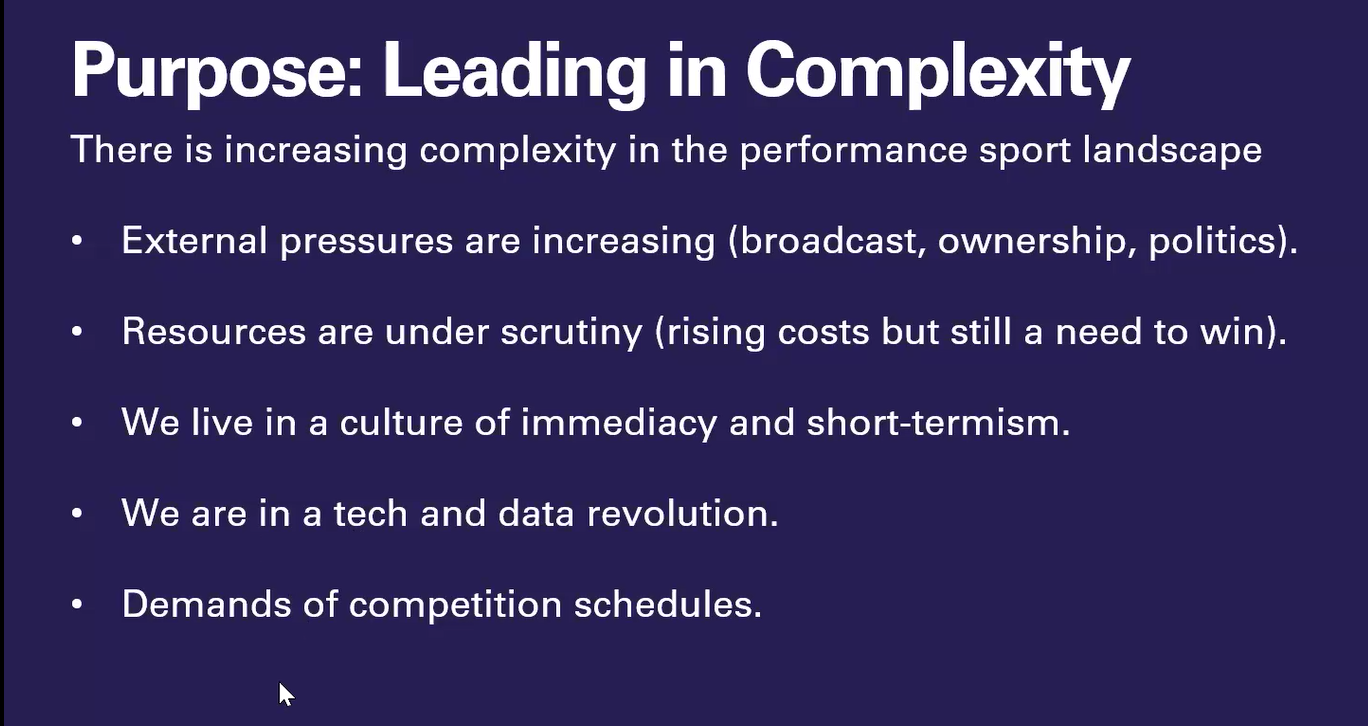
To follow up, we shared five areas where complexity continues to grow in sport. Most if not all will be familiar to athletes, coaches and practitioners alike:
Adaptability: a vital skill
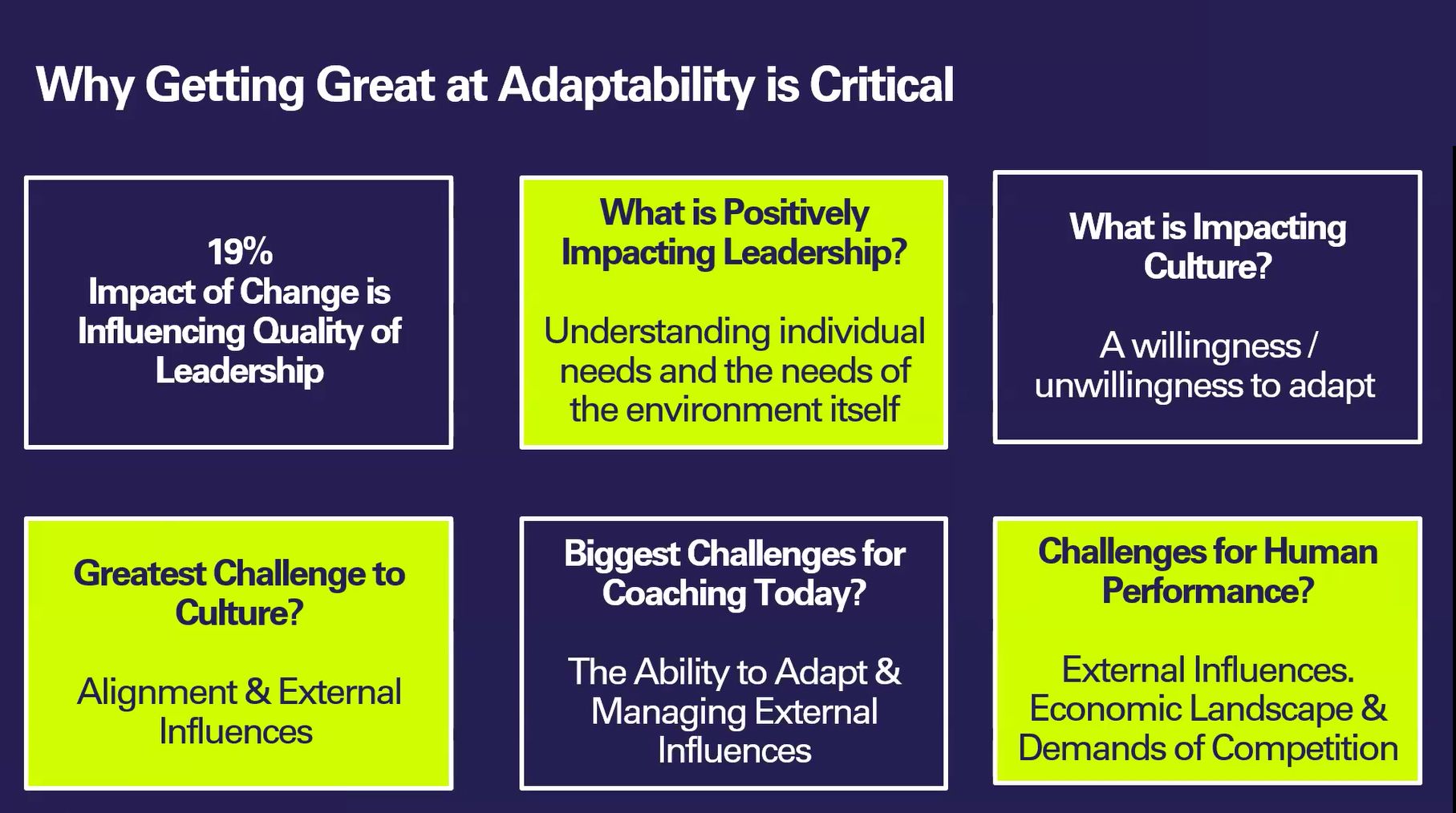
Session one explored the concept of adaptability and how leaders can increase the chance of an effective response from their teams. This came up in the Trend Report. The following also stood out from the report’s findings:
The Magnificent Seven: tips for leading in complexity
Cox distilled his thoughts on the topic into seven ‘magnificent’ areas. “Whether they’re magnificent or not, you’ll be able to make a call on it,” he said.
In a world where change is constant, smaller or less-resourced teams can gain a competitive edge by being more agile.
“This is a simple one: it’s really prioritising time to actually analyse what is changing.”
As one participant said, “adaptive cultures are the ones where everybody has a voice. They can voice feedback, they can push back on ideas, and ultimately, that helps you get to the right idea.”
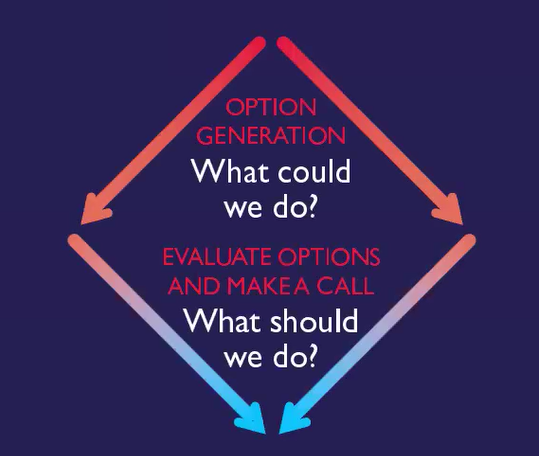
While tapping into collective wisdom is essential, it must be balanced with the ability to make decisions and act quickly. Yet while on-field decisions can be taken in minutes, “off the pitch,” as Cox said, “we can often be inordinately slow in adapting and responding to change.”
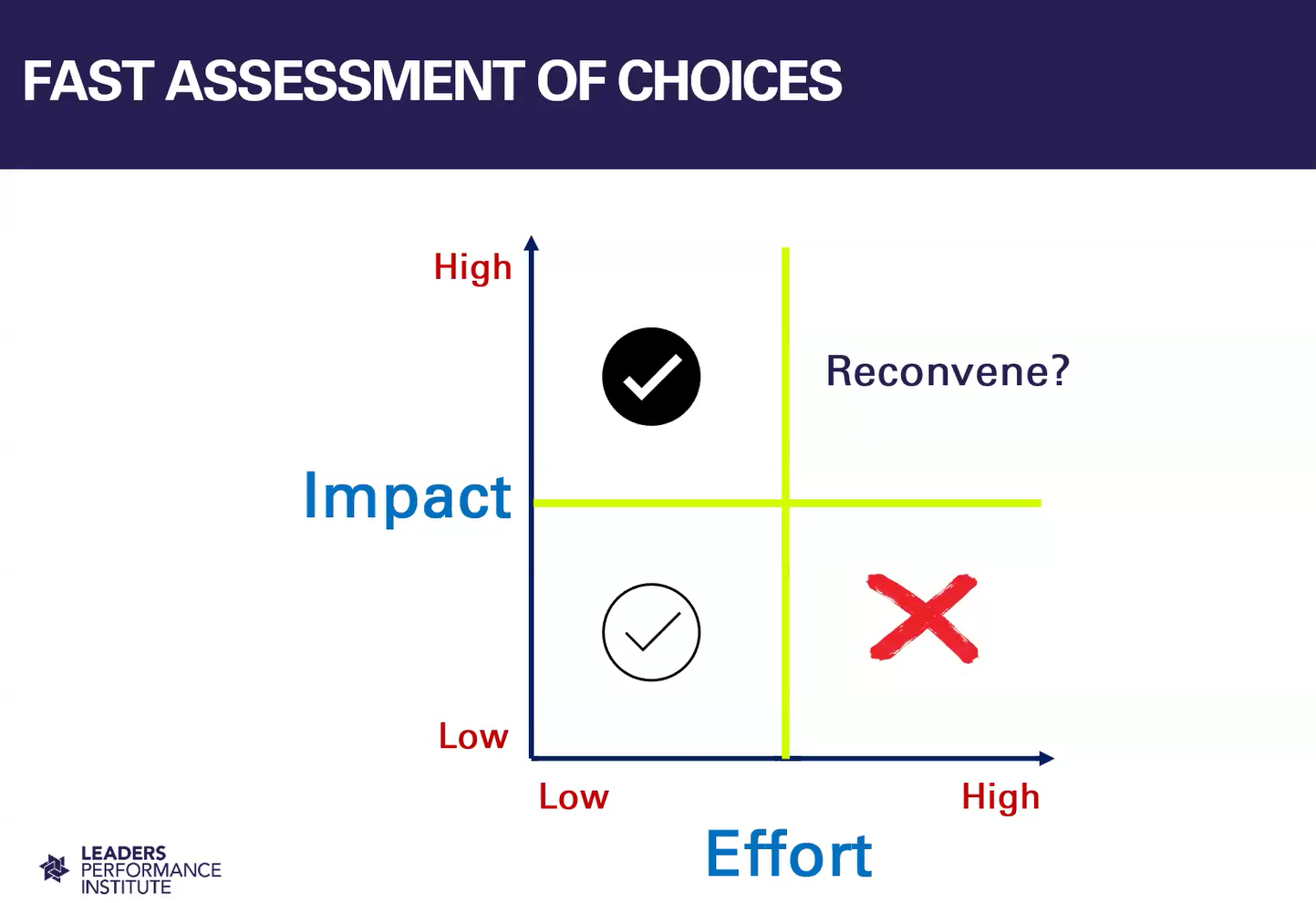
The ideal choices are those that are high impact and low effort. These are the quick wins. Conversely, high effort and low impact choices should be avoided as they are distractions and drains on resource.
Agility requires action, even in the face of uncertainty. Not knowing everything shouldn’t prevent progress.
You can, however, take a structured approach by recruiting wisely, implementing training programmes and pivoting smartly. Teams, Cox suggested, can ask themselves “what are our skill gaps for now or where are we strong now? What are the skills we’re going to need to make this pivot?”
“To adapt, we’ve got to learn,” said Cox with specific reference to the special forces, “and the better we are at debriefing, then the better we are at learning and then adapting.”
He explained that debriefing should be a deliberate, embedded practice. It’s not just about reviewing what happened – or when responding to a crisis – but extracting lessons to fuel future action.
“To what extent can we get these transitions right?” asked Cox. “Because obviously they have big organisational and team impacts, not just on the individuals close to them, they can filter down to the whole organisation.”
Who are your cultural guardians? Cultural guardians, as discussed by Dr Edd Vahid, are the individuals or mechanisms that ensure core values and practices are preserved during leadership changes. They are, as Cox explained, indispensable. “Any new leader is going to want to change things,” he said, “but what are the pieces that we need to absolutely hold on to? What is handed over to the leaders that we know to be true about this culture in this organisation?”
To sum up…
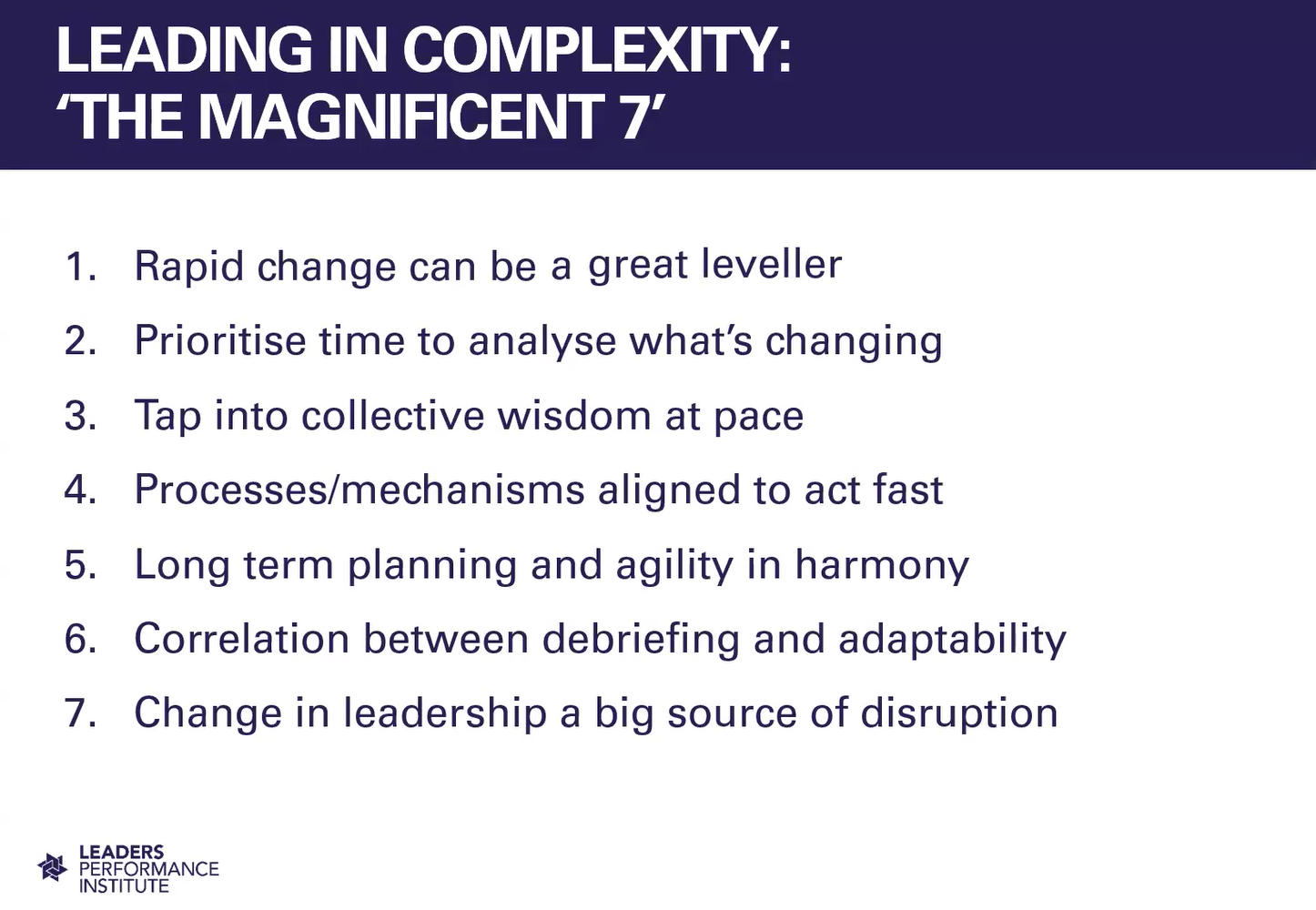
Looking ahead
This session was the first in a three-part series. Future discussions will explore:
Part 2: Inhibitors to adaptability – what gets in the way?
Part 3: Building a collective playbook for leading in complexity

21 May 2025
ArticlesIn this exclusive column, performance specialist Iain Brunnschweiler outlines how he fights the inevitable nerves with tools he has picked up during a career spent in elite sport.
The anxiety felt almost totally consuming. His legs felt heavy, and he doubted that any words would come out of his mouth when and if he did attempt to start speaking. His brain was scrambled with a hundred thoughts, which seemed impossible to coordinate into anything helpful.
The year was 1995, and that boy was me.
I honestly cannot remember what I spoke about, but I sure remember how it made me feel.
Everyone was looking at me. I felt so insecure and so nervous it was almost unbearable. It felt very different from the sports field, where I felt at home. On the field of play I felt like I had permission to be myself. But I did not feel it there on that stage.
Fast forward 30 years, and I stepped onto the stage at the Royal College of Music in front of more than 120 sports leaders from around the world at Leaders Meet: The Talent Journey. I was privileged to be afforded the opportunity to facilitate the event for the Leaders Performance Institute.
The nerves were there again, however, over the past 30 years, I have developed a range of resources to allow me to adopt a more preferable state to be able to speak in front of people.
Confidence and humility: a tricky balance
Humans are remarkable things, aren’t they. We’re all individual, all experiencing the world in a unique way, all dealing with themselves on a daily basis and simultaneously seeking to demonstrate something to the outside world. We all have varying levels of self-awareness and varying levels of skill in dealing with the questions being asked of us in our own contexts.
Consider some of the situations a sports leader might find themselves in: starting in a new leadership role, rallying your team during difficult times or times of change, seeking to inspire others through your words or actions. Now for those of us who have seen skilful leaders or coaches in practice, some of these skills can seem effortless. However, behind that skilful act is undoubtedly someone who has wrestled with their own feelings of doubt or insecurity and drawn upon their own experiences in order to choose and deliver an appropriate response to their audience.
Being able to speak up with a balance of confidence and humility can be tricky. And it is a skill that may be the difference in the career trajectory or simply contentment of any aspirational individual.
Actors, agents and authors
I remember being shown some research by a fabulous person, colleague and psychologist, Malcolm Frame, called ‘The Psychological Self as Actor, Agent, and Author’. The paper is written by American psychologist Dan McAdams, whose work talks to the developmental journey of any human. My interpretation of McAdams’ work is that the ‘Actor’ is the social self, the ‘Agent’ is the motivated self, and the ‘Author’ is the narrative self.
As Malcolm told me: “Embracing this cycle each day isn’t just self-improvement – it’s building an unshakable architecture of strength, capacity and resilience within our very operating system.”
As a more novice practitioner I was certainly an Actor. Concerned almost solely with how I was perceived and wanting to be liked by everyone.
For example, when I first accepted the role of a national coach within the England Cricket pathway, I was unsure how to be. I struggled to understand what was required of me. Having to stand up and speak in front of some of the most talented young players in the country, as well as the brilliant support staff that I was working with, felt like a huge stretch.
I felt high anxiety when I was ‘on show’ and witnessing the show going on around me. As I developed and became more experienced, I realised that my motivations and aspirations could not be reached if I was not able to override my anxieties and take action towards my desired outcomes. As an Agent, I was able to step onto ‘the stage’ and make choices that were my own.
After more than 25 years of striving in the elite sporting context, I finally feel that I am able to become more of an Author in my own context. I can control the narrative more effectively to serve me in the way I find helpful. It helps for me to have reflected on my past experiences. Successes and failures, taking learnings from them that can help me in the present, as well as support me in the future.
Nerves are not necessarily a bad thing
Having reached a senior role at a Premier League football club, I was interacting with directors and owners and being asked to make major decisions that would affect numerous people. Whilst never easy, I was more comfortable in doing so, having been on such a journey. The moments of bravery earlier in my career which felt incredibly tough, were now serving me in the moment.
The stories that I now tell myself about my past, help me to feel more well-resourced in the moment. I have accumulated a broad range of experiences which I can draw upon now, and allow me to both enjoy it and embrace however I am feeling. Tactics such as self-talk, the use of perspective, and an acceptance that I prefer to be playful rather than serious, all serve me and allow me to accept my emotions. I have certainly not solved this! However I am very clear on the progress that I have made.
So, as I stepped onto that stage in 1995, my nerves were similar to my nerves in 2025. However, I was now more well-resourced to acknowledge and accept them and even use them to my advantage. Being nervous now lets me now that I care about what I am doing. That it is important to me. And that’s OK.
I don’t think any advice would have helped that boy in 1995. It was stepping up onto that stage that he needed.
Iain Brunnschweiler runs the Focus Performance Consultancy. He is a former professional cricketer, has authored two published books, and previously served as the Head of Technical Development at Southampton Football Club.
What to read next
Former netball player Vicki Wilson describes her journey from the court to coaching, high performance and sports administration and offers advice to aspiring female athletes.
In April, Vicki Wilson, Director at the Brisbane Broncos, joined our group call. Women coaches and practitioners from across the globe gathered to listen to Wilson tell the story of her journey from athlete, to coach, to high performance manager, and now a member of the board of directors at the Broncos. Hers is a story we wanted to share more of and to learn from.
What has propelled Wilson’s career?
From Wilson’s perspective, she believes she has an eye for detail and an ability to plan, whilst wanting the best for athletes. She enjoys imparting knowledge, as well as gathering knowledge to extend her perspectives. She has also always been determined to be better. Having been an international athlete herself, Wilson can also lean on those experiences to guide her work. She’s also adaptable and, since her days playing netball, has always asked questions and seeks to understand ‘why’.
A key lesson was when she was dropped at an early stage in her playing career. It came just as she thought she would be made captain. The lesson she took was to never take anything for granted. This has resonated with Wilson every time she has applied for a role since. It also means she will quickly move on to the next challenge.
What drives success?
To help people succeed Wilson shared some tips:
Support your high performance managers
Contrary to instinct, Wilson believes sitting with high performance managers and helping them with their planning is critical. Many will have come from a coaching background and might not know the role fully. It shouldn’t be assumed that they know what’s expected and what needs to be done. Expectations need to be shared clearly before a season starts. It’s about shaping this support around learning, and being their ally and not wanting them to fail, rather than trying to catch them out and needing them to show they know everything already. It really is about eliminating all assumptions.
Wilson’s inspiration
Wilson wanted to mention the women head coaches who were part of the original Australian Institute of Sport. There weren’t many, and they experienced difficult moments. However, they paved the way for others by challenging and contributing when in shared spaces between sports. They were avid readers and learners, many working in academia. They also showed that women coaches can be as successful as men. Wilson has been inspired in particular by Wilma Shakespeare, who was an international athlete, captain, coach, administrator, Queensland Academy of Sport CEO, and eventually travelled to the UK to be the founder and first National Director of the English Institute of Sport [now UK Sports Institute] in 2002. It is Shakespeare that inspired Wilson to explore administrative roles.
Thinking of joining a board of directors?
Wilson spoke about her advice for those who are interested in joining a board. She recommends sitting with someone who has done the role. This will help you fully understand what’s expected, and what’s your purpose in that role. From her experience, it’s about challenging management; making sure they’re doing what they said they would and asking them if it could be done better. It’s also about managing staff and athletes, and getting to know everyone in an organisation at a personal level.
Wilson fielded questions from the group too. They asked about:
Her challenges along the way
Wilson was open enough to share where some of the biggest challenges have laid – fortunately our previous community call attests to changes in ways of working. It has happened that athletes who are closing in on retirement have wanted the decision to be made for them. As you can imagine, that hasn’t made it easier for them to accept said decision. Wilson has also learnt the importance of an administrative team who are supportive and aligned to your values, having lost a role, alongside others, when strong decisions were needed. She is also grateful for the work done by many to have changed the way athlete pregnancy is treated.
Planning for the logistical realities
It’s not always spoke about, but coaches and other staff will make decisions, and have decisions made for them that can leave them unsure of their future and exposed financially. Wilson shared that she has found that when it mattered, things gained positive momentum quickly for her. Small contracts came in, moves to different countries weren’t as terrible as feared. She learnt to be open and once she’d accepted something be all in. Wilson has learnt to not panic, and importantly, to back her own skillset. It helps that she has a positive mindset, and that she’s always been a naturally good connector.
The group reflected on…
1. What their organisations are doing to support them. Answers included:
2. What they would like to see in a dream world:
3. How they’re supporting others:
4. Resources recommended for learning outside of sport:
What to read next
Here are five tips from Chelsea and the Ineos Grenadiers in their pursuits of future success.
Drawer had just completed his first season as the Performance Director of the Ineos Grenadiers cycling team – a team with whom he enjoyed immense success in their previous incarnation as Team Sky between 2016 and 2018.
In recent seasons, the Grenadiers’ success has tailed off. Drawer’s return is part of the team’s attempt to restore their lustre.
“You look for these elements of when the team was super strong and maybe some of the changes needed at that time didn’t necessarily happen,” he added in reflection.
Drawer was speaking with Chelsea’s Director of Performance Bryce Cavanagh, who also inherited a team treading water in 2023.
“Our situation is probably slightly different as they’ve been through so much turmoil,” said Cavanagh of Chelsea, who underwent a change of ownership in extraordinary circumstances in 2022. It marked the end of an era in which Chelsea’s successes underlined a shift away from the traditional powerhouses of English football.
Back in 2003, Chelsea were disruptors in their field. The same could be said of Team Sky in the 2010s when they transformed road cycling through their innovative approach to performance.
Both have since retreated into the pack, with Cavanagh admitting that entrepreneurial spirit was lacking in Chelsea’s performance department when he arrived. “There was probably a scenario where the change is seen as a threat,” he said. While there was a desire and willingness from the club’s new owners to deliver change, “people saw that as a risk that created vulnerability in their roles.”
The challenge is clear, but Cavanagh combined with Drawer to offer five tips to performance directors charged with restoring the good times.
1. Look for ‘clarity, competence and community’
Cavanagh, who in addition to the more traditional elements of his role has been tasked with a “cultural reboot”, immediately set his stall out at Chelsea with his stated desire for ‘clarity, competence and community’.
He asked two questions as he began to address the clarity piece:
Cavanagh also sought to understand the competence of the system (not individuals) with further questions:
Additionally, Cavanagh’s conception of community is as an outcome of the values, behaviours and definitions agreed by the collective.
“We had to really define where we wanted to go and what the bus looked like because then people ended up self-selecting,” he said.
2. Set standards… slowly but surely
Do not assume that high performance standards are a given across the board. Variations are common and a performance director must be prepared to ask, as Cavanagh did, “what are the things that you walk past? That you are willing to accept?”
Many have been tempted to emulate revered environments such as the New Zealand All Blacks’, but that wasn’t necessarily going to help Cavanagh at Chelsea in the summer of 2023.
“I tend to look at it like an election where you’ve just got to get the majority, and if the majority starts to [behave a certain way], that’s the culture that end up in power and every vote that gets laid is slowly going towards that,” he said.
“We weren’t the All Blacks. They’ve laid down their votes over 100 years and any new person who walks into that environment knows what’s accepted. Our environment wasn’t like that, so we’ve had to slowly and surely create it. We’re not there yet, but we’re on our way.”
3. Pay attention to your people
Drawer craved data insights that demonstrated how the sport of road cycling had developed in his six years away from the sport, but he also takes time to speak to his people – the ones working on the front line.
“Lots of staff wanted to share opinions, ideas or anecdotes in meetings around ‘the sport’s changed, it’s a bit like this’,” said Drawer, who welcomed their views. “Data and evidence is just as much people sharing opinions, ideas and observations as it is studies into how our team may be training, changes in racing patterns, probabilities.” He is “building this wealth of understanding and insight around what’s going on.”
4. Celebrate successes, however small
Cavanagh freely admits that his instinct is to go for the performance gap, but he has had to check himself because he has seen the value in celebrating wins, however small.
That goes for his department, but it also goes for the players. “Every player in our club now has an individual development plan at a first team level,” he said. “They work on that every day that they come into the club, which is quite unique.” When targets are hit, whether in the gym or on the pitch, it is a cause for celebration.
5. Decide the stories you tell about yourselves
No sports organisation can control what people say and think, but they can influence the internal narrative. And the more positive it is the better.
“This is more of an entrepreneurial time for us,” said Drawer. “We have adopted a startup mentality and will say ‘let’s try stuff. If it doesn’t work, what’s the worst that can happen?’ Because we’re not where we want to be at the moment and I think that’s just beginning to happen.
“Hopefully when the season starts we come out fighting in a very different way. We’ve spoken about it last year, but the idea of feeling that you can never crack it is the mentality that we need.”
What to read next
With Practice, Anyone Can Lead a Courageous Conversation… and ‘Skilled Candour’ Can Help
What sets apart an effective, efficient and successful high performance team in sport? Smart protocols, for sure. There’s plenty to be said about useful technology, too. But the overriding factor is the individuals who come together in service of the athletes.
“Our goal is to put the athlete in the centre and then we fit the jigsaw pieces around them,” says Simon Rice of the Philadelphia 76ers.
This universal goal has long inspired Teamworks’ efforts to support high performance teams in their delivery of personalised and unified support to athletes. We understand that because the jigsaw pieces often move, practitioners must be able to see the complete picture in real time as they make high-stakes decisions.
High Performance Unpacked delivers a snapshot of that world through the eyes of the specialists who grace this Special Report.
Beyond the NBA, we hear from the worlds of the English Premier League, NFL, WNBA, motorsport, Olympic and Paralympic sports and others.
We explore how high performance roles and structures are evolving; tackle the question of scalability, which often comes down to the ability of interdisciplinary teams to elevate the collective and surmount the growing complexity of high performance environments; we then shift the focus to athlete care and ponder where the balance needs to sit between challenge and support while asking how tech can be best leveraged to meet the athlete’s needs; lastly, we ask how tech and data set the stage for the innovations that deliver efficient and effective high performance programmes.
Complete this form to access your free copy of High Performance Unpacked: Interconnected Performance Teams.
Tips gleaned from a Leaders Virtual Roundtable titled ‘Generating organisational alignment: what to consider and work works’.
Alignment is perhaps more crucial than ever in high performance, yet as this practitioner noted, it is absent too often.
They were speaking at a Leaders Virtual Roundtable that dug into the topic.
“We’ve got a large team of staff, whether that’s coaches, practitioners, athletes, and that starting point of knowing where you’re going or what you’re aiming for is really important,” said one attendee who works for a Premier League team. “Then we build a strategy around that. So what we’re looking to do and the type of things we’re trying to do – and the things we’re not going to try and do.”
“I think the point of making it intentional is a huge one for us,” said another participant who works in the NWSL. “That’s been a huge emphasis with us as a staff this year – just making sure that we are all aligned and all on the same page.”
It takes time and effort and, over the course of the conversation, the participants shared their experiences and offered some best practice tips to help you and your team.
Alignment starts at the top
The consensus was that alignment flows from the top of an organisation. The table said that senior leaders must articulate an organisation’s goals and consistently reinforce them.
“Ownership has come in and been very clear about the goal of the club,” said the practitioner from the NWSL. “We want to be a leading global sports franchise, not just within the soccer space, not just within the women’s football space.” It is a lofty aspiration but all staff members understand the aim.
Find the low-hanging fruit
Next is identifying the obstacles, “the low-hanging fruit”, which means “each department approaching the general structure of practice by identifying what’s important and then identifying how you’re going to measure those things,” as a participant working in Major League Baseball explained. “Then you break that down into its subcomponents and figure out how you’re going to identify where the lowest-hanging fruit is to then solve those problems.”
Frequent check-ins
Find opportunities to check against your team’s objectives. As one attendee said of their team’s meetings, “we started with the end goal for the end of the season and how we are going to break that up.”
It requires “crystal clarity,” as another attendee put it. They said: “do we reduce the amount of interpretation, and then on the back of that, how are we checking for understanding?” It cannot just be a case of the leader “broadcasting” messages of expectation or definitions. “What’s actually being heard and understood? How frequently do we check that?”
Develop a common lexicon
Words are critical in ensuring that athletes are presented with a united front. “That comes with knowing what are the goals, the mission, the vision of the club,” said the same attendee, “and then all being able to speak from a common language.”
“It’s in how we use strategy and try and bring it to life,” said another attendee. “I’ve seen staff buy-in, not only in one-to-one meetings or annual reviews, but day to day. They are using the language that exists in our strategy – we’re talking the same way, and we’re trying to achieve the same things.”
Let staff shape how your vision comes to life
As a leader, it is also critical to understand staff motivations and aspirations. “There’s so many compartmentalised pieces to some environments,” said one attendee with knowledge of the British sports system. “How do we actually align where there are different motivations and aspirations?”
“If you get buy-in from people and input from day one, I always find that more impactful,” offered one participant. When people are invested it leads to smarter ideas and strategies – and everyone understands how they can help to achieve them.
Make accountability the norm
Each department must articulate their goals within the bigger picture. One attendee said: “We all have a vision of what each department is working towards and who’s going to be responsible for those elements.” A team can also ask, “‘this is what this department is working on – is that getting us to where we want to go?’”
Where your values are on the wall, they can serve as a useful conversation-starter. One attendee, who works as a director of performance, spoke of approaching a staff member “standing in front of our strategy and saying, ‘where’s the work you’re doing? Where does it fit in our strategy? The acid test is they say, ‘oh, yeah, I work on this, and I know I contribute to that’. If they can’t do it then that’s on me, because we haven’t made it really clear where their work fits.”
Where there’s progress, you can celebrate the wins. “People get the chance to be appreciated. ‘OK, this is what you’re working on, this is how it’s going’” said the participant from a club in the NWSL, “and we can celebrate the victories where we’ve started to move the needle towards that ultimate goal.”
Be agile in your programmes
Alignment is not fixed, it requires constant revisiting. As one attendee said, “when we start to add more staff and the structure sometimes becomes redundant” as reporting lines change. The risk is “you have people who are tied to titles and roles that may not function anymore.”
Therefore, it is important to move beyond grand gestures of alignment and place emphasis on those day to day interactions. “The behaviour layer”, as one attendee phrased it. “‘If we do this well, we would see this, this and this’. So now you actually have things to hold people to or, if they are demonstrating it, celebrate it. ‘Great! Let’s have more of that’. If they’re falling short, ‘let’s have a conversation. Why aren’t we seeing some of that? It’s taking it from the grand gesture to the day to day: ‘demonstrate it, live it, breathe it’.”
3 Mar 2025
ArticlesFrom integration to performance under pressure, we shine a light on the topics that engaged our high performance community in February.
“The coach knowing their players, having good relationships and understanding what they need – this sets you up for success. They also let talented people around them do their jobs. This is particularly important when the pressure comes and you need to remember that everyone is there for a reason.”
With those words, Moore, a renowned orator amongst AFL players, neatly captured some of the performance conversations happening across the Leaders Performance Institute.
Here, we pose five questions, all of which were answered in some shape or form during February. We hope these to help you on the path to being a better coach or leader.
Dr Robin Thorpe has instant reservations when performance departments describe themselves as ‘integrated’.
“It’s become a new trend or buzz term in high performance,” said the former Director of Performance at Red Bull. “I’d be really interested to see how many self-proclaimed integrated departments and processes actually are.”
Thorpe was speaking at the first session of ‘The Future of Performance Sport’, a three-part Virtual Roundtable series brought to members by the Leaders Performance Institute and Exercise & Sports Science Australia
In a truly integrated department, he argued, there has to be “positive and respectful challenge between staff and then between the disciplines” and he is unconvinced that this is always the case in many environments.
“Not to be controversial, but I would think that in some of the areas or places where true integration is preached, there might actually not be any collaboration whatsoever,” Thorpe added. “And so, without collaboration, there might not be any friction points or any challenge, so it might only be perceived as an integrated process.”
There’s plenty those goes into it, as high-performance specialist Rachel Vickery said during a Leaders Virtual Roundtable.
For one, a coach’s words and actions are critical in high-pressure moments. “As soon as something is set up as a threat – ‘if we don’t win this we’re not making the playoffs’ – the stress response kicks off,” said Vickery. “If we can flip that to opportunity – and I’m not talking about rainbows, crystals and unicorns – I’m talking about intentional language; ‘how clean can we play this?’ The language is really important in those moments.” She also spoke of a Premier League coach who worked to de-escalate his own arousal state before giving half-time team talks. It also important for coaches (and their teams) to not fall prey to the notion or narrative that an undemonstrative touch line figure is somehow disinterested.
Appreciative inquiry is a social constructivist-informed model that seeks to engage people in self-determined change. The model, which was devised in the 1980s by David Cooperrider and Suresh Srivastva, is inherently positive. It focuses on discovering and amplifying the best of what already exists (individually and collectively) within a system or organisation.
The idea was discussed in great detail at our most recent Leadership Skills Series session.
Appreciative inquiry stands in contrast to most change models, which tend to identify problems and seek to fix them.
The generational gap in sport applies to athletes and coaches, but the term just as readily applies to coaching and performance staffs, as was discussed in this Leaders Virtual Roundtable.
One environment, in preparation for the 2026 Commonwealth Games, is asking its athletes and coaches a series of questions as they seek to bridge the generational gaps.
“We’ve been getting athletes into a room and asking ‘how are you experiencing this environment?’” said the attendee who shared the story. “We ask ‘do you feel like you’re developing? And do you feel like you’re successful along with your wellbeing is being looked after?” They ask coaches: “What is your intention in terms of the environment or the experience that you’re trying to create for athletes?”
There has been some positive outcomes. “This insight has led to some activities that coaches and athletes can engage in to bridge that gap and make it more likely that people are collaborating efficiently and effectively on the path to get that goal.”
It may sound counterintuitive, but you really should.
David Burt, the Director of Entrepreneurship at the University of New South Wales, delivered a presentation at the Leaders Sport Performance Summit in Melbourne in which he lauded the value of exploring ‘terrible ideas’. His rationale was sound: it reduces the negative emotions that can cloud creativity and reduces the impact of power dynamics in a team environment.
Burt said: “Terrible ideas allow you to develop new skills and meet different people in the process. There is a surprising amount of value in implementing a little bit of resource in them to drive another layer of growth.”