22 Apr 2025
ArticlesPerformance Coach Ronan Conway believes that coaches can bring a fresh dimension to team gatherings and help teams tap into their inherent power by adding some facilitation principles and techniques to their skillset.
In recent years I worked with a coach of a football team. He’d regularly vent to me about players not speaking up in meetings, and how the group lacked leaders and energy. So I decided to sit at the back of some player meetings to observe the dynamic.
A clear pattern emerged. Standing at the top of the room, the coach would send waves of golden information and inspiration toward the players in the shape of tactics, opponent analysis, and game plans. His style was to direct, to instruct, and to hand players the answers – because that’s how he was coached, that’s what he excelled at; plus time was of the essence. The players’ role was simple: to listen and absorb.
My feedback was as follows:
“The coach needed to maintain his directive style as a solid foundation, and layer in skills to stimulate group discussion”
My suggestion was to maintain his directive style as a solid foundation, and layer in skills to stimulate group discussion – not to replace his approach, but to complement it.
In the following weeks after delivering his game plan, he practised popping the ball into the players’ court; inviting their thoughts and insight. Within weeks he facilitated a post-game review, opponent analysis, and culture session with the squad. To different degrees, the players played a key part in both sessions. These small shifts had profound results:
To get to this point, it required a big shift in attitude towards his group and his role. It called for him to swap his teacher cap for his facilitator cap.
“The change called for the coach to swap his teacher cap for his facilitator cap.”
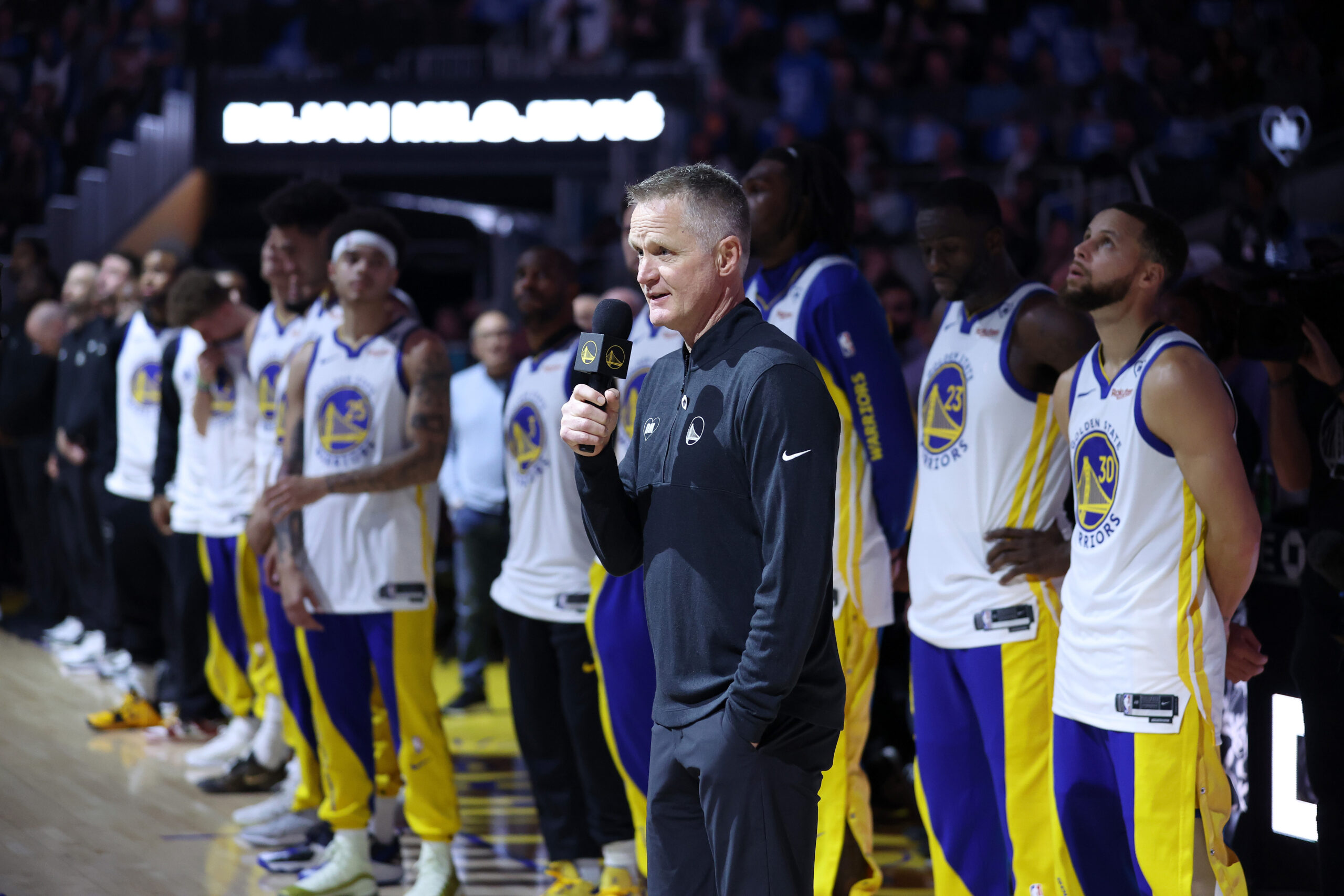
Photo: Ezra Shaw/Getty Images
Before facilitating any meeting, it helps to adopt a group-centred lens. To have a strong belief in the group’s inherent wisdom. When you look at your squad in front of you, you see an ocean of insight, inspiration and breakthroughs. You see teachers rather than students. You see answers in the room.
The transition from a teacher to a facilitator mindset can be tricky. Most coaches are experts in their field, and at times it can suit to simply tell players what they need to know. But as a facilitator it’s not about telling, rather it’s about being curious. It’s about fostering the right conditions for the group to unearth their own answers.
“The transition from teaching to facilitating is about fostering the right conditions for the group to unearth their own answers.”
For some this may require a loosening of the reins, but it doesn’t mean letting go of them. Your direction and leadership is still central, but you’re inviting your squad to step up with you from time to time. It’s important to say that certain players and squads certainly won’t have all the answers. In this case, at least they get to practise critical thinking and to put their own fingerprints on a discussion.
Steve Kerr, the Head Coach of the Golden State Warriors NBA-winning team, is a proponent of player-driven meetings. For Kerr, it’s not about “control”, rather “guiding” or “nudging players in the right direction”. That ‘nudging and guiding’ is the essence of facilitation.

Stimulating any form of response from a group is about moving energy. Moving energy can look like a smile, a nod, a raised hand. Maybe a word. Or a sentence. In time perhaps a rich, flowing discussion. We call this process, ‘getting the water flowing’.
Here are some facilitation tips to get your meetings flowing:
Show of hands: When faced with 30 blank faces, and the energy feels stuck, you can get the water trickling with a show of hands. ‘Hands up if you know’; ‘if you agree’; ‘who relates’; ‘if you’ve experienced this’. Each hand raised or not is a micro-investment in the meeting.
Open-ended questions: Clear open-ended questions are the keys for unlocking the treasure. They typically begin with ‘how’, ‘why’, or ‘what’, and generally elicit deeper insights than closed questions which give yes/no answers. The quality of the question will determine the quality of the response.
Intentional language: ‘The answers are in the room’: use language that reflects this mindset. You are not wondering if they have an answer, you know they do. Instead of ‘does anyone have an answer?’, try ‘who wants to go first/next?’.
Non-verbal communication: Facilitation isn’t just verbal. A nod or some steady eye contact can subtlety signal, ‘I want to hear from you’. You can lightly scan the room, naturally clocking different individuals throughout the meeting. At the very least, these ‘I see you’ moments will keep people checked-in and engaged.
Pair up: Speaking in front of an entire group is a big interpersonal risk to take. Pairing up to speak is a more manageable one. It gets all voices flowing; it builds safety; it serves as a stepping stone to a wider group conversation.
If your questions are met with silence, don’t sweat.
That liminal space between question and answer can be an intense time. When I started out facilitating in schools, most of my questions would hang in the air for what felt like minutes. Time sped up, as did my heart rate. I’d hold my breath. My brow got sweaty. ‘Someone. Please. Say. Something,’ my inner world yelled. The group shuffled awkwardly longing for the same. Until, finally, I’d move things along with a joke, or by answering my own question. Phew.
After enough moments like this, my relationship with silence changed. I found these moments to be a necessary and natural punctuation point; a chance for the room to slow down and to breathe. In the moments when I filled the silence, I wasn’t saving the group from the discomfort, I was in fact saving myself from my own discomfort. Rather than seeing silence as a void to be filled or feared, I started seeing it as a space for gold to be found. Granted not all silences lead to answers, but at least give the group time to gather their thoughts and muster up some courage.
‘Sitting in the silence’ is a useful practice in these moments. Meaning, allowing silence space – trusting it – and remaining as relaxed as possible.

“The more I trust myself to sit in the silence, the more the group trusts themselves to speak up.”
Here are two nuggets which help the process of sitting in the silence:
1. Trust the silence
When a group isn’t responding, a myriad of things can be happening for them. Quite often, they’re just not used to being asked. The silence is almost like a test to gauge ‘is this a token question or a genuine ask?’ In filling the silence, a lack of belief in oneself and the group is communicated. Being willing to ‘sit in the silence’, we signal a strong confidence in the group. You’re saying, ‘I know you know and I’m willing to wait’. It amazes me: the more I trust myself to ‘sit in the silence’, the more the group trusts themselves to speak up.
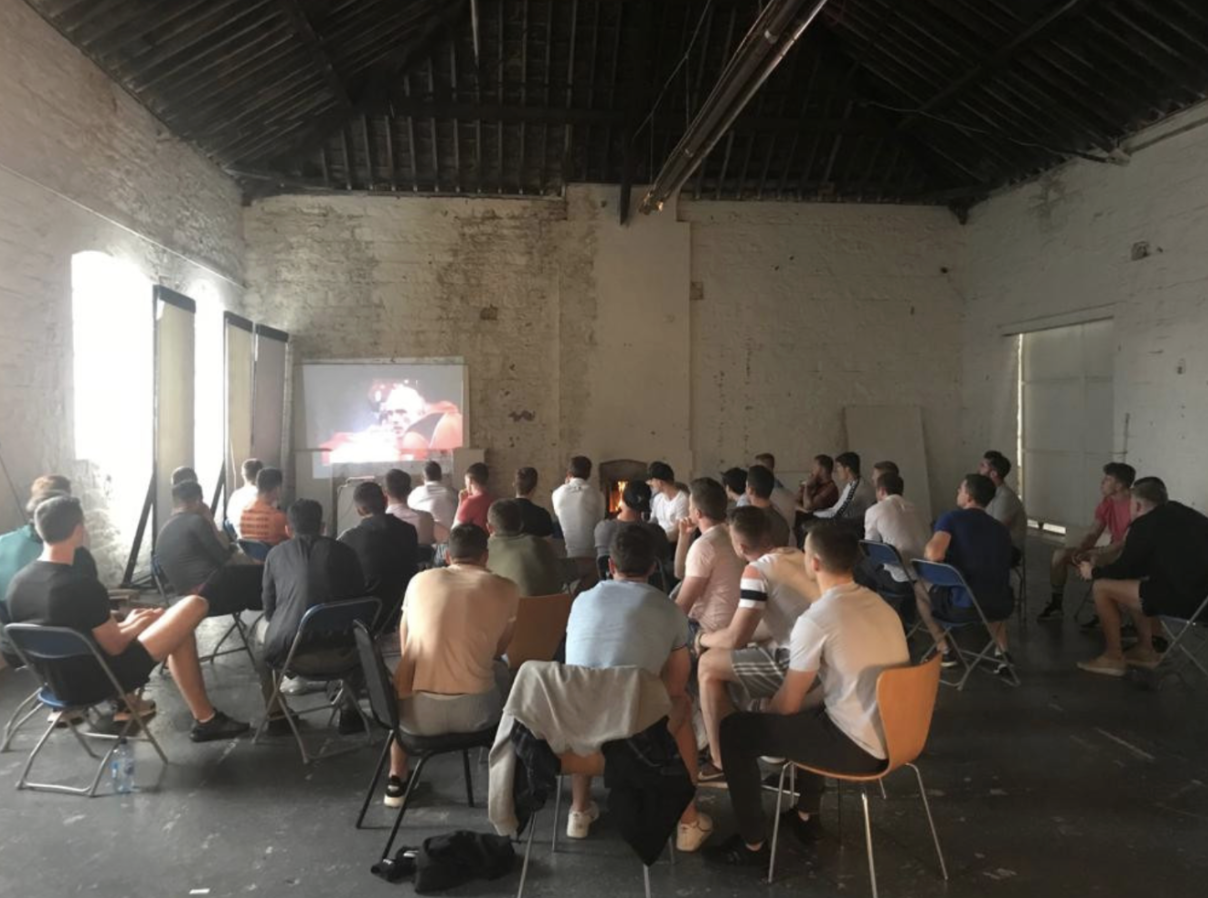
A connection-building workshop facilitated by Ronan Conway.
“The group needs to feel like you can hold yourself before they feel that you can hold them.”
2. Stay grounded
Sitting in the silence isn’t just about waiting it out, it’s about being as relaxed as you can. When we are on edge, stressed, or overly desperate for answers, groups are less willing to engage. The group needs to feel like you can hold yourself (stay calm, regulated, at ease) before they feel that you can hold them.
So before team meetings, or indeed when a wall of silence rises up, I’ll do the following to stay rooted and grounded:
Like a skill, facilitation takes time and deliberate practice. It may take time for everyone to adjust to the new rules of engagement, but once it starts flowing, the impacts can be transformative.
If you try this, I’d love to hear your experience of it.
Hopefully this article serves you and your team’s journey ⛰️
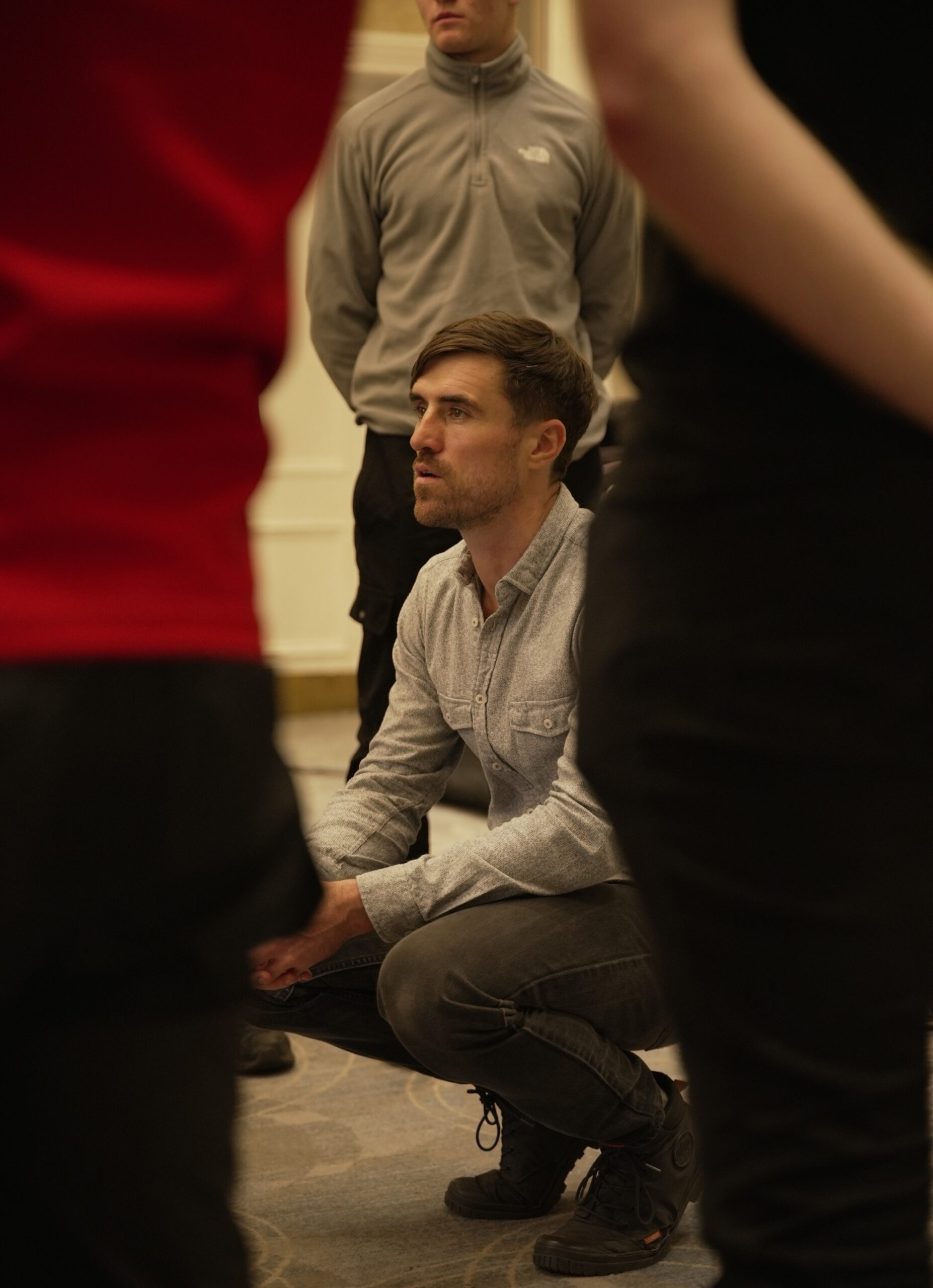
Ronan Conway is a performance coach who specialises in building cohesion and motivation in elite sports teams. He has worked with some of Ireland’s most successful teams, including the Ireland men’s rugby team, Dublin GAA’s five-in-a-row-winning men’s Gaelic football team and, currently, Leinster Rugby.
Ronan has honed his craft as a facilitator since 2012. He believes skilled facilitation can play a key role in empowering players and generating greater buy-in and belonging.
You can read more about Ronan’s work with elite teams here and here . Or you can visit his website at ronanconway.ie and find him on LinkedIn .
Here are five tips from Chelsea and the Ineos Grenadiers in their pursuits of future success.
Drawer had just completed his first season as the Performance Director of the Ineos Grenadiers cycling team – a team with whom he enjoyed immense success in their previous incarnation as Team Sky between 2016 and 2018.
In recent seasons, the Grenadiers’ success has tailed off. Drawer’s return is part of the team’s attempt to restore their lustre.
“You look for these elements of when the team was super strong and maybe some of the changes needed at that time didn’t necessarily happen,” he added in reflection.
Drawer was speaking with Chelsea’s Director of Performance Bryce Cavanagh, who also inherited a team treading water in 2023.
“Our situation is probably slightly different as they’ve been through so much turmoil,” said Cavanagh of Chelsea, who underwent a change of ownership in extraordinary circumstances in 2022. It marked the end of an era in which Chelsea’s successes underlined a shift away from the traditional powerhouses of English football.
Back in 2003, Chelsea were disruptors in their field. The same could be said of Team Sky in the 2010s when they transformed road cycling through their innovative approach to performance.
Both have since retreated into the pack, with Cavanagh admitting that entrepreneurial spirit was lacking in Chelsea’s performance department when he arrived. “There was probably a scenario where the change is seen as a threat,” he said. While there was a desire and willingness from the club’s new owners to deliver change, “people saw that as a risk that created vulnerability in their roles.”
The challenge is clear, but Cavanagh combined with Drawer to offer five tips to performance directors charged with restoring the good times.
1. Look for ‘clarity, competence and community’
Cavanagh, who in addition to the more traditional elements of his role has been tasked with a “cultural reboot”, immediately set his stall out at Chelsea with his stated desire for ‘clarity, competence and community’.
He asked two questions as he began to address the clarity piece:
Cavanagh also sought to understand the competence of the system (not individuals) with further questions:
Additionally, Cavanagh’s conception of community is as an outcome of the values, behaviours and definitions agreed by the collective.
“We had to really define where we wanted to go and what the bus looked like because then people ended up self-selecting,” he said.
2. Set standards… slowly but surely
Do not assume that high performance standards are a given across the board. Variations are common and a performance director must be prepared to ask, as Cavanagh did, “what are the things that you walk past? That you are willing to accept?”
Many have been tempted to emulate revered environments such as the New Zealand All Blacks’, but that wasn’t necessarily going to help Cavanagh at Chelsea in the summer of 2023.
“I tend to look at it like an election where you’ve just got to get the majority, and if the majority starts to [behave a certain way], that’s the culture that end up in power and every vote that gets laid is slowly going towards that,” he said.
“We weren’t the All Blacks. They’ve laid down their votes over 100 years and any new person who walks into that environment knows what’s accepted. Our environment wasn’t like that, so we’ve had to slowly and surely create it. We’re not there yet, but we’re on our way.”
3. Pay attention to your people
Drawer craved data insights that demonstrated how the sport of road cycling had developed in his six years away from the sport, but he also takes time to speak to his people – the ones working on the front line.
“Lots of staff wanted to share opinions, ideas or anecdotes in meetings around ‘the sport’s changed, it’s a bit like this’,” said Drawer, who welcomed their views. “Data and evidence is just as much people sharing opinions, ideas and observations as it is studies into how our team may be training, changes in racing patterns, probabilities.” He is “building this wealth of understanding and insight around what’s going on.”
4. Celebrate successes, however small
Cavanagh freely admits that his instinct is to go for the performance gap, but he has had to check himself because he has seen the value in celebrating wins, however small.
That goes for his department, but it also goes for the players. “Every player in our club now has an individual development plan at a first team level,” he said. “They work on that every day that they come into the club, which is quite unique.” When targets are hit, whether in the gym or on the pitch, it is a cause for celebration.
5. Decide the stories you tell about yourselves
No sports organisation can control what people say and think, but they can influence the internal narrative. And the more positive it is the better.
“This is more of an entrepreneurial time for us,” said Drawer. “We have adopted a startup mentality and will say ‘let’s try stuff. If it doesn’t work, what’s the worst that can happen?’ Because we’re not where we want to be at the moment and I think that’s just beginning to happen.
“Hopefully when the season starts we come out fighting in a very different way. We’ve spoken about it last year, but the idea of feeling that you can never crack it is the mentality that we need.”
What to read next
With Practice, Anyone Can Lead a Courageous Conversation… and ‘Skilled Candour’ Can Help
15 Apr 2025
ArticlesA recent Leadership Skills Series session provided some tools that all leaders and coaches can use with their athletes and colleagues alike.
That was the premise for this recent Leadership Skills Series session, where members of the Leaders Performance Institute were invited by our friends at Management Futures to explore:
There are two key principles:
What is ‘skilled candour’?
When we have explored this topic in the past, we referenced the term of ‘radical candour’, which coined by executive coach Kim Scott, who argues in her 2017 book Radical Candor: Be a Kick-Ass Boss Without Losing your Humanity that leaders have a ‘moral imperative’ to step into difficult conversations and challenge with skill. This requires courage because it is simply easier to avoid such conversations.
Scott’s idea has influenced Management Futures, who fashioned their own concept: ‘skilled candour’, which underlines the skill behind the action.
On that note, psychological safety is essential so that people know that you are coming from a well-intended place. If there isn’t a belief that there is trust or positive intention, it may well trigger the ‘inner chimp’ (the primitive, emotional part of our brains, which is there to protect you but, in certain circumstances, can arouse feelings of defensiveness).
When the chimp has been triggered it’s unlikely that you will have a productive conversation.
The aim must be to create a sense of safety so we can be honest and speak directly:
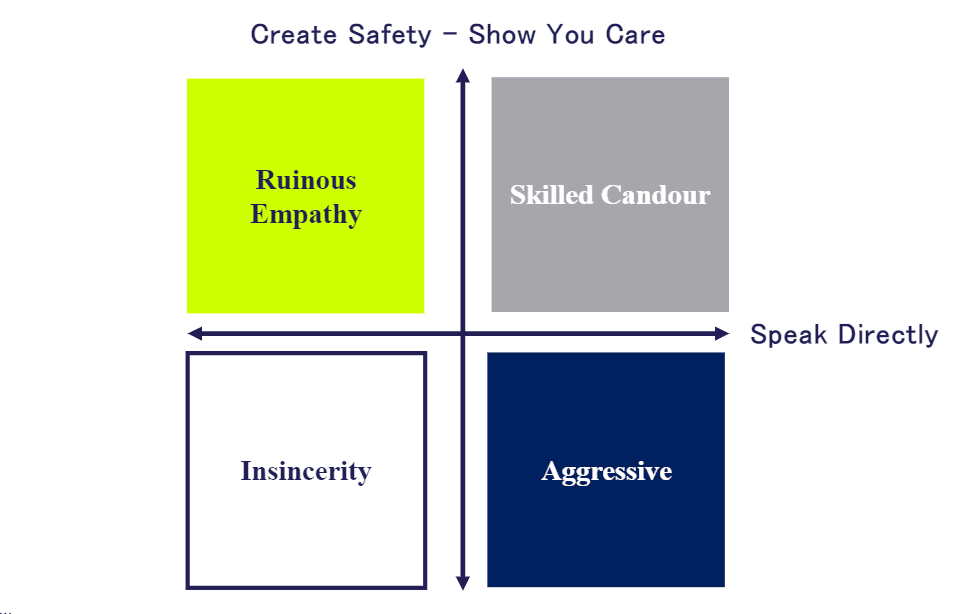
Image: Management Futures
Ruinous empathy: this is where we say what needs to be said in a clear and direct way. When you want to spare someone’s short-term feelings, you don’t tell them something that they need to know. You care personally but fail to challenge them directly, with ruinous consequences.
Insincerity: when you neither care personally nor challenge directly. You offer insincere praise to a person’s face and criticise them harshly behind their back.
Aggressive: when you challenge someone directly, but don’t show you care about them personally. It’s praise that feels insincere and feedback that isn’t delivered kindly.
We asked the practitioners and coaches in attendance where they thought they sat on the skilled candour graph. A straw poll delivered a striking insight:
Ruinous empathy: 45%
Insincerity: 3%
Aggression: 12%
Skilled candour: 39%
There are five key skills to enable your preparation, delivery and summary of a courageous conversation.
The SBI feedback model
The Center for Creative Leadership’s SBI feedback model is a useful tool for both positive and constructive feedback. ‘SBI’ stands for ‘situation/standard’, ‘behaviour’ and ‘impact’.
Below is a simple example of what this could look like – the key is what we want to get straight to the point:
Situation/standard: To begin, we should guide the person to recall the exact time and place where the action we’re discussing occurred. The more specific we are, the better, as it will help them visualise their surroundings and actions at that moment. This provides the context for the feedback.
Example: ‘It’s really important in team meetings that everybody gets the chance to share their opinions and feels heard’.
Behaviour: Outline the specific actions or behaviours that prompted the feedback. As with the previous part, it’s must be as detailed as possible. We’ll achieve this by providing two key pieces of information:
Example: ‘I’ve noticed in the last couple of meetings that when people have come up with an idea you’ve immediately said something negative about it’.
Impact: We should highlight what we believe the impact of their actions was. This impact could pertain to you, the team or other individuals. As with the previous section, it needs to be detailed and is divided into two parts:
Example: ‘You’ve talked about why it’s not possible and the impact of that is that it’s draining the energy out of the room and stopping people speak up’.
What to read next

In a recent Leaders Virtual Roundtable, members discussed how teams can improve the data literacy of their coaching cohorts.
“I said to him: ‘I had you when you were a player – I know you wouldn’t understand any of this – so why are you telling this to our players?’”
The performance director in question shared this story at a recent Leaders Virtual Roundtable entitled ‘Effective Integration and Interpretation of Data in Coaching’.
It quickly dawned on the coach. “He went: ‘yeah, I’m sorry, I hold my hands up’. That was powerful because he could see it.”
Ideally, a coach would have both the working knowledge and the confidence to make targeted and effective data-influenced interventions that remove confusion or ambiguity.
Over the course of an hour, members of the Leaders Performance Institute, drawn from a mixture of analytics, sports science and coaching backgrounds, discussed the steps they are taking to improve the data literacy of coaches at their organisations. They homed in on four factors.
Performance practitioners: engage the coach early in their tenure. Data can be another string in their bow. “You don’t want to burden them,” said one participant from the Australian Olympic and Paralympic system, “but how can you elevate them and enhance them as a coach?” The key is to explain that data is there to support their intuition as a coach. Even AI should be no more than a ‘co-pilot’. Data analysis should support the work of the coach and “give them confidence in their decision making.”
Furthermore, as analytics career pathways evolve, more teams are establishing hybrid coaching and analytics roles. “Some of the best analysts are good interpreters and translators for coaches,” said one attendee working in English football, “and some of them have taken that on themselves to think ‘I can go and progress in this’ if they’ve got an interest in pushing on with the coaching area as well.”
“Timing is everything with coaches,” said one member, while making the distinction between ‘teaching and developing’ and the ‘telling and giving of answers’. “The timing of when you plant the seed or present something new to a coach is really the start of the success or failure of what you’re trying to do.” Another attendee suggested that a practitioner must consider “what is it that you’re going to provide? And what is it you’re going to hold back?” A third offered an example of this in practice: “We’ve introduced not just new technology, like tools and hardware, but also a large number of new datasets and data metrics for the coaches to understand.” An astute practitioner will foster a curious mindset and understand “when it’s OK to give the coach a little bit more to stretch them and when we will hold something back.”
When a curiosity-driven coach uses data to support their intuition, they can do their most effective work. “I always tend to try and attach myself quite closely with any analyst to marry up the science and the art,” said an age-group cricket coach in England. “It’s about getting the data and then allowing that coaching gut feel and observation to take place as well.”
From the analysis side, it requires someone able to move beyond their specialisms to communicate readily with the coaching staff and other colleagues. “The positions of technical directors or performance managers within this space are critical to make the decisions about what we translate and how we do that,” said a member. “My experiences of things when they’ve gone well would be with practitioners that have those professional skills to communicate and give what is needed rather than give too much.”
It’s on the coach to establish the need for their performance team. “The practitioners shouldn’t overwhelm the coach, but also the coach shouldn’t overwhelm the practitioners,” said a participant from the British Olympic and Paralympic system. “Do they truly have a priority? Do they truly know what it takes to win?” The coach needs to be clear on how the data is to be used, whether it’s to inform development, to pose exploratory questions, or to make a decision. “Coaches can fall into a trap. They want to know everything, but do they truly need to know everything? What are they actually prioritising?” From there the team can decide “what are they going to double down on and ask where the gaps are for exploration.”
What to read next
What sets apart an effective, efficient and successful high performance team in sport? Smart protocols, for sure. There’s plenty to be said about useful technology, too. But the overriding factor is the individuals who come together in service of the athletes.
“Our goal is to put the athlete in the centre and then we fit the jigsaw pieces around them,” says Simon Rice of the Philadelphia 76ers.
This universal goal has long inspired Teamworks’ efforts to support high performance teams in their delivery of personalised and unified support to athletes. We understand that because the jigsaw pieces often move, practitioners must be able to see the complete picture in real time as they make high-stakes decisions.
High Performance Unpacked delivers a snapshot of that world through the eyes of the specialists who grace this Special Report.
Beyond the NBA, we hear from the worlds of the English Premier League, NFL, WNBA, motorsport, Olympic and Paralympic sports and others.
We explore how high performance roles and structures are evolving; tackle the question of scalability, which often comes down to the ability of interdisciplinary teams to elevate the collective and surmount the growing complexity of high performance environments; we then shift the focus to athlete care and ponder where the balance needs to sit between challenge and support while asking how tech can be best leveraged to meet the athlete’s needs; lastly, we ask how tech and data set the stage for the innovations that deliver efficient and effective high performance programmes.
Complete this form to access your free copy of High Performance Unpacked: Interconnected Performance Teams.
Tips gleaned from a Leaders Virtual Roundtable titled ‘Generating organisational alignment: what to consider and work works’.
Alignment is perhaps more crucial than ever in high performance, yet as this practitioner noted, it is absent too often.
They were speaking at a Leaders Virtual Roundtable that dug into the topic.
“We’ve got a large team of staff, whether that’s coaches, practitioners, athletes, and that starting point of knowing where you’re going or what you’re aiming for is really important,” said one attendee who works for a Premier League team. “Then we build a strategy around that. So what we’re looking to do and the type of things we’re trying to do – and the things we’re not going to try and do.”
“I think the point of making it intentional is a huge one for us,” said another participant who works in the NWSL. “That’s been a huge emphasis with us as a staff this year – just making sure that we are all aligned and all on the same page.”
It takes time and effort and, over the course of the conversation, the participants shared their experiences and offered some best practice tips to help you and your team.
Alignment starts at the top
The consensus was that alignment flows from the top of an organisation. The table said that senior leaders must articulate an organisation’s goals and consistently reinforce them.
“Ownership has come in and been very clear about the goal of the club,” said the practitioner from the NWSL. “We want to be a leading global sports franchise, not just within the soccer space, not just within the women’s football space.” It is a lofty aspiration but all staff members understand the aim.
Find the low-hanging fruit
Next is identifying the obstacles, “the low-hanging fruit”, which means “each department approaching the general structure of practice by identifying what’s important and then identifying how you’re going to measure those things,” as a participant working in Major League Baseball explained. “Then you break that down into its subcomponents and figure out how you’re going to identify where the lowest-hanging fruit is to then solve those problems.”
Frequent check-ins
Find opportunities to check against your team’s objectives. As one attendee said of their team’s meetings, “we started with the end goal for the end of the season and how we are going to break that up.”
It requires “crystal clarity,” as another attendee put it. They said: “do we reduce the amount of interpretation, and then on the back of that, how are we checking for understanding?” It cannot just be a case of the leader “broadcasting” messages of expectation or definitions. “What’s actually being heard and understood? How frequently do we check that?”
Develop a common lexicon
Words are critical in ensuring that athletes are presented with a united front. “That comes with knowing what are the goals, the mission, the vision of the club,” said the same attendee, “and then all being able to speak from a common language.”
“It’s in how we use strategy and try and bring it to life,” said another attendee. “I’ve seen staff buy-in, not only in one-to-one meetings or annual reviews, but day to day. They are using the language that exists in our strategy – we’re talking the same way, and we’re trying to achieve the same things.”
Let staff shape how your vision comes to life
As a leader, it is also critical to understand staff motivations and aspirations. “There’s so many compartmentalised pieces to some environments,” said one attendee with knowledge of the British sports system. “How do we actually align where there are different motivations and aspirations?”
“If you get buy-in from people and input from day one, I always find that more impactful,” offered one participant. When people are invested it leads to smarter ideas and strategies – and everyone understands how they can help to achieve them.
Make accountability the norm
Each department must articulate their goals within the bigger picture. One attendee said: “We all have a vision of what each department is working towards and who’s going to be responsible for those elements.” A team can also ask, “‘this is what this department is working on – is that getting us to where we want to go?’”
Where your values are on the wall, they can serve as a useful conversation-starter. One attendee, who works as a director of performance, spoke of approaching a staff member “standing in front of our strategy and saying, ‘where’s the work you’re doing? Where does it fit in our strategy? The acid test is they say, ‘oh, yeah, I work on this, and I know I contribute to that’. If they can’t do it then that’s on me, because we haven’t made it really clear where their work fits.”
Where there’s progress, you can celebrate the wins. “People get the chance to be appreciated. ‘OK, this is what you’re working on, this is how it’s going’” said the participant from a club in the NWSL, “and we can celebrate the victories where we’ve started to move the needle towards that ultimate goal.”
Be agile in your programmes
Alignment is not fixed, it requires constant revisiting. As one attendee said, “when we start to add more staff and the structure sometimes becomes redundant” as reporting lines change. The risk is “you have people who are tied to titles and roles that may not function anymore.”
Therefore, it is important to move beyond grand gestures of alignment and place emphasis on those day to day interactions. “The behaviour layer”, as one attendee phrased it. “‘If we do this well, we would see this, this and this’. So now you actually have things to hold people to or, if they are demonstrating it, celebrate it. ‘Great! Let’s have more of that’. If they’re falling short, ‘let’s have a conversation. Why aren’t we seeing some of that? It’s taking it from the grand gesture to the day to day: ‘demonstrate it, live it, breathe it’.”
3 Mar 2025
ArticlesFrom integration to performance under pressure, we shine a light on the topics that engaged our high performance community in February.
“The coach knowing their players, having good relationships and understanding what they need – this sets you up for success. They also let talented people around them do their jobs. This is particularly important when the pressure comes and you need to remember that everyone is there for a reason.”
With those words, Moore, a renowned orator amongst AFL players, neatly captured some of the performance conversations happening across the Leaders Performance Institute.
Here, we pose five questions, all of which were answered in some shape or form during February. We hope these to help you on the path to being a better coach or leader.
Dr Robin Thorpe has instant reservations when performance departments describe themselves as ‘integrated’.
“It’s become a new trend or buzz term in high performance,” said the former Director of Performance at Red Bull. “I’d be really interested to see how many self-proclaimed integrated departments and processes actually are.”
Thorpe was speaking at the first session of ‘The Future of Performance Sport’, a three-part Virtual Roundtable series brought to members by the Leaders Performance Institute and Exercise & Sports Science Australia
In a truly integrated department, he argued, there has to be “positive and respectful challenge between staff and then between the disciplines” and he is unconvinced that this is always the case in many environments.
“Not to be controversial, but I would think that in some of the areas or places where true integration is preached, there might actually not be any collaboration whatsoever,” Thorpe added. “And so, without collaboration, there might not be any friction points or any challenge, so it might only be perceived as an integrated process.”
There’s plenty those goes into it, as high-performance specialist Rachel Vickery said during a Leaders Virtual Roundtable.
For one, a coach’s words and actions are critical in high-pressure moments. “As soon as something is set up as a threat – ‘if we don’t win this we’re not making the playoffs’ – the stress response kicks off,” said Vickery. “If we can flip that to opportunity – and I’m not talking about rainbows, crystals and unicorns – I’m talking about intentional language; ‘how clean can we play this?’ The language is really important in those moments.” She also spoke of a Premier League coach who worked to de-escalate his own arousal state before giving half-time team talks. It also important for coaches (and their teams) to not fall prey to the notion or narrative that an undemonstrative touch line figure is somehow disinterested.
Appreciative inquiry is a social constructivist-informed model that seeks to engage people in self-determined change. The model, which was devised in the 1980s by David Cooperrider and Suresh Srivastva, is inherently positive. It focuses on discovering and amplifying the best of what already exists (individually and collectively) within a system or organisation.
The idea was discussed in great detail at our most recent Leadership Skills Series session.
Appreciative inquiry stands in contrast to most change models, which tend to identify problems and seek to fix them.
The generational gap in sport applies to athletes and coaches, but the term just as readily applies to coaching and performance staffs, as was discussed in this Leaders Virtual Roundtable.
One environment, in preparation for the 2026 Commonwealth Games, is asking its athletes and coaches a series of questions as they seek to bridge the generational gaps.
“We’ve been getting athletes into a room and asking ‘how are you experiencing this environment?’” said the attendee who shared the story. “We ask ‘do you feel like you’re developing? And do you feel like you’re successful along with your wellbeing is being looked after?” They ask coaches: “What is your intention in terms of the environment or the experience that you’re trying to create for athletes?”
There has been some positive outcomes. “This insight has led to some activities that coaches and athletes can engage in to bridge that gap and make it more likely that people are collaborating efficiently and effectively on the path to get that goal.”
It may sound counterintuitive, but you really should.
David Burt, the Director of Entrepreneurship at the University of New South Wales, delivered a presentation at the Leaders Sport Performance Summit in Melbourne in which he lauded the value of exploring ‘terrible ideas’. His rationale was sound: it reduces the negative emotions that can cloud creativity and reduces the impact of power dynamics in a team environment.
Burt said: “Terrible ideas allow you to develop new skills and meet different people in the process. There is a surprising amount of value in implementing a little bit of resource in them to drive another layer of growth.”
16 Jan 2025
ArticlesFour nuggets of wisdom from John Longmire, who recently signed off as Senior Coach of the Sydney Swans after 14 seasons.
Having fashioned a reputation as one of the finest coaches in the league during his 14 seasons in charge, Longmire has taken a new position as the Swans’ Executive Director for Club Performance. He handed the coaching reins to his assistant, Dean Cox, as the club’s succession plan swung into action.
“I couldn’t get rid of the feeling that maybe it’s time,” Longmire told his players in a moving farewell speech. He had first discussed the idea of stepping away with the team’s management 18 months earlier and returned to the topic midway through the 2024 AFL season.
Longmire’s 333rd and last game in charge turned out to be October’s Grand Final, which Sydney lost to Brisbane. Overall, he took the Swans to four Grand Finals and won one flag, in 2012.
The Swans’ list and performance infrastructure are the envy of most in the league. In fact, few departing coaches ever leave their successor a team in such good shape.
This may have been on Longmire’s mind at the Kia Oval – a ground where, as a 16-year-old back in 1987, he played in an infamous exhibition game for North Melbourne against Carlton.
“It was labelled the ‘Battle of Britain’,” he said while directing Leaders Performance Institute members towards the YouTube highlights. Those that click through can expect a litany of violent fouls.
“It was my first game, and I was absolutely petrified,” he said with a smile.
Longmire then returned to his time as Senior Coach and we’ve picked out four nuggets of wisdom.
1. Don’t become set in your ways
Injury put paid to Longmire’s playing career in 1999 (he won the AFL flag in his final game for North Melbourne) and, three years later, he became an assistant to Sydney’s then Senior Coach, Paul Roos.
Longmire was 31 years old at the time – still young enough to be a contemporary of the players he was now coaching. By 2024, both he and the sport had changed.
“The older we get, the further we get from that age demographic,” he said, “and the more rigid, the more set we can become in our ways and our beliefs – that’s the real danger.”
Longmire consciously moved with the times, but his wisdom would have counted for little if his players did not pay attention. “I know what it takes for a successful organisation to stay competitive,” he continued, “but I am the one that has to bend and move.”
One example was his gradual shift from focusing on the team’s leadership group to spending more time with the younger players. Longmire would watch and listen to them without judgement and, when necessary, “bring them back to where you know high performance teams like to operate.”
2. Find your truthtellers
“The best cultures are the ones that keep moving and adjusting to the ecosystem,” said Longmire, who emphasised the coach’s role in that process.
“I walk amongst our playing group during our warm-ups and that’s a case of sensing the mood, working out who’s talking to who and what they’re talking about.”
He also leaned heavily on his most empathetic players (“those that don’t just walk past your office – they walk in and say: ‘how are you going, coach?’”). The relationships he shared with those players were “ever more valuable” because they were his best eyes and ears in the changing room.
“Make sure you water those relationships because they’re the ones that will keep you in a job.”
3. You’re not bulletproof – don’t try to be
For all his stature as a coach, Longmire was keen to remain “connected and relatable” to his players and staff. As he said onstage in London, “the coach is no longer looked upon as being bulletproof” whatever their standing may be within the game.
His final speech to the players and staff as Senior Coach attested to that belief. He weaved in personal stories and his voice cracked at times. He wiped away tears too.
It called to mind the weekly ‘storytelling’ sessions that Longmire made a key feature of the Swans’ environment. He told the Leaders audience that players and staff share stories or complete a series of tasks for discussion each week. Recent examples included writing ‘a letter to your 16-year-old self’. These sessions are popular with players and staff alike.
“Sometimes it’s a photo of something that mattered to you and quite often there’s tears involved,” he said. “The way I looked upon coaching 25 years ago is completely different now – these 18, 19, 20-year-olds need to be able to relate to you. If you can show that you’re human, you get a lot more back.”
4. Look beyond winning and losing
Winning cannot be everything, even for a proven winner.
“If we measure ourselves on the ultimate success, there’s a lot of years of being unhappy,” said Longmire. A coach must find other factors, such as the personal development of players or staff. He said it is critical to have more in the ‘plus’ column than the ‘negative’.
“Identify, enjoy, and celebrate those moments. And make sure you get joy out of the journey.”
21 Aug 2024
ArticlesNatasha Patel of US Soccer and Simon Wilson of Stockport County discuss the influence of performance analysis on organisational strategy.
An article brought to you in collaboration with

That is according to a straw poll of attendees at a recent Virtual Roundtable hosted by the British Association of Sport & Exercise Sciences [BASES] and the Leaders Performance Institute.
We have collaborated with BASES on a three-part series called Advances in Performance Analysis and kicked things off with a first session, titled ‘The Influence of Performance Analysis on Organisational Strategy’.
Leading the conversation were Natasha Patel, the Director of Sporting Analytics at US Soccer, and Simon Wilson, the Director of Football at League 1 side Stockport County.
They began by leading a discussion of the biggest challenges facing people who use data analysis in sport. There were four that stood out:
Patel and Wilson, who began their careers in sport as performance analysts, shared a series of considerations rooted in clear principles, effective communication and strategic benchmarking when leveraging performance analysis to drive organisational success.
Establish key principles
Both Patel and Wilson continually referred to the importance of key principles. These, as Wilson explained, must outline how you are going to work and how data and analysis inform this; this allows for more creativity (and alignment) when you move through the layers. Patel, who worked at Premier League club Southampton across two spells, explained that from the beginning of her first spell, between 2011 and 2019, there was immediate buy-in from the technical director, who valued data and video analysis hugely.
Have a clear game model
A game model – a common requisite in football as well as other sports – can inform everything that follows, including data analysis. Patel said she better understood the coaches’ needs and how they want analysis delivered when there was a game model to follow. She and her colleagues were able to gain the buy-in of coaches when being intentional in spending time with them. This allowed the analyst to shine when they were able to take information from the coaches themselves and the athletes, turning it into digestible data and visuals that could help everyone. Similarly, Wilson explained how Stockport’s game model has informed their squad building and helped to generate a well-filtered target list of players who may improve the team.
Consider the end user
As Patel said, it is important to consider the end user and what performance analysis looks like to them. Once you have identified the end users, you can then work out how to get the best process for them and, subsequently, enable the trickling of information to help influence the end user, whether that be to help support or challenge their way of thinking. She referred to this as ‘stakeholder mapping’. In her second spell at Southampton, between 2022 and June 2024, Patel came to understand that each stakeholder had a unique information threshold and that more education could have been provided in-season for different stakeholders. This was a good reminder to Southampton that as performance analysis teams and departments grow and mature, so does the quantity and depth of insights.
Know the journey
Wilson, who has been with Stockport since 2020, shared that at the beginning of their current seven-year plan, they adopted a version of the Elo Rating System (derived from the world of chess), with support from a third party, to showcase the quality differences between clubs, leagues and countries. Wilson explained that the system provided objective insights into how much better the team needed to be and how they needed to grow to progress through the leagues. Engaging in this benchmarking exercise then informed the business case of how much to invest in players, staff, facilities and other infrastructure.
Patel spoke more specifically about the influence of performance analysis on player and athlete auditing and the amount of impact it has had in this space. When primarily operating in an academy environment, there are also decisions to be made around retaining and transitioning players. These metrics formed a core part of how decisions were made at Southampton, whether they were to challenge opinions and assumptions or to simply create more productive conversations. As a matter of course, Patel’s department collected athlete maturation data, leveraged the Premier League’s game-wide injury data and, finally, garnered insights from character profiling.

The renowned actor and comedian is a devotee of improvisation, which can enhance your leadership abilities if you can develop an improv mindset.
‘I became immersed in the cult of improvisation,’ she wrote of her career ascent in Bossypants in 2011. ‘I was like one of those athletes trying to get into the Olympics. It was all about blind focus. I was so sure that I was doing exactly what I’d been put on this earth to do, and I would have done anything to make it onto that stage.’
Fey had a point, and the ability to improvise is also an essential leadership asset.
‘Improvisation thrives at the pivotal intersection where planning and strategy meet execution,’ wrote Bob Kulhan, another highly regarded improv comedian, in his 2017 book Getting to ‘Yes And’.
A recent Leadership Skills Series session used Kulhan’s premise to explore how improvisation can enhance your leadership. Here, we explore some of the elements that emerged during the discourse.
How does the ability to improvise elevate performance in both individuals and teams?
There are three elements:
How do the principles of improvisation correspond with the skills required for effective leadership?
This is where it is useful to visit The Four C’s of improvisation:
The role of psychological safety
Google initiated its two-year Project Aristotle in 2012 with a view to better understanding what makes teams successful. The organisation studied 250 attributes in their 180 teams and learned that psychological safety is by far the most important factor in determining a team’s performance.
Psychological safety can be defined as ‘a shared belief that it is OK to speak up candidly with ideas, questions, concerns and even mistakes’. It is a driver of innovation, creativity, engagement and productivity.
Additionally, an improvisation mindset is fundamental to how we might create a psychologically safe environment.
It can allow you to have more open conversations. If there is a feeling of being able to speak up without being judged and critiqued, you are likely to witness a higher level of participation and engagement in your teams.
We know that teams function better when there is a mutual feeling of respect and security.
Psychological safety increases people’s willingness to be open and accountable. This can lead to getting more ideas on the table and increased contributions from across the team.
Common signs of psychological safety:
Tina Fey’s rules of improvisation
In Bossypants, Fey outlined some of the improv principles that have supported her work and career:
Questions to help you become a ‘Yes, And’ leader
Kat Koppett, the author of Training to Imagine and herself an esteemed improv specialist, suggests a series of questions that can help people in sport to reflect on becoming a leader in improvisation:
Firstly, ‘what can I notice here?’ What am I tuning into in terms of what others are communicating? Pay close attention to what others are communicating verbally and non-verbally. What are your senses telling you about how the other person is showing up?
Secondly, ‘what can I accept here?’ This is really important, especially for leaders who are often looked up to as the ones who have the answers. Let go of your personal agenda and allow others to influence your thinking.
Thirdly, ‘how can I build on these ideas or perspectives?’ It’s important to consider that the goal is not to debate competing ideas but to co-create something.
LASER: a five-pillar approach to using improv in the leadership space
Neil Mullarkey is one of the world’s premier improv actors and, in 2023, he released his book In the Moment. In it, he details some practical skills to help leaders demonstrate the behaviours that help create the conditions for teams to be more creative.
There are five: