The seven-weight world champion spoke to SBJ Tech ahead of her second fight with Ireland’s Katie Taylor.

You can’t have a discussion about sports technology today without including athletes in that conversation. Their partnerships, investments and endorsements help fuel the space – they have emerged as major stakeholders in the sports tech ecosystem. The Athlete’s Voice series highlights the athletes leading the way and the projects and products they’re putting their influence behind.
* * * * *
Two of her losses included the tightly fought split decision against Katie Taylor that headlined Madison Square Garden two years ago. Their rematch last month, which Taylor won by a controversial unanimous decision, was as the co-headliner with Jake Paul and Mike Tyson in the Most Valuable Promotions card was held at AT&T Stadium in Texas and streaming live on Netflix.
Also in November, Serrano, 36, partnered with Total Wireless, a no-contract 5G provider that runs on the Verizon network — and received her very first mobile phone. Citing an unwavering, distraction-free focus on boxing, Serrano had resisted owning a phone until now. She will host a meet-and-greet with fans at a Total Wireless store in Brooklyn on Dec. 1.
On not owning a mobile phone…
No, never. It’s going to be my first one. All my communication has been through my trainer, my brother-in-law, which is Jordan Maldonado, and every now and then, I’ll steal my sister’s phone and do everything there. I do have an iPad, but this would be my first phone.
On who she’ll call or text first…
I think it’s going to be my sister, and I’m going to talk. She will be happy that I don’t take her phone anymore. Now I have my own.
On working with Total Wireless…
Total Wireless definitely has a good commitment with the Latino companies, Latino athletes. What really got me was because their plans, and then they’re associated with Verizon. I needed a plan and something that’s not going to slow me down. Because I’m always high pace, and I needed something that’s going to do that for me.
On how she evaluates brand partnerships…
If I truly believe in it, if I’m happy with them, if I see their work and what they’ve done for others, and what they’re doing for in general — yeah, that’s how we partner up. If I believe in it wholeheartedly, then I’m going to go with them. There’s people that we’ve gotten offers from, and I said I don’t agree with what they’re doing, or I don’t get what they their motives are. So I will not represent them.
On being on co-headlining with Jake Paul and Mike Tyson…
Obviously the fans wanted this fight. I believe I won the first fight. So it was really easy when my team came up to me and said, ’It’s going to be on Netflix in a big stadium for 80,000.’ I said, ‘Let’s do it.’ We gave an iconic first fight, headlining Madison Square Garden, selling it out. And I think we’re just going to do a better fight this time. And I think we’re both deserving of this platform to go out there and represent for the women in the sport.
It’s truly an honor. I’m super proud. I have an amazing team that even thought of me to put this fight on. I can’t wait. I know I’m going to put on a show. I’m ready. I know Katie’s ready. And you’re going to witness women’s boxing at its finest.
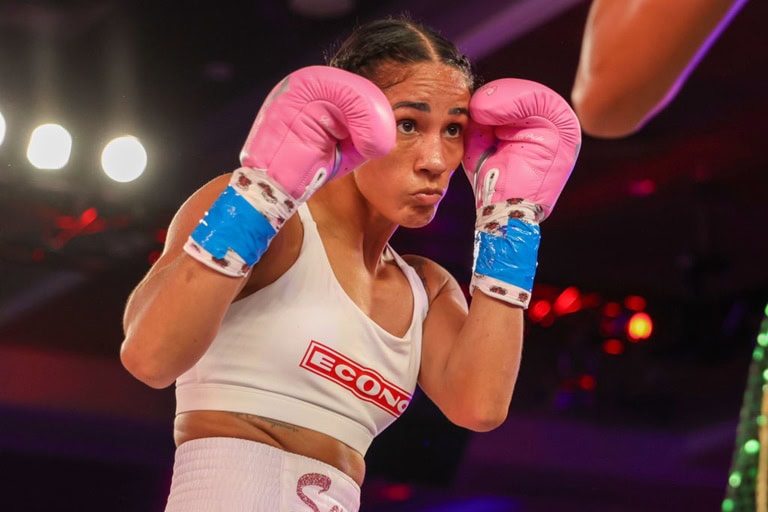
On her training methods…
I’m old school. I have an old school trainer. We’ve been doing it for 16 years this way. It’s been working for me for 16 years. I’m one of the most accomplished female fighters in the world, and that’s only [after] having nine amateur fights. I have 50 pro fights. And if it ain’t broke, why fix it? But we definitely train smarter this camp. I train hard for all my fights. So I’d be lying if I you that I trained harder. No, we just trained smarter. I’m ready to become undisputed champion at 140.
View this post on Instagram
On how she’s evolved…
I never really, in the beginning of my career, thought of recovery as part of training, but that was definitely a plus for this fight. As you get older, your body gets a little more wear and tear, so you definitely have to concentrate on that and just eating good and just going out there and performing, making sure you’re training hard and running the miles you have to run, putting in the work, and you’ll do good at fight time.
On her team…
My team is very small. It has been my brother-in-law [who is] my manager and my trainer, which is Jordan Maldonado; and my sister [Cindy]. We’ve been together. It’s been us three. I do have a pad coach, but he does what my main coach, Jordan, tells him to do. I had a nutritionist, and I learned things from him. So I moved it over to this fight. I try and cook for myself, but I’m I don’t like too much. I don’t like an entourage. I don’t like too many people around me. So it’s been my small team, and I’m happy. They just bring the best out of me.
On what she learned about fighting Katie Taylor…
Katie is definitely a warrior. She’s tough as they come. She’s not going to go down easily, and she’s going to fight every minute, every round, and that’s what I I learned. I gained more confidence after that first fight. I know I hurt her. I’m capable of hurting her again this fight. And that’s what we’re going to try to do.
On the growth of women’s boxing…
It’s been a long journey. Definitely people had their doubts in us, but now that they’ve seen that champions are fighting champions, we’re putting in on great shows — I’m not the type to brag, but when I do express how much money I’m making in my fights, that’s to motivate these young girls and show them, inspire them. There’s a light at the end of the tunnel, like ‘I can make this type of money if I continue to fight, work hard.’ Now, with this type of money, women are coming into the sport more. They’re putting on shows. They’re fighting, they’re getting in shape, and we have amazing talent, amazing champions, and I think it’s only getting better.
This article was brought to you by SBJ Tech, a Leaders Group company. As a Leaders Performance Institute member, you are able to enjoy exclusive access to SBJ Tech content in the field of athletic performance.
In the last episode of this series of the People Behind the Tech podcast, the Magic’s Harjiv Singh discusses smart practice design, targeted data visualization, and the cognitive elements of motor learning.
A Data & Innovation podcast brought to you in collaboration with
Hot on the heels of Andrea Hudy, who recounted her own story of ACL troubles in episode one, Harjiv told the tale of a pickup basketball game that ended with him tearing his ACL and meniscus while also suffering an avulsion fracture.
The 16 months of rehab stoked an interest in sports science that not only led him to the NBA but, since January, roles at the Grand Rapids Rise women’s volleyball team, as Director of Performance Science, and the University of Michigan, where Harjiv teaches out of the Human Performance and Sports Science Center.
John Portch and Joe Lemire could not have wished for a more engaging guest on this finale to this People Behing the Tech podcast series, where Harjiv delved into the sports science principles that define his work.
He also shared his thoughts on training drill design [15:39] and the transferability in competition – a relatively new area of enquiry. “It could be as simple as, in basketball, you’re putting a defender in front of you,” he says. “But it can also be as complex as the angle and the approach of that defender, the people in the vicinity of the athlete, where the athlete is starting from, their position on the court. And that’s merely the introductory part of this.”
Then there’s his thoughts on the “neglected” cognitive component to ACL injuries [6:41]; the need to know your audience when visualizing data [27:38]; and his ability to ask applied questions in the lab at Michigan.
Check out episode two:
Five Years on from the USWNT Introducing Menstrual Cycle Tracking, Sports Science for Female Athletes Remains Under-Developed. So What Can Athletes and Practitioners Do about it?
Listen above and subscribe today on iTunes, Spotify, Stitcher and Overcast, or your chosen podcast platform.
Here are 10 factors that can increase the effectiveness of your recovery practices.
An article brought to you by our Partners

Those two are inseparable as far as Skylar Richards is concerned. He says: “As technology has improved, to allow us to have interventions to help the best they can off the field, that has really given us the ability to look into what’s effective, what’s efficient, and how we can individualise those sorts of treatments to make sure we’re as optimal as possible.”
In Early August, Richards who is an Athletic Trainer with the US Soccer Federation, spoke at a KYMIRA Webinar titled ‘The Evolution of Athlete Recovery’ where he was joined by Mark Pavlik, the Head Coach of the Penn State men’s volleyball team, and session moderator Johnny Parkes, the Lead National Coach at the United States Tennis Association.
“So much in sports science and medicine, we worry not so much about the medicine side of things as much as the optimisation,” Richards continues. “And so really keeping people as healthy as possible is the focus with recovery but also then the art of how to do that consistently within their regime.”
Here, we discuss 10 factors raised during the webinar to consider when seeking to establish optimal, consistent recovery practices with your athletes.
Do you need to prioritise passive or active modalities? Your athletes’ culture of recovery – practices and habits – should tell you. In his time at FC Dallas between 2012 and 2019, Richards noted differences between his younger players, who were happy to visit the recovery lab while they watched tape, and those players in their mid-30s who had families and, frankly, far less time and cognitive capacity. “Those become the tricky puzzles to figure out,” he says. “How can I help them recover in their lives and support them in that? That can be the difference between applying an active modality versus a passive one, a wearable or something like that. It helps them to do it all the time no matter what life throws at them.”
Whatever an athlete’s preferred combination of recovery modalities, there is an important question to ask. “What gives you the biggest dosage of all those things put together in one package, which is easy to manage and to be consistent?” says Richards. “You don’t want them to burn out having to think about stuff all the time.”
A veteran may have a busy life but, as a cohort of largely self-driven individuals, Richards can work with soccer players to “scratch that itch” around self-improvement. “Something that I’ve found I can do well with my older athletes: I’ll say ‘why don’t we try to instal a recovery room at your house? It gives you an hour away from the kids and the craziness to go in, watch some videos, and now read a book. Whatever you need to do justify it as your job’.” Now, the athlete has a consistent pattern of recovery and doesn’t feel the need to, say, go on an evening run that may well clear their minds but has a detrimental effect on their physiology. “We scratch the same itch by helping you rather than sacrificing something.”
The success of Richards’ approach with his veterans has enabled them to take that message to the rest of the team. “Getting them to talk about that approach to the younger players really helps them to buy-in,” he says. With men’s volleyball at Penn State, it sits with Pavlik and his colleagues to educate the archetypal 18-year-old who “doesn’t know what they don’t know yet from a recovery standpoint”. He says: “They’re coming off of club or high school practices at most three times a week, they’re living at home with mum and dad when they wander into our gym, it’s my job to ensure that the educational points that we’re trying to drive home so they can have a longstanding, successful collegiate career, and those that continue to move on through the professional ranks and international ranks with men’s volleyball have something in their background.”
That aforementioned education is best delivered by a friend. In that regard, Pavlik ensures that his student-athletes are surrounded by smart and passionate people who make an effort to build relationships. “We do a pretty good job of getting these people around my team early in their career and, let’s face it, the adage of ‘the team doesn’t care what you know until they know that you care’ [is true],” he says. “When you have these types of experts having relationships with our players; coming to practice, just being around the water cooler during water breaks, being able to just say ‘how’s it going?’ Then when the guys are in a position to listen to what the expert is saying they’re no longer experts – they’re friends, they’re buddies.”
Are there opportunities for you around game day? “It’s always been crazy to me that we control every other variable with athletes all the time, but the one day we completely flip the schedule is game day,” says Richards. “Those older guys love those moments of recovery on the road. For them, it’s less chaotic, it’s easier to focus. So much so that we’ve had a lot of success with having players to stay at a hotel the night before a home game or have that option, so that they can get into that rhythm and we change those practice times to the same as game times so they can get that day before the game rhythm into their bodies and their minds.” The benefits are palpable. “Allowing them to get into that rhythm early on, sleep, get out of that chaos, get their recovery mode early and have time to do any modalities that they want is crucial.”
Customisation is important and, at Penn State, it goes beyond age (i.e. an athlete at 18 versus an athlete at 23). “We look at the age and the experience of the athlete, then we take a look at what their on-court responsibilities are,” says Pavlik. “Some max jump much more often than others on the court during the match or practices. There are going to be some that have to get up the floor a lot more than other guys. What we try to do here is make sure with our training staff and med staff that we understand what we’re asking them to go through.” For Richards, it involves asking better questions. “What is the question for that athlete that we can solve the best? All physiology is too much of a blanket statement,” he says. “Is it overall energy? Is it mental fatigue? Is it truly physical fatigue? Is it something masking as another [marker]? And how can we hit those?”
As moderator Johnny Parkes says, “With all these physical modalities we can use, I think we sometimes forget about the things we can control the most, which is our level of sleep recovery, hygiene and the effect of resetting the body for the next day.” For Richards, good sleep can be an outcome of a holistic approach to recovery. “That’s when you get the most synergistic effect out of all of them,” he says while asking, “Can we create that cycle of measurements to enhance individualisation and effectiveness?” He once again cites the idea of players staying in hotels the night before a game. “It really ties this together in a practical way in terms of ‘let’s get you good sleep in an environment I can go in early and control, make sure the sleep hygiene is there, giving you the time to implement those things well and then tie-in any other recovery modalities you want at the same time’.”
According to Richards, both younger and older athletes are interested in the gamification of recovery, but in different ways. “Younger players thrive for the most part on comparing what they’re doing and being effective versus their peers,” he says. “For an older athlete, I’ve found they’ve passed that point in their life, they’ve been saturated by that already and what you come to is the gamification comes from comparing them to themselves. Can they get a high score? Can they see what’s most effective for them? What patterns help them to be the most consistent over time? Scoring that on a streak becomes the better motivator for them.”
What don’t teams consider as much as they should in recovery and how do we overcome them? “Anything is better than nothing,” says Richards. “We have a huge market for recovery tools and methodologies but I haven’t seen a huge move towards a blend of that. That’s where I’ve been pushing a lot of companies on their research. Can we let the monitoring devices drive the intervention; the duration, the velocity, the frequency and occurrence? Can we use measuring sticks to drive it for individuals; its appropriateness, effectiveness and sufficiency on an individual level? Until we do that I don’t think we’re doing the best we can do to figure out the puzzle, which is an athletic body.”
The man who helped save Steph Curry’s ankle explains that there are times when athletes can train their movement patterns in the name of performance.
A Data & Innovation podcast brought to you in collaboration with
The Director of Performance at Uplift Labs was on the pod to discuss how the company’s AI can reduce injury risk in athletes.
There is no better candidate to delve into injury prevention and mitigation than the man often credited with saving Steph Curry’s ankle.
We made a whistlestop tour of his work at the Minnesota Timberwolves, Atlanta Hawks and, of course, the Golden State Warriors.
Also on the agenda were:
John Portch Twitter | LinkedIn
Listen above and subscribe today on iTunes, Spotify, Stitcher and Overcast, or your chosen podcast platform.
The renowned orthopaedic surgeon, who previously served as the Medical Director at the New England Patriots, discusses the art of medical leadership in sports.
A Data & Innovation podcast brought to you in collaboration with
“Fortunately, we had a great coach in Bill Belichick, great ownership in the Krafts, Jonathan and Robert, and I really talked to them around the facility about providing a competitive medical advantage and how we would do that.”
Provencher, who served as the Patriots’ Medical Director between 2013 and 2016 – earning a Super Bowl ring in 2014 – is the latest guest of John Portch and Joe Lemire’s on the People Behind the Tech podcast, which is brought to you by the Leaders Performance Institute and SBJ Tech.
Provencher is one of the foremost orthopaedic surgeons in the world and has treated elite athletes from across the globe at the Steadman Clinic in Vail, Colorado.
In a wide-ranging chat, we also explored:
John Portch Twitter | LinkedIn
Listen above and subscribe today on iTunes, Spotify, Stitcher and Overcast, or your chosen podcast platform.
The US Applied Performance Specialist Manager at Kitman Labs talks about development opportunities for female practitioners and athletes alike while exploring how workflows can be improved in both professional and college sports.
A Data & Innovation podcast brought to you in collaboration with
“The conversation has grown,” says MT Eisner, “but curiouser and curiouser: has the conversation grown because I’m in that circle or has the conversation genuinely grown?”
The US Applied Performance Specialist Manager at Kitman Labs would like to think it’s the latter. “Within Kitman, we talk about it consistently, within the other organisations that we’re helping [we ask] ‘how can we assist with this?’” she continues.
“We had this organisation want to now start tracking menstrual cycles, starting to do X, Y and Z with their athletes. ‘Who else is doing this? What conversations are you having? Who can we tap into?’ and so forth.”
In addition to the increasing focus on female athletes – and the development of female practitioners – our conversation also covered:
John Portch Twitter | LinkedIn
Listen above and subscribe today on iTunes, Spotify, Stitcher and Overcast, or your chosen podcast platform.
Ty Sevin of Keiser says that coaches often overcomplicate performance.
A Human Performance Article Brought to you by our Main Partners

Ty Sevin, the President of Keiser Corporation, was speaking at a lunchtime masterclass at the 2022 Leaders Sport Performance Summit at London’s Twickenham Stadium.
The session, which was titled ‘Engineering Human Performance: utilising the principles of elite sport and bringing them to the boardroom’, placed Sevin onstage with Matchroom Boxing’s Head of Performance Dan Lawrence as they discussed their favoured high performance pillars, bridging performance gaps, and taking the standards of elite sports training into everyday life.
“[Performance Coach and Professor] Andy Galpin said ‘methods are many and concepts are few’,” Sevin continued, “and I feel like there’s a fundamental lack in the understanding of concept – basic fundamental principles that guide us in human performance – and more performance coaches [are becoming] dogmatic about their methods.”
Sevin, a former athlete and coach with three decades of experience at Olympic and collegiate level, was addressing the question of why coaches often overcomplicate performance. “The method is the means to the end but they don’t focus on being dogmatic about the concepts, they focus on the methods. So you have to understand what kind of engine you’re building and that totally depends on what the requirement of the sport is. And once you can simplify that, evaluate the athlete, evaluate what they have to perform on the field, it doesn’t matter what they do in the weight room if it doesn’t transfer on the field of play it’s a total waste of time.”
Physical-tactical-technical-mental
What sets apart podium-potential athletes from the rest? “There was not a physical gap between the people who won and who didn’t: it was the extreme ownership and it was the passion that they had – the soft skills,” said Sevin, perhaps reflecting on his time as the Director of the Track and Field Residency Program at the United States Olympic Committee’s Olympic Training Center in Chula Vista, California. “It’s the relentless pursuit in many cases of going where no one had gone before.”
He highlighted specific traits: belief, consistency, compliance, hard work and dedication. In underlining his point he referenced the reflections of British Olympian Dina Asher-Smith, who spoke onstage earlier that day. “You have to have a team built around you,” he added, suggesting that community may be the most important factor behind those traits.
They all provide the foundations for Sevin’s winning “triad” of an athlete’s physical capability, tactical and technical ability and mental competency. The coach’s role is essential at that intersection. “You’re trying to address each one of those things individually and then going back to your basic concepts of ‘what does this athlete need? What are their strengths?’ Doing a simple SWAT analysis on an athlete, which is something that came from the business world that I incorporated at a very young age. You’ve got to know the strength of an athlete and what their weaknesses are; and within those three pillars you can address almost anything that happens as long as the principles are being met on top of it.”
Better coaches are better guessers
Sevin was immersed in the traditional coaching ethos of being athlete-centred, coach-driven and science-based. However, he prefers to switch ‘science’ for ‘results’.
“Science seeks answers and training seeks results,” he said. “If you look to science, you have to have pragmatic experience. The reason that coaches I think do well over time is not that the coach is so much better than the coaches they’re competing against, it’s because they have the opportunity to work with athletes over a long duration of time where they learn knowledge and they see all these different holes that athletes can have. So if you’re a young coach and you’ve got no mentor or progress and you see a hole or a deficiency in an athlete, you’re practically guessing; and as you become more experienced as a coach you become a better guesser.
“Someone asks: ‘how do you get to that level?’ It wasn’t because I was a better coach, I got involved with really good coaches at a really young age and you learn from the athletes. There’s nothing you can learn in a university setting that will help you on the field; and that’s the art of coaching.”
Sevin, who also worked as a stockbroker upon leaving college, feels that the lessons he learned in that world were readily applicable to his future coaching. “I had that foundation of understanding of how to do strategic operations planning and I applied it to an athlete,” he said. “And when you identify every criterion that’s necessary for whatever they’re competing in and you have a pretty good idea of that athlete. [You have to] test, evaluate, prescribe.
“So I test. I’m matching that test up against what the demands are of that position, that body type, that skillset, that metabolic need; what are the limb speed requirements? What are the power output requirements? What do they have to do to become resilient? That all falls in that onion of the human capabilities. You test, you evaluate, and then based on your education, based on your pragmatic experience, you implement.”
Sevin explained that he sees himself more as an educator than a coach, that he focuses heavily on the ‘why’ with an athlete. “I like it because a lot of coaches don’t know the ‘why’. They really don’t know the why, they just do it because that’s the way they were trained or that’s how their mentor did it and that’s where the dogmatic approach comes from.”
Education and communication are the coach’s trump cards. “It’s an evolution of understanding the athlete, how is your relationship with them, how do you communicate with them, but if you can identify the problem, tell them why this is hurting their performance, and have a game plan, and be honest about it and say ‘this could work or it may not work’, with the honesty and the communication you fill the gaps in over time.”
In our latest Member Case Study Virtual Roundtable, James Morton of Science in Sport reviews his time spent helping to develop a winning strategy with Team Sky.
A Leaders Performance Institute article brought to you by our Partners

Recommended reading
The Secrets of an Agile Team: when McLaren Racing Began to Make Ventilators
Framing the topic
Our final Member Case Study of the year was led by James Morton, Professor of Exercise Metabolism at Liverpool John Moores University, and focused specifically on executing performance in one of the most challenging performance environments in sport – the Tour de France. James shared with us his experiences from the Team Sky, now Ineos Grenadiers, environment around how they approach the race and maximising the impact on rider performance.
“Lack of knowledge is not always the problem… it’s the ability to take this knowledge and develop and deliver practical and simple solutions that counts… it’s the detail and final step of delivery that makes the difference in sport” – Sir Dave Brailsford, Team Sky / Ineos
Performance Knowledge & Delivery
This is the concept of it is what you do that really matters not always what you know. How are you taking the knowledge and applying it – execution.
There are four pillars of consideration to this model (Close, Kasper & Morton, 2019):
High-performing teams strive for Transformational Improvements – practitioners who engage in research and practice, constantly auditing and wanting to improve.
The Knowledge Delivery Framework
Developing the programme and athlete performance plan through the performance checklist:
Where can you lose or win this race? What can stop us winning?
Identify the factors that can stop you winning (cycling example):
What can you do from a delivery perspective to optimise performance?
Discussion points
Biggest challenges