At a recent Leaders virtual roundtable, John Bull of Management Futures explained that long-term success depends on preserving what works while embracing challenge and evolution.
He even compared some high-performance environments to a cult.
“Pete didn’t mean that as a negative thing, but he felt there was a cult of personality around figures such as the coach or the GM,” said John Bull, to whom Keen was speaking at the time. “His concern was when they leave; what would happen to performance?”
Bull, the Head of High Performance at Management Futures, recently led a virtual roundtable session for Leaders Performance Institute members that explored the facets of organisations that have sustained their success over a long period.
“Pete challenged us,” added Bull. “He said, ‘it would be great if someone did a piece of research helping us to understand, if you look at sustained environments, what are they doing differently? And what can we learn from that if we want to make a system more sustainable?’”
There are both environmental and leadership dimensions and, as Bull would go on to explain, it is something at which all leaders can work.
“How do you become very good at being a sustained leader within your own organisation? How good are you at balancing adding value for today versus adding value for tomorrow?”
He then posed another question to encourage the table to think about the topic:
If you had to place a single bet on the organisation that will be the most consistently successful over the next 50 years – in any domain you choose – what characteristics would you look for?
In response, the table proposed three characteristics:
With the scene set, Bull turned to a research project titled ‘Radically Traditional’, which was led by Alex Hill, the author of the 2023 book Centennials: the 12 habits of great, enduring organisations. Hill led the project on behalf of UK Sport and the Centre for High Performance.
In 2018, Hill wrote of the project for the Leaders Performance Institute:
Why do some teams sustain success, whilst others stumble and fall? What sets them apart? And how can we learn from them? Well, our findings suggest it’s by becoming Radically Traditional. With a stable core – purpose, stewardship, openness – and a disruptive edge – experts, nervousness, accidents.
Back at the roundtable, Bull attempted to illustrate this idea:
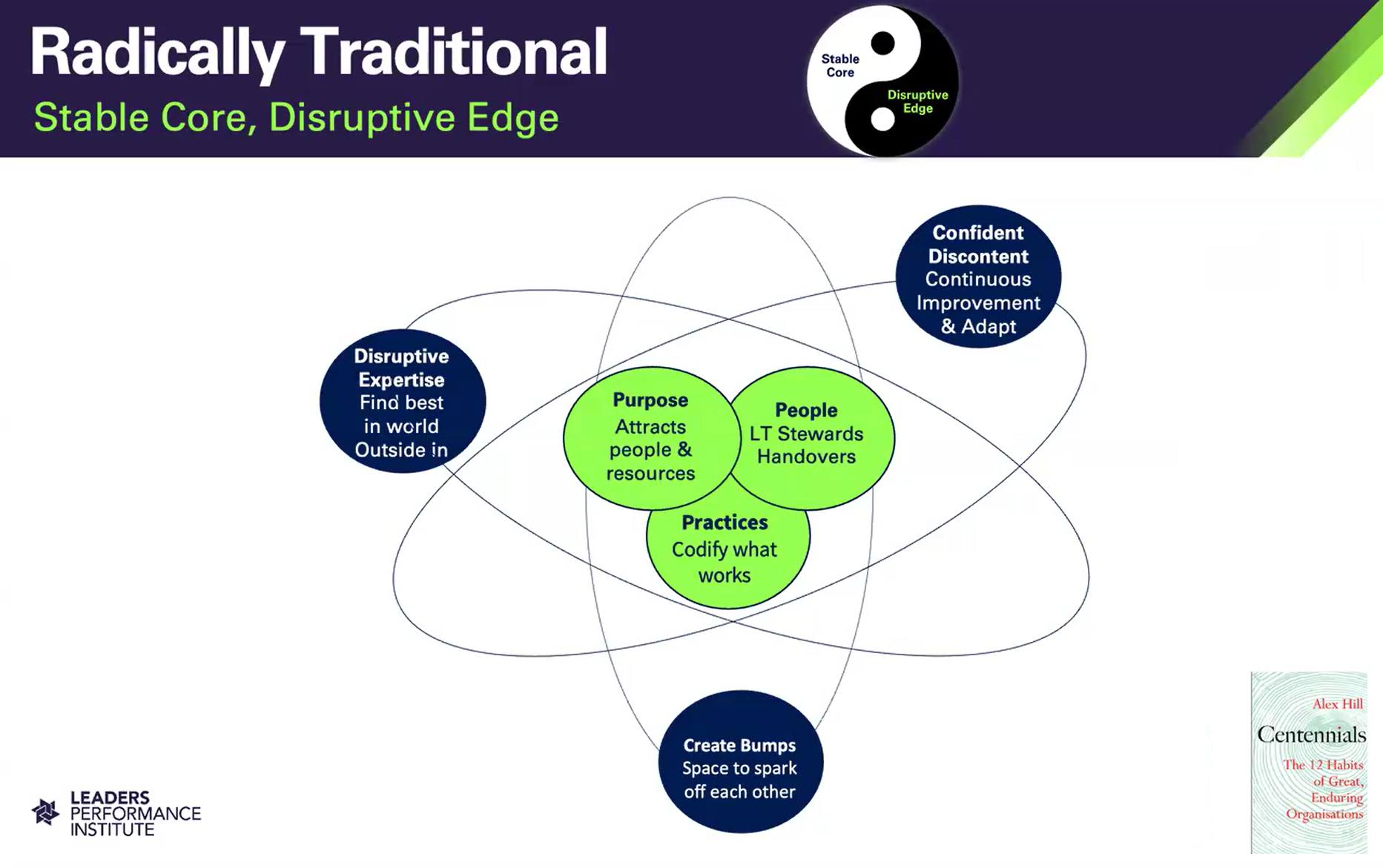
He then explained each element in turn.
The stable core
The disruptive edge
When it comes to finding a disruptive edge, Bull cited two leaders who proved their credentials.
Firstly, Peter Blake, the founder of Emirates Team New Zealand, the perennially successful America’s Cup sailing team.
“His founding principle was we want to combine insights from sailors and the designers,” said Bull, adding that this did not sit well with the team’s designer, Bruce Farr.
“Farr decided he didn’t want to listen to sailors messing with his design and, very courageously, Blake said, ‘well, that’s fine. Then you’re not the designer for our campaign’; given that Farr was the best designer in the world, that was pretty courageous.”
That was in the early 1990s; Team New Zealand has since gone on to win the America’s cup five times, including the last three editions.
Bull’s second example is Gene Kranz, who served as one of NASA’s Flight Controllers during the Apollo Lunar missions of the 1960s and early 1970s. Kranz made sure that his team at the Manned Space Center in Houston regularly ate meals together.
The bonds formed during those mealtimes were likely critical to the Apollo missions, especially during the successful effort to bring home the stricken crew of Apollo 13 after an explosion occurred on their spacecraft 200,000 miles (320,000 km) from Earth.
There is, as Bull explained, power in breaking bread with your peers and colleagues. “Without a doubt, the best problem-solving discussions I ever heard were when the senior team were around a table eating lunch,” he said. “And if you go back to if I were betting on an organisation, one of the things I’d do is walk into the café and I’d want to see if mobiles are out or if people are engaged in conversation and how mixed the tables are across function.”
A member from a military background told the table that he has tried something similar with his team. He said such interactions can generate “something that solves some problems that you as a leader didn’t necessarily foresee”.
He added: “that’s a major organisational decision to be comfortable with maybe a little bit less productivity with a purpose that that is an investment in future productivity based on relationships.”
As the session wound to a close, Bull steered the conversation towards four transitions to which we need to pay attention (and the risks to avoid):
1. Big success: the risk of complacency
“It can be really hard to avoid,” said Bull. However, in environments of sustained success, he has noticed “leaders are slightly paranoid when they get success; and that’s what drives them to go further.”
2. Big failure: the risk of overreaction
“The danger is that we throw the baby out with the bathwater; that we throw out some of the good as well as some of the things that we don’t need to change,” said Bull. “But there’s something about going ‘not all tradition is worth keeping’.”
3. Change in key people: the risk of losing knowledge
“One of the key things is managing handovers,” said Bull. “I think it is also looking to recruit for curiosity and humility. Sure, you want people to bring in some disruption and change, but you also want them to spend some time figuring out what has worked and not change everything.” He returned to Keen’s observation about cultish environments. “How do we make them not cults but a repeatable formula that can pass from generation to generation?”
4. Significant external change: the risk of slow or inadequate adaptation
“What’s interesting in the sustained organisations is they are often not the first to come out with a new innovation, but they are the first to start thinking about it and innovating,” said Bull, who observed that they can be conservative by nature, which does not quell their desire to test and learn. “They’re big believers in evolution rather than revolution in that sense.”
If you have any further questions around how to sustain success with your team, feel free to reach out to Management Futures directly via [email protected]
What to read next
Tom Crick, the Chief Scientific Adviser to the UK Government’s Department of Culture, Media & Sport, explains that there is a responsibility on leaders to build environments that empower people, engender trust, and enable swift learning.
“You’ll hear things like ‘AI will replace teachers’ or ‘AI will replace doctors’ – no they won’t,” he told an audience at the 2025 Leaders Sport Performance Summit in London.
It is more likely, he said, that “AI-enabled or AI-augmented teachers might replace teachers”; similarly, “AI-augmented doctors might be more effective from a diagnostic perspective.”
Crick believes the current discourse that paints AI as either “humanity’s destruction or its ultimate saviour” is “not very helpful for the broader conversation around technology utility and adoption”.
His words were delivered to a room full of coaches and practitioners from across the globe, all of whom have seen AI play an increasingly prominent role in their work; and, as far as Crick is concerned, sport’s leaders must simply get to grips with it.
“There’s no way you can be a leader and be digitally incompetent,” he said. That doesn’t mean one has to train as a computer scientist, but a working knowledge is essential. “I don’t understand how you would see the impacts and the challenges for your business if you just say ‘I’ll delegate that; that’s a CTO or CDO problem’.”
That said, Crick understands the anxiety around AI and tech, which he attributes to a “confidence and capability challenge”. “It can be quite exposing if you’re the senior leader in an organisation,” he continued. “You basically have to say ‘I know nothing about this stuff and it’s a massive gap in my knowledge and understanding.’ It takes humility to own that.”
Over the course of half an hour or so, Crick prompted the leaders in the room to reconsider their approach to AI.
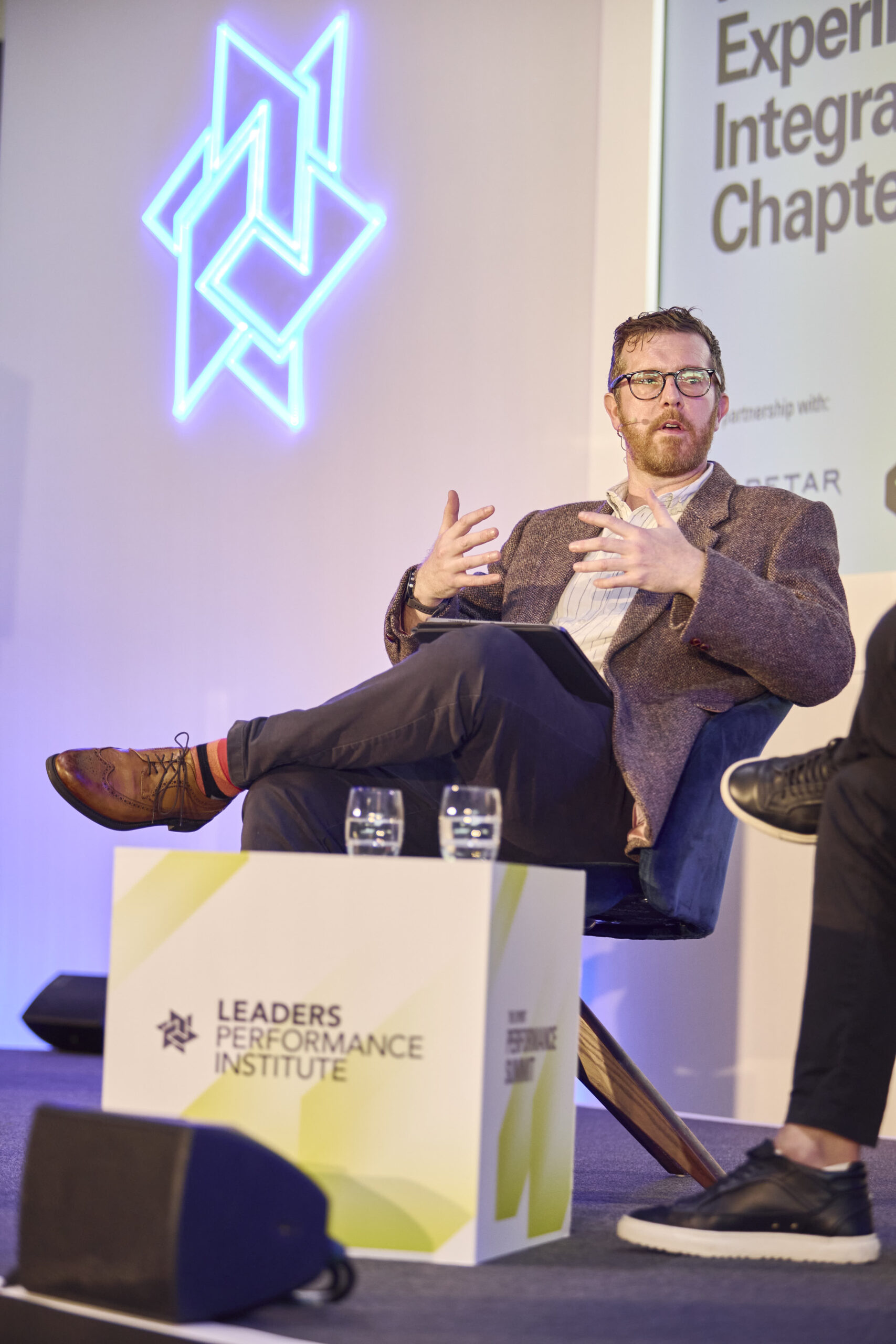
Tom Crick onstage at the 2025 Leaders Sport Performance Summit at London’s Kia Oval.
Don’t deal in blind trust – keep the human in the loop
“Lots of generative AI tools are just statistical probabilistic bullshit generators,” said Crick. “People anthropomorphise these tools far too much. [AI tools] don’t think and they don’t have an intrinsic understanding of things.”
In stating these limitations, he encouraged the audience to not just “automatically trust the system” and to look more closely at both the challenges and opportunities presented by AI.
“AI will not magically remove uncertainty, but it can reshape and augment what that might look like for you as a coach,” he added. An AI tool may help you churn through datasets at inhuman speed, but “we have to be grounded in the dangers of these tools as a shortcut to absolute certainty.”
It comes back to what Crick terms a person’s “critical AI literacy”. “We want to stay curious; we don’t want to be too complacent.”
As such, he promotes “AI with humans in the loop” because AI “augments human capability and does not replace it”; human agency, he argued, is “sacrosanct”.
Get the basics right before even thinking of scaling
Crick believes that organisations should think about the “skills, competencies, behaviours and dispositions” they’ll need in the coming years because if teams are unsure why they’re using AI, if there’s no strategy and no idea of when to invest, when to lead and when to follow, their efforts will be built on a “foundation of sand”.
It starts with the basics. “Think about good data disciplines and make sure the data is high quality,” he said. It is also a question of clarity and alignment, which he revealed is a perennial problem across the various departments of the British Government when it comes to AI.
Your structure will guide how effective your delivery is and will enable you to verify or validate datasets and practices. This is critical because AI is not a “magic black box” where you simply “crank the handle and out comes the answer”. In any case, Crick argued, such an approach would be “disempowering for coaches and people who work in sports performance.”
Design for trust and accountability
AI usage must be rooted in values that promote accuracy and trust. “Values are useful anchors and shouldn’t be seen as constraints,” said Crick, who explained that the DCMS, in defining its AI strategy, will “enshrine high level principles to provide assurance and confidence to everyone who works in the department.”
It comes down to “doing the right thing in the right way and how that comes through in legitimacy, trust, transparency, verifiability; and things such as explainability and understandability too.”
Therefore, when using AI in athlete-facing settings, coaches and practitioners should work in an open and transparent way. They should ask themselves “where’s the feedback loop? What’s the mechanism for co-design and co-creation of shared outcomes? This naturally leads back to the humans in the loop”.
Crick likens technological leadership to an art or craft, one that is particularly important when the going gets tough.
“What does that look like when you bounce human intuition around and the magic algorithm says ‘no’? [What do you do when] the algorithm says you should do x but the experienced coach says you should do y? How do you reconcile such elements, especially under pressure?”
Be curious
“I think you need to have a system and culture that rewards curiosity,” said Crick.
When teams test and learn they will fail often and he argued that leaders must accept that fact.
The key, he argued, is “to fail fast, adapt and refine very quickly”.
It comes back to the leader and those foundations. “How do you have the structure in place to recognise that?”
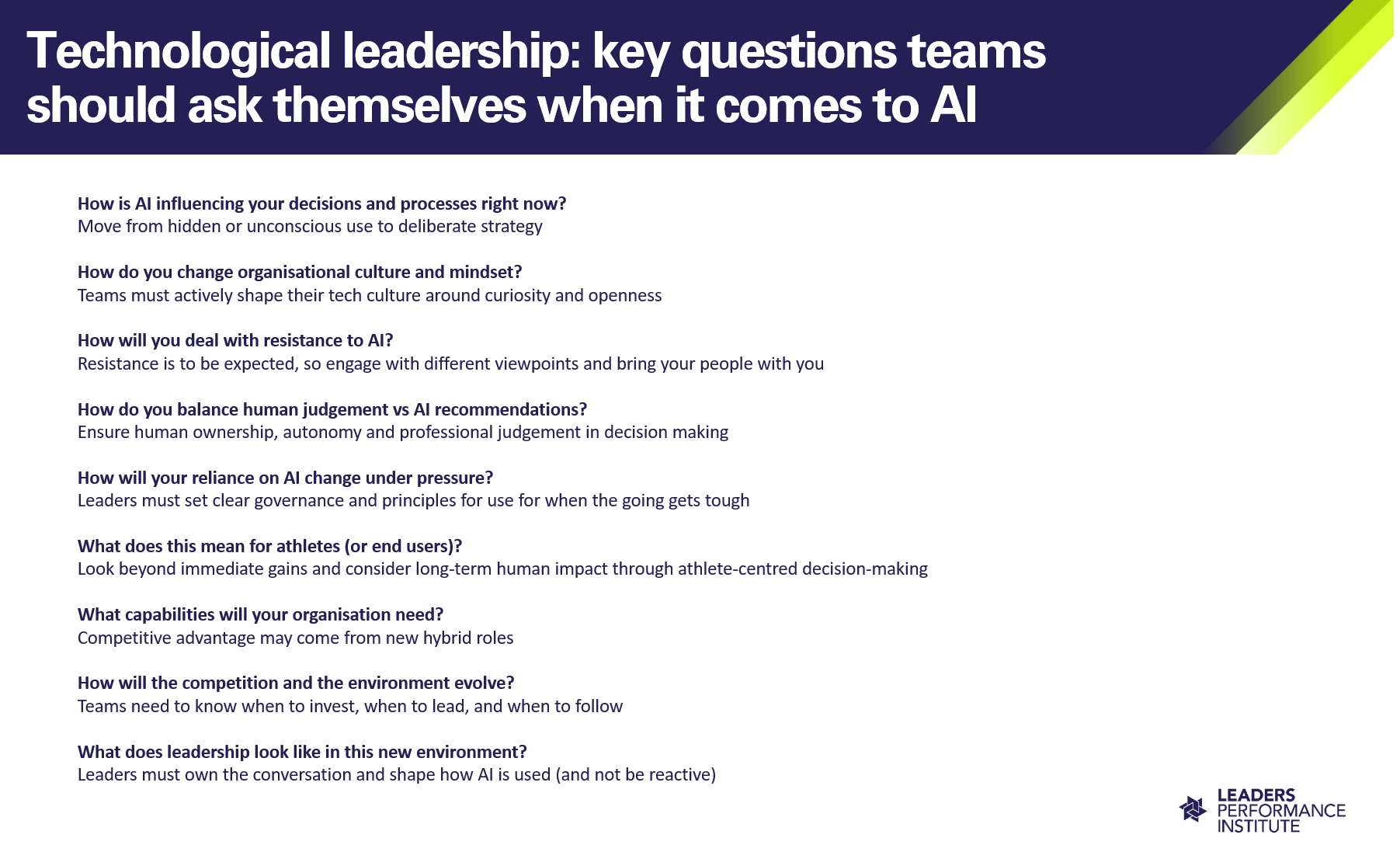
Crick wrapped up his session with a further series of questions to ponder:
What to read next
In the third part of his miniseries, Basketball New Zealand GM Paul Downes explains how a peripheral format became a legitimate, strategically prioritised pathway for international success.
Main Image: Basketball New Zealand
More often, it is resisted because proposed change is perceived as threatening what people care most deeply about: identity, legacy, fairness, and standards.
This article uses the evolution of the 3×3 Tall Blacks programme as a case study in applied change leadership, exploring how innovation can be mobilised without destroying trust or fragmenting a system.
Specifically, the article examines how 3×3 Basketball shifted within Basketball New Zealand (BBNZ) from being viewed as a peripheral or competing format to a legitimate, strategically prioritised pathway for international success. Drawing on innovation and change management research, it demonstrates how leadership decisions around pace, protection, communication, and culture shaped the programme’s trajectory. Central to this case is a simple but often neglected principle: organisations can only move at the speed of their people.
What is 3×3 basketball?
3×3 Basketball was formalised by the International Basketball Federation (FIBA) in the late 2000s as a condensed, high‑tempo version of the game designed for urban environments, broadcast appeal, and global accessibility. Played with three athletes per team on a half court, a 12‑second shot clock, and first‑to‑21 scoring, the format demands rapid decision‑making, tactical clarity, athletic versatility, and exceptional individual skill under pressure.
Since its inclusion as an Olympic discipline at the Tokyo 2020 Olympic Games, 3×3 has moved decisively from an alternative format to a mainstream high‑performance sport. It now operates with its own world rankings, qualification pathways, professional circuits, and national team competitions governed by FIBA. Crucially, success in 3×3 is not achieved by lightly adapting 5×5 systems; it requires distinct preparation models, athlete archetypes, and tactical identities.
Who are the 3×3 Tall Blacks?
New Zealand competes in 3×3 Basketball through a clearly defined international competition pathway. The men’s senior programme, known as the 3×3 Tall Blacks and, known on the FIBA circuit since 2025 as #2PointNation, contests major national team events including the FIBA 3×3 Asia Cup, the FIBA 3×3 World Cup, and, where applicable, Olympic or Commonwealth Games qualification tournaments. Athletes may also compete in FIBA‑sanctioned professional events such as World Tour Challengers, World Tour Masters, and selected Pro circuits, which contribute to global ranking points and qualification status.
These competitive realities require BBNZ’s 3×3 programme, across U21, U23, and senior team, to be innovative by necessity. With constrained resources and limited margins for error, the Men’s (and Women’s) programme has had to identify where competitive advantage is possible, how learning can be accelerated, and how athletes can be developed into genuine 3×3 specialists rather than part‑time participants (through also prioritising 5×5).
3×3 as a strategic opportunity, not a threat
Within the New Zealand basketball landscape, historical emphasis has understandably sat with the Tall Blacks (men’s 5×5) and Tall Ferns (women’s 5×5) programmes. These teams carry deep cultural significance, reinforced by landmark performances such as the Tall Blacks’ fourth‑place finish at the 2002 FIBA World Cup and the Tall Ferns’ participation at the 2004 Olympic Games. However, podium finishes at pinnacle 5×5 events, and consistent Olympic qualification, have become increasingly difficult in a global ecosystem shaped by professional leagues, deep talent pools, and significant financial asymmetry.
Within this context, 3×3 has emerged not as a replacement for 5×5, but as a distinct strategic opportunity: a format in which New Zealand can plausibly compete for medals through deliberately creating an identity, strategy and specialisation by targeted coaches and athletes. Yet recognising opportunity was not sufficient. Elevating 3×3 within a 5×5‑dominant system required leaders to manage legitimate fears that resources, attention, or cultural value would be diverted.
As 3×3 Tall Blacks Head Coach Piet Van Hasselt said:
Resistance to 3×3 didn’t mean disloyalty. It often meant people cared deeply about 5×5 and felt responsible for protecting it. 3×3 is still the new kid on the block in basketball terms and is very different to 5×5.
This framing was critical. Resistance was interpreted not as obstruction, but as a signal of attachment and responsibility. That distinction shaped how change was approached: not through mandate, but through dialogue, clarity, and deliberate pacing.
Three roles that support successful innovation in HP environments
Across HP sport and other expert systems, innovation research converges on the importance of leaders occupying multiple complementary roles rather than relying on individual charisma or isolated expertise (1,2,3). Three roles are consistently evident in successful innovation initiatives.
1. The System Architect
The ‘System Architect’ role is grounded in organisational ambidexterity and strategic leadership research. Scholars such as Tushman and O’Reilly (1, 2) demonstrate that breakthrough innovation depends on senior leaders designing separate but integrated systems, protecting exploratory work from short‑term performance pressures while integrating it at the top through strategy, resourcing, and authority. Mintzberg’s work on “designing the organisation” (3) reinforces this view in that effective leaders shape structures, decision rights, and power flows rather than running experiments themselves.
In HP sport terms, the architect decides where innovation sits, how it is protected, and how it is judged. Without this role, innovation becomes personality‑dependent and fragile; with it, innovation becomes institutional.
2. The Technical Champion
The ‘Technical Champion’ is one of the most empirically supported roles in innovation literature. Research by Howell and Higgins (4, 5) shows that innovations outperform when championed by credible insiders who persist under resistance, mobilise informal networks, and translate abstract ideas into legitimate practice. Subsequent work clarifies an important dependency: champions burn out or are marginalised (6) without organisational protection from architects.
In HP sport, champions are domain‑credible leaders for example coaches, senior athletes, or tactically fluent specialists who are willing and able to absorb resistance on behalf of others while legitimising change through performance.
3. The Cultural (Learning) Enabler
The third role of ‘Cultural’ or ‘Learning Enabler’ is supported by Amy Edmondson’s (7) research on psychological safety. Innovation fails less often due to lack of ideas than due to fear. Leaders who frame their strategic initiatives as learning problems, without lowering standards, create environments where experimentation, respectful conflict, and early failure are informational rather than punitive. This role ensures innovation does not collapse into compliance or defensive behaviour, particularly in high‑stakes environments such as elite sport.
The blended roles within BBNZ 3×3
Within the BBNZ 3×3 system, Nikolay Mikhalchuk (High Performance Manager, 3×3 – hereafter HPM) and Piet Van Hasselt (Head Coach, 3×3 Tall Blacks) can be viewed as functioning as deliberate amalgamations of all three innovation roles, in part due to the realities of scale and resource constraint.
Architectural leadership
As system architects, Mikhalchuk and Van Hasselt emphasise structural protection and integration, explicitly designing daily training environments and pathways for learning rather than forcing premature exposure. Mikhalchuk explains:
Decisions are made to take a step back, spend more time… align yourself, the coaching staff, and then prepare, rather than throwing athletes in the deep end before they understand the system and role expectations.
This reflects programme ambidexterity through protecting exploration (learning the 3×3 system) while gradually integrating it into the national pathway across U21, U23, and senior programmes.
Champion and cultural leadership
As technical champions and cultural enablers, both leaders are able to translate strategy into daily training behaviours while safeguarding learning. Van Hasselt captures this when he notes:
We’re trying to find a gap we can exploit based on our strengths… We have forged an identity, with clarity, and our players have bought into it.
He further explains how culture and learning interacted:
Great leadership and athlete ownership has meant we’ve been able to build through younger players, and now these players are becoming specialists.
Through deliberate ‘test and learn’ cycles, particularly in the Under-21 and Under-23 Nations League exposure and targeted senior competition, 3×3 specialists have emerged organically rather than being imposed.
Managing change in a 5×5-dominant culture
At a technical level, the transition from 5×5 to 3×3 can present genuine challenges. Mikhalchuk notes:
There are a lot of nuances and rules around 3×3 which would drive 5×5 players mad… The transition from a 5×5 star to the 3×3 court is close to impossible.
Yet once athletes choose to engage, the experience is often transformative. Van Hasselt observes:
Every time a 5×5 player comes in they absolutely love it… We have found players who are courageous and ready to take a leap of faith to this exciting new challenge.
These insights reinforced a core leadership lesson that people cannot be rushed through change they have not yet made sense of. Progress depended on aligning belief, understanding, and competence. Indeed, moving at the speed of people, not planning cycles.
View this post on Instagram
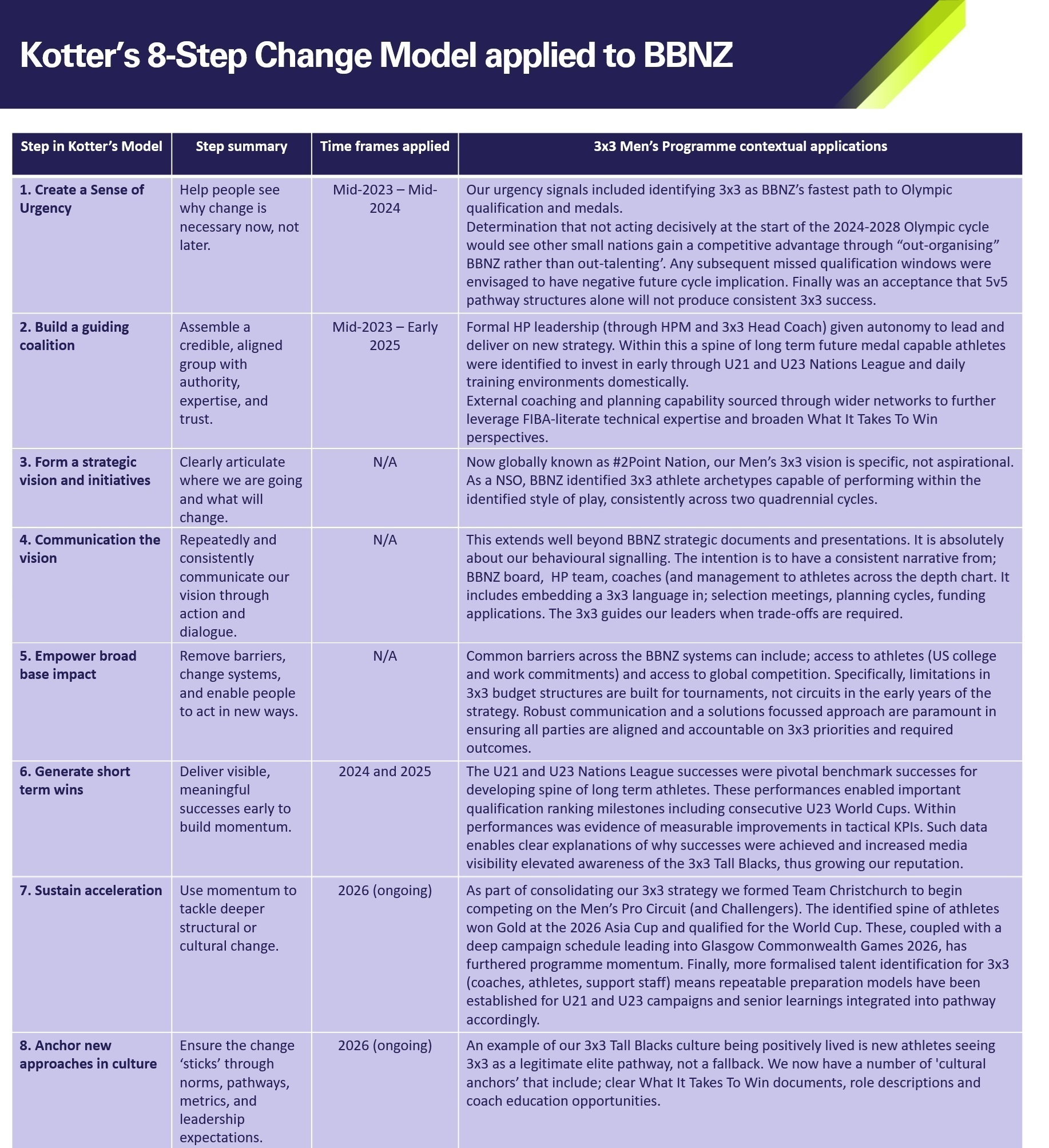
Applying Kotter’s 8‑Step Change Model
Recognising the complexity of this transition, BBNZ have applied Kotter’s 8‑Step Change Model (8) to structure and evaluate progress. A central insight of Kotter’s model is that sustainable change is built deliberately, sequentially, and with reinforcement. This model, and its contextual application is summarised here:
Concluding remarks
Within the global FIBA 3×3 landscape, the 3×3 Tall Blacks’ #2PointNation identity signals strategic clarity and a commitment to playing to New Zealand’s strengths rather than mimicking others. The Men’s programme accelerated once 3×3 was framed, and accepted, not as a format that could rely on occasional 5×5 participation, but as “our game, our way.”
An aligned approach to innovation, grounded in organisational values and supported by deliberate change management, has enabled the programme to become a respected and emerging force internationally. As Van Hasselt reflects:
Our programme and players strong commitment to improvement has helped us perform better game by game. The commentators tell us we can beat anyone in the world… they like us because we’re different.
Mikhalchuk adds:
We’re quick, we’re strong, we’re consistent and tough… We feel we can build those twos, and when opponents adjust, we can drive and create uncontested shots.
Ultimately, what gets funded gets celebrated. With increased High Performance Sport New Zealand (HPSNZ) investment toward the 2028 quadrennial, the Men’s 3×3 programme has moved from experimentation to embedded strategy. As Van Hasselt summarises the ambition:
We’d love to medal at LA 2028… We are continuing our exciting journey and improving every game and event as a team.
The broader lesson is clear. Successful innovation is not a hero story. It is a role system, paced deliberately, anchored culturally, and led with respect for how people actually change.
References
1) Tushman, M. L., & O’Reilly, C. A. (1996). Ambidextrous organizations: Managing evolutionary and revolutionary change. California Management Review, 38(4), 8–29.
2) O’Reilly, C. A., & Tushman, M. L. (2004). The ambidextrous organization. Harvard Business Review, 82(4), 74–81.
3) Mintzberg, H. (1983). Structure in Fives: Designing Effective Organizations. Englewood Cliffs, NJ: Prentice-Hall
4) Howell, J. M., & Higgins, C. A. (1990). Champions of technological innovation. Administrative Science Quarterly, 35(2), 317–341. [jstor.org]
5) Howell, J. M., Shea, C. M., & Higgins, C. A. (2005). Champions of product innovations: Defining, developing, and validating a measure of champion behavior. Journal of Business Venturing, 20(5), 641–661. [researchgate.net]
6) Shea, C. M. (2021). A conceptual model to guide research on the activities and effects of innovation champions. Implementation Research and Practice, 2, 1–13.
7) Edmondson, A. C. (1999). Psychological safety and learning behavior in work teams. Administrative Science Quarterly, 44(2), 350–383
8) Kotter, J. P. (1996). Leading Change. Boston: Harvard Business School Press
What to read next
You Don’t Arrive Strategic: How Leaders Grow Into their Role
Chris Davies, the BRC’s Head of Emergency Planning & Response, explains that his organisation has adopted a ‘when not if’ approach to the increasingly complex world of humanitarian crises.
Main Image: The British Red Cross / YouTube
In the early hours of 14 June 2017, a fire at the residential tower in the North Kensington area of west London killed 72 residents, injured a further 70, and left many more homeless and bereaved.
In the aftermath, the British Red Cross worked to support the survivors but as Chris Davies, their Head of Emergency Planning & Response, said, “one of the challenges we had is there were an awful lot of people in the community who didn’t trust us and didn’t necessarily want the Red Cross in the room”.
Davies, a former infantry officer in the British Army who joined the British Red Cross in 2022, was speaking at the 2025 Leaders Sport Performance Summit in London. He explained during his presentation that this mistrust was born of their lack of local understanding.
Three months after the fire, in September 2017, the organisation’s then CEO, Mike Adamson, wrote: ‘it took us too long to reach out to the real grassroots groups and that cost us in terms of trust through the process. We are still trying to address this.’
While noting his pride in some elements of their response, Adamson acknowledged that ‘there is a real lesson here about how we engage with a community that we do not know. We need to add people with different skills to our response and recovery teams. We also need to explore the extent to which our scale and brand give us convening power to help bring organisations together and respond dynamically to need.’
It was a chastening experience, but one that has not been repeated as the organisation adapted. “In the past, there has always been a sense of organisations like ours knowing what’s best and that’s wrong. We don’t,” said Davies onstage. “That humility is really important.”
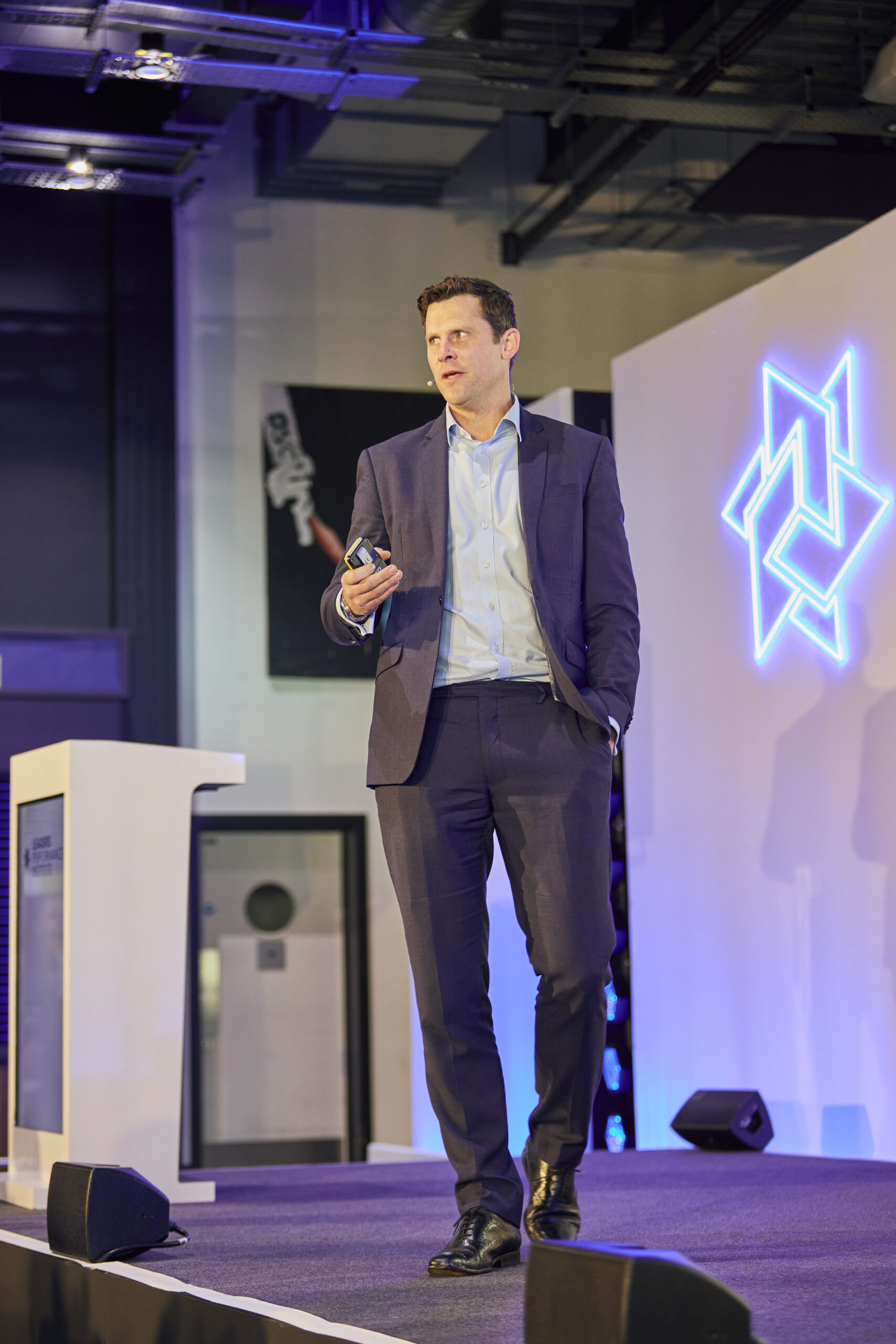
Chris Davies, the Head of Emergency Planning and Response at the British Red Cross, onstage at the 2025 Leaders Sport Performance Summit.
Here, we explore how the British Red Cross, as part of a wider international movement that is more than 160 years old, adapts as the character of crisis response changes.
Spot the need for change
“The mission is critical in our world,” said Davies, “but the mission is only as good as the individual’s understanding.”
He shared the British Red Cross’ mission with the room:
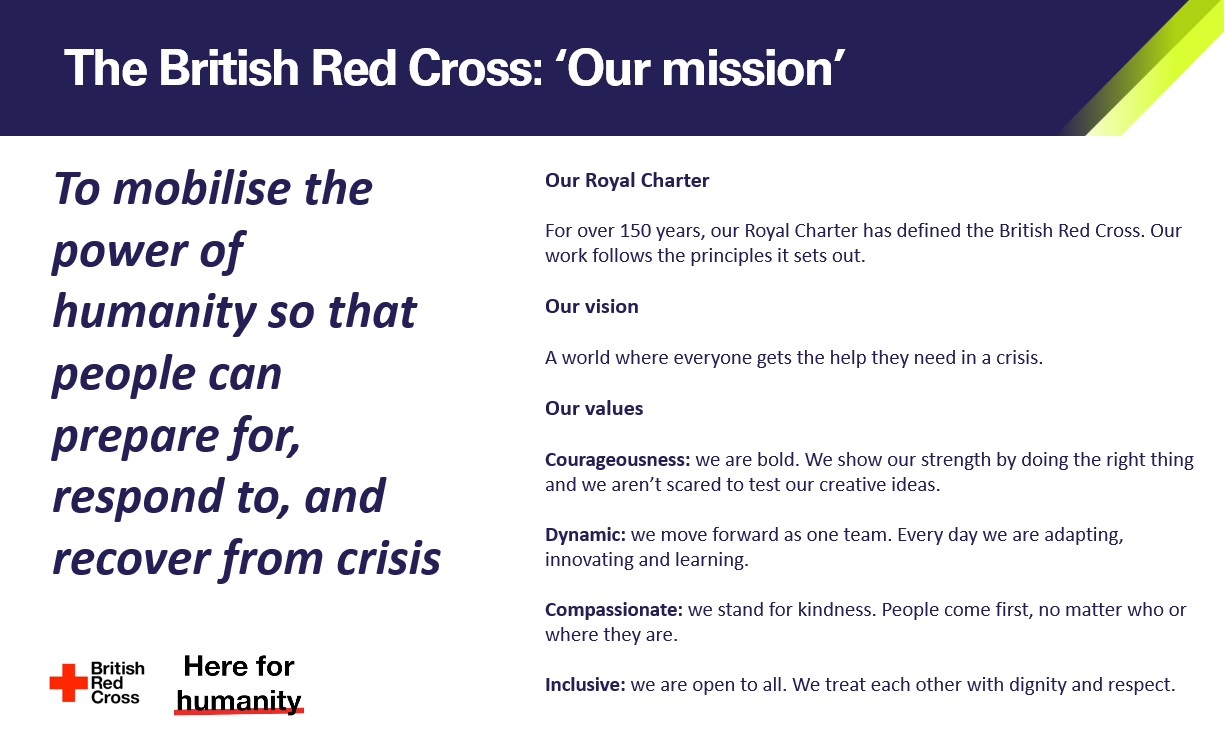
Their mission is simple but powerful; their vision and values provide scope for interpretation. Combined, they enable the organisation’s leaders to spot the need for change when something is off and then do something about it, as happened in the aftermath of the Grenfell response.
“The nature of humanitarian work is unchanging,” said Davies, specifically referencing the core human need for connection and support. “However, the character of that work is constantly shifting.”
That character had been misunderstood at Grenfell, but they fared better when severe flooding hit the town of Brechin in eastern Scotland in October 2023.
“The team I deployed were a local team who had to self‑mobilise and respond alongside the local authority,” said Davies. “We had essentially taken it to that point of how you build the mission into teams so they can respond and have the right response. I didn’t need to phone them up and tell them to do that; they operated independently with the right resources at the right time because they had already won the trust of that community in Brechin because they were from that community and they knew there was a high risk of flood.”
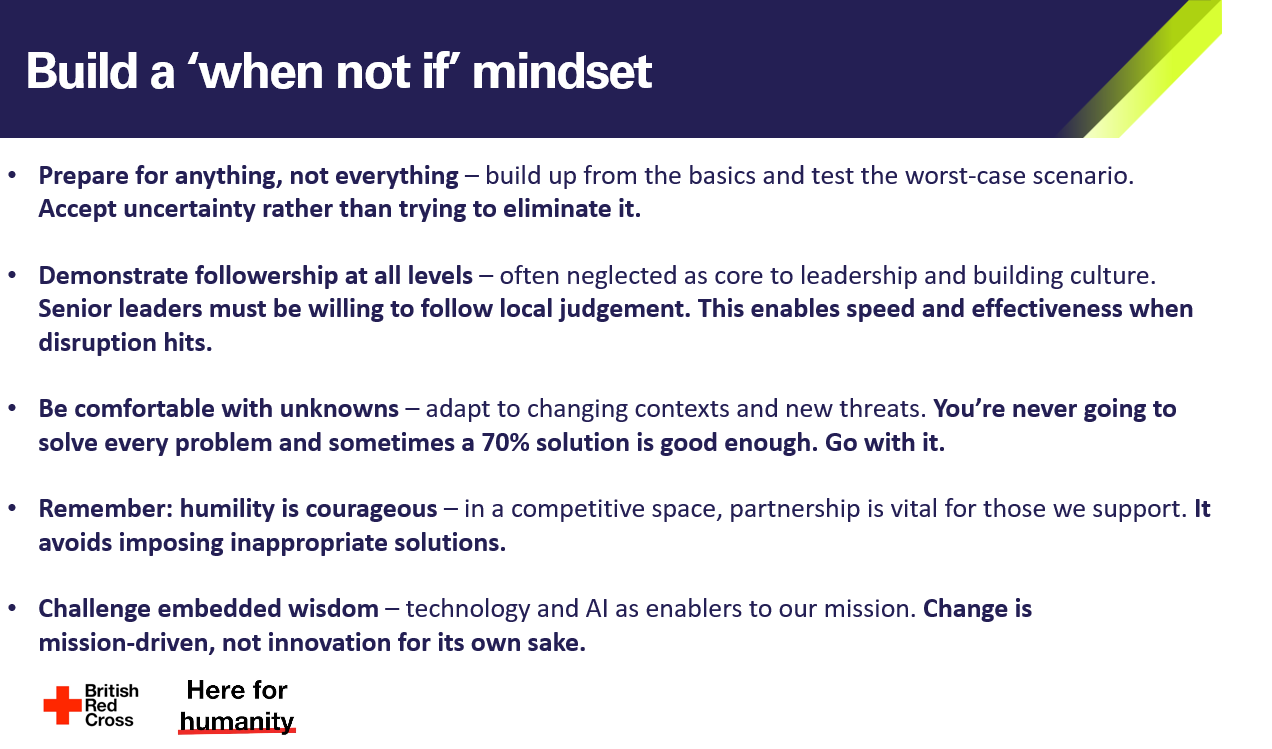
Adopt a ‘when, not if’ mindset
In Britain, climate change is currently the biggest humanitarian threat. “One in four homes by 2050 will be impacted by climate change, according to the UK government,” said Davies. “Are we ready for that? No. We’re not as an organisation, but also as a country, we’re not ready for that scale and impact is coming down the road due to climate change.”
That work is already underway, with the British Red Cross, as an auxiliary to government (“we’re not an NGO”), trying to build its readiness through community connections, by liaising with the relevant authorities, and using technology such as AI where suitable (e.g. a flood monitoring app is in the pipeline).
On top of this, crises and disasters grow ever more complex, which necessitates sending junior leaders into the fray ever earlier.
It is not a decision taken lightly given the gravity of the work and the blend of paid staff and volunteers. It can be a tricky dynamic to manage and there often isn’t time for adequate training. “We are putting immense expectations on them because of the changing environment; the world in which we operate.” It’s a challenge they haven’t yet nailed.
A key leadership skill in that regard is the ability to sustain a ‘when not if’ mindset. Davies illustrated this with a slide:
Trust is critical to mobilising people in complex environments
Davies described the UK as “one of the most complex environments in the world”. To make his point, he spoke of Britain’s “increasingly polarised society” and high poverty rates, which help explain why “trust in the UK Government is the lowest it’s been for decades.” He quoted the British Office of National Statistics, which put the figure at less than 25% of respondents in late 2025.
This has implications for institutions of all hues. “An organisation like ours, which is a large institution, your brand is globally recognised, you also have to work hard to earn that trust.”
They understand that adaptation requires leaders to let their people in the field act, adjust and learn in real time from the people whom they are supporting.
To help illustrate that point, Davies presented the British Red Cross’ ‘Trust Model’:
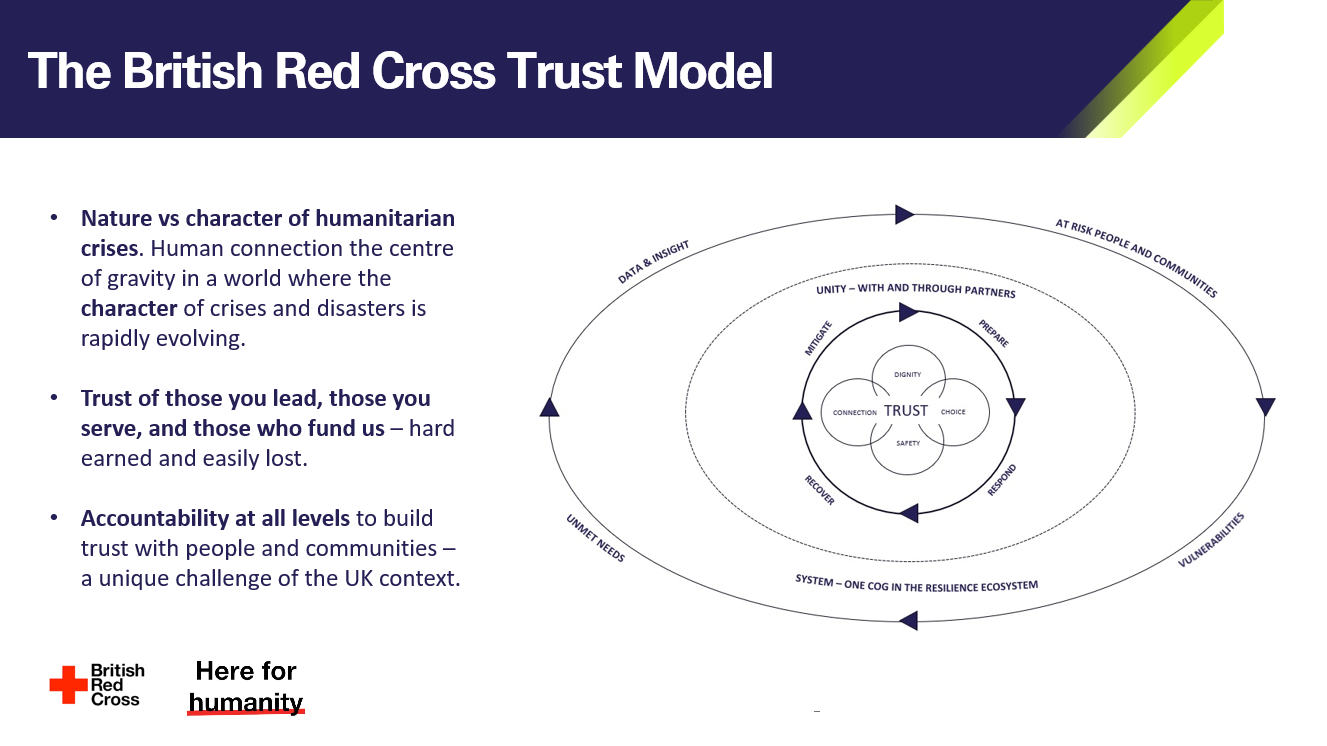
Essentially, as the graph above aims to explain, they treat complexity as a given and trust (built on dignity, choice, safety and connection) as a requisite that enables the kind of decentralised decision-making and coherent action witnessed in Brechin.
“Ultimately a model like this puts the dignity and choice of those communities at the centre and ensures that we’re supporting them in the way that they need as those demands evolve over time.”
What to read next
Adaptability: ‘Change Is Everywhere and Leaders Must Respond All the Time. It’s No Small Ask’
World Rugby’s Brett Robinson describes the treacherous path he navigated when delivering the global federation’s Impact Beyond 25 strategy.
Robinson, a former Wallabies international-turned-sports scientist and C-suite executive, beat France’s Abdelatif Benazzi by 27 votes to 25 in the second round of the election held by World Rugby’s Executive Council.
His narrow majority meant he succeeded Sir Bill Beaumont without a honeymoon period. Yet his achievements thus far, chiefly the implementation of World Rugby’s Impact Beyond 25 programme and building consensus around new laws of the game, have been commendable.
“I’m really proud of where we’ve got to as a game because, when I came into the role, we were fractured and divided,” he told an audience at Leaders Meet: Australia in Brisbane in February.
There were factions within the World Rugby Council that could be divided into England and the Celtic nations on one side with the French and Latin nations on the other. Robinson, as an Australian, said he was “coming into a gunfight between the Celts, the English and the French.”
For all that, in September 2025, the 17th World Rugby General Assembly had endorsed Impact Beyond 25, its five-to-seven-year strategy for developing and promoting the world game heading into the men’s Rugby World Cup in 2027 and Women’s Rugby World Cup in 2029 (both to be hosted in Australia) with the 2028 Olympic Games in LA sandwiched in between.
So what changed? Below, we explore Robinson’s approach to calming rugby’s internal strife.
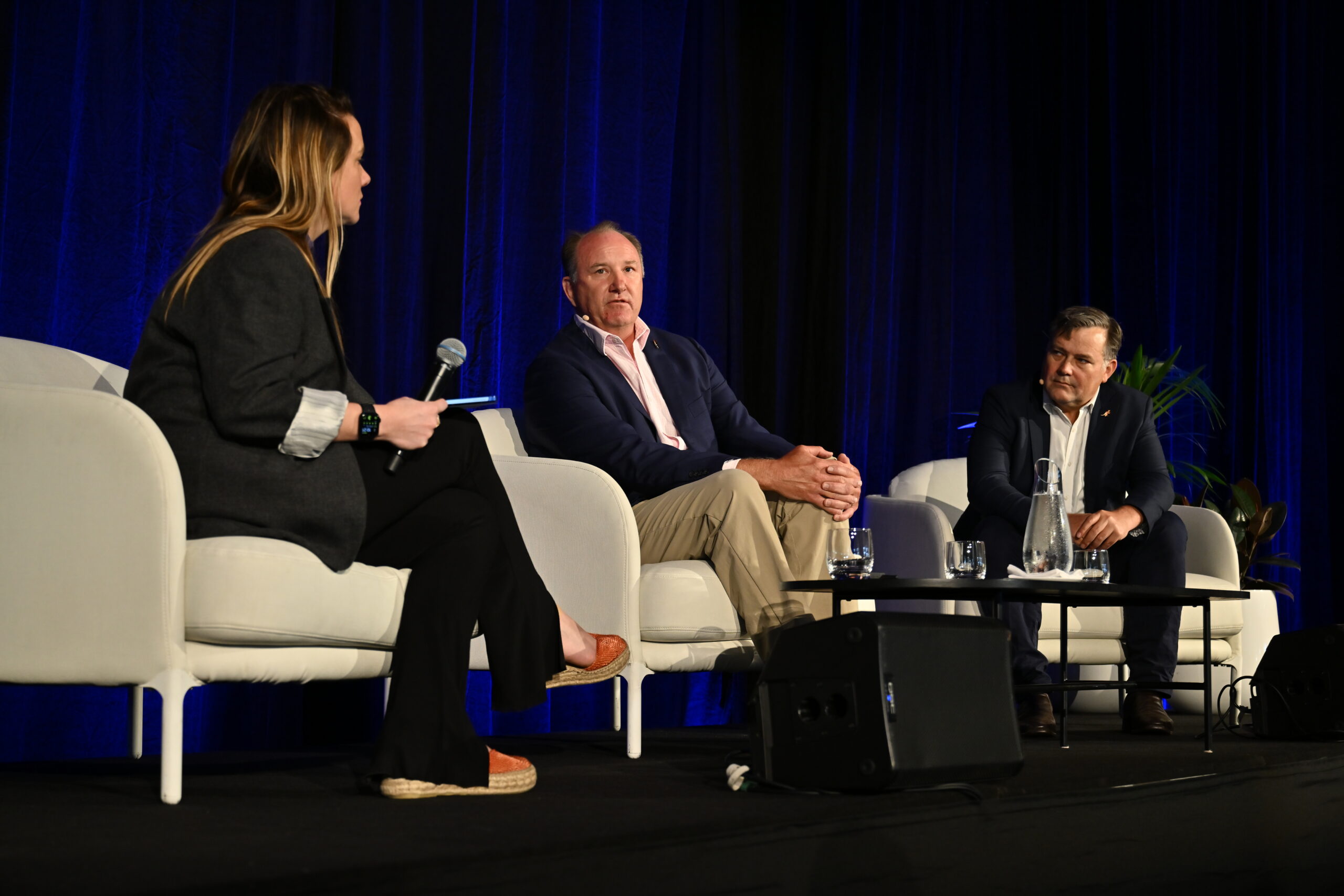
Brett Robinson (centre) onstage at Leaders Meet: Australia with Rugby Australia’s Director of High Performance Peter Horne and Leaders’ Managing Director Laura McQueen. (Photo: Albert Perez / The Leaders Performance Institute.)
Firstly, he didn’t shy away from the problem
As Robinson explained, “some countries were incredibly frustrated; they wanted to revolt and blow everything up.” Others were about “organisationally working with the change and not being too destructive”.
Almost half of the 52 members of the World Rugby Council voted for Benazzi as Chair. Robinson, who will serve a four-year term, did not shy away from that fact. “We’ve got differences of opinion, we’ve got some challenges, and there’ll be some people that were disappointed after the election,” he said in the aftermath.
In December 2025, he expanded on his thoughts as a guest on the Rugby Unity Podcast. “The system upon which World Rugby is built has been in place for 30 years,” he said. “We have systems that simply don’t work and prevent us from reacting with the necessary speed.” It is worth remembering that he made those observations after Impact Beyond 25 had been launched.
Onstage in Brisbane, he further outlined an enduring sticking point: that France and England account for approximately 70% of the revenue generated in rugby union. This had led to political as well as economic tensions across the different factions; and the question was how World Rugby could engage and incentivise the other unions to align in pursuit of a more equitable distribution.
He ensured World Rugby’s new strategy was a collective endeavour
The Impact Beyond 25 strategy was unanimously ratified just days before the 2025 Women’s Rugby World Cup final, which saw a crowd of 82,957 watch England beat Canada 33-13 at Twickenham.
The timing could not have been better. England 2025 was the most well-attended Women’s World Cup ever. World Rugby’s unions gave their blessing to a global impact plan that, in the international governing body’s own words, ‘is built around three core themes of profile and participation, careers and gender equity, and capability and expertise with the mission of inspiring more women and girls to get into rugby on and off the field of play.’
Most importantly, it bore the fingerprints of all those involved in its creation.
“It’s really important that, in my role, I bring the game together and we agree on what shared success looks like and we pursue it together,” Robinson told Rugby Unity.
He expanded on those comments in Brisbane. “We’ve built a collective plan where we’re all engaged, we’re all incentivised, and we’re all a part of that journey,” he said, adding that the plan includes taking All Blacks and Wallabies Test matches to the United States. Such moves “will help build the fandom that ultimately will drive the commercial outcomes and [increase rugby union’s] market share”.
He accounted for local complexity
“We are not going to do everything from Dublin,” he told the Brisbane audience, name-checking World Rugby’s base and then pointing to the man sat beside him onstage, his former World Rugby colleague Peter Horne, who now serves as Director of High Performance at Rugby Australia.
“What we do is only as good as what he [Horne] can deliver and vice versa.”
In some places, such as Australia and England, Robinson said, “we have an Anglo-Saxon way of governing; we’ve got strong boundaries around the role of the chair, the board, the CEO, the executive. In other parts of the world, they have very different ideas of the president or the chair being an executive authority.”
He cited the example of Argentine Gus Pichot, the former Vice-Chair of World Rugby. “He’s not the chair and he’s not on the board of the Argentine Rugby Union, but he is making every decision coming out of it; and so I have to work with that, acknowledging that I need to keep his chair informed and his CEO informed; but if Gus doesn’t agree with it, it doesn’t happen. And I could say, ‘well, that’s just a crazy way of governing’, but I can’t change it, so I have to work with it. The French are the same; Florian Grill is their president. He’s not the CEO, but he operates as an executive chair.”
On that last note, Robinson said: “I spent a lot of time before Christmas with the French in Paris. I’m going back there in a couple of weeks’ time.” These meetings have proven invaluable. “You have to work really hard to genuinely display that you’re listening and supporting, and they don’t necessarily say ‘yes, yes, yes’, but actually they can see the ‘why’.”
World Rugby is now reaping the rewards of his efforts. “Having the French and the Argentinians now with us, and rebuilding the relationship with the Celts and the English, was probably the biggest challenge that I faced; and now we’re there, we need to push on and deliver.”
He won’t rest on his laurels
“You’ve got to be systematic; from my experience, if you go randomly into anything like this, you are more likely to fail than not,” said Robinson. “You have to set up a proper process.”
He listed the necessary personal qualities of a chairperson: trustworthiness, empathy, and emotional intelligence. He balanced these against an ability to act and make tough decisions. All are essential in a world where alignment is predicated on retaining the trust of the individuals involved in the process.
Robinson then explained that the executive board of World Rugby had just undergone a review. He said: “I’ve been running a process over Christmas where we have a 360 on our behaviours; I’m getting a 360 on me. We’re having a discussion about board effectiveness; how that relates to the implementation of our strategy. We have some blind spots and weaknesses on our board, and we have succession plans that are coming. So those things are really important because it all rots from the head.”
What to read next
Why Change Only Sticks when you Lead your People Through the Transition