In his latest column, Iain Brunnschweiler explains that the best coaches keep their cool and understand the craft of human interactions.
It’s a scene we have all witnessed time and time again. The crowd get to see how passionate the manager is, how much they care about the team’s performance and how much this error hurts them personally. But as an executive sitting in the stands, paying the manager a huge salary, I would be asking myself just how effective they are being at their job in that moment?
In psychological terms, unless this display of anger is some form of ‘DiCaprio-esque’ acting skills from the manager in question, it means that they are emotionally deregulated. And when any human is emotionally deregulated, psychologists tell us that their ability to perform a number of high level tasks (such as taking in information and strategic decision-making) is massively impacted in a negative way.
Having stepped out of full-time work and into a world of consultancy, supporting a number of different organisations, it has given me time to reflect on my true beliefs, and aspects of performance development that I hold as truths.
One area that I keep circling back to, is the power of self-regulation.
Desirable adult behaviours
My observations of the best staff I have operated with is that they have worked out ways in which to self-regulate in the most pressurised moments. Now, this self-regulation takes numerous different forms based on the individual in question, but it is grounded in the fact that everyone needs personal strategies to stop themselves from essentially turning into a spoiled child when the going gets tough!
I have been extremely lucky to have worked alongside some of the industry’s top performance psychologists over the past two-and-a-half decades, both as a player and as a member of staff. My major learning from these leading members of the fraternity, is that they unlock introspection and retrospection in the people they are working with, in order to help the individual understand their own ‘personal best state’ to operate in. Then they help them work out their derailers, and identify when these derailers are likely to occur, in order to develop strategies to minimise the negative impact. It sounds simple! However, in reality this is a live process that can take years.
In youth development, one of my observations, present in football more than any of the other sports I have worked in, is that coaches can demonstrate levels of deregulation which are seemingly totally disproportionate to the age group of athlete they are working with. I have seen coaches of U9 teams screaming at 15-year-old trainee referees because they are certain that the ball went out. I’ve seen opposition coaching staff of U14 teams nearly coming to blows on the side of the pitch because the game is not going the way they envisaged it going. In the cold light of day, if you were to show these adults footage of themselves, especially alongside a GIF of a screaming child, their embarrassment levels would be high I have no doubt. In these cases, more work is needed in order to help them effectively self-regulate. Because, in my opinion, behaviour like this is letting down the children in their care. The role of a youth coach is to not only help the kids to learn the game, but also to be a role model of desirable adult behaviours.
Another observation is that it is not just the game itself that causes a non-desirable state in adult members of staff. I have seen many coaches lose sight of what is really at the heart of coaching – in my opinion this is genuinely attending to the children/people within your care in order to help facilitate their development in a skilful manner.
One of the reasons this occurs is the current audit-driven, process-oriented world in which we live. Coaches behave in insecure ways, sometimes unable to attend to the players in front of them because they are so nervous about what their boss thinks, or what is written down on their ‘curriculum’! As a wise man once said to me, the players ARE the curriculum. The thought that a bunch of middle-aged folk in tracksuits, can predefine the development needs of an entire squad every day of the year, by writing down a development curriculum before the season starts is once again, misguided at best.
The heart of coaching: guard rails, not train tracks
The best coaches (and I use that term in the broadest sense to include multiple ologies) I have worked with, are the ones who prioritise human interactions above all else. These elite practitioners are aware of the organisational documents, and will create environments that are guided by club principles, yet at the heart of their decision making is the child or adult in front of them at that moment. I heard a great analogy once, that development environments should have guard rails, rather than train tracks.
My interpretation of this is that it is really helpful to have broad principles and guidance (‘the way we do things around here’), but that it is genuinely unhelpful to have prescribed sessions that staff are forced to deliver. This normally just serves to deregulate or demotivate – two states that are certainly NOT optimal for performance development.
For those in charge of delivering performance and/or development environments, it would be worth considering the behaviours you are seeing from your staff teams. Are they operating in a manner which indicates that they feel psychologically safe enough to be themselves, within the broad principles of the organisation? Or are they nervously hoping that they are adhering to their boss, curriculum or audit’s demands, whilst compromising the athletes within they care?
When you’re reflecting on your own personal optimal performance state, it’s useful to consider what your derailers are, and what your strategies are. I am certainly NOT suggesting that we should not be passionate, and should not show that we care. But hopefully we can see fewer water bottles being volleyed, and fewer 15-year-old trainee referees being shouted at by the people who are supposed to be role models. I know that most athletes would prefer this.
Questions for the reader:
Iain Brunnschweiler runs the Focus Performance Consultancy. He is a former professional cricketer, has authored two published books, and most recently was the Head of Technical Development at Southampton Football Club.
Graham Turner delivers insights fresh from his book The Young Athlete’s Perspective where he discusses why adults can both help and hinder learning.
The book provides valuable insights into key topics and issues, such as:
The key to becoming the best learner – self-regulation
In this article, I have focused on self-regulation and its role in enabling young athletes to become better learners.
To be successful, young athletes must be proactive, independent, resourceful, and persistent. Self-regulation is the process by which an athlete continuously monitors progress towards their goals, evaluates outcomes and redirects unsuccessful efforts. Key to this process is the individual’s awareness of and knowledge about their own thinking (metacognition). Each athlete must be behaviourally proactive in their own learning process and learn to be self-aware, problem-focused and goal-oriented. Higher-level athletes learn to self-regulate by exerting greater control over their feelings, thoughts and actions during three distinct phases:
Through the use of direct quotes, the book explores the developmental journeys of these young athletes and provides examples of how young people demonstrate initiative, take responsibility, and optimise learning by:
Seeking out specific environments
Creating specific structures
Implementing consistent processes
The level of learning achieved by an athlete will vary depending upon the level of their self-regulatory skill. Young athletes’ accounts of engagement with adults within the talent development environment demonstrate how being listened to and understood positively impacts this process.
And athletes who successfully self-regulate eventually become distinguished by their sensitivity to the social context and a proficiency in the ability to recognise how an adult may,
Help learning
Or hinder learning
The young people in this book have revealed that for them, the essence of being in a sports talent development programme is hard work. Each young person details an individual set of contextualised circumstances that has subsequently influenced the extent to which they have been able to take control of their own learning. Individual stories depict how the behaviour of different adults teaches young athletes how to act and how for the young person, their interpretation of and response to this is key to their talent development experience.
The self-regulated learner incorporates self-motivational beliefs with task strategies (plans and methods) to develop and apply self-regulation processes and is influenced reciprocally by the results of those efforts.
Positive collaboration
When the young person is motivated to find solutions to the challenges they face the key to positive collaboration is dependent upon the adult’s ability to create conditions that promote engagement. The narratives of the young athletes in this book demonstrate how for them, the experience of talent development extends far beyond the time spent in training and competition and can come to influence every area of their life. This existence requires the young person to live in a reality where the expectation is that they are continually striving to improve performance, and so for as long as they commit to meet this demand they must constantly search for ways to positively influence individual progress.

The Young Athlete’s Perspective is available now from all good booksellers.
Graham works for the Australian Institute of Sport (AIS) as a systems leader, supporting sports to establish world’s best High Performance Pathways that identify, develop, support and progress talented athletes to achieve medal winning performances. He has previously worked at organisations including Wolverhampton Wanderers, Gymnastics Australia and Leeds Beckett University. He holds a PhD in Talent Development in Sport.
This recent Leadership Skills Series session asked what strategies we can use and to consider when we currently do our best analytical thinking.
Most people in high performance sport are operating in a volatile and complex landscape, so as part of this session, we explored common errors we make in our thinking and why, strategies for improving the quality of our analytical thinking, and identify opportunities to use more analytical thinking in our environments.
Before we delve into some of the detailed content and ideations, what do we mean by analytical thinking? Here is one definition: ‘It is our ability to collect information, analyse it and use those insights to solve problems and make decisions’.
System one & two thinking
To kick off the session, we leaned into the work of Nobel Prize winner (in Economic Sciences) Daniel Kahneman in his 2011 book Thinking, Fast and Slow.
Kahneman suggests that there are two types of analytical thinking. The first is the ‘fast thinking system’ or ‘system one thinking’ where our brains come up with automatic answers to things without a conscious effort. This mode of thinking is both efficient and effective in domains where we have deep expertise of experience. There are downsides, however. These lines of thinking are influenced by emotions and affected by biases which can lead to highly predictable mistakes. As humans we make a lot of errors in our thinking, but often those errors are predictable and it quickly becomes a case of how do we prevent these from happening again, or what to look out for.
To summarise system one thinking – it is automatic, intuitive, influenced by emotions and affected by biases; and so we can make predictable mistakes.
How does System two thinking differ from one? Kahneman defines this as the slow reasoning system which requires more effort and deliberation. We have a higher level of intention to stop and move into a space of deliberate thinking, it isn’t a case of the thinking just popping into your head, it takes energy and tends to be more complex. Analytical thinking is more aligned to system two thinking. There are downsides to this as well – it uses a lot of energy so there can be a tendency to delegate to system one.
To summarise system two thinking – it is effortful, deliberate, requires complex computation, it controls urges but can make you experience laziness and over-trusting system one.
Common errors in our thinking
As part of the session, we explored eight common errors that can affect thinking in our environments. It’s important to be aware of these as they will influence your ability to think analytically.
The first error is the law of small numbers. This error refers to the idea that we can get sucked into drawing conclusions using limited information – making small sample sizes to find a pattern when we shouldn’t. This is a good example of what Kahneman aligns system one thinking to.
The second error is confirmation bias. Often people pay attention to and seek evidence to support existing beliefs. This error is one of the most important to think about as our brain is setup to look for evidence to support the assumptions we already have and doesn’t look out for or seek counter evidence.
The third error is operating from an out-of-date mental map of the world. It’s quite a wordy one but it factors in the idea that we continue to keep acting as if the world we understand is still the same without challenging it. In high performance sport this can be a dangerous error in thinking, such is the fast-paced nature of the landscape.
The fourth error is unconscious bias about people and their potential. It is often perceived as black and white or either positive or negative. There are two other types of bias – projection and affinity. In considering unconscious bias, we often hear talk about negative bias, but not as much about the ‘halo effect’ which is where you recognise a characteristic you have seen before in high performance and you expect it to show up again. Projection bias incorrectly judges someone’s potential on the basis of current skills. Finally, affinity bias looks for the same qualities we have seen before. Arguably, this is one of the most common and well-known set of thinking errors.
Loss aversion is another error we see in thinking. It is where the fear of loss or losses is stronger than the desire for gains. There is a lot of research and evidence that suggests that humans will put more effort in avoiding a loss than getting a gain – the gain is undervalued.
The sixth error is status quo bias. This is the preference in maintaining assurance of current approaches and having an opposition to change. This is a dangerous game to be playing.
The penultimate thinking error as part of this section is the ‘bandwagon effect’. This line of thinking is a pull in wanting to adopt an approach because everyone else is doing it – the idea of conforming to thinking in a group and we will do what others do. This is a downside to analytical thinking. The real question we should be evaluating is whether there is evidence that what someone else is doing will work for us. Contexts are unique.
Finally, attribution error. This is defined by overestimating the impact of personality, character and underestimating the impact of the environment on behaviour. It’s very common that people can struggle in certain environments but thrive in others.
Improving analytical thinking
We’ve highlighted common errors in thinking, so how can we shift the dial and improve our ability to be more analytical? Before we explore some specific strategies, we discussed four tips to consider as part of this process:
What about strategies for improving the quality of our analytical thinking?
When thinking about your role as a leader or collectively how you operate as a team, the below are a set of strategies that can support analytical thinking in a positive way, in a number of different contexts.
The first strategy is ‘STOP moments’. Stand back, Take stock, Options, Proceed. It is also known as hot-debriefing during events and something that can be done in the moment. When thinking about ‘stand back’, this is taking more of a helicopter view of a situation or problem. ‘Take stock’ is the acquisition of data and analysing what is happening around that. ‘Options’ is as it sounds. Exploring options around what you can do differently. Finally ‘proceed’ is stepping back into the moment, taking action and assessing what impact your new approach has.
Debriefing. We would hope that many of us are already doing this to support their analytical thinking.
Another strategy is holding ideation sessions, also known as front foot innovation. There are traditionally two types of innovation: response which is where change needs to be imposed and proactive, which is much more disruptive and intentional in how to be innovative.
Improving cognitive diversity is another important strategy for analytical thinking. Seek out different perspectives, as so often we get multiple people with the same expertise approaching problems and questions.
Have you considered the idea of perspective shifting? This strategy looks at a situation from someone else’s perspective, putting yourself in their shoes, if you will. Often you will find that we look at problems and questions from our own contexts, which dovetails the thinking error of status quo bias.
Perspective taking underpins Edward de Bono’s main argument in his renowned 1985 book Six Thinking Hats. De Bono discussed two pairs of hats which allow us to reflect on our own particular preferences – the first is red and white, which refers to gut feel and intuition (red) and facts (white). What is your default and comfort when evaluating this first pair of hats and do you bring in enough of the other? When does the red or white hat have to be challenged? For the second pair of hats we have yellow and black. Yellow refers to being optimistic, assuming something is possible and thinking about the how. Black is of course the opposite – the constructive critic which is thinking through what could go wrong. Effective techniques that enable black hat thinking are pre-mortems and red-teaming. Pre-mortem is the assumption for a moment we will fail. From that perspective, it involves looking and identifying what is most likely to go wrong. Red-teaming is the idea of tasking some of the team with figuring out how to beat your strategy.
Finally, a really effective strategy for analytical thinking is root cause analysis. Many of us have heard of the ‘5 Whys’ which is a simplistic but effective method. Perhaps more impactful is the use of multiple cause diagrams which allow us to work from a challenge and identify the different causes that are having an impact.
Further considerations
As we have covered in this review of analytical thinking, it does take more time, deliberation and effort to do effectively. That is the nature of the beast in doing system two thinking well. In reflecting on the common errors and strategies above, ask yourself these questions:
The club’s President joins the Leaders Performance Podcast alongside Selinay Gürgenç Comolli and Julien Demeaux.
A podcast brought to you by our Main Partners

Le Téfécé were Ligue 2 champions in 2022 and, last season, won the Coupe de France – their first major trophy in 66 years.
Toulouse also finished 13th in their first season back in Ligue 1 – well clear of the relegation zone. Not that Damien Comolli, the club’s President since 2020, is resting on this laurels.
“Everyone said ‘well done on staying up’ but we’re not interested in staying up – we never mentioned staying up – we said we want to finish as high as possible,” he tells the Leaders Performance Podcast.
“There are games that we feel we should have won and could have won. We lacked this cutting edge, this winning mentality at times, we should have got more points, we should have finished higher than 13th in the table.”
Damien Comolli has overseen the Toulouse’s resurgence under new owners RedBird Capital Partners, but he couldn’t have done it without his ‘truth teller’, the club’s Head of Strategy & Culture, Selinay Gürgenç Comolli, and Julien Demeaux, Toulouse’s Head of Data.
Both Selinay and Julien joined Damien for this episode, which is brought to you by our Main Partners Keiser.
The theme is Toulouse’s upwards trajectory and what it is going to take to help establish the club at the vanguard of European football.
On today’s agenda:
Henry Breckenridge Twitter | LinkedIn
John Portch Twitter | LinkedIn
Listen above and subscribe today on iTunes, Spotify, Stitcher and Overcast, or your chosen podcast platform.
20 Jul 2023
ArticlesRohan Taylor, the Head Coach of Swimming Australia, discusses his instincts, managing his energy and choosing his words carefully.
“I’m on that journey, to be honest,” says the Head Coach of Swimming Australia. “I’m very comfortable now, today, to say it’s my number one skillset that I think I have to keep front and centre. I see instinct and intuition as a collection of knowledge and experience that touches me on the head and says ‘have you seen this before?’ so I need to stop and listen and tap into it.”
Taylor explains that he welcomes data but that he “won’t let it override what I feel”. “When I made the most successful moves or the most successful decisions or things that I’ve done really well, it’s been driven by my instincts with information informing me,” he continues.
It is not just decision-making around Swimming Australia’s programming either. “In a room when I’m talking to a group of people, I’m looking around to see is there a connection happening here and I rely on my instincts to tell me where to pivot if it’s not.
“My instincts tell me ‘you’re probably not hitting the mark’. I rely on them heavily and I’m very confident in them. And if I make a mistake, I make a mistake. It doesn’t faze me. I learn from that and it’s all about continual improvement for me.”
Taylor, who is currently with the Australian Dolphins at the 2023 World Aquatics Championships in Fukuoka, Japan, was a major contributor to our March Special Report Navigating Your Way Through Major Competitions. Here, he reflects on his style as a leader and where he can continue to improve and develop.
Responses have been edited for clarity and brevity.
What is the key to getting the big decisions right and managing them effectively?
RT: I’m always a big believer that I’ve got to surround myself with people smarter than me and build that trust. Getting a big decision right is speaking to the right people to tell me what I need to hear and not what I want to hear; getting the right feedback. Because you can go to people and say ‘yeah, that’s the way to go’ but then they’ll ask questions and make me think a little bit more. So I’ve vetted my decision-making with trusted people around me. I think that’s a really important part. But for the piece I’m doing, is I’m trying to influence a greater number of people. Now I can’t go and have those conversations with everybody. So what I do is, those people around me are my influencers, they’re the ones that if they agree, the likelihood is that everybody else will follow along because they trust them even if they don’t trust me. So my decision making is making sure I spend the time informing and collaborating with the right people and then we’ll move forward together and be aligned; and if I don’t do that I usually find myself having to eventually do that anyway. So if I make a unilateral decision, I likely have to follow up by going back to those people to bring them onboard. So I spend the time talking to them before I go out and do that.
Is that when you feel at your most confident and in command?
RT: Absolutely, because you know you’ve got buy-in from the right people. Also, the thing is that I’m quite comfortable to make flexible moves on the go, but I’ll do it through the right people who will influence me, but it’s a two-way street. I’m very confident in saying ‘hey, here’s the direction’ but I’m also confident that if there’s a need to move one way or another that I’ve got people around me who will help me to make that adjustment if I need to. And they trust me.
How carefully do you choose your words? What can you say to an athlete? What do you prefer not to say?
RT: In this day and age you’ve got to be very careful. That’s the challenge and that’s the learning that all of us in leadership; and the coaches, who are leaders in their own right, are having to check their language, their feedback, because it’s a different world we live in now, from the point of view of sensitivity. For me, it’s the level of trust with the person you’re giving feedback to has a lot to do with it as well. Even then, I err on the side of caution more than anything. There’s times I’d like to say ‘pull your head in, you’re being a dickhead’ and although I want them to hear that, but I have to deliver it a different way. I think about what I feel like saying, and then I think ‘OK, I’m going to walk away and re-frame this and is there a message I need to try to deliver and then work it out?’ It takes a lot longer, to answer your question! You’ve got to take time to deliver things if you want to be impactful. At times it’s exhausting, to be honest.
How do you ensure you are protecting your own time and mental resources?
RT: Well, I moved where I’m living now. I moved 400m from the beach on the Sunshine Coast. I relocated for environmental reasons and that was absolutely a targeted move for my family. At some point today, I’ll be in the surf having a swim or go out on a jetski. I’ll go and play and that’s giving me to have that hour to myself or with my wife or walk or whatever. That’s simplistic me. I have targeted times where I just lock in on things and I’ve learned to disconnect now; I’m better at that. So I either physically remove myself or put myself in a different space or I go and read a book or something – usually I’m reading books about leadership so I’m not really getting out of that space! But I am actually refreshing my mind around re-engaging in that learning. I go and watch my girls do sport and that’s always a great little release. So I think I’ve got the balance right. The big thing for me is the balance is not about 50% this or 50% that, it’s 100% this and 100% that. So if I’m going out for an hour to spend on the jetski and go wave-jumping or surfing, I’m 100% into that. I’m not going out there thinking about something else. That’s to me is balance. That’s utopia to get to that point. Then I feel that I’ll be fine.
The latest edition of the Leadership Skills Series explored the concept of Secure Base Leadership and its impact on individual and collective performance.
Within the session, we leant on the work of American psychologist George Kohlrieser, who has identified nine key characteristics of secure base leaders.
What is secure base leadership?
In the words of British psychologist John Bowlby, a secure base is a person, or at its best a collective environment, from which we draw inspiration, security and self-confidence to push the boundaries and perform at our best. A parent that provides a secure base creates a healthy, well-rounded child who can take risks, be separate and independent. As an extension to the work of Bowlby, Kohlrieser suggests that a secure base involves creating a collective environment in which we draw inspiration, security and self-confidence.
‘Secure base leadership’ is a term coined by Kohlrieser to describe the qualities and skills common to leaders who are exceptional in their ability to act as a catalyst to people performing at their best. In his book Dare to Care, Kohlrieser suggests that we need to care personally and in a genuine way to enable people to take risks and push forward in any aspect of life.
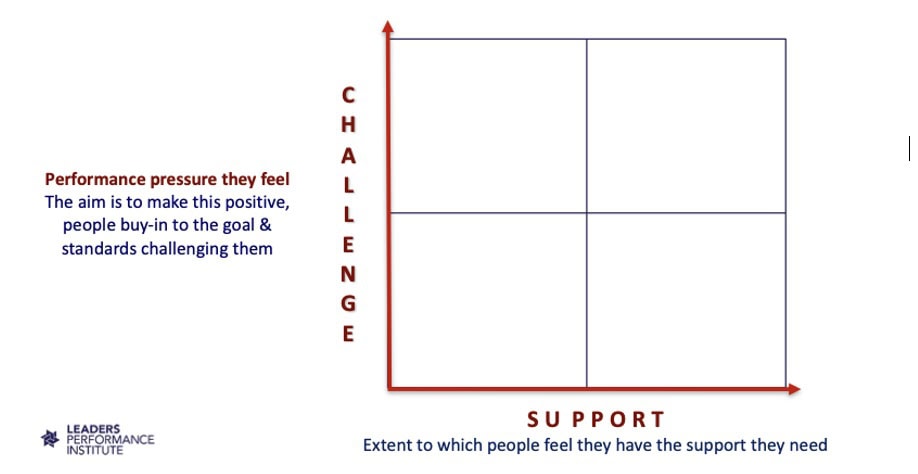
We will explore the specific characteristics that arose from the research below, but Kohlrieser suggests that secure base leadership is the ability to bring challenge and support together. Challenge on its own, isn’t enough to push someone forward. First and foremost, a secure base needs to be provided.

Nine characteristics of a secure base leader
Kohlrieser suggests thar we need all nine of the characteristics.
Mapping your team by challenge and support
What do others feel about your current level of challenge and support? To bring some of the research to life, there is a simple tool we can all use as leaders to map out the current landscape of your teams, as it pertains to the levels of challenge and support you are currently giving them as a leader. Similarly, you can also ask others how they feel about the challenge and support provided.
Challenge relates to the performance pressure people feel. The aim is to make this positive; people buy-in to the goal and standards challenging them. Support is the extent to which people feel they have the support they need.
In early June, some of the most respected leaders from across sport in Texas gathered at Global Life Field in Arlington to discuss the pressing performance matters of the day.
It is designed to connect people with responsibility for performance at the highest levels of world sport with each other and the ideas that have served their peers best. The top jobs in elite sport are often lonely places and always comprise unique challenges. The following is a record of the Think Tank meeting that took place on 7 June at Global Life Field in Arlington, Texas. A behind-closed-doors event, the account that follows is a general one and aimed at presenting the lessons learned from the conversation.
Attendees
General Manager, Texas Rangers
Assistant General Manager, Texas Rangers
General Manager, Dallas Mavericks
General Manager, Houston Texans
Chief Executive Officer, San Antonio Spurs
Mental performance can be enhanced
In viewing mental performance as separate from mental health, the group explored the means and ways that cognitive capacity and skill acquisition can be enhanced in athletes. We value our team’s high IQ athletes but what can we do to develop the IQ of those less gifted individuals?
Key points:
Holistic athlete development
The consensus was that holistic approaches to player development provide a competitive advantage – if they are implemented effectively. How can teams remove the barriers to effective implementation?
Key points:
Balancing short term and long term aims
Sustained success may be your aim – and that takes careful planning – but what if there is the window of opportunity to win now? Can the short and long term truly be balanced?
Key points:
The importance of cultural fit
Bound up with the idea of balancing your short and long term visions is your level of commitment to your organisational values. If there is a superstar talent in your ranks who is a poor cultural fit, what should you do?
Key points:
Specialist or generalist?
Often, a general manager can feel like a jack of all trades and a master of none. How can the leader best help when they don’t have the wisdom, expertise and vision to understand what the gold standard is in a specific domain?
Key points:
13 Apr 2023
PodcastsScott Hann, who coaches Max Whitlock, a three-time Olympic champion for Great Britain in gymnastics, discusses why coaches need greater support with their mental health. He also delves into his approach to athlete feedback and his self-development as a coach.
A podcast brought to you by our Main Partners
“Then, all of a sudden, you get home and you’re hoovering the floor in your living room and it just hit me. What was it all for? What’s happened?” he tells the Leaders Performance Podcast.
Whitlock, who won a further gold at the delayed Tokyo Games to make it six Olympic medals in total (he won two bronzes at London 2012), recently went public with his mental health struggles and, here, Scott explains that his mental health has also suffered as a consequence of his work.
“After the Olympics, nobody’s holding you on a pedestal, no one’s coming around and helping you with anything now. It’s done and you’re on your own. It was really hard.”
Scott’s efforts to safeguard his mental health is just one of several topics on the agenda, which is today brough to you by our Main Partners Keiser.
Also up for discussion are:
Henry Breckenridge Twitter | LinkedIn
John Portch Twitter | LinkedIn
Listen above and subscribe today on iTunes, Spotify, Stitcher and Overcast, or your chosen podcast platform.

In late March, some of the industry’s most respected leaders from across the globe gathered at Scotiabank Arena in Toronto to discuss the pressing performance matters of the day.
It is designed to connect people with responsibility for performance at the highest levels of world sport with each other and the ideas that have served their peers best. The top jobs in elite sport are often lonely places and always comprise unique challenges. The following is a record of the Think Tank meeting that took place on 28 March at Scotiabank Arena in Toronto. A behind-closed-doors event, the account that follows is a general one and aimed at presenting the lessons learned from the conversation.
Attendees
General Manager, Toronto Maple Leafs
Head Coach, Toronto Maple Leafs
Senior Basketball Advisor, New York Knicks
Performance Director, Manchester City
Head Coach, Scotland Rugby
How can the leader of the team reduce both the pressure and distractions faced by coaches and athletes? The first and most important step is to create an environment that enables athletes and staff to be at their best.
Key points:
Sir Alex Ferguson, Arsène Wenger, Mike ‘Coach K’ Krzyzewski, Joel ‘Coach Q’ Quenneville. These were some of the longest-tenured and most successful coaches in sporting history when they left their highest profile roles. Replacing figures of such stature can be daunting and fallow periods are almost inevitable as teams seek to fill the vacuum. What can be done to ease the transition from a legacy coach?
Key points:
In some elite sports, there is an underdeveloped understanding of when athletes are conditioned or deconditioned. Moreover, this does not always align with training-to-game models. Where should the emphasis be placed in this continuing challenge?
Key points:
A lofty ambition, for sure, but a noble goal for all teams regardless of their pedigree. At the very least, all teams can strive for their pinnacle.
Key points:
In the first instalment of a two-part interview, Lisa Jacob of Hockey Ireland describes how she interprets her role as High Performance Director.
She is a former dual international athlete, having represented Ireland at both field hockey and rugby sevens. In hockey, she accrued 139 caps and scored 17 goals between 2006 and 2014 and, upon retiring from hockey, took an 18-month contract to play sevens.
In her post-playing career, she returned to hockey and coached the Ireland girls’ under-16 and under-18 teams. She also worked as a coach developer. Then, in 2019, Jacob was appointed to Hockey Ireland’s board of directors and she became the organisation’s Strategic Director later that year. It began a run of several swift transitions.
In 2020, Jacob became the women’s programme’s Team Manager, in charge of logistics and operations – “the glue that gets things moving” – as she puts it. “I had no career plan – I just ended up as Team Manager perchance,” she tells the Leaders Performance Institute.
“I did that into the Tokyo Olympics and then we had a couple of coaches who finished up after the Olympics, but the team had a World Cup qualifying tournament maybe eight weeks later. So I went from Team Manager to an assistant coach. I knew the group and I had a coaching background anyway.
“I had that critical choice of ‘do I go towards coaching or do I go towards something else?’”
Her decision was ‘something else’ and she became High Performance Director in September 2022. It is a role she discusses in the first half of a two-part interview with the Leaders Performance Institute.
“I sit overarching all of high performance over the men’s and women’s programmes and the pathway,” she continues. “My role is trying to support the head coaches to enable them to focus on their role and take away some of the stakeholder management and fight for resources, and go between the institutes.”
Hockey Ireland identifies, develops, trains and selects players from across both jurisdictions on the island of Ireland, which means that Jacob works closely with Sport Ireland, Sport Northern Ireland, the Sport Ireland Institute, the Sport Institute of Northern Ireland, as well as the Olympic Federation of Ireland.
“They would all be big stakeholders with whom I work directly and my piece is as a kind of advocate; planning; doing all of the policies and proposals.
“The performance director’s role is important because that fight for resources always exists, so there needs to be somebody who’s always separate, who can oversee everything and go ‘hold on, if we join these dots we can get more bang for our buck’ or ‘this is more important than this space, even if you don’t like it, and this is why’, ‘this is the bit that’s important for you’ etc.”
Working under the programme’s head coaches (Mark Tamilty on the men’s side and Sean Dancer on the women’s) is a mixture of Hockey Ireland employees and institute service providers.
“There’s a lot of staff around the team, which can be great, but it can also cause a disconnect,” Jacob says. “I see my role as checking where everyone is at. I feel by listening that you really get a feel for it, where things are at, what might need to happen. It might seem small but I am helping people with their performance challenges as they see them.
“I also have a role in working with the athletes. By and large, I work with the leadership group to address any issues. In some ways, I need to be separate enough but also connected enough to understand if there are issues or changes of direction needed. I need to be approachable enough for those to come to the fore.”
What have been some of her reflections on her first six months in the role? “I’ve learned that the role is quite hard to define,” she says, adding, “there’s more than one way to do the performance director role, certainly in Ireland. You take the piece around how you can position and engage yourself and engage everybody in a way that you can shift the dial.”
There is not always unanimity. “It’s certainly not always an easy one but there’s a lot of really good people in the programme and my job is to get the best out of them, make sure that things are working well, so they can do what they’re best at.”
At the time of writing, both the men’s and women’s programmes are placed thirteenth in their respective FIH World Rankings (“that’s probably accurate enough”) but the women’s team exceeded all expectations to finish runners-up at the 2018 FIH World Cup. It was a breakthrough moment for the women’s game in Ireland and, in the subsequent time, the programme has enjoyed an increased range of, and access to, service providers. “That has allowed us to professionalise the programme for the girls. They get more direct support to be able to commit to hockey as well as pursuing work or study. They’re not scrambling to make things work.”
While that silver medal provided a watershed, there have not been wholesale changes, and there will not be any on Jacob’s watch.
“The programme is in place and has had a really clear plan over the last four years or so,” she says. “We’re now in 2023, which is a key year for qualifying for the Olympics. You might sit down and look at something with the coach but it’s really now small tweaks with a few key questions such as ‘are you going to go on a warm weather tour?’ So I’d work with the coach to set the direction of the programme but it’s not from a blank page or throwing out everything we’ve been doing.”
To wrap up the first part of her interview, the conversation turns to social support for athletes and staff and how Jacob can make an impact. She discusses her role with regard to the Ireland women’s programme, stating that the squad is a “really good group of friends” and “sometimes that can be good and sometimes that can make it harder to have honest conversations in the performance space.”
This is why the team have placed an emphasis on building relationships in the truncated time between the Tokyo and Paris Olympic Games. “When we have lunch, we need to sit together, you need to be asking your mate what’s going on in their life proactively rather than just hoping it will happen just because we’re in the same training base for two days a week.”
Players and personnel may not always talk about themselves but they may tell other Hockey Ireland staff about a teammate or colleague. Jacob explains that the work of Hockey Ireland’s head of performance services is invaluable in that regard. For her own part, she is sure to have contact points within the staff.
“I have realised in the last six months that there’s one or two people who sit very naturally in the space of supporting people through performance challenges.” She must ensure the right person is available for each challenge. “If you’re on the ground observing, you can send the right support towards someone or even follow up with them yourself – but there’s so many people I that I literally cannot do it all myself – with me, there are key people I try to keep across because I tend to be the glue for everybody else and it’s made me think quite a lot about how you structure and support people’s wellbeing and mental health in a high performance environment.”
Lisa Jacob is a contributor to our latest Special Report, titled Navigating Your Way Through Major Competitions: a snapshot from Olympic, Paralympic and elite team sports. In addition to Hockey Ireland, it features insights from Swimming Australia, the Lawn Tennis Association, Athletics Australia and Welsh Rugby Union. Each has teams competing in major tournaments this year and all are bound to give you something to think about in your future projects.