21 Jun 2024
ArticlesThe NSWL’s Bay FC and the WNBA’s Golden State Valkyries are two expansion teams and both have women GMs. Here, we bring you the views Bay’s Lucy Rushton and the Golden State’s Ohemaa Nyanin.
In March, Bay FC began their inaugural NWSL campaign to great fanfare.
The club was co-founded by former US women’s national team stars Brandi Chastain, Aly Wagner, Danielle Slayton and Leslie Osborne, who propelled the project from an ambitious idea to a grand reality.
They hired Lucy Rushton as General Manager. Rushton, who was the second woman to serve as GM in MLS when she joined DC United in 2021, spoke at this month’s Leaders Sport Performance Summit at Red Bull in Santa Monica.
Rushton is no stranger to the Leaders stage having also spoken during her time at Atlanta United, whom she joined following excellent spells with Watford, Reading and the Football Association in her native England.
She sat next to another trail blazer, Ohemaa Nyanin, the newly appointed GM of WNBA expansion franchise the Golden State Valkyries, who will join the league in 2025.
Nyanin, a Ghanian-American, had been with the New York Liberty for five years, most recently as Assistant GM, jumped at the chance to bring further basketball prestige to this corner of southern California. She previously served as Assistant Director of the US women’s national team and helped Team USA to Olympic gold in 2016 and World Cup gold in 2018.
The duo delivered insights into how they are shaping the cultures of their nascent organisations; how they’re working or planning on working with their athletes; how they’ve chosen to lead; how they’re supporting their staff; as well as how they’re changing the sporting landscape.
Owners must establish the culture and values
The Bay culture was clear well before Rushton had even accepted her position: everything is about the people, from the staff to the players. The owners want everyone to be B-A-Y. That is:
Brave – the ownership want the franchise to be bold in the industry, pushing boundaries, breaking barriers by being innovative.
Accountable – the staff turn up everyday and are responsible for their actions and drive, and push themselves forward.
You – Bay FC also celebrate themselves as individuals and bring their true authentic selves to work every day.
The three concepts have helped shape the mindset each day and give the staff and players something tangible to hold onto. The organisation’s vision is to be a global sport franchise at the head of innovation and change.
How can these be measured? For Rushton, “it’s the feeling when you go to bed or wake up and how you feel about going to work the next day or that morning”. She believes the staff feel good and know they can influence what is happening; they know it’s a positive environment and everyone is striving for the same things.
Women’s sport should not simply replicate men’s sport
Rushton’s experience of men’s football taught her a valuable lesson. “Coming into a women’s franchise, it’s so important that we understand and appreciate the difference to men’s sport and don’t try and replicate it,” she said. The club has been intentional on that since day one and strives to be people-first, player-centric, and celebrates and promotes good female health.
With Bay midway through their first season, Rushton reflected on how the staff live the values every day. They all want to work hard, but care, kindness, and mutual support are just as critical for an expansion team. You need people who want to be there, who have the grit to go through the ups and downs, but support each other when you might not have the same resources as the teams that are 5 or 10 years old.
“How we approach training everyday and present ourselves to the players gives them energy,” she continued. “Which in turn the players buy into and end up energised and galvanised.” The key is how you present yourself and how you turn up and how you live by the standards that have been set, and the biggest factor is togetherness and collaboration of all departments.
Measure success through environment and collective wellbeing
Nyanin left a household name in the New York Liberty, but her goal is not to merely recreate that team in the Bay Area. Nor does she simply want to recreate the Golden State Warriors (Valkyries co-owner Joe Lacob is also the majority owner of the Warriors). Nyanin wants the Golden State Valkyries to stand alone.
She needs to find people that are interested in a vision of winning championships, in alignment with the ownership group. Success will ultimately be measured in trophies. They are the first WNBA expansion team since 2008, so Nyanin is considering what it looks like to build a successful organisation. She said: “We need to find individuals who are interested in being challenged every day, leaning into the team. Do you want to come to work everyday, and serve the athletes everyday in a way that provides for an innovative space, that provides for us to do what we know we can do, and how quickly can we get there?”
With this question in mind, Nyanin reflected on the qualities she seeks out as the Valkyries hire and write job descriptions. “Being an expansion team means you have to be entrepreneurial. By embracing the unknown can you be empathetic too,” she added.
Rushton asked Nyanin about measuring success from a cultural perspective rather than through championships. In response Nyanin said it is about the climate of the people that come in the door. “When we ask how you are doing they might say ‘I’m fine’ or ‘I’m good’, but if you say ‘how are you doing in the terms of a climate?’; so ‘sunny, or ‘cloudy’, or ‘rainy’ – it adds depth. A way of measuring success is how we can collectively come up with our non-results-based success criteria, how do we make it such so that everyone is sunny?”
For Nyanin, ‘sunny’ doesn’t mean super excited, or super extroverted – you can be introverted but still be sunny. Success is ultimately defined by how the Golden State Valkyries create their own definitions of safety in the workplace; it stems from executives to coordinators, to players, and even changing the way agents and external stakeholders engage with the organisation.
A culture born of diversity
We all know the saying about the best-laid plans, so Rushton and Nyanin spoke of the importance of allowing culture to shape itself. For Rushton, the critical moments are when things haven’t gone to plan. “How you react to things not going to plan is how you create culture. Actions taken in those moments show the players and staff what’s acceptable and what’s not,” she said.
Some decisions have been made that may have impacted performance outcomes but certainly reinforced their culture and values. They might have been a “nightmare” at times, but they’re critical. The backing of the ownership and the Head Coach, Albertin Montoya, helped give Rushton the confidence to go ahead. Showing the group that the leaders are aligned was powerful and gave them the confidence that it was the right thing to do and that the leaders had each others’ backs.
For Nyanin, it is important to give newly-hired executives their own blank slate to contribute to the masterpiece. She said: “If everyone has a different background, you have to listen to their ideas as they’re all coming from different spaces. So it’s still being architected from all different walks and types of cultural differences.”
This means that it’s important to Nyanin to have each executive bring their own unique experience. Through these different experiences and backgrounds the culture develops. This will bring challenges and added work, as you have forces leaders out of their comfort zones. It also means that you have to be willing to think differently.
“It’s like explaining basketball to children, who all ask ‘why?’ People from different backgrounds are going to ask why do we need to execute things this way, and will ask good questions, and bring contributions beyond asking ‘why?’”
In return, Nyanin believes that the athlete will benefit, especially the female athlete who comes with different complexities. “If your own staff can challenge you and ask you why before the athlete does, then you’re giving the athlete a space for them to feel safe to be elite at their sport.”
Athlete care is paramount
What about their appeal to female players? Bay spoke with the potential recruits about player-centricity of club and how they were going to elevate player care. From starting from a blank slate, they were able to accelerate mechanisms that can help with impacting the salary cap through player housing for example. The club emphasised treating them like the athlete they are in comparison to some of their poor experiences in other environments.
In Rushton’s experience, the priorities are very different to male athletes, where pay often dictates the direction of negotiations. With females, it’s about living standards and how the organisation will elongate their career. It’s important to give them confidence in the staff who would give them the best care, medical treatment, and infrastructure. Rushton is proud that, as far as she knows, the players have no complaints about the level of care and how the organisation treats them as female athletes.
On a day to day basis it boils down to two things in her mind. Firstly, helping them be in the best position they can be for the longest time possible and, secondly, to help them live a nice lifestyle outside of football.
This focus on player care resonated with Nyanin, who was pleasantly surprised at the rapid expansion of the NWSL given her own experience of the WNBA. Bringing it back to athlete experience is hugely important because, in WNBA, athlete experience tends to focus on ‘how you do get elite talent to come through?’ Nyanin explained that longevity in the sport is different, although is it changing, because the majority of the athletes play six months in the WNBA and then go and play overseas where the conditions are often worse, but they’re getting paid more money. “Understanding the motivations of the athlete prior to them coming to your organisation and engaging in your space is important,” she said.
Attracting elite practitioners from male sport
How might top level practitioners be attracted from historically better-funded male sports? Both Nyanin and Rushton believe that efforts must be based on the vision, culture and concepts the organisations trying to build.
For the Valkyries, as Nyanin explained, the vision is to “build the best, to be the most elite, to build a space where people feel they’re being heard and their ideas being executed in a way that results in excellence. Why wouldn’t you want to come? How can I create an environment for you to thrive, and how can we do that together?”
Rushton agreed. She said: “it shouldn’t be about the gender. It does matter though – many wouldn’t be right for women’s sport. I want to make you the best practitioner in what you do, and give you the platform to excel in your specialisation.”
New franchises means recruiting for those who are willing to challenge themselves and go outside the box with their thinking. It becomes about finding the people who are comfortable with the associated risk in order to better themselves. Rushton believes they have to “believe that they can go there and make a difference.” Rushton also observed that, “a lot of males would find it refreshing to come to a female athlete team because it’s a totally different environment, with totally different feeling and vibe.”
For Rushton herself, when she moved from men’s to women’s football there were two main factors that drew her in:
How fans contribute to a team culture
There remains another crucial component of a team culture: the fans.
The final moments of the session were used to discuss how both Nyanin and Rushton, and their organisations, are forging connections with their fans. As Nyanin said, fans expect communications, but there are times when you can’t share with them. This is a dilemma considering that the fans are also investing in the franchise and so they deserve communication. It becomes about finding the balance around what to do when things aren’t going well. Working on being honest in their communications so that the fans understand that the leaders and everybody involved is working to solve any issues.
Similarly, Rushton and Bay have been deliberate in how they present the organisation to the fans. The Business Operations team at Bay go to the fans and ask them to bring the energy and passion; to be part of their story. They seek to empower the fans and have them be part of the journey. Bay have gone out to the community, had fans come and watch training, and prioritised outward action in the build-up to launch. People now want to be a part of their journey.
Rushton spoke of how Bay deliberately tell the stories of their players. This means that people become invested in the emotional side of who the player is, so if the team lose a game, the fans are more invested in the person than the result. The outcome is one of which she is proud and the Valkyries hope to emulate. “The fans have fallen in love with the team, despite the record.”
Results will surely follow but, here and now, both women are intent on proving that new women’s sports teams are not only viable but can thrive.
Some cultural leaders are front and centre, but many work from the wings to deliver the success their teams crave. Here are some steps you can take to ensure your team has its cultural leaders too.
Those leaders can be athletes, such as England captain Harry Kane, who will lead the Three Lions in their Euro 2024 campaign. Or Breanna Stewart, the New York native who returned home in 2022 and led the Liberty to the 2023 WNBA Finals; bagging the league’s MVP in the process.
Kane and Stewart are the embodiment of local heroes who have done well, particularly if you include Kane’s remarkable spell at Tottenham Hotspur.
Then there are coaches who represent an expression of the systems that enable their programmes to excel. On that front, one can point to Kane’s international manager, Gareth Southgate, who has overseen England’s most successful spell since the mid-1960s.
Cultural leaders, however, need not be so high profile. They operate at all levels of an organisation, independent of job title or seniority. Do you recognise the cultural leaders in your team? What steps can you be a better cultural leader?
Cultural leadership – the super enabler
The link between leadership and sustained success is the centrepiece of a research project run by Edd Vahid, the Head of Football Academy Operations at the Premier League.
In June 2022, the business and leadership consultancy commissioned Vahid to undertake a piece of research to discover the ‘secrets of culture’. Two years later, this project, titled ‘Cultural Hypothesis’, is on the cusp of publication.
Ahead of its release, Vahid is leading a three-part Performance Support Series at the Leaders Performance Institute that seeks to explore the enablers in high performing cultures.
The first session, which took place in early May, was a useful way of testing the importance and relevance of the four enablers highlighted by Vahid in the Cultural Hypothesis: purpose, psychological safety, belonging and cultural leadership.
The second, which took place in early June, homed in on cultural leadership, specifically how leaders might change or sustain a culture. The concept is, as Vahid described, a “super enabler” for your sense of purpose, belonging or even psychological safety.
Culture should be an accelerator and energiser
In the session, Vahid observed that organisations are increasingly deliberate and intentional about culture because they see it as a competitive advantage. It is not a one-time annual event – it’s a regular part of ongoing conversations.
This is lost on some organisations, as Jon R Katzenbach, Illona Steffen and Caroline Kronley wrote in the Harvard Business Review in 2012:
‘All too often, leaders see cultural initiatives as a last resort. By the time they get around to culture, they’re convinced that a comprehensive overhaul of the culture is the only way to overcome the company’s resistance to major change. Culture thus becomes an excuse and a diversion rather than an accelerator and energiser’.
Four ways to get to grips with your culture
To understand culture you need keen observation and data collection. Vahid proposed several useful tools:
During the Korean War, John Boyd, an American military strategist and fighter pilot, devised the OODA Loop as a decision-making process designed to emphasise adaptation and agility in four stages:
Organisations can apply the OODA Loop to assess and respond effectively to cultural dynamics.
Vahid also pointed to other efforts to collect data around culture, such as UK Sport’s ‘cultural health check’ or retail giant Selfridges using data to better understand their most culturally-stressed communities.
Vahid also stressed the importance of critical incident reviews to help observe culture during specific moments such as exits, inductions, wins and losses.
Teams can also find their place on the Sigmoid Curve, a common model for tracking organisational growth and decline. At each stage, expectations can change, which affects what we see, hear and feel.
Five Steps Towards Cultural leadership
Vahid explored five steps that can help a team to develop cultural leaders.
As this session of the Leadership Skills Series demonstrated, we can all become better leaders by developing trusting relationships.
For the latest edition of our Leadership Skills Series, we explored the art of persuasion. All leaders in sport have the potential to influence others’ thoughts, feelings or actions through effective communication and interpersonal techniques.
The session highlighted four related areas of focus.
Trust is rightfully acknowledged as the cornerstone of effective leadership and the foundation of relationship-building. To unpack all of that we turned to the Trust Equation. It is a conceptual formula used to describe the components that build trust in professional and personal relationships. It’s often represented as: 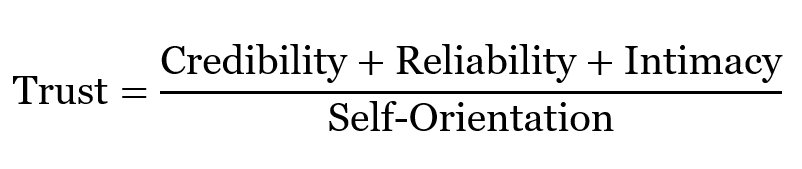
This is what each component means:
Credibility speaks to words and credentials. How authentic are we?
Reliability is the perception of a person’s integrity. Do you do what you say? Are your actions connected to your words?
Intimacy involves the feeling of safety or security when sharing information with someone. How safe or secure does the client or colleague feel in sharing with us?
Self-orientation reflects the degree to which a person’s focus is directed towards themselves as opposed to being focused on others. What are our motives? For our benefit or the benefit of others?
The higher the numerator (credibility, reliability, intimacy), the greater the trust. Conversely, the higher the self-orientation, the lower the trust. Ultimately, the equation serves as a mindful tool to enrich discussions, elevate trust levels, and deepen relationships within our teams.
When leading a team or a department, it matters how you are perceived by others. The ability to self-assess your personal status is another strategic tool wielded by seasoned leaders to convey confidence and authority. It includes an assessment of your:
Such elements can be ranked on a scale from 1 (‘low status’) to 10 (‘high status’) and, when done sincerely, this can be an invaluable guide for navigating various workplace scenarios and can even foster emotional intelligence, which is pivotal in forging genuine connections with athletes and team members. It can also facilitate the development of more impactful leadership skills that inspire and motivate with greater efficiency.
Flows of logic are the pathways our minds create to connect ideas and evidence to reach a reasoned conclusion. They are essential in critical thinking, problem-solving, and, of course, forming persuasive arguments. Flows of logic involve a sequence of statements or steps that follow one another in a rational and coherent manner. These frameworks can take three different forms, depending on your scenario:
These can be indispensable guides when constructing persuasive arguments. By grounding our narratives in these logical flows, we enhance storytelling capabilities and foster deeper connections with our teams. This pragmatic approach ensures proactive, relevant support while avoiding unnecessary complexity, thereby maintaining clarity and engagement, particularly in high-pressure situations where decisive leadership is paramount.
If you can put those three factors together then you can be better at delivering your message. Mindful communication is another tool upon which you can rely. This idea urges leaders to remain present and deliberate when communicating. It can help a person to:
The members in attendance discussed the success and failure of these elements in the context of people that ‘think to speak,’ and those that ‘speak to think’.
Here are some effective mantras to keep in mind:
Final reflections
As members reflected on the transformative potential of incorporating these persuasion techniques into their leadership repertoire, they described the following as essential steps towards mastering persuasiveness in your leadership approach:
29 Jan 2024
ArticlesFrom the English Premier League to the NBA via the AFL, the Leaders Performance Institute Think Tank gives coaches, managers and directors the opportunities to share lessons and ideas around the performance questions of the day.
The Think Tank is designed to connect general managers, coaches and directors of performance – the people with responsibility at the highest levels of world – sport with each other and the ideas that have served their peers best.
The discussions on the day were wide ranging, as the participants delved into five common problems and identified possible approaches and solutions.
Renewal is a continuous process in sport, which is not to say that it is always easy, frictionless and without complications. If you are the person tasked with delivering upon your team’s vision, consider:
It is often incumbent on the head coach to provide the energy to the playing group, but who is looking out for the energy of the coach? At a time when coaches fear coming across as ‘weak’, here are some tips for coaches seeking to protect their personal energy.
Succession planning is hard, particularly when one considers that generation-defining coaches are more a product of circumstance than formal programmes. Nevertheless, how can we give aspiring coaches a better chance?
No one has the fully come to terms with talent development pathways, hence the ever-present questions around attributes, development gaps and purpose. What can we do to better identify and then develop our young athletes?
No other area is as widely misunderstood by coaches and practitioners as artificial intelligence and its role in sport. There is, however, no need to stray from your performance principles in putting them into practice. Remember:
Participants
Mo Bobat, Director of Cricket, Royal Challengers Bangalore
Michael Bourne, Performance Director, Lawn Tennis Association
Matti Clements, Executive General Manager, Australian Institute of Sport
Steve Cooper, football manager
Chris Fagan, Senior Coach, Brisbane Lions
Rob Key, Managing Director of Cricket, England & Wales Cricket Board
Marc-Oliver Kochan, Managing Director, Red Bull Athlete Performance
Sean Marks, General Manager, Brooklyn Nets
Tabai Matson, Director of Performance & Development, Harlequin RFC
Sara Symington, Head of Olympic & Paralympic Programmes, British Cycling
Jess Thirlby, Head Coach, England Netball
Simon Timson, Performance Director, Manchester City FC
Gregor Townsend, Head Coach, Scotland men’s rugby team
23 Jan 2024
ArticlesMembers of the Leaders Performance Institute answered this question from their own experience and shared responses ranging from environmental renew to the power of positive storytelling.
The notion of ‘belonging’ can be simply defined as ‘a sense of connectedness to others and what you are doing’. The Cambridge English Dictionary extends the definition of belonging to ‘a feeling of being happy or comfortable as part of a particular group and having a good relationship with the other members of the group because they welcome you and accept you’.
Psychology research shows that in cultures and environments that show autonomy, competence and belonging, individuals will elevate their engage in tasks and activities they are asked to commit to.
It’s clear from both the literature and lived experiences of the group that creating belonging is a powerful tool for a harmonious and high-functioning environment. The aim of this particular roundtable was to share best practices and examples of how we are trying to foster belonging in our environments.
It starts at the induction stage
In one of the breakout groups, they reinforced the idea that the process of creating positive belonging starts at the induction or onboarding phase and how important it is to dedicate time and intent towards this process to set the right tone. The work to create belonging continues week on week during this onboarding phase, with the acknowledgement and value that an individual or individuals bring to the team. From a team perspective, it is an opportunity to acknowledge the variety and diversity of backgrounds, skills and views of those in the department or organisation from the outset.
In summarising this first point, there was an excellent reflection that how we make people or an individual feel is the most important thing. Every interaction matters and what you do is about making them feel the way you want them to feel.
Setting the stall out around the culture
There were a number of reflections on how to give your environment the best opportunity for positive belonging. Identify the values and culture expected of individuals within your environment, and perhaps most importantly, find practical ways to instil them. Is everyone in the environment crystal clear on what the behaviours and expectations are? If you have this in place, there can be collective accountability. Similarly, it is important to be consistent in positively reinforcing, noticing and celebrating positive examples of those behaviours.
A couple of people on the call also suggested that coach buy-in is really crucial in this process. If the head coach buys into the values then the majority of people in the environment tend to follow, such is the influence the head coach carries.
In setting yourselves up for success, create opportunities for athletes, coaches and staff to convene and build the culture together. Creating opportunities for discussion on values and behaviours supports the idea of creating a sense of belonging. It is widely acknowledged that engagement, contribution and a love for what you do leads to a sense of belonging, therefore lies the challenge in ensuring we are bringing this to life.
Finally, there was a discussion around language and its importance. There was a fantastic phrase shared on the call that ‘above-the-line language is powerful, but below-the-line language is powerless’. There is a responsibility to own the standards of the language.
The power of storytelling
A common response from the group around effective ways to instil belonging was utilising the power of story. Find the story that connects to the people that you’re working with, whilst recognising the significant cultural differences that exist in the environment. The story that you use must align with the culture. One environment on the call shared how they leant on metaphor in creating an overarching theme that is reframed every year.
Story also presents the opportunity to connect those across the backroom staff, athlete population and other forward-facing roles. There was a suggestion this should also extend to family members of those involved, bringing them into the culture and environment, knowing the importance of the environment off the field. Do they feel that sense of belonging as well?
Finally, we also discussed the impact story can have around connecting individuals to the cultural environment of the country that you are in. It also presents the opportunity to embrace the culture that individual is bringing into the environment.
Create opportunities for shared experiences & collective input
Responses from the group indicate that every interaction matters and it is important to be mindful of that. Therefore, how are you intentionally creating opportunities for shared experiences and opportunities for collective input from different stakeholders?
A simple initiative to instil is celebrating ‘the good’ when done well and highlighting small wins and successes.
Encourage active listening and understanding of everyone’s opinions – providing a space and opportunity for everyone to have a voice in key decisions is found to be an effective way of supporting belonging in an environment. To ensure the above is both effective and a success, organisational leaders require an openness and receptivity to ensure the environment is designed to be safe.
There were also a number of reflections around the power of ‘inclusive initiatives and rituals’ that bring people together. Finally on this point: are you formally capturing information from the stakeholders in your environment in a consistent way? This is a simple tactic to remain on the pulse of the environment, ensure those in the organisation have a chance to provide feedback and contribute to decision-making and the state of play on the culture.
Providing space to better understand the ‘whole person’
One of the final key buckets of discussion around instilling a sense of belonging in your environment was formal and informal opportunities to better understand the whole person. We should strive to provide space to celebrate authenticity and our true selves. Does your environment provide an opportunity for employees to breathe and express themselves?
A foundation stone of the High Performance Strategy in the Australian Olympic System is the athlete’s voice. The idea is to provide opportunities to understand one’s journey, both as an athlete and as a person. The self-determination theory concept is something that is really key in this piece and its relatedness to belonging. Creating opportunities to understand the whole person allows for further insight around ones intrinsic motivation and the opportunity for honest, open conversations within the environment.
Final reflections
At our Leaders Meet: High Performance Environments event in Melbourne back in 2023, we ran an Open Spaces session on this exact topic. The aim of the session was to allow the audience on the day to share stories, experiences and perspectives on belonging. Five things came through strongly from those in the room that day around what we can do to enhance belonging in our environment.
15 Jan 2024
ArticlesHelene Wilson led the Northern Mystics to the ANZ Premiership in 2021 but not before taking her playing group on a individual and collective development journey.
“Working in netball, in a woman’s environment, and coming from a background of being a teacher, I think that learning is incredibly important,” she told the audience at September’s Leaders Meet: Driving Step Change in Female High Performance at Manchester’s Etihad Stadium.
“And how do we create an environment where high performance comes from out-learning your opposition and people are on a journey together to get there?”
Wilson, who currently serves as Manager of High Performance Sport New Zealand’s [HPSNZ] Women in High Performance Sport programme, was primarily at the Etihad to discuss her five years as Head Coach of the Northern Mystics, a netball team in New Zealand’s ANZ Premiership.
She took the Mystics’ reins in 2017 and would eventually lead the Auckland-based franchise to success in the 2021 Premiership Grand Final, ending their 24-year wait for a national championship. But not before the team bottomed out in 2019. “We were the wooden spooners,” she said.
The team had performed promisingly in the preceding seasons but, in 2018, the unforeseen departure of goal shooter Maria Folau due to personal reasons left the Mystics underpowered. It showed on the court and Wilson admitted that she was perhaps fortunate to retain her job at one stage given the turmoil behind the scenes, “but the players wanted to come back and play for the team because they believed in what we were trying to do.” Two years later they were champions.
Beyond reaching and winning a Grand Final, Wilson and the Mystics wanted to rewrite the history of netball underachievement in New Zealand’s Northern Zone, where Wilson coached the sport for three decades.
“The Northern Zone has the biggest number of participants in netball – a third of our netball-playing population is there. There is also a population of ethnic diversity, age diversity, socio-economic diversity,” she continued. “We had 17 netball centres across that area and I inherited a narrative over that time that we’re talented – more than anyone else – but it’s actually a curse in high performance because that doesn’t matter.”
There had, according to Wilson, been a history of disharmony in the Mystics ranks. “The landscape of where we come from, and thinking about the land, it was actually quite disjointed. Auckland, our biggest city in New Zealand, is groups of little villages that are quite insular and quite different to each other. And we were also sitting on volcanoes and literally it was pretty explosive the way we used to behave.”
By the time they won the championship in 2021 and went close again the following year, this was a team transformed. “We won the Premiership after 24 years of trying, but really the learnings, what happened between 2017 and 2019 and up to 2021 was massive and it’s not just about me and what I did – it was about what we did together.”
Finding energy and bringing clarity to the changing room
The “catalyst for change”, as Wilson describes it, was her involvement in HPSNZ’s Te Hāpaitanga: Women in High Performance Sport Coaching Initiative. Its pilot programme ran in 2019 with Wilson serving as a mentor to women applying to be high performance coaches.
The cohort visited a ‘marae’, a Māori meeting ground, of which the focal point is the ‘wharenui’, the communal house where people meet. A wharenui, with its ornate wooden carvings and elaborate design, is steeped in Māori metaphor. It provides a space for collective, inclusive, reflective practice (‘Rongo’ in Māori) that enables people to reengage with problems in the world beyond (‘Tū’) having formed a consensus on the best solutions.
“There is an energy about it,” she said. “The process and energy is like a coming together and moving apart in a state of clarity, which is collectively built together. The process of ‘Karakia’ – transitioning from one realm to another – takes us from the worlds of Tū and Rongo.”
It was a cultural element that resonated first with Wilson then with her playing group. “You don’t need to know it’s Māori,” she said. “If I stood at the front and tried to be Māori I think people would think I’m a fraud and I’ve got to be respectful, not being Māori, but having a deep understanding because I do come from New Zealand.” Wilson encourages coaches working in other regions or nations to find the cultural artefacts that are authentic their groups. “There’s stuff around us everywhere that you can apply in different ways and it’s the framework that is key.”
Coming away from the pilot programme, Wilson drew on the work of corporate anthropologist Michael Henderson who wrote a book in 2014 entitled Above the Line. According to Henderson, people will come to a team with their own beliefs, which play out as behaviours. People’s values are born of their beliefs and behaviours and, in a team setting, these all help to construct the group’s collective behaviours. These eventually become the team’s culture.
At the Mystics, group behaviours tended to be a product of the disharmony that denoted the team’s decades of under-achievement. The group would seemingly generate a lot of heat but not necessarily much light.
It ultimately comes down to the leader. “The mistake we often make is starting at values rather than giving space for beliefs to be heard,” said Wilson. The trick was to create a space where everyone felt empowered to share their beliefs. “We came together as a group and said ‘everyone’s a leader. The standard we walk past is the standard we are prepared to accept’ and it’s super important not to walk past unacceptable standards. So we redefined our environment so that everyone on our team was a leader and ‘leadership’ was simply our actions and our behaviours. It wasn’t the role or the position we were given.
“We needed to have a better understanding of what being valued and contributing to value looked like and how that would affect performance. So there was intense learning at this time because the players wanted to be a leader but there needs to be clear evidence of what that means for performance – and intense learning is how do we care, listen and bring those diverse opinions to the table, as well as skillsets the people bring. I think we learned that together as staff, performance experts and players.”
Learning from the ‘moment of truth’
In his 2021 book Belonging, Owen Eastwood cited Harvard professors (the late) Richard Hackman and Ruth Wageman, specifically their renowned 2008 publication on corporate leadership teams entitled Senior Leadership Teams: What it Takes to Make them Great. ‘Of all the factors we assessed in our research,’ they wrote, ‘the one that makes the biggest difference in how well a senior leadership team performs is the clarity of the behavioural norms that guide members’ interactions’.
It was on Wilson and Sulu Fitzpatrick, who was appointed as the Mystics captain in 2021, to create the right environment. “We were trying to learn what stuff we will deploy in that circumstance to ensure that the collective performance outcomes we needed were going to happen. In the Māori world we call this ‘Kotahitanga’. ‘Ko’ meaning a central point’; ‘Tahi’ meaning one; ‘Kotahitanga’ meaning collective unit.”
For the Mystics, Kotahitanga meant reaching a consensus through ‘Wānanga’. “It’s a word that means coming together and meeting to discuss, collaborate and consider,” Wilson told the Etihad audience. “It could look similar to a team meeting but it can take many forms and Wānanga happens in many ways. Conceptually, it happens in the world of Rongo; you’ve got to go deep. At a Wānanga, I put a concept on the table, a picture of performance that I may see as a head coach, or someone else may put it there depending on who’s taking a lead that day, and the Wānanga takes the form of questions, from multiple perspectives, and we keep going until we get some sense of alignment. It doesn’t come with any level of expertise or experience, it comes with everybody’s level and everybody contributes.”
The Mystics would typically hold a team-wide Wānanga once a week and any time the group deemed one necessary. Wilson’s role was to ensure: “enough creative tension in the room to drive performance and shift performance but also making sure that people were able to learn the art of listening, hearing, weaving different perspectives and energy that people brought to the Wānanga.
“Wānanga can get heated, it can be soft and gentle, it can be all of those things, but Wānanga is about is that you sit there in the world of Rongo until you get it done. Sometimes we had training or practice [in the world of Tū] straight after and we were running late because the Wānanga is more important than the physical practice – practice had to happen whenever it needed to happen based on the Wānanga.”
Wilson explained that there were three broad categories of people, characterised through their ‘energy’, who would join a Wānanga: people who connected to others from the heart, those who had insight from their intellect, and people with the drive and willpower to perform. “My shift as head coach was to connect to those three levels of care of where I was with an individual.”
It was not easy. At first, there was a lack of intent, decisiveness and the results did not necessarily translate into performance. “I think setting this up was one of the most challenging things I’ve ever done and one of the spaces where I learnt so much as a coach.”
Crucially, the group bought-in, even after the underwhelming 2019 season and the disruption of the pandemic. In time, the group developed its own lexicon, which included the term ‘moment of truth’, meaning a reference to the key moments in a match as defined by players and coaches individually, who would then weave their ‘moments of truth’ together in a Wānanga. “We would stay there until we were ready to define the moment of truth that was going to give us the greatest learning going forward.”
As she said, it was not always Wilson who led the Wānanga. She recognised the need for others to take the lead in order to feel that they belonged and that their input was valued. ‘We look for proof of our values from our leaders,’ wrote Owen Eastwood in Belonging. ‘We do not want our leaders’ personal beliefs forced upon us – we want our tribe’s authentic values articulated.’
That is where Wilson felt the key knowledge sat in any case. “My learning was to sit at the back and know that my knowledge was not sufficient; that the knowledge was in the room and I was there to sense the problem and the Wānanga would sort out what the problem was. I needed to be the last one talking in the room.”
In Part II, we explore how the coaching staff helped the Mystics players to transfer their personal and collective development to the court.
We asked Hockey Canada Head Coach Danny Kerry who has worked with both during his 30-year coaching career and highlight four factors in his personal development.
He cites renowned coach developer Nigel Redman in his response. “Nigel uses this phrase: men have to battle in order to bond, so we have to have gone to battle first. ‘You’re a tough nut so I’ll be around your nonsense’ – sorry – you can see my biases playing out there. Whereas [as Redman says] women have to bond first before they battle.”
Kerry, who led Great Britain’s women to field hockey gold at the 2016 Rio Olympics, is at pains to tell the audience at Manchester’s Etihad Stadium that this yardstick should only be used in general terms and may even be an oversimplification. It is, however, illustrative of the dynamics of which a coach must be aware.
He continued: “If you spend time and energy to understand the dynamics that are playing out within high-performing female teams, if you spend the time and energy to talk to those things, spend the time and energy to build the relationships between those players so you can understand what particular perspectives individual athletes carry, why they think as they do, what their life experiences are, that level of trust in the relationship goes up significantly and then they will literally run through brick walls for you. If you don’t do that, as soon as the challenge and threat comes they can be [slow] to it.”
He then reflects on the transition he made from coaching Great Britain’s women to the men’s programme in 2018. “I tried that approach, if I’m blunt, with the men and it was effective to a degree, but if I had my time again I would probably put them into some form of battle or get them to understand each other in that environment along with some of this other work.”
Kerry, who was joined onstage by Emma Trott, the former Women’s Junior Endurance Coach at British Cycling, spoke at length about his personal development as a coach three decades into his career and the evolving demands of his players.
Here, we highlight four factors that shaped the coach that took the reins at Hockey Canada in March 2023.
“I was the classic coach. All about hockey and very hard-nosed. Very cycle and task-oriented, Xs and Os,” said Kerry. However, as he said, when it came to people’s feelings and relationships, “I received some pretty blunt feedback then tried – and failed – to adjust”. He quickly realised he was doing himself a disservice. “I say I failed but it’s still not my sweet spot. So my big learning, whether it was male or female, was around how relationships develop as an entirety and with individual athletes.”
It led him to adapt his behaviour and the most notable example was his pitch-side presence during the penalty shootout that followed the draw in Great Britain’s gold medal match with the Netherlands in Rio. “I always positioned myself high; the reason for that was, one, I was task-focused and, two, athletes pick up on your anxiety as a coach and, being pitch side, that’s not a great thing. You don’t want to add to their anxiety as a coach, so actually being up high helps with that,” he continued. This time, however, he reflected and changed his custom. “I remember just thinking literally ‘what does this group need from me now as a coach and what doesn’t it need?’ And so at that point in time, my ability to ask myself that question at that most pressurised moment, probably of my career, was to self-regulate. All they need now is a ‘we’ve done this, we’ve rehearsed this, our processes, all good?’ Everyone nodded and off they went. I wouldn’t have been able to do that previously. It’s still a struggle, but that was a good example of being able to regulate yourself to then help the athlete be in the right place they need to be to perform.”
As a male coach in a female environment, Kerry is aware of the need to afford athletes personal space when it comes to issues such as the impact of the menstrual cycle on training history, volume and conditioning, particularly as there is still “some debate and ambiguity about what the science is saying”. While working with Great Britain’s women, he would defer to the team doctor in such matters. “It was led by our doctor, a person seen to be on the ‘outside’. We didn’t want athletes to think we were encroaching on something so personal to them. That needs to be handled with incredible skill.” He discussed it in terms of “managing the bell curve and deviations from the group”. “It’s not a science, it is a sense, it’s a craft. What is optimum for this group of athletes as a whole can mean that some people adapt ahead of the bell curve, others struggle because that’s not what they wish for themselves, but that’s an optimum for the entire group,” he said. “All facets of coaching, whether that’s sitting in a meeting discussing the players, whether that’s discussing how we push collectively as a team, whether that’s what we’re going after and how we’re going after it. It’s understanding that you’re trying to find an optimum for that particular team and then helping those people below the bell curve find their value in that, finding what works for them. That is the craft of coaching and, in my experience, that doesn’t get discussed in coach development.”
Kerry was initially taken aback by the Canada women’s often literal interpretation of his instructions. “There’s a lot you can unpack there,” he said. “You can unpack it from the angle of gender, you can unpack it from the angle of your understanding of what’s going on. How are they feeling? Is there literal interpretation because they don’t want to get it wrong? Are they doing it because of the way they’ve been coached all of their life? Are they taking it literally because of the dynamic playing out within that female group? [They could ask themselves] Am I trying to do that because I’ve got a 200-cap athlete next to me?
“There’s a whole raft of psycho-social dynamics playing out there. So based on the experience I’d had, just talking to that very quickly; almost trying to create environments where [I’m asking] does it require me to talk to them? Does it require me to remove myself from that room and get them to sort it out themselves? Does it require me to use data, which involves the assistant coach of the programme leading that? Making these decisions as a head coach requires identifying some of these dynamics that are going on.”
Kerry warmed to the topic and added: “Quite often when people talk about performance, they’re talking about a very objective domain, whereas I think it’s more about these aspects. What is the greatest burden of that environment? What environment are you creating to ensure the most optimum versus the learning curve? What’s your impact on that? How can you create an environment between your athletes that allows them that peer to peer conversation that Emma was talking about? How quickly do you set those things up because they are, in my experience, the single greatest inhibitor to the team and the acquisition of skill?”
There have been occasions in the past where he wishes he could have coached female players differently. “If I had my time again, I would definitely approach it in a different way, but at the time, I didn’t have that experience having been in hyper-masculine environments.”
Kerry believes that leadership skills are fundamental to performance. “You want people to lead even without the title,” he said. “[With Great Britain’s women] we had a discussion about that very early on talking about everyone has the capacity to lead in their own way that’s congruent to them. So if I were to summarise, normalising leadership as one of the fundamentals of performance is one of the key aspects of your job [as coach], so talking to that, raising awareness of what that is and how it can be done, part of that is raising self-awareness in the athletes, how they can influence others, is absolutely fundamental. It’s right up there with are you fit enough? In terms of female role models, I’d like to think the women’s hockey programme has some incredible female role models, someone like Kate [Richardson-Walsh] and others and now stepping into different domains whether that’s big business or sports. I’m very proud of that.”
He continued: “We have some stereotypical views of what it takes to lead, actually. Breaking that down and allowing these athletes to lead congruently to who they are is one of the things I’m most proud about. So Kate leads in a way that’s congruent to her, Alex [Danson] is a very different leader but still effective, and I’m now trying to do the same with field hockey Canada.
“There’s a moral dimension to having a team that’s well-led, there’s also a huge performance dimension to having a team that’s well-led and a depth and granularity to what leadership is. By the same token, whether we’re leading or following, we talk about that responsibility and what it means to follow well. The difference in my experience with male teams and female teams is the female teams seem to implicitly understand the importance and significance of that and really buy-in quite quickly”.
In the final instalment of this Performance Support Series we explored ways that we can all improve when it comes to debriefing performance.
Over the course of the three sessions, we are focusing on three core areas as part of this topic:
For the final part of this learning series, the focus of the content and conversations centred around implementing effective debriefing to create a learning culture in your team.
Outcomes of the session included:
Debriefing as a critical component of a high performing organisation
In setting the scene for this virtual roundtable, we leaned into the work of Arie De Geus, who was one of the early thinkers in the space of systems thinking and how we can learn and ally new learning to create a competitive advantage. De Geus was quoted as saying that ‘the only competitive advantage the company of the future will have is its managers’ ability to learn faster than their competitors’. Effective debriefing forms a key role in creating a true learning organisation and allowing you to use learning as a source of competitive advantage.
Combining the work of De Geus, Peter Senge in his work for The Fifth Discipline suggests that the highest performing organisations consistently learn and put systems in place where they are able to extract information and collective intelligence. When thinking about the topic of debriefing, there are often questions considered around to how we should do it and when. Answering these questions and systematising will support a shift towards a culture of learning.
Before we move into exploring specific elements of debriefing, we also explored the difference between traditional organisations and those who are termed learning organisations.
Senge defined organisations as where people continually expand their capacity to create the results they truly desire. Pedlar provides a definition of a learning organisation as being able to facilitate learning of all its members with the aim of continuously transforming itself.
How are we currently implementing debriefing?
Reflecting on how we are currently implementing debriefing provided an opportunity for those on the call to share their experiences of this process in their environment. There were some differences in responses to how debriefing is leveraged.
As part of this conversation, there were some interesting reflections on the nature of debriefing in some of our environments. A point was made around debriefs or reviews leading to us slipping into planning or a solution mindset. We can experience tangents and not effectively staying on the task of the debrief – effective debriefing requires intent and discipline.
There were also some reflections on debriefing tending to focus on the eventuality of a negative outcome such as a defeat, as opposed to when we win. Participants on the call shared that in the debriefing process, often there is a lack of action, something that other members of the team or players pick up on. Actions are crucial for buy-in – it is easy to review and reflect, but to generate actual change is where the impact of a debrief comes in.
Skills for effective debriefing
We’ve discussed the importance of debriefing and how it is currently being implemented in our environments, but it is also important to consider the skills required for debriefing to be effective. When the question of what skills are required were put to the group, these are some of the responses that followed:
For effective debriefing, having a framework or system in place will elevate its impact. We discussed a simple framework that can be used by anyone as a benchmark:
Planning for action. Planning for the debrief is important, particularly how the debriefs will happen and the skills required to make them effective. Often it is easy for debriefs to become emotional – a process in pre-planning helps to keep things on track.
Action. This is the doing part.
Reflection. How do you reflect accurately, especially in an emotionally charged environment, whether positive or negative? Reflection is a key still to aid questioning and listening.
Relating back into action. Take the learning and do something with it. If you do not do this, it is a waste of time. Debriefing is about initiating change and continuous improvement.
To summarise this section, having the ability to reflect, appraise and reappraise is considered a cornerstone of lifelong learning and performance.
Challenges in debriefing
The group highlighted a number of challenges that are associated with debriefing. The idea was to identify what often gets in the way of being good at debriefing, allowing us to evaluate how we currently approach debriefing. There were six key challenges highlighted that we should be aware of.
To summarise
The influence of debriefing is a topic often talked about within the Leaders Performance Institute. We all know the importance of it but there is a feeling that there remains vast room for improvement in how to do it effectively. As we rounded off this virtual roundtable, we reflected on some of the key considerations and opportunities for debriefing, to ensure you engage in it more effectively in your environment.
It’s worth noting that debriefing is free, yet presents a fantastic opportunity for continuous improvement without financial resource. With any sort of debriefing, using a process to embed and plan out debriefing is a positive first step in its impact. Remove outcome bias and instead focus on the learning, decision-making and impact areas – outcome bias will sway the quality of the debrief. Be sensitive of time and, where you can, engage in debriefs immediately after the performance. Keep them short and to the point. Gather as many facts as possible first, allowing you to be dispassionate and objective. As an observation, watch for people proving vs. challenging themselves. Reflection skills are powerful so ensure you practise them to elevate the quality of the debrief. Finally, keep a journal and a log of the key learnings from the process.
The Bees’ men’s under-18s coach discusses her career journey and the lessons she’s learned along the way.
A podcast brought to you by our Main Partners

“There’s no shortcuts, even though everyone seems to want them these days,” she tells Henry Breckenridge and John Portch on the Leaders Performance Podcast, which is brought to you today by our friends at Keiser.
“Time on the grass, working in different environments, working under different people as leaders will help you to understand what it looks like for you.”
Bedford, who has also coached with underage women’s teams at the Football Association [FA], Leicester City Women in the WSL, and served as an assistant coach at Arsenal Women, talks enthusiastically about her first six months Brentford.
In her new role she is a pioneer. One of the few women coaches operating at the top level of the men’s game.
Elsewhere in this episode, she delves into the importance of her mentors, who include Mo Marley, the current Head Coach of England Women’s under-23s.
Bedford recalls a time at an FA training camp when, at Marley’s side, she encountered the senior women’s England squad. She says: “Every senior player that walked passed her gave Mo a hug and I was like ‘I want to be Mo, I want to have that impact’. But actually, the more I worked with Mo, whilst I love her to bits and still have tremendous respect for her, how Mo leads is not how Lydia leads.
“You learn loads of things, good and bad, from people that you work under and then you find your own way.”
Elsewhere on the agenda, Bedford spoke about:
Henry Breckenridge Twitter | LinkedIn
John Portch Twitter | LinkedIn
Listen above and subscribe today on iTunes, Spotify, Stitcher and Overcast, or your chosen podcast platform.
In the final Leadership Skills Series Session of 2023, we focused on this increasingly essential skill, from the required mindset to the need to understand your boss.
It is a popular topic of conversation within the Leaders Performance Institute for those overseeing departments or who have direct lines into executive leadership or board level personnel.
Throughout this session we focused on some key concepts for managing up effectively, taking time to discuss and share best practices around:
Your mindset towards the relationship
Before exploring some of the practical examples of effectively managing up, we need to set the tone through ensuring the right mindset is in place to approach this. Leaning on the work of Richard Boston in The Boss Factor, we focused on four different mindsets you could engage with as part of the relationship and process of managing up.
Boston offers a useful framework to reflect on this mindset towards your relationship with your boss. The key insight from Boston’s framework is to consider the impact of this mindset on the relationship, notably your engagement, motivation and ability to manage up. These are the four mindsets on which we focused:
Understanding your boss
We previously explored your mindset towards your relationship with your boss. As an extension to this point, understand their drivers and pressures so you can both support them and understand their point of view will boost you ability to be collaborative in the conversations.
What can you consider about your boss or direct report which will support these conversations?
Understanding yourself
We’ve evaluated the drivers and pressures of the person you are managing up to. As part of this process we also need to increase our self-awareness around our trigger areas. Before engaging in these interactions, do you have a clear understanding of your own thoughts and feeling to the below?
Proactively develop the relationship
Finally, how can we proactively develop the relationship to make managing upwards effective and collaborative? Below are nine considerations for you to reflect upon: