What Leaders Performance Institute members said in a recent Virtual Roundtable about the state of play in the field of performance analysis.
Current challenges
When analysing the responses from the group, as expected there were some commonalities in current challenges.
Collaborating with other disciplines
The most common was the ability to collaborate and work with other disciplines, whether this be with individuals operating within technical, tactical or physical domains. Specific to some of the responses, was the relationship between performance analysis and coaching as well as the under-appreciation of physical data in some regions. Reflections from different sports alluded to the fact that coaches are at different stages in their understanding and utilisation of performance analysis, so it can be challenging to work in an optimal and collaborative way. There was an appreciation that many coaches work in subjective terms, so adding context to objective data and information is important to meet the coaches where they are at. Finally as it pertains to collaborating with other disciplines, a further challenge shared was working to keep all parties happy with what is collected and presented considering resource, timelines and what is needed to be prioritised within the programme.
Clearly defined processes
In evaluating the challenges, there were a number of responses that aligned to processes and ways of working. Clearly defining the role and purpose of the department was one that featured. Secondly, information siloes was another popular response and is likely to be a by-product of the challenge already outlined above. Finding out what is most important in terms of data collection and analysis also featured, suggesting that in some programmes there isn’t perhaps that clarity around the role and purpose of the department in alignment to the overall performance model. As a final thought on this overarching theme, the group suggested that there is a need to have space for strategic thinking to continue to evolve processes and answer questions around the future trends or direction of their respective sports.
Working with the modern day athlete
There was an appreciation that the modern day athlete has some differences in how they operate and obtain information compared to more mature athletes. We come onto some potential solutions for this later on, but it was clear to see that those participating in this particular roundtable are thinking about ways to better connect, educate and present information to their athletes. The key question around this is how and what is having the most impact?
Collation vs analysis
We are in a data tsunami was one of the comments on the call and it’s fair to say that’s a pretty accurate representation of where high performance sport is with performance related data and information. Some of the specific challenges that sit within this bucket included: the split between video analysis and data analysis. Data is more ‘buzzy’ at the moment but video can’t be forgotten as it continues to be a key method of analysis. One participant shared that we are in danger of doing more collating and not enough in-depth analysis. This chimes with the notion of knowing what is important to the programme and then being able to use data in actionable ways to support that.
What are some interventions or best practices to support these challenges?
Collaborating with different disciplines
To ensure the group left the roundtable with some best practice ideas, we had discussions around how some of these challenges were solved or being worked on. A simple suggestion that has had a positive impact was removing the notion of analysts being sat in one office, grouped together and instead integrating them in the same operating spaces as the coaches.
A couple of organisations on the call alluded to how they have renamed departments, one of those being to a Coaching & Analysis department, combining both disciplines. Analysts are an extension of the coaches, but one particular team are encouraging their coaches to become analysts in their own way. There was a consensus that the days of separate departments are gone.
Alignment is something teams have worked at to encourage collaboration between disciplines. Many organisations use a ‘what it takes to win model’ which is the performance backwards approach – something akin to this is a good way of aligning everyone to an end goal. In facilitating this type of model, ensure everyone is given access to others’ information and data. Often, departments can be too protective and it’s damaging to clarity and decision-making. Make the information readily available for all.
Be intentional around the development of non-technical skills with staff. If practitioners are talking and engaging in informal conversations, there will be a better understanding of the problems and questions being asked.
Finally, one environment on the call shared how one of the analysts has developed an interactive report where all disciplines feed into it for the team’s monthly meeting. Disciplines having to input into this report gives ownership and during discussions, it has allowed for more objective viewpoints as opposed to emotional ones that can sometimes arise.
Working with the modern athlete
This process can be influenced before you even interact with the athlete. The group discussed the importance of looking at the recruitment of analysts. It was suggested that individuals that have some experience in a teaching or pedagogical context is advantageous to supporting the interaction with the athletes. We need to look beyond just looking at the technical skillset of being an analyst, but other skills that will help deliver the technical element of the work. The ability to deliver information to people is what separates the good analysts from the best ones.
We will often experience athletes wanting information laid out in black and white, hence the importance of quality non-technical skills. Get to know the players so they feel more comfortable in being challenged. Insights profiling of the players has also seen positive outcomes to better understand learning preferences and styles.
Finally, athletes tend to spend the most time communicating and working with the coaches. Working through the coaches is a simple way to convey and communicate messages. It is also worth bearing in mind that your best players may not have the best physical stats.
Collation vs analysis
To prevent over-collating and under-analysing, it’s important to instil clear processes so that when you are in the height of the season, distraction is reduced. Focus on getting processes well defined in the pre-season so you can almost ‘set and forget’ and work on an automation scale.
If the data we are collating is not informing decisions or aligning to the outcomes of our model, there is no point collating or keeping existing information. It is important to pause and review whether the data is genuinely helping us to make decisions.
Finally, there was an appreciation that there is curiosity around what we don’t know, which is a parallel stream we should be thinking about, but it shouldn’t be the performance analyst’s role to explore this. This is where specialist expertise from data scientists to find the hidden messages and investigate largest data sets is better associated.
Opportunities in the future
Below is some insight from the group around what they see as being opportunities for the practice of performance analysis.
20 Jul 2023
ArticlesRohan Taylor, the Head Coach of Swimming Australia, discusses his instincts, managing his energy and choosing his words carefully.
“I’m on that journey, to be honest,” says the Head Coach of Swimming Australia. “I’m very comfortable now, today, to say it’s my number one skillset that I think I have to keep front and centre. I see instinct and intuition as a collection of knowledge and experience that touches me on the head and says ‘have you seen this before?’ so I need to stop and listen and tap into it.”
Taylor explains that he welcomes data but that he “won’t let it override what I feel”. “When I made the most successful moves or the most successful decisions or things that I’ve done really well, it’s been driven by my instincts with information informing me,” he continues.
It is not just decision-making around Swimming Australia’s programming either. “In a room when I’m talking to a group of people, I’m looking around to see is there a connection happening here and I rely on my instincts to tell me where to pivot if it’s not.
“My instincts tell me ‘you’re probably not hitting the mark’. I rely on them heavily and I’m very confident in them. And if I make a mistake, I make a mistake. It doesn’t faze me. I learn from that and it’s all about continual improvement for me.”
Taylor, who is currently with the Australian Dolphins at the 2023 World Aquatics Championships in Fukuoka, Japan, was a major contributor to our March Special Report Navigating Your Way Through Major Competitions. Here, he reflects on his style as a leader and where he can continue to improve and develop.
Responses have been edited for clarity and brevity.
What is the key to getting the big decisions right and managing them effectively?
RT: I’m always a big believer that I’ve got to surround myself with people smarter than me and build that trust. Getting a big decision right is speaking to the right people to tell me what I need to hear and not what I want to hear; getting the right feedback. Because you can go to people and say ‘yeah, that’s the way to go’ but then they’ll ask questions and make me think a little bit more. So I’ve vetted my decision-making with trusted people around me. I think that’s a really important part. But for the piece I’m doing, is I’m trying to influence a greater number of people. Now I can’t go and have those conversations with everybody. So what I do is, those people around me are my influencers, they’re the ones that if they agree, the likelihood is that everybody else will follow along because they trust them even if they don’t trust me. So my decision making is making sure I spend the time informing and collaborating with the right people and then we’ll move forward together and be aligned; and if I don’t do that I usually find myself having to eventually do that anyway. So if I make a unilateral decision, I likely have to follow up by going back to those people to bring them onboard. So I spend the time talking to them before I go out and do that.
Is that when you feel at your most confident and in command?
RT: Absolutely, because you know you’ve got buy-in from the right people. Also, the thing is that I’m quite comfortable to make flexible moves on the go, but I’ll do it through the right people who will influence me, but it’s a two-way street. I’m very confident in saying ‘hey, here’s the direction’ but I’m also confident that if there’s a need to move one way or another that I’ve got people around me who will help me to make that adjustment if I need to. And they trust me.
How carefully do you choose your words? What can you say to an athlete? What do you prefer not to say?
RT: In this day and age you’ve got to be very careful. That’s the challenge and that’s the learning that all of us in leadership; and the coaches, who are leaders in their own right, are having to check their language, their feedback, because it’s a different world we live in now, from the point of view of sensitivity. For me, it’s the level of trust with the person you’re giving feedback to has a lot to do with it as well. Even then, I err on the side of caution more than anything. There’s times I’d like to say ‘pull your head in, you’re being a dickhead’ and although I want them to hear that, but I have to deliver it a different way. I think about what I feel like saying, and then I think ‘OK, I’m going to walk away and re-frame this and is there a message I need to try to deliver and then work it out?’ It takes a lot longer, to answer your question! You’ve got to take time to deliver things if you want to be impactful. At times it’s exhausting, to be honest.
How do you ensure you are protecting your own time and mental resources?
RT: Well, I moved where I’m living now. I moved 400m from the beach on the Sunshine Coast. I relocated for environmental reasons and that was absolutely a targeted move for my family. At some point today, I’ll be in the surf having a swim or go out on a jetski. I’ll go and play and that’s giving me to have that hour to myself or with my wife or walk or whatever. That’s simplistic me. I have targeted times where I just lock in on things and I’ve learned to disconnect now; I’m better at that. So I either physically remove myself or put myself in a different space or I go and read a book or something – usually I’m reading books about leadership so I’m not really getting out of that space! But I am actually refreshing my mind around re-engaging in that learning. I go and watch my girls do sport and that’s always a great little release. So I think I’ve got the balance right. The big thing for me is the balance is not about 50% this or 50% that, it’s 100% this and 100% that. So if I’m going out for an hour to spend on the jetski and go wave-jumping or surfing, I’m 100% into that. I’m not going out there thinking about something else. That’s to me is balance. That’s utopia to get to that point. Then I feel that I’ll be fine.
6 Jul 2023
ArticlesLiam Broady’s coach David Sammel explains that as the groundwork has been laid beforehand, tournament tennis is all about building a player’s rhythm and confidence. To that end, there are a number of tools at a coach’s disposal.
The Leaders Performance Institute is on the phone to David Sammel, a tennis coach with more than 30 years of experience coaching men’s ATP Tour players.
This week, Sammel is at the All England Lawn Tennis & Croquet Club in Wimbledon to coach Britain’s Liam Broady in both the gentlemen’s singles and doubles at The Championships.
We are speaking on Wednesday 5 July. It is the day after Broady’s first round defeat of Constant Lestienne and the day before he dispatched fourth seed and three-time grand slam finalist Casper Ruud. It was an ideal moment for Sammel to reflect on his development as a coach.
“I have different tools that I’ve developed over the years and I feel sad for those players in the past because there’s situations I look back on and I would have dealt with them differently now to how I did then,” he says. “But that’s part of the learning process as a coach and the other side of the coin is that I would hate to look back, even in five years’ time from now, and say I’m exactly the same as I was five years ago.”
Broady, the men’s world number 142, was due to play Ruud on the day of our conversation, but the rain put paid to that idea. Inclement weather is just one of a number of disruptions that players can routinely expect at a tournament.
“These days are tricky to manage because their stress and anxiety is there as the build-up to the match continues; and keeping someone in a holding pattern is not easy. The job almost shifts to keeping the player entertained in different ways and being light-hearted in practice,” adds Sammel.
“The work is really done beforehand and once you get into the tournament it’s just a bit of maintenance, a little bit of sharpening and keeping the player relaxed between matches. At majors it’s a little different because you always get a day off in between and, of course, like the rain at Wimbledon yesterday, we now get two days and, possibly, depending on how the weather is today, three days off.”
Here, the Leaders Performance Institute details five factors that underpin Sammel’s approach to coaching during a competition.
During a tournament, Broady will aim to rise at his usual time, whether he is playing or not. Routine is important, although practice times will depend on the availability of practice courts.
Nevertheless, the fundamentals should not change because a player is competing at the All England Club. “What I’ll say to players is the court is the same size, you’re playing against people you can play anywhere in the world, and it’s just a label that this is the best tennis tournament in the world. You need to go out there and play tennis – not Wimbledon. It’s trying to keep the head in a place that, at the end of the day, it is your job to play tennis – it is not to play different tennis because it’s Wimbledon. It’s to play the best tennis that you can put on the court on the day.”
That said, “You’re not ignoring the fact that this is something a little bit different, but you’re saying ‘this is why you’ve done all the work. You dream about these things as a kid and now you’re living it and that’s amazing’.”
Practice at a tournament is primarily to give players “a feel of the ball”, as Sammel explains. He speaks often about the need for players to find their “rhythm”. He says: “There’s nothing you really want to be working on unless there’s a couple of specifics because you’ve scouted the opponent and say something like ‘let me feed you a few balls, you’re going to get quite a few of these during the match’.
“The problems come if the player starts to miss a few balls and gets a little uptight – they feel the magic is disappearing.” The key in those moments is to talk the player “back down off the ledge”. “You’ve got to say ‘look, let’s have a drink. Relax. Let’s not think about this for a moment. Maybe let’s hit a few serves.’ And when you feel like they’re truly relaxed go back to it and hopefully they find some rhythm.
“On bad days, that’s when it’s important for the coach to be there and not show any stress and just be relaxed. That often calms a player. You also need to remind them that there’s nothing they’re going to face tomorrow that they haven’t faced before. They just need to go through your history and know that they’ve dealt with whatever adversity has been directed at them because that’s where real confidence comes from.” Confidence is key. “With great athletes, the difference is their belief and confidence to perform and bring a level no matter how they’re feeling.”
Sammel has learned to trust his instincts as a coach. “The one big thing that coaches are there for is feeling the moment and the timing of when you say things. Give very few messages, important key ones, and do not overload the player – when a player has too much to think about that really hurts their performance,” he says. It is also essential to read their body language. “When you’re talking to an athlete, you can tell in their eyes whether you are actually connecting and they’re hearing you or whether it’s just being blocked out. They’re nodding yes, they’re saying yes, but you know it’s not going in. That’s when you really need to change tack or understand that this is just not the right moment and then you’ve got to be looking out, pretty much all day, for the right moment when they’re open to having a different approach and you go again at trying to get your message across. That is one of the big things that comes from experience, that timing.”
He adds: “If you overload a player that’s going to kill them, but if you have an important message, you’ve got to find the right moment and know that it’s actually gone in. That can take two or three attempts but not in the same way; if you try to bulldoze a player with the same approach their resistance will grow stronger and then you’ve got no chance of getting the message in.”
Sammel stresses the need for “adult conversations”. He says: “When you’re in a good place, where you can go through a couple of things and you can see it’s going in and the player will ask a question like an adult, not like a victim.”
According to Sammel, a ‘victim’ would say thing such as: “‘I don’t know if I can do this’ or ‘what you’re asking is impossible right now’ or they’re dismissive. You know they have a worry, they have a stress and they’re trying to pretend that it’s not there. You have to try to have a conversation. ‘Look, let’s talk about whatever is bothering you, let’s get it out in the open, and that way we can deal with it before you go out there’. Because when a player has something bothering them, if they don’t take care of it before they go out there then you’re looking at disaster.”
Defeats are inevitable but there is always something a player can take into their next tournament and upsets, such as Broady’s defeat of Ruud, can happen.
“After a disappointment, the coach’s job is to immediately shed light on what the next step is for the player to progress and go forward,” says Sammel. “You need to be going to the next tournament with optimism. ‘If we put a couple of things right, we practise a couple of things and get a bit better at those, that makes you even tougher. Let’s take that to the next tournament and see what happens then’.
“I have a saying that I’ve used for over 20 years, which is ‘do the work and good things will happen – you just don’t know when’. I’ll say: ‘This major is over and obviously we were hoping for more, it didn’t happen, but that doesn’t mean it won’t happen in the next major. Let’s keep working and the good things will happen. It’s not our job really to know when because that’s the excitement of sport’.”
The latest edition of the Leadership Skills Series explored the concept of Secure Base Leadership and its impact on individual and collective performance.
Within the session, we leant on the work of American psychologist George Kohlrieser, who has identified nine key characteristics of secure base leaders.
What is secure base leadership?
In the words of British psychologist John Bowlby, a secure base is a person, or at its best a collective environment, from which we draw inspiration, security and self-confidence to push the boundaries and perform at our best. A parent that provides a secure base creates a healthy, well-rounded child who can take risks, be separate and independent. As an extension to the work of Bowlby, Kohlrieser suggests that a secure base involves creating a collective environment in which we draw inspiration, security and self-confidence.
‘Secure base leadership’ is a term coined by Kohlrieser to describe the qualities and skills common to leaders who are exceptional in their ability to act as a catalyst to people performing at their best. In his book Dare to Care, Kohlrieser suggests that we need to care personally and in a genuine way to enable people to take risks and push forward in any aspect of life.
We will explore the specific characteristics that arose from the research below, but Kohlrieser suggests that secure base leadership is the ability to bring challenge and support together. Challenge on its own, isn’t enough to push someone forward. First and foremost, a secure base needs to be provided.

Nine characteristics of a secure base leader
Kohlrieser suggests thar we need all nine of the characteristics.
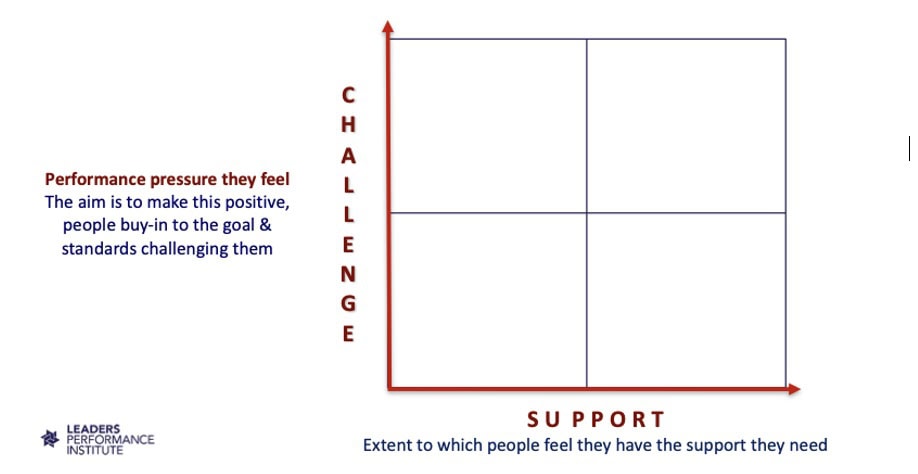
Mapping your team by challenge and support
What do others feel about your current level of challenge and support? To bring some of the research to life, there is a simple tool we can all use as leaders to map out the current landscape of your teams, as it pertains to the levels of challenge and support you are currently giving them as a leader. Similarly, you can also ask others how they feel about the challenge and support provided.
Challenge relates to the performance pressure people feel. The aim is to make this positive; people buy-in to the goal and standards challenging them. Support is the extent to which people feel they have the support they need.
30 Jun 2023
PodcastsThe Parisian club’s new Director of Rugby discusses his work at Leinster and what it will take to replicate that success in the European Champions Cup and French Top 14.
A podcast brought to you by our Main Partners

Stuart Lancaster, the new Director of Rugby at Racing 92, agreed to join the Parisian club last September while enjoying his seventh season as Senior Coach at Leinster. It meant a fresh challenge for the man who also coached England at the 2015 Rugby World Cup.
Says Lancaster: “For the first time, really, my head was turned a little bit by the opportunity to try something new in a different country, in a different competition, the Top 14, and to try and build something as successful as Leinster but in a completely different context”.
He discusses his move at length in today’s episode, which is brought to you by our Main Partners Keiser. During the conversation with Henry and John, he also touches upon:
Henry Breckenridge Twitter | LinkedIn
John Portch Twitter | LinkedIn
Listen above and subscribe today on iTunes, Spotify, Stitcher and Overcast, or your chosen podcast platform.
What Leaders Performance Institute members said in a recent Virtual Roundtable about coaching and leading in an inclusive way.
One of the groups on the call used the above as the start of the conversation – a question was asked whether or not Lewin’s equation is a linear relationship around trying to get as much talent and as good an environment as possible to maximise performance. Or is it actually about optimisation? Finding the optimal relationship between talent and the environment. Different talents could be successful in different environments, and vice versa, as opposed to just trying to put as much talent into a particular environment, and then make it as good as it can be. Something to think about.
Reflecting upon psychological safety
When we reflect on experiences of feeling included, often we hear responses such as the feeling of being heard, feeling safe to speak up, challenge and ask questions without a level of self-censorship – this is the essence of psychological safety. If that self-censorship is present, Lewin would say this would really impact the environment. It can create hostility and have an impact on performance. It will also affect the authenticity of the environment. If we feel a level of covering or lack of authenticity, social scientists have found it can actually compromise our ability to think by up to 30%.
There are four levels of psychological safety:
For the purpose of this roundtable discussion, we emphasised the importance of inclusion safety as the first level of this process – it is a precondition for the other levels of safety. Are your athletes or staff comfortable in that coaching or leadership relationship? Social sciences research suggest that in the need to feel valued, there needs to be a sense of belonging first to allow the rest to grow together. If you want to explore some deeper thinking around belonging, consider some of Owen Eastwood’s work.
Finally on this point, in the quest for establishing psychological safety, role-modelling is key, particularly from those at the top of the organisation who have influence. A clear statement of intent can go a long way to increasing psychological safety, and comfort for other stakeholders aligned to the organisation.
Onboarding
Throughout the group conversations, the onboarding process was identified as a crucial component in fostering a strong sense of inclusion safety, and one where we felt thinking around this is currently under developed. The consensus from the conversations is that many environments are often more mature in their thinking around onboarding with players, as opposed to staff. Circling back to Lewin’s equation that was used at the top of the call, staff however, are the ones that are often the biggest shapers of an environment so there’s work to be done here. So what’s working and what can be improved?
Most organisations are striving to be quality learning environments – this often starts with having psychological safety present. Are we making it clear and backing it up with action, that the moment new people walk through the door and are being introduced to the culture, that there’s an intent and commitment to invest in one’s growth? ‘The better you are will make for a better collective’.
Do we need to challenge our thinking in this space? Why do we recruit somebody? Often we think about the technical elements, but are we considering and paying enough attention to the ‘softer’ skills as a key component, and then bringing them up to speed on the environment from there? Specifically to inclusion, some organisations have started to add an inclusion question in their interview processes as well, which has been an interesting addition to see how many people struggle to articulate their position on it.
To create true inclusion safety, the onboarding process can in actual fact begin before an individual is in the building, during the recruitment process itself. It’s important to think about a 360 approach to connect to all elements of the organisation. What are the cultural connections someone will live and see on a daily basis? What does that tangibly look like for specific teams, because we know sub-cultures exist? Then there is the relationship with the athletes themselves – what do they look like? Often it comes back to relationships and how we treat each other was a comment from one of the groups, which is why there is an emphasis on recruiting the right individuals for your environment, and also role-modelling from those that carry influence.
Finally, seek to measure the impact of these processes. We know there is a high turnover in professional sports. Are you surveying your culture in general and also capturing insights into the effectiveness of those best practices that are integrated as part of the onboarding process? Be intentional and frequent in checking if people feel a part of an organisation.
Front loading through education
It’s perhaps not a huge surprise that ‘education or educating’ as a term was frequently used in our conversations, from a variety of different perspectives. As a provocation within the group, the question of what are the behaviours that create inclusion safety is a simple but effective place to start when considering this process.
One environment on the call shared an anecdote of how they front-loaded education around psychological safety with their coaches across a two-year period, with one of the end results being that this could have a positive impact on how they then create environments for players. Those in the organisation felt it was important to respect where coaches and other staff are coming from, respecting those opinions and creating opportunities to ask questions and develop thinking around psychological safety. The safety it created for coaches thus created better safety for the players. There was a clear undertaking of needs analysis with stakeholders (in this case coaches) to support psychological safety.
As an extension to the point above, there were discussions about leading inclusively, and how some traditional coaches may not have experienced this style before – assuming that ‘hero leadership’ (leading from the front, pushing, directing) is the way to achieve success. It is important to help and educate coaches to lead more from the centre, and not to dismiss people if they are less successful at the beginning of their leadership journey.
Transparency and choice of language is important here as well. We discussed high standards and high support environments. To create alignment, there needs to be high support and education resources to accompany the expectations of high standards. There needs to be clarity around expectations on the front end. For example, sharing that a particular training session is going to be really hard, and the failure rate is probably going to be pretty high, and that’s okay. The relationship between transparency and willingness to share information is more important than ever before.
Finally, consider the power of facilitation with those in the environment. Do they have self-awareness of their own biases? How do you work to respect different individuals’ backgrounds through understanding their perspectives and an awareness of where they’ve come from? We are striving to encourage that level of safety so that people can be more open and buy-into the environment. Culture often starts with the identity of the group, so this creates the opportunity to design that culture from safe foundations and the removal of self-imposed thoughts and beliefs.
Respecting differences
Environments have different cultures. Educating players and staff on each other’s background and culture shows respect and awareness. The heritage and lineage of where people are coming from is really important. What we can do to bridge those cultural gaps? The importance of delivering according to need – for example, prayer rooms and certain types of foods.
People want to be expressive. Whether that’s to dress in a certain way as an example. How are we welcoming that? Inclusion can be a combination of belonging and uniqueness working collaboratively with one another. How are we helping somebody simultaneously fit in and stand out?
Empathy is crucial. Create an environment where empathy is on display and can be nurtured. We also have to think about the idea of being comfortable with inclusion looking different to certain groups and people. Do you ask your players and staff ‘how can we include you more’ or ‘what would help you feel more included here?’
Takeaways: Group Reflections & Insights
At the end of the call, attendees were asked to share a key reflection of thoughts from the roundtable that they’d like to take forward:
Ioan Cunningham, the Head Coach of the Wales women’s rugby union team, discusses his traits as a leader as well as the importance of connection and fun in a team environment.
A stern test awaits them this weekend in round three, with England travelling to Cardiff Arms Park on Saturday (15 April), with Wales’ schedule wrapped up back to back away matches. They will face France at Grenoble’s Stade des Alpes on 23 April before ending their Six Nations campaign against Italy at the Stadio Sergio Lanfranchi in Parma on 29 April.
Cunningham explains to the Leaders Performance Institute that, instead of coming home after the France match, the team will then make the six-hour coach journey to Parma and spend the week in Emilia-Romagna preparing for Italy.
“You don’t lose two travel days [returning to the UK and setting out again] and it gives you the best chance to prepare,” says Cunningham, who recently contributed to a Leaders Performance Special Report on how teams can manage their preparations for major competitions.
“We can set up camp in Parma ready for the week,” he continues. “Already family and friends are looking to come out and spend time with the players.” He indicated that the players would have some free time in Parma on the Wednesday. “They get to see their friends or family and spend some time outside the camp. The weather will be decent in Italy in April and they can feel good; ‘the sun is good, I feel I am in a good place, and I’m getting ready to play Italy at the end of the week’.”
Cunningham also emphasises the importance of fun. “We created mini teams within our squad with different responsibilities or creating games. We asked the girls to name their teams. They chose famous Welsh people and had t-shirts made and, suddenly, you have an identity and you’re part of a team.”
What were some of the names chosen? “Duffy, the singer, was one,” he says. “The Nessa character from [British sitcom] Gavin & Stacey. So you’ve got a t-shirt with the picture on front and it’s quite funny when you get those up and running. What was really good, you had an opportunity then where I might say there’s a trade opportunity here, ‘do you want to trade anyone out of your team because they’re not pulling their weight?’ And those are quite funny when they’re trading players and there’s an opportunity to draft. It was quite fun.”
Connection and downtime are essential too, which is why friends and family were invited to Parma, just as they were for Wales’ 2022 Rugby World Cup campaign. “If you’re away from home and family and friends have travelled to watch you, making sure the players have contact time with their family and friends and also inviting the family and friends into our environment is massive. On those downtime periods, parents are always welcome to come into our hotel and team room to spend time with the players, as well as the players going out.”
Cunningham also spoke to the Leaders Performance Institute about the development of his newly professional squad. Here, we turn attention to Cunningham as a leader.
How important are your instincts? How do you prevent yourself losing touch with your intuition?
IC: Instincts are huge. Your gut feel. Your coach’s eye as well as your gut. ‘I’m not feeling this today, it’s a bit off, I need to have a chat with this person’. Another part of instinct, as well as data, if you have a short turnaround and you haven’t had much in the tank in that week, we might do a 20-minute run through on a captain’s run day [usually a Friday, although Cunningham’s team do not undertake this traditional rugby practice in a typical fashion; see below] but the majority of the time we won’t. But it’s having that feel, even at the start of the week, if you’ve come off a good win, for example, they think they’re in a good place, they have just beaten one team but there’s another team coming after us, so maybe it’s bringing their feet back to the ground and why. Instinct is huge, not only on players but on management; feeling if they’re a bit fatigued. We did something last year when we felt people were tired and we’d been in a long time; ‘right, let’s cut tomorrow. We won’t come in tomorrow’, just having a mental recharge away from the environment or we know someone who’s very friendly with us in the group and he’s got a coffee van so we put a coffee van up inside the training field, so we’ll finish the session and then go have a coffee at his van; just spending time together, having a chat, we put some music on, and then just having those connections then. It just recharges us and makes us feel like we’re ready to go again.
Must data back your intuition?
IC: 100%. It’s got to be aligned to everything we want to do. Regarding rugby stats, our main page is stats that are important to us in the game and which change behaviour. So if we want to get off the floor quicker, we’ll stat that up. Say with that, ‘60% speed of feet, we need to get to 70%, then. How do we get off the floor quicker?’ That’ll change behaviour. But then there’s other data regarding volume and load from a GPS point of view, which we know now the type of load we want to put into the players in a test week; ‘if we want to cover 22k, we need to get this amount of high speed metres into the players’. That’s all important and relevant to the game we want to play.
What is the key to getting the big decisions right and managing them effectively?
IC: Regular communication with the right people, constant drip effect of the same message; ‘why we’re doing it, this is the game we want to play, because it’ll give us this’. Those conversations in a week are huge for me. We’ll always wrap up the day with ‘how did it go? ‘it went well’ ‘do we need to change anything tomorrow?’ We’ll run through tomorrow’s sheet and we’re constantly working a day ahead, then we’ll look to the week ahead. It’s really important.
Do you reflect on your own decision making and communication skills?
IC: Some of that could be better, if I’m honest. When you’re in it, you’re entrenched in the work and when someone asks you a question you’re into something else, but I do deliberately try to give myself time to reflect on ‘did I give that message correctly? What tool did I use? Did I react well to that? How do I want to come in tomorrow? I need to speak to this person and how do I do it?’ I do try to deliberately reflect on my day and what I’ve done. It’s a huge part of performance. I like to have good relationships with some key members of staff as well that will give me feedback on how I’ve done; or ‘how was our meeting? Were we happy with it?’ Those things are important for me as well.
How do you protecting your own time and resources?
IC: You can turn around and, before you know it, the day’s gone and there’s so much happened in that day that sometimes the car journey or just driving the car is good, reflect, and put something on, music or a podcast, just putting something on to reflect is good.
What do you do in lieu of the captain’s run?
IC: We do a walkthrough and we do this exercise called ‘walk the map’. So the map is our pitch. We’ve got this five-metre pitch that we roll out and we walk through everything that we’re taking into the game both with and without the ball. We’ll do ‘what-if’ conversations. ‘What if we concede in the first two minutes? What do we do? What does it look like? What if we get a yellow card to a nine? Who steps in?’ We cover those sorts of things as a team as we walk the map. On the captain’s run day, we’ll actually walk the ground from try line to try line with our leaders just walking and talking through what we’re going to do and the kickers will kick and that’s it.
Ioan Cunningham is a contributor to our latest Special Report, titled Navigating Your Way Through Major Competitions: a snapshot from Olympic, Paralympic and elite team sports. In addition to Welsh Rugby Union, it features insights from Swimming Australia, the Lawn Tennis Association, Athletics Australia and Hockey Ireland. Each has teams competing in major tournaments this year, and all are bound to give you something to think about in your future projects.
In late March, some of the industry’s most respected leaders from across the globe gathered at Scotiabank Arena in Toronto to discuss the pressing performance matters of the day.
It is designed to connect people with responsibility for performance at the highest levels of world sport with each other and the ideas that have served their peers best. The top jobs in elite sport are often lonely places and always comprise unique challenges. The following is a record of the Think Tank meeting that took place on 28 March at Scotiabank Arena in Toronto. A behind-closed-doors event, the account that follows is a general one and aimed at presenting the lessons learned from the conversation.
Attendees
General Manager, Toronto Maple Leafs
Head Coach, Toronto Maple Leafs
Senior Basketball Advisor, New York Knicks
Performance Director, Manchester City
Head Coach, Scotland Rugby
How can the leader of the team reduce both the pressure and distractions faced by coaches and athletes? The first and most important step is to create an environment that enables athletes and staff to be at their best.
Key points:
Sir Alex Ferguson, Arsène Wenger, Mike ‘Coach K’ Krzyzewski, Joel ‘Coach Q’ Quenneville. These were some of the longest-tenured and most successful coaches in sporting history when they left their highest profile roles. Replacing figures of such stature can be daunting and fallow periods are almost inevitable as teams seek to fill the vacuum. What can be done to ease the transition from a legacy coach?
Key points:
In some elite sports, there is an underdeveloped understanding of when athletes are conditioned or deconditioned. Moreover, this does not always align with training-to-game models. Where should the emphasis be placed in this continuing challenge?
Key points:
A lofty ambition, for sure, but a noble goal for all teams regardless of their pedigree. At the very least, all teams can strive for their pinnacle.
Key points:
Leaders Performance Advisor Meg Popovic wraps up her Performance Support Series with an exploration of athlete-led leadership and the implications of balancing ‘agency’ and ‘structure’ in your team’s social environment.
Recommended Reading
What Are your Trade-Offs in the Quest for Success?
Our Athletes Are Not Always in Tune with their Bodies, But Help Is at Hand
Performance Perspectives: Balancing the Emotional and Rational in Performance Support
Framing the topic
This was the third and final session of our first Performance Support Series of the year, which focused on ‘The Performance Paradox’. Across these sessions, which are led by our Performance Advisor and performance specialist Dr Meg Popovic, the aim is to explore the trade-offs, and considerations in the quest to win for staff, athletes, and their wider organisation. This series is centred around Transformational Learning Theory; how we learn to transform ourselves and our teams we co-create. This final session focused on the voices in athlete-led leadership.
Recap
The Oxford Languages definition of ‘paradox’: ‘a seemingly absurd or self-contradictory statement or proposition that when investigated or explained may prove to be well founded or true; a statement, person, or thing that combines contradictory features or qualities’.
“A flower won’t open if I yell at it and say ‘bloom!’” – Marion Woodman
Assumptions
Holding space: athlete-led leadership
If we imagine more space for athletes to find and integrate their voices into the system (club/team/organisation that surrounds the athlete):
Our own voice process – “All grown-ups were once children… but only few of them remember it.” Antoine De Saint-Exupery, The Little Prince
Pedagogy, coaching = reflective practice, self knowing.
Meg asked our members to reflect on their own voice process, and make notes on the following questions:
It’s important to understand our younger athletes, think about what life was like for you at that time, and how to help them in order to get the best out of themselves as people and performers.
Agency vs structure
When looking at the social relationships between individuals and larger groups and social institutions that have influence on those individuals, consider the following:
Structure – macro: the recurrent patterned arrangements / social structures which influence or limit the individual choices and opportunities available. The Club / Organisation and its departments.
Agency – micro: the capacity of the individuals to have the power and resources to fulfil their potential, express themselves and act upon their own will. The athletes.
The structure and the agency are always in a co-active dance together, let’s see where they blend and where they don’t.
Low agency, low structure = drift
High agency, low structure = laissez-faire
Low agency, high structure = regulation
High agency, high structure = alignment
Think about the departments of your organisation, if you were to evaluate the relationship between the club, the department and the athletes and the dialogue between them: where would you plot them on a graph with the quadrants above?
Strength-based best practices
Thinking about the departments within your club or organisation, if they’re really good at engaging players’ voices:
Members of the Leaders Performance Institute spoke at length about a topic pertinent to us all in this recent Virtual Roundtable.
Here are four key themes that we pulled out of our conversation around how to effectively define and solve performance problems.
Recommended reading
The Cynefin Framework – Using the Most Appropriate Problem-Solving Process
Design Thinking Defined (IDEO)
Five Tips From IDEO for All Leaders in Sport
Pig Wrestling: Clean Your Thinking to Create the Change you Need (Goodreads)
The Checklist Manifesto: How to Get Things Right (Amazon.co.uk)
Why We Sleep: The New Science of Sleep and Dreams (Amazon.co.uk)