Ahead of the 2026 season, Dr Benjamin Kelly explains how loss aversion afflicts the F1 paddock and how the same biases cost companies billions in lost revenues.
The Brazilian driver, in his Ligier, collided with Luca Badoer’s Forti, which flipped upside down and ended in the gravel trap.
After some confusion, the trackside marshals belatedly deployed the Safety Car to pick up the race leader, Williams’ Damon Hill.
Diniz managed to continue and made a pit stop as the Safety Car prepared to pull in. However, his Ligier burst into flames as he attempted to rejoin the race.
Both drivers were unhurt despite Badoer being forced to crawl from underneath his Forti unaided in the confusion; Diniz subsequently abandoned his ruined vehicle without assistance too.
At a distance of three decades, footage of the Safety Car, a Renault Clio – a 150bhp city runaround – leading Hill’s 700bhp Williams and Michael Schumacher’s Ferrari seems quaint.
The criticism that came the marshals’ way underlined how Safety Car deployment in the 1990s tended towards ad-hoc chaos. They were typically borrowed road cars, they improvised pace and there were no standardised rules.
Fast-forward to 2026 and we have Aston Martin and Mercedes Safety Cars bristling with telemetry and data links.
Yet while the machinery has evolved, the cognitive vulnerabilities exposed by Safety Car moments have not.
The real deficit remains: human decision-making under pressure still misfires.
The Safety Car bunches the field, resets race dynamics, and, critically, forces high-stakes strategy calls in seconds.
Data across more than 200 Grands Prix reveals a chilling pattern: 68% of Safety Car deployments trigger suboptimal decisions. This is not because teams lack talent or simulation power, but because of loss aversion (the behavioural bias where avoiding pain outweighs equivalent gains) distorts pit wall logic under yellow lights.
To underline the point, here are three F1 case studies in pressure-induced error.
1. Mercedes at the 2020 Sakhir Grand Prix: over-defensive pitting
When George Russell deputised for world champion Lewis Hamilton at the 2020 Sakhir Grand Prix following Hamilton’s positive test for Covid‑19, his remarkable performance should have produced a debut victory. Instead, a sequence of communication breakdowns, tyre mix‑ups, and late‑race chaos denied Russell the chequered flag.
A late‑race Safety Car is deployed following Jack Aitken’s spin at the final corner, which dislodges his Williams car’s front wing and leaves debris on the racing line.
Mercedes is presented with two choices:
Mercedes reacts by calling in both Russell and his teammate Valtteri Bottas for an unplanned double‑stack pit stop. They feel the Safety Car creates the perfect opportunity to pit with minimal time loss and finish the race on fresh tyres.
However, a radio fault means Russell arrives and is mistakenly fitted with Bottas’ front tyres, which violates tyre allocation rules. The mistake in the pit lane is mechanical, but the decision to double‑stack at all reflects a deeper bias. Mercedes immediately realises the error and instruct Russell to pit again on the next lap.
As for Bottas, with no tyres ready, the Finn is sent back out on his old hard tyres after a long delay.
Russell plummets from P1 to P9 while Bottas eventually takes P8.
What happened? This was a classic case of loss aversion. Pit crews tend to fear losing track position more than they value tyre advantage; protecting a lead trumps expected value in the calculus. It echoes golf when a player decides to lay up short of a par-5 hazard, sacrificing birdie odds to avoid the potential pain of a bogey.
2. McLaren at the 2025 Qatar Grand Prix: anchored to plan A
McLaren, with Oscar Piastri on pole and his teammate, the aspiring world champion Lando Norris, in P3, enters the race expecting a two-stop strategy based on pre-race simulations.
On lap seven, a Safety Car is deploys after Sauber’s Nico Hülkenberg and Alpine’s Pierre Gasly collide.
As this new evidence emerges, the entire grid, with the exception of the McLarens and Haas’ Esteban Ocon, pits. Pitting makes sense due to the 25-lap maximum rule for tyres on the 57-lap Lusail track; two pits stops are mandatory for each driver in any case. Pitting on lap seven allows teams to complete the race with two clean 25‑lap stints. There is also the fact that pitting under the Safety Car massively reduces the time cost.
But McLaren is anchored to the pre-race model – they’ve committed mentally. They delay the stop. Their rivals undercut. Piastri and Norris miss out on the podium.
What happened? This was classic anchoring bias. New information (Safety Car, track evolution) is discounted because the original plan feels ‘safer’.
3. Drama at the 2021 Abu Dhabi Grand Prix: authority collapses under dual pressure
Perhaps the most infamous in recent times, Mercedes’ Hamilton leads Red Bull’s Max Verstappen on old, hard tyres, at the 2021 Abu Dhabi Grand Prix. He is mathematically cruising to an eighth world title just as Williams’ Nicholas Latifi crashes and triggers the Safety Car.
Mercedes faces a choice: pit Hamilton for soft tyres (risky as he’d lose track position) or have him stay out (on old tyres, but his position would be protected).
They have Hamilton stay out. It is a reasonable decision under loss aversion – avoid the certain pain of dropping position – but Race Director Michael Masi, under torrential team radio pressure from both Red Bull’s Christian Horner (“You have to race!”) and Mercedes’ Toto Wolff (“No, Michael, no! That was so not right!”), makes a call that bends the regulations. He unlaps only selected cars (just the five placed between Hamilton and Verstappen rather than all eight as per the regulations), then restarts the race on the same lap rather than the following lap, which was the rule at the time.
Fresh-tyred Verstappen blasts past the disadvantaged Hamilton on turn one and claims both the chequered flag and the 2021 world championship. The FIA later cites “human error.”
What happened? Masi faced cognitive overload, from duelling authority figures (in this case team principals) and an ambiguous rulebook to live broadcast pressure and split-second timing. He defaulted to the heuristic that felt ‘right’ under duress: let the fastest car win, ignore procedural nuance. The regulatory error is the symptom; the bias is the disease.
Why this pattern repeats: Attentional Control Theory meets the pit wall
Attentional Control Theory (ACT) explains the mechanism at play: under stress, humans shift focus from task goals to threat appraisal. On the pit wall, that threat is losing track position. Mental bandwidth narrows. Working memory floods with:
With capacity overloaded, crews revert to loss aversion heuristics i.e. ‘protect position at all costs’. While this worked in 1996 when Clios led the field safely, it fails in 2026 when marginal tyre advantage can swing a race. Compounding hits harder.
A defensive Safety Car call leaves you vulnerable to undercuts on the next lap. Hamilton’s stay-out in Abu Dhabi was reasonable in isolation but under two-car pressure (Masi plus both team principals) it triggered a regulatory cascade. One error amplifies into a second.
The business parallel: boardrooms defend rather than attack
Replace ‘pit wall’ with ‘C-suite’ and the pattern scales perfectly:
A 2023 McKinsey study found that 64% of board decisions during crises were suboptimal not because of information gaps, but because of process breakdown under cognitive load. It is the same mechanism as the pit wall: stress narrows focus, heuristics override analysis.
The fix: process over heroics
Elite teams and organisations beat loss aversion by building process immunity. Red Bull’s mastery of 2024-25 Safety Car restarts wasn’t luck; it was systematic.
The Red Bull playbook (which any organisation can adopt):
McKinsey teams using checklists and red-teaming cut high-stakes errors by 44%; aviation proved it scales to life-or-death; F1 proves it scales to titles.
The invisible opponent
The yellow lights flash. A crash freezes the pack. Your rivals have Mercedes power units and tyre warmers. You have a pit wall under cognitive fire and a rulebook with ambiguous clauses. The invisible opponent – loss aversion, anchoring, authority bias, compounded errors – costs more points than any gap in car performance.
From Renaults herding supercars in the mid-90s to Abu Dhabi’s 2021 title reversal, Safety Cars have revealed F1’s deepest truth: the fastest car loses when humans default to defence.
Spot the bias. Build the process. Accelerate through the pack.
Dr Benjamin Kelly advises investors and professional athletes on decision making strategies in high stakes environments. If you would like to speak to Benjamin about his work, please contact a member of the Leaders Performance Institute team.
What to read next
At a recent virtual roundtable, high-performance specialist Rachel Vickery explained that pressure exposes weaknesses, which is why an ability to manage your arousal state is critical.
Rachel Vickery begins her presentation with these common examples of athletes and coaches buckling under pressure.
“Typically, the cause has less to do with what’s happening in the arena and a lot more to do with what’s happening everywhere else,” she told the Leaders Performance Institute members at a recent virtual roundtable.
Vickery, who hosted the session, is a high-performance specialist helping teams in the worlds of sport, business and the military perform under pressure.
“There’s this belief that no matter what’s happening, I can put my game face on,” added Vickery, “but we can’t compartmentalise our physiology.”
There is also the fact that pressure is, as she explained, “pigeon-holed into the wellness or wellbeing box or shot off to the psychologist”, which ignores the fact that pressure is a daily accumulation that adds to a person’s allostatic load. It is far from being some kind of character flaw despite that perception persisting in some corners.
“We know from the environments that we work in that pressure is actually the constant,” she continued, “but it’s the physiological stress response that is often the variable.”
Indeed, we are all oscillating between arousal states; calm one moment, activated the next.
“We will fluctuate between the two states across a day, across a month, across a year and a season and a career.”
In early human history, a calm state meant time to “rest and digest” and activated meant “flight or fright”. The latter has become the norm. “Given our lifestyle these days, most high achievers run in the high arousal state more of the time.”
This is unsustainable in the long term because it pushes people close to their physiological stress threshold, which is where performance begins to break down.
This, Vickery argued, is why it is important to reduce that allostatic load.
What is allostatic load?
Allostatic load is the cumulative ‘stacking’ of stressors over time that erode the amount of physiological ‘space’ an athlete has between their current arousal level and their personal stress threshold. Vickery refers to this as their “buffer”.
She explained that while competition rarely creates a problem, it can reveal one.
The stressors in question can be personal (e.g. a lack of sleep), organisational (e.g. misalignment), performance-based (e.g. being outside your comfort zone), or physiological (e.g. reduced ability to hear or absorb information).
Crucially, “as long as your arousal state stays below your threshold, your negative performance will not show up.”
Strategies to increase your buffer
Stressors tend to occur across three categories:
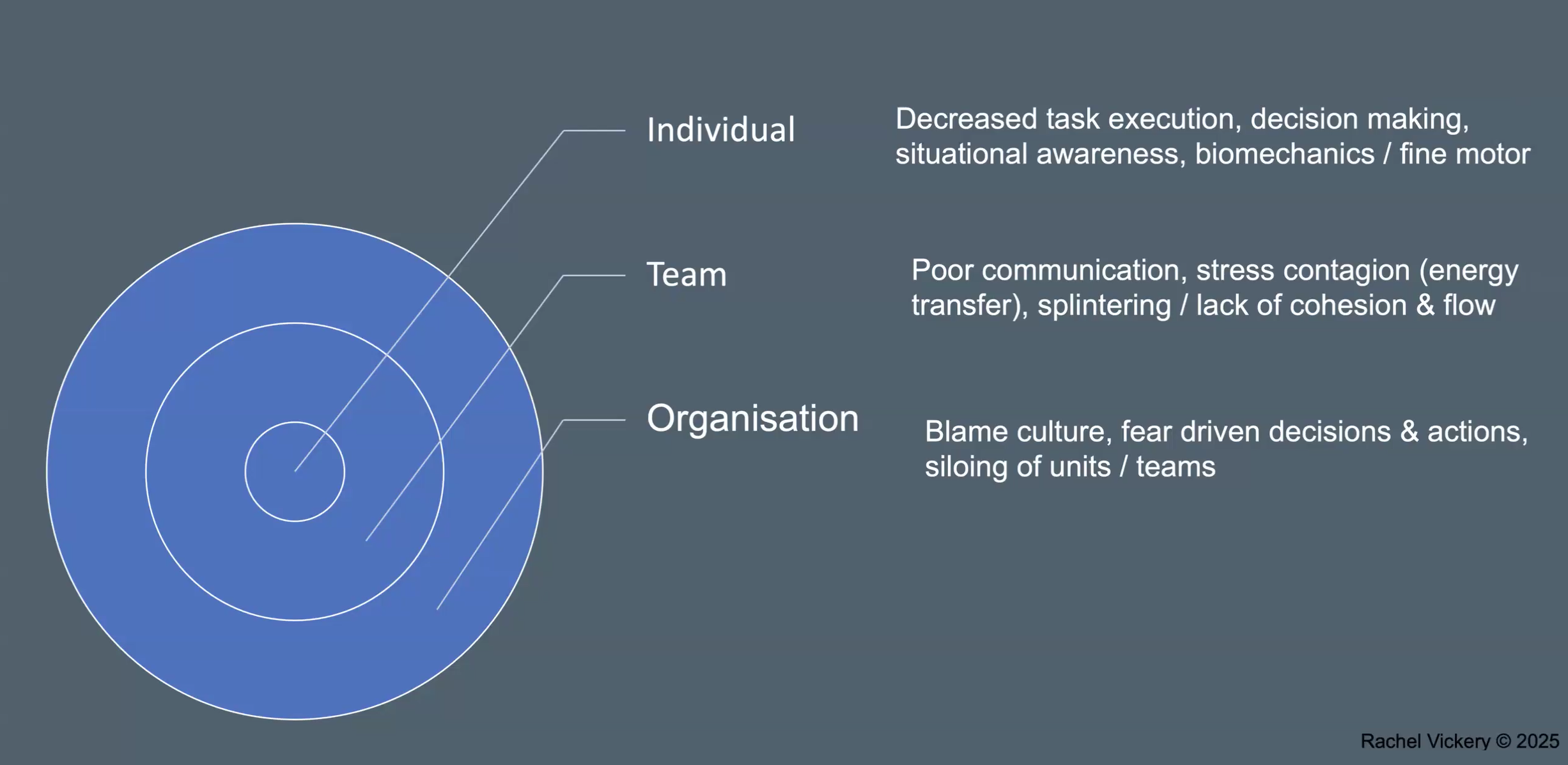
Vickery shared a range of strategies for each:
Vickery described organisational strategies as the “missing piece”. She said: “we often see organisations make dysregulating choices and decisions.” She recommends:
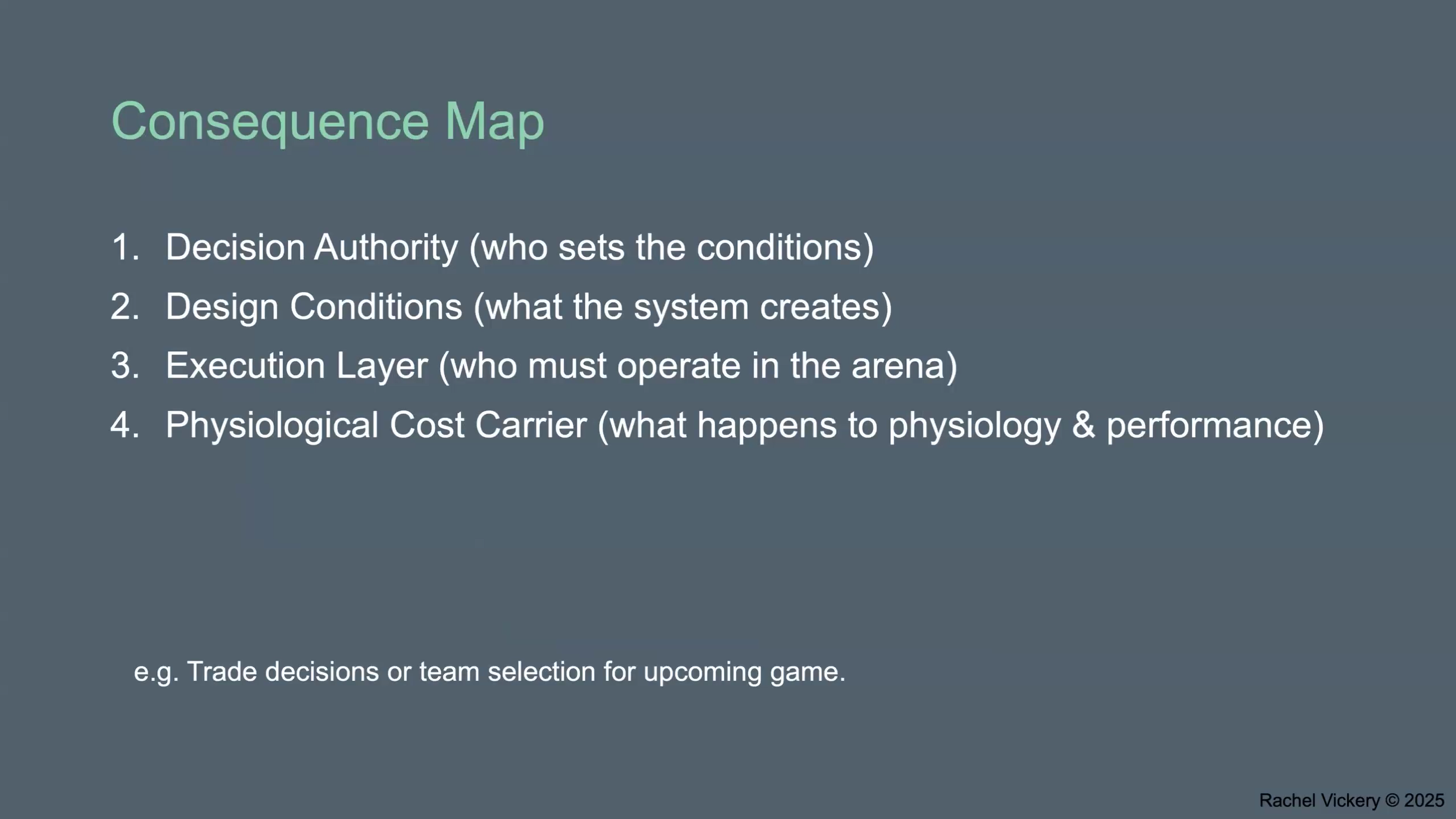
“Pressure is an accelerant, not a compass”
With this observation Vickery wrapped up her presentation. “Very seldom do people rise to the occasion,” she said. “What we often see is things are masked until people come under pressure; and that’s when their performance will splinter.”
In other words, pressure will only magnify your existing strengths and weaknesses, which makes preparation – the creation of that buffer – so important.
She struck a chord with members, who shared their own thoughts at the conclusion. Here is a selection of their comments and observations:
“Our mission as a group was how can we make sure our athletes are self‑reliant and capable of making the best decisions under pressure?”
“We moved to a case management situation where we’re rigorously, deliberately, consistently looking at athlete need. If there’s 50 staff, it might only be two staff that will have the greatest impact rather than everybody feeling like they must be involved.”
“We’ve got to take our mind away from trying to perfect exactly what the athlete might face because you will never replicate it. What can we build into their toolbox so that they can be that self‑reliant person in that moment?”
“Could athletes benefit from developing more coping‑based strategies; things they can do in advance in their preparation?”
“It really depends on the perspective that the athlete is taking. So you must understand that first before you can decide what the strategy might be to reduce the allostatic load… You would need a specific strategy to deal with fear of failure versus legitimate contract implications; the financial implications versus their more personal perspective.”
“Digital overload is a huge piece in terms of making our allostatic load worse. It’s an under‑represented space that we probably don’t spend enough time and energy on.”
What to read next
Ben Ashdown and Mustafa Sarkar of Nottingham Trent University are working on a research programme aimed at providing an evidence-informed and objective approach to tracking resilience on the pitch.
Main Image: Thomas Eisenhuth/Getty Images
“Even within the same football academy we’ve seen staff have different views of what resilience is,” Ben Ashdown, a Senior Lecturer in Sport and Exercise Psychology and Lead Researcher at Nottingham Trent University, tells the Leaders Performance Institute on Teams.
“They’ll say ‘resilience is a really important part of our philosophy but actually we don’t really know what it is, we don’t really know how to measure or assess it, we don’t really know how to track it’,” says Dr Mustafa Sarkar, who also joins the call. He is an Associate Professor of Sport and Performance Psychology at Nottingham Trent and Lead Supervisor of the research programme.
Together, alongside Dr Chris Saward, Dr Nathan Cobb, and Dr Julie Johnston at Nottingham Trent University, they are leading a research programme to identify behavioural indicators of resilience in English academy football and develop a resilience behaviours observational tool. As part of the research, they have worked with academy stakeholders including coaches, psychologists, scouts, and analysts. They are also conducting a season-long study at a Category One academy (Derby County Football Club).
Based on their research, they have found that resilience behaviours can be categorised under six themes:
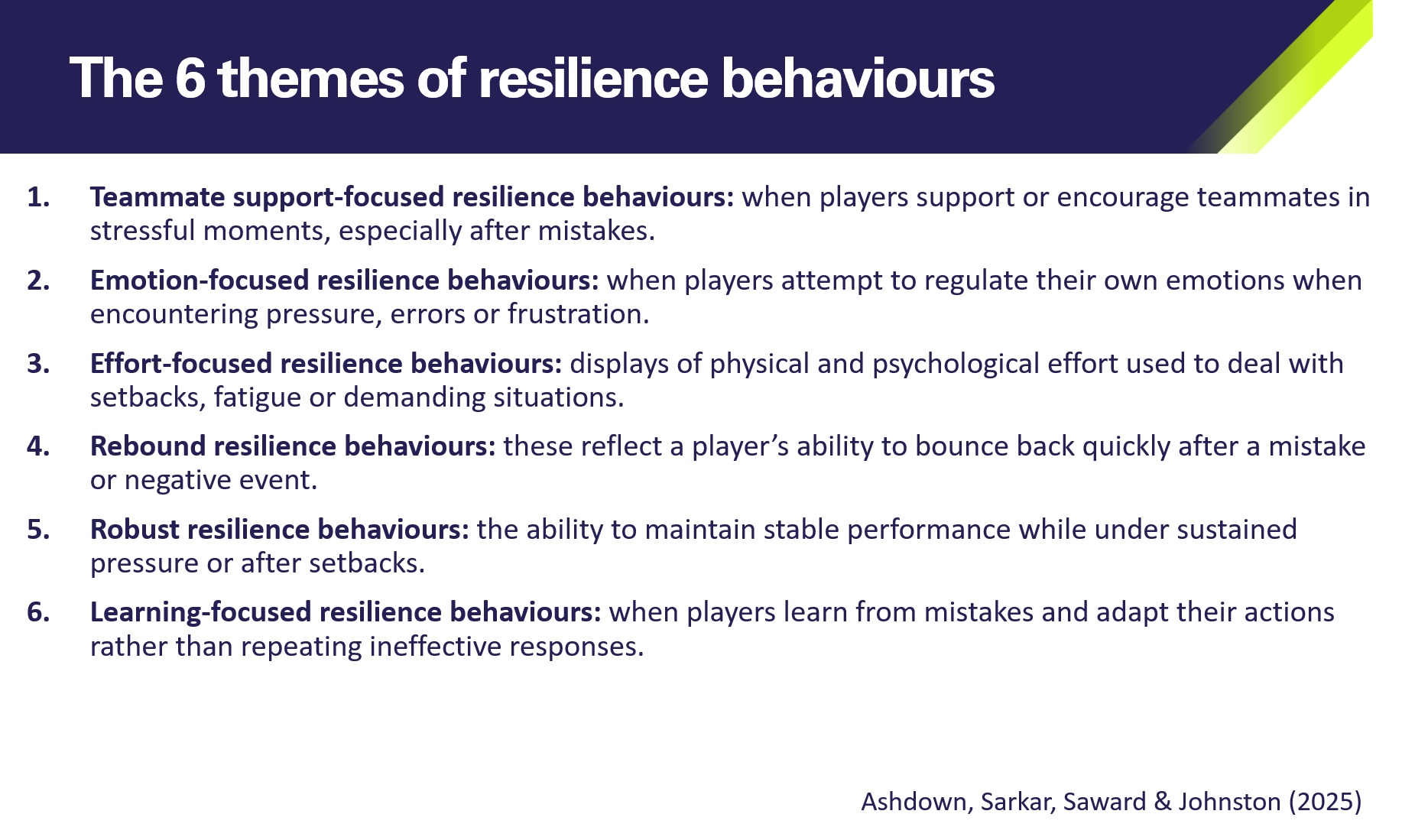
At the end of this research programme, they hope to have developed a tool for sport psychologists and coaches primarily, with some benefit to analysts who might contribute to the tracking of these behaviours through video-based analysis.
Sarkar says: “We don’t necessarily see it as a tool for identifying talent. I think it would be more as a conversation-starter with a player for player development purposes.”
Resilience: a behavioural response
As the exploration, measurement, and assessment of resilience in sport has tended to rely on self-report alone, myths and misconceptions have emerged (such as resilience being related to endurance and the suppression of emotion), and there is a gap between what resilience truly entails and what practitioners witness on the pitch.
“Coaches and support staff are starting to recognise that both physical and mental rest are critical to sustained resilience over time,” says Sarkar who has spent time with academy stakeholders dispelling those myths and misconceptions. “Part of resilience is about helping individuals to develop their thought and emotional awareness. It is not about encouraging people to hide their emotions”.
Additionally, “resilience requires more nuanced (context-specific) language because a person’s resilience in relation to being injured might be quite different to their resilience in relation to a loss of form”.
The behavioural elements of resilience lay at the heart of their research programme.
“We see resilience as a behavioural response,” says Ashdown, “but, up till now, there hasn’t been any literature that has actually asked what do these behaviours ‘look like’? How do we observe them? I think our work, in a behavioural sense, gives us some directly observable, reliable and valid indicators of resilience in football.”
The appeal for coaches, psychologists, and analysts is clear. “They’ve really bought into this idea that we’ve got something to look for on the pitch, and if we can see it [resilience], then maybe we can then develop it and track it over time,” Ashdown continues.
Their initial 2025 study/paper identified 36 behaviours (across six themes mentioned above), which have since been refined to ten. “We retained at least one across the six themes, which is another indicator that they’re pretty reliable.”
These behaviours include: demonstrating supportive actions during pressure or adversity (support-focused behaviour); positive body language in response to stressors (emotion-focused behaviours); and regaining focus in the face of challenges (robust resilience behaviours).
How might coaches approach these behavioural themes in their resilience development work?
The Leaders Performance Institute asks Ashdown and Sarkar about each of the six themes and they give consideration to each in turn with the caveats that a) they should be viewed collectively in order to develop a holistic view of an athlete; and b) the data collection and analysis of their research programme remains ongoing.
When players support or encourage teammates in stressful moments, especially after mistakes.
Ashdown admits that the relational aspects of resilience are more significant than he initially thought. “At times I probably assumed resilience was an individual capacity that you developed almost by yourself without realising that social support (through your teammates) is really significant,” he says.
“Through the work of Ben and others we’re starting to find that resilience is very much relational,” says Sarkar. “The development of resilience is dependent on cultivating high quality relationships. The interesting bit about social support is that we’ve found that it’s not necessarily about getting social support, but it’s about the perception that that support is available to you. From a resilience perspective, the perception is more important than receiving the actual support itself.”
Ashdown then shares a story of academy training drills, at Derby County FC (work led by academy sport psychologist, Lyle Kirkham, and supported by Ashdown), where players had a “secret support partner”. “We tasked some players with, right, when your teammate experiences some adversity or stressor or when they’re under pressure, find ways of offering them support,” he says, adding that the process raised the players’ awareness of how they’re reacting, responding and interacting with their teammates.
When players attempt to regulate their own emotions when encountering pressure, errors or frustration.
While there isn’t yet the data to support a definitive conclusion that emotion-focused behaviours depend on age and phase, as Ashdown explains, “there’s so many points where the participants said ‘we would expect to see a different response from a 10-year-old than one of our under-18s’.”
Emotional maturity is sure to be a factor. He adds: “How these players react and respond to things, particularly at younger ages, it’s a lot more visible, whereas maybe the older players tend to try and disguise how they’re feeling.”
This is a behavioural theme where interdisciplinarity comes to the fore. “We’re working with performance analysts to try and identify these behaviours through video footage and I think we’ll end up with a bespoke set of behaviours based on the phase [foundation, U9-U11; youth development, U12-U16; professional development, U17-U23].”
Displays of physical and psychological effort used to cope with setbacks, fatigue or demanding situations.
What does making an effort ‘look like’ in any sport? “There’s a danger of making assumptions because every player is different,” says Ashdown with reference to both physical and psychological indicators of effort. Their work has talked of pairing GPS data with observations but, as he admits, “this is where we need to be careful and cautious of not mislabelling players based on a perceived lack of effort and we must be aware of individual differences”.
For Sarkar, again, it is more about setting the terms for a player development conversation. He says: “You might come up with a resilience profile to say one player has got hypothetically high effort-focussed behaviours and lower teammate-focussed behaviours, but we see this observational tool more holistically across all six themes”.
These reflect a player’s ability to bounce back quickly after a mistake or negative event.
These need to be channelled. It is no good if a player makes a mistake and runs around like a headless chicken for the next 10 minutes and is sent off.
“One of the participants in our research mentioned that exact point in relation to effort-focused behaviours,” says Ashdown, before echoing Sarkar’s earlier reflections. “The most value in this behavioural approach is the opportunities that it creates for player-coach or player-psychologist reflection.” This, Sarkar suggests, could be a joint review of game video clips where the coach and/or psychologist says to the player ‘talk us through your thought process. What were you thinking and feeling at the time? How might you react and respond differently?’ or it a series of ‘what-if’ questions and scenarios. ‘What if this were to happen in the future? How would you react and respond?’
Sarkar adds that any intervention should be context-specific. “If a player has done that once are we then making an assumption that they’re doing that all the time – is this a one-off occurrence versus a pattern of occurrences? If it’s a one-off, like Ben said, then it’s probing that player about what they were thinking at that particular point in time. But we have to be careful that we’re not intervening based on a one-off versus a pattern.”
The ability to maintain stable performance while under sustained pressure or after setbacks.
Ashdown and Sarkar make the point that robust resilience behaviours risk being conflated with youthful inconsistency – and all its causes – at academy level.
“One of the participants in our research said it’s not about consistency of performance but the consistency of behavioural responses to things. So performance will fluctuate but is there some consistency in the way they’re behaving, reacting and responding?” says Ashdown. “What some of the coaches are after is a flattening of the curve emotionally and the way the players are managing things on the pitch.”
Sarkar believes coaches may be able to use the resulting observational tool as a means of evaluating the efficacy of pressure training scenarios. “What are you, the coach, actually seeing in terms of their reactions, responses, certainly from a behaviours point of view, and as a result of that pressure training, are you actually seeing an increase in some of the resilience behaviours in relation to these themes?”
When players learn from mistakes and adapt their actions rather than repeating ineffective responses.
Pressure training also presents an opportunity for self-reflection and learning through its video component – this is the ultimate purpose of this resilience behaviours work. “If we’re aware of that, can we support them in navigating those more effectively when they’re inevitably going to come up on the pitch?” says Ashdown.
“We don’t learn from experience, we learn from reflecting on experience,” says Sarkar, paraphrasing the American educational reformer John Dewey. “Pressure training shouldn’t just be about putting people under pressure in training and then automatically assuming somehow that they’re going to develop their resilience to future situations?”
At Derby County, led by Kirkham and supported by Ashdown, they have also introduced a series of gamification principles in delivering education and feedback at the academy through a resilience behaviours lens. This includes FIFA-style cards for players, and a football-specific version of snakes & ladders to mirror the ups and downs of the academy journey.
The future of resilience tracking
When it comes to resilience, coaches are acting on intuition, which is valuable but ultimately has its limitations.
“We’re trying to make that process more objective and systematic; hence this is where the interdisciplinary piece comes in,” says Ashdown. “We wouldn’t expect coaches in the moment in the game to be thinking about necessarily tagging or noting these behaviours. We might ask the analyst, with support from the psychologist, to do live coding or tagging of these behaviours or retrospective tagging based on the recording. That would then lead to conversations with the players. With this work, there’s a big opportunity to bring together coaching, performance analysis, and psychology.”
Sarkar explains that they are using the behavioural data to create a resilience profile for players across the noted behaviours. “That gives you a holistic viewpoint,” he says. “A player might have higher team-focused resilience behaviours and slightly lower effort-focused resilience behaviours and a medium level of learning-focused resilience behaviours. So, it gives you a nice overall resilience profile of an individual.”
The hope is that their work will eventually provide an evidence-informed and objective approach to tracking resilience on the pitch.
“It can also then become part of the everyday conversation with multiple staff. So rather than just a conversation in relation to psychology, it’s a broader conversation about player development.”
What to read next
Playfulness and Resilience: How Ballet and Music Schools Link Them Together to Amplify Both
19 Jan 2026
ArticlesAs the 2026 Australian Open gets underway, Dr Benjamin Kelly details how loss aversion and pressure biases erode performance exactly when players can least afford it.
In the first round at Wimbledon Taylor Fritz trails two sets to love and is two points from defeat against record‑breaking server Giovanni Mpetshi Perricard, whose 153mph serves had dominated early.
While serving at 5–1 in the fourth‑set tie‑break, Mpetshi Perricard blinks. The American claws back, steals the set, and goes on to win in five. The Frenchman’s collapse from a seemingly unassailable position is a vivid example of how even explosive servers falter when trying to protect a lead.
Across 650,000+ points from Grand Slam tournaments between 2016 and 2019, players facing high situational pressure – such as break points and match points – produce significantly more unforced errors and double faults than on routine points. Both eventual match winners and losers show the same pattern. Even the best players in the world are predictably worse when the stakes rise.
This is not random variance or bad luck. It is loss aversion in action. When a double fault risks handing over a break, servers tend to play more conservatively: they hit fewer aces and outright winners, but also commit fewer outright errors. Studies have shown that ace rates can drop by around 15–20% on break points compared with routine points, while double faults also decline. The same psychology drives safer second serves and more central returns under pressure. Players trade risk for safety at precisely the moment when controlled aggression would close the point most efficiently.
Elite tennis reveals decision making under uncertainty with brutal clarity. Every serve and return is a discrete decision with measurable consequences. Pressure points expose systematic decision biases that erode performance exactly when players can least afford it. Understanding these patterns gives coaches and captains tools to protect automatic execution and tilt the odds in high‑stakes moments.
Loss aversion on serve: trading winners for safety
In keeping with my recent articles on decision making within golf and football, Prospect Theory explains why servers often choke on break points. Losses – double faults, games and sets conceded – loom larger than equivalent gains like aces or outright winners. Facing break point, players do not simply fear the double fault; they over‑adjust by serving safer, reducing the risk of a catastrophic loss but also shrinking their margin for winning the point.
Analyses of Grand Slam matches show this clearly. On break points, players reduce double faults (a form of loss avoidance), but their ace rates and winner percentages fall significantly. Second‑serve accuracy may improve slightly under pressure, but the trade‑off is fewer aggressive first serves and fewer free points. Overall, servers win fewer high‑pressure points than their baseline serving statistics would predict.
The pattern mirrors golf’s par‑versus‑birdie putting gap, where professionals hole par putts more reliably than equivalent birdie putts, despite identical distances and conditions. In tennis, the reference point is holding serve. Routine points allow a more natural level of aggression; break points trigger defensive conservation, with players subconsciously prioritising avoiding a break over maximising the chance of holding.
This recent body work on high‑stakes tennis has explicitly tested loss aversion. When time pressure and competitive stakes are framed in terms of losses (for example, ‘do not get broken here’), players consistently adopt safer shot selection across the board. That behaviour can compound: one tentative service game invites more pressure in the next, increasing the frequency and intensity of high‑stress points.
Choking mechanisms: when pressure disrupts automaticity
Attentional Control Theory offers a useful framework for understanding why these patterns emerge. Skilled serving is largely automatic: years of practice have tuned complex sensorimotor routines that operate with minimal conscious control. Under pressure, that balance can be disrupted through two main routes: distraction and explicit.
Distraction occurs when worries about the score, the crowd, or the implications of losing a point clog working memory. Explicit monitoring occurs when players shift attention inward and try to consciously control normally automatic mechanics, such as toss height or arm speed. Both mechanisms interfere with fluid execution.
Grand Slam data shows that high‑pressure points are associated with more errors, and that prior errors increase the likelihood of further mistakes. A double fault or badly missed first serve raises anxiety, which can push a player toward more explicit monitoring on the next point. Unforced error rates rise when recent mistakes coincide with break points for both winners and losers. Experimental work on serving under pressure shows that second‑serve accuracy can degrade under these conditions, even in highly skilled players.
One practical solution is to train and cue external focus rather than internal mechanics. When players focus on an external target – such as ‘drive the ball through the back corner of the box’ – they tend to maintain accuracy and speed better under pressure than when they focus on their arm motion or toss. Coaches can replicate pressure in training by simulating break points, adding consequences for double faults, and insisting on external cues only.
Tactical biases and the momentum myth
Pressure does not only affect serving mechanics; it also distorts tactical choices. Confirmation bias can lead players to persist with patterns that worked earlier in the match – for example, repeatedly attacking with the forehand – even after the opponent has adjusted. High‑pressure points often make players cling more tightly to these familiar patterns, reducing tactical flexibility.
Hindsight bias then colours post‑match analysis. Players and coaches frequently reconstruct a contest around one or two ‘turning points’, such as a double fault in a tie‑break, and label them as decisive mistakes. In reality, work on pressure and compounded errors suggests these visible moments sit on top of a sequence of subtle shifts in attention, confidence, and tactical risk‑taking across many games.
The popular notion of ‘momentum’ is often a narrative laid over these processes. Apparent swings in momentum frequently reflect ordinary variability plus predictable pressure responses, rather than some independent force. Statistical work on break points shows that players’ conservative serving and shot selection under pressure is broadly similar across rounds and contexts, even if commentators frame later‑round points as uniquely special.
A toolkit for coaches and players
High‑performance tennis environments can counter these biases by deliberately adjusting how players train, frame, and review key moments:
Reframe break‑point serves as opportunities to execute a pre‑agreed, high‑margin aggressive pattern rather than as mines to be tiptoed through. Track ace and winner rates by pressure level, not just overall hold percentage, to reveal overly defensive tendencies.
Regularly simulate break points and game points in training, with modest but meaningful consequences for double faults or missed patterns. Require external focus cues only (‘aim at the back corner of the box’, ‘hit through the logo on their chest’) to protect automaticity under load
Before matches, agree two or three ‘go‑to’ serve–first‑ball patterns for pressure points, so players are not improvising under stress. This limits the influence of confirmation bias in the moment and embeds flexibility into the plan.
Separate analysis of pressure points from routine points in post‑match reviews. Quantify how much serving behaviour changed on break points (ace rate, double faults, location patterns) instead of relying on memory and narrative. Use this as a basis for revised training goals rather than simply labelling moments as ‘chokes’.
Tennis exposes human decision‑making with nowhere to hide. Every point offers immediate feedback. Players who learn to master loss aversion, protect automaticity, and maintain tactical flexibility under pressure do not just win more; they reliably convert pressure into advantage. Coaches and leaders who design for these realities can build environments in which their athletes thrive when others falter.
At the margin between top‑10 and top‑50, these invisible patterns often make the difference. Surfacing and reshaping them in my opinion is one of the most powerful – and underused – edges available in the modern game.
Dr Benjamin Kelly advises investors and professional athletes on decision making strategies in high stakes environments. If you would like to speak to Benjamin about his work, please contact a member of the Leaders Performance Institute team.
What to read next
The Invisible Opponent: Why our Own Cognitive Biases May Present the Most Formidable Challenge
2 Oct 2025
ArticlesFemale athletes, Artificial Intelligence, adaptive leadership and psychology were all on the agenda in September.
“Most of my career has been in the men’s game,” he said in the aftermath. “It was the only reference I ever had. To get the opportunity to coach these girls you have got to observe and listen and find ways to make them tick.”
The bonds they have forged during his two-year tenure will last a lifetime. “To be associated with these girls, they are driven, they have changed my life, changed the way I think as well. All of those sorts of things are added bonuses. A trophy is one thing, a medal is another thing but actually the quality of the people you work with is the ultimate.”
Mitchell’s sentiments were reflected across several of the conversations we hosted for members of the Leaders Performance Institute in September, from coaching female athletes to a coach’s ability to adapt to their changing environment.
Here are some of the choicest cuts.
Performance anxiety or body anxiety?
Last month, we shone light on Rachel Vickery’s appearance onstage at the Women’s Sport Breakfast at our Sport Performance Summit in Philadelphia. Vickery, a high-performance specialist and former artistic gymnast, recounted a recurring issue from her time working as a physio. Young female athletes would occasionally be sent to her with what was assumed to be exercise-induced asthma. It turned out their breathing difficulties were often anxiety-induced.
“You could see the look of relief on their faces when I started talking about body image, self-esteem and self-worth,” she continued. “So I started a seminar series in 2008 for female athletes and their parents called Growing Up in Lycra around body image identity.”
The seminars were picked up by Swimming Queensland. “I project managed the transformation of these seminars into an education DVD resource that was sent to all female athletes, parents and coaches State-wide.” It was later turned into a national resource by Swimming Australia. “We got some former Olympians involved and that resource went to all of our female athletes, their coaches and their parents. That resource is still used today.”
The role of AI in learning
Vickery was back at the helm for a Leaders Virtual Roundtable discussing how Leaders Performance Institute members can make learning more effective within their teams.
AI was high on the agenda. “AI should be used to support the growth and creativity of staff as opposed to being used for shortcuts where people become lazy,” said one coach developer.
Overreliance on AI, as this coach pointed out above, can stifle creativity. The table also suggested a series of shortcomings in current generations of AI:
The table then highlighted some potential solutions:
Are you an adaptive leader? You’ll need these four skills…
Tim Cox, the Director & Lead for High Performance Research at Management Futures, led a Skills Sprint Session virtual roundtable for Leaders Performance Institute members on the topic of adaptability.
It is a skill, as Cox explained, that was highly coveted by the coaches and practitioners who contributed to our Trend Report earlier this year.
Not that this is anything new. “It is well known that Charles Darwin did not talk about ‘the survival of the fittest’,” Cox continued, with reference to Darwin’s 1859 book On the Origin of the Species.
“The endpoint of Darwin’s research was that it’s not the strongest or the most intelligent of the species that survives, it is the one that is most adaptable to change.”
Over the course of 25 minutes, Cox discussed traps that people can fall victim to in pursuit of better adaptability. He also brought into focus the qualities of adaptive leaders and the skills that can aid adaptation.
Cox discussed four skills:
Read more about the qualities of adaptive leaders here.
‘Sports psychologists cannot just sit and wait for work to come in the door’
Darren Devaney, the Lead Performance Psychologist at Ulster Rugby, and Daniel Ransom, the Head of Psychology and Performance Lifestyle at the Manchester United Academy, co-hosted a virtual roundtable exploring how teams can better use psychology.
They discussed three requisite qualities in depth:
According to Devaney, the psychologist must “get away from the assumption that we work with the individual athlete only”. Instead, they should ask themselves “is my intervention best targeted at an individual or is this more systemic? And if I’m going to be here for the next five or six years, what’s the most useful way of spending one or two hours on this? Is it working with a head coach? Is it working with all the staff? Is it working with a group of players, or is it the one-to-one with the athlete?”
Psychology is not just the work of the psychologist. “An hour spent with one individual athlete is very well spent,” said Devaney, “but an hour spent with somebody that upskills or shapes them”, such as a coach, brings your work into “exponential territory”. He continued: “it changes how they do their work with 20 or 25 people over the course of the week”.
Ransom added: “If we really want to embed and integrate psychology what we require is other people to take on our ideas and work in ways that are psychologically-informed.”
“We can’t sit still and wait for work to walk in the door,” said Devaney. “I’ve often reflected that this organisation functioned for decades without me in the building, so if I’m not here, this place can keep going. I need to recognise the fact that it might not be every day the main thing that everybody’s thinking about, so how can I do that in a way that doesn’t produce scepticism or kickback?” Nevertheless, “you must be proactive in trying to have an impact.”
Ransom has advice for anyone encountering scepticism. “If people are ready for more in-depth and focused work, then let’s meet them there. If they’re not, and they’re at that sceptical end, how do we try and offer them something which is appropriate to the needs of what they might be open to? If we pitch that wrong and we try and go too hard or move too quickly with those people, I think you can get caught in a potential tug of war where we don’t really make much progress and people hold their position.” With skilful guidance, people can “see the value that other people have, and that can be a way of opening a few windows and doors to them.”
Find out more here.
4 Sep 2025
ArticlesAt July’s Women’s Sport Breakfast Rachel Vickery spoke of the problems facing female athletes in ‘Lycra-based sports’.
“I could do it no problems at all in low-level competition,” said Vickery in reflection, “but I fell on the international stage and it cost me a medal.”
Some Leaders Performance Institute members will be familiar with Vickery’s work as a high-performance specialist helping teams in the worlds of sport, business and the military perform under pressure. A smaller number may be aware that she competed for New Zealand between the ages of 13 and 19 and won New Zealand Gymnast of the Year in 1993.
Upon her retirement, Vickery retrained as a physiotherapist and began to explore what went wrong for her in gymnastics when the going got tough.
The latter was top of the agenda at July’s Women’s Sport Breakfast in Philadelphia, which served as a prelude to the Leaders Sport Performance Summit.
These popular morning gatherings were started by Rachel Woodland (who left Leaders in August) and will remain a staple of our performance summits in North America, Europe and Australasia.
“We want this to be a space where, if you don’t know people, you can go into the main room with a bit more confidence from knowing that you’ll see some familiar faces,” said Woodland in setting up her conversation onstage with Vickery.
An audience of largely female coaches and practitioners were keen to hear Vickery discuss her work supporting female athletes in what she calls the “Lycra-based” sports of gymnastics and swimming.
“If you’re an athlete who goes through puberty in a Lycra-based sport as a female, it sucks,” she said.
Vickery recounted a recurring issue from her time working as a physio. Young female athletes would occasionally be sent to her with what was assumed to be exercise-induced asthma. It turned out their breathing difficulties were often anxiety-induced.
“You could see the look of relief on their faces when I started talking about body image, self-esteem and self-worth,” she continued. “So I started a seminar series in 2008 for female athletes and their parents called Growing Up in Lycra around body image identity.”
The seminars were picked up by Swimming Queensland. “I project managed the transformation of these seminars into an education DVD resource that was sent to all female athletes, parents and coaches State-wide.” It was later turned into a national resource by Swimming Australia. “We got some former Olympians involved and that resource went to all of our female athletes, their coaches and their parents. That resource is still used today.”
Chase excellence, not perfection
Vickery, who competed in the late 1980s and early 1990s, spoke of her “complete loss of identity” in an era where little thought was given to either an athlete’s self-perception or their post-retirement transition.
“Everything up to that point had been wrapped around this identity of me being a gymnast: what I ate, what I wore, where I went, what I did on my weekends,” she said.
Gymnastics, she added, is a “very negative, perfection-driven sport,” which didn’t help in those competitions when she fell short. “My sense of self-worth was poor by the time I retired. I had connected to the external validation that came from the media or my school and I’d use that to define whether I was good enough as a human being – which is crazy when I look back on it, but I did not have the emotional maturity to know how to process that.”
It is critical to help athletes understand that they are not defined by what they do.
“Perfection tends to shut us down,” says Vickery. “Our nervous system sees perfection as a threat because the next logical step is, ‘well, if I’m not perfect, then I’m not enough’.”
The key, as Vickery now tells young athletes, is “to shift from chasing perfection to chasing excellence.” Anyone, she believes, can aspire to excellence, which she describes as a “curious and creative state that opens up our nervous system and allows us to tap into performance in a really cool way”.
She says it also “allows you that separation to ride through adversity in tough times” and is “freeing”.
Failure is necessary
Vickery then raised the spectre of failure. “One of the things I took from gymnastics into life is that failure is not only an option, it’s actually necessary.” She made her point by discussing the satisfaction she’d feel at executing a difficult routine. “The only way to get to that point is to fail, fail, fail and fail,” she continued, adding that she would regularly end up in a heap on the gym floor.
“Those failure iterations are so important and just being able to stay open to that in life is essential but, as high achievers, we are often defined against it. Yet failure is just one more iteration closer to getting the thing right.”
Vickery applies the same thinking to sport, medicine and the military or indeed any elite field. “At a deep human level we’ve all got the same fears, self-doubts and insecurities,” she continues.
The solution is the same for all too. “It’s in the ability to regulate one’s own arousal state or threat response, and not only in the moment of pressure and execution, but that ability to front-load puts a lot of buffer in the system to absorb the elevated state. You always have a ‘go time’ but you are then able to self-regulate and come back down again.”
Embrace the chaos backstage
Anyone can increase their buffer. It involves doing “deep work to explore our own messiness – whatever it is that drives our own fears, self-doubts and insecurities – and whatever we know about ourselves. I call it our ‘backstage’.”
One problem is that when we turn up and see others performing, we see their stage but not their backstage. “We don’t see their chaos.” That said, we can assume is that they’ve put in the hard yards. “Confidence can only come from doing big and difficult things. It means doing the preparation, doing the work, and just waiting for the confidence to show up.”
There is also a role for receptive coaches – the kind of which Vickery lacked in her own athletic career.
She told the audience that five or six years ago she bumped into her first female coach, an austere woman who “taught me how not to treat people in a high-performance environment; how not to set them up, how not to coach.”
Vickery, now grateful for the lessons her former coach inadvertently provided, told this woman she was inspirational in ways she probably didn’t expect. This time there was no rebuke when Vickery spoke her mind.
“It was a powerful and pleasant conversation.”
What to read next
13 Feb 2025
ArticlesWe recently hosted a virtual roundtable on the topic with practitioners from across elite sport. Leading the conversation was Rachel Vickery, a renowned specialist in the field.
“There is so much focus on the technical and tactical aspects of craft, and then people hope that it shows up under pressure,” said Vickery, a high-performance specialist who has worked with a range of elite operators in sports, business, medicine and the military to help them improve their performance under pressure. She was speaking as the host of a recent Leaders virtual roundtable on the topic.
Too often, Vickery added, teams fail to understand “what’s changing in the biomechanics of a person, their situational awareness, their ability to read and see the field; their communication style and strategy, and their decision making” when the pressure mounts.
The key is “being able to help people understand what happens to them in those environments and then being able to train for that” because, as Vickery said, performance under pressure is a skill that can be learned and the trick is “putting actions behind the words”.
Below are seven training and environment-based tips or factors, gleaned from the conversation, to digest and take back to your teams.
Athletes and coaches want to be able to keep their ‘smart brain’ online in moments of pressure, but no two people are the same. Some are more proficient than others. However, as one participant put it, “all personalities are capable of performing at the highest level, it’s just that some have to be more intentional in their approach” to training. “Have you got enough buffer in the system to absorb that natural increase in arousal state peaking?” said Vickery, who explained that an individual can develop that ‘buffer’ through personalised support and training interventions.
Performance under pressure is not some mystical ‘other’. People should be encouraged to work out what enables them to be their best and what detracts from their performance. Get to the bottom of that and you can understand your performance when under pressure. “If it’s something that impacts an athlete or coach’s performance, then it’s fair game for the performance conversation,” said one participant from Major League Baseball. It’s also important to consider the outside elements that contribute to someone’s stress levels. As Vickery said: “Very often it’s less to do with the performance arena than what’s going on outside”.
Stress can lead to burnout and mental ill-health and so people at your team should look out for each other. A participant spoke of their general manager taking part in their team’s compulsory mental first aid programme and, in the act of doing so, helping to normalise the conversation. Another participant spoke of their team’s work to identify personal triggers and cues. Their key question was: ‘what will we see in you when you’re feeling pressure?’
Vickery issued a timely reminder that mental elements need to be fine-tuned just as much as the physical, technical or tactical. “It’s not just about fixing ‘broken’,” she said. “How do we go on taking things to a higher level?” Giving athletes and coaches a chance to assess their mistakes is critical.
While you cannot truly replicate high-pressure moments in training, you may be able to replicate the feelings they elicit. One participant with experience of the British sports system spoke of a time his team tested their analysts. They sabotaged the analysts’ equipment 20 minutes before the start of a competition and asked them to identify and fix the problems they created. The key to such tactics is to “review it, learn from it, go again, get your reps.”
A coach’s words and actions are critical in high-pressure moments. “As soon as something is set up as a threat – ‘if we don’t win this we’re not making the playoffs’ – the stress response kicks off,” said Vickery. “If we can flip that to opportunity – and I’m not talking about rainbows, crystals and unicorns – I’m talking about intentional language; ‘how clean can we play this?’ The language is really important in those moments.” She also spoke of a Premier League coach who worked to de-escalate his own arousal state before giving half-time team talks. It is also important for coaches (and their teams) to not fall prey to the notion or narrative that an undemonstrative touch line figure is somehow disinterested.
There are various ways to follow that aforementioned Premier League coach’s lead, but it requires trust, humility and a healthy dose of perspective, particularly for coaches to be able to accept feedback from their athletes and to self-reflect. Several participants have set up their coaches with cameras and microphones during training and competition as a learning exercise. During the heat of the moment, Vickery encourages leaders to ask themselves: “The ways I interact with you, my language, instruction and delivery – are they going to set you up for performance or going to detract from performance?”
24 Jan 2025
ArticlesCollege teams across the US are starting to consider the mental side as a critical element of player development and are using Pison’s AI-powered solution in their pursuit of answers.
Main image: Pison

Priced annually at $359 per player, the package comes with the same hardware and ENG technology as the company’s Pison Perform product – which encompasses sleep tracking in addition to cognitive assessments – plus access to an online data visualization dashboard and Pison Baseball Pro app with drills specific to the sport.
“As far as this game goes, it’s been known to be 90% mental, but how often do we train the mental part of the game?” said Marc Deschenes, Pison’s VP/Sports Operations and a former professional pitcher. “Us being able to use that information and integrating that into player development for performance and awareness on the baseball field is integral in making this game more complete for our players.”
Pison’s sensors detect electrical signals that emanate from the brain, pass through the nervous system and manifest in muscle movements. Its breakthrough is in coining what it calls ENG (electroneurography), which measures electrical signals in a way that would typically require complex lab testing via a chip pressed to the surface of the skin.
The roots of the company’s technology are in treating degenerative brain illnesses such as ALS, but it broke into sports about one year ago with an eye on performance and evaluation use-cases. Pison’s sensors measure cognitive functions such as reaction time, mental agility and focus through light-based reaction tests that range from 20 seconds to three minutes.
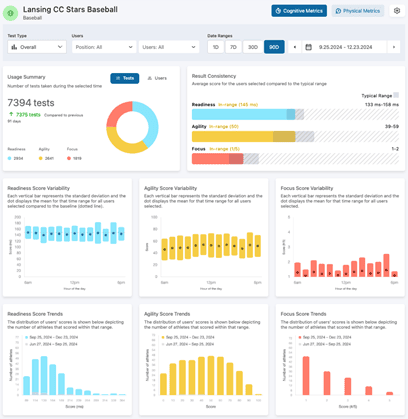
Image: Pison
Pison has public partnerships with the baseball programs at Penn State, Oral Roberts, West Virginia (including use by 2024 No. 7 overall MLB draft pick of the St. Louis Cardinals JJ Wetherholt), and Lansing Community College, which Deschenes calls a “power user” because of feedback they have provided. At the youth level, Pison works with USA Prime New England (which Deschenes owns) and Fort Worth Christian Academy for baseball, as well as the Boston Hockey Academy.
Multiple MLB teams are also evaluating the technology, and the league itself is in the process of testing it for on-field approval.
The new product was formally announced at the American Baseball Coaches Association conference in Washington D.C. this morning. In the future, Pison will look to expand to other sports and potentially integrate its sensors into existing wearable vendors.
“The product, really, is taking a sophisticated technology that has been in the medical world – and kind of out of reach even there because of the cost – and bringing it down to something that everybody can use,” said John Joseph, Pison’s CRO. “When we look at the market, we aren’t just going after the MLB market or college. This is really for anybody that wants to develop that elite mental game.”
This article was brought to you by SBJ Tech, a Leaders Group company. As a Leaders Performance Institute member, you are able to enjoy exclusive access to SBJ Tech content in the field of athletic performance.
Is wellbeing the centrepiece of your high performance work?
In this Performance Special Report, which is brought to you by our Main Partners Keiser, we explore the work of organisations who have taken steps in that direction. We delve into the thorny issue of athlete challenge and support and ask where the balance should sit, we look at the admirable efforts of the AFL to inculcate wellbeing literacy in their young athletes (who have a ‘business as usual’ attitude to the topic), we look at the sterling efforts being made on behalf of the oft-forgotten coaches and high performance staff, and, finally, we ask what is coming down the road in this space as teams cotton on to the performance advantages.
Complete this form to access your free copy of Human Flourishing, which features insights from the World Series-winning Texas Rangers, Harlequins, the AFL, Australian Institute of Sport and a selection of world-renowned academics. They offer a snapshot of their work while openly admitting there is much more to do. Nevertheless, the performance benefits become clear across these pages.
Dr David Fletcher explains how the training environment can be manipulated to promote resilience.
A Human Performance article brought you by our Main Partners

“It’s the same for all of us in our day-to-day lives with stressors and strains that we experience,” he continues. “It might be that a major life event occurs and as a consequence that’s the last straw that breaks the camel’s back and we struggle as a consequence. It may be day-to-day stressors in the environment that build up over time.
“Psychologists call this ‘allostatic load’ and it’s where it can lead to burnout or, in a sporting context, overtraining.”
There is more to it than just teaching psychological skills or qualities. “That’s the starting point.”
Fletcher is talking to the Leaders Performance Institute for a series that looks at better understanding psychological resilience, how it can be developed, as well as any other considerations for coaches in sport.
In the third part of our interview, Fletcher discusses how the environment in which someone operates influences their resilience, which has implications for coaching practice.
Why is it important to balance challenge and support in developing resilience?
DF: Challenge is all about providing developmental feedback. It’s feedback telling you how you are going to develop over the next 12 months and the challenge is for you to be able to step up your game in this respect. And, of course, there could be physical goals, certain technical goals, nutritional goals, lifestyle goals, psychological skills training goals. There’s a whole raft of different things that go into challenging people; and in sport and high performance we tend to be quite good at that. The area that sometimes gets neglected is the idea of supporting people in order to meet those challenges and those demands. ‘So if you’re going to progress by this much in the next week or the next month towards this goal, what do we need to put in place to support you in order to do this?’
What can coaches be doing better?
DF: This is all about encouraging people; providing them with confidence and motivation. I mentioned developmental feedback, but the feedback we need here is motivational feedback. Instead of looking forwards, we’re saying ‘12 months ago, you were here now you here look at how you’ve progressed and here are the reasons why you’ve progressed over the last twelve months you did this better. You did this better. You perform well in this situation, in this context’. So it’s about bolstering people, bolstering their self-esteem, their confidence and motivation. It’s also about providing them with support around what they’ve done better and how they’re doing things better on different fronts.
Is there a role for other staff too?
DF: Absolutely. This is where you need to try and draw in your sports science and medicine team so that the sport support they get is bespoke to them as individuals particularly at elite levels of competition. So what are the fine-grained areas that you can work on that are bespoke and specific to you? It’s an area that can get neglected, particularly at the higher levels. The optimal development of resilience is very much contingent upon balancing challenge and support, the fluctuations between the two, and trying to get that balance right; and some of the research that we’ve done suggests the best coaches intuitively and instinctively have a really good feel not only on how to balance the two for an individual but how to balance challenge and support for all of the individuals in the team. So you can imagine, if you’ve got a squad of 20-30 players they’re coming in and out of training, they’ve got all sorts of things going on in their lives. It’s not just the stressors and demands associated with the sport. It’s things outside of the sport. So no psychologists in the world could monitor all of those stresses and demands on all of those different athletes and then modify and tweak an intervention. The best coaches have got that real instinctive sense of when to back off somebody, dial down the challenge, dial up the support and put the arm around them. Or maybe an individual is getting a bit complacent and they need to dial up the challenge in different ways.
Are there any specific types of training for resilience that involve manipulating the environment?
DF: It’s really extending this idea around challenge and support and looking at specific contexts. What are the specific types of stresses and strains that people need to perform under? The principles are the same whatever the sport. We’re still looking at how can we place individuals under or challenge them to perform under more pressure. The key to that is what can we do to support them to do that? So you’re asking more of the athletes but you’re also saying ‘in order to meet this demand here’s my advice, here’s some of the things that you can do to step up and meet that demand’; and that’s crucial for coaches to do. You don’t just throw them into a pressurised situation that that, first of all, is too pressurised and too extreme. We’ve seen some cases of that in the past over the last couple of decades where people have wildly misjudged that and what people are capable of. I might add to that as well situations when the pressure is completely irrelevant or unrealistic, such as in a boot camp. The stresses and the pressures can be completely irrelevant to what your athletes will face in competition. The environment has got to be progressively challenging and it’s got to be realistic to meet these demands, but also, as I emphasised before, you’ve got to support players and athletes in order to achieve this. So what are you underpinning this with in terms of psychological skills training around imagery, around preparation around planning, around nutritional development? All the things that can help them meet these demands within the context that they’re working.
Read our interview in full:
Part II – Psychological Resilience: Everyone Has a Trainability Bandwidth