At a recent virtual roundtable, high-performance specialist Rachel Vickery explained that pressure exposes weaknesses, which is why an ability to manage your arousal state is critical.
Rachel Vickery begins her presentation with these common examples of athletes and coaches buckling under pressure.
“Typically, the cause has less to do with what’s happening in the arena and a lot more to do with what’s happening everywhere else,” she told the Leaders Performance Institute members at a recent virtual roundtable.
Vickery, who hosted the session, is a high-performance specialist helping teams in the worlds of sport, business and the military perform under pressure.
“There’s this belief that no matter what’s happening, I can put my game face on,” added Vickery, “but we can’t compartmentalise our physiology.”
There is also the fact that pressure is, as she explained, “pigeon-holed into the wellness or wellbeing box or shot off to the psychologist”, which ignores the fact that pressure is a daily accumulation that adds to a person’s allostatic load. It is far from being some kind of character flaw despite that perception persisting in some corners.
“We know from the environments that we work in that pressure is actually the constant,” she continued, “but it’s the physiological stress response that is often the variable.”
Indeed, we are all oscillating between arousal states; calm one moment, activated the next.
“We will fluctuate between the two states across a day, across a month, across a year and a season and a career.”
In early human history, a calm state meant time to “rest and digest” and activated meant “flight or fright”. The latter has become the norm. “Given our lifestyle these days, most high achievers run in the high arousal state more of the time.”
This is unsustainable in the long term because it pushes people close to their physiological stress threshold, which is where performance begins to break down.
This, Vickery argued, is why it is important to reduce that allostatic load.
What is allostatic load?
Allostatic load is the cumulative ‘stacking’ of stressors over time that erode the amount of physiological ‘space’ an athlete has between their current arousal level and their personal stress threshold. Vickery refers to this as their “buffer”.
She explained that while competition rarely creates a problem, it can reveal one.
The stressors in question can be personal (e.g. a lack of sleep), organisational (e.g. misalignment), performance-based (e.g. being outside your comfort zone), or physiological (e.g. reduced ability to hear or absorb information).
Crucially, “as long as your arousal state stays below your threshold, your negative performance will not show up.”
Strategies to increase your buffer
Stressors tend to occur across three categories:
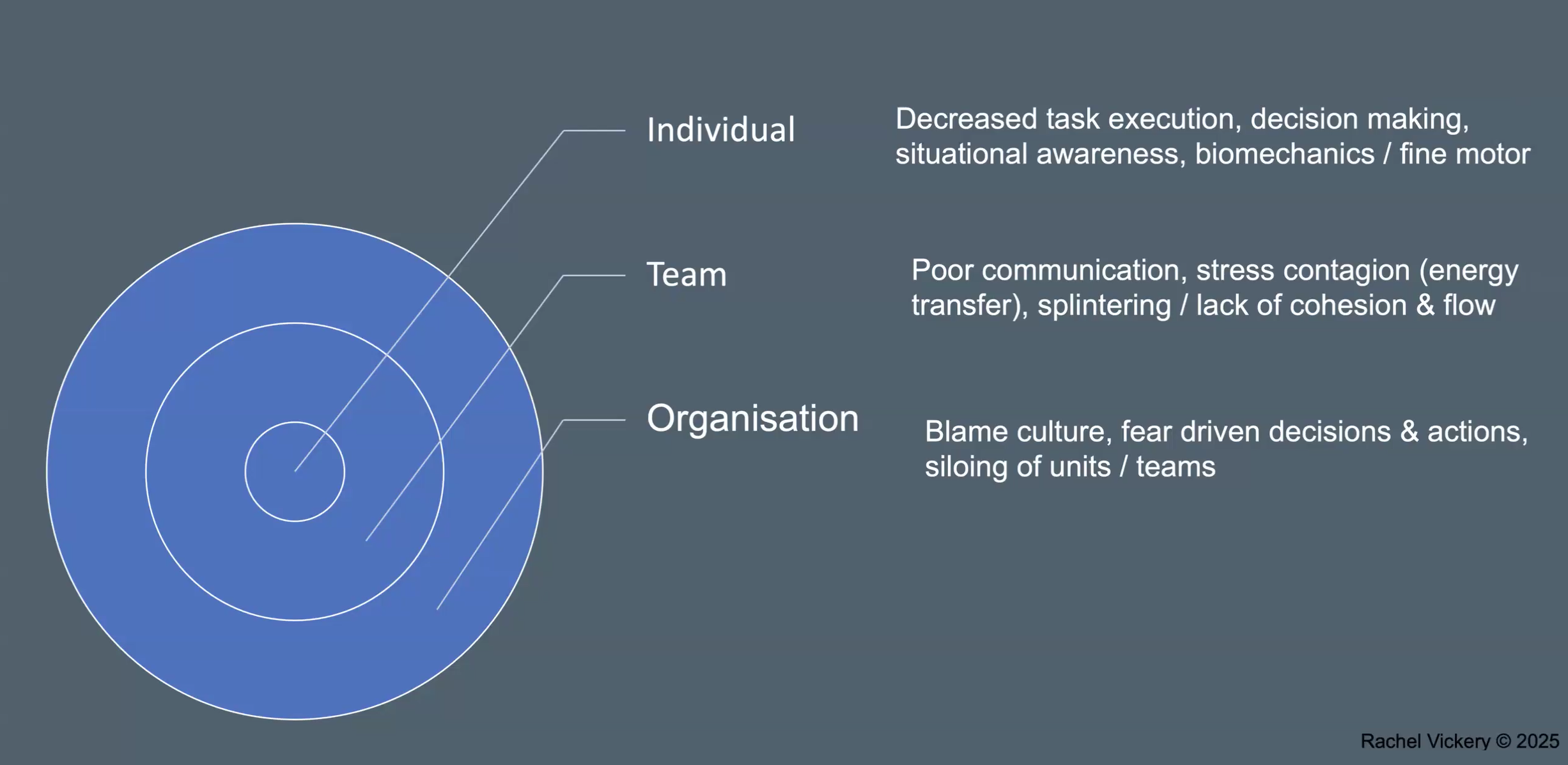
Vickery shared a range of strategies for each:
Vickery described organisational strategies as the “missing piece”. She said: “we often see organisations make dysregulating choices and decisions.” She recommends:
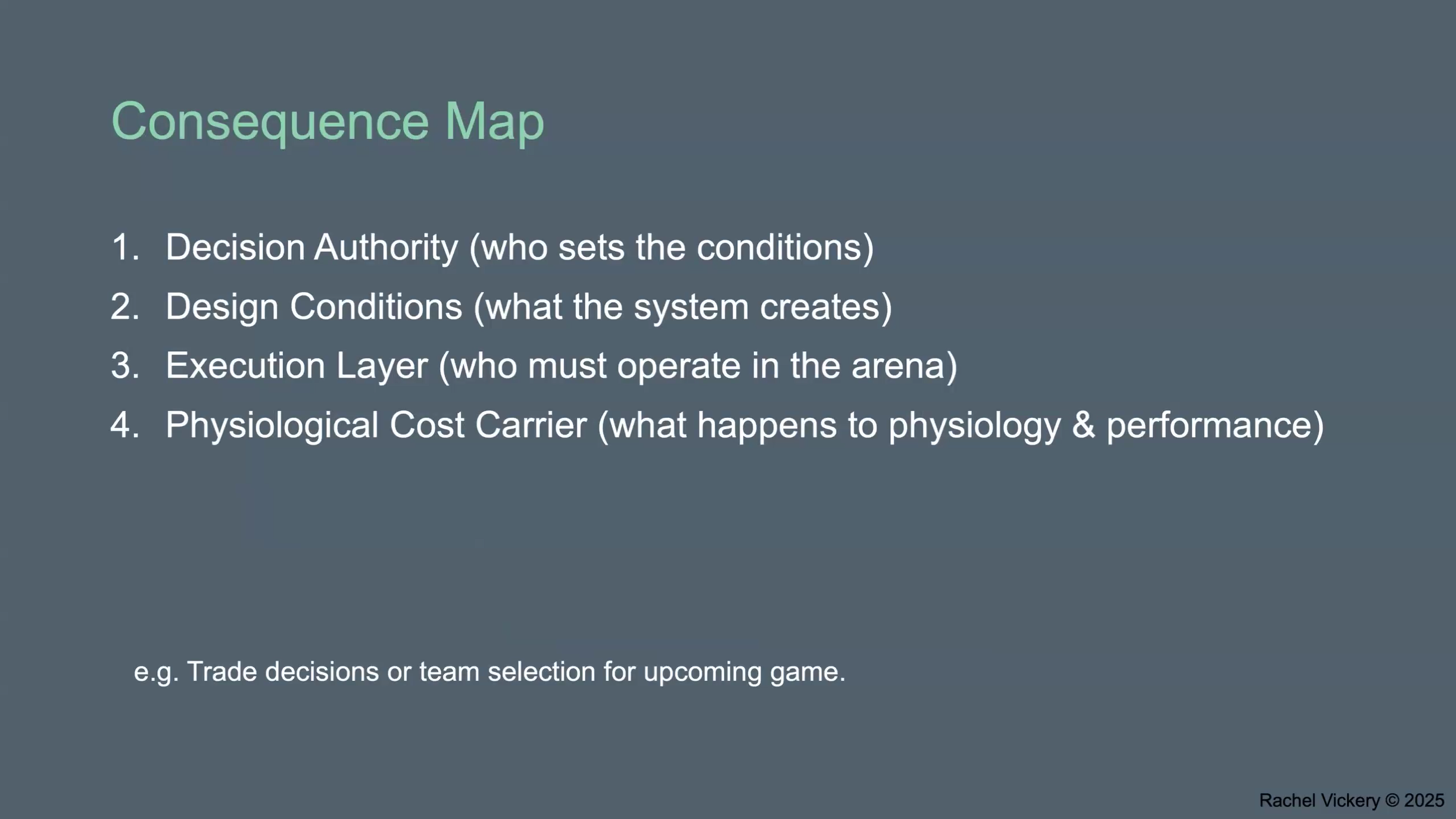
“Pressure is an accelerant, not a compass”
With this observation Vickery wrapped up her presentation. “Very seldom do people rise to the occasion,” she said. “What we often see is things are masked until people come under pressure; and that’s when their performance will splinter.”
In other words, pressure will only magnify your existing strengths and weaknesses, which makes preparation – the creation of that buffer – so important.
She struck a chord with members, who shared their own thoughts at the conclusion. Here is a selection of their comments and observations:
“Our mission as a group was how can we make sure our athletes are self‑reliant and capable of making the best decisions under pressure?”
“We moved to a case management situation where we’re rigorously, deliberately, consistently looking at athlete need. If there’s 50 staff, it might only be two staff that will have the greatest impact rather than everybody feeling like they must be involved.”
“We’ve got to take our mind away from trying to perfect exactly what the athlete might face because you will never replicate it. What can we build into their toolbox so that they can be that self‑reliant person in that moment?”
“Could athletes benefit from developing more coping‑based strategies; things they can do in advance in their preparation?”
“It really depends on the perspective that the athlete is taking. So you must understand that first before you can decide what the strategy might be to reduce the allostatic load… You would need a specific strategy to deal with fear of failure versus legitimate contract implications; the financial implications versus their more personal perspective.”
“Digital overload is a huge piece in terms of making our allostatic load worse. It’s an under‑represented space that we probably don’t spend enough time and energy on.”
What to read next
Ben Ashdown and Mustafa Sarkar of Nottingham Trent University are working on a research programme aimed at providing an evidence-informed and objective approach to tracking resilience on the pitch.
Main Image: Thomas Eisenhuth/Getty Images
“Even within the same football academy we’ve seen staff have different views of what resilience is,” Ben Ashdown, a Senior Lecturer in Sport and Exercise Psychology and Lead Researcher at Nottingham Trent University, tells the Leaders Performance Institute on Teams.
“They’ll say ‘resilience is a really important part of our philosophy but actually we don’t really know what it is, we don’t really know how to measure or assess it, we don’t really know how to track it’,” says Dr Mustafa Sarkar, who also joins the call. He is an Associate Professor of Sport and Performance Psychology at Nottingham Trent and Lead Supervisor of the research programme.
Together, alongside Dr Chris Saward, Dr Nathan Cobb, and Dr Julie Johnston at Nottingham Trent University, they are leading a research programme to identify behavioural indicators of resilience in English academy football and develop a resilience behaviours observational tool. As part of the research, they have worked with academy stakeholders including coaches, psychologists, scouts, and analysts. They are also conducting a season-long study at a Category One academy (Derby County Football Club).
Based on their research, they have found that resilience behaviours can be categorised under six themes:
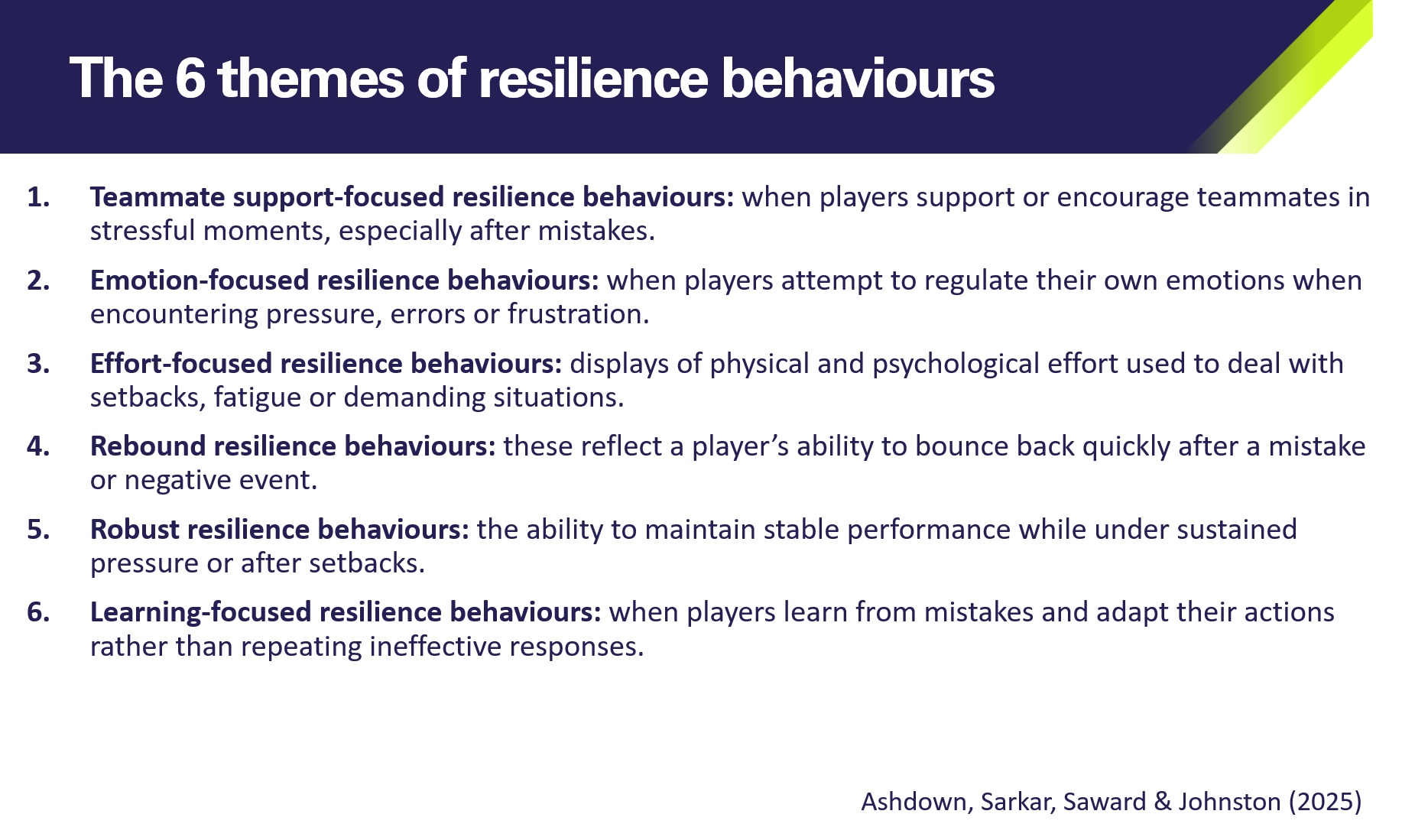
At the end of this research programme, they hope to have developed a tool for sport psychologists and coaches primarily, with some benefit to analysts who might contribute to the tracking of these behaviours through video-based analysis.
Sarkar says: “We don’t necessarily see it as a tool for identifying talent. I think it would be more as a conversation-starter with a player for player development purposes.”
Resilience: a behavioural response
As the exploration, measurement, and assessment of resilience in sport has tended to rely on self-report alone, myths and misconceptions have emerged (such as resilience being related to endurance and the suppression of emotion), and there is a gap between what resilience truly entails and what practitioners witness on the pitch.
“Coaches and support staff are starting to recognise that both physical and mental rest are critical to sustained resilience over time,” says Sarkar who has spent time with academy stakeholders dispelling those myths and misconceptions. “Part of resilience is about helping individuals to develop their thought and emotional awareness. It is not about encouraging people to hide their emotions”.
Additionally, “resilience requires more nuanced (context-specific) language because a person’s resilience in relation to being injured might be quite different to their resilience in relation to a loss of form”.
The behavioural elements of resilience lay at the heart of their research programme.
“We see resilience as a behavioural response,” says Ashdown, “but, up till now, there hasn’t been any literature that has actually asked what do these behaviours ‘look like’? How do we observe them? I think our work, in a behavioural sense, gives us some directly observable, reliable and valid indicators of resilience in football.”
The appeal for coaches, psychologists, and analysts is clear. “They’ve really bought into this idea that we’ve got something to look for on the pitch, and if we can see it [resilience], then maybe we can then develop it and track it over time,” Ashdown continues.
Their initial 2025 study/paper identified 36 behaviours (across six themes mentioned above), which have since been refined to ten. “We retained at least one across the six themes, which is another indicator that they’re pretty reliable.”
These behaviours include: demonstrating supportive actions during pressure or adversity (support-focused behaviour); positive body language in response to stressors (emotion-focused behaviours); and regaining focus in the face of challenges (robust resilience behaviours).
How might coaches approach these behavioural themes in their resilience development work?
The Leaders Performance Institute asks Ashdown and Sarkar about each of the six themes and they give consideration to each in turn with the caveats that a) they should be viewed collectively in order to develop a holistic view of an athlete; and b) the data collection and analysis of their research programme remains ongoing.
When players support or encourage teammates in stressful moments, especially after mistakes.
Ashdown admits that the relational aspects of resilience are more significant than he initially thought. “At times I probably assumed resilience was an individual capacity that you developed almost by yourself without realising that social support (through your teammates) is really significant,” he says.
“Through the work of Ben and others we’re starting to find that resilience is very much relational,” says Sarkar. “The development of resilience is dependent on cultivating high quality relationships. The interesting bit about social support is that we’ve found that it’s not necessarily about getting social support, but it’s about the perception that that support is available to you. From a resilience perspective, the perception is more important than receiving the actual support itself.”
Ashdown then shares a story of academy training drills, at Derby County FC (work led by academy sport psychologist, Lyle Kirkham, and supported by Ashdown), where players had a “secret support partner”. “We tasked some players with, right, when your teammate experiences some adversity or stressor or when they’re under pressure, find ways of offering them support,” he says, adding that the process raised the players’ awareness of how they’re reacting, responding and interacting with their teammates.
When players attempt to regulate their own emotions when encountering pressure, errors or frustration.
While there isn’t yet the data to support a definitive conclusion that emotion-focused behaviours depend on age and phase, as Ashdown explains, “there’s so many points where the participants said ‘we would expect to see a different response from a 10-year-old than one of our under-18s’.”
Emotional maturity is sure to be a factor. He adds: “How these players react and respond to things, particularly at younger ages, it’s a lot more visible, whereas maybe the older players tend to try and disguise how they’re feeling.”
This is a behavioural theme where interdisciplinarity comes to the fore. “We’re working with performance analysts to try and identify these behaviours through video footage and I think we’ll end up with a bespoke set of behaviours based on the phase [foundation, U9-U11; youth development, U12-U16; professional development, U17-U23].”
Displays of physical and psychological effort used to cope with setbacks, fatigue or demanding situations.
What does making an effort ‘look like’ in any sport? “There’s a danger of making assumptions because every player is different,” says Ashdown with reference to both physical and psychological indicators of effort. Their work has talked of pairing GPS data with observations but, as he admits, “this is where we need to be careful and cautious of not mislabelling players based on a perceived lack of effort and we must be aware of individual differences”.
For Sarkar, again, it is more about setting the terms for a player development conversation. He says: “You might come up with a resilience profile to say one player has got hypothetically high effort-focussed behaviours and lower teammate-focussed behaviours, but we see this observational tool more holistically across all six themes”.
These reflect a player’s ability to bounce back quickly after a mistake or negative event.
These need to be channelled. It is no good if a player makes a mistake and runs around like a headless chicken for the next 10 minutes and is sent off.
“One of the participants in our research mentioned that exact point in relation to effort-focused behaviours,” says Ashdown, before echoing Sarkar’s earlier reflections. “The most value in this behavioural approach is the opportunities that it creates for player-coach or player-psychologist reflection.” This, Sarkar suggests, could be a joint review of game video clips where the coach and/or psychologist says to the player ‘talk us through your thought process. What were you thinking and feeling at the time? How might you react and respond differently?’ or it a series of ‘what-if’ questions and scenarios. ‘What if this were to happen in the future? How would you react and respond?’
Sarkar adds that any intervention should be context-specific. “If a player has done that once are we then making an assumption that they’re doing that all the time – is this a one-off occurrence versus a pattern of occurrences? If it’s a one-off, like Ben said, then it’s probing that player about what they were thinking at that particular point in time. But we have to be careful that we’re not intervening based on a one-off versus a pattern.”
The ability to maintain stable performance while under sustained pressure or after setbacks.
Ashdown and Sarkar make the point that robust resilience behaviours risk being conflated with youthful inconsistency – and all its causes – at academy level.
“One of the participants in our research said it’s not about consistency of performance but the consistency of behavioural responses to things. So performance will fluctuate but is there some consistency in the way they’re behaving, reacting and responding?” says Ashdown. “What some of the coaches are after is a flattening of the curve emotionally and the way the players are managing things on the pitch.”
Sarkar believes coaches may be able to use the resulting observational tool as a means of evaluating the efficacy of pressure training scenarios. “What are you, the coach, actually seeing in terms of their reactions, responses, certainly from a behaviours point of view, and as a result of that pressure training, are you actually seeing an increase in some of the resilience behaviours in relation to these themes?”
When players learn from mistakes and adapt their actions rather than repeating ineffective responses.
Pressure training also presents an opportunity for self-reflection and learning through its video component – this is the ultimate purpose of this resilience behaviours work. “If we’re aware of that, can we support them in navigating those more effectively when they’re inevitably going to come up on the pitch?” says Ashdown.
“We don’t learn from experience, we learn from reflecting on experience,” says Sarkar, paraphrasing the American educational reformer John Dewey. “Pressure training shouldn’t just be about putting people under pressure in training and then automatically assuming somehow that they’re going to develop their resilience to future situations?”
At Derby County, led by Kirkham and supported by Ashdown, they have also introduced a series of gamification principles in delivering education and feedback at the academy through a resilience behaviours lens. This includes FIFA-style cards for players, and a football-specific version of snakes & ladders to mirror the ups and downs of the academy journey.
The future of resilience tracking
When it comes to resilience, coaches are acting on intuition, which is valuable but ultimately has its limitations.
“We’re trying to make that process more objective and systematic; hence this is where the interdisciplinary piece comes in,” says Ashdown. “We wouldn’t expect coaches in the moment in the game to be thinking about necessarily tagging or noting these behaviours. We might ask the analyst, with support from the psychologist, to do live coding or tagging of these behaviours or retrospective tagging based on the recording. That would then lead to conversations with the players. With this work, there’s a big opportunity to bring together coaching, performance analysis, and psychology.”
Sarkar explains that they are using the behavioural data to create a resilience profile for players across the noted behaviours. “That gives you a holistic viewpoint,” he says. “A player might have higher team-focused resilience behaviours and slightly lower effort-focused resilience behaviours and a medium level of learning-focused resilience behaviours. So, it gives you a nice overall resilience profile of an individual.”
The hope is that their work will eventually provide an evidence-informed and objective approach to tracking resilience on the pitch.
“It can also then become part of the everyday conversation with multiple staff. So rather than just a conversation in relation to psychology, it’s a broader conversation about player development.”
What to read next
Playfulness and Resilience: How Ballet and Music Schools Link Them Together to Amplify Both
In this recent virtual Learning Series roundtable, Drs David Fletcher and Danielle Adams Norenberg explain why there is now more to the role than individual counselling.
An article brought to you in partnership with

“Just this last year I’ve had many more enquiries than I have had in the last 18 years around how my experience and background can help across the institution,” he said.
Once upon a time, it was primarily athletes who requested Fletcher’s time. Today it is just as likely to be a senior coach or performance director.
“Another space is the development of a multidisciplinary team,” he continued. “There’s also a demand for support getting people from technical expertise into leadership-type roles. The other space is working at board level around systems, structures and processes.”
Fletcher co-presented the second part of a Leaders Virtual Roundtable Learning series entitled ‘How Do we Enhance the Impact of Psychology in Performance Environments?’
For all that the role of psychology in performance is expanding, there are enduring challenges.
Wider perceptions for one. “Coaches haven’t necessarily been able to spend the time to truly understand what it is that sports psychology can do,” said Dr Danielle Adams Norenberg, the Head of Psychology at the UK Sports Institute, who joined Fletcher on hosting duties.
“We are still seeing some differences in who is hired, how they’re hired, what support they’re getting.”
Over the course of an hour, the duo set out those challenges before exploring the key role that performance psychologists can play in providing improved coach education and systemic-level support.
Common challenges in sports psychology
Coaches broadly accept the ‘80:20’ idea, which posits that 20 percent of performance is psychological (even if people quibble with the exact balance). Yet relatively few organisations provide the necessary service support.
To compound matters, the psychologists themselves are often at a disadvantage due to:
While these challenges persist, perceptions are shifting. The next part of the conversation focused on the ways a psychologist can support coach development and other system-level elements.
The performance psychologist’s role in coach development
“It’s hard to separate the technical and tactical from psychological, mental decisions coaches have to make,” said a performance manager from the New Zealand system.
Fletcher corroborated this observation. “Without doubt I’ve been doing much more work with coaches than one-to-one sessions with athletes,” he said. However, he finds coach education programmes to be “extremely hit and miss” both within national governing bodies and professional environments.
“A national governing body of sport might have a pretty solid coach education to go through your level one, level two, to get out in the field. But then when you’re working at Olympic level, what support is there?”
Fletcher and Adams Norenberg then outlined the two areas where psychologists can ensure more hits than misses:
A psychologist, as Fletcher explained, can help a coach to develop their “time management skills, body language, and communication skills” in the pursuit of better performance.
By the same token, psychologists have been instrumental in facilitating a shift from deficit-based to strengths-based coaching. Adams Norenberg said: “Even if planted within a very generic training session, athletes have the self-awareness, knowledge and autonomy to make the most out of their training session by focusing on developing their strengths.”
Psychology is another string in a coach’s bow. If they understand the types of pressures that athletes experience they can “choose a particular training session to not necessarily develop technique or tactical skills, but psychology skills.” She cited the example of the VR headsets used in training by Team Europe ahead of the 2025 Ryder Cup. Some players simulated the spectator abuse they would endure at Bethpage Black; others used it not for pressure training but relaxation, such as the Norwegian Viktor Hovland, who recreated the fjords of his homeland.
A performance psychologist can also help to ensure your actions match your words
Adams Norenberg refers to individual psychology work (in the absence of a wider remit) as little more than “icing the collapsing cake”.
It is unnecessarily limiting, as Fletcher illustrated using this common scenario. “If you’re hired as a sports psyche to do lots of athlete one-to-one work, the athlete leaves the room or steps off the track after a training session that’s been supported by a performance psychologist only for some organisational communication to come out that takes away all of that work.”
The solution lies in “working with our leaders to try and help them see that psychology can support them in the alignment of decisions to values and can help them communicate those decisions in ways that that land in a way with athletes that they see and value the support”.
Performance psychology v clinical psychology
There has been a trend towards pathologising psychological issues, which causes clinical psychologists to misunderstand the day to day work of performance counterparts.
With this issue in mind, Adams Norenberg recently hosted a forum for the clinical psychologists in the UKSI’s referral network outlining what performance psychologists do. “I have worked more with the network to try and build up a better relationship and understanding of what the sports psychologist’s roles and skillset is.”
What to read next
‘Sports Psychologists Cannot Just Sit and Wait for Work to Come in the Door’
In the first session of our latest three-part Learning Series, Darren Devaney of Ulster and Daniel Ransom of Manchester United discuss the steps psychologists can take to ensure their smoother – and smarter – integration in a sporting environment.
An article brought to you in partnership with
More than 80 per cent of respondents feel that psychology is ‘very important’ in the enhancement of human performance, yet 43 per cent also feel that psychology is the most ‘underserved’ area of human performance.
The discrepancy chimed with Darren Devaney. “It’s like people know they want it, but they’re not quite sure how to make it happen,” said the Lead Performance Psychologist at Ulster Rugby.
Devaney was co-presenting at the first session of a three-part Leaders Virtual Roundtable Learning Series in partnership with the Chartered Association of Sport & Exercise Science.
The series is entitled ‘How Do we Enhance the Impact of Psychology in Performance Environments?’
His co-presenter Daniel Ransom, the Head of Psychology and Performance Lifestyle at the Manchester United Academy, offered his analysis of the report’s findings.
“What it perhaps highlights is the gap between research and application, as well as the immaturity of psychology as an applied discipline,” he said while also noting the appetite in the sports performance community for psychological services.
When session attendees, many of whom had a background in psychology, were invited to rate their own effectiveness, most answers were grouped in the middle.
“It probably just reflects that it’s not fixed,” said Ransom of the results. “That level of effectiveness will change throughout seasons or cycles, and, I guess we’re hoping to be at the top end but we know at times it’s going to move up and down a little bit.”
Over the course of an hour, the duo discussed the role of the psychologist and the ways they can develop and sustain their work in sporting environments.
The requirements of the psychologist
Together, Devaney and Ransom drew up a list of requisites for a practising psychologist in sport:
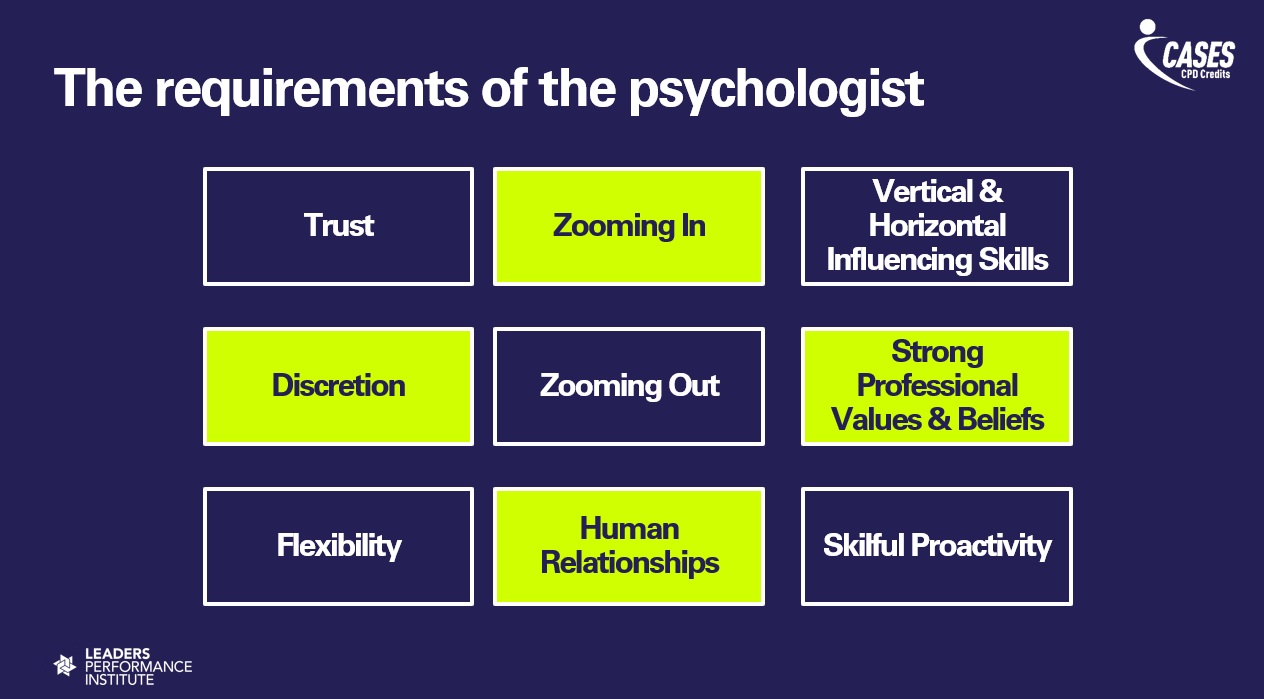
They then homed in on a selection:
Zooming in and out
According to Devaney, the psychologist must “get away from the assumption that we work with the individual athlete only”. Instead, they should ask themselves “is my intervention best targeted at an individual or is this more systemic? And if I’m going to be here for the next five or six years, what’s the most useful way of spending one or two hours on this? Is it working with a head coach? Is it working with all the staff? Is it working with a group of players, or is it the one-to-one with the athlete?”
Vertical and horizontal influencing skills
Psychology is not just the work of the psychologist. “An hour spent with one individual athlete is very well spent,” said Devaney, “but an hour spent with somebody that upskills or shapes them”, such as a coach, brings your work into “exponential territory”. He continued: “it changes how they do their work with 20 or 25 people over the course of the week”.
Ransom added: “If we really want to embed and integrate psychology what we require is other people to take on our ideas and work in ways that are psychologically-informed.”
Skilful proactivity
“We can’t sit still and wait for work to walk in the door,” said Devaney. “I’ve often reflected that this organisation functioned for decades without me in the building, so if I’m not here, this place can keep going. I need to recognise the fact that it might not be every day the main thing that everybody’s thinking about, so how can I do that in a way that doesn’t produce scepticism or kickback?” Nevertheless, “you must be proactive in trying to have an impact.”
Ransom has advice for anyone encountering scepticism. “If people are ready for more in-depth and focused work, then let’s meet them there. If they’re not, and they’re at that sceptical end, how do we try and offer them something which is appropriate to the needs of what they might be open to? If we pitch that wrong and we try and go too hard or move too quickly with those people, I think you can get caught in a potential tug of war where we don’t really make much progress and people hold their position.” With skilful guidance, people can “see the value that other people have, and that can be a way of opening a few windows and doors to them.”
The foundations
Devaney and Ransom set out four foundations:
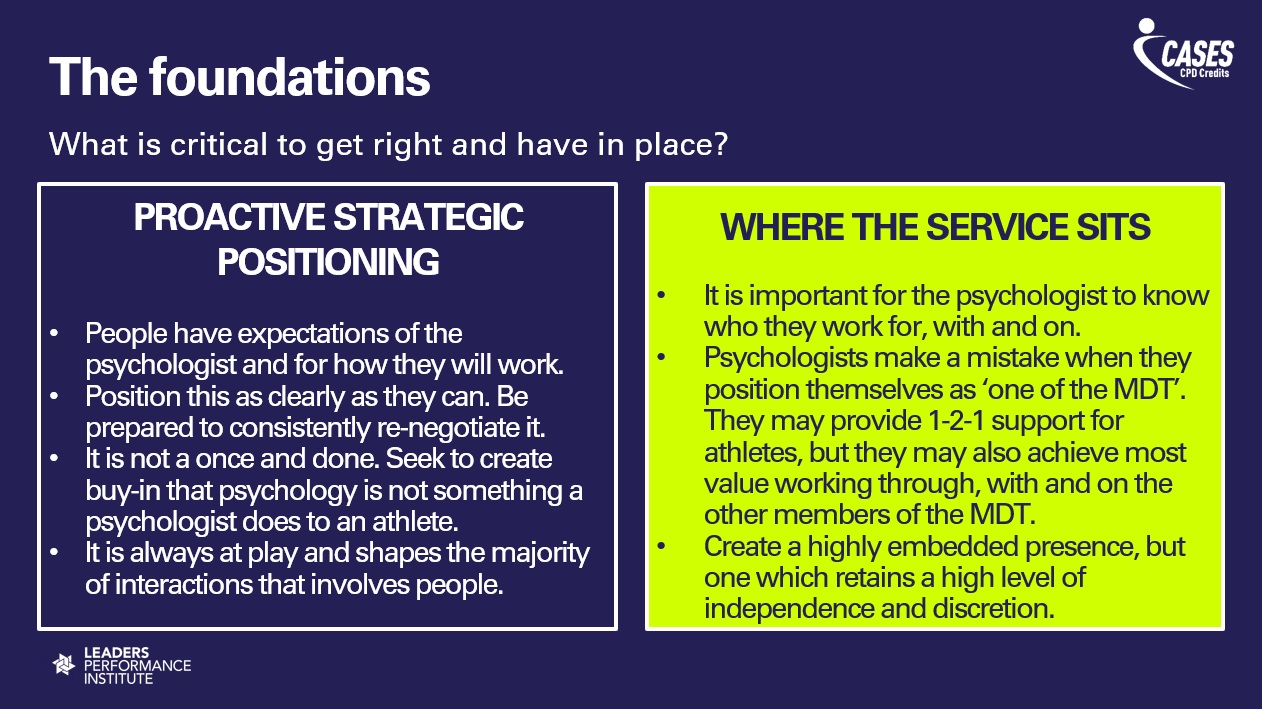
Devaney argued that in professional sport at least, a psychologist’s job can be harder if the head coach is not one of those key stakeholders. “They can really shape what the role can be,” he said. “Like whose priorities do I need to be trying to align with? If I’m running into time demands, and we’re trying to figure out where and when I’m going to do work, who actually has the best steer on that?”
Whether you’re preparing for success today or down the line, the priority needs to be clear. But that’s not always the case. “It sounds pretty straightforward, but you’d be surprised how often those ideas can be misaligned,” said Ransom. “It makes it really difficult for you to work in an integrated, embedded way, with a long-term focus if other people are perhaps expecting immediate impact on individuals when you have a more systemic, broader focus.”
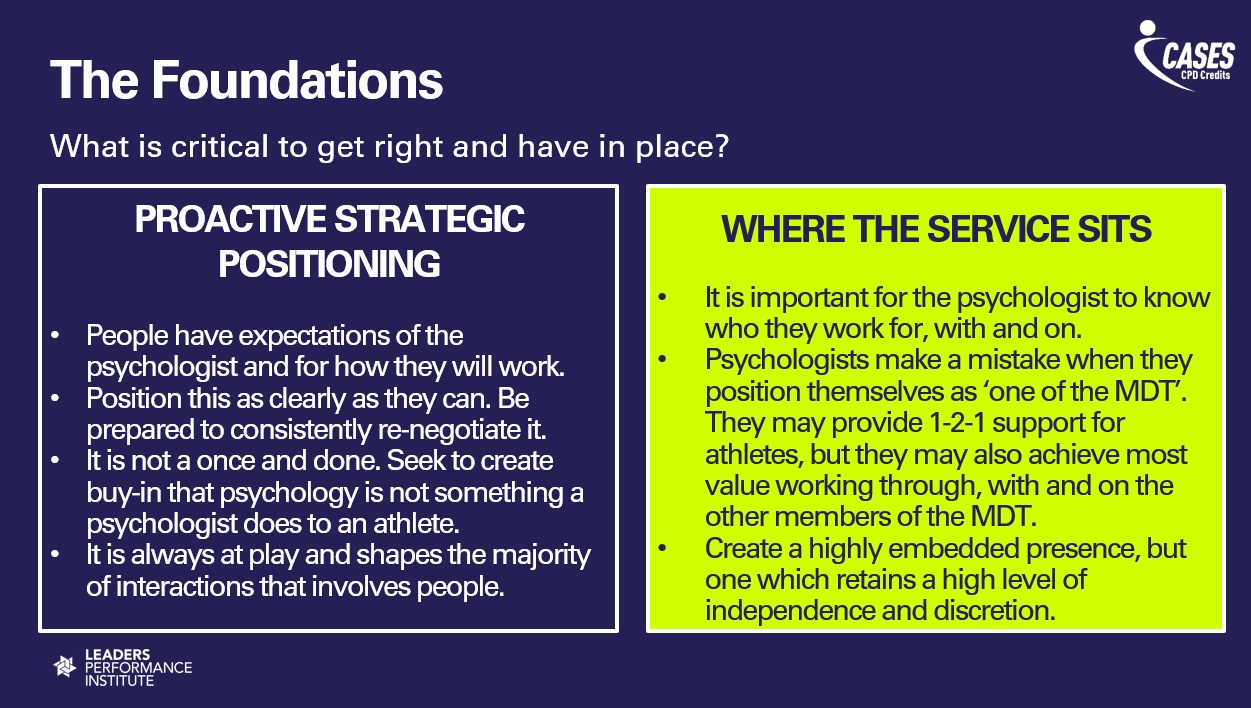
A psychologist’s positioning is not fixed. Ransom argued they must be “prepared to renegotiate the position time and time again”. He has had to “go through a process of having to establish, clarify and communicate boundaries in terms of what my role is.”
“The need to renegotiate is just so consistent,” added Devaney, “and I think there’s a bit of me sometimes that thinks that there’s an arrogance that if I’ve explained it once, everybody will get it and know it all the time and keep it at the forefront of their mind.”
The duo’s point about intentionally stepping away from being part of an MDT, to not be “boxed in”, raised a concern from one attendee about the potential negative impact on the sport psychologists as the conduit into clinical psychology. Ransom and Devaney took the point.
Ransom, who clarified that it was more about not being aligned to a single department of the MDT than not being a member per se. “As practitioners, we have to be flexible,” he said. “So there’d be times where, in my role, I would be positioned as part of an MDT. There’s times where I’d be positioned closer to some of the coaching staff.”
This takes skill, as Devaney said: “If I’m going to sit somewhat outside of the MDT and start to bring suggestions to them about how I can be supportive of their process, I’m going to have to do so very delicately and skilfully to get the impact that I want.”
Keep building
Both men had some advice for the table:
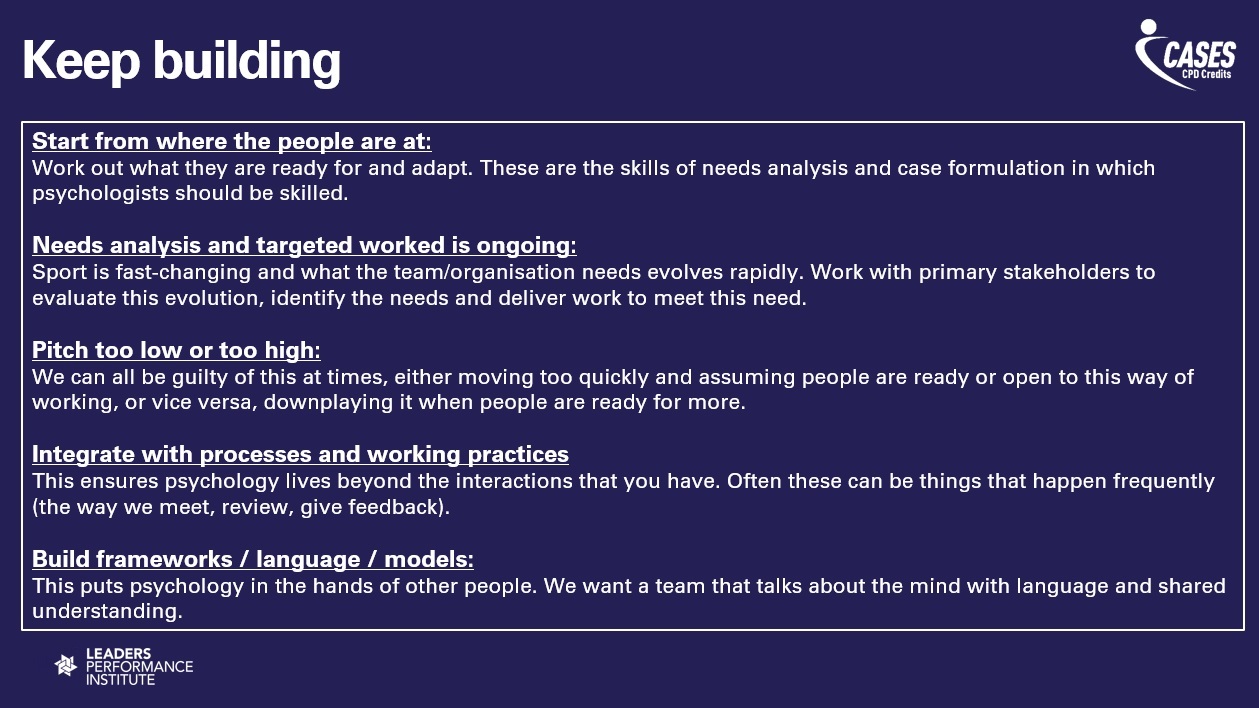
In reflecting, Devaney spoke of a personal experience: “The best question I’ve ever been asked by a head coach that I worked with was ‘what rooms and meetings do you need to be in to be able to be more effective in your job? Tell me, and I’ll make it happen’. That’s such an empowering position.
“He was basically offering an open invite to integrate what psychology is into the different practices of the organisation.”
Devaney also spoke about the importance of maintaining a shared lexicon, particularly in sports with regular athlete and staff turnover.
The finishing touches
Of the finishing touches, Ransom said: “If we think about the foundations through to the building blocks, which were more around the processes, the ways of working, the frameworks, then this bit is more around the actual skills of the practitioner and the key relationships that they have.”
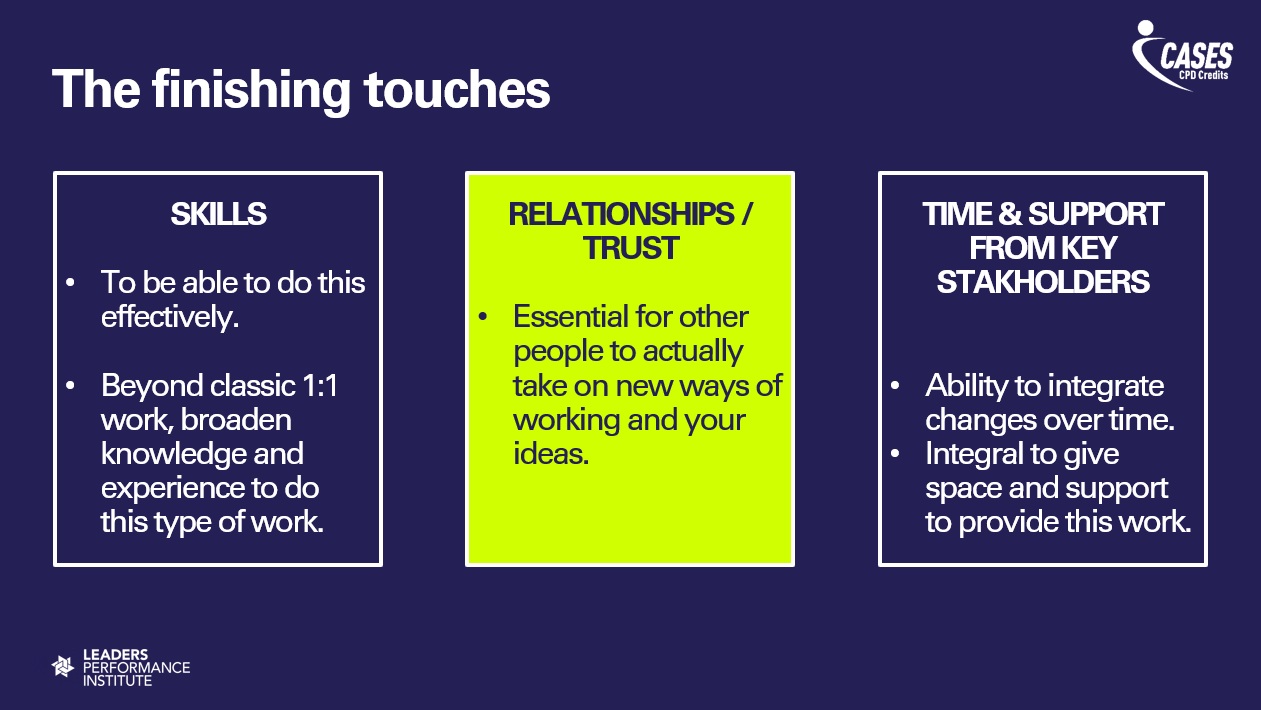
“Here,” Ransom continued, “we’re talking about the importance of having skills beyond the classic ability to do individual one-to-one work, which people might associate with psychologists. So we have the ability to carry out discussions among teams of staff and hold those types of collaborative conversations, which is a skill in and of itself. Do we have the confidence and competence to sit with a team of experts and navigate a conversation in a way, which is encouraging different people to contribute, which is embedding or weaving in some psychology input into that without dominating that conversation?”
Session 2 of ‘How Do We Enhance the Impact of Psychology in Performance Environments?’ is on 2 October. You can sign up to be part of this Learning Series here.
As Angus Mugford and Rich Hampson explained in a recent Leaders Virtual Roundtable, it begins with teams better serving the psychologists on their books.
This is all according to a straw poll of Leaders Performance Institute members during a recent Virtual Roundtable.
“I’m not surprised,” said Angus Mugford, the former Senior Vice President of Player Development & Performance at the New Jersey Devils. “I would be curious to ask the group what kind of services and provisions you have because the thing that always jumps out when you mention sports psychology or psychological services is that it means different things to every stakeholder.”
That’s the first problem. “You’re often setting your services up for failure.”
Mugford was joined by Rich Hampson, the Head of Psychology on the men’s side at the Football Association, to discuss why psychological services are not set up to succeed and to propose some ideas for redressing the balance.
Better developmental pathways for psychologists
Sometimes, through no fault of their own, psychologists are ill-prepared for careers in sports performance and, when things go wrong, Hampson feels they can be scapegoated for structural failures elsewhere. “It’s almost like they’re going from reception [kindergarten] into year one of school,” he said.
There should be better pathways for aspiring practitioners once they walk through the door. “The first thing you’d want is close supervision, guidance, the opportunity to observe and be observed in your practice,” Hampson continued. “There’s a lot to be desired in terms of the number of touchpoints in those first two years of applied practice and the kind of supervision that should go alongside that.”
It is not hard to see why problems can mount without true accountability. “It is leaving practitioners with a load of uncertainty or potentially false confidence.” Or rather than focusing on their practice and its impact, they are potentially more focused on navigating the political landscape – “the things that keep them in a job”.
Mugford, while serving as President of the Association of Applied Sports Psychology [AASP], oversaw the development of a certification pathway for mental performance consultants. However, there are few internship opportunities on offer in both professional and US college sports. “The system has not caught up with the pathway yet,” he said, adding, “there’s also a difference in the way the clinical pathway is creating and fostering development versus the mental skills pathway.”
Teams must establish what is required of their psychological services
A team’s psychological services are a common point of misalignment. “If you think of the people that drive a job search, even just the definition. Let’s say we have a GM, head coach and director player of development talking about sports psychology, I’d be willing to bet each of their definitions and perspectives are different,” says Mugford.
Hampson has observed this in job adverts. “You know they’re saying ‘we’re not sure’ because the job description lists key responsibilities and includes vague psychology words,” he said. “It’ll probably be ‘help with mental health’ and then something about ‘wellbeing’, then ‘athlete performance’ and ‘coach performance’.”
For leaders tempted to type those words, he has some advice. “Consider: what is this helping us to achieve?” If it’s still unclear, you might instruct a consultant to complete an assessment. “What is going to make the biggest impact here in the short to medium term? Let’s go after that. If nothing else, you’re then clear on what success looks like and you’re actually clear on the skillset you need – it will help your hiring process to be more specific. It’s not because they’re ‘good’ or ‘bad’. This person might be the best fit here, but they may not fit what we’re going after here.”
For Mugford, it is critical to decide who is running the hiring process and who to ask for their input. In his time at AASP, he developed a decision-making tree (see image below) to help provide clarity when developing a performance programme:
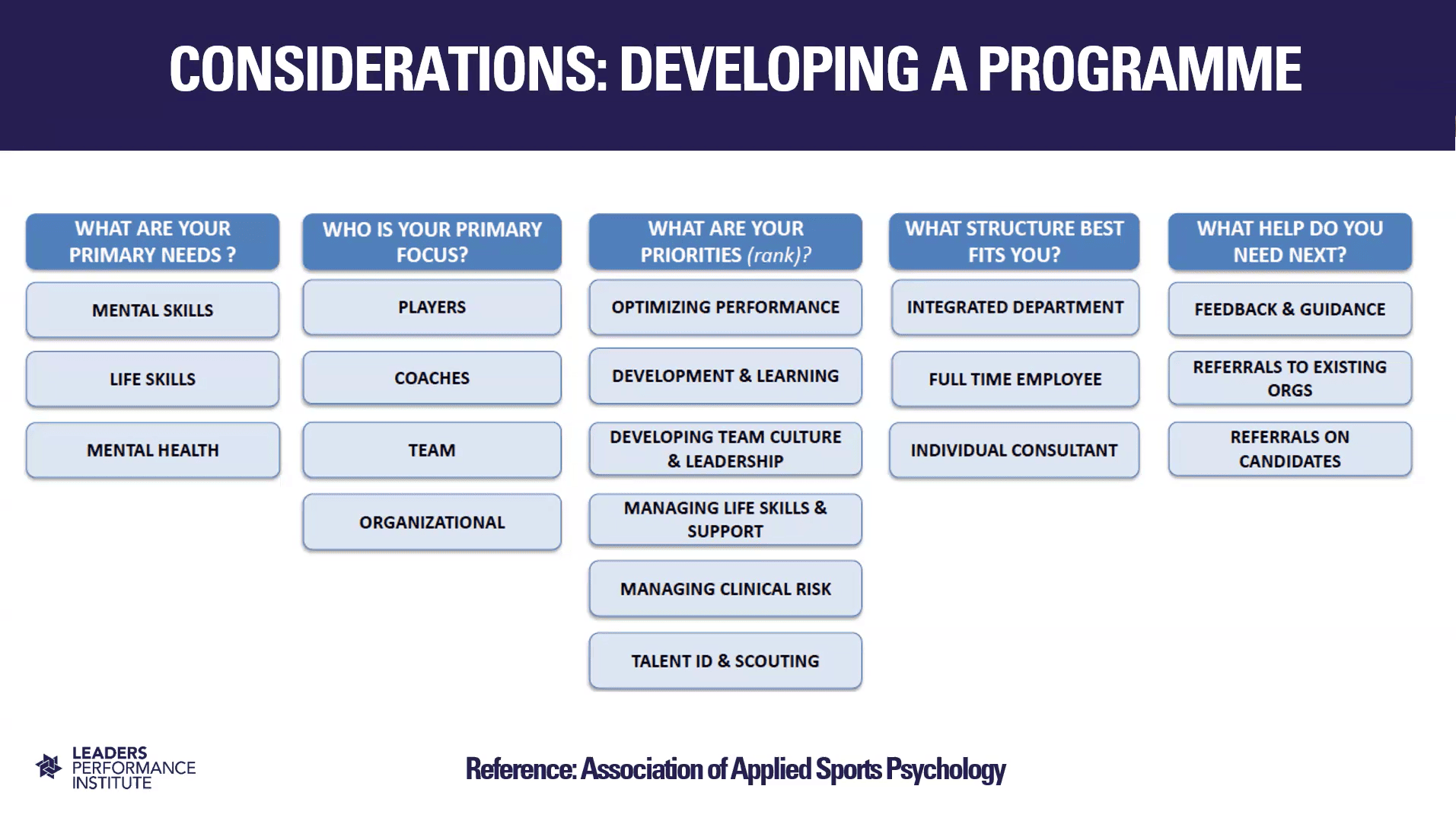
Mugford said: “What information do you need to gather and seek? [After using a decision-making framework] I often find there might be a search and interview process that organisations sometimes put on hold because they realise they have now got a different decision to make.”
Embed psychology as another performance service
“High-profile sports environments are unforgiving,” said Mugford. “It’s like you put someone in a room and, if they fail, their credibility and trust may be done.” Psychologists have fallen into this trap in the absence of a proper induction.
He argued that it is on key stakeholders to manage inductions and help the psychologist to build trust, particularly in environments where they might be unaware of social or sports norms. “It can create havoc and a longer pathway to building relationships,” he added. “The onboarding process can really minimise the downside and accelerate the positives. We underestimate that window.”
The work can be hard and lonely, as Hampson explained. A psychologist might be spread thin due to budgetary reasons or because their role is too broad and ill-defined. “It’s always really hard to be in the helicopter and going ‘what is psychology trying to achieve here?’ and simultaneously be on the ground driving things forward while being a really good practitioner.”
For Hampson, the solution is a leader able to set the direction, to bring in people with the right skillsets and develop them against established markers. Then, the psychologist “can deliver with the guidance of the person above them”.
That structure is critical, as Mugford explained. “Organisations will often over-index on fit, personality and EQ, whereas building a team or programme, even language that sticks for a culture, that goes beyond an individual’s preference or training is something for teams to think about.”
Find ways to track, test and refine your psychology work
Some people in sport openly lament the perceived lack of metrics in psychology. This frustrates Hampson: “I see psych fall down because it’s not defined well enough early enough.” However, if you are clear at the beginning, “90 per cent of it can be tracked. The broader you are, the less defined you are, it’s harder to ask: ‘is this actually having impact?’”
Benchmarking tends to be an area where sport excels, but not when it comes to psychological services. Hampson said: “I think sports should be more confident in going ‘if we’re clear on what we’re doing, more often than not, we’ll be able to give you an indicator here, whether that has done what we want it to do’; and then, like any science experiment, if your first intervention doesn’t lead to the outcome that you want, it gives you a real good platform to go ‘OK, why did that not work? And what do we need to adapt and change?’
“I think that’s really hard to do in a really objective way when you’re not setting that in the first place.”
What to read next
Sports Science Research: the Strengths, Weaknesses and Opportunities
