7 Nov 2024
ArticlesEsther Goldsmith and Dr Natalie Brown from Sport Wales offer their best advice for beating taboos, finding the right words, and picking the opportune moment.
This results from historic perceptions of the menstrual cycle and female-specific factors such as pelvic health being personal, secretive and related to feelings of embarrassment, shame and uncleanliness.
However, female health and topics such as the menstrual cycle are normal biological functions related to hormonal control, the same as heart rate, breathing, and appetite.
From speaking to practitioners and coaches, as members of the Sport Wales Female Health & Performance Team, we know there are additional influences on comfort levels when having conversations with female athletes about the menstrual cycle. For example, knowledge of the topic, appropriateness, gender of practitioner, experiences (professional and personal) and perceived relevance (both to athletes and performance).
Previously reported barriers to conversation include:
Here are our top tips…
1. Acknowledge that everyone feels different
It is important to acknowledge and have awareness that some athletes may feel comfortable to talk openly about their menstrual cycles whereas some may feel like it’s the worst thing in the world to start with. This could be influenced by their culture, age, family, and social surroundings.
2. Think about language
One thing that is important to be aware of is the language that you use. We’ve all grown up using euphemisms for lots of different things, whether that is for parts of the body or biological functions that we are embarrassed to talk about. There are lots of period euphemisms or ‘code words’ but using these can reinforce the perception of awkwardness, embarrassment and the negative stigma that is historically related to menstruation. We encourage using the terms menstrual cycle, menstruation, periods, and period products.
3. Consider the who, what, where, when and how
Before initiating conversations with female athletes about their menstrual cycle or other aspects of female health, have a think about the ‘who’, ‘what’, ‘where’ and ‘when’ and ‘how’…
Who – Who is best to have the conversation? Do you want support from another coach/team member to improve comfort of the first conversation e.g. is there someone the athlete is familiar with. Dependent on the age of the athlete, this may be a parent or guardian.
What – It’s OK to let the participant know that you’re not an expert. Explain the reasons why you want to talk about menstrual cycles – that they are key factors in health and wellbeing and may also affect training and performance. Avoid statements such as ‘don’t need to know any more detail’. Remember to be clear, to use evidence and to listen to what they are saying back to you.
Where – Be aware that there may be cultural barriers that prevent people feeling comfortable talking about these topics and let them know that they are in a safe space outside of these barriers. Try to avoid it being an afterthought to a conversation that you’re already having that might be interrupted or have a time limit to it.
When – Is there an opportune moment to bring it up rather than a formal conversation? Think about when you approach an athlete to talk, when is the best time? When they’re tired and hungry after training?! Probably not, but don’t just ignore it! Remember that it is important for long-term health and performance of the athlete.
And finally, here are some ideas for ‘how’ to start the conversation:
4. Think about actions
Following on from a conversation with a female athlete about their menstrual cycle, how could you action outcomes of the conversation and improve support? You don’t have to have all the solutions, but following up on actions promptly is important. This will help with positive experiences of talking openly about female specific factors. An example of this could be an athlete with heavy periods is extremely worried about leaking through the white shorts, so you put motions in place to change the colour of the kit.
5. Consider all the stakeholders
Whilst conversations with female athletes are the first step engaging all stakeholders in that athletes’ support network is important. This includes parents/guardians/carers, other coaches, support staff, teammates and medical practitioners.
Sometimes athletes respond better to an older athlete talking about their experiences with their menstrual cycle. Encouraging senior athletes to talk to junior athletes may be helpful in your sporting environment.
These approaches and principles can be applied to other female specific areas such as sports bras, pelvic floor health/incontinence and menopause. For further advice on conversations with female athletes, complete our Menstrual cycle openness and conversations e-module.
Further reading:
How Sport Wales Is Enabling Female Athletes to Succeed on the World Stage
Drs John Francis and Denise Martin highlight gaps and identify potential opportunities when recruiting performance analysts for teams across sport.
An article brought to you in collaboration with

This is just one of the misapprehensions that continue to dog the world of performance analysis; a range that spans from data collection and reliability to value capture and integration.
All were addressed in the third and final session of a virtual roundtable series hosted by the British Association of Sport & Exercise Sciences [BASES] and the Leaders Performance Institute.
Dr John Francis of the University of Worcester and Dr Denise Martin from Atlantic Technological University in Ireland were on hand to lead a discussion titled ‘Advances in performance analysis: what the research is telling us’ that sought to provide insightful tips for attendees.
Integrating practitioner and academic expertise
In a straw poll, more than half of attendees declared that use academic resources to support processes and projects. It’s a promising start, but Francis was in no doubt that the applied world and academia can and should work closer together.
He and his colleagues surveyed 175 analysts on the time they spent collecting good, accurate and meaningful data and how they tested that data before providing key insights to the end user. The cohort delivered several insights:
The PRECISE Framework
Francis and his colleagues have devised a framework aimed at delivering recommendations related to validity, familiarisation and reliability. Their research is currently subject to peer review but does shed light on the question of integrated approaches.
The PRECISE Framework addresses those issues listed above:
Who writes your team’s job descriptions?
As discussed, the search for unicorns is counterproductive, but then that is often a by-product of poorly-conceived job descriptions. Is enough time being spent on positioning them in the right way?
Attendees swiftly pointed out a series of challenges:
The research of Francis and his colleagues also observed that too few job advertisements provide a feel for the environment in which someone will be entering.
On this front, they have recommendations for both organisations and applicants across four areas:
Organisation: outline values and goals, provide infrastructure, staffing and philosophy.
Applicant: understand the organisation’s goals and how to contribute.
Organisation: list job-specific tasks and required skills; list specific academic or coaching knowledge and software competencies; emphasise evidence-informed processes and the need to understand feedback and learning strategies.
Applicant: gain clarity on role tasks and responsibilities; highlight relevant experiences in application and determine their fit. Identify areas for personal and professional growth.
Organisation: clearly present salary bands and rewards.
Applicant: assess job value and potential rewards.
Organisation: detail career progression and CPD activities.
Applicant: make informed decisions about career path within the organisation; consider your long-term aspirations.
Ensuring value capture in applied performance analysis
Martin and her colleagues have conducted research into value capture in performance analysis and alighted on three key questions:
What? Organisational capability to generate, curate and translate data to co-create knowledge and insight.
How? Skills and contextual intelligence allow practitioners to embed effectively in the performance ecosystem.
Why? These lead to what Martin calls the ‘lightbulb moments’ – where value is added to decision-making processes and contributes to performance.
The ‘Lighthouse Model’ for practice
Martin explored her ‘Lighthouse Model’, which seeks to showcase the ‘how’ (the base of the lighthouse) and the ‘what’ (the tower). As you reach the top, the ‘light’ emphasises the learning opportunities derived from understanding and better-informed judgements.
“Developing a Framework for Professional Practice in Applied Performance Analysis”
😎Very proud to see the capstone project from my PhD published this morning.
👉We define the role of an Applied PA, the components of practice and the expertise which underpins this pic.twitter.com/32vMGSYxN7
— Denise Martin (@deniseanalysis) July 26, 2021
To do the ‘what’, you need to establish the ‘how’, which includes:
Martin emphasised contextual awareness i.e. what is needed from your environment to then have an impact on athletes, coaches and executives – those you are trying to create the ‘lightbulb’ moments for.
The following are cornerstones for the ‘what’:
Gaps and opportunities: how do you get the lightbulb to shine?
Esther Goldsmith and Dr Natalie Brown explain how Sport Wales provides embedded support for Welsh athletes.
As we mentioned previously, there is a lot of myths and confusion about what you should or shouldn’t be doing as a practitioner or coach in sport when working with females. Unfortunately, similar to all sports science practices, there is no ‘one-size-fits-all’ approach. Every athlete that you work with is going to be different, and female athletes are no exception. In fact, when it comes to menstrual cycles, we know that this increases variation as every individual will have a different experience of their menstrual cycle, and this might even change from cycle to cycle.
At Sport Wales we work internally and externally to ensure that every female athlete in Wales can access support when it comes to female athlete health. However, this looks different depending on the context.. We have a dedicated team of practitioners who work together to provide a multidisciplinary approach to support female health and performance. As a team, we have four aims:
Whilst menstrual cycles have previously been a big focus of research and delivery at Sport Wales, we also appreciate that this isn’t the only area that female athletes need support in! Pelvic health, pregnancy, breast support, female puberty, menopause and RED-S [relative energy deficiency in sport] are areas that we have expertise around and are working with sports to consider. We also make sure that female-specific factors are considered across all practitioner disciplines, and collaborate with other teams in Sport Wales, such as the coaching team, for consistency and a whole organisation approach.
Female-specific factors do not have to be standalone or demand a lot of time and resource. Instead, we promote integrating and embedding into ongoing work to support the individual athlete. Some good examples of this might be:
Another approach focusses on providing education to athletes and sharing the importance of considering and talking about the menstrual cycle. The menstrual cycle has been, and still often is, a taboo or topic that isn’t often discussed, the first step to working with female athletes is to help them feel comfortable talking about periods!
This is even more of a challenge when talking about pelvic floor health and stress incontinence. We encourage female athletes to track their own menstrual cycle so that female athletes understand what their cycle means for themselves; what symptoms they experience, how that relates to training and competition and how to manage or reduce symptoms. In addition, we help support female athletes to understand the importance of having a regular menstrual cycle and when to seek help if periods become irregular or symptoms are severe. Tracking can also be a useful starting point to initiate conversations about female health.
We also work with coaches and support staff to educate them about the menstrual cycle; we have created four online e-modules that any sport and practitioner across Wales can access. Whilst education for athletes, coaches and practitioners helps improve their knowledge which we know can help everyone feel more confident to have conversations, we also provide education and support on ‘how’ and ‘what to do next’ to encourage conversations and support to be translated into practice.
From a behaviour change perspective, education and training are two possible interventions. However, enablement and environmental restructuring are additional interventions and approaches we take to support female health and performance. For example, helping sports contemplate the environment they provide and whether it is set up for a menstruating athlete (e.g. are there period products available during camps?).
Over the last five years, there has been a lot of progress internally amongst the practitioner team at Sport Wales to better support female athletes in Wales. We have worked hard on:
Embedding female health support into practice does not have to be complicated or require additional time and resource – it should not be an ‘extra thing’. It is important to support the individual athlete, and female-specific considerations should be incorporated into this as normal practice. A huge amount of support can be provided through open conversations and environments between the athlete, coaches and practitioners.
In our next article we will explore conversations with female athletes in more detail.
The institute’s Female Health & Performance Team sets out some of the most important considerations for female athletes from grassroots through to elite level.
“There are still female athletes who see it as a positive if their periods stop when they’re training,” Dr Natalie Brown, a Research Associate at the Welsh Institute of Performance Science, tells the Leaders Performance Institute on Teams.
“This is because it’s easier and more convenient; they’ve not got to deal with the symptoms or the bleeding.”
Yet the impact on their short and long term health, let alone performance, could be significant. “It’s an indicator that they do not have enough energy for those basic bodily functions.”
Nevertheless, such myths have grown to fill the void left by a lack of education and awareness across sport.
Brown is part of the Sport Wales Female Health & Performance Team who are working to redress that balance by seeking to identify how the Welsh sports system can better support female athletes in their health and performance.
In the first of a series of articles exploring the work of Sport Wales’ Female Health & Performance Team, we discuss some of the major health and performance considerations for female athletes as well as some of the common myths that endure.
Female athletes: long overlooked
It was encouraging to see a 50:50 split between male and female athletes at an Olympic Games for the first time in Paris earlier this year, but the stark reality is that just 22 per cent of leadership positions in sport are held by women.
This is a symptom of a wider gender imbalance. Sport, much like society, has been geared towards males, with female sport often overlooked and under-resourced.
“Females are participating more, and that’s great to see, but the environments in which they are participating have not necessarily been set up for females,” says Esther Goldsmith, who both works alongside Brown within the Female Health & Performance Team and joins her on the call.
A girls’ rugby team, for example, may not have access to suitable changing rooms or toilets. “That means they have to arrive prepared and, if they’ve not got access to toilets, what does that mean if you’ve got someone on her period?” says Brown.
“Even in just focusing on the menstrual cycle you’re ignoring the bigger picture around women’s experiences of sport and how the system that we’ve designed doesn’t enable women to thrive in sport because they’re trying to thrive in a male system.”
She continues: “Girls go through puberty earlier than boys and so they have experienced hormonal changes at a time when they’re very unlikely to have been exposed to a strength stimulus and an appropriate movement at a young age when they would really benefit from it.”
“The other thing is access to physios,” says Goldsmith. “Most female teams don’t have access to a full-time physio, whereas male teams do.” Inevitably, female teams suffer more time lost to injuries than their male peers. “In a male setup you might have a physio input that means that there’s no time loss as a result of a niggle.”
This is compounded by the lack of sports science research on female athletes.
“Females have different biological and physical makeups,” says Goldsmith. “We know our hearts, circulation and hormones are different, our anatomy is different, and therefore our biomechanics are different.”
As long as the performance community overlooks this, from the grassroots to elite level, female athletes will leave both health and performance potential on the table.
Education
The Female Health & Performance Team is focused on trying “to provide practical, tangible things that you can do to support your female athletes without it becoming too complicated or time-consuming to achieve,” as Brown puts it.
Education is a significant lever. “A lot of teams say ‘we need education’ but then they don’t necessarily know how to deliver it,” says Goldsmith. “I will deliver some classes to athletes, coaches and practitioners and work with them to help them take responsibility for themselves.”
Sport Wales is aiming to create a culture where everyone, from board members to volunteers, considers the importance of female health. Goldsmith and her colleagues work with athletes and coaches to address health, wellbeing and performance questions.
It might involve classroom discussions but it could also take in one-to-one sessions. “If you’re working with an athlete there’s a bit of that ‘we’ve got to work on this together’ because every female body is completely different and everyone will respond in a different way,” she adds.
“You’ll go into some sports and work with some female athletes and they’ll respond to or act differently with you to how they might in their day-to-day training environment because you’re external and not part of their setup.”
Goldsmith will also adapt her approach depending on to whom she speaks. “Classes will look different depending on what part of the pathway you’re working on because a 14-year-old is going to respond very differently to a 25-year-old.”
She and her colleagues also strive to go beyond “surface level” initiatives and have carried out behavioural mapping. “How do we actually change behaviour so that females are considered, whether that’s with the athletes themselves or with the coaches and performance directors to look at actionable ideas?”
Myth busting
Around 90 per cent of athletes who menstruate report some symptoms including pain, reduced motivation and fatigue. Brown uses this stat to set the scene for an illuminating story: “I once asked an athlete if their menstrual cycle affects their training and they said: ‘no, not at all. I just miss training if I’m really struggling’. I just had to sit there and say ‘OK, we’re going to have to take a step back here’.”
Brown and her colleagues routinely dispel common misunderstandings and myths.
One such myth is the supposed need to periodise training according to an athlete’s menstrual cycle. “There is inconsistent evidence that you should completely adjust all of your training based on phases of the menstrual cycle,” she says.
Media headlines suggesting links between ACL injuries and the menstrual cycle have not helped. “I’ve worked with some athletes who are petrified of training in a certain way at a certain time because of those headlines and their anxiety,” says Goldsmith. Another persistent myth is the idea that stopping the use of hormonal contraceptives will restart someone’s cycle (they may experience a withdrawal bleed, which is not the same as a menstrual bleed).
Coaches are just as susceptible to these myths. “You could see them, especially with team sports, asking ‘well, if I’ve got two athletes in that phase and two athletes in that phase and 20 in that phase, how do I make sure that they’re all training based on their phases?’” All are relieved to hear there is an alternative solution to providing female-specific support.
One might also assume that a female coach would be more sympathetic to the needs of a female athlete but that is not always the case. “Some female coaches or practitioners, for example, never had any menstrual symptoms,” says Brown. “Some of them therefore don’t have the automatic motivation to consider it, and sometimes both male and female coaches can perceive athletes as using their symptoms as an excuse.”
It is important that it is not just females either, particularly as the majority of coaches are male. Some have a wealth of knowledge in the area, others don’t. “If you ask male coaches if they think there should be equal opportunities for males and females they wouldn’t say ‘no’,” says Goldsmith. “But that doesn’t mean they’ve factored some of the things we’ve talked about into their practice. They just haven’t developed that understanding. But when you start communicating it as a performance thing, they’re like ‘OK, this applies to the world I live in’.”
To further help athletes, as well as their GPs, Sport Wales Medical Consultant, Dr Katy Guy, has prepared a letter that female athletes can take to their GPs if they were to notice a change in their menstrual cycle. “We know GPs are under the cosh and have a lot to think and know about, so we’re just trying to create a resource to help bust that myth beyond our institute,” says Goldsmith.
For all the obstacles that remain, both Brown and Goldsmith are optimistic.
“In the last two years there’s been quite a shift,” says Brown. “Before that, the conversation was starting and there was some awareness but it was more around what was not being provided. There’s been an increase in both research and support in the last two years.
“The increased visibility of women’s sport has also supported that shift. So rather than us saying ‘this is important, you need to consider it, this is why’, I feel like we’ve shifted towards sports, athletes and coaches saying ‘we know it’s important. What can we do?’”
Stay tuned for upcoming articles where Brown and Goldsmith provide practical suggestions and solutions for supporting female athletes, from enhancing knowledge and establishing supportive environments to embedding positive behaviours and suitable management strategies.
Further reading:
‘Female-Specific Considerations Should Be Part of Normal Practice’
11 Sep 2024
ArticlesIn the second of a two-part series, Sonal Arora, an experienced surgeon, outlines how teams can do more to help their athletes as learners.
Sonal Arora, a Consultant Emergency Surgeon with the Chelsea & Westminster NHS Trust in London, posed the question to an audience at last year’s Leaders Sport Performance Summit.
“Feedback is when I am telling you what you should do,” she said following a pause. “Debriefing is a two-way process.”
Over the course of 30 minutes onstage, Arora laid out how, in a joint research project, Imperial College and its peers working in operating theatres across the United States and Australia alighted on better feedback and debriefing as the solution to improved learning and performance.
She spoke about the OSAD [Objective Structured Assessment Tool for Debriefing] and how coaches in sport might learn from the way debriefs are conducted post-surgery.
“The real secret is to try and get [the learner] to identify what their performance gaps are and how they feel, or how the team feel, they can work better to improve it for next time,” Arora continued.
“Your role as a facilitator is to wrap all of this up at the end and determine how they are going to take what they’ve learned from this session and apply it to their future practice.”
“Now let’s come back to the real world.”
OSAD, she admitted, is too detailed for working surgeons who need something accessible and appealing if they are going to open themselves up to a debrief during a busy and often chaotic day.
“How can we take those lessons [from OSAD] and translate them into something short and simple that anybody can understand?”
Arora and her peers settled upon the SHARP tool.
What is SHARP?
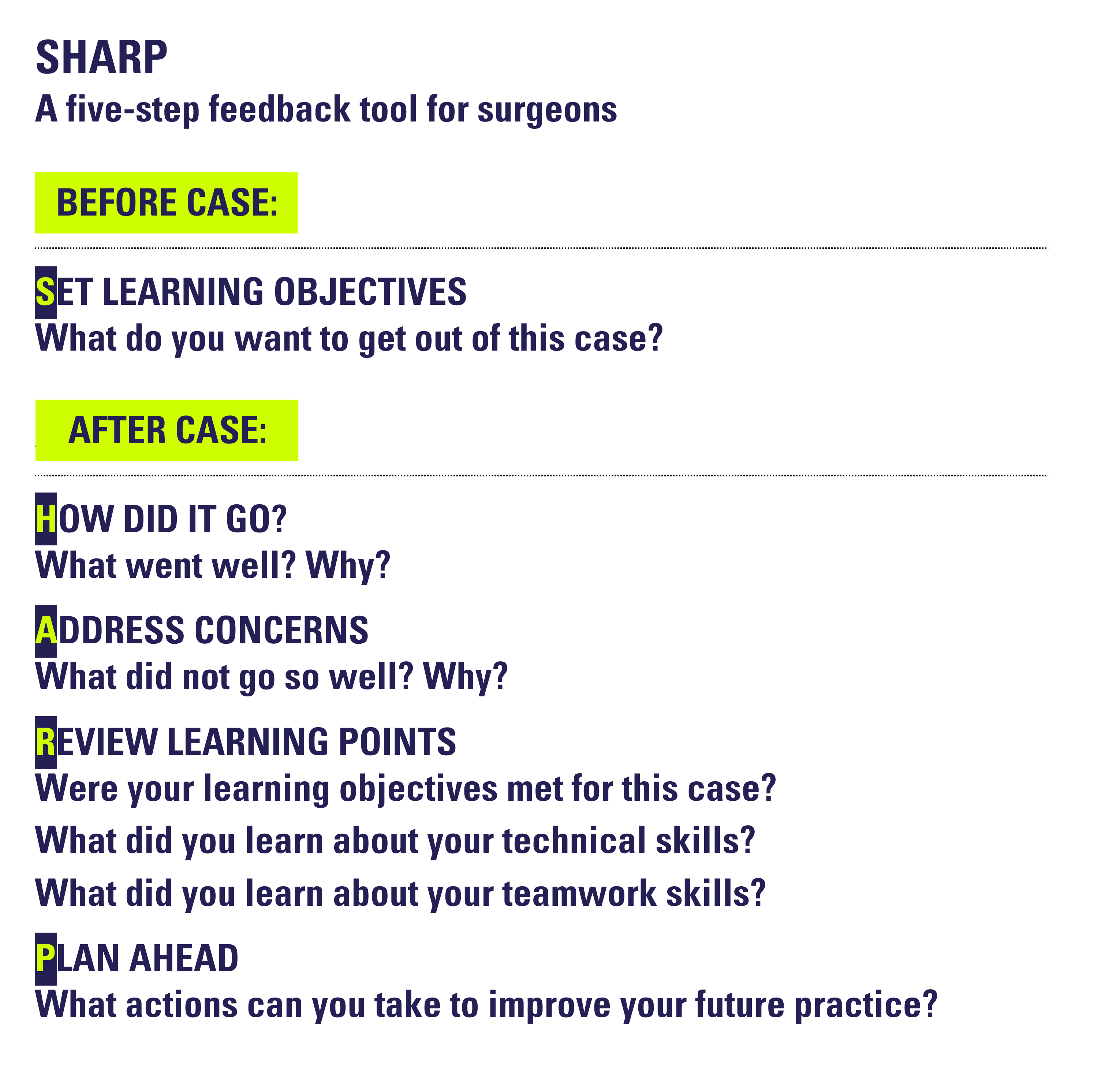
SHARP was first use in 2013 and remains popular in surgical settings; there are written and verbal elements. The acronym stands for:
S – Set learning objectives
H – How did it go?
A – Address concerns
R – Review learning points
P – Plan ahead
Why is SHARP effective?
It’s quick. “It takes two minutes; so it really stops that ‘I don’t have time for this’,” said Arora, mindful that athletes and coaches are often time-poor. “We looked at feedback, debriefing and performance for cases before we introduced SHARP as a baseline; then we measured all of those outcomes afterwards. What we found was that feedback significantly increased, much more feedback was provided, learning objectives were set, but also the quality of debriefing significantly improved.”
Here is a typical structured assessment using SHARP:
How does SHARP differ from standard feedback?
As Arora said, feedback is too often a one-way street. “We could see beforehand if there was feedback, it was just ‘yes, that’s great’ or ‘no, we should have done this’ or ‘next time, just do it’,” she said. “It was very didactic, very unidimensional, very much one person or 10 dressing down another.”
SHARP encourages learner engagement. “It was much more, ‘what do you want to take away from this?’ And afterwards it’s ‘OK, you did this bit very well. It was a difficult case, but next time try and make a better use of your assistants’.”
There is an element of feedback but “you can pick up what’s important to them, not what I think they didn’t do right.”
Doesn’t surgery use ‘hot debriefs’?
Yes, usually at the end of the day. There will also be a hot debrief within 15 minutes of a catastrophic or fatal event. “If it’s so awful that the patient dies on the table unexpectedly, the rest of the list is cancelled because nobody in the team is in the right frame of mind; it’s not fair and it’s not safe to operate on people when you are thinking about what’s gone on,” said Arora.
In such scenarios, a SHARP debrief is held seven days later. “That’s critical following a terminal event.”
5 Sep 2024
ArticlesIn the first of a two-part series, Sonal Arora, an experienced surgeon, outlines how any coach can become a better facilitator.
“You would think that the environment in which we do this is very contained, very prescriptive, nice and quiet; that you’re allowed to get on with it and everything works,” she said. “Unfortunately, that’s not the case.”
Arora is a Consultant Emergency Surgeon with the Chelsea & Westminster NHS Trust in London. She told an audience at last November’s Leaders Sport Performance Summit at the Kia Oval that the picture can be particularly bad during emergency procedures.
“Lots of research looking into stress in surgery has shown that things break down in almost all cases,” she continued. “We have the door to the operating theatre opening and closing every other minute. You are trying to do this difficult procedure. The patient is bleeding. The anaesthetic machine is beeping and somebody is just coming in and out talking about whatever it is that they want to talk about. The noise can be so loud it’s almost as much as a motorway. So it’s not that sterile setting that you would think.”
Inevitably, as Arora explained, this has consequences. “One in ten patients who come into our hospital will suffer from iatrogenic harm – that means harm due to the healthcare that they are receiving, not the pathology.” In some cases, iatrogenic harm can be fatal.
Despite improved simulation tools, the situation persists. “We thought: how can we accelerate this learning? How can we get people to perform better, faster, safer in a way that would take little resource and maximise what we were already doing?”
Over the course of 30 minutes, Arora laid out how, in a joint research project, Imperial College and its peers working in operating theatres across the United States and Australia alighted on better feedback and debriefing as the solution to improved learning and performance.
Here, the Leaders Performance Institute returns to her presentation in a two-part feature. In part one, we set out how Imperial’s OSAD [Objective Structured Assessment Tool for Debriefing] can assist those individuals responsible for facilitating post-performance reviews.
In part two, we will shift the focus to Imperial’s SHARP [Structured, Healthcare, Assessment, Review, and Performance] tool, which is more geared towards the learners themselves.
‘Why not optimise learning that’s already happened?’
As mentioned above, Imperial settled upon revamping its approach to feedback and debriefing. “Why not optimise the learning that has already happened?” said Arora. “We had the perfect setup; we had all the recordings, we used to video everybody’s performance and simulation, but we were doing nothing with these videos. People would just turn up, have their simulation, a quick chat. ‘How was it?’ ‘Alright.’ ‘Great. See you next time.’ Ad infinitum.
“So we all know that debriefing is crucial; we know it’s part of the learning process; we know that it’s a way of reflecting upon performance.”
Yet it is too readily dismissed as a soft skill. “We look so carefully at our performance in so many different domains, but nobody’s looking at how well we are performing in giving effective feedback; and the idea was that if we can improve the quality of our feedback, we could improve performance.”
The process also needs to be embedded. “People need ring-fenced time for this. It can’t just be an add-on that somebody is doing well, other people are doing it off the cuff at the end of the game, at the end of an operation, at the end of the week. It needs to be given the time and the importance, and that comes from the top down.”
OSAD: the Objective Structured Assessment Tool for Debriefing
In 2012, Arora was part of a team that developed the OSAD tool. It was designed to improve debriefing practices in surgery and other areas of healthcare by providing a structured, evidence-based approach to evaluating the quality of debriefings.
To this day, it remains a useful tool. “The real secret is to try and get [the learner] to identify what their performance gaps are and how they feel, or how the team feel, they can work better to improve it for next time,” said Arora. “Your role as a facilitator is to wrap all of this up at the end and determine how they are going to take what they’ve learned from this session and apply it to their future practice.”
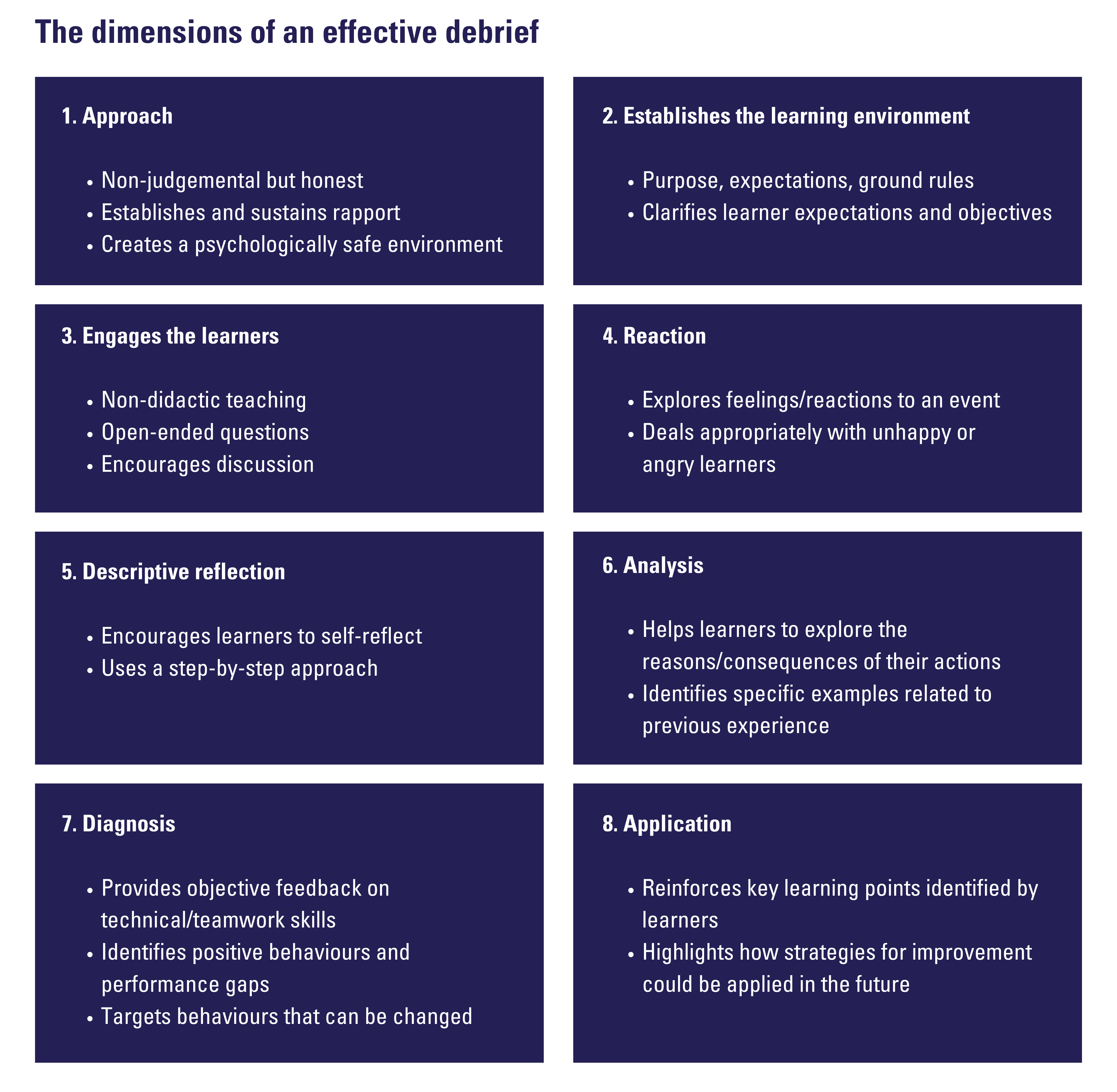
OSAD, which is based on eight elements enables people to reflect on their own debriefing practice and train others to more effectively deliver feedback. Those elements are:
Facilitators are invited to score themselves on a scale of one (poor) to five (very good) on each of those elements.
Using OSAD, Arora explored each element in setting out the characteristics of an effective debrief:
OSAD can be used and adapted as required, whether you are new to the space or a seasoned debriefer. It has proven to be a game-changer, but it is not perfect. Not if you’re a learner anyway.
“If we tried to give that eight-thing item with lots of small writing to our surgeons who are in the middle of life-saving surgery, they’re going to tell you to get lost,” said Arora.
“How can we take those lessons and translate it into something really short, really simple that anybody can understand?”
In part two, we explore how Imperial answered that question through the development of its SHARP tool.

Kate Warne-Holland of the Lawn Tennis Association discusses the competition formats introduced at the height of Covid. Such were the opportunities for player-coach interaction that these formats have been retained as we continue to emerge from the pandemic.
“I think we did even better during the pandemic because it was an opportunity,” says the Under-14s Girls’ Captain at the Lawn Tennis Association [LTA].
“I think we all saw it as an opportunity to talk more because what happens in tennis is the day to day gets so unbelievably busy. I’m sure it’s the same in every sport. The coaches are coaching and we’re trying to organise and make things better but we can’t find the time to really reflect and do that together”.
One area of improvement was the online provision of coach education – a special project of Warne-Holland’s – and there was also the establishment of 15 regional player development centres (RPDCs). She estimates that 75% of all young British players are based at one of these centres. Each RPDC has an LTA-funded head coach that has been employed from tennis’ wider coaching pool.
“We have a very strong link to the head coaches and their development plans; where they want to go, what they want to enhance in their programmes,” she adds.
“Covid was a terrible thing in numerous ways, but here was an opportunity. Player development is much more connected and it also gave us a chance within the LTA for more fluid cross-department communication”.
Warne-Holland, who has been in her current role for three years, was a contributor to our March Special Report Navigating your Way Through Major Competitions. The LTA will take young British players away from the natural habitats of their home programmes to tournaments across the globe. Youngsters can be away for up to 15 weeks per year, as she told the Leaders Performance Institute.
The LTA’s approach to youth development is continually tweaked and, as Warne-Holland explains, the travel and budget constraints enforced on the organisation during the height of the pandemic led her and her colleagues to adopt a “hybrid” approach between UK-based camp and both home and overseas competition programmes as lockdown restrictions eased.
“That meant we could get the kids together, sparring, peer group training, and get the competition box ticked by allowing them to compete more often, which they weren’t getting because they weren’t able to travel.
“We sought out cheaper court time, good venues in the middle of the country, outdoors as much as possible. We came up with what we called ‘NAGP [National Age Group Programmes] weekends’. They’re now called National Matchplay Weekends because they’re not solely for NAGP.
“It’s a fluid group of 16 players. For each weekend, eight automatically get their place based on success before but then another eight go into a selection process”.
As Covid restrictions eased in Britain, the LTA also devised a junior team competition between players from England and Scotland that helped to replace the summer and winter cups that were cancelled as the globe got to grips with the pandemic.
Crucially, as Covid policies receded, these competitions have remained. “They haven’t disappeared now we are back to ‘normality’,” says Warne-Holland. “They were so valuable and they were encouraging the private coaches to be there and coach on court. It provided an opportunity for the coaches to develop the players right in front of them. So they weren’t on a balcony, watching four matches, and then going home and working on it. We allowed and encouraged them to sit on court so they were able to impact on the player immediately.
“Ideas like that we’ve kept. It’s a very effective way of actually providing an environment that will help these kids when they travel, because it’s peer v peer, so it’s both pressured and very high support”.
Warne-Holland is not entirely fazed by the notion of future challenges, including budget cuts. “You’d find other ways to make things happen and find that high challenge,” she says. “Take them to the strongest tournaments, don’t take them to the easier, more expensive tournaments in places such as Scandinavia. Take them across the pond to France, get in the minibus, and off you go! I think it’s a more realistic journey for them. As I tell the girls, smooth seas don’t create great sailors. Make it choppy, make it high challenge, but if we’ve done the right things they’ll be able to go towards the challenge rather than running away”.
The latest Leaders Performance Institute members Virtual Roundtable focused on the use of internal athlete management systems (AMS) and, in particular, the challenges around maximising its usage and the solutions that are having the most impact.
From the conversations on the call, it has become abundantly clear that multiple challenges remain, there is still a gap around how to actually maximise the systems to their fullest potential, but on the flip side, there are some effective solutions taking place across the industry to shift the dial. For the first segment of the call, we laid out on the table the key challenges everyone is facing.
Barriers to effective utilisation
The speed and functionality of the system continues to provide nagging daily challenges that can slow down work streams – ‘we are reverting back to pencil and paper pretty quickly’.
Within organisations there are different levels of knowledge and competency around data processes and the utilisation of the AMS. The lack of knowledge alignment is creating challenges to the efficiency of processes and communication across departments. This will feed into the solutions section as well, but there isn’t often orientation around what actually needs be collated and why – there are many different viewpoints so too much data is being collated which is making it hard to connect effectively with the athletes.
This point links closely to the one prior. There is a lot of inputting of inaccurate data or missing data. As one of the participants on the call summed up ‘if you are putting garbage in you will get garbage out’.
One of the most popular challenges shared in the groups was the lack of integration between different platforms which are utilised by different performance departments. It is creating more work, data overload and not a clear picture for athlete development. Many environments are also finding that certain systems are very rigid and are instead looking to develop their own internal systems which are tailored to their specific needs – one member of the group shared that service providers and vendors are trying to provide solutions we don’t need.
As we know, one of the main reasons for data collation and analysis is to improve performance outcomes for athletes. Some of the organisations on the call shared that there still remains a gap in the athlete’s literacy and general buy-in about the systems. If we are unable to get the athletes onboard, it makes it incredibly challenging to initiate any kind of changes in behaviour.
Solutions and considerations to elevate effectiveness
Considering the complexity and ‘rabbit holes’ we can find ourselves heading down with athlete management systems, the conversation was a gentle reminder to ensure you continue to do the basics right. Capture the data effectively, consistently and accurately. There are important questions to regroup on around what’s important to capture, how is the information shared, how is it visualised and what does it mean? Start at a place of simplicity and importance.
We are witnessing an increase in different stakeholder involvement around performance: players, parents, other departments, executives etc. Be intentional in figuring out how to connect with them around the data. Ensure it is user-friendly, digestible, colourful if it needs to be – we should be striving to tell stories and create emotion around this so it elevates the engagement with the information.
Education is perhaps one of the most crucial elements in elevating the effectiveness of your systems. We need to strive to get everyone on the same page and focus time and effort on the ‘human elements’ of working with data to elevate understanding.
From an athlete perspective, educate them on ‘the why’ and work on engaging them so there is no secrecy, no fear, but complete transparency. Recruitment: one organisation on the call who have recently transitioned AMS provider shared the success they had around being intent on hiring people who were incredibly proficient with the new system and who could help the team build it out to maximise its effectiveness, as opposed to trying to uptrain existing staff which would prove to be incredibly time consuming. When athletes believe that something will support their performance, they start to take ownership of the conversation and it leads to those casual collisions we desire.
Another simple solution that has witnessed some impactful results has been a shared message from senior leadership to outline expectations when it comes to the utilisation of the AMS – ‘we are doing this. We’re investing a lot of money and everybody will be using it, it’s not an option’. A top-down message to bring everyone to a level playing field of understanding is a simple step to creating clarity and alignment.
It’s fair to say that everyone on the call is craving a one-size-fits-all system that integrates everything that all departments and stakeholders want – the reality is that it is going to be incredibly challenging to do this. Not trying to have a one-size-fits-all will take away a lot of stress. Instead, try focusing on building a database that can house what’s critical and then having your individual platforms that are specific to the day-to-day tasks.
Linking to point four above, a clear expectation from everyone to maintain high standards around data hygiene. It’s a simple solution but how many organisations can safely say their data hygiene is perfect?
Group reflections and insights
![]()
Are you ready to take your team on tour? Or are you adequately prepared for your next major competition? In answering those questions we seek to give you something to ponder in this Performance Special Report, brought to you by our Main Partners Keiser. In this pages, we explore how training camps can be used to capitalise on a team’s collective knowledge and how trips can be used to develop a team’s sense of belonging. We also turn our lens to contingency planning on tour and the considerations that make for a smart debrief afterwards.
Complete this form to access your free copy of Navigating Your Way Through Major Competitions, which features insights from Swimming Australia, the Lawn Tennis Association, Wales Rugby, Athletics Australia and Hockey Ireland. Each has teams competing in major tournaments this year, and all are bound to give you something to think about in your future projects.
Victoria Moore
Head of Performance Support & Solutions
Athletics Australia

14 Mar 2023
ArticlesIt does not necessarily require a new building, according to the members of the Leaders Performance Institute who gathered for this recent Virtual Roundtable.
Recommended reading:
Leaders Performance Journal Building For Success
What Defines a Good Practice Facility?
‘”Training Facilities Are a Feeling” – you Can’t Say that to an Architect!’
Framing the topic
We often talk about environments within the Leaders Performance Institute, however within this topic-led virtual roundtable, we looked to extend these conversations into the physical space. We asked our members how their facilities were shaped and how they have evolved in order to contribute to the culture and environment they are trying to create.
We picked out four key points from our discussions: