Leaders in Business
  • Membership
  • Events
  • Content
  • Virtual Learning
  • Connections
  • Partners
Login
  • Leaders Meet: Innovation
  • Events
    • Leaders Week London
    • Leaders Sports Awards
    • Leaders Club Events
    • Leaders Performance Institute Events
    • Leaders Meet: Innovation
  • Memberships
    • The Leaders Club
    • Leaders Performance Institute
  • About
    • Careers
    • Contact
I’m a sports leader:
  • Off The Field For those focused on the business of the sport View more
  • On The Field For those working with an athlete or elite team View more
  • Login
    • Leaders ClubThe membership for future sport business leaders
    • Leaders Performance InstituteThe membership for elite performance practitioners
  • Newsletters
Performance Institute Leaders Performance Institute Logo
  • Membership
  • Events
  • Content
  • Virtual Learning
  • Connections
  • Partners
Login
Members Only

23 Jan 2026

Articles

‘If your Staff Don’t Believe their Self-Development Is a Team Priority then it Just Won’t Happen’

Premium
Share
Facebook Twitter Email Copy Link
https://leadersinsport.com/performance-institute/articles/if-your-staff-dont-believe-their-self-development-is-a-team-priority-then-it-just-wont-happen/

In a recent Leaders Virtual Roundtable, performance specialist Iain Brunnschweiler led a discussion on strategies more effective learning. We pick out ten below.

By John Portch
“In this era where there’s so much data, there’s so many insights, there’s a risk we forget that human learning is a major part of how we progress.”

With those words host Iain Brunnschweiler, who runs the Focus Performance Consultancy, set the scene for a virtual roundtable discussion during which Leaders Performance Institute members shared the strategies that have facilitated better individual and organisational learning within their teams.

“There’s definitely something about learning being contagious,” he added in expectation. “If credible, valuable members of staff are going after things deliberately like you are, I’d hope that there’s some sort of contagion within your organisation.”

To start proceedings, Brunnschweiler outlined a four-part model of organisational learning. “This is an unpublished model,” he said of it. “This is the world according to me.”
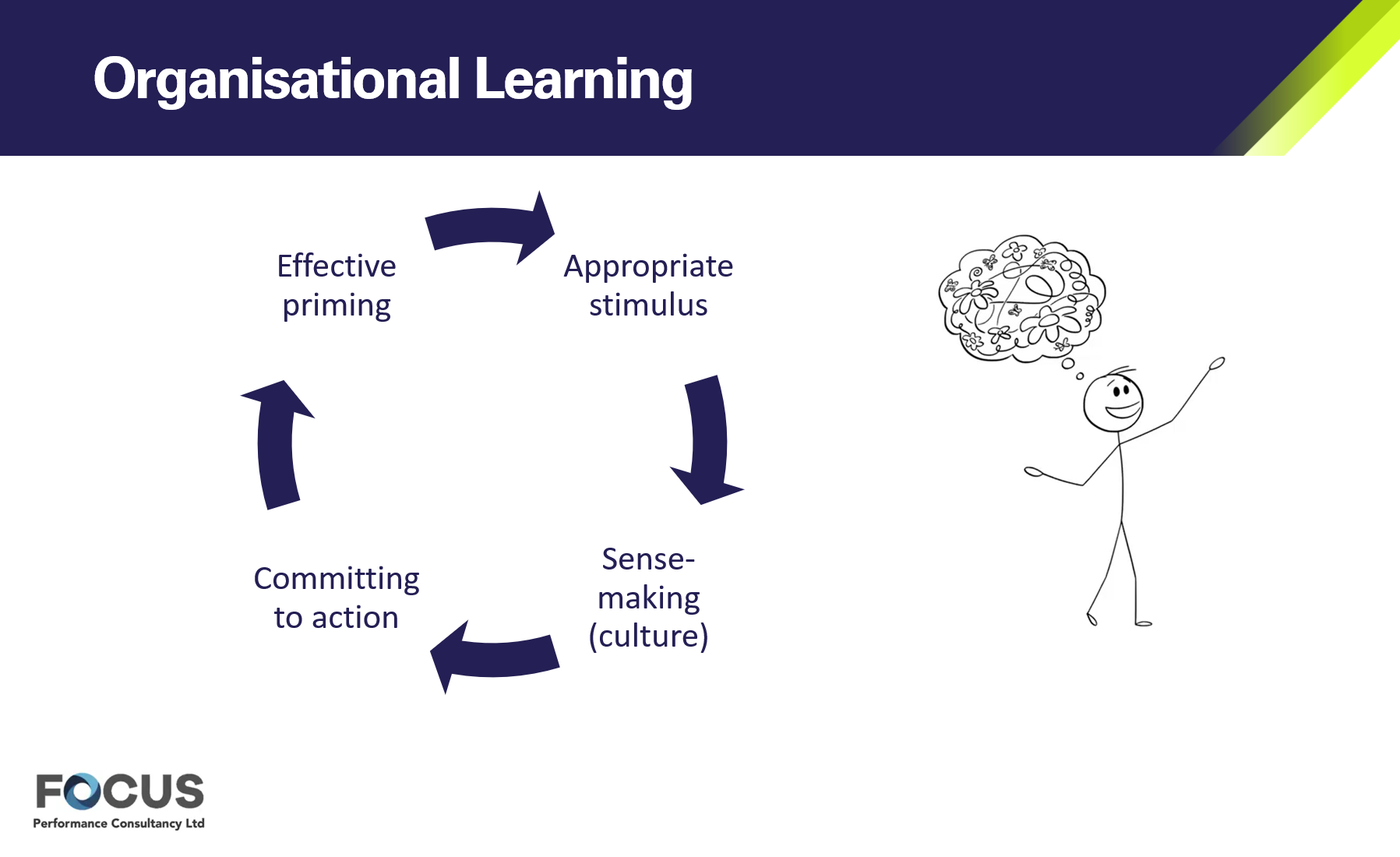
Effective priming

“How can we deliberately set people up for learning? That’s something that I’ve increasingly considered,” said Brunnschweiler, who highlighted one-to-one conversations with staff members as a way to identify their aspirations and their motivations.

Appropriate stimulus

“How do we provide a stimulus to create thought in aspirational people?” In a previous role, Brunnschweiler implemented weekly 30-minute meetings with staff members. He also enlisted external speakers and asked individuals to present on a teaching project.

Sense-making (culture)

“If within your organisational culture there are people and spaces that allow you to have conversations, check and challenge your thinking, that is a really good way of helping the learning to land,” said Brunnschweiler, while emphasising the cultural dynamic.

Committing to action

“Often,” Brunnschweiler said, “the greatest risk here is that we have a brilliant conversation, and then we do nothing about it’. How do we commit to something that’s going to make some sort of change, whether it’s small or large?”

The group then shared ten strategies to encourage more effective individual and organisational learning:

1. Give staff members the freedom to explore learning

“If we want to happy or we want to have happy staff, we need to give them some freedom,” said a sports scientist working in the major US leagues. “And if we want them to be free, then we have to encourage them to be courageous and pursue what they want to have and what they want to do.”

Brunnschweiler said:

“A learning culture starts with recruitment… can we keep shifting that culture by recruiting naturally curious and hungry people and maintain momentum.”

 2. Hunger for learning must be role-modelled from the top

Often, staff members are eager to learn, as a psychologist working in the US college system observed, “but having leadership model this is so key”. Only then will staff members carve out the time, as he said:

“If your staff members don’t feel like they have the grace and space to allocate time in the day they’re going to say, ‘I have to do this,’ or ‘I have a meeting’ instead.”

3. Understand people’s motivations

If you can understand someone’s motivations or aspirations then you have an anchor for a conversation about their development. Brunnschweiler explained that it is important to focus on those who want to learn, not those who don’t. He said:

“Some people have little appetite for self-development. And I think we have to be cognisant of our own energy… and accepting of that fact.”

4. Create individual development plans for staff members

The aforementioned psychologist made a convincing case for staff IDPs. He said:

“We talk so much about player development plans, but do we truly have staff development plans, like, ‘here’s where you are, here’s where you can go, here are the gaps to be filled’?”

5. Place staff on secondments when possible

“We don’t put barriers in the way of our people going out on secondment,” said a director of cricket in the English game, where the season is not a 12-month schedule. This is, as Brunnschweiler observed, a cost-effective way of bringing IP back into the building. He said:

“How can we be resourceful? Can we create opportunities for people to visit places and return with knowledge without spending money?”

6. Find your critical friends

Sense-making can be difficult, but sometimes it just takes opening your phonebook. A call with a critical friend is what Brunnschweiler calls a “micro sense-making space”. He said:

“I’ve accrued a small network of people who, for example, when I’m driving, I just phone them up and I know they’ll challenge my thinking and that I’ll learn from that conversation.”

7. Learn from failures

“I’m far more interested in the failures,” said a physiotherapist at a globally renowned organisation. “When my team see me talk about failures, when things have gone wrong, that makes people listen a bit more; and I often think we should prep to fail. Are we ready to fail, so that if we fail, we can look back and say, ‘okay, we did everything we wanted to do?’” Brunnschweiler agreed, adding:

“It’s a good sign if you’ve lost and a staff team are reviewing and reflecting on it and they’re genuinely unpicking and they’re able to call each other out or go, ‘do you know what, I messed up today’. That is a real signature of a place that wants to get better.”

8. Importance of managerial vulnerability

Leaders can role-model learning, but they can also demonstrate vulnerability.

“If you can put your hands up and say, ‘I made a mistake’, that sets the culture, it sets the environment,” said a physiotherapist working in Australian sport. In building on that point, the physiotherapist from No 7 said:

“If we can guarantee that removal of blame, it will encourage us to talk about what we can learn.”

9. Job security

It sounds obvious, but managerial vulnerability goes hand in hand with job security.

“In a fast‑paced environment there is more chance of people getting sacked. I think this could be almost correlated to your hunger for learning,” said the physiotherapist based in Australia. “You might just sit there, be quiet, go insular, and just tick our day‑to‑day off – you don’t want to put your neck out there.” He has witnessed the impact of leaders reiterating that people’s jobs are safe.

“When you are told people aren’t just going to get sacked, it creates the environment for learning.”

10. Appoint a dedicated staff member for learning

“I’ve never worked somewhere that’s had a dedicated head of learning,” said an analyst working in Middle Eastern football. “It always falls on line managers and it’s hit and miss.” Brunnschweiler agreed and added:

“How does any organisation ensure that a PDR process is not just some tick-box exercise, but there’s genuine validity in what you’re going after, what you’re going to commit to, and then it’s followed up on?”

What to read next

Five Effective Learning Strategies at the Royal Air Force

7 Jan 2025

Articles

The Debrief – a Snapshot of Powerful Discussions Happening Right Now Across the Leaders Performance Institute

Category
Leadership & Culture
Share
Facebook Twitter Email Copy Link
https://leadersinsport.com/performance-institute/articles/the-debrief-a-snapshot-of-powerful-discussions-happening-right-now-across-the-leaders-performance-institute-10/

Female athlete health, mental performance, data-informed recruitment and leadership were foremost in conversations across the Leaders Performance Institute in December.

By John Portch
With the new year ahead of us, the Leaders Performance Institute cordially invites you to take a swift look back.

There was plenty on offer on our Intelligence Hub in December and here we bring you four key thoughts from the final weeks of 2024 to set you up for success in the months ahead.

Before we get into it, remember our first summit of the year takes place at Melbourne’s Glasshouse in just under four weeks’ time. More info here. We hope to see as many of you there as possible.

If there’s an upcoming virtual learning session that takes your fancy, please let a member of the Leaders Performance Institute team know.

Right, back to the matter at hand. Here are four themes that stood out in December.

  1. Female athletes are too often overlooked

That’s not really news and, to be fair, is not entirely representative either. We have sought to address the fine work being done (as well as the enduring iniquities) in our latest Performance Special Report, titled A Female Lens on Performance: what it takes to help women and girls thrive in elite sport.

The report, which is brought to you by our Partners Keiser, features Garga Caserta, the Head of Performance at NWSL side the Kansas City Current, who discusses the best ways to balance challenge and support for players.

He also touched upon his reluctance to chase ‘low-hanging fruit’ in women’s sport performance, particularly where data is lacking:

“Research shouldn’t be about recognition, and a professional sports environment is not the place for research. The team and athletes suffer from it rather than benefit.”

Elsewhere in the report, we spoke to:

  • Helene Wilson and Jody Cameron at High Performance Sport New Zealand about their efforts to create opportunities for female coaches and practitioners across their nation.
  • Chloe Francis, the Head of People Operations at England Rugby, about her organisation’s maternity policy.

We also pondered the potential implications of the gendered environment for female athletes and coaches.

Download A Female Lens on Performance now.

  1. Does your mental performance coach do enough for your team?

Be careful how you answer that question. If you feel that your mental performance coach never quite fulfils their remit, perhaps you’re not setting them up to be successful. It could be, as mental performance coach Aaron Walsh argues in this exclusive column, that you’re viewing their work from the wrong angle.

Walsh wrote:

To successfully integrate the work, teams need to understand what a mental performance coach can do to elevate performance and how to deliver that work most effectively. Traditionally, the delivery model has involved one person attempting to meet the needs of everyone in the environment. This often leads to frustration for both the team and the provider. The team feels like the demands are only sometimes met, while the provider feels more time is needed.

A more effective model is viewing the provider as a facilitator, where they engage the key leaders in the environment and help drive the work. Yes, contexts will be provided for the provider to deliver critical messages and practices directly. Still, as we know, the mental side of performance happens every day and all the time.

Read the full article here.

  1. Are you happy with how your team is using its data?

Even if you are, you probably feel that you can tighten up processes here or look at things through a different lens there.

It was a theme that ran through our Kitman Labs podcast series where the Leaders Performance Institute was joined by Kitman Founder Stephen Smith to chat to a range of guests from across the world of soccer.

These included Dr Karl-Heinrich Dittmar, the Head of Medical at German Bundesliga champions Bayer Leverkusen. He spoke at length about the club’s efforts to use data to outmanoeuvre their rivals when recruiting:

We have now one of the best German players, Florian Wirtz. He is, together with Jamal Musiala, definitely one of the top two talents in the German Bundesliga. And he decides to stay longer with Bayer Leverkusen because he has a chance to improve. He could have gone to Bayern Munich, he could have gone to Chelsea, he could have gone to Real Madrid, but he didn’t because he knows with our strategy, and this strategy is based on data, he can improve. And his outcome after some years will be much better. And this is a big argument for our recruitment team to bring players to Bayer Leverkusen.

During the course of this Kitman Labs series, we also spoke to:

  • Paul Prescott, who helped to deliver the English Premier League’s Elite Player Performance Plan, and Morten Larsen the Head of Methodology at Danish Superliga club Aarhus (who are renowned for their talent development work)
  • Arianna Criscione, the Head of Football Operations at Como Women, and Sarah Smith, the Director of Medical & Performance at Angel City FC
  • Yael Averbuch West, the General Manager of Gotham City FC
  1. How do you develop leaders?

It’s an age-old question, but no-one has really nailed it. Dan Jackson, the General Manager of Player Development & Leadership at the Adelaide Football Club is no exception.

“I can’t teach leadership,” he told the Leaders Performance Podcast. “I can help unlock what’s already in there.”

Jackson feels that leaders can be created. “Leadership is 100 per cent made, but it’s made from a very young age.”

Beyond the origins of leadership, Jackson also spoke about the importance of prioritising others in a team environment.

“Great sustainable teams are built in environments where everyone’s looking to help someone else out,” he adds. “When you fill someone else’s bucket, it fills yours.”

It’s well worth your time. The same can also be said for these other guests, who all joined our three-part Keiser Series podcast in December:

  • Duncan French, the Senior VP of the UFC Performance Institute
  • Flo Laing, the Lead Physiotherapist for the Scotland women’s rugby team
  • Lachlan Penfold, the Head of Performance at the Melbourne Storm

29 Oct 2024

Articles

‘Female-Specific Considerations Should Be Part of Normal Practice’

Category
Human Performance, Leadership & Culture
Share
Facebook Twitter Email Copy Link
https://leadersinsport.com/performance-institute/articles/female-specific-considerations-should-be-part-of-normal-practice/

Esther Goldsmith and Dr Natalie Brown explain how Sport Wales provides embedded support for Welsh athletes.

By Esther Goldsmith and Dr Natalie Brown
We know that females are different to males, and that we need to take that into account when working with female athletes – but what does this really mean in practice?

As we mentioned previously, there is a lot of myths and confusion about what you should or shouldn’t be doing as a practitioner or coach in sport when working with females. Unfortunately, similar to all sports science practices, there is no ‘one-size-fits-all’ approach. Every athlete that you work with is going to be different, and female athletes are no exception. In fact, when it comes to menstrual cycles, we know that this increases variation as every individual will have a different experience of their menstrual cycle, and this might even change from cycle to cycle.

At Sport Wales we work internally and externally to ensure that every female athlete in Wales can access support when it comes to female athlete health. However, this looks different depending on the context.. We have a dedicated team of practitioners who work together to provide a multidisciplinary approach to support female health and performance. As a team, we have four aims:

  1. Enhance knowledge and awareness
  2. Establish open and supportive environments
  3. Embed positive behaviours
  4. Equip with solutions and management strategies

Whilst menstrual cycles have previously been a big focus of research and delivery at Sport Wales, we also appreciate that this isn’t the only area that female athletes need support in! Pelvic health, pregnancy, breast support, female puberty, menopause and RED-S [relative energy deficiency in sport] are areas that we have expertise around and are working with sports to consider. We also make sure that female-specific factors are considered across all practitioner disciplines, and collaborate with other teams in Sport Wales, such as the coaching team, for consistency and a whole organisation approach.

Female-specific factors do not have to be standalone or demand a lot of time and resource. Instead, we promote integrating and embedding into ongoing work to support the individual athlete. Some good examples of this might be:

  • A nutritionist considering menstrual cycle symptoms alongside their nutrition advice (a female athlete may experience premenstrual nausea that means she finds it hard to fuel)
  • An S&C coach factoring in menstrual cycle phase to physical testing notes for an individual who experiences considerable fatigue during her period to account for any changes in testing results

Another approach focusses on providing education to athletes and sharing the importance of considering and talking about the menstrual cycle. The menstrual cycle has been, and still often is, a taboo or topic that isn’t often discussed, the first step to working with female athletes is to help them feel comfortable talking about periods!

This is even more of a challenge when talking about pelvic floor health and stress incontinence. We encourage female athletes to track their own menstrual cycle so that female athletes understand what their cycle means for themselves; what symptoms they experience, how that relates to training and competition and how to manage or reduce symptoms. In addition, we help support female athletes to understand the importance of having a regular menstrual cycle and when to seek help if periods become irregular or symptoms are severe. Tracking can also be a useful starting point to initiate conversations about female health.

We also work with coaches and support staff to educate them about the menstrual cycle; we have created four online e-modules that any sport and practitioner across Wales can access. Whilst education for athletes, coaches and practitioners helps improve their knowledge which we know can help everyone feel more confident to have conversations, we also provide education and support on ‘how’ and ‘what to do next’ to encourage conversations and support to be translated into practice.

From a behaviour change perspective, education and training are two possible interventions. However, enablement and environmental restructuring are additional interventions and approaches we take to support female health and performance.  For example, helping sports contemplate the environment they provide and whether it is set up for a menstruating athlete (e.g. are there period products available during camps?).

Over the last five years, there has been a lot of progress internally amongst the practitioner team at Sport Wales to better support female athletes in Wales. We have worked hard on:

  • Increasing normalised conversations related to female health internally and externally
  • Engaging sports around female-specific monitoring (and facilitating this)
  • Challenging practitioners to consider sport science and medicine support through a female athlete and health lens
  • Building trust with athletes to talk about female-specific topics
  • Creating an open culture where people are receptive to learning and asking questions

Embedding female health support into practice does not have to be complicated or require additional time and resource – it should not be an ‘extra thing’. It is important to support the individual athlete, and female-specific considerations should be incorporated into this as normal practice. A huge amount of support can be provided through open conversations and environments between the athlete, coaches and practitioners.

In our next article we will explore conversations with female athletes in more detail.

22 Oct 2024

Articles

How Sport Wales Is Enabling Female Athletes to Succeed on the World Stage

Category
Human Performance, Leadership & Culture
Share
Facebook Twitter Email Copy Link
https://leadersinsport.com/performance-institute/articles/how-sport-wales-is-enabling-female-athletes-to-succeed-on-the-world-stage/

The institute’s Female Health & Performance Team sets out some of the most important considerations for female athletes from grassroots through to elite level.

By John Portch
A regular menstrual cycle is generally a sign of good health in female athletes – although not all female athletes are necessarily aware of this.

“There are still female athletes who see it as a positive if their periods stop when they’re training,” Dr Natalie Brown, a Research Associate at the Welsh Institute of Performance Science, tells the Leaders Performance Institute on Teams.

“This is because it’s easier and more convenient; they’ve not got to deal with the symptoms or the bleeding.”

Yet the impact on their short and long term health, let alone performance, could be significant. “It’s an indicator that they do not have enough energy for those basic bodily functions.”

Nevertheless, such myths have grown to fill the void left by a lack of education and awareness across sport.

Brown is part of the Sport Wales Female Health & Performance Team who are working to redress that balance by seeking to identify how the Welsh sports system can better support female athletes in their health and performance.

In the first of a series of articles exploring the work of Sport Wales’ Female Health & Performance Team, we discuss some of the major health and performance considerations for female athletes as well as some of the common myths that endure.

Female athletes: long overlooked

It was encouraging to see a 50:50 split between male and female athletes at an Olympic Games for the first time in Paris earlier this year, but the stark reality is that just 22 per cent of leadership positions in sport are held by women.

This is a symptom of a wider gender imbalance. Sport, much like society, has been geared towards males, with female sport often overlooked and under-resourced.

“Females are participating more, and that’s great to see, but the environments in which they are participating have not necessarily been set up for females,” says Esther Goldsmith, who both works alongside Brown within the Female Health & Performance Team and joins her on the call.

A girls’ rugby team, for example, may not have access to suitable changing rooms or toilets. “That means they have to arrive prepared and, if they’ve not got access to toilets, what does that mean if you’ve got someone on her period?” says Brown.

“Even in just focusing on the menstrual cycle you’re ignoring the bigger picture around women’s experiences of sport and how the system that we’ve designed doesn’t enable women to thrive in sport because they’re trying to thrive in a male system.”

She continues: “Girls go through puberty earlier than boys and so they have experienced hormonal changes at a time when they’re very unlikely to have been exposed to a strength stimulus and an appropriate movement at a young age when they would really benefit from it.”

“The other thing is access to physios,” says Goldsmith. “Most female teams don’t have access to a full-time physio, whereas male teams do.” Inevitably, female teams suffer more time lost to injuries than their male peers. “In a male setup you might have a physio input that means that there’s no time loss as a result of a niggle.”

This is compounded by the lack of sports science research on female athletes.

“Females have different biological and physical makeups,” says Goldsmith. “We know our hearts, circulation and hormones are different, our anatomy is different, and therefore our biomechanics are different.”

As long as the performance community overlooks this, from the grassroots to elite level, female athletes will leave both health and performance potential on the table.

Education

The Female Health & Performance Team is focused on trying “to provide practical, tangible things that you can do to support your female athletes without it becoming too complicated or time-consuming to achieve,” as Brown puts it.

Education is a significant lever. “A lot of teams say ‘we need education’ but then they don’t necessarily know how to deliver it,” says Goldsmith. “I will deliver some classes to athletes, coaches and practitioners and work with them to help them take responsibility for themselves.”

Sport Wales is aiming to create a culture where everyone, from board members to volunteers, considers the importance of female health. Goldsmith and her colleagues work with athletes and coaches to address health, wellbeing and performance questions.

It might involve classroom discussions but it could also take in one-to-one sessions. “If you’re working with an athlete there’s a bit of that ‘we’ve got to work on this together’ because every female body is completely different and everyone will respond in a different way,” she adds.

“You’ll go into some sports and work with some female athletes and they’ll respond to or act differently with you to how they might in their day-to-day training environment because you’re external and not part of their setup.”

Goldsmith will also adapt her approach depending on to whom she speaks. “Classes will look different depending on what part of the pathway you’re working on because a 14-year-old is going to respond very differently to a 25-year-old.”

She and her colleagues also strive to go beyond “surface level” initiatives and have carried out behavioural mapping. “How do we actually change behaviour so that females are considered, whether that’s with the athletes themselves or with the coaches and performance directors to look at actionable ideas?”

Myth busting

Around 90 per cent of athletes who menstruate report some symptoms including pain, reduced motivation and fatigue. Brown uses this stat to set the scene for an illuminating story: “I once asked an athlete if their menstrual cycle affects their training and they said: ‘no, not at all. I just miss training if I’m really struggling’. I just had to sit there and say ‘OK, we’re going to have to take a step back here’.”

Brown and her colleagues routinely dispel common misunderstandings and myths.

One such myth is the supposed need to periodise training according to an athlete’s menstrual cycle. “There is inconsistent evidence  that you should completely adjust all of your training based on phases of the menstrual cycle,” she says.

Media headlines suggesting links between ACL injuries and the menstrual cycle have not helped. “I’ve worked with some athletes who are petrified of training in a certain way at a certain time because of those headlines and their anxiety,” says Goldsmith. Another persistent myth is the idea that stopping the use of hormonal contraceptives will restart someone’s cycle (they may experience a withdrawal bleed, which is not the same as a menstrual bleed).

Coaches are just as susceptible to these myths. “You could see them, especially with team sports, asking ‘well, if I’ve got two athletes in that phase and two athletes in that phase and 20 in that phase, how do I make sure that they’re all training based on their phases?’” All are relieved to hear there is an alternative solution to providing female-specific support.

One might also assume that a female coach would be more sympathetic to the needs of a female athlete but that is not always the case. “Some female coaches or practitioners, for example, never had any menstrual symptoms,” says Brown. “Some of them therefore don’t have the automatic motivation to consider it, and sometimes both male and female coaches can perceive athletes as using their symptoms as an excuse.”

It is important that it is not just females either, particularly as the majority of coaches are male. Some have a wealth of knowledge in the area, others don’t. “If you ask male coaches if they think there should be equal opportunities for males and females they wouldn’t say ‘no’,” says Goldsmith. “But that doesn’t mean they’ve factored some of the things we’ve talked about into their practice. They just haven’t developed that understanding. But when you start communicating it as a performance thing, they’re like ‘OK, this applies to the world I live in’.”

To further help athletes, as well as their GPs, Sport Wales Medical Consultant, Dr Katy Guy, has prepared a letter that female athletes can take to their GPs if they were to notice a change in their menstrual cycle. “We know GPs are under the cosh and have a lot to think and know about, so we’re just trying to create a resource to help bust that myth beyond our institute,” says Goldsmith.

For all the obstacles that remain, both Brown and Goldsmith are optimistic.

“In the last two years there’s been quite a shift,” says Brown. “Before that, the conversation was starting and there was some awareness but it was more around what was not being provided. There’s been an increase in both research and support in the last two years.

“The increased visibility of women’s sport has also supported that shift. So rather than us saying ‘this is important, you need to consider it, this is why’, I feel like we’ve shifted towards sports, athletes and coaches saying ‘we know it’s important. What can we do?’”

Stay tuned for upcoming articles where Brown and Goldsmith provide practical suggestions and solutions for supporting female athletes, from enhancing knowledge and establishing supportive environments to embedding positive behaviours and suitable management strategies.

Further reading:

‘Female-Specific Considerations Should Be Part of Normal Practice’


Members Only

10 Oct 2024

Articles

Why Learning Is too Important to Take too Seriously

Category
Coaching & Development, Premium
Share
Facebook Twitter Email Copy Link
https://leadersinsport.com/performance-institute/articles/why-learning-is-too-important-to-take-too-seriously/

Lucy Pearson, the Director of FA Education, the Football Association’s educational department, highlights five areas where education too often fails its learners.

By John Portch
“I know I’m at my best when I’m quite playful,” said Mo Bobat, the Director of Cricket at Royal Challengers Bangalore.

Bobat was speaking at the 2023 Leaders Sport Performance Summit in London shortly before leaving his role at the England & Wales Cricket Board [ECB].

His self-assessment is supported by no less a figure than Carl Jung.

‘The creation of something new is not accomplished by the intellect but by the play instinct acting from inner necessity,’ wrote the renowned psychiatrist and psychotherapist in his 1921 essay ‘Psychological Types’.

Lucy Pearson, the Director of FA Education, connected Bobat and Jung on the Leaders stage the very next day as an example of her belief in learning through play.

“As a society, we make a distinction between work and play,” she said. “Work is grown up, it’s serious, it’s important; and play is seen in the adult world as childish, frivolous, a bit inessential, a luxury. But play is the creative process through which we learn.”

Pearson argued this is just one area where education too often fails its learners. She identified five in total.

1. Few organisations are ‘learning democracies’

Learning democracies, as Pearson explained, are organisations where everyone is afforded opportunities to learn regardless of their position.

She observed that there are people whose roles are steeped in learning and experimentation but too many roles are perceived as merely transactional or administrative. Pearson said this is a problem because “organisations fail to cash in on the power of every single individual to drive improvement across the business.”

Everyone, from administrators to S&C coaches, should have “learning at the heart of their work”. “You have to give people time to think, we have to give them permission to experiment”, she added, because “if they find a better way of doing something the whole organisation benefits.”

2. There must be an element of chaos and creation

In illustrating her point about play, Pearson painted contrasting mental pictures of a reception (kindergarten) class and a year-11 (1oth grade) geography class.

The former is full of learners who “are not being held back from themselves. They respond in the moment to what they’re seeing, doing, hearing, what other people are doing or hearing, and they’re encouraged all the time to be curious”. It looks fun.

In contrast, the geography class represents a scene more akin to work. “There’s more organisation, much less noise, less energy, more focus,” said Pearson, who argued that while there’s a time and place, this approach is detrimental; that something is lost when moving away from the “chaos and creation” of the reception class.

How do you challenge the seriousness that comes with high performance? “At FA Education, we’re seeking to change and establish a culture in coach development that takes learning seriously, and rightly so, but frames that seriousness through the singularity of having a qualification.”

She illustrated her point using grassroots coaches. “They’re probably coaching because if they don’t their child can’t play,” said Pearson. “They do want to get better but they don’t want to go to Level 2 because that’s too serious.”

The key, she believes, is to “allow coaches to wander around outside and find the stuff they’re interested in and care about and can engage in.”

3. Learning opportunities must be designed

Playfulness and learning democracies are not enough. “People can be playful at work, yes, but we need to be thoughtful about what we’re looking to achieve in those learning opportunities. Design is deliberate – not accidental – if you want to drive high performance.”

As such, FA Education is on a “journey to design, develop and deliver learning, across a number of different modes, to a range of people who’ve all got different tasks, concerns and priorities.”

Pearson is mindful, however, that people can’t be compelled to learn. “Learning is up to the learner,” she said. “All we can do is create the circumstance in which the learning has the best opportunity to happen.” She likened it to classes at school that we either liked or didn’t like. “The teachers all may have put the same amount of effort in, but it was the all-round environment that you found yourself in, the person leading it, the text that somebody chose – it all needed to be thought-through on your behalf.”

4. Learning that sticks

Pearson believes that learning is misunderstood and, therefore, isn’t always effective. “We need to make learning that sticks because we pick up pieces of information relentlessly – but that isn’t learning,” she said. “Learning is a change process.”

“The evidence of learning having happened,” as she explained, “is the ability to recall that information or that skill at a later date and apply it in a variety of circumstances.”

In making her case she cited the book How People Learn, by Nick-Shackleton-Jones, who argues that people “routinely make the mistake of starting a learning project by asking people themselves what they need to learn – the correct starting point is to understand what people care about and what they’re trying to do.”

She reiterated her belief that learning is all too often imposed. “We’ve all had it. You’ve now got to do your training in X and you don’t really care about X, but you have to do it anyway. So you tick it, you’ve done it, the business is happy. But have you learned anything?”

5. Learning with purpose

Pearson argued that this all needs to be pulled together with purpose. She mentioned Lucy Skilbeck, the Director of Actor Training at the Royal Academy of Dramatic Art [RADA], who shared her welcome letter to first-year students onstage at Leaders the previous day.

Skilbeck’s letter speaks of RADA’s responsibility to protect, develop, promote and maintain their art form. ‘Why does this matter?’ Skilbeck asked students. ‘Because membership of an academy, which you have achieved through your talent, potential, skill and determination, brings responsibility and a contribution to something bigger than yourself. There is a history, a future, and a vision at RADA.’

Pearson could have just as easily given a sporting example of purpose. “Learning is connection,” she said. “If you’re not learning, you’re not connecting; and to successfully connect people with purpose, and to ensure that purpose is connected to human value, is how we achieve true high performance.”

Questions to ask yourself:

  1. Do you know what people really care about in your team?
  2. Do you maximise the capacity and capability of everyone in your team to learn?
  3. What opportunities can you provide for colleagues to incorporate playfulness into their approach to work?
  4. Do you have learning design expertise in your organisation?
  5. What clear higher purpose is learning connected to in your organisation?

Members Only

11 Sep 2024

Articles

Debriefs and Accelerated Learning: Transferable Lessons from the World of Medicine – Part II

Category
Coaching & Development, Premium
Share
Facebook Twitter Email Copy Link
https://leadersinsport.com/performance-institute/articles/debriefs-and-accelerated-learning-transferable-lessons-from-the-world-of-medicine-part-ii/

In the second of a two-part series, Sonal Arora, an experienced surgeon, outlines how teams can do more to help their athletes as learners.

By John Portch
“What is the difference between feedback and debriefing?”

Sonal Arora, a Consultant Emergency Surgeon with the Chelsea & Westminster NHS Trust in London, posed the question to an audience at last year’s Leaders Sport Performance Summit.

“Feedback is when I am telling you what you should do,” she said following a pause. “Debriefing is a two-way process.”

Over the course of 30 minutes onstage, Arora laid out how, in a joint research project, Imperial College and its peers working in operating theatres across the United States and Australia alighted on better feedback and debriefing as the solution to improved learning and performance.

She spoke about the OSAD [Objective Structured Assessment Tool for Debriefing] and how coaches in sport might learn from the way debriefs are conducted post-surgery.

“The real secret is to try and get [the learner] to identify what their performance gaps are and how they feel, or how the team feel, they can work better to improve it for next time,” Arora continued.

“Your role as a facilitator is to wrap all of this up at the end and determine how they are going to take what they’ve learned from this session and apply it to their future practice.”

“Now let’s come back to the real world.”

OSAD, she admitted, is too detailed for working surgeons who need something accessible and appealing if they are going to open themselves up to a debrief during a busy and often chaotic day.

“How can we take those lessons [from OSAD] and translate them into something short and simple that anybody can understand?”

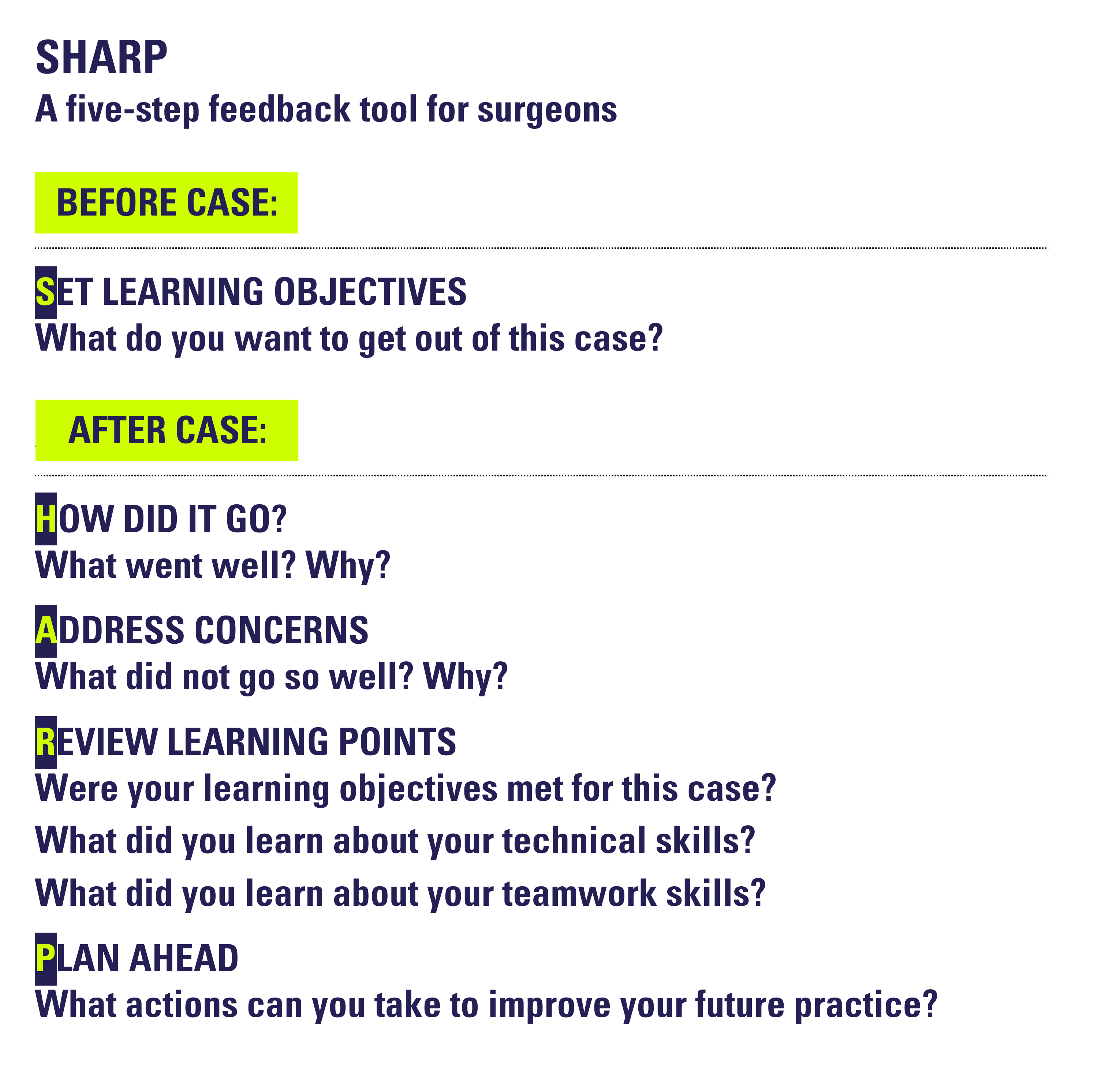
Arora and her peers settled upon the SHARP tool.

What is SHARP?

SHARP was first use in 2013 and remains popular in surgical settings; there are written and verbal elements. The acronym stands for:

S – Set learning objectives

H – How did it go?

A – Address concerns

R – Review learning points

P – Plan ahead

Why is SHARP effective?

It’s quick. “It takes two minutes; so it really stops that ‘I don’t have time for this’,” said Arora, mindful that athletes and coaches are often time-poor. “We looked at feedback, debriefing and performance for cases before we introduced SHARP as a baseline; then we measured all of those outcomes afterwards. What we found was that feedback significantly increased, much more feedback was provided, learning objectives were set, but also the quality of debriefing significantly improved.”

Here is a typical structured assessment using SHARP:
How does SHARP differ from standard feedback?

As Arora said, feedback is too often a one-way street. “We could see beforehand if there was feedback, it was just ‘yes, that’s great’ or ‘no, we should have done this’ or ‘next time, just do it’,” she said. “It was very didactic, very unidimensional, very much one person or 10 dressing down another.”

SHARP encourages learner engagement. “It was much more, ‘what do you want to take away from this?’ And afterwards it’s ‘OK, you did this bit very well. It was a difficult case, but next time try and make a better use of your assistants’.”

There is an element of feedback but “you can pick up what’s important to them, not what I think they didn’t do right.”

Doesn’t surgery use ‘hot debriefs’?

Yes, usually at the end of the day. There will also be a hot debrief within 15 minutes of a catastrophic or fatal event. “If it’s so awful that the patient dies on the table unexpectedly, the rest of the list is cancelled because nobody in the team is in the right frame of mind; it’s not fair and it’s not safe to operate on people when you are thinking about what’s gone on,” said Arora.

In such scenarios, a SHARP debrief is held seven days later. “That’s critical following a terminal event.”

Members Only

5 Sep 2024

Articles

Debriefs and Accelerated Learning: Transferable Lessons from the World of Medicine – Part I

Category
Coaching & Development, Leadership & Culture, Premium
Share
Facebook Twitter Email Copy Link
https://leadersinsport.com/performance-institute/articles/debriefs-and-accelerated-learning-transferable-lessons-from-the-world-of-medicine-part-i/

In the first of a two-part series, Sonal Arora, an experienced surgeon, outlines how any coach can become a better facilitator.

By John Portch
Sonal Arora’s description of an operating theatre during surgery is, frankly, alarming.

“You would think that the environment in which we do this is very contained, very prescriptive, nice and quiet; that you’re allowed to get on with it and everything works,” she said. “Unfortunately, that’s not the case.”

Arora is a Consultant Emergency Surgeon with the Chelsea & Westminster NHS Trust in London. She told an audience at last November’s Leaders Sport Performance Summit at the Kia Oval that the picture can be particularly bad during emergency procedures.

“Lots of research looking into stress in surgery has shown that things break down in almost all cases,” she continued. “We have the door to the operating theatre opening and closing every other minute. You are trying to do this difficult procedure. The patient is bleeding. The anaesthetic machine is beeping and somebody is just coming in and out talking about whatever it is that they want to talk about. The noise can be so loud it’s almost as much as a motorway. So it’s not that sterile setting that you would think.”

Inevitably, as Arora explained, this has consequences. “One in ten patients who come into our hospital will suffer from iatrogenic harm – that means harm due to the healthcare that they are receiving, not the pathology.” In some cases, iatrogenic harm can be fatal.

Despite improved simulation tools, the situation persists. “We thought: how can we accelerate this learning? How can we get people to perform better, faster, safer in a way that would take little resource and maximise what we were already doing?”

Over the course of 30 minutes, Arora laid out how, in a joint research project, Imperial College and its peers working in operating theatres across the United States and Australia alighted on better feedback and debriefing as the solution to improved learning and performance.

Here, the Leaders Performance Institute returns to her presentation in a two-part feature. In part one, we set out how Imperial’s OSAD [Objective Structured Assessment Tool for Debriefing] can assist those individuals responsible for facilitating post-performance reviews.

In part two, we will shift the focus to Imperial’s SHARP [Structured, Healthcare, Assessment, Review, and Performance] tool, which is more geared towards the learners themselves.

‘Why not optimise learning that’s already happened?’

As mentioned above, Imperial settled upon revamping its approach to feedback and debriefing. “Why not optimise the learning that has already happened?” said Arora. “We had the perfect setup; we had all the recordings, we used to video everybody’s performance and simulation, but we were doing nothing with these videos. People would just turn up, have their simulation, a quick chat. ‘How was it?’ ‘Alright.’ ‘Great. See you next time.’ Ad infinitum.

“So we all know that debriefing is crucial; we know it’s part of the learning process; we know that it’s a way of reflecting upon performance.”

Yet it is too readily dismissed as a soft skill. “We look so carefully at our performance in so many different domains, but nobody’s looking at how well we are performing in giving effective feedback; and the idea was that if we can improve the quality of our feedback, we could improve performance.”

The process also needs to be embedded. “People need ring-fenced time for this. It can’t just be an add-on that somebody is doing well, other people are doing it off the cuff at the end of the game, at the end of an operation, at the end of the week. It needs to be given the time and the importance, and that comes from the top down.”

OSAD: the Objective Structured Assessment Tool for Debriefing

In 2012, Arora was part of a team that developed the OSAD tool. It was designed to improve debriefing practices in surgery and other areas of healthcare by providing a structured, evidence-based approach to evaluating the quality of debriefings.

To this day, it remains a useful tool. “The real secret is to try and get [the learner] to identify what their performance gaps are and how they feel, or how the team feel, they can work better to improve it for next time,” said Arora. “Your role as a facilitator is to wrap all of this up at the end and determine how they are going to take what they’ve learned from this session and apply it to their future practice.”

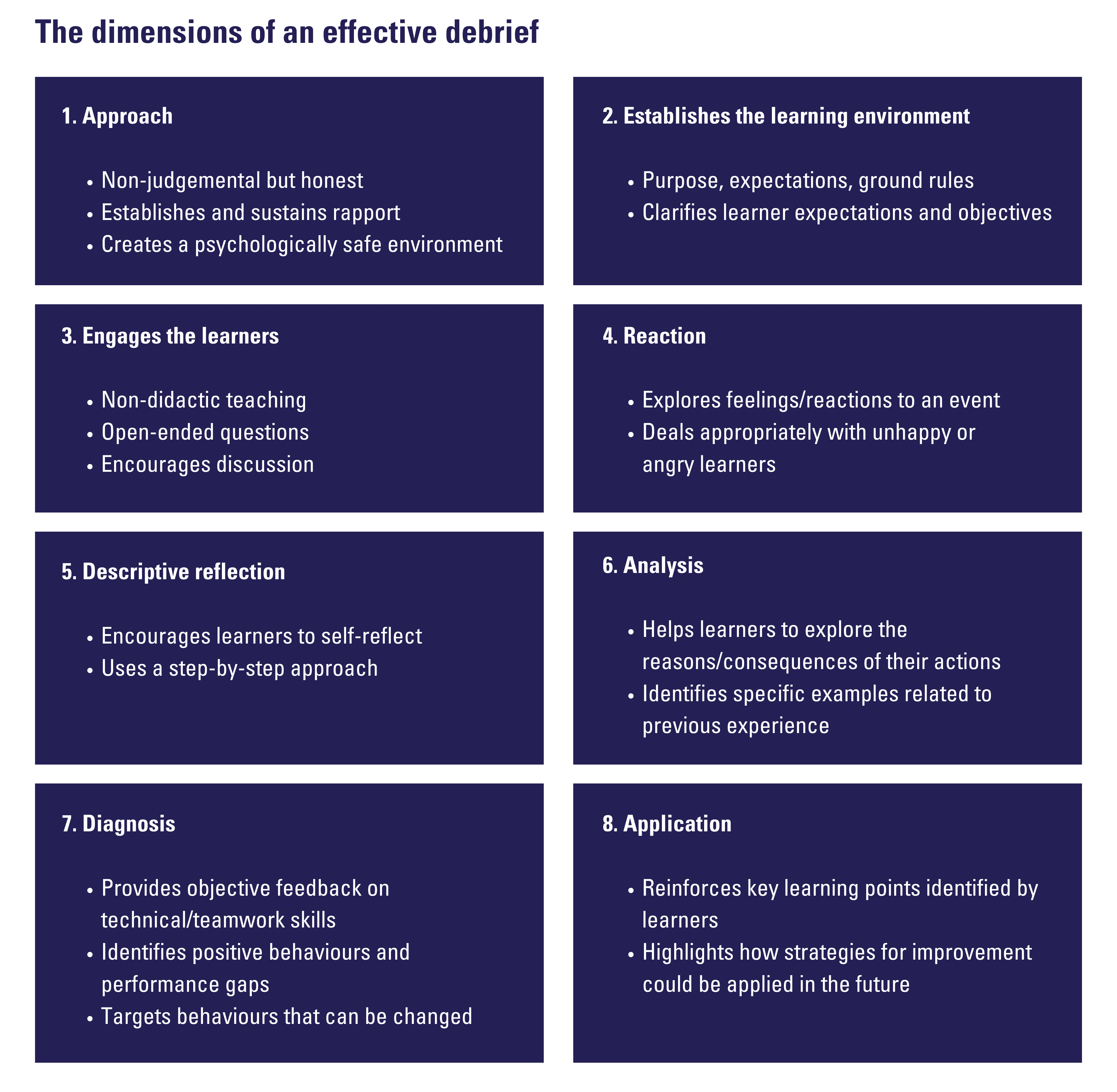
OSAD, which is based on eight elements enables people to reflect on their own debriefing practice and train others to more effectively deliver feedback. Those elements are:

  1. Approach: The method and style used to conduct the debriefing.
  2. Learning environment: The setting and atmosphere that facilitates learning.
  3. Learner engagement: The involvement and participation of learners in the debriefing process.
  4. Reaction: The immediate responses and feedback from learners.
  5. Reflection: Encouraging learners to think critically about their performance.
  6. Analysis: Breaking down the events and actions to understand what happened and why.
  7. Diagnosis: Identifying the strengths and areas for improvement.
  8. Application: Applying the lessons learned to future practice.

Facilitators are invited to score themselves on a scale of one (poor) to five (very good) on each of those elements.

Using OSAD, Arora explored each element in setting out the characteristics of an effective debrief:
OSAD can be used and adapted as required, whether you are new to the space or a seasoned debriefer. It has proven to be a game-changer, but it is not perfect. Not if you’re a learner anyway.

“If we tried to give that eight-thing item with lots of small writing to our surgeons who are in the middle of life-saving surgery, they’re going to tell you to get lost,” said Arora.

“How can we take those lessons and translate it into something really short, really simple that anybody can understand?”

In part two, we explore how Imperial answered that question through the development of its SHARP tool.

Members Only

1 Aug 2024

Articles

Why ‘Marginal Gains’ Came at a Cost for British Cycling

Category
Coaching & Development, Leadership & Culture, Premium
Share
Facebook Twitter Email Copy Link
https://leadersinsport.com/performance-institute/articles/why-marginal-gains-came-at-a-cost-for-gb-cycling/

Head Coach Jon Norfolk reveals why performance planning was perceived as the programme’s true competitive advantage going into the 2024 Games and beyond.

By John Portch
Since Beijing in 2008, British Cycling has topped the medals table in cycling at each subsequent Summer Olympics and Paralympics.

The ‘marginal gains’ philosophy of Sir Dave Brailsford, who served as British Cycling’s Performance Director between 2003 and 2014, was at the heart of this success throughout.

It was Brailsford’s “daily bread” said Jon Norfolk, the Head Coach at British Cycling, at last year’s Leaders Sport Performance Summit in London.

British Cycling, long after Brailsford had departed, continued to focus on maximising the one percenters – and it worked.

“These were really exciting times for the organisation,” Norfolk continued. “We were quick, we were agile, we were really detailed.” There was, however, a price to pay.

“I think I’m going to call it a ‘cost’. I think a cost of that agility and that speed was that we were moving very quickly. I’m not sure at each point we understood genuinely what created that performance.”

By January 2020, Norfolk and his colleagues had identified that cost and decided that the solution lay in better performance planning. They hoped to implement a change in emphasis after the Tokyo Games but, when the worsening pandemic caused their postponement in March 2020, they could begin that process earlier than anticipated.

Here, we explore British Cycling’s motivations and their rationale for ripping up a way of operating that was working – and still worked – in favour of a new approach weighted in favour of collaborative performance planning.

What was wrong with the ‘marginal gains’ philosophy?

Three factors rendered the philosophy unfit for purpose, even as the team continued to be successful:

  1. British Cycling was so focused on the one-percenters that it couldn’t fully account for the performance of its riders.
  2. The International Cycling Union [UCI] shifted its Olympic programme away from straight-line to more volatile competitions, with fewer of the ‘controllables’ beloved of GB Cycling.
  3. The team was forced by an UCI law (introduced in 2023) that declared any equipment used in competition must be commercially available. The secrets born from marginal gains had to be shared with Great Britain’s competitors.

Why was performance planning British Cycling’s first port of call?

An internal audit revealed an inconsistent approach to planning across its numerous disciplines that too often did not harness the talent in the building. Some performance plans were good but too often people had little scope for influencing a rider’s plan because it was too protected. Sometimes the plans were downright unclear. “People were struggling to get their handprints on the plan, to make an impact, to improve the plan,” said Norfolk.

What needed to change?

A good performance plan will tell an athlete where they’re going and how to get there; coaches will use that plan to stretch their athletes and be bold in their approach; and, if the plan is clear, leaders will be able to ask how the plan is tracking and where they can support the athlete and the coach. If British Cycling gets that right then the sky’s the limit. Said Norfolk: “I want an environment where coaches can leverage their plan, stretch athletes, and aim for things they may not be able to reach; but as a consequence, we’ll get a lot further because we’ve set clear, brave and long-term targets.”

Was there any resistance?

Plenty. “It’s a really tricky thing to encourage someone to let go of something which has worked,” said Norfolk. Some coaches carried the plan in their head and found it difficult to communicate their thoughts to a multidisciplinary team; others felt threatened and exposed when laying a plan out on the table for others to check and challenge. For some coaches, it was, as Norfolk explained, a “stick”. On top of that, he explained that some environments, such as BMX, were seen as “plan-resistant” given their “free-form”, “pack-like” approach to performance. Any approach would need to consider the environment as well as the demands of the discipline.

What was the answer?

Turn that stick into a carrot. British Cycling chose to encourage performance plans that actively separate the coach from the performance outcome. It made sense. “We’ve all been in a spot where we’ve seen great coaching but the athlete hasn’t performed for a particular reason; and we’ve also seen athletes perform and it’s not really due to the coach,” said Norfolk.

If the coach is armed with a well-considered, clear and powerful plan, it will amplify their coaching. It also makes things easier on the senior management at British Cycling, who are juggling multiple individual performance plans at any given time. “The clearer your plan is, the more people can access it, the more people understand it, and the more people you’ll have back your plan.” It’s also a useful way of removing the biases of an individual in pursuit of a more compelling proposition. “When we’ve got 20 plans in front of us, we’ll back the clearest plan with resource and time.”

Have there been positive outcomes so far?

The proof will be in the pudding in Paris, but Norfolk cited some initial successes, including the greater clarity enjoyed by the British Cycling leadership team and coaches freely admitting to missteps in management meetings. Norfolk and his colleagues can now watch events and the planning is evident in the execution. “It’s not perfect, we’re not finished,” he said, “but it’s exciting because we’re learning, stretching and growing and we’ve got a systematic path towards great performance.”

17 Jul 2024

Articles

How Sport Wales Is Challenging the Lack of Support and Education Around Female Athlete Health

Category
Human Performance, Leadership & Culture
Share
Facebook Twitter Email Copy Link
https://leadersinsport.com/performance-institute/articles/how-sport-wales-is-challenging-the-lack-of-support-and-education-around-female-athlete-health/

As Dr Natalie Brown tells us, Sport Wales’ Female Health and Performance Team is putting the female athlete health at the forefront of performance conversations.

By Rachel Woodland, Lottie Wright & Sarah Evans
There needs to be more support for practitioners, coaches and others working in sport when it comes to better understanding women’s health.

That is the consensus across our Women’s High Performance Sport Community, from ongoing conversations to a recent mini survey conducted during our latest Community call, where the focus turned to education for staff.

We were joined by Dr Natalie Brown who is a Research Fellow working as part of a collaboration between Sport Wales and Swansea University with the Welsh Institute of Performance Science [WIPS].

Brown leads the Sport Wales Female Health & Performance Team, which has grown to seven members and is responsible for supporting all staff at Sport Wales in their journeys towards better understanding women’s health.

Brown’s own reasons for her specialism in women’s health stem from her time as a performance scientist with Welsh and British Swimming. She wanted to know more about what she didn’t know and to support the female athletes as best as possible to optimise their performance. It was an early nod to the relevance and interconnectedness of women’s health for practitioners.

Support for female athlete health at Sport Wales

In Brown’s time, Sport Wales’ approach to female athlete support has progressed from being wrapped around individuals to three areas of focus:

  1. System level support
  2. Individual athlete support (and support for practitioners too)
  3. Sport-specific support

There are also three key themes that span everything Sport Wales do: athlete development, health & wellbeing, and athlete environment. Where once Brown worked alone, she now oversees a multidisciplinary team of seven, with specialisms in physiotherapy, physiology, medical, nutrition, strength & conditioning. The work has gone from focusing on the menstrual cycle to include puberty, relative energy deficiency and more to fully encompass female health support.

It is critical for those practitioners to be a good fit and Brown’s team was put together by grouping those who had an interest and the drive and motivation to work in this area of sport. Across the Welsh system, it enabled a network of voices to be created, rather than a single voice; making it more embedded and more natural.

The team work both in overseeing projects and research into specific areas of women’s health and in supporting the athletes, practitioners, coaches, and sports in applying knowledge to their performances. As Brown said, “we’ve got a knowledge development, but we’ve also got application and those two things run in parallel.”

Their efforts to speak to athletes help them to better understand areas where there was suitable support and where there was not. It enabled the sports science and medicine teams to adapt their athlete support. Concurrently, Brown and her colleagues captured all this information to help inform their progress.

Surveys to better understand ways of working

Seven years ago, Brown’s team circulated a survey for all of Sports Wales’s sports science practitioners. It asked:

  1. Did practitioners have conversations about the menstrual cycle in their sports, with their athletes, with the coaches?
  2. How confident are they talking about the topic?
  3. What is their knowledge level?

The survey was circulated at a time before women’s health proliferated as a topic of interest. It identified gaps, highlighted the steps needed to effect change, and what practitioners were requesting. And so the team came together that now works within Sport Wales.

Having a dedicated Female Health & Performance Team allows planning around how to move forward in support of both female athletes and performance practitioners; and as staff members have changed, so Sport Wales has continued to survey its people. They continually assess people’s comfort levels discussing multiple topics within female health and the factors that influence that comfort.

Brown was also particularly interested in whether or not practitioners know where to go to seek further support. The figures are startling. “20 percent still say no, which is too big,” said Brown. That 20 percent is therefore part of her team’s plan. All practitioners need to know that the Female Health & Performance Team is there to support them, and also direct them to other resources and, just as importantly, emphasise that the whole of a team behind a sport need to have this information shared with them.

A more recent survey enabled Sport Wales to better understand how it can support its system’s network of coaches and practitioners. Indeed, there is a growing cohort that see the relevance of a female health lens in addressing issues such as injury risk and performance improvements. This information has helped Brown’s team ask for additional resources and support. It also helps build the full story and picture.

The emergence of a common practice

Sport Wales conducted the survey, put together a team, worked across its sports, and what has emerged are common practices that help to embed female health as a topic within the Welsh sport system.

For example, as Brown said, “across the three themes [see above] there are always at least two people from the team asking how does that apply from a female perspective? Have we considered XYZ from a female-specific angle?”

The current approach is praised for creating an open culture. The Female Health & Performance Team have worked with the sports to normalise conversations around women’s health and how it relates to performance.

Potentially the most interesting piece to emerge from their most recent survey was around knowledge improvement and how the team want to receive information. The two highest reported options were athlete stories & experiences and resources to read. This has led to a shift in how Brown and the team are supporting practitioners and prevented them from heading down the wrong route. It also means that Sport Wales can also think about how to use the stories and experiences to support wider practitioner development. For example, what would it look like for a new starter?

It’s standard practice for all Sport Wales projects to be evaluated as they happen, which means that check-ins keep the team challenged and relevant, as well as aligned to organisation’s wider aims. Their purpose and rationale remains clear.

Another positive consequence is that Welsh sports proactively approach Brown and her team to request help and support. There’s also now an induction for any athlete joining Great Britain’s World Class Programme. It looks across all areas of female health and includes screening from an MDT approach, which then means specific areas can be addressed for the individual, as well as from the perspective of their sport. The overall goal is to ensure that female health considerations aren’t an extra thing or a tick-box exercise that’s added on but are standard, truly embedded and normal practice for providing individual holistic support.

Compared with how things were done previously, one of the biggest changes for Brown has been planning ahead and thinking about how you upskill practitioners and how to engage with sports, as well as identifying which elements are sport-specific and require different support or consideration; and how to provide those resources for athletes, coaches, and practitioners. This is all with the key moment in mind: ‘the doing of it’.

In monthly meetings Brown’s team create scenarios and engage the practitioners in conversations around topics such as energy deficiency or puberty. It provides the space to address meaningful questions as part of the conversation, such as ‘how does that apply in practice?’ or ‘what does that mean?’ This space has potentially been the most impactful development, according to Brown.

Beyond the work that she and her team are completing, they’re linking in with the other parts of the Welsh network across other universities supporting WIPS and Sport Wales, as well as the other Home Nations of the UK. “So in terms of staying ahead of the curve, it’s always a challenge, especially with the pace at which female sport is currently moving.”

How to make female health a performance priority at your team:

  • Invite people external from your female health and the performance team to come in and join the conversations, raising different questions.
  • Balance individual needs versus sport specific challenges with whole system support.
  • Specialist areas need to consider the female specifics as normal, for example nutrition is thought about with that lens too.
  • If you’re working as a lone ranger in this space, consider how things are being embedded, knowledge is being passed on, and progress to creating a team is happening.
  • Language is a really important area too. Don’t exclude anyone, but also correct. Underpinning language with evidence has been effective. Language can also be the key to confidence to talk about the topics and roll it out with athletes.
  • Consider behaviour changes and the role of psychology in female health.
  • Always provide the evidence of why behind knowledge, advice, support. Especially considering the volume of information, including misinformation, being shared around these topics at the moment.

Members Only

4 Jun 2024

Articles

How to Demonstrate an ROI on Mental Skills Work

Category
Coaching & Development, Human Performance, Premium
Share
Facebook Twitter Email Copy Link
https://leadersinsport.com/performance-institute/articles/how-to-demonstrate-an-roi-on-mental-skills-work/

What gets measured gets done, but charting the impact of mental skills has proven particularly tricky for teams across the world of sport.

A Human Performance article brought you by our Main Partners

By Luke Whitworth
In the modern landscape of high performance sport, we often here the phrase ‘everything that is managed is measured’.

Such is the desire to show impact and return on investment, we are indeed measuring much of what can be measured.

Nevertheless, it can be difficult to measure the impact of areas such as coach development work or, as discussed in a recent Virtual Roundtable for Leaders Performance Institute members, mental skills work.

A number of environments on the call were already in the process of measuring their mental skills work, some to a high success level, whereas others were closer to the start of their journey.

In any case, it is fair to say that there are no teams with all the answers, but here are some points to consider.

Measuring the success of your mental skills work

While it is easy to jump into the measuring process, it is important to first build some pre-requisites.

We can’t be trapped into the tendency to measure for measure’s sake. Have you defined and discussed what you are measuring and why? Is it and will it impact performance outcomes? On the roundtable, some members suggested positioning mental skills as a development tool to impact performance; it presents a more positive and forward-thinking narrative.

Make sure you are capturing the data and insights in a valid and reliable way. Also, make time to debrief and discuss results to understand how stake holders are interpreting data.

Does trust exist in the environment between staff, players and the coaches? When we think of the success of effective mental skills or sport psychology support, trust is a cornerstone of a well-functioning approach. Build up the trust before jumping into the measurement or else the data or insight you collate may lack purity. Involve the athletes early in the process as well – working with the athlete on a version of self-evaluation that can be trusted.

Additionally, how can you work through your coaches to get athlete buy-in while garnering their feedback on the athletes’ growth and improvement?

How to capture the impact of mental skills more effectively

Separate the process from the outcome. There is a combination of quantitative and qualitative data in all evaluations of outcome or impact.

One member shared that they combine goal-setting information gleaned from their athletes and ‘progress’ notes within their athlete management system. As part of this process, there have group evaluations centred around athlete makeup twice a year.

Athletes need to have personalised baselines and, therefore, baseline profiling can enable teams to identify the individual’s unique characteristics. Athlete profiling can entail a battery of behavioural observations and group debriefs, which allow you to crowdsource your staff members’ insights into the key areas in which you are trying to measure impact. Psychometric tests may also prove a useful tool. A member at the roundtable outlined how their organisation has started to ask their coaches to provide feedback and rate their mental skills programme.

If you can identify patterns, then your programmes will be much easier to scale. An organisation at the roundtable, an environment with a large number of multisport athletes, has developed a custom in-house tool that enables them to highlight performance gaps, opportunities and focus areas.

Go to home
Follow us on Instagram Follow us on LinkedIn Follow us on X

Contact

Leaders UK

Tuition House
27-37 St George's Road
Wimbledon
SW19 4EU
London
United Kingdom

Enquiries Line: +44 (0)207 806 9817
Switchboard Number: +44 (0)207 042 8666

Leaders US

120 W Morehead St # 400
Charlotte
NC 28202
United States

Enquiries Line: +1 646 350 0449

Leaders

  • Contact
  • About
  • Careers
  • News
  • Privacy Policy
  • CA Privacy Rights
  • Cookie Notice
  • Website Terms of Use

Performance Institute

  • Membership
  • Events
  • Content
  • Virtual Learning
  • Connections
  • Partners

Latest

Intelligence Hub
High Performance Future Trends Research Elite Performance Partners continue to drive the potential in high performance forward through renewed Leaders partnership
Your Privacy Choices

© 2026 Leaders. All rights reserved

  • Privacy Policy

Attendees

x