Emily Scarratt and John Mitchell knew their England team could be world champions, they just needed the right environment to be able to prove it.
The centre had just competed in her fifth tournament (a joint record in the women’s game), claimed her second winner’s medal, and helped to complete an 11-year quest to bring the World Cup trophy back to England. It was almost the perfect way to bow out after 17 years as an international, 115 caps and a world record 754 points.
Yet she had only played 19 minutes of England’s campaign – all as a second half substitute in the Red Roses’ opening pool match; a 69-7 defeat of the United States in Sunderland.
“I’ve definitely been part of environments before where that kind of non-playing player can become quite negative and toxic,” she told an audience at the 2025 Leaders Sport Performance Summit in London.
“For a large part of my career, I was starting and therefore it’s very easy to say the right things and present in that way when you’re not under the stress of not being selected or not playing as much as you would like.”
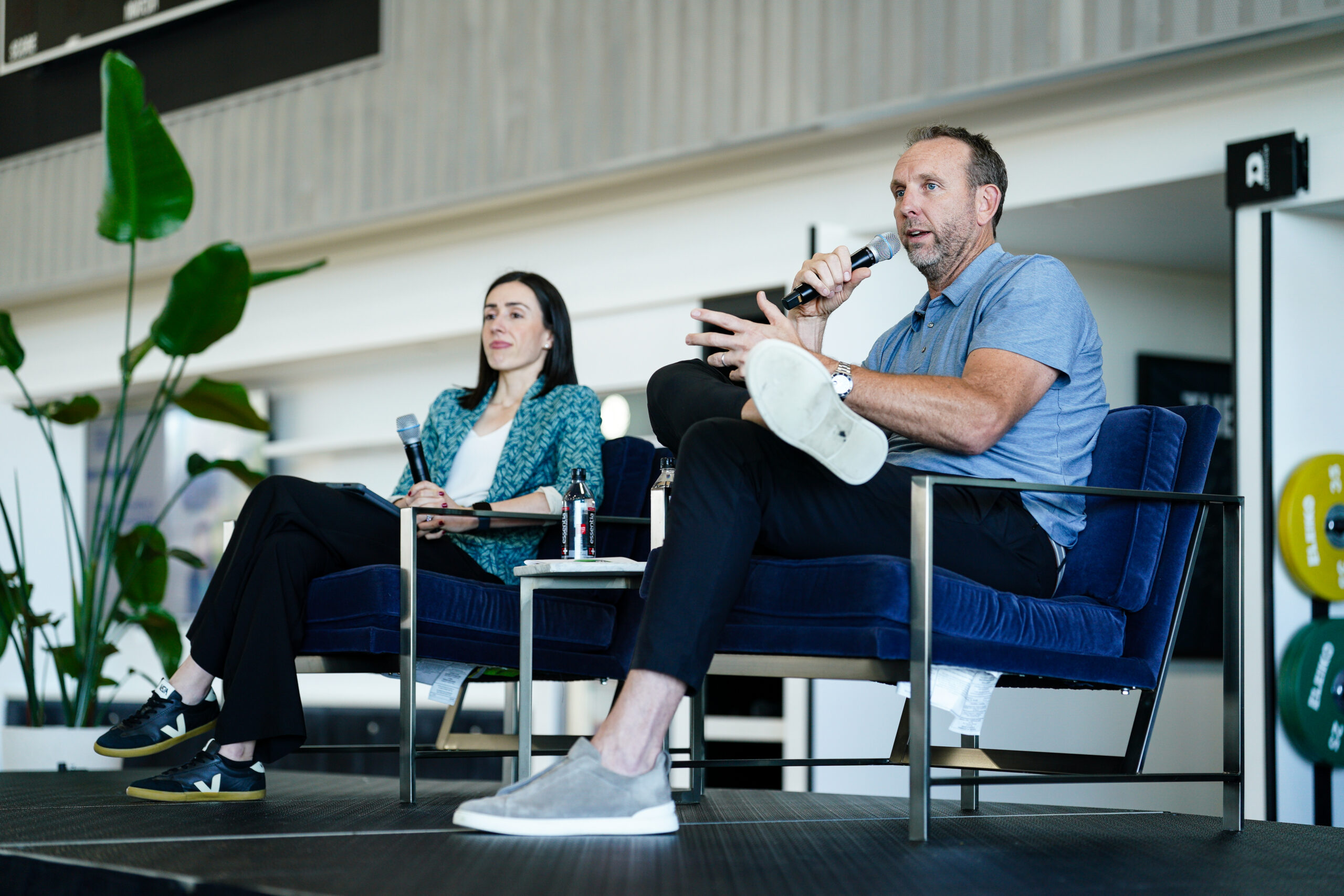
Scarratt was joined onstage by England Head Coach John Mitchell, who in early February extended his contract until the 2029 World Cup and added Scarratt to his coaching staff.
The session moderator, Rachel Vickery, asked him what it meant to see Scarratt and her other non-playing teammates (known within the Red Roses setup as “pillar” players) celebrating with such vigour.
“I reflected that we actually hit the sweet spot with the culture,” said Mitchell. “Sometimes you don’t get that sweet spot and we might not get it again.”

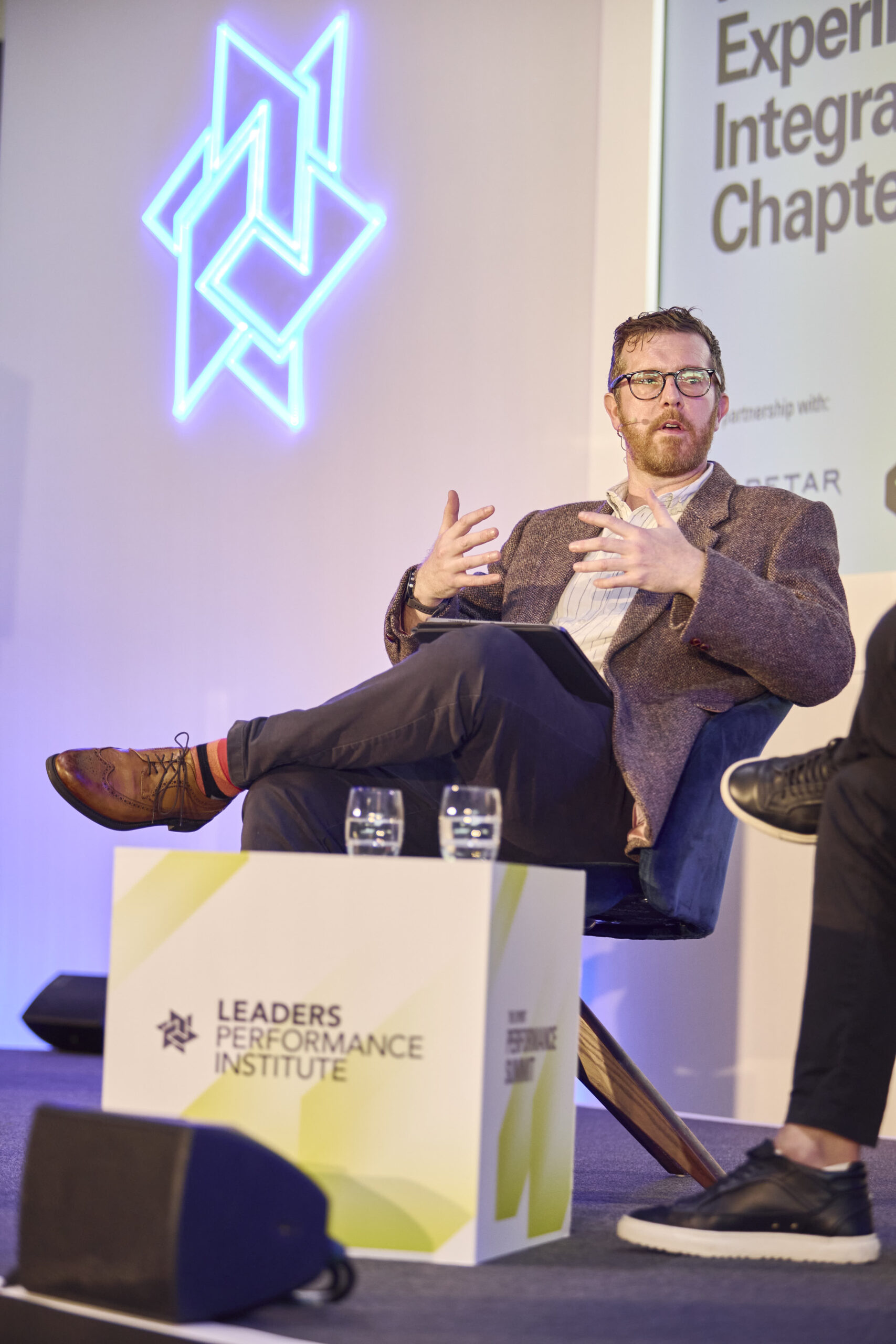
Rachel Vickery (left) talks to John Mitchell (middle) and Emily Scarratt (right) onstage at the 2025 Leaders Sport Performance Summit.
Here we reflect on what Mitchell and the Red Roses got right for 2025.
He spoke up when something wasn’t quite right
When Mitchell signed up to become England Head Coach in 2023, his remit was to win the World Cup. He was a coach with a proven track record in the men’s game who had now been handed the resources and the players to deliver the Women’s World Cup on home soil.
But in 2018 and 2022 England had lost World Cup finals they could, or perhaps should, have won.
“The leading question was how do we get done what we haven’t through the years?” said Mitchell.
It involved integrating young talent (eight players made their World Cup debuts against the US) and tactical tweaks (they had been too reliant on their maul). Both required an environment that enabled the best team on paper to prove they were the best team on grass.
To deliver on that front, Mitchell and the team’s leaders landed on three guiding values: ‘courage’, ‘take the handbrake off’ and ‘be all in’.
These values inspired England’s veterans and new internationals alike. “If the top person genuinely believes that culture is important it makes a difference,” said Scarratt. “Potentially in previous campaigns that hasn’t been the case and culture could get a little bit sidetracked or lost along the way.”
Mitchell even spoke up when he spied a shortcoming in the players’ well-meaning desire to ‘do it for the girls’.
“My thinking was that emphasis might be slightly calibrated towards ‘me’ – not intentionally – but how do I get the girls to calibrate towards ‘we’?” he said. “Because if I inspire you and I’m inspired by you, isn’t that more important, more inspiring to the person next to you? We get the job done and then our voice around our individual ‘why’ will be far greater.”
The cultural tweaking never stopped
“It’s very easy to just pick values, put them somewhere and hope that people live by them,” said Scarratt. “Our values were genuinely threaded through a lot of what we did, whether it was medical presenting or S&C presenting” and, when you witness that, “it’s very easy to buy-in”.
Mitchell held difficult conversations when necessary, but all players and staff, Scarratt said, were expected to speak up when necessary “to nip things in the bud before they became potentially bigger.”
At the suggestion of leadership consultant Patrick Marr, Mitchell would ask his player leadership group and support staff on the eve of each international camp to tell him “who’s going to pull the cart forward? Who’s going to sit on the cart? Who’s going to hold up the cart?”
After an hour he would “come back and I’d see two or three players, plus a couple of staff, where our priority needs to go,” he said, adding “we would then decide on who I would speak to and who they would speak to.” For every player or member of staff, there would be someone who could bridge that gap and “communicate around standards of behaviour”.
Mitchell even danced on TikTok when duty called
If you’re an England supporter, you may have seen the TikTok video of Mitchell dancing with his players.
“I needed to show vulnerability,” he said of such moments, which was not something he considered as a younger coach. “I had to do things that I probably don’t normally do and join in with the girls on certain things.”
Psychological safety may start with players or their head coach dancing in the dressing room, but it ultimately manifests on the pitch during tricky spells or in performance meetings when a staff member has the courage to raise a performance issue.
Mitchell knew he had to lead from the front. “Sometimes you’ve got to be the leader of those actions before somebody else does them.”
That said, his belief in the power of the head coach has been softened (and his self-awareness amplified) by three decades in the sport. “You learn through emotional intelligence that you don’t have to be absolute or right when making decisions. Just use your people. Listen to your people.”

John Mitchell and Emily Scarratt shake hands as their session draws to a close at the 2025 Leaders Sport Performance Summit in London.
The team talked about the pressure they felt
For the first time, England openly spoke about winning the World Cup. It served as a pressure valve and, again, gave voice to their values.
“It might sound a bit silly but we hadn’t done that before,” said Scarratt, implicitly acknowledging how awkward the group felt at first about such an “un-English” sentiment.
As the English media and public latched onto the team ahead of the US match, the pressure grew. The players trained poorly on one occasion but, instead of dismissing it, they discussed it openly.
“I think we did a really good job of dampening it down by not not speaking about it,” Scarratt added. “By actually putting it out there and allowing people to know that other people felt like that.”
And Mitchell’s words after England eased through the gears on the opening night set the tone. He said: “There’s bigger games coming where teams will put even more pressure on us, so let’s take confidence from what we’re building and stacking as we’re going along. Our game doesn’t need to be perfect, it just needs to be effective, and that will win us the tournament.”
He was right and, looking to 2029, their goal is to win back-to-back World Cups, establish a legacy as one of women’s sports greatest teams, and to further grow the women’s game.
These lofty goals provoke three questions that Mitchell and England must answer: “What will earn the right? What will we keep and take forward with us? And then, thirdly, is what we what will we need to start again?”
What to read next
Meaning Does Not Guarantee Medals, But it Strengthens the Behaviours that Make Medals Possible
In the second part of his series, the British Olympic Association’s Paul Ford explains that while Games environments are challenging, Great Britain’s success is testament to stringent planning and preparation – and that athlete education is at the heart of it.
Athletes are compacted into a brand-new village of more than 16,000 people who are all subject to a constrained competition schedule in what amounts to 52 world championships in 17 days, all in the same city.
It’s almost like they are being set up to fail when they’re expected to deliver the best performance of their lives.
However, we like to flip this as an opportunity.
At the British Olympic Association we feel if we educate and mentally prepare the team for what to expect it can bring a performance gain. We unite all the athletes competing as part of Team GB while giving them the platform to perform to the best of their ability.
It builds on the concept of ‘One Team GB’ as I wrote here.
A part of something bigger
‘One Team GB’ is the idea that while Team GB is made up of various national teams and individuals – and the last thing we want to do is remove that individuality – we are all there united under the same common goal as Team GB. To perform at our best and inspire our Nation!
An awesome colleague, Olympian Georgie Harland, conducted a project with the help of Owen Eastwood, during the Tokyo 2020 Olympic Games cycle. They explored our Olympic heritage dating from the 1896 Athens Games. That process unearthed so many different stories, which say to today’s British Olympians: ‘you’re not the first to go to the Games, you won’t be the last either, but you are the next and you now have the opportunity to create your own story’.
More recently, our Athlete Services Manager, Olympic rhythmic gymnast Rachel Smith, evolved this with some exceptional work going into the 2024 Paris Games around generating a true sense of belonging for our future Olympians.
As a Sport team, we visit all the different sports in advance of the Games (our Games Ready roadshow) and talk about these stories going back 130 years and always bring it back to the idea that you have the opportunity to create your own story, leave your mark as an individual in your sport and inspire the nation and next generation.
We encourage athletes to think ‘you matter as an individual’ but also ‘you’re part of a collective effort, and most importantly, you belong here’. They have their individual focus, and being selfish is fine, but we recognise that we’re here as part of that greater common purpose. Bonded by the collective support of one another. This is hugely important when the pressure is so high. No one is on their own!
Looking forward, we will engage past Olympians to continue support this process because they can bring their own stories to life. The athletes of 2028 will recognise the stars of 1984 (when the Olympics were last in LA) such as Daley Thompson and Seb Coe. That peer-to-peer connection is so much better than me trying to tell the same stories alone third hand.
The Opening Ceremony: to go or not to go?
At an Olympic Games, there are certain things you can use as a performance boost. It might be attending the Opening Ceremony: if you walk behind the flag as part of Team GB it can be a massive ‘switch on’ moment ahead of going into competition. However, if you’re competing the next morning at 8:00am in the pool, attending the opening ceremony is not ideal preparation.
You must look at the opportunities afforded by the Games and tap into the bits that are going to build you up without compromising your preparation.
If it’s your first Games, it can be hard to understand just how these different experiences might affect you. You may be on your feet a lot more than normal, meaning your hydration may be lacking, as may your sleep, because you don’t necessarily go back to your room after training and you may stay up later than normal because of the Games ‘buzz’. You may well be looking at your phone and messaging people more so than normal in competition; all that blue light exposure may ruin your sleep quality.
We find that several first-time athletes will struggle to stick to their plan because they might see their role models or idols in other sports who are hugely successful doing something in the gym and they think to themselves ‘oh, maybe I should give that a go’. That’s a potential recipe for injury disaster.
We must prepare that message in advance and tell athletes that when the Games arrive, they must stick to their process because the performances will be there and the results will take care of themselves if they do so. Don’t deviate from the norm at the crucial moment!
When to land these discussions is the next question. Some sports, such as sailing and canoeing, will know their Olympians as early as September 2027; others, such as track and field, won’t select until May 2028. So the education journey we go on with the sailors and canoeists is long; we can plan out and get that right and drip feed it at the right times. Whereas the track and field athletes don’t want to hear anything about the Games because they’re not necessarily going. We must be smart in making the education bespoke and fit for purpose for each sport. Equally, some will want us to sit down and talk it through while others just want those short videos and podcasts. It’s finding out how the different cohort of athletes’ best digest information.
Athletes will already have their own coping strategies and, as with anything else that goes into the preparations, it’s about not trying new things at a Games. Their coping strategies shouldn’t be any different to what they normally are – it’s just that the amplitude of the noise is going to be greater than anything you’ve experienced before.
Our former Team GB psychology lead, Dr Kate Hays, in the build-up to Tokyo 2020, talked through ‘stress buckets’ and the ‘taps’ you place on that bucket are your coping strategies. Our thoughts remain the same: everyone’s release mechanisms will be different, but you need to know when to turn on those taps.
We encourage athletes, coaches and support staff to openly discuss their taps ahead of time so that they are both known and understood, and crucially, supported by their peers.
Blue days, white days
At the Games, we also arrange ‘blue days’ and ‘white days’ where athletes and staff wear Team GB attire of the corresponding colour.
It may sound autocratic, but it is deliberate – even if it’s harder at Winter Games because you’re in so many layers – and there is a rationale. If you walk into an unfamiliar space where you are unknown, it can be uncomfortable, particularly if you’re not from a team sport where the squads tend to move on mass. If you’re an individual fencer, archer or table tennis player, you might be there by yourself and it can be a lonely environment as mentioned – and the last place you want to be lonely is at an Olympic Games, stuck in your own head, when the pressure is mounting.
If you go into the dining hall on a ‘white day’, you’ll see the British athletes stand out against all the other national colours. It’s a safe and comfortable place for you to be part of; it says, ‘we’re all over here’. We tend to say where we’re going to sit each day but the blue and white does make it easier; and it’s not just in the dining hall but also when moving around the village. It’s a conversation-starter and you’ve broken down the barrier because you’re bonded by the kit.
In Paris, we also had our own barista in our Team GB Olympic block so that we could create this common space for people who are all there for the same reason together. You’re not forcing them out of their room but you’re offering it as an incentive.
Our role in performance preparation
We leave the technical work to the coaches, but we need to look at the whole performance picture: what does it take to maximise this and what facets can affect that? What can we tweak within the environment to facilitate comfort, safety, and ultimately enable people to be brave and thrive?
A fundamental part of how you prepare people to perform is as much about getting them mentally and emotionally ready of what to expect. Whilst the swimming pool at a Games is still 50m, and the athletics track is 400m long; it’s the bells and whistles around them that change. We help to prepare athletes and staff for what to expect of the ‘circus’ around them. Their belonging and sense of value to the team, and how by going into this together we can thrive when it matters most.
What to read next
2 Feb 2026
ArticlesIn the first month of 2026 Leaders Performance Institute members discussed at length strategies for effective learning, the value in evidence-informed practice, and why your values should be the carrot, not the stick.
It was a lesson to all sleeping giants. Here was a team with the most losses in the sport’s history and, over the course of their 16-0 season, had compiled more wins than between 2020 and 2023 in total.
Indiana Head Coach Curt Cignetti spoke of a “paradigm shift” in the aftermath of the Hoosiers’ 27-21 defeat of Miami.
“People can cling to an old way of thinking, categorising teams as this or that or conferences as this or that or they can adjust to the new world, the shift in the power dynamic in college football today,” he said.
Cignetti was brought in ahead of the 2024 season and transformed the mindset of a team that had been treading water for decades.
“There’s got to be a lot of like-minded individuals who come together for a common purpose, and sometimes that belief has to be a little bit irrational,” said Indiana centre Pat Coogan.
“Especially in a place that hasn’t had success like Indiana. I’ve seen it, and I’ve seen the way this place has been characterised, and when Coach Cig got here, he believed, and he got people to believe. Sometimes people laughed at him and thought he was crazy, but that’s irrational belief. You’ve got to get people to buy-in and believe in the mission.”
With a host of senior players set to graduate, success may not be replicable in the short term, but Cignetti is ready for whatever comes next.
“Perfection is impossible to attain on a consistent basis,” he said. “But we’ll continue to take it one day at a time, one meeting at a time, one practice at a time, and just keep improving and committing to the process and showing up prepared, trying to put it on the field, and see where it takes us.”
It was a powerful message to kick off the year in sports performance and one that underlined the importance of the fundamentals while refusing to stand still.
Which brings us nicely to the happenings at the Leaders Performance Institute these past four weeks.
Insight of the month
‘What underpins successful teams across formats is not uniformity, but clarity of individual responsibility within a collective framework. Team performance does not replace individual accountability; it depends on it.’
In a guest column, James Thomas, the Performance Director at Warwickshire CCC, spoke about facilities being a secondary concern until the leaders had created the right environment to enable athletes, whether they’re the Olympic champions with whom he has worked or Premier League and Champions League-winning footballers, being paramount.
Read more about why high performance is not something leaders should demand. It is something they should enable.

Britain’s Anthony Joshua on his way to winning gold at the 2012 London Olympics. (Scott Heavey/Getty Images)
Surprising insight of the month
Did you know that Team GB built its own hub within the London Olympic Village in 2012. This was very much a “host nation benefit” as Paul Ford MBE called it in another popular guest column last month.
The Head of Sport at the British Olympic Association wrote:
When we finished in London we looked and thought: ‘it’s not home advantage necessarily, we just need to be more creative’.
It provoked a question: how do we create an optimal physical way of uniting the team within the Games environment? Part of it was using our Olympic Village residential space smarter. But you can’t expect this of the local organising committee to do on our behalf, since their brief is so vast. Instead, we decided to take it out of their hands. And for each of the subsequent Summer Olympics we have found an out-of-village space exclusively for our use.
Read more about their approach here.

Team GB flag bearers Helen Glover and Tom Daley pose for a selfie outside the residence of the British Ambassador to France ahead of the 2024 Olympic Games in Paris. (Alex Pantling/Getty Images)
Best advice
Leaders Performance Institute members across the globe strive to encourage learning throughout their teams and while it will always be an important feature of any successful team, you should not waste your time on the wrong people.
As performance specialist Iain Brunnschweiler explained at a Leaders Virtual Roundtable:
“There’s definitely some people who, you can try as hard as you like to get them to learn and I think we have to be cognisant of our own energy as someone who’s seeking to help. It’s a bit like athletes, isn’t it? If you’re up for it, I’ll give you 150% of my energy. If you’re not, after a period of time, I’ll just go, ‘look, you crack on’. So I think we have to be accepting of that.”
Over the course of an hour, Brunnschweiler and a band of LPI members noted ten strategies for more effective learning.
One you might have missed
Jamie Taylor of Dublin City University and the CoEx|Lab made the case for evidence-informed as opposed to evidence-based practice.
He enlisted the help of students from DCU’s online doctorate and MSc programmes, which are aimed specifically at coaches and practitioners in high performance sport.
One such student is Eilish Ward, the Head of Player Development at the Ladies Gaelic Football Association.
As she told Taylor, you can’t simply drop research on top of a sports programme. It must be used critically, in conjunction with a coach’s own research, and applied in an informed manner.
“There’s not necessarily one solution,” she said. “There’s no one way to learn anything or to gain experience or expertise.”
The key for Ward in her work is to ensure she and her colleagues are “making as informed decisions as possible when we’re designing learning activities” because “not everything from research may be transferable into a practical environment and, equally, every practical environment is going to be hugely different.”
Read more about DCU’s programmes here.
Quote of the month
“We have to become diplomats, high‑level development people who can manage such diverse groups. Somewhere along the line, we need to start creating those development opportunities for everybody who’s on this call.”
These are the attention-grabbing words of a performance director working in India who spelled out the challenges in talent identification and development.
He and a host of LPI members listed five of the most common trends (and five opportunities) in that space.
Good to know
Organisational values should be your carrot, not your stick.
That’s according to Emma Keith, a Royal Air Force Group Captain, is the Commandant of the Tedder Academy of Leadership at the RAF. In 2015 she became the first woman to run RAF Officer Training.
In her appearance at the 2025 Leaders Sport Performance Summit in London, she spoke about how the RAF’s values, all contained within the prosaically titled Air Publication One document, had been used to browbeat good people.
“Actually 99% of my organisation are amazing, they really are, and I wanted a document that was aspirational for them, that they could believe in, that it was the organisation they wanted to be a part of. And we know from all the different behavioural models of change that it only happens when people want to change, not because it’s been forced on them.”
Again, the focus was learning strategies in an inspiring presentation.

The RAF’s Emma Keith onstage at the 2025 Leaders Sport Performance Summit in London. (Leaders)
What’s coming up for members
26 Jan 2026
ArticlesJames Thomas of Warwickshire CCC tells us facilities count for little if leaders have not created the right environment first.
These things do matter. But after more than two decades working across Olympic and professional sport, I’ve come to believe that high performance is fundamentally an environmental challenge, not exclusively a technical one.
We don’t build winning teams or successful athletes by simply stacking programmes on top of talent. We build them by creating environments that consistently allow people to do their best work, make good decisions under pressure, and grow over time. When environments are working, performance becomes more repeatable, more resilient and ultimately more sustainable.
Whether it’s the four-year Olympic focus or the daily spotlight on professional sports. We are operating under constant scrutiny. The margins between competitors are small, the pressure is relentless, and the temptation to chase quick fixes is ever present. In that context, leaders are often drawn towards visible interventions, new structures, new roles, new technology (I know I have been), but the organisations that thrive over time are not those with the most impressive facilities or the biggest performance teams. They are those that are deliberate, consistent and disciplined about the environment they are continually trying to create, especially when results fluctuate.
Lessons from the boxing ring
One of the most formative experiences of my career came during my time as a performance director in Olympic boxing, in the build-up to and during the London 2012 Games.
Many of our world class boxers developed and trained in local boxing gyms, cramped spaces, ageing equipment, minimal to no recovery provision and little separation between training, admin and daily life. These were not purpose-built high-performance centres. They were community gyms, often operating with limited budgets and shared resources.
Yet within those walls, Olympic and world champions were forged.
What struck me most was not what those environments lacked, but what they possessed in abundance. There was deep trust between coaches and athletes. There was absolute clarity around standards and an expectation to commit. And there was a shared belief in the work being done, even when conditions were far from ideal.
That experience challenged a common assumption in high-performance sport; that performance requires elite surroundings. It reinforced a lesson I’ve returned to repeatedly across different sports and systems: facilities and equipment are only part of the environment. People, behaviours and belief are the real performance differentiators.
Boxing also exposes a truth that can sometimes become diluted in team sports: the individual performer has ultimate accountability for their career and performance.
On competition day, a boxer steps into the ring alone. There are no substitutions, no tactical timeouts and no teammates to absorb pressure. Preparation, decision-making and performance are owned entirely by the athlete. That reality creates a powerful mindset.
In the most effective boxing environments I worked in, athletes did not outsource responsibility to coaches, support staff or systems. They understood that support existed to enable performance, not to carry it. Behind each boxer sat a committed group of coaches, physios and performance practitioners, but the roles were clear. The system provided expertise, challenge, support and yes, at the highest level, impressive facilities. But responsibility for improvement always remained with the athlete.
This ownership created cultures where preparation was a non-negotiable, excuses given no airtime and standards were self-imposed rather than enforced. Accountability was not contractual; it was woven into its culture.
While boxing is an individual sport, this principle has resonated with me and translates directly into team environments, particularly in modern professional sport, where complexity is the norm.
From the boxing ring to the crease
In my current role as Performance Director in professional cricket, players operate across multiple formats within a condensed competitive window. From April to October, athletes move between the tactical patience of red-ball cricket, the intensity and speed of T20, and the unique demands of short-form franchise competition, both domestically and internationally.
Cricket is a team sport, but performance within it is highly individualised. Players are often selected for specific skillsets. Some are chosen for endurance and control, others for explosive impact. Some anchor innings, others finish them. Some lead with the ball, whilst others support in the field.
What underpins successful teams across formats is not uniformity, but clarity of individual responsibility within a collective framework. Team performance does not replace individual accountability; it depends on it.
The most effective environments make it clear why each player is selected, what excellence looks like in their role, and how their performance enables others. When players understand their contribution to the collective, alignment improves, decision-making accelerates, and pressure becomes more manageable. Easy to say, but this is hard to get right consistently, especially we often have large squads of players, all looking for 1st team selection. Individual Player Development Plans (IDPs) have been a useful tool to frame season and multi-year goals and how selection decisions can be woven into the discussions, that would otherwise be difficult to frame in a progressive manner.
Creating the space where performance can thrive
One of the most common traps in high-performance team sport is mistaking intensity for effectiveness. I have seen this a lot across all the sporting environments I have worked in. Long hours, relentless training loads and constant meetings can create an illusion of commitment. But without alignment, they often produce fatigue rather than progress. Effort becomes noise rather than momentum and time away from the environment, whether that’s for rest or self-development can be viewed as falling short. I’m calling this out!
Strong environments focus relentlessly on alignment. They establish a shared performance language. Coaching, data and performance teams work from the same principles. And leaders are clear about what the organisation is optimising for at any given moment.
When alignment is strong, intensity becomes purposeful. When it isn’t, that intensity becomes exhausting and I’d suggest the high levels of burnout we are commonly seeing in our system is in part down to this.
The environments that consistently outperform are those where honest conversations are encouraged, mistakes are reviewed and owned, with feedback flowing in all directions. Psychological safety is often talked about and often debated, but for me, this does not mean lowering standards or avoiding difficult conversations. In fact, it enables those conversations to happen earlier and more productively.
‘No spark without friction’ is a phrase I am always drawn to and I think it’s highly relevant in this context.
When I think of environments I have been part of, that have enabled this openness and safety, it has often come from understanding the players and staff in a more meaningful way. Learning about people, their goals, their strengths and areas for development can often help with those difficult conversations and decisions.
Why environment is a leadership choice, not a cultural outcome
Leaders set the tone here. How they respond to bad news, selection tension or performance dips sends a powerful signal about what the environment truly values.
We are also living through an unprecedented expansion of data, analytics and technology in sport. Used well, these tools enhance decision-making. Used poorly, they overwhelm and it starts and ends with the people using those tools.
High-performance environments succeed when data clarifies rather than complicates decisions, supports coaching judgement rather than replacing it, and is translated into simple, actionable insight. The most effective systems invest as much in people and interpretation as they do in platforms and tools.
If high performance is an environment rather than a programme, leadership attention must shift accordingly. The question is no longer “What initiatives should we launch?” but “What conditions must we consistently create?”
Final reflections: build what outlasts you
From my experience across Olympic and professional sport, leaders who build sustainable high-performance environments focus on four priorities.
First, they set a clear long-term performance direction. Ambition without direction creates noise. Leaders must articulate what the organisation is trying to become, what type of performers and people it wants to develop, and how success will be defined beyond short-term results.
Second, they are explicit about the environment they are creating. Every organisation has an environment, whether intentional or accidental. High-performing leaders are deliberate about behaviours, standards and expectations. Culture does not need to be complicated, but it must be visible and consistently reinforced.
Third, they obsess over daily performance habits. Performance is built in small, repeatable behaviours, quality of preparation, clarity of communication, ownership of recovery and willingness to review and adapt. What leaders notice and reinforce signals what truly matters.
Finally, they recruit people who take responsibility and can grow. People are the environment. The strongest systems are built by individuals who take ownership of their impact, are open to developing their technical and leadership skills, and understand how their role contributes to a collective effort.
Across Olympic gyms and professional stadiums, one principle has remained constant for me: high performance improves when clarity of direction, accountability of action and care for people are aligned.
Facilities matter. Data matters. Structure matters. But environments win or lose on the quality of people, the standards they live by and the habits they repeat every day.
High performance is not something leaders should demand. It is something they should enable.
James Thomas is the Performance Director at Warwickshire County Cricket Club and one of sport’s leading high performance experts. If you wish to speak to James, please contact a member of the Leaders Performance Institute team.
2 Jan 2026
ArticlesTeam culture, coach development and cartoons loomed large as we wrapped up 2025.
Here at Leaders Towers we were delighted to enter 2026 with Lando Norris newly installed as the Formula 1 world champion.
Several of us hope it will be the first of several world titles for the Brit, but my colleagues and I were also struck by the manner in which his McLaren Team Principal, Andrea Stella, spoke of Norris’ holistic development since finishing a distant second in 2024.
“He definitely learned a lot from last year’s mission, even though it didn’t go all the way to the last race,” said Stella in the aftermath. “There were some learning moments, like in Austria. That was tough.”
Stella referred to the moment when Norris collided with Max Verstappen as they vied for the lead at the 2024 Austrian Grand Prix. Norris would not finish the race; Verstappen claimed fifth position and a further ten points as he motored towards his fourth world championship. But Stella believed that something changed for Norris that day.
“I think Lando raised his self-image, along the lines of, ‘I can compete with Max’,” Stella added, warming to the topic.
“In my view, there was another important turning point this season: the way Lando responded to the difficulties at the start of the season. That was the beginning of a structured, holistic process that encompassed personal development, professional driving and racing craftsmanship. And I’m particularly pleased that Lando was able to capitalise on that because I haven’t seen anything like it in terms of the amount of work, the people involved and the speed of development.”
These utterances came just days after a Leaders Performance Institute Virtual Roundtable where members discussed holistic athlete development and alighted on some of the themes raised by Stella including athlete co-ownership, the convergence of performance disciplines, and the increasing emphasis placed on mental performance.
Members can read more here.
There was plenty more besides to engage our members’ during a busy December at the LPI.
Insight of the month:
“One of the things I see, certainly in the corporate world, is that people mistake ‘good’ for high performing. In my experience, genuine high-performing teamwork is much rarer than people would admit.
“We know what it feels like when a team is dysfunctional and something’s not working, but when a team is harmonious and there are fairly good relationships, people mistake that for being a high-performing team.”
The wise words of John Bull, the Head of High Performance at our friends Management Futures. Bull led a session looking at the elements that go into making a high performance team, from the building blocks needed to the human factors that can inhibit your progress.
Best advice:
“Listen to the system and the system will tell you what it needs. I think a large part of where culture can get derailed is where people don’t feel heard and valued.”
So said a performance support specialist from the Australian Olympic and Paralympic system at a virtual roundtable where members discussed how their team cultures are evolving.
They specifically referred to the potential resistance a leader may encounter from long-tenured staff or when dealing with rapid turnover. In any case, your people must feel you are listening to them.
Performer(s) of the month:
We’re within our rights to say Norris here, but December’s accolades go to Bluey Heeler and her friend Rusty.
The second half of that sentence may make little sense if you’re not familiar with the Australian children’s animated series Bluey, but one women’s international cricket team has inaugurated its ‘Rusty Award’ for the best teammate, a gong that is handed to a player at the end of every training camp or block.
“We used an episode to bring to life our ‘embrace change’ value,” said the team’s performance lead at the very same virtual roundtable.
Good to know:
Did you know there are four types of innovation?
That is according to renowned change management specialist Greg Satell and his model of innovation, which Professor Fabio Serpiello, the Director of Sport Strategy at Central Queensland University, shared during the second instalment of his three-part roundtable exploration of tech-supported innovation in sport:

Serpiello then shared his thoughts on each quadrant:
Basic research – a low understanding of both domain and problem: “We don’t really know what the problem is and we don’t really know in which field or area it happens.”
Disruptive innovation – a well-understood domain but poorly understood problem: “In this area you may need something like innovation labs or launch pads.”
Breakthrough innovation – a poorly understood domain but well-defined problem: “This is the reverse of disruptive innovation… the classic example of open innovation.”
Sustaining innovation – a well-understood domain and problem: “The most common form in sport [and often the subject of] continuous research, design thinking or road mapping.”
Members can read more here.
Startling fact of the month:
Serpiello was back at it in the third and final session of his series with further reflections on our 2025 Trend Report.
The report posed the question: do you have a process in place to make sure that the tech you implement is the right one?

Fewer than half of respondents said ‘yes’, with more than a third saying ‘no’. Curiously, nearly 20 percent said ‘I don’t know’.
“That’s a good chunk,” said Serpiello. “It is probably more interesting than the ‘yes’ and ‘no’ given that most of the people that responded are at the ‘head of’, ‘director of’ or ‘vice president of’ level.”
What followed was an exploration of what a thorough and considered process of procurement should include.
One you might have missed:
Jamie Taylor, an Assistant Professor in Elite Performance at Dublin City University [DCU], used a virtual roundtable to explain to members that coach development too often veers towards less direct practices.
“Similar to what we see in coaching, there has been a view that it’s inappropriate to offer more direct pedagogical approaches,” said Taylor. He believes this is a consequence of sport being influenced by executive coaching practices and adult learning theory. Yet coaching is not C-suite work.
Supported reflection and communities of practice can be useful, but there are limitations. “If the coach hasn’t got the knowledge to reflect, or the coach developer doesn’t have a strong pedagogical capacity, then it can end up being just a nice coffee and a nice chat.”
Read more about the challenge of raising coaches from merely ‘competent’ to genuinely ‘expert’ here.
Finally…
A photo record of the best bits of 2025 at the Leaders Performance Institute.
What’s coming up in January for members:
Check out your 2026 virtual learning calendar at:
John Bull of Management Futures says it as he sees it, but stresses that all teams can improve their teamwork.
“One of the things I see, certainly in the corporate world, is that people mistake ‘good’ for high performing,” said the Head of High Performance at Management Futures. “In my experience, genuine high-performing teamwork is much rarer than people would admit.
“We know what it feels like when a team is dysfunctional and something’s not working, but when a team is harmonious and there are fairly good relationships, people mistake that for being a high-performing team.”
He presented this distinction between dysfunction and high performing as different ends of a continuum:

“In order to get to the right-hand side of this continuum, high-performing teamwork requires people to lean into behaviours that don’t come naturally,” added Bull.
He then explained that there is also a risk in over-collaborating. “This is about quality not quantity. Our efforts to get more out of teamwork can sometimes slow down performance.”
There is also a distinction between working within a ‘stable team’ (e.g. a department within a high performance team) and teamwork across boundaries, between people who rarely work together or don’t see themselves as one team (e.g. business and performance functions).
The aviation industry, Bull said, excels at cross-boundary teamwork.
“If you think about when you have a critical incident while flying, you’ve often got people in the crew who don’t know each other. The crew must collaborate with air traffic control on the ground, and they won’t know them,” he continued. He explained that the industry has long valued listening and speaking up.
It has also placed an emphasis on ‘diamond thinking’, which looks like this:

“In aviation, when you have to solve an issue, as a rule of thumb, you should spend 50 percent of the time opening the diamond up,” he said. “You get a lot of input but you’re then clear on who’s going to make the final call. Some of us in the coaching space struggle with the balance between democracy and a leader making a decision. Diamond thinking allows for that.”
Bull then led the table into a discussion on his four building blocks of team performance:

He explained each in turn and their different elements.
1. Unifying focus
“If you don’t have clarity you can’t create any of the other conditions.”
2. Quality of interaction
“Trust enables us to lean into more uncomfortable conversations and have the real performance conversations in a way that doesn’t put those relationships at risk.”
3. Quality of action
“High-performing teamwork emerges when people go for the gap.”
4. Shared responsibility
“It’s getting people to recognise that when the team’s not performing they should feel empowered to step in and say something about it and not just rely on the team leader.”
As a follow on, Bull highlights six human factors that can serve to inhibit team performance:

Again, he shared his thoughts on each:
Unequal contribution: “We know from research that if you have a group or a team of eight people 70 percent of the contribution will come from two or three… Status and personality has more of an impact on who speaks than who knows stuff, and that should scare you as a team leader.”
Groupthink: “It’s a hardwired principle of how our brains work that we will conform to the thinking of the group if we don’t have a strong view… One of the best ways to combat groupthink is to get people to think individually before a group discussion.”
Low psychological safety: “Probably the biggest thing that kills team performance is a lack of psychological safety.”
Fixed position: “One of the things that hurts psychological safety the most is defensiveness, where people are in a fixed position. The way you deal with the fixed position that I’ve seen work best is to deal with it one-to-one.”
Tribal or siloed behaviour: “We’re wired as humans to be tribal and there are two types of tribal behaviour. One is where you are deliberately trying to beat the other. What is much more common is you’re not competing but you just don’t think about the other ‘tribe’ as much.”
Poor use of time: “Humans tend to be pretty bad at how we use time together in groups. A quick win is to get the team thinking about when we had our best team meeting, what was it about that, what’s getting in the way of it.”
Bull then returned to the themes of psychological safety and fixed positions when sharing and describing the three types of “thinking environments” in groups and teams as revealed by Management Futures’ research:

“The bottom two points are ineffective,” said Bull. “The definition of open dialogue is where people are saying what they think, but as soon as they’ve put their view out they’re inviting disagreement. It’s not about trying to win the argument, it’s about trying to get to a collective insight of what we know as a group. It’s very different to trying to influence colleagues.”
With time running out, Bull shared a final slide highlighting four key skills to encourage collaboration, with a series of questions for members to ponder: 
In a recent Leaders Virtual Roundtable, members discussed how their team cultures are evolving, with one readily embracing the global hit Bluey in its pursuit of performance.
“We used an episode to bring to life our ‘embrace change’ value,” said the team’s performance lead at a recent virtual roundtable.
It made sense. For one thing, the eponymous character, an Australian cattle dog (known colloquially as a Blue Heeler) puppy, is cute; secondly, the show’s themes of self-development and selflessness resemble the values often espoused in dressing rooms.
With his fellow Leaders Performance Institute members smiling, the performance lead explained that his playing group had gone as far as creating a ‘Rusty Award’, which is named in honour of Bluey’s friend Rusty, an Australian kelpie, to celebrate teammates.
He continued: “At the end of each camp, the players pass the Rusty Award to whoever they think has either embodied our values or has been a real good person around their teammates over that camp or weekend.”
That insight set the scene for a conversation on how members believe their own team cultures are evolving; what is working well and where the opportunities lie.
This is a snapshot of what they shared.
Firstly, there are five things that most teams on the call tend to do well:
1. Articulate their values in a resonant way
Values have to be more than words on a wall.
“Having consistent language has worked well for us,” said the aforementioned performance lead. “We have three values or pillars – ‘embrace challenge’, ‘evolve yourself’ and ‘enjoy the ride’ – and the coaches and support staff have been forthright in using that language within sessions so that the players can always draw back to that.”
A performance support specialist from the Australian Olympic and Paralympic system spoke of her organisation’s renewed emphasis on transparency.
“We’re trying to communicate to athletes as frequently as we can to drive that connection,” she said. “If they feel like they’re well informed and they’re part of the planning, they can also hear reflected back to them things that they have potentially asked for in our feedback mechanisms.”
“We can’t leave any of this for chance,” added a head of coaching and development from the British system. “How intentional can we be with spending time on it? To start to label things so they aren’t subject to misinterpretation?”
2. Inspire personal accountability
It is a question of the standards you walk past being the standards you’re prepared to accept, whoever you are.
“That starts with leading yourself,” said the performance support specialist. “You’ve got to be able to look after yourself before you can look after your teammates.”
“When are we nudging?” said the head of coaching and development. “When are we realigning and checking and challenging the behaviours that we do not want to see or may not be in line with our desired options?”
3. Make their people feel safe
Whether you encounter resistance from long-tenured staff or you are dealing with rapid turnover, your people must feel that you are listening to them.
“Listen to the system and the system will tell you what it needs,” said the performance support specialist, adding, “I think a large part of where culture can get derailed is where people don’t feel heard and valued.”
In response, a sports scientist spoke of their institute’s desire to engender a collective sense of belonging in the pursuit of innovations.
“It’s allowed people to feel like they can make another level of contribution,” she said. “It opened the door in ways where some of our different support team members and our coaches have been given an opportunity to talk about their ‘why’ and talk about their own attachment to our values.”
From that place of interpersonal safety, teams and team members are ready to tackle the issues of the day, even if they end up down “rabbit holes” as an athlete support officer working in the UK system put it.
The first step is to establish the performance question. “That enables us to have challenging conversations without it feeling personal”. Then you must “make sure your people have the ability to express themselves, bring new ideas, problem-solve and make decisions and add their own flavour.”
3. Try new things in low-risk settings
Comfort in risk-taking cannot be separated from notions of accountability, belonging and safety.
“We have benefited from a strong, overt, and repeatedly iterated attitude from our new director and leadership team to take on and try new things,” said one long-tenured attendee presently adapting to new management at a new practice facility. “There’s a sense that we’re not writing a new story but a new chapter.”
4. Celebrate their people
The Rusty Award is a prime example, but gestures can be just as important.
“A lot of people probably perceive working on your culture as a grand gesture moment,” said one attendee, “whereas the little gestures and the little interactions matter way more because they stack and pound over time”.
On top of these encouraging signs of progress, there are three areas where teams can further strengthen their culture with simple tweaks:
1. Celebrate progress, not perfection
“I like to celebrate our imperfections and reframe expectations to give the team belief in its potential,” said a performance support specialist based in Australia. “We say pressure is a privilege, but expectation can sometimes make culture deteriorate because of the pressure and expectation to perform or to behave in a certain way.”
2. Focus on the small interactions
“Corridor conversations are key,” said the athlete support officer, “and I think we forget the impact that they can have.”
3. Keep challenging your assumptions and biases
One attendee suggested red-teaming, which is the practice of stress-testing ideas. He said: “How do we check our blind spots? How do we identify them? How do we systemise those processes?” Doing so is important because “what don’t know what we don’t know”.
What to read next
Renowned performance advisor Richard Young explains how serial winners cut through noise, prepare for pressure, and deliver when it counts.
It’s on every classroom wall for a reason: literacy is foundational. It’s the skill that keeps on giving.
In high performance, we need a different kind of literacy — one that helps us lead, perform, and sustain success amid noise, pressure, and constant change.
It’s the ability to navigate complexity with clarity and intent.
That’s what I call performance leadership.
Over eleven Olympic cycles, I’ve seen what separates one-off winners from serial champions. It isn’t more talent, motivation, or resources.
It’s three deeper literacies that repeat medallists — and the systems around them — consistently master. I call them The Three Literacies of Repeat Medal-Winning Systems. This idea is explored in my book Amplify: The Keys to Performance Leadership.
Beyond the surface
There’s a difference between reaching high performance and sustaining it. The first is an achievement. The second is an art.
Sustained success isn’t about pushing harder or repeating what worked before, it’s about finding and releasing the hidden friction — the small resistances that quietly wear performance down over time. Grit may get you to the summit, but clarity, alignment, and rhythm are what keep you there.
Too often, leaders chase short-term wins or mistake movement for momentum. These distractions drain energy and blur focus. Exceptional leaders rise above by cutting through the noise — focusing on the vital few forces that sustain performance over time. That’s where the Three Literacies come in: the disciplines that keep clarity sharp, alignment strong, and rhythm alive. Let’s explore each of these.
Einstein once said, “If I had an hour to solve a problem, I’d spend 55 minutes defining it and five minutes solving it.” Most teams flip that ratio.
Problem literacy isn’t about tackling a high volume of problems, it’s about knowing which problems matter most and gaining alignment around them. It’s the discipline of naming the real issue, not just the visible one.
In medal-winning systems, people don’t confuse activity for clarity. They slow down to diagnose, ask uncomfortable questions, and map the terrain before they march.
I once worked with a cycling team convinced their problem was bike technology. Our analysis revealed the real limiter wasn’t the equipment, it was the decision speed between coaches and mechanics during live races. Once they solved that, medals followed.
Try this:
Before your next big decision, pause and ask: what problem are we really trying to solve?
Then get the people closest to the action to describe it.
If you hear ten different answers, you don’t have problem literacy yet.
Once the right problem is named, preparation literacy ensures you build the systems, habits, and routines that hold under pressure.
A gold medallist once told me, “When I feel pressure, I return to my basics. That’s my anchor.” True preparation is quiet, repetitive, and often invisible — like a rhizome spreading beneath the soil. You don’t see the roots growing, but they’re forming strength, connection, and resilience long before anything breaks the surface. When pressure comes, those roots hold everything together.
When the right problem is identified, the solution becomes leverageable and sustainable.
As a great leader once told me, “Think once and deliver often.” That’s the essence of preparation literacy: finding the root issue and creating a systemic solution that can deliver again and again. It’s not about reacting faster, it’s about building better. The deeper the root, the stronger and more repeatable the performance.
Try this:
Audit your preparation. Ask, “If the pressure doubled tomorrow, would our routines still hold?” Preparation literacy isn’t about doing more—it’s about building deeper. Because when the surface shakes, only what’s rooted endures.
Knowing what to do and doing it under pressure are two different skills.
Performance literacy is the capacity to act with clarity when the stakes are high and the conditions unpredictable. It’s the meeting point of preparation and reality where plans are tested, emotions surge, and choices define outcomes.
Champions train for this space. They prepare their systems, minds, and relationships to hold steady when the environment doesn’t. High performers don’t wait for calm. They rehearse in the storm. They build familiarity with chaos, practice decision-making under fatigue, and refine communication when time and pressure close in. Over time, they develop a kind of internal rhythm that holds even as everything around them speeds up.
Performance literacy shows up in the small details — the pause before reacting, the deep breath before deciding, the steady tone in the middle of noise. It’s the mark of someone who has built trust in their process and belief in their preparation.
Try this:
Pressure-proof your moments. Rehearse them. Run “what if” scenarios. Expose yourself and your team to the demands of performance before the real moment arrives. Each deliberate repetition builds readiness, confidence, and flow.
The best don’t rise to the occasion; they return to what they’ve trained for. Performance literacy ensures what you’ve trained for is enough when it matters most.
The Performance Leadership Triad
Together, the three literacies form a Performance Leadership Triad:
• Problem literacy focuses your energy on the right target.
• Preparation literacy builds the foundation to hit it.
• Performance literacy ensures delivery when it counts.
Miss one, and the system wobbles. Solve the wrong problem and effort is wasted. Prepare poorly and pressure exposes it. Neglect execution and planning stays on paper.
Literacy never ends
School teaches reading, writing, and arithmetic. High performance demands Problem, Preparation, and Performance literacy—the hidden grammar of sustained success. Because literacy doesn’t end at school — it evolves. And when you master these three, you don’t just win once; you create a system capable of winning again and again.
In my book Amplify: Performance Leadership, I explore these three literacies in depth, with stories from Olympic campaigns, diagnostic tools, and practical frameworks you can apply immediately.
Richard Young is an internationally renowned performance advisor. He has been involved with 11 Olympics as an athlete, coach, researcher, technologist, and leader working across more than 50 sports and seven countries focused on sustained high performance. He has won international gold medals and coached world champions. He founded international performance programmes including, the Technology & Innovation programmes for Great Britain and New Zealand, and a Performance Knowledge & Learning programme for the New Zealand Olympic, Winter Olympic and Paralympic teams. Across seven Olympic cycles he has researched the differences between medallists and non-medallists, their coaches, support staff, leaders and the system they are in to unlock the keys that separate them from the rest.
ESA Director of Science Carole Mundell discusses creativity and problem-solving in volatile environments both in space and here on Earth.
Main Image: European Space Agency
The video depicted a range of space-faring feats performed by the European Space Agency [ESA] as it enjoyed its 50th year.
Mundell, who is the Director of Science at the ESA , brought the room back to Earth again when outlining her efforts to bring together 23 European nations (more specifically their governments) in pursuit of the agency’s interstellar goals.
“Diplomacy is a contact sport,” said Mundell, who is a diplomatic veteran at this stage. She is responsible for a pan-European staff of over 45,000 people, with headquarters in five jurisdictions. You can also throw in the challenges posed by Brexit, the pandemic (when international diplomacy definitely was not a contact sport) and the war in Ukraine.
“The political churn at the moment is unprecedented,” she continued. “From one day to another, we don’t know whether our member state governments will continue to be governments or remain in place for another election.”
This volatility stands in contrast to ESA missions, all of which take decades to devise and tend to last longer than most political careers.
Then there’s the space-based challenges. In her time onstage, Mundell described a range of missions, from explorations of Jupiter’s moons to detailed observations to the surface of Mercury. All require incomprehensible precision.
Take the LISA [Laser Interferometer Space Antenna] mission. Its purpose is to detect gravitational waves in space; the ripples in space-time caused by cosmic events such as black hole collisions.
“They will have three spacecraft flying in convoy, with two and a half million kilometres between each spacecraft,” she said. “They will follow an Earth-Sun orbit and they will rotate and stay in that triangle.”
The lasers in question must be able to point with precision narrower than a proton.
““We’re going to measure the nature of space-time itself. It’s eye-watering technology.”

LISA measuring the properties of gravitational waves (Image: the European Space Agency)
Mundell has become adept at managing the external elements that could derail projects such as LISA. Thanks to her leadership, ESA’s creative and technical minds are able to do their best work in a climate of political uncertainty.
Psychological safety
In space, Mundell told us, things often go wrong. Take the Euclid mission, the purpose of which is to map the ‘dark’ universe. The lens of space telescope, which orbits the sun 1.5 million km from Earth, became contaminated by a strip of ice thinner than a strand of DNA. Mundell’s team had to find a way to defrost the ice without damaging the equipment’s sensitive optics.

Euclid begin its dark universe survey. (Image: European Space Agency)
But if you can reasonably anticipate microscopic space ice then you can devise a plan to defrost it.
“We did that last month,” she said almost matter-of-factly, but the ESA’s staff have built trust in their systems. “At a time of crisis, the first thing you do is check the process.” The system provides a layer of safety that goes beyond the interpersonal dynamics originally associated with the term ‘psychological safety’ (although these remain important; Mundell says: “Please create the best possible cultures you can. Please have the courage to really call out bad behaviour”).
“The cognitive safety comes from the fact that you know there is a process that you’ve all built together.”
This knowledge is also useful when navigating potential cultural differences present in a supranational organisation.
More creative, less expensive, more innovative
On her way to the Kia Oval, Mundell received news that one of an ESA contract negotiation was going backwards.
“My first instinct was to think of a solution,” she said. “And a very calm senior colleague said to me: ‘we don’t need to escalate this’. We don’t always need to go to the nuclear option.”
Such setbacks and budget cuts are par for the course. During his annual press briefing in January, ESA Director General Josef Aschbacher revealed that the ESA budget for 2025 would be €7.68 billion. It was €7.79 billion in 2024, but Germany, Italy and the UK reduced their contributions by a collective €430 million.
“We have to continually innovate and make things more creative, less expensive, but more innovative,” said Mundell, who explained that the ESA must design to cost. While there is room for creativity in day to day problem-solving, the process guides the action taken. “We have a whole quality assurance system where we set our objectives and we say ‘what will we do?’ ‘What did we say we’d do?’ ‘Did we do what we said?’”
Enduring purpose
The ESA was founded to enable European nations to explore the cosmos and further the continent’s knowledge and understanding. It’s an enduring purpose that continues to appeal. On 1 January this year, Slovenia became the 23rd member state, with several others still in the queue to join.
“Our missions are lifetime generational missions,” said Mundell. “You’ll see that people will give a significant fraction of their lifetime to develop, design and fly these missions, and ultimately protect them, to deliver science back to society. Children in school today will use data from our missions.”
She explained that once every three years there is a council meeting of ESA members at a ministerial level to decide the agency’s budget for the next three-year cycle. She shared an image from the 2022 meeting in Paris. It was taken just before she joined:

The official portrait of ministers at the 2022 ESA Council Meeting at Ministerial Level. (Photo: Stephane Corvaja / European Space Agency)
“This is a photograph of inspiration,” she said. “These ministers come from all different political backgrounds, they were facing various different challenges at this time. There was cost of living crisis and obviously the war in Ukraine was pushing all sorts of problems across these member states, and yet they all came together and they agreed that space is important.”
Hear more from Carole Mundell
10 Nov 2025
ArticlesAs Scottie Scheffler’s Ryder Cup travails show, team performance is not simply the sum of individual capabilities. It’s the product of psychological compatibility, complementary strengths, behavioural synergy under pressure, and clear role definition.
Whilst traditional analytics focused on individual statistics and course fit, the tournament results validated what behavioural economics could have predicted: personality compatibility matters more than raw talent in team formats.
As Europe secured a commanding 15-13 victory, several US pairings failed spectacularly despite strong individual credentials. These failures weren’t random—they were predictable through behavioural analysis. Equally important, Europe’s successful pairings demonstrated the power of complementary psychological profiles. Here’s how the science of decision-making under pressure explains both the failures and the successes.
Prospect Theory in action
Before examining specific pairings, it’s necessary to understand Prospect Theory, the Nobel Prize-winning framework developed by Daniel Kahneman and Amos Tversky. The theory reveals that people feel losses approximately twice as intensely as equivalent gains, evaluate outcomes relative to expectations rather than in absolute terms, and shift their risk-taking behaviour depending on whether they’re protecting a lead (becoming conservative) or trying to recover from a deficit (becoming aggressive). Understanding these principles allows us to predict when players will make poor decisions, even when they’re emotionally calm and technically skilled.
The gold standard: Seve Ballesteros and José María Olazábal
The most legendary Ryder Cup partnership in history provides the perfect template for behavioural compatibility. Playing together 15 times between 1987 and 1993, Seve and Ollie won 11 points with a record of 11-2-2—the most successful pairing in Ryder Cup history.
Why they worked:
Ballesteros’ aggressive, risk-seeking approach was balanced by Olazábal’s steady precision. Different styles, unified purpose, perfect synergy.
At the 2025 Ryder Cup, Rory McIlroy and Tommy Fleetwood demonstrated the same principles, going 4-0 in their matches. McIlroy’s aggressive, expressive leadership paired perfectly with Fleetwood’s steady, supportive presence. It was a modern validation of the Ballesteros/Olazábal template.
The English-Morikawa disaster
The most glaring failure at the 2025 Ryder Cup was the Harris English and Collin Morikawa pairing, which DataGolf retrospectively ranked as the worst possible combination (132nd out of 132 pairings for Team USA).
They lost 5&4 to McIlroy/Fleetwood on Friday and lost 3&2 to the same pair on Saturday.
Behavioural analysis tells us that both players share problematic psychological profiles for team play.
These include:
When facing the aggressive, crowd-energised McIlroy/Fleetwood duo, they had no mechanism to generate counter-momentum or break negative cycles. Their conservative tendencies amplified each other, creating a downward spiral that traditional coaching couldn’t address.
The contrast with Ballesteros/Olazábal is stark: Where Ballesteros told Olazábal “I will take care of the rest,” English and Morikawa had no such clarity. Both waited for the other to lead.
Scheffler’s team format struggles: when strengths become weaknesses
Perhaps more surprising was Scottie Scheffler’s continued struggles in team formats. Despite being the world’s most dominant individual player, his Ryder Cup record tells a different story: 2-4-3 overall, 0-3 in foursomes.
The behavioural explanation is that Scheffler’s individual strengths become liabilities in team play.
More specifically:
The same psychological traits that make him unbeatable individually (complete control, perfectionism, internal focus) become obstacles when success depends on partnership dynamics. His pairing with Russell Henley (both introverts, both analytical, no clear leadership dynamic) lost 5&3 to Jon Rahm and Sepp Straka, the match effectively over after the front nine.
These Ryder Cup results offer crucial insights for organisational team building:
Traditional thinking suggests pairing similar personalities for harmony. Behavioural economics shows the opposite: complementary traits create stronger partnerships. Successful teams need energy generators AND steady influences, communicators AND processors, leaders AND supporters.
Evidence: Ballesteros/Olazábal (complementary) = 11-2-2. English/Morikawa (similar) = 0-2.
Individual excellence doesn’t guarantee team success. The psychological skills required for individual performance (self-reliance, internal focus, personal control) can become liabilities in collaborative environments. Leaders must assess team readiness separately from individual capability.
Evidence: Scheffler is world No1 individually but 2-4-3 in Ryder Cup team play.
Every successful partnership has clear role definition: who leads, who supports, who generates energy, who provides stability. Without this clarity, decision-making becomes paralysed.
Evidence: Ballesteros told Olazábal “I will take care of the rest”—instant clarity. English/Morikawa had no such definition.
How individuals respond to pressure in team settings follows predictable patterns. Some become more conservative (loss aversion), others more aggressive (risk-seeking), some internalise stress, others externalise it. Understanding these patterns allows for better team composition and intervention strategies.
The Prospect Theory twist
Interestingly, as the US fell further behind, Prospect Theory predicted they would become more risk-seeking (people take more risks when in the domain of losses). This psychological shift actually improved some performances in singles play, where individual risk-taking could be an advantage rather than a team liability.
Practical applications for leaders
Team formation:
Performance optimisation:
Crisis management:
Conclusion
The 2025 Ryder Cup demonstrated that in high-stakes team environments, behavioural compatibility often trumps individual talent. Whilst the US had superior individual players on paper, Europe’s better understanding of team psychology—whether intentional or intuitive—proved decisive.
The evidence is compelling: Ballesteros/Olazábal’s 11-2-2 record and McIlroy/Fleetwood’s 4-0 performance demonstrate the power of complementary psychological profiles. Conversely, English/Morikawa’s 0-2 disaster and Scheffler’s 2-4-3 record show the cost of ignoring behavioural compatibility.
For leaders in any field, the lesson is clear: team performance is not simply the sum of individual capabilities. It’s the product of psychological compatibility, complementary strengths, behavioural synergy under pressure, and clear role definition. Understanding these dynamics isn’t just useful, it’s essential for consistent high performance in team-based environments.
The most successful organisations will be those that apply behavioural economics principles to team formation, recognising that the science of human decision-making under pressure is as important as technical skill in determining outcomes.
Dr Benjamin Kelly is the Head of Behavioural Economics & Social Impact at Kavedon Kapital. If you would like to speak to Benjamin about his work, please contact a member of the Leaders Performance Institute team.
What to read next
What Behavioural Finance Teaches us about (Bad) Decision Making in Golf