2 Mar 2026
ArticlesIn February, high performance specialists from across the sporting landscape wrote and spoke about a range of topics including performance systems, coach wellbeing and organisational alignment.
The Chinese-American star, who had just won silver medals in the slopestyle and big air at the Milano Cortina Olympics, had been asked at a press conference if she saw those medals as “silvers earned” or “golds lost”.
She chastised the journalist for his “ridiculous perspective” but her wider comments were more telling.
“How do I say this? Winning a medal at the Olympics is a life-changing experience for every athlete. Doing it five times is exponentially harder because every medal is equally hard for me, but everybody else’s expectations rise, right?” she said.
“I’m showcasing my best skiing. I’m doing things that quite literally have never been done before. So, I think that is more than good enough, but thank you.”
It called to mind the Milwaukee Bucks’ Giannis Antetokounmpo, who was similarly exasperated in a press conference when he was asked about the Bucks’ ‘failure’ upon their elimination from the 2023 NBA Playoffs.
“There’s no failure in sports,” he responded. “There’s good days, bad days, so days you are able to be successful — some days you’re not. Some days it’s your turn, some days it’s not your turn. That’s what sports is about. You don’t always win — so other people are going to win, simple as that. We’re going to come back next year, try to be better, try to build good habits, try to play better.”
Gu, it must be said, won gold in the halfpipe just days later (making it three golds and three silvers in two Olympics) but she and Antetokounmpo (who won the NBA Cup with the Bucks in 2024) hinted at how unhelpful it is to frame high performance as anything less than first place or a gold medal.
Setbacks are inevitable, but as Gu and Antetokounmpo show, athletes, coaches and programmes can choose how they meet the moment. Those that prepare smartly, with the right focus and guidance, can give themselves improved chances of success.
These ideas came up time and again at the Leaders Performance Institute in February. Here is a flavour of what was said.
Insight of the month
The Winter Olympics are on the agenda across the Performance Hub, with high-performance specialist Richard Young telling us what happens when teams stray from their mission:
As the event approached, small adjustments began to appear. Plans were refined again. Extra conversations were added. Senior leaders checked in more frequently. None of it seemed dramatic, yet the clarity that had carried them started to dilute. The athletes felt it before anyone articulated it. The system became busy, and when the moment came the performances were close but the medals did not follow.
The issue was not effort; it was the absence of a shared and protected standard. When everything feels important, the essential things lose their edge. The debrief circled around marginal gains, yet the real margin had slipped much earlier. At some point the team stopped asking whether each decision truly met gold medal quality.
Read more here.
Quote of the month
This month its Peter Hodgkinson, who wrote of his time working as Build Operations Manager for the INEOS Britannia sailing team during the 37th America’s Cup.
Given the youth and inexperience of his build team, psychological safety and intent-based leadership were the order of the day. He wrote:
Surprises are for birthdays and Christmas, in my book. I wanted this young team under pressure to speak up. I wanted them to feel that it was wrong not to say something if they were concerned about a part or a process or were having a problem. I wanted to hear what they had to say, I was desperate to hear what they were thinking, and it was important that I responded productively when they did bring me bad news.
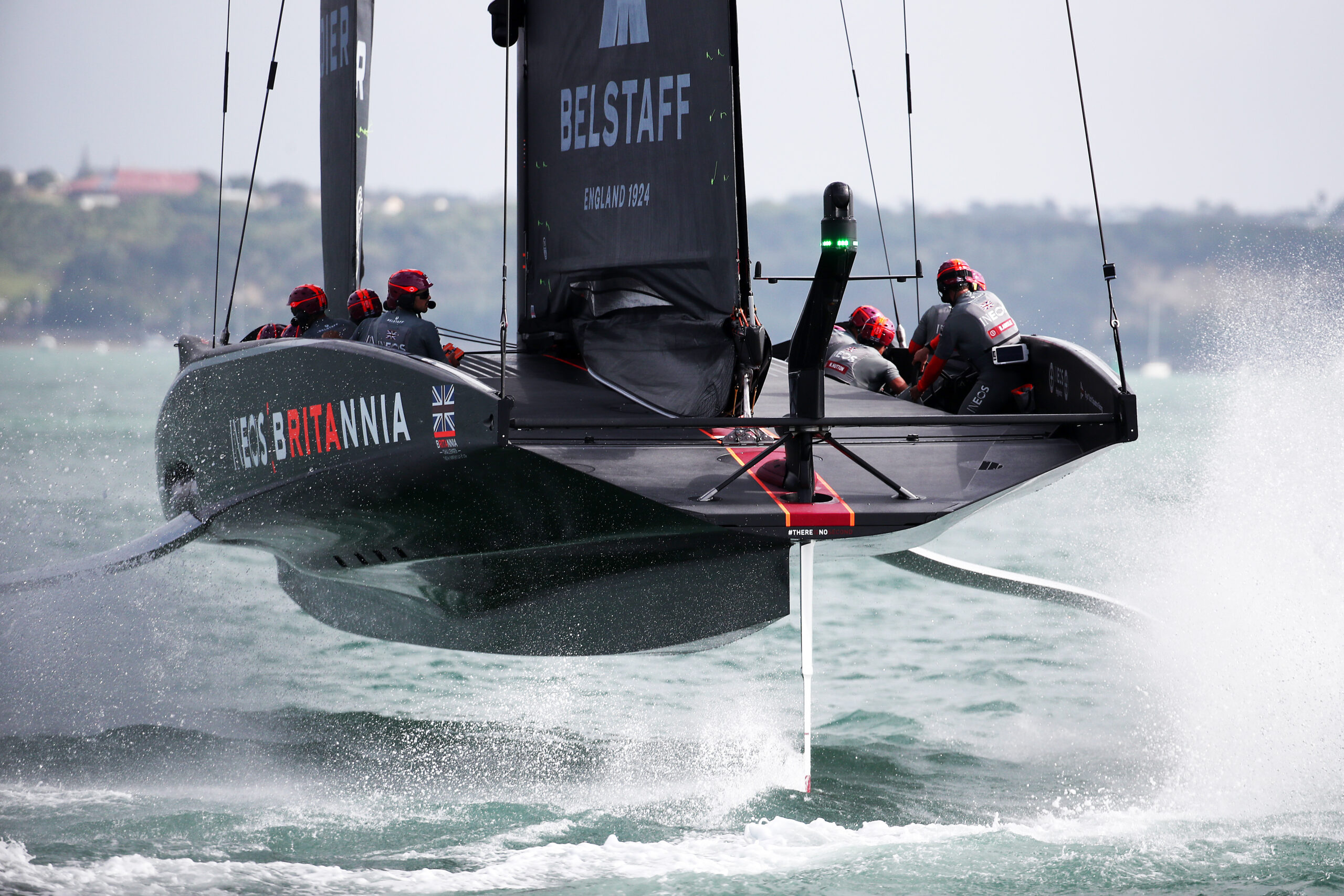
INEOS Britannia in action at the 37th America’s Cup. Photo: Getty Images/Fiona Goodall
Good to know
Pressure doesn’t make you better, but it does reveal what is already here.
That is according to high-performance specialist Rachel Vickery, who led a virtual roundtable for members looking at how they can reduce their athletes and coaches’ allostatic load – that is the cumulative ‘stacking’ of stressors over time that erode the amount of physiological ‘space’ an athlete has between their current arousal level and their personal stress threshold.
The stressors in question can be personal (e.g. a lack of sleep), organisational (e.g. misalignment), performance-based (e.g. being outside your comfort zone), or physiological (e.g. reduced ability to hear or absorb information).
Crucially, as Vickery explained, “as long as your arousal state stays below your threshold, your negative performance will not show up.”
Read more here.
Coach wellbeing
Though often neglected, members of the Leaders Performance Institute gathered to share ideas on how they can better support their coaches.
In one particular World Cup-winning environment, when athletes wanted specialist help, they were asked to book appointments. There was no 24/7 service.
This, their former manager explained, not only developed the self-reliance of the players, but also served to protect coaches and staff members who were all too ready to put themselves out, whether for out-of-hours appointments or “2am emails”.
Read more here.
Aussie rules
In early February we welcomed many of you to Brisbane for Leaders Meet: Australia, where organisations including the Brisbane Lions, Cricket Australia and World Rugby tackled the challenges of the day.
Chief amongst those was the ever-pressing need for alignment.
The Lions’ Senior Coach Chris Fagan favoured strong relationships with senior management; Australian all-rounder Ellyse Perry espoused the value of psychological safety in cricket; and World Rugby Chair Brett Robinson, as an executive, emphasised trust built on clarity from the top.
We picked out five elements for your consideration.
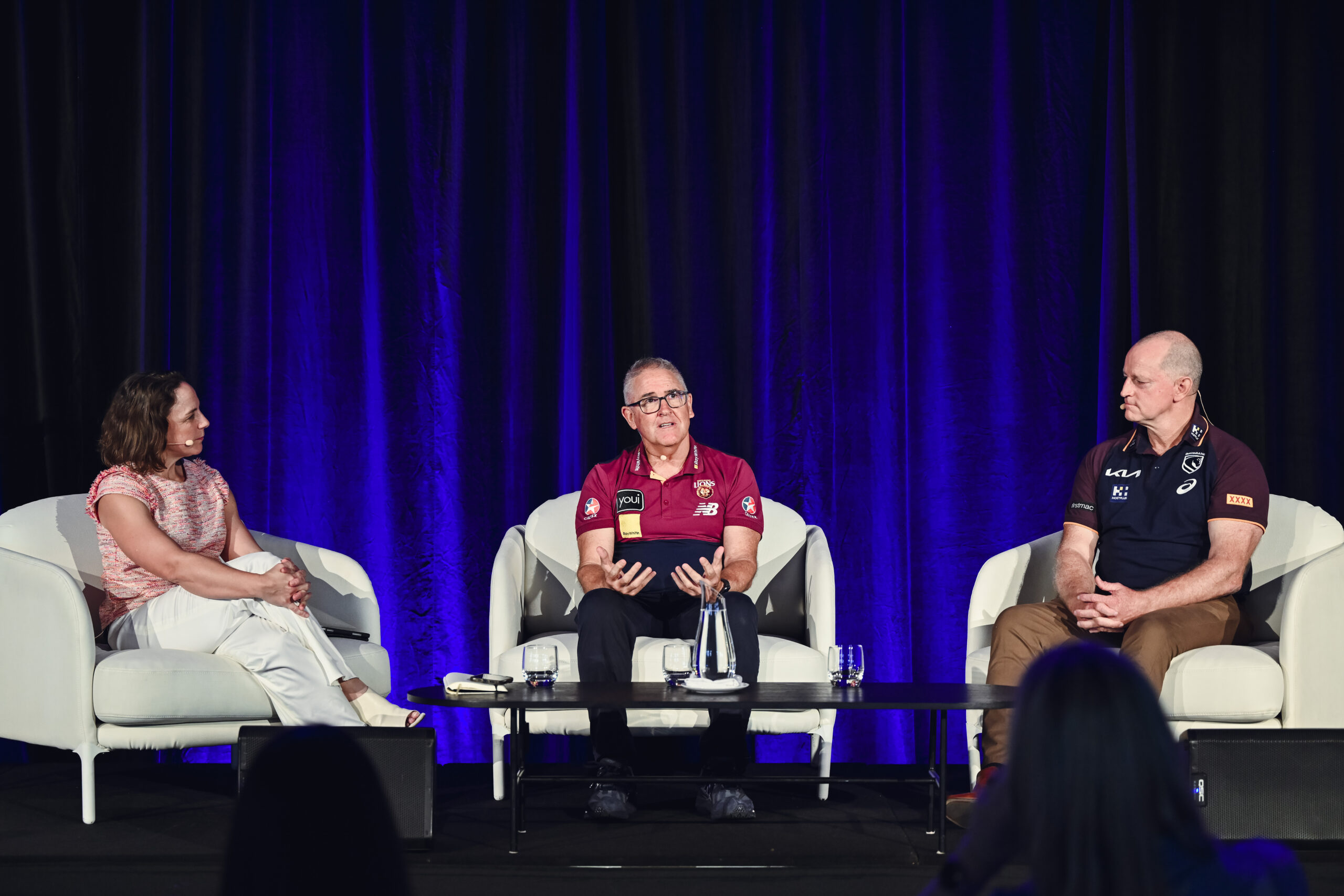
Chris Fagan (centre) in conversation with Michael Maguire (right) and moderator Rachel Vickery. Photo: Albert Perez
One you might have missed
Ben Ashdown and Dr Mustafa Sarkar of Nottingham Trent University pondered the behavioural elements of resilience in young players at football academies in this exclusive interview.
Their research has identified six resilience behaviours:
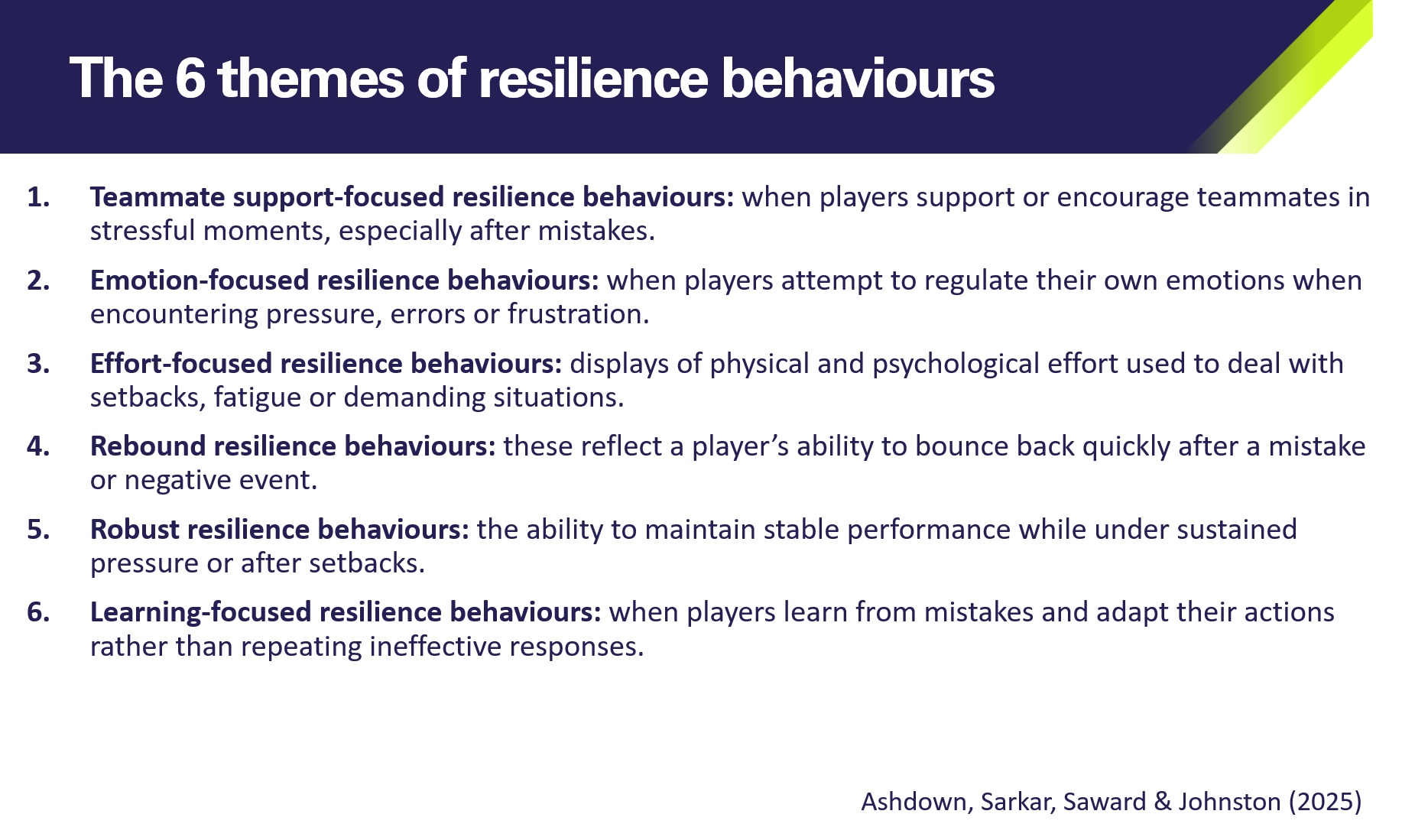
Their hope is to use these six to fashion a tool to help academy staff identify and develop resilience behaviours in their young athletes.
Read more here.
What’s coming up for members
There’s plenty more that can be done but, at a recent Leaders virtual roundtable, members suggested some ideas that have worked for them.
“Take the medical room as an example,” said the former manager of the team in question. “That was a nine-to-six place for booking appointments because we were trying to demonstrate the reality around what life looks like rather than getting the athletes into that mindset of ‘I’ll just ring the physio, I feel like my hamstring needs a little bit of rub at 10 o’clock at night’.”
This, he explained at a recent Leaders virtual roundtable, not only developed the self-reliance of the players, but also served to protect coaches and staff members who were all too ready to put themselves out, whether for out-of-hours appointments or “2am emails”.
It was a simple but important way of addressing the fact that staff wellbeing support tends to lag behind its athlete equivalent, which has its personalised wellbeing plans, dedicated staff and education programmes.
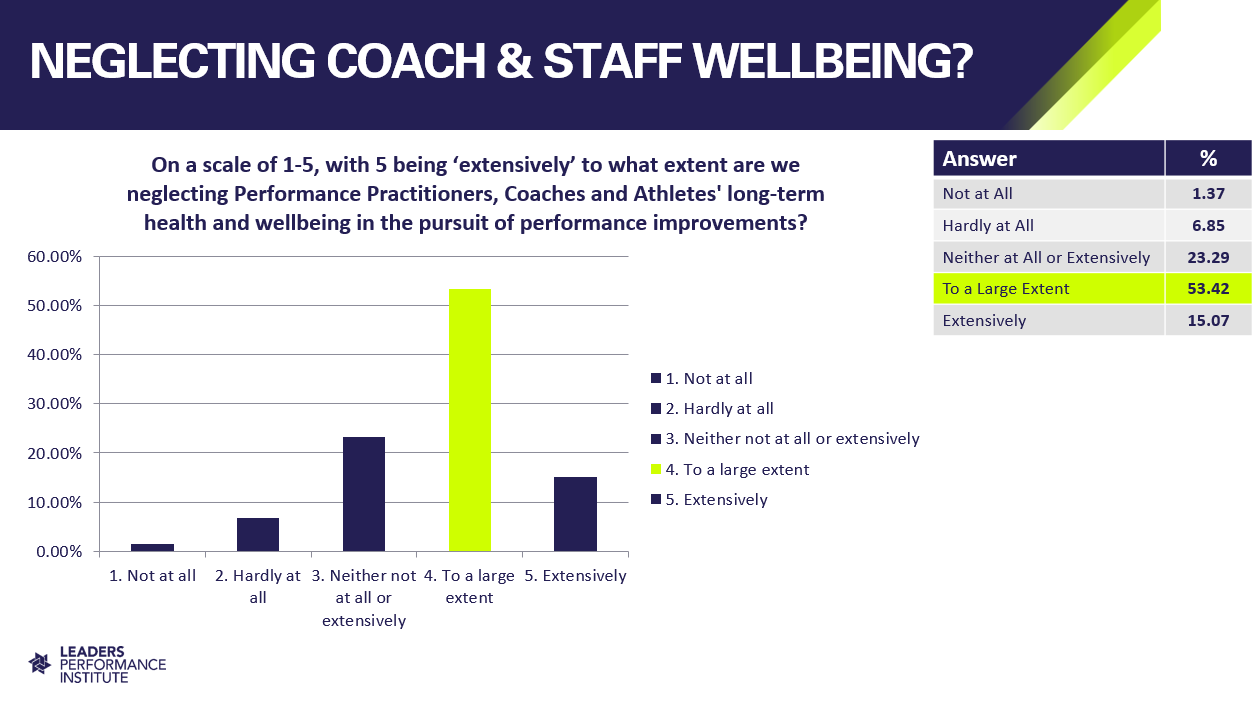
Our 2025 Trend Report painted a vivid picture of how neglected coach and staff wellbeing is across elite sport.
The key is in showing that performance and wellbeing are just as indivisible for coaches and staff as they are for athletes.
“A system wins a championship, and a system is like an ecosystem,” the erstwhile team manager continued. “If we mapped out some of the challenges we face within our environments, how many would relate back to wellbeing?”
The penny has started to drop. Below, we focus on the initiatives that have served Leaders Performance Institute members well, as discussed during the roundtable.
Apply universal principles of wellbeing
This must be the starting point. Consider belonging, identity, balance and thriving (rather than merely surviving) as elements of wellbeing; teams readily apply these to athletes, but they should apply to coaches and other staff too.
As a performance lifestyle manager based at a British university told his fellow members: “if we break down the behaviours that we celebrate, we have to believe that thriving staff who are relaxed and able to sit back and think of the bigger picture are beneficial within our systems.”
Formalised support structures
As mentioned above, in more mature systems, these have long been in place for athletes. “We’re seeing that happening in our coaching space too,” said a wellbeing and engagement manager based in the Australian system, which leads the way along with nations such as the UK. “Our coaching development team has started to look at ways of doing that and having coach development plans in place. I know it’s simple, but that doesn’t happen fundamentally in organisations.”
With prevention built into the system it helps to reduce levels of reactive support for employees, which brings us nicely to good habits.
Healthy routines
“I find you get a lot of people who just see their role as 24/7,” said the former team manager. “We decided as a group to change the paradigm and put the same expectations on the staff as we did on the players. We knew the gold standard was eight hours of sleep a night, so that became the staff expectation.”
The ‘gold standard’ is not just a nice metaphor. Research demonstrates the link between high wellbeing and decision-making quality. It comes back to those elements of wellbeing discussed above.
“It meant that our staff group were consistently operating at a much higher level of performance than previously,” he added.
‘Thrive days’
Again, this comes back to the system and structures. “You have to incentivise some people to take time off,” said an Australia-based wellbeing manager who spoke of what they call “thrive days”. “They have been really successful from an organisational perspective.” An employee will also have personal objectives related to their wellbeing.
Coaches and staff benefit directly, but the system benefits when people can “hold on to their identities outside of work or outside of coaching; and that coaching doesn’t become their primary identity,” as the academy manager noted.
Personalised, flexible work schedules
If you want staff members to prioritise their personal lives – often their greatest source of stress – then you must enable them to do so either through flexible scheduling or rotating duties.
“We’ve got a couple of coaches who this year became new parents,” said a coach working in Australia as an example. “We give them the flexibility to design the training calendar programme for the year so it navigates around their day‑to‑day demands.” The same goes for non-parents too.
Of course, as one member pointed out, rest days, rotation and a reduction in back-office tasks are all easier to propose for teams with greater resources.
A coach that role models the desired behaviours
The coach needs to be a role model in self-care, which is often easier said than done.
“If we can’t get them to shift in their thinking, it’s very hard to get this in place,” said the former team manager. “Influence really comes from the behaviours; what people see, how they’re feeling your leadership, particularly around wellbeing and what you expect of yourself.” But even for well-meaning leaders it is a problem if “you’re asking someone else to prioritise their wellbeing, but you’re not demonstrating that yourself.”
Peer to peer encouragement is invaluable too. “Having a small thing like a peer support group where staff members are connecting with like‑minded people and sharing insights is one way of supporting them,” said the academy manager.
Internal stability
We often talk about consistency in performance, but it is just as important in your internal comms, as a cricket team based in England have found.
“It creates stability throughout the training day so that under pressurised match‑day situations we are already familiar with what the process and structure should be,” said the team’s sport and exercise psychologist. “We know where we can get that information and, actually, it should land on their desk pre‑game.”
The same goes for pre-season plans, weekly updates and even five-year plans. “It links back to the coaches’ levels of stress because it’s less up and down during the day because they know what the action is linked to.”
Clarity also provides a sense of safety. “We have to make sure that all the coaches and staff feel comfortable that they can raise things with myself or with other people because you’re not going to know what the challenges are around people’s wellbeing if they don’t feel comfortable raising that,” said a UK-based academy manager.
What to read next
2 Oct 2025
ArticlesFemale athletes, Artificial Intelligence, adaptive leadership and psychology were all on the agenda in September.
“Most of my career has been in the men’s game,” he said in the aftermath. “It was the only reference I ever had. To get the opportunity to coach these girls you have got to observe and listen and find ways to make them tick.”
The bonds they have forged during his two-year tenure will last a lifetime. “To be associated with these girls, they are driven, they have changed my life, changed the way I think as well. All of those sorts of things are added bonuses. A trophy is one thing, a medal is another thing but actually the quality of the people you work with is the ultimate.”
Mitchell’s sentiments were reflected across several of the conversations we hosted for members of the Leaders Performance Institute in September, from coaching female athletes to a coach’s ability to adapt to their changing environment.
Here are some of the choicest cuts.
Performance anxiety or body anxiety?
Last month, we shone light on Rachel Vickery’s appearance onstage at the Women’s Sport Breakfast at our Sport Performance Summit in Philadelphia. Vickery, a high-performance specialist and former artistic gymnast, recounted a recurring issue from her time working as a physio. Young female athletes would occasionally be sent to her with what was assumed to be exercise-induced asthma. It turned out their breathing difficulties were often anxiety-induced.
“You could see the look of relief on their faces when I started talking about body image, self-esteem and self-worth,” she continued. “So I started a seminar series in 2008 for female athletes and their parents called Growing Up in Lycra around body image identity.”
The seminars were picked up by Swimming Queensland. “I project managed the transformation of these seminars into an education DVD resource that was sent to all female athletes, parents and coaches State-wide.” It was later turned into a national resource by Swimming Australia. “We got some former Olympians involved and that resource went to all of our female athletes, their coaches and their parents. That resource is still used today.”
The role of AI in learning
Vickery was back at the helm for a Leaders Virtual Roundtable discussing how Leaders Performance Institute members can make learning more effective within their teams.
AI was high on the agenda. “AI should be used to support the growth and creativity of staff as opposed to being used for shortcuts where people become lazy,” said one coach developer.
Overreliance on AI, as this coach pointed out above, can stifle creativity. The table also suggested a series of shortcomings in current generations of AI:
The table then highlighted some potential solutions:
Are you an adaptive leader? You’ll need these four skills…
Tim Cox, the Director & Lead for High Performance Research at Management Futures, led a Skills Sprint Session virtual roundtable for Leaders Performance Institute members on the topic of adaptability.
It is a skill, as Cox explained, that was highly coveted by the coaches and practitioners who contributed to our Trend Report earlier this year.
Not that this is anything new. “It is well known that Charles Darwin did not talk about ‘the survival of the fittest’,” Cox continued, with reference to Darwin’s 1859 book On the Origin of the Species.
“The endpoint of Darwin’s research was that it’s not the strongest or the most intelligent of the species that survives, it is the one that is most adaptable to change.”
Over the course of 25 minutes, Cox discussed traps that people can fall victim to in pursuit of better adaptability. He also brought into focus the qualities of adaptive leaders and the skills that can aid adaptation.
Cox discussed four skills:
Read more about the qualities of adaptive leaders here.
‘Sports psychologists cannot just sit and wait for work to come in the door’
Darren Devaney, the Lead Performance Psychologist at Ulster Rugby, and Daniel Ransom, the Head of Psychology and Performance Lifestyle at the Manchester United Academy, co-hosted a virtual roundtable exploring how teams can better use psychology.
They discussed three requisite qualities in depth:
According to Devaney, the psychologist must “get away from the assumption that we work with the individual athlete only”. Instead, they should ask themselves “is my intervention best targeted at an individual or is this more systemic? And if I’m going to be here for the next five or six years, what’s the most useful way of spending one or two hours on this? Is it working with a head coach? Is it working with all the staff? Is it working with a group of players, or is it the one-to-one with the athlete?”
Psychology is not just the work of the psychologist. “An hour spent with one individual athlete is very well spent,” said Devaney, “but an hour spent with somebody that upskills or shapes them”, such as a coach, brings your work into “exponential territory”. He continued: “it changes how they do their work with 20 or 25 people over the course of the week”.
Ransom added: “If we really want to embed and integrate psychology what we require is other people to take on our ideas and work in ways that are psychologically-informed.”
“We can’t sit still and wait for work to walk in the door,” said Devaney. “I’ve often reflected that this organisation functioned for decades without me in the building, so if I’m not here, this place can keep going. I need to recognise the fact that it might not be every day the main thing that everybody’s thinking about, so how can I do that in a way that doesn’t produce scepticism or kickback?” Nevertheless, “you must be proactive in trying to have an impact.”
Ransom has advice for anyone encountering scepticism. “If people are ready for more in-depth and focused work, then let’s meet them there. If they’re not, and they’re at that sceptical end, how do we try and offer them something which is appropriate to the needs of what they might be open to? If we pitch that wrong and we try and go too hard or move too quickly with those people, I think you can get caught in a potential tug of war where we don’t really make much progress and people hold their position.” With skilful guidance, people can “see the value that other people have, and that can be a way of opening a few windows and doors to them.”
Find out more here.
John Crawley of the US Olympic & Paralympic Committee is wary of the risk of dehumanising athletes in the pursuit of performance.
Whether it’s high performance or data-related (or even the regular anti-doping tests), it can be intrusive and dehumanising.
“While I appreciate the opportunity for data to inform decision making, I also think we have to be really careful about too much information clouding our judgement, too much information getting in the way of relationships, and too much information turning into surveillance that turns athletes away from sport itself,” says Crawley, the US Olympic & Paralympic Committee’s High Performance Director for team sports.
“We’ve lost athletes because of that,” he continues. “Let’s be honest here: there are athletes who have said ‘once this is over with I want to have my life back’.”
Such micromanagement would not be tolerated in other fields, he believes, and no athlete wants to feel like “a pin cushion that is being monitored 24 hours a day; and if anything is perceived to be off or not optimised then something is wrong and there needs to be an intervention.
“I think we have to be really careful about that.”
Crawley was a contributor to our Teamworks Special Report earlier this year and candidly shares his thoughts on the consequences of the growing sophistication and complexity of high performance environments.
“While increasingly specialised areas of service and support present a challenge, there is also an opportunity to be more reflective and critical around how and why things are evolving the way they are,” he says.
“We want to get back to what these systems were designed to do, making sure that they are operating in the most effective manner possible without becoming overly burdensome, intrusive, or otherwise counterproductive.”
Here, Crawley reflects on how the high performance system may get there.
Coaching, connecting and caring
Crawley recalls a conversation with a friend who happens to be a serial-winning US coach. That coach had three focuses for the LA cycle, telling Crawley ‘I want to focus on coaching, connecting and caring.’
“Coaches have the ability to cut right to the heart of it,” says Crawley.
Don’t always add – try to take away
Crawley remains open-minded to new ideas and approaches but in some respects his approach has evolved from where it might have been 20 years ago. He’s gone from routinely exploring where he can add services or modalities, to asking the opposite. “Are there things that we don’t need to be doing anymore that are getting in the way? Are there things that are counterproductive to ultimately what we’re trying to do? Are there things that are too invasive? Are we getting away from connection between the provider and the athlete and are we now operating more through a filter of some kind of technological gadget?” he says.
“I’m asking more critical questions to get to the heart of why things are being done, their impact, and ensuring we are being supportive and not being overly prescriptive or dehumanising those interactions in any way.”
How does the athlete experience us?
Crawley is also wary of the myriad voices an athlete will hear each day. He says: “When we think about design and implementation, one of the things that’s really important for us to understand is how does the athlete experience this? How many different voices are they hearing and how many different perspectives are they getting? How can we think with the end in mind and bring that back to how we operate as a team?”
It becomes a question of wellbeing. “Unless their personal lives are supported as well – mental capabilities, emotional support, educational desires, professional desires, career aspirations, etcetera – I don’t think the athletes would be in the best position to really aspire towards their ultimate athletic aspirations.”
Surveillance versus support
Crawley stresses that he is not a Luddite but, when using tech, he says: “we have to be mindful of moving into a space of surveillance versus a space of support and there needs to be a strong distinction made between the two.”
The tech must prove to be a demonstrable asset. “I think there is real value in what we’re doing but I also want to have a sober assessment of what we’re doing, why we’re doing it, how we’re doing it and, going back to what that coach said, I want to be able to coach with my full capability, I want to be able to connect to the individuals, the human being, and I want to be able to care for them and myself. How can I best go about doing that? What’s going to pull me in that direction and what’s going to push me away?”
What to read next
Your Team Is Probably Not as Aligned as you Think, But you Can Get Better at it
In a recent Leaders Virtual Roundtable, we tapped into the collective wisdom of the room to unearth ideas to help the community better manage coach and staff wellbeing.
“I have a relentless stream of calls and messages,” she said. “It’s hard to sleep when your phone is on all night.”
The system may recognise the need to look after staff wellbeing but “the reality is that organisations might not understand the challenges staff face on the ground at camps and tours.”
The challenges are systemic and cultural, as Leaders Performance Institute members continually pointed out during a recent Virtual Roundtable on the creation of healthy environments in sport.
“Regardless of what you have written down on a piece of paper, the culture is that you know everyone is there all the time pushing for performance, because that’s what’s required when you’re at the top end of things,” said a sports scientist working in Canada.
“How do you chip away at that over time and shift people’s perspective to this idea that ‘I’m actually a detriment to my team when I show up not at my best, so out of respect for my teammates, I need to make sure I’m ready to be here’?”
The group put their finger on five enduring challenges and, while there’s no perfect solution in a world where the ‘martyr mindset’ still holds sway, five ways to better support coaches and staff.
Challenge #1: The typical focus on the athlete often comes at the expense of the coach
Athlete wellbeing is considered paramount. While understandable, but it can too often come at the expense of coaches and other staff.
“We’ve had athlete wellbeing and engagement in place for more than ten years. We still don’t have coach wellbeing and engagement in place at all.”
Response: Find space for coach and staff wellbeing in your strategy
You may face budgetary constraints and cultural reticence, but you can’t take away the stigma attached to asking for help without providing wellbeing services.
It can be as simple as baking wellbeing-based KPIs into your performance reviews, as is the case in the Australian system courtesy of its High Performance 2032+ Sport Strategy.
The Australian system also provides coaches and staff with access to the Australian Institute of Sport’s mental health referral network.
Challenge #2: Coaches don’t always want or seek help
The aforementioned ‘martyr’s mindset’ often makes coaches instinctively reluctant to seek help.
“We do offer our coaches mental health support. Very few of them take advantage of it. It speaks to the challenge of what are the things that are going to make a difference.”
Response: Encourage coaches and staff to develop work friendships
There’s no silver bullet, but it helps to talk. “One of the highest predictors of employee satisfaction is if that person has a best friend at work,” said a wellness director from the US. “You want a culture that encourages relationships to be formed organically.”
Challenge #3: Presenteeism
All coaches need an extended break from time to time. As one attendee said, “it’s about creating environments where it’s safe to take leave. So you feel relaxed when you’re on leave. Not like, ‘shit, things are falling apart”.
“Too often the culture makes coaches think ‘If I’m not here, then I’m not seen to be fully committed.’”
Response: Paint presenteeism as irresponsible
Stepping back is often the responsible thing to do. “Respect your team and don’t be selfish by turning up,” said a performance coach from New Zealand.
It can also help to arrange staff cover when people are taking a break. “We spend a lot of time setting up partnerships that allow performance support staff to be backfilled and allow them to have time off when they’ve been away at world championships,” said a performance director from Australia, although they also admitted it can be harder to cover for coaches.
Challenge #4: Risk-based approaches to wellbeing have made us reactive, not proactive
The volume of high-profile duty of care failures in sport has led to a risk-based, reactive approach to wellbeing. Teams too often wait for things to go wrong but, as a wellbeing manager from Australia said, “compliance should be the bare minimum”.
“Unfortunately, it’s an easier conversation with your board when you’re talking about risk rather than the potential opportunity or the performance-enabling aspect.”
Response: Take a more personalised approach
“We’re starting to have more individualised conversations with people,” said the Canadian sports scientist.
“We want to get into the habit of doing things a little bit differently and recognise that you can’t show up at your best 24-7.” The question they seek to ask is: “What stress do we need to take off of you in order for you to feel like you’re at your best?”
Challenge #5: Too much focus on technical expertise
An old trope that needs little explaining.
“Our practitioner education system is about your ability to deliver your expertise and communicate technical things well. Your role in supporting wellbeing, or even looking after your own wellbeing, isn’t really covered at all.”
Response: Demonstrate that wellbeing and performance are indivisible
It sounds obvious when someone from within the system spells it out. “Ultimately we are human, and if our wellbeing is going well, we’re much more likely to perform when we’re creating those environments,” said the Australian wellbeing manager.
It should be integral to coach development programmes and role modelled by leaders.
“I try to model taking time off when I’m feeling tired, admitting, ‘OK, I just need a personal day, guys, I’m just feeling a bit rough’,” said a wellness manager from the US system.
There is also a tacit acknowledgement of this link between wellbeing and performance from even the most resistant head coaches.
“If we challenged the culture by working with assistant coaches, hopefully creating the next generation of head coaches that are willing to prioritise their wellbeing, then the assistant coaches were viewed as the threat,” said a US college-based performance coach.
It is important to encourage wellbeing for all.
What to read next
As Esme Matthew and Dr Kate Hutchings explain, the reality is you won’t always find the answers in research Papers. Dialogue and individualised plans are critical.
Our recent Women’s High Performance Sport Community call featured the UK Sports Institute sharing how organisations can better support athletes returning to performance postpartum.
We were delighted to be joined by:
The conversation focused on the structures UKSI have put in place to support athletes, including the role multidisciplinary teams (MDTs) have, which practices are having a positive impact on athletes, and what was learnt in the most recent Games cycle.
Six core themes emerged around what is involved in guiding an athlete successfully through pregnancy and their postpartum return. We also discussed what can be done where resources are limited.
The timing of when an athlete chooses to inform their coach and support team of their pregnancy will vary, but having conversations as early as possible during pregnancy is essential to map out return-to-performance plans. It’s advised that athletes establish support networks and define expectations with their teams before delivery. This could include what they expect in terms of communication from their coach, when they’re hoping to train, and how they’d like to stay connected to their sport or team. The panel recommended putting this in contract form and falling back on the initial discussion when necessary.
In their experiences, Matthew and Hutchings have found that Performance Lifestyle Advisors play a pivotal role in helping athletes navigate logistics like childcare, breastfeeding, and travel. It might also be that the Performance Lifestyle Advisor is the team member the athlete lets know first of their plans to have a child, and signposted the athlete to the resources offered by the Female Athlete Performance Programme.
Deciding what will be monitored before giving birth will help with this planning process and ensure shared expectations postpartum. The monitoring plan will also help shape MDT support. More on each to come.
It won’t surprise you to hear that effective return requires collaboration between many people, including but not limited to:
That being said, the athlete must be central to all decisions, with support teams adapting to their evolving needs. It also won’t surprise you that no athlete return is the same as any other, even if it isn’t the athlete’s first child. Ultimately it comes down to who they trust to help them make decisions. Even if the goal is to have the athlete make final decisions, they’ll seek input and guidance along the way.
A key learning from more recent years has come from athletes wanting to test and push the boundaries of what’s possible when pregnant. For Matthew and Hutchings, the health and wellbeing of the athlete and baby are the first priority. But athletes are not used to that being a default mindset. It’s not that they don’t care about their own wellbeing or the wellbeing of their baby, but they are used to continuously thinking about how they are going to be better athletes. How can they return faster? How can they get themselves in the best possible shape pre-delivery so that their postpartum period is as easy as possible. Alongside this, MDTs will need to come together to help support an athlete through some really difficult questions. For example, ‘can I go on this training camp in warm weather?’, ‘can I still compete at this week of my pregnancy?’ or ‘can I still do my sport?’ The reality is that you are not going to find an answer to these questions in a research article.
A further reality is that these questions will always be asked, and that a standard FAQ section won’t suffice. Instead, the duo recommend talking through the risk.
Typical questions:
The aim is to have the athlete answer these question for themselves. The MDT needs to be able to provide guidelines for athletes to be able to consider that for themselves, given that some examples, such as ‘can I go on this training camp to Australia, where we know it’s going to be really hot?’ and ‘can I still do a competition while it’s still really hot if I feel OK?’ can’t be answered ahead of time. They have to be able to answer it on the day given how many factors might change. But we should be educating them in how to make that decision.
One way to approach this is to talk through the theory with the athlete. With the heat example, that’s explaining blood flow and where else blood will be directed beyond the placenta. If they understand the theory of it, it can make it easier for them to make decisions for themselves.
Beyond this, a couple of things to definitely avoid were shared too:
The UKSI are also really clear with the athletes that they don’t provide any sort of obstetric support. So they’re not there to be midwives or health visitors.
Then there are additional considerations to think of for who might be part of the athlete’s support team. For example, Hutchings is working with a Paralympian and she had to leave a meeting because she was going to a session where her hearing dog was going to be trained to listen for a newborn baby’s cry. There are situations where the planning for post-natal is even more considered.
Involving a partner can also be an excellent addition to support teams. It gives them more information for when the athlete needs them to fight the traditional athlete mentality to push through. There can also be a discussion about how hard this transition might be and that the athlete is going to need support through their decision making. It can provide another check and challenge for them when questioning if they really need to push that hard today or offer observations such as ‘I can see you feel really tired. Why don’t you just have a day off?’ It’s not an athlete’s mindset. Their mindset is more likely ‘I feel a bit off, but I’m going to carry on anyway’. Matthew shared that, “having someone that’s there with them on a day-to-day that can really help with that has been really useful”.
It’s also important to train staff. Matthew added that ahead of the Paris cycle, the learning module for staff across the UKSI was rewritten. Para athlete support was interwoven across the module rather than being a separate section, as it had been previously.
On the call, we also spoke about any instances where an athlete might prefer to talk to Matthew or Hutchings about her pregnancy, rather than her MDT in her sport and her coach, and everything that goes with it. Both have found this to be quite rare. If it has happened it’s normally been where they are the only female support they have, or when the team haven’t known about the pregnancy yet. In response to this, they’d focus on brining everyone together to be aligned with the initial message to the athlete being a reminder that Matthew and Hutchings are there as an extra layer of support for both the athlete and their support team within the sport. This is usually followed up with an MDT webinar. This would cover what their training and pregnancy would look like. Talking through training plans postpartum with all of their support team with the athlete in the room. Typically this gels and brings everyone together.
Matthew and Hutchings were quick to point out that some of the best examples of support teams have been all male apart from themselves. They’ve been incredibly understanding, and couldn’t do enough for the athletes. It’s just trying to bring everyone together and get them on the same page.
The other time this can happen is before an athlete is pregnant, but they would like to talk about what training might look like during pregnancy or what return timelines might look like for them in their sport, and they might not want to talk to the sport about it yet because they don’t feel comfortable.
So Matthew and Hutchings would always encourage them to tell their sport as early as possible, but it does at least give like a bit of a safety net for that.
When asked around practices that have a positive impact on athlete return postpartum, pelvic floor education and support before and after birth was repeatedly described as transformative for any female athlete, given its impact on incontinence and strength training.
From research around the Commonwealth Games in 2022 one in five athletes reported urinary incontinence. They were planning for adapting to this through kit changes or fluid restrictions. The stats for urinary incontinence postpartum, regardless of mode of delivery, is at one in three athletes; and faecal incontinence is one in 10. “It’s such an important area for us to get right and that’s why we always work very closely with pelvic health physios,” said Hutchings. “If you keep up and do all your pelvic floor exercises, if you’ve got good pelvic health antenatally, you reduce your risk of urinary incontinence by 40 per cent postpartum, regardless of the method delivery.”
Athletes are encouraged to use tools like the NHS Squeezy app and see a pelvic health specialist pre- and postnatally if something bespoke is needed.
As a group we also discussed being careful with the interrelatedness of symptoms of pelvic floor weaknesses and REDs. With it being important to stay diligent around REDs given changes to nutritional needs, if breastfeeding; plus changes in bone density linked to giving birth. All with the added complexity that athletes remain on the register for drugs testing in their sports and will need to be sensible with supplements.
Given that no two athletes’ journeys are the same. Plans must be flexible and responsive to daily changes in health and energy. Monitoring will play an important role here, with the likes of readiness scores, subjective wellness, sub-max testing guiding training and return.
It’s important to have awareness about each athlete’s training environment. Especially as each athlete will stop full training at different stages antenatally for a variety of reasons. That could also impact when they reengage postpartum too. This awareness, allied to open communication, is even more important if they’re the only pregnant athlete in a squad or sport.
This is important for thinking about athletes feeling disconnected, and how we can continue to keep them in the same spaces as other athletes, but with a different programme, for example in the gym, or continuing to attend squad meetings, even if they’re not training at the same capacity.
As mentioned earlier, having some really clear markers as part of an athlete’s individualised plan is also helpful. This would include discussing what you would like to measure postpartum before you get there. This can useful for the coach too. Matthew and Hutchings also always work hard on helping the athlete connect with detraining while accepting that some of the markers that they would keep track of normally are going to go down. There are also conversations about things like blood volume and endurance levels. For example, some endurance athletes will panic about losing fitness and when these conversations happen, Matthew and Hutchings talk about the physiological principles that sit around pregnancy that actually support a maintenance of economy and supporting systems. So having those markers lets the athlete and MDT talk through the pregnancy, what are you expecting to see, and managing those expectations and then, postpartum, what would you look to be monitoring when you come back and when would you look to do that?
An example where this work well, is in rowing and Jack Brown’s work with Olympic double sculls bronze medallist Mathilda Hodgkins-Byrne. They included clear physiological markers and sub-max testing to guide return. Together they put some good markers in place around sub-max testing to look at economy. They had some clear markers in the sand that the sport wanted the athlete to meet but did some nice monitoring around that. This included morning monitoring, which is quite tricky to get done when the athlete is having to get up and look after her child. Her first thought is to talk about what can work and potential practical solutions that you can look at. It could be that starting with just a readiness score for training for the day can be tracked and then over time you can start to build others back in. For example, resting heart rate in the morning when that feels really important, say, six months postpartum.
We discussed options to support training, including blood flow restriction. However, there are other things that can be done that are just really sound training principles around muscle hypertrophy postpartum that could be harder to implement than previously; therefore focus could be on those first. It could be as basic as doing good training and recovery. It can be quite difficult for athletes to do the training postpartum when they’ve got so much going on, like getting to training, being able to take the time out to do it, finding childcare, sorting all of their nutrition. So that’s a really big focus for the UKSI postpartum, the planning and organisation. With nutrition, this might be have you got something in the car that you can eat on the way home? Because once you get home the baby is back to you and you’re in full-on Mum mode.
Further, if an athlete or coach wants to use methods such as BFR because they want to accelerate their return, it’s known that from a pelvic floor point of view the UKSI doesn’t get people running much before 12 weeks anyway. Thus, you could accelerate other areas such as muscle development, but it’s the pelvic floor that you want to engage. And that takes time.
Both Matthew and Hutchings advocate for mental health support, and work with a psychologist for pregnant and postpartum athletes. The change they face is vast, likely moving from a very regimented and structured training life to one full of unpredictability and many unknowns and firsts. There can be a struggle with the dual identity of being a new mother and an elite performer. As Hutchings said: “I think that’s really important for us to recognise and have those conversations and then feeling comfortable to say to their team. Actually, I don’t feel all right today or I’m a bit tearful, I’m struggling or I don’t feel like I fit in.”
It’s important for the MDT to recognise that an athlete might feel disconnected as they return to their sporting environment. They might be the first (or only current) athlete to be pregnant.
A simple support mechanism has been the creation of a WhatsApp group for pregnant and postpartum athletes to foster peer mentorship and shared learning. This informal network has been highly valued for emotional support and practical advice.
What about those with fewer resources?
Smaller sports often lack in-house expertise. UKSI fills this gap by offering bespoke support and education.
How might you take advantage of the UKSI’s experiences in athlete return postpartum?
7 Mar 2025
ArticlesThe wellbeing plans available to student-athletes to include connections to mental health professionals, as well as the Zone’s screening tool that monitors athlete wellness.

Outside of just being the right thing to do, there’s a straight line from holistic support of athletes and business success. Wellbeing begats better performance, which begats results, greater fan interest and, ultimately, a product fans will pay for.
Last year, the NCAA released the latest version of its mental health best practices, outlining obligations for all member schools (regardless of division) to create a healthy environment for athletes. Components of that plan included support via resources and connections to mental health professionals, as well as a screening tool to monitor athlete wellness.
The NCAA required D-I members to provide this by last August. And this November will be the first deadline for schools to prove they’re doing so. With that mile-marker approaching, The Zone is gearing up to test a new feature in its athlete wellness platform: the Mental Readiness Score. The metric will provide insight into an athlete’s mental state.
Knowing the score
In a walkthrough with SBJ, The Zone CEO and Co-Founder Ivan Tchatchouwo showed a series of check-in questions that help create the score. Prompts focused on physical essentials like hydration and sleep but also considered ratings for categories such as confidence and energy level. The quick series produces a score (scaled from 0-100) that a coach can see for each player, while the individual student view will show tiered descriptors (such as ‘Fully Ready’ or ‘Needs Attention’) to take away the pressure of potentially seeing a poor numerical score.
Tchatchouwo said the feature, which The Zone will pilot with select schools as part of its premium platform offering before a future rollout, came as an idea from numerous conversations on different campuses since the company was founded in 2021.
The Zone has a client base of roughly 200 teams at various levels of the NCAA, offering three tiers of its platform: basic, premium and enterprise.
“The biggest thing, and we’re seeing this in all sets of industries and technology in college sports, is how do you harmonize this data to drive value for the athlete but also to drive value for the administration?” Tchatchouwo said.
Coaches will be able to see Mental Readiness Scores for each athlete and a collective score for a team, allowing for responses at the individual and group levels in their teaching and preparation. The Zone’s athlete experience also offers support via breathing and visualization exercises that cater to the user’s preference.
One of The Zone’s biggest triumphs of 2024 came through validation from its own data and research. Tchatchouwo said that athletes who used The Zone 15 times saw their moods “significantly” improve, and that was especially true for women who used The Zone’s platforms. He also added that client schools see up to 3X more access to their athletes via The Zone platform, meaning an increased understanding in what their athletes are collectively experiencing on the mental side.
“What we’re seeing is the athletes that are stigmatized, that don’t talk about it, are getting help from The Zone,” Tchatchouwo said.
This article was brought to you by SBJ Tech, a Leaders Group company. As a Leaders Performance Institute member, you are able to enjoy exclusive access to SBJ Tech content in the field of athletic performance.
30 Jan 2025
ArticlesProject leads Anna Warren and Tham Wedatilake discuss the factors that enable Insight 360’s data-led approach to athlete management.
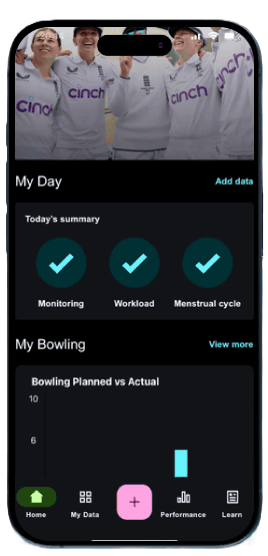
Insight 360 is a data-driven approach to performance management and athlete monitoring. It was launched in February 2024 by the ECB in collaboration with Ascent, their digital services provider, and includes an app for players (to view their data), a dashboard for practitioners (to view data across the board), and a portal that practitioners can use to input data.
“When you see the little research that’s out there, you’ve not got much to hang your hat on,” said Anna Warren, the Head of England Women’s Science & Medicine, at November’s Leaders Sport Performance Summit in London. “We’re using this platform to better understand in depth the female cricketer; what they look like from the academy through to the international cricketer.”
The rollout has been a success and, as the ECB launches phase two (the wider introduction of injury data and more sophisticated use of match data), we highlight the factors that led to its sport-wide take up.
It reflects the concerns of players
Insight 360, as the name suggests, represents a holistic approach to collating athlete data. There is a focus on availability and performance, but there is also a focus their health, home life, and career progression. “Players come to us and discuss their issues quite openly,” said Dr Tham Wedatilake, the Lead Physician for England Women’s Cricket, who joined Warren onstage to discuss the project. “They want to perform without any barriers.”
It is a co-designed platform
Ahead of the launch, the ECB gathered input from practitioners and coaches across the English game. “This means Insight 360 is bespoke for women’s cricket,” said Warren. Players, she said, are happy with an app that allows them to review their own data in as much detail as they like. “This is good for player buy-in, which is always a challenge in relation to athlete monitoring.”
There is also the power of a co-designed project. UK Sports Institute have found as much with their Project Minerva. Dr Richard Burden, the UKSI’s Co-Head of Female Athlete Health & Performance, said: “Get the practitioners involved, get athletes, get the teams and bring them along with it because if they’re onboard you get easier access to them and you’re going to produce something that’s more translatable, meaningful and applicable to them.”
Warren is on the same page with Insight 360. “You can link loads of different data sources together and start to answer some key performance questions – we’re not looking at everything in isolation.”
It provides a single source of truth
Collaboration can be easier said than done. “When you have so many people pull data together it becomes almost impossible for the human brain to comprehend and then deliver effective, unbiased solutions to players’ needs and expectations,” said Wedatilake.
Insight 360 is the single reference point and it provides continuity. “As soon as one person leaves and another is working with the players, that record gets lost,” said Warren. “We’re really trying to create a joined-up system.”
It is future-proof
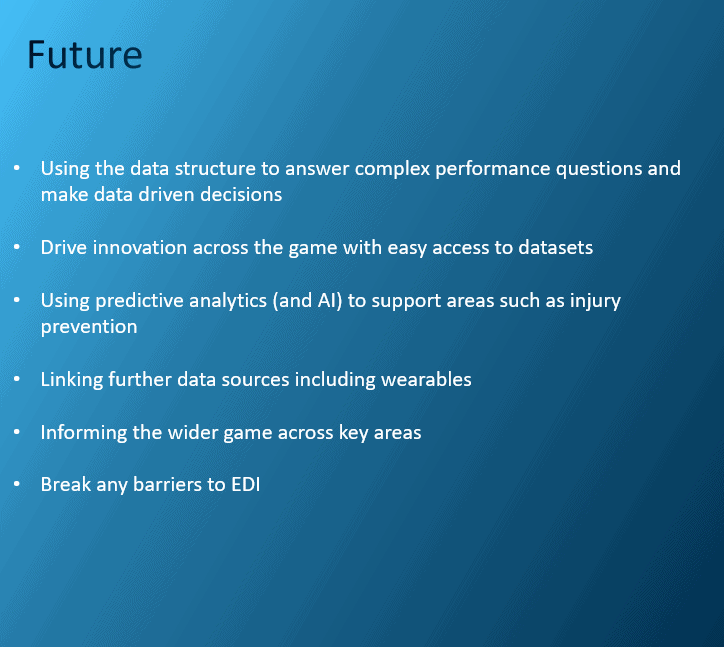
Wedatilake explained that Insight 360, as part of its next phase, will include injury data. He said: “It will be a game-changer for us in terms of load and injury risk and other factors such as the menstrual cycle and wellness.” The platform is primed to integrate future sources of data.
He does, however, also temper his excitement with a note of caution. “We didn’t want to get greedy too early,” he added. It was critical to have the right structure and means of integration before adding different elements, whether they are rooted in stats or video.
One of the next steps is further automation, particularly with regards to match data. “That’s the beauty of this system,” said Warren. “It’s so much quicker for people.”
She and Wedatilake wrapped up their presentation by setting out their ambitions for Insight 360:
Lasso Safe’s AI-powered software helps sports teams to assess risk and better care for its athletes.
Photo: Lasso Safe

Founded by a pair of retired professional athletes — endurance cyclist Pamela Minix and figure skater Luis Hernández — Lasso Safe has developed an evidence-based, research-validated survey and software to detect potentially toxic environments and unsafe relationships.
Players Health, a sports insurance group that recently raised a $60 million Series C round, will use it to “create safer, more supportive environments that lead to both healthier athletes and more sustainable businesses,” said Kyle Lubrano, Chief Mission Delivery Officer of Players Health.
Minix said Lasso Safe completed validation of its most updated product in October and described it as “a machine learning software that recognizes athletes’ experiences — specifically the areas are mental, emotional, physical and social wellbeing. We recognize them on spectrum from healthy, happy experiences to harmful and even abusive experiences.”
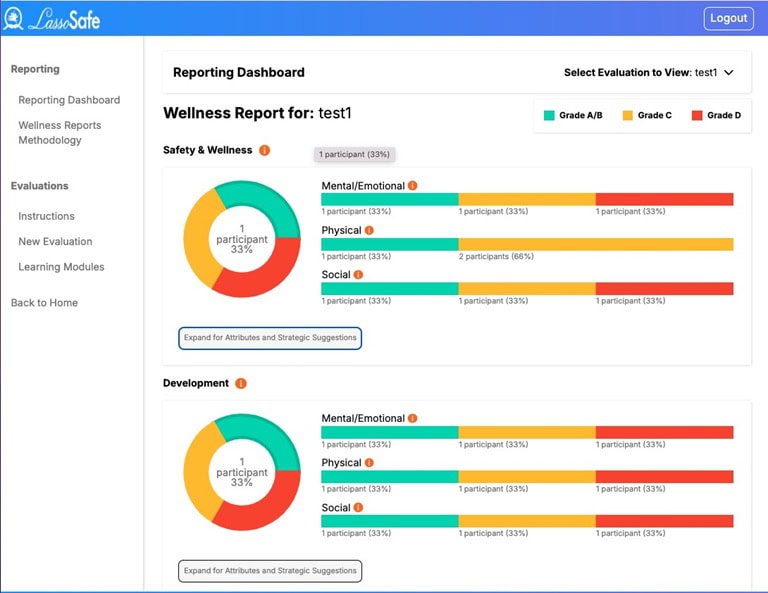
Lasso Safe described the product as “a machine learning software that recognizes athletes’ experiences — specifically the areas are mental, emotional, physical and social wellbeing.” Image: Lasso Safe
It was originally developed for national governing bodies that serve Olympic sports but has been modified for age groups as young as elementary school. Minix noted the increasing pressures at the youth level, in part because of growing expectations from the coaches and the growing financial investment in the space.
“Any level can experience this, not just highly competitive levels, so we focus on youth, but we do all age groups,” Minix said. “The software is designed to recognize even the first step away from that, when maybe those pressures start to come up or any type of misconduct within those wellness pillars.”
The frequency of surveys is at the discretion of each organization. Minix noted that Players Health will typically require them at least once during an application process to the platform, but many groups will administer them periodically or after incidents.
Questions asked of athletes include whether they feel valued by the coach, whether they have adequate access to nutrition and hydration during training sessions and more. Surveys can take anywhere from five to 15 minutes to complete.
Minix said Lasso Safe has run pilots with about 50 universities in the past five years, led by Utah State and Victoria University in Australia. The first adopter of the latest software is Globocol, a case management company based in the UK that offers services for sporting integrity, DEI, health and safety and data governance, among other uses.
This article was brought to you by SBJ Tech, a Leaders Group company. As a Leaders Performance Institute member, you are able to enjoy exclusive access to SBJ Tech content in the field of athletic performance.
Four staging posts to help you follow through on your wellbeing aims when reality starts to bite.
A Human Performance article brought to you by our Main Partners

You may want to go for that walk or a run, but perhaps there’s still so much that needs to be done before your team’s next training session. You know you’ll feel guilty if you step away from your desk for more than a few minutes.
To compound matters, you may silently chastise a colleague for stepping away from their desk and ask yourself ‘where are they finding the time?’
“There is not a single person in this room who has not felt guilt daily,” said Sonia Boland, the National Wellbeing Manager at the Australian Institute of Sport [AIS].
She was addressing an audience at the Leaders Sport Performance Summit in Melbourne in February where the question of guilt, and the fear of fostering an ‘excuses culture’, were raised.
“In those moments where I absolutely feel that, if you know it’s going to help you do your next thing better, ask yourself: what’s the worst that’s going to happen?” she continued, making the point that performance won’t instantly collapse because you’ve gone for a stroll.
“You’ve got to have something around you to allow you to take that step out of the door.”
Boland is echoed in her sentiment by Emily Downes, the General Manager of Wellbeing & Leadership at High Performance Sport New Zealand [HPSNZ], who admitted to the same feeling.
“We all probably struggle with that at one point in time or another,” Downes said. “Who else do you need to have on your support crew that helps give you that permission?”
“It’s not doing new things, it’s not creating new programmes,” added Boland. “It’s just giving more focus to how we do what we do, not what we do.”
Boland and Downes suggested four key staging posts in reaching this goal.
1. Establish what you mean by ‘wellbeing’
Establish the framework for how you want to talk about wellbeing before all else.
Boland will not define ‘wellbeing’ in sport. “What became really clear is that we’re all talking about slightly different things,” she said of her time at the AIS. “When we’re talking about wellbeing, are we talking about your wellbeing or my wellbeing? Or are we talking about the wellbeing of everyone in this space? Are we talking about the environment that enables us to be who we need to be? If you don’t know that, it’s probably the first step.”
2. Consider an ‘ecological’ approach
The wellbeing conversations at the AIS, HPSNZ and beyond are shifting from simply duty of care and risk management for athletes (and increasingly coaches) towards wellbeing as a performance enabler. It’s an encouraging development, but Boland argued that it needs to go beyond a focus on the individual.
“We can throw heaps of money to help athletes and coaches do wellbeing better, we can talk to them to the cows come home about how to deal with burnout, how to lower your stress levels, but none of that means anything if the things happening above and around them are continuing to compound how that stress is coming,” she said.
The Australian system promotes an “ecological model”, as Boland explained. This means there is a focus on relationships, structures, policies and even job descriptions – because job descriptions can help people to set boundaries and feedback mechanisms.
“People want feedback, they want to learn and grow from when it’s not working,” she added. “We need to have the opportunity to fail and we need to have the environment where we can do that. And all of those things contribute to the wellbeing of the individual.”
3. Support self-care
We return to the question of guilt over self-care despite growing awareness of its performance benefits.
“The challenge around this is: are you asking for it?” said Downes. “Are you communicating to your manager what support looks like for you or what you might need to be at your best?”
She addressed the leaders in the room directly. “Have you set up systems within your environment to enable people to [step away from their desk]?”
There is similar thinking across the Ditch. “[If you get up and leave] think about the poor person next to you who’s got the same level of guilt,” said Boland. “They might look at you and say ‘yeah, maybe I’ll give that a go tomorrow’. It creates the culture where we prioritise what we need to do to perform at our best.”
4. Make it make sense to your people
Different words will resonate with different groups, so choose your terms smartly when discussing wellbeing.
“Find language that makes sense to you and your people,” said Boland. “If I think about the Olympic and Paralympic system, the language that needs to be used in skateboarding needs to look different in equestrian, and it’s going to look different in rowing. It’s not one-size-fits-all.
“Find the stuff that’s going to resonate, that connects to the meaning and purpose.”