Why it will still be business as usual at the UKSI, offering the same high calibre performance support services.
An article brought to you by our Partners at the

He is discussing the logistics of the UK Sports Institute [UKSI] changing its name from the English Institute of Sport in April. As part of the process, on the 24 April, the organisation’s website and email addresses changed and its staff entered a short period of downtime to enable those changes to take effect.
“Everything worked like it did across Y2K and nothing dropped out of the sky,” he says, referring to the late-’90s fear across society that digital calendars resetting to ‘00’ on 1 January 2000 might cause havoc. “I did have a flashback on the morning and remembered the millennium,” he adds.
The English Institute of Sport [EIS] was founded shortly after the turn of the millennium, in 2002, to support teams and athletes across the UK’s ‘Home Nations’ – England, Scotland, Wales and Northern Ireland.
“We routinely send hundreds of our people on secondments with teams or sports to the Olympics and Paralympics,” he continues. “What we all aspire to do is support British sports, teams and athletes that go to the Paralympics and Olympics and perform at their best, and they come from all of the Home Nations. For me, it just helps with that.”
The EIS, and now the UKSI, will continue to work closely with the other home nations to ensure all the support offered is aligned.
The reasons behind what Archibald admits was a “misnomer” are “locked up in the mystique that surrounds the genesis of the Institute”.
“Right from the outset, there was a question mark about the name,” he says.
“People who have been with the organisation for 20 years have sent me screenshots of various documents and items of stationery with the name ‘UKSI’ on them”.
For some people, the misnomer was an important issue and they argued for change.
“A number of voices within the system raised the question again and again when others didn’t see it as a priority”.
Of course, the name change was never the priority – the Institute’s commitment throughout the 2024 Paris cycle was and remains the delivery of ‘outstanding support that enables sports and athletes to excel’ – but the case was vigorously made and the name change was approved by all key stakeholders.
The transition was operationalised in the 12 months before it was announced and, through that process, the other Home Nations sports institutes, namely Sportscotland, Sport Wales and Sport Northern Ireland, offered their full support. “They are all 100% behind us and we do not now supersede them. We might be the scale operator, but they will carry on doing the great work they’ve always done”.
While there is some nostalgia for the era of the EIS, there is undoubtedly greater cohesion with the renaming. “UK Sport [the government agency responsible for investing in Olympic and Paralympic sport in the United Kingdom], the UK Sports Institute, British Olympic Association and British Paralympic Association – we feel it more accurately reflects the Institute’s role as a powerhouse of the British sporting system.”
Speaking of which, the changes to the previous EIS logo are minimal. “We haven’t deviated too far because we did feel that if you change both the logo and the name too much at the same time then you do run the risk of becoming somewhat unrecognisable”.
The EIS logo, characterised as it was by a V shape, has been retained with tweaks to the colours used – red, white and blue – to make it more British. “There was no piece of paper that clarified the original colour scheme and there were lots of stories floating around. One was that the colours were, broadly speaking, although not exactly, the five Olympic colours. There was also a view that the V may be the V for ‘victory’ or maybe a butterfly stroke or maybe the ribbon of a medal.
“Following consideration and reflection with our people, we felt that the ribbon concept chimed with more of our people more strongly in the sense that we see ourselves as an organisation that provides the support and the infrastructure to athletes and sports to help them win.”
“We wouldn’t be comfortable putting the medal on the front and we’re in the background, but the ribbon that holds the medal sits well alongside what the UKSI is going to do and what the EIS has done. So we’ve gone back to that history and that may have driven the original logo and we’ve maintained that. We’ve also changed the colour to have a GB-style red, white and blue, and that can be used online and in some of our physical branding as well”.
The UKSI does not expect its rebranding to have any impact on the quality of the services it provides to the UK’s sports teams and athletes. “Fortunately, we’re a business to business institute that does not serve the general public,” says Archibald. “The risk for us in a name change, with a loss of custom or a loss of recognition, is negligible. For example, we supply to British Swimming and they’re not going to get confused by who we are.
“The high standard of support that we offer to sports and athletes will not change, we are as committed as ever to delivering the quality that we have become known for across the board.”
Archibald explains that an internal working group, in tandem with a small group of consultants, ensured the transition was smooth as the branding was brought up to date and rolled out across all UKSI platforms.
“We see this as a significant piece of work but not one that’s so high risk that we needed to follow a particularly well-beaten path. We’ve done it ourselves and we’re confident that we’ve run a good process and taken everyone with us,” he says.
There is optimism for the future too. “We’ll have a little more confidence as there’s no question mark about why we’re called this or why we aren’t called that and it will enable us to be more confident in how we express ourselves.
“We’re not expecting a 20% performance uplift for the sector at Paris on the basis that we’ve changed our name, but we do see it as a long-term strategic adjustment that will hopefully help us to attract the best people from across the country to work for us, people that weren’t as keen to join the English Institute of Sport as they would the UKSI, especially if they come from the other Home Nations.
“We also feel this could apply to athletes having a greater understanding of who we are and what we do and perhaps make them feel more comfortable acknowledging our work externally if they’re not from England.”
Another aspect that remains unchanged is the often recognised black t-shirts sported by EIS staff when working with teams and athletes. This was important to Charlotte Henshaw, who won gold in the Canoe Sprint women’s KL2 event at the 2020 Tokyo Paralympics.
Upon learning of the EIS’s impending name change from UKSI Communications Manager Grace Cullen, she asked: ‘Will you still be wearing the black t-shirts? That’s all that matters because we see people in black t-shirts and we feel reassured because we know those people, they know what they’re doing, they’re there to support us’.
“We’ve changed our name, we’ve slightly changed our logo, and we will still be in our black kits,” says Archibald. “It does stand out as most UK National Governing Bodies tend to wear red, white and blue and our people have always been in black. It’s nice that athletes recognise that and, for them, it will be business as usual.
“It doesn’t matter if our name is changing, they know UKSI people will be of the same high calibre and will still be there to support them.”
Lúcás Ó Ceallacháin of the Australian Institute of Sport delves into his work with teams across the Australian system.
Main image: courtesy of the Australian Institute of Sport
“If I were to describe it in a nutshell,” he says, “It’s a facilitation method. A novel way of having great conversations.”
During his sessions, attendees will be encouraged, using un-themed Lego (“no Star Wars”), to build a model based on a thought, question or intention.
Lego Serious Play’s reputation as a tool for solving complex problems stems from a project in 1996 when Lego Group owner Kjeld Kirk Kristiansen worked with two professors from the IMD Business School in Lausanne, Switzerland, to explore ways to stimulate imagination and creativity within his organisation.
It has proven popular as a strategic planning tool, with Lego bricks physically standing in for issues and challenges faced by companies across the corporate world. The method is also making inroads in the world of sport thanks to the work of individuals, such as Ó Ceallacháin, who has observed high levels of engagement with athletes and coaches.
“The amount of cortex devoted to any given body region is not proportional to that body region’s surface area or volume, but rather to how richly innervated that region is,” he continues. “Your hands have a disproportionate representation in your brain. Sports people use their hands and body more than the average person so these senses are trained to a higher level.”
Some of sport’s challenges are ideal for exploration through Lego Serious Play. “Where it works really well is with things like high-ceiling, low-threshold questions where everybody’s got an answer, everybody wants to contribute. If you’re talking about strategy, culture, values or vision, it’s a good tool.” Lego Serious Play also encourages people to be curious rather than judgemental, and is designed to give everyone a voice, from the head coach to the kit person.
It is not, Ó Ceallacháin stresses, a mere team-building exercise. “There’s definitely a team-building element because you build connection, but if someone says ‘we’ve done paintball and we’ve done go-karting – let’s do Lego next’ then I know they’re just trying to fill a couple of hours with a fun activity. I’ll quickly say no to those kinds of things, but if someone says ‘we’re struggling to understand why this is a problem in our organisation’ that’s where I get curious.”
Here, Ó Ceallacháin explains how he uses Lego Serious Play with teams across Australia.
How does a typical session pan out?
LÓC: A typical session lasts for two hours – this is to ensure we have time to build the skills they need to use the method. The first 30 minutes are dedicated to introducing the method, the background and how to communicate through metaphor and storytelling. Then we get cracking! The method follows four steps – Question, Build, Share and Capture. We use the Padlet App to capture our work as we go.
Is there an optimal group size?
LÓC: I like to work with smaller groups but it can be done on a large scale. The challenge with large groups is you won’t have enough time for everyone to hear what is being shared – so you need extra help on tables or in the room.
How do you use Lego Serious Play in your sessions?
LÓC: I’ll take a group through the skills first; ‘what do you need to be able to do?’ and the skills are not about ‘how do you connect these pieces or how do you do that?’ The skills are about ‘how do you tell stories, how do you use metaphors?’ So something as simple as an orange brick might hold a lot of meaning for somebody because they’ve put meaning into it. We ask questions, we build the answer, we reflect and share the answer together – that’s how we generate insights – then we capture, we’ll take pictures and keep a record of it and break it all down and build something else. Typically they’re building for five minutes. It’s not hours of building. The bulk of the session is always about the discussion that they have about whatever they’ve built.
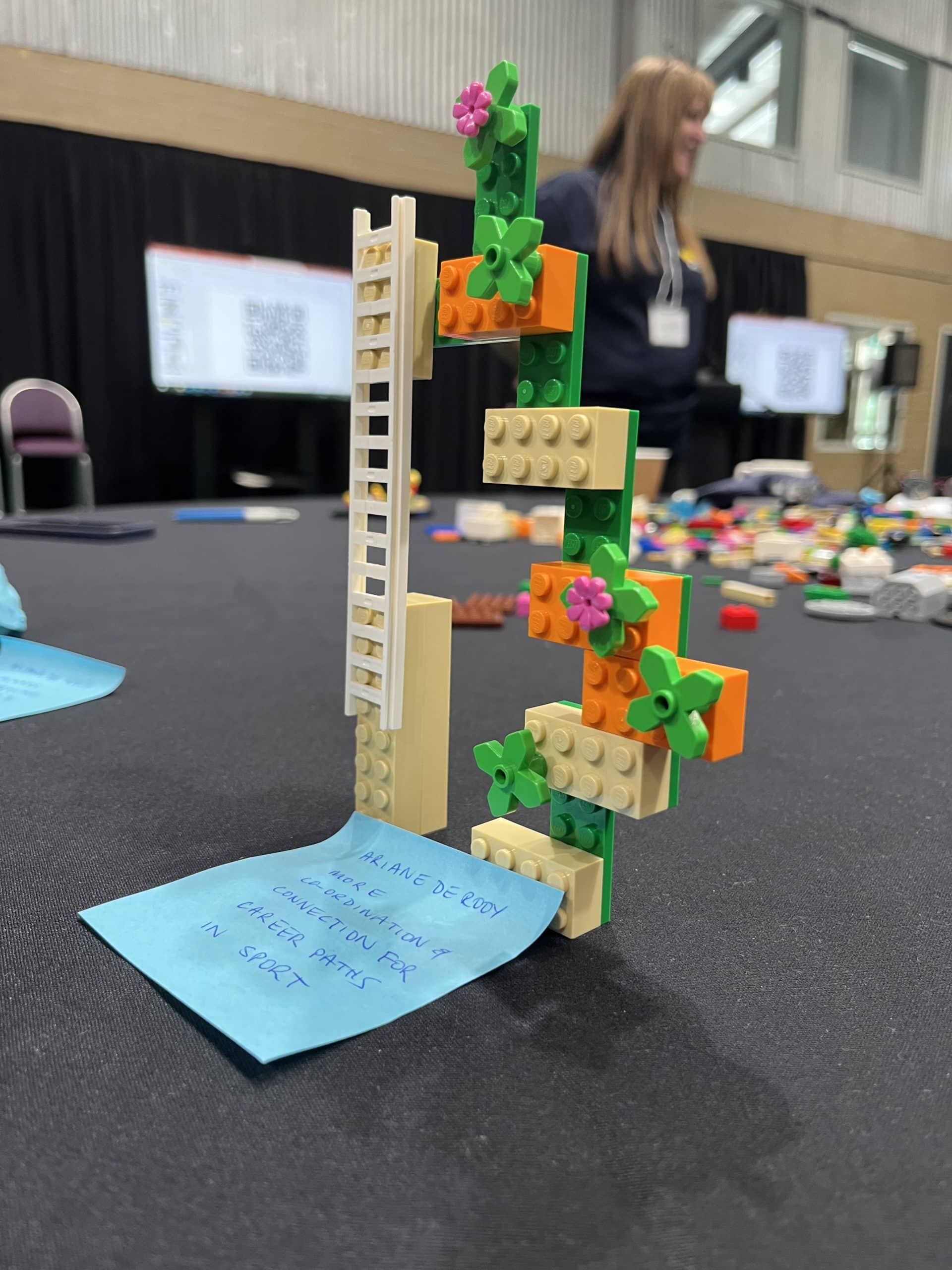
Image: Australian Institute of Sport
With what issues does Lego Serious Play work best?
LÓC: Questions that need creative answers. These are typically around vision, strategy, culture, values, UX design, innovation, team development. What’s exciting now is how people are taking this to their own environments and applying their owns skills to enhance it. It unlocks the creative thinking of the wisdom in the room.
What is a good type of question to ask?
LÓC: High-ceiling, low-threshold questions – future-focused questions where everyone has an answer and can contribute. I use an assets-based approach so I will often frame the question in a positive way. My approach is to understand what their challenge is currently and also what they may have tried previously. The flow of a session builds to a bigger question but all the steps on the way contribute to the momentum of a session.
How does that look in practice?
LÓC: For example, one technical director asked: ‘how do we get the best out of each other?’. Their team was new and had few opportunities to be in the room together. So there was a bit of ‘who am I and what am I about? What do I care about and what are my values? What makes me tick?’ All of that came out in a three-minute build that we did and they started talking about that. Then we said ‘think of a time when you’ve been part of a really successful team – what did it look like? What did it feel like? What helped you to be your best in that team and what are some of the things that you bring to that team that no one else can bring?’ Lots of stuff came out and then they were then able to talk about ‘what are the things that are common? What are the things that are different? How do we get to those next steps for what we want to build?’ And they’ll continue that conversation long after I’m gone. But it just kind of gave them a primer rather than just coming in and asking ‘what are your values?’ and they look at their logo or their crest and start talking about whatever had been written down by corporate leadership a couple of years ago. They asked of themselves: ‘what are our behaviours? What does that look like? How do we want the players to experience us as a coaching team as well?’
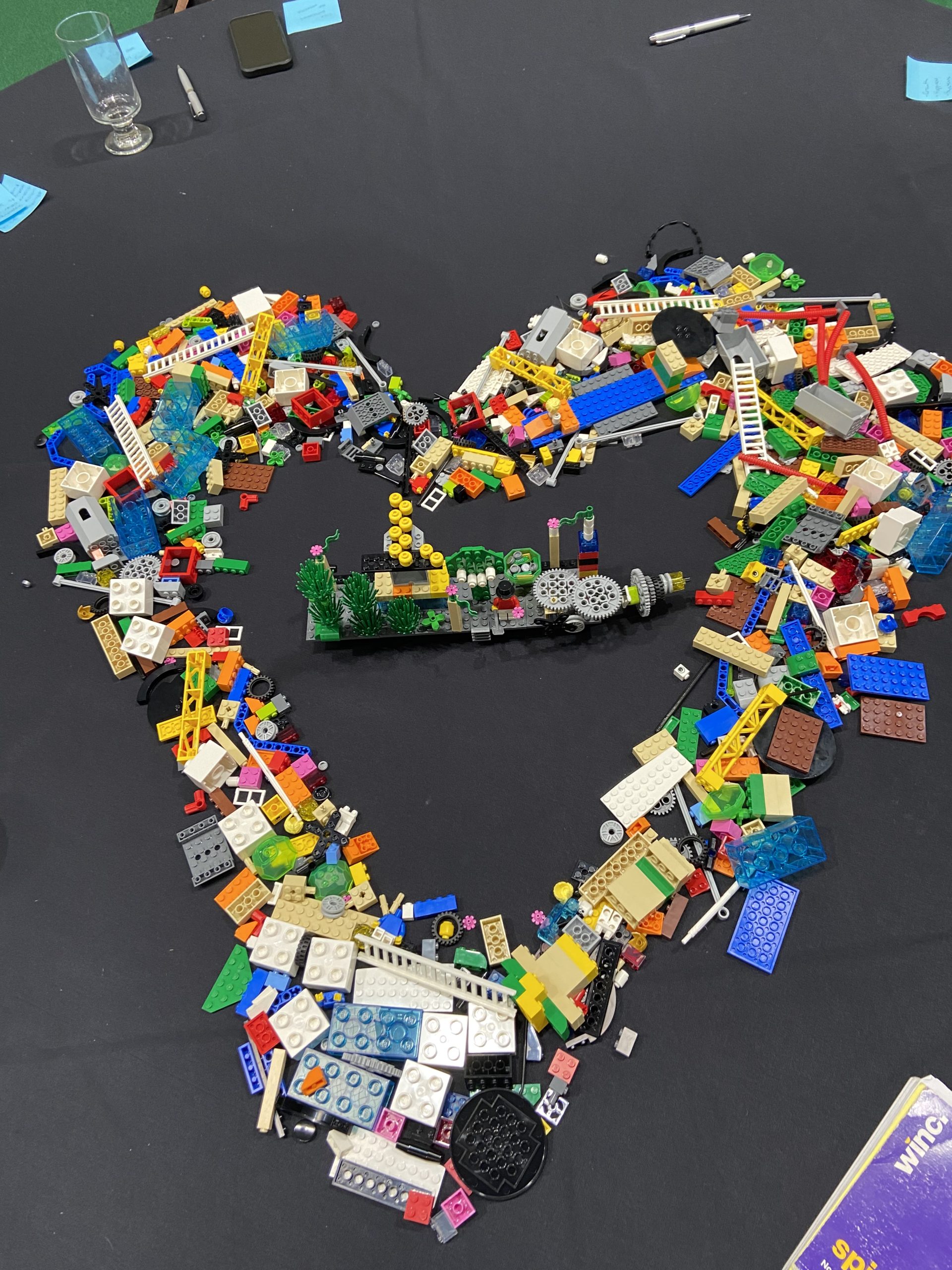
Image: Australian Institute of Sport
Can you outline the science behind Lego Serious Play?
LÓC: I learned from [Lego Serious Play expert] Michael Fearne – who trained me – there are sound scientific principles underpinning the use of Lego in engaging people, changing the conversation and solving complex problems. The way building something with your hands unlocks knowledge you didn’t know you had. There is also the joy and productivity of getting into a flow experience. There is safety in talking about issues through a model rather than the usual business/power dynamic. For example, we might have an idea and we try to make sense of it, but when you put something physical out into the world and you and I can look at it together and say ‘well, what do you see? What do I see? Let’s turn it around and look at it from another side’. We see very different things. And then the flow piece is fascinating with sportspeople because of the connection between the hand and the brain. When you’ve got a big pile of Lego in front of you and your hands are like another search engine for your brain. So you start pulling out stuff that you didn’t even know was there. With my HP hat on – in simple terms, it works!
How might that emerge during a session?
LÓC: So I go back to our orange brick. One coach used an odd orange brick in a model and I asked them about it. They said: ‘Oh… that’s the fire in my belly and that’s why it’s in the middle. My grandad was the first person who brought me to a game. That’s where I got the fire and I take that wherever I go and I think about how important it is to pass that on to the next generation of kids’. That was just a little brick, just the colour, that didn’t look like anything but the fact that we had a quick conversation about it; and the meaning that somebody had put into that brick was really powerful. These stories come up and the power of storytelling resonates here in Australia, where that storytelling tradition is really strong. And I feel like sportspeople just love a good yarn.
How does a second or third session differ from a first?
LÓC: We can get to more complex questions more quickly using different skills, such as rapid builds or you can build with no question or instructions. Then I hand them a Post-It with a theme to explain using the model they built. With the skills warmed up we can tackle system issues or stakeholder maps – the truly complex environment that HP Sport operates in.
How do you encourage introverts or those less likely to talk to actually speak up?
LÓC: I make sure that we let people know that they only have to share what they want to and I also put caps on time. With curious questioning lots of people start to share more. Best of all is that others in the room model the sharing and it gets the rest of the group going. The design of the first hour is all about warming up to get to better sharing – we don’t jump in at the deep end. In my research as part of my Professional Doctorate in Elite Performance at Dublin City University I am also looking more closely at how Lego Serious Play builds the behaviours that contribute to psychological safety.
How do you know when to stop digging with a person? What are the signs to move on to the next person?
LÓC: We put time limits to ensure that we don’t get one person dominating the conversation but I also invite the group to question the model and be curious about it. Often I do very little talking. At the top of the session I make sure that people know that they only have to share what they are comfortable with. The time limit helps with those who are more sceptical too – they get time to warm up to the method and once others share their stories you find the sceptics start to join in. This is also part of the power of Lego Serious Play – it flattens the hierarchy – no one is more expert in your own story and model than you, but you invite others in to see and share your inner world. That demonstrates courage and vulnerability.
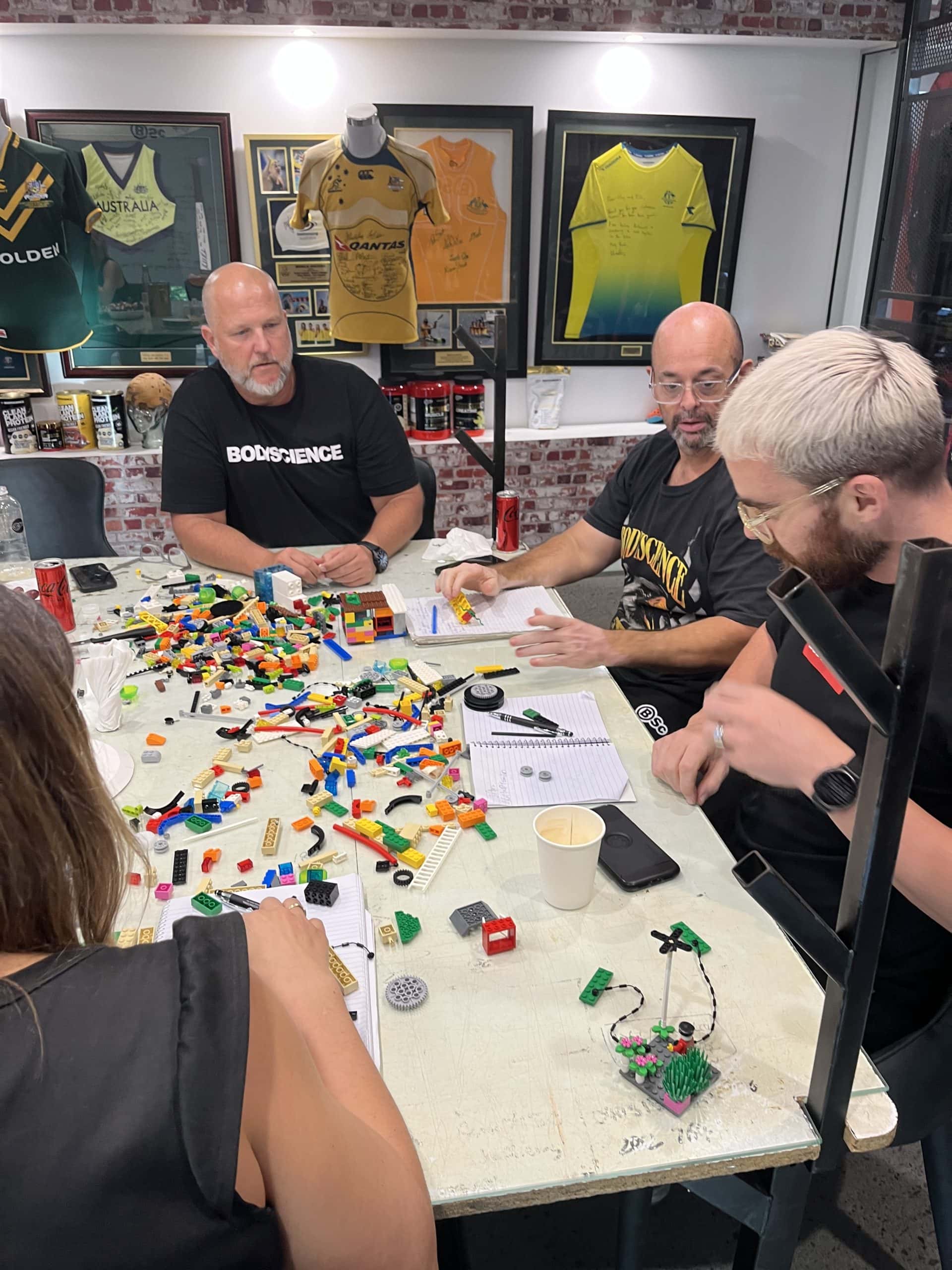
Image: Australian Institute of Sport
You said you take pictures. What are you trying to capture?
LÓC: I’m documenting the experience, summarising insights and generating artefacts that can continue to be used long after the session ends. We are also encouraging people to reflect on and retrieve what they have learned. Also, each model is broken down after it is built – so you are constantly breaking down the models to build something new. It also allows me to be fully present in the room and the conversation.
Do you take notes along the way?
LÓC: Honestly, very few. My job is to continue to facilitate the flow of the conversation so that the participants are producing the questions. This is another reason why the live feed on Padlet is important. By the end of the session the group will produce some simple guiding principles to apply going forward.
Do you prefer to be well-versed in the sport or team?
LÓC: I like to have some background and context of the room I am walking into – where does the session fit in for them, what kind of headspace are they in? I don’t want to have preconceived notions about the group or the outcome. As a former athlete, coach and High Performance Director myself, I’m cautious about what I introduce to an environment.
How do you work with leaders to give them the skills to host sessions of their own?
LÓC: I’m doing a large amount of Lego Serious Play facilitator training now. It can be nerve-racking to lead a session with your own team so I’m currently building a community of practitioners who I train. They are very supportive of each other and help to design sessions for each other. I am excited to see how others apply LSP, especially in situations like 1-to-1 wellbeing or coaching sessions. Everyone will come up with their own way of applying this to solve their challenges.
The first day in Melbourne featured Collingwood FC, EPP and Management Futures, while delving into topics from environment profiling to psychological safety.
In partnership with

Across the course of two days, we sought to break down this theme by watching a live environment in practice, exploring frameworks and perspectives on how to recruit talent for your environment, the power of teaming and how it drives collaboration and teamwork, and insights from different industries on how to design, shape and evolve environments.
Here are the key takeaways from the first day.
(Day 2 takeaways here.)
Session 1: Collingwood Training Observation
Speaker: Craig McRae, Senior Coach, Collingwood
Magpies training observation questions:
For the first portion of the event, we watched the team train. Attendees were asked to note down observations around three core questions, the answers to which were then fed back to coaches. Those questions were:
Feedback:
Question: what was the focus of the pre-training meeting?
Question: how often do you do repeat the same drills?
Question: talk us through the senior coach and assistant coach relationships – how do you communicate, challenge and collaborate?
Question: how do you balance the winning mentality in the vision versus that mentality in training?
Question: what role or involvement in the training is by the leadership group?
Session 2 – Performance in Practice: Part 1 – Building a High Performing Team (Selecting the Right Talent)
Speakers: Dave Slemen, Founder, EPP, and Anna Edwards, Managing Director, EPP
Nine-Step framework:
Communication:
Character:
Leadership / followership:
Relationships:
Strategy & planning:
Philosophy:
Sporting knowledge:
Technical skills:
Traps & Opportunities: Getting the Right Talent in Your Environments
Speakers: Darren Burgess, Director, EPP, and Craig Duncan, Director, EPP
Session 3 – Performance in Practice: Part 2 – Building a High Performing Team (Creating High Performing Teamwork)
Speaker: John Bull, Head of High Performance, Management Futures
Four skills of effective collaboration:
Six common inhibitors of effective teamwork:
Psychological safety
Psychological safety is the extent to which people feel that speaking up will be welcomed and not judged negatively.
The conversations we are not having will be some of the most important the neuroscience. When people feel social pain it compromises the brain’s ability to think by up to 30%.
Four types of psychological safety:
How can we increase psychological safety?
Creating conditions for high performing teamwork
Further reading:
Check out the takeaways from the second day here.
Matt Butterworth of the Australian Institute of Sport reflects on the organisation’s mental health services.
A Human Performance article brought to you by our Main Partners
“Traditionally, it centred around careers and education,” Matt Butterworth, Mental Health Manager at the Australian Institute of Sport [AIS], tells the Leaders Performance Institute. “There may have been some mental health support but nothing as formal and structured as a mental health service. Then there was a fundamental shift in how the AIS did things.”
One of the key milestones was the launch of the AIS’s Wellbeing & Engagement initiative in 2018. “The resulting services were a statement that we’re helping people to be the best athletes but we’re also helping them to develop into well-rounded people that can get on with their lives while they’re athletes. They’re also as well prepared as possible when they transition out,” Butterworth adds. “It’s not ‘you’re a high performance athlete and that’s it’, it’s more about ‘you’re a high performance athlete and we’re here to support you as an overall human being as well’.”
Within the theme of wellbeing, the AIS Mental Health Referral Network overseen by Butterworth operates as a national service where athletes, coaches and high performance support staff can see a mental health professional such as a psychologist for individual support that is confidential and at no cost to them. “The benefit of a national service is that you can operate at a larger scale to benefit more people across sports in terms of the resources we can build and offer in the mental health space. Then the sports themselves can choose to engage with the services they find useful.”
Here we explore where mental health sits in the wider picture for Australian athletes, coaches and practitioners.
Matt, where does the line sit between mental health and mental skills?
MB: There is a network of performance psychologists who are employed by individual sports and they focus more on helping people with matters related to their performance on the field, on the track or in the pool. This is more mental skills-focussed. Our mental health services at the AIS focus less on performance or execution of a sporting skill, and more on helping people in managing wider aspects of their lives, such as their overall mood, relationships, and day to day functioning. The issues that my team assist with, such as anxiety difficulties, may be happening during an athlete’s performance but they’d also be occurring in other important areas of their lives such as during work, study, or with family and friends.
Can you truly balance wellbeing and performance?
MB: I think a balance can be achieved. The way I’ve heard others explain it really well is for people to be aware of what their priorities are and to spend most of their time doing things that are important to them. That’s the terminology that I think we’ll start using a bit more down here because usually when you say ‘lifestyle balance’ you see people roll their eyes and start turning away from you. If we’re aware of what our priorities are, the important things for us to be doing, the things to make life quite meaningful and enjoyable for us, then that’s a good way to be spending most of our time.
How can you address the common fear, that mental health services are only for making athletes feel better about poor performance?
MB: I think the people who choose to come into a high-performance system, whether they are athletes, coaches, or high performance support staff, like physios, dietitians etc. they probably self-select in that they are quite focused on performing and wanting to win. My perspective would be ‘what are the things we can do to help them move towards that?’ There are times when you have setbacks, there are times when you don’t win. If you can accept not necessarily feeling awesome, accept when things don’t go to plan, it is quite important to manage your emotions and figure out what you need to do to change the result or get a better result in the future. If that involves people feeling a bit better instead of being absolutely crushed and devastated every time that they have a set back or they don’t win an event, then I’m OK with that. I would say it’s more about the journey and the trend to where you’re heading rather than feeling devastated any time you lose. That’s not helpful either.
How are the mental health issues facing Australian athletes evolving?
MB: Typical presentation issues for us are anxiety and depression. That’s the same for pretty much most mental health services around the world and it’s not that different in sport. It is not necessarily a new issue but we’re becoming better at detecting more things. I think our system is now doing more work in the space of eating disorders. We’re becoming aware of just how common traumatic experiences are for people generally in life and that people in our system experience traumatic experiences too. So we’re starting to get better at how we might educate people around that, how we best provide services to support people. An athlete, coach or staff member can go and see a psychologist or mental health clinician for one-to-one support if they want. The Mental Health Referral Network has been operating since 2018 and referral rates are continuing to trend upwards. Generally, the people who access the service have difficulties at the mild to moderate end rather than needing to go to hospital or anything like that, and I think that’s an indication that people feel less stigma and are more comfortable reaching out for support. We’ve evaluated our services in the last year too and our clients are telling us that our services are helping them to be more aware of what’s more important for mental health, and how to look after their mental health as well. We’re thinking about how we continue to make this sustainable and accessible for more people as well.
How can an athlete refer themselves?
MB: Athletes and other eligible people can refer themselves to the Mental Health Referral Network directly by calling or emailing us. They can also be referred to us by another person, typically this would be by an Athlete Wellbeing Manager in their sport, but we also get referrals on behalf of people such as family members, performance psychologists, coaches, doctors or other support staff. Anyone can make a referral on behalf of an eligible person.
What about the mental health of coaches?
MB: Any coach or high performance support staff member can access the Mental Health Referral Network. Our stakeholders told us back in 2019 that if we want a healthy system then we’ve got to look after as many parts of the system as possible – particularly the coaches and performance staff that work directly with athletes. Coaches play a crucial role in the wellbeing of athletes and the broader system. We know that the expectations and pressure on coaches are very high, their roles are multifaceted, and their job security can be low. This combination of factors can take a high toll on them and their families. With coaches in particular, there’s been a development at the AIS in the past two years of having a specific High Performance Coach Development team. They focus on how best to develop coaches in the Australian high performance system. Part of their work has a wellbeing aspect as well. We liaise with their team about how they best get information about services available to them in front of the coaches that they’re working with.
Have you enjoyed much success?
MB: Yes, I think so. Independent research that we’ve commissioned over the last four years has told us that mental health rates in our high performance system have been fairly stable across that time but access to our Mental Health Referral Network has continued to increase year on year. We take this as a positive sign that people are increasingly aware of the need to take care of their mental health and that they’re feeling more comfortable, and less stigmatised, to proactively reach out for support when they need it. A recent independent survey of people who’ve accessed the Mental Health Referral Network also told us that the service has helped them in managing their mental health, in some cases they said it had saved their life, and they want the service to continue to be available to them. We also know from this research that we’ve got work to do around building more awareness, continuing to have the right skills mix of professionals, and we’re about to do some work around how we keep the service sustainable into the future as demand continues to increase.
Do you feel these initiatives have built the credibility of the Mental Health Referral Network?
MB: Yes. The credibility of our programs such as the Mental Health Referral Network has been built by a number of factors. A key one which I think is a hallmark for any type of success has been having great leadership. My team and I have been fortunate to have excellent leadership sitting above us so that we could get on with the job of helping athletes, coaches and staff. There’s been many leaders who’ve assisted. Our current Acting Director of the AIS, Matti Clements, has been a leader at executive level and has really owned and driven the AIS’s approach to wellbeing over the last four years. I think it’s accurate to say that her vision and leadership has been transformative for our system. I think that other factors that have helped in building credibility is the authenticity and work ethic of the people providing mental health services to athletes, coaches and staff. The people involved have taken the approach that if we say we’re going to do something then they’ve worked really hard to deliver that for our stakeholders, whether that’s an individual athlete or a national sporting organisation or one of the organisations that runs the various games in terms of Olympic, Paralympic and Commonwealth Games.
What is next in the mental health space for the AIS?
MB: I think moving more into how we best support mental health at a systemic level, so the overall Australian sport system or the National Sporting Organisations (NSOs/NSODs) who are running their high performance programs but, at the same time, also needing to support the mental health and wellbeing of their athletes.
Does that research tend to back up what you thought in the first place?
MB: Yes, I think so in a number of areas. It’s also given us insights into particular issues we should be targeting more. The trauma space is one of those, the eating disorder space is another one as well, which is why in our Mental Health Referral Network we’ve done a lot of work to ensure professionals with those skillsets are available to help people in our system. Moving forward, we want to create pathways for people who experience more serious mental health difficulties. While the rate is probably lower than we have in the broader community, we’ve got some work that we need to do in that space around having good pathways.
The Acting Director of the Australian Institute of Sport discusses the leader’s role in modelling health-seeking behaviours.
A podcast brought to you by our Partners Elite Performance Partners

Her observation is all too common in such a male-dominated industry with certain roles, such as psychology, often presumed to be a more natural fit for a female practitioner than, say, a strength & conditioning role.
Matti, for her part, is a psychologist by training but has served in a series of senior managerial roles – becoming a pioneer in the process – and has shifted perceived wisdoms in the fields of people, culture and wellbeing.
As such, she was an ideal guest for the latest edition of the Elite Performance Partners (EPP) Industry Insight Series Podcast where she spoke to Dave Slemen, EPP’s Founding Partner, about her career journey and her thoughts on the evolution of psychology and wellbeing in sport.
She continues: “Over time, I got a bit more comfortable with ‘what do I bring? Why am I here? So what is the role that I’m being asked to fill and how do I utilise my strengths in that role?’”
Over the course of the conversation, Matti also spoke about:
Listen above and subscribe today on iTunes, Spotify, Stitcher and Overcast, or your chosen podcast platform.
Members of the Leaders Performance Institute gathered at Loughborough University in the UK to hear from organisations including the Lawn Tennis Association, Loughborough University Tennis Academy, England & Wales Cricket Board, English Premier League and Management Futures.
In Partnership with

An ongoing thread throughout the conversations across the day was how crucial relationship building is when working within an interdisciplinary team.
Session 1: Session Observation with Loughborough University National Tennis Academy:
Featuring:
For the first session of the day we had an interactive session, observing a live tennis training session at Loughborough University National Training Academy. Nick Cavaday, and the coaching team wore microphones during the session so the attendees were able to see and hear how the team approach their coaching sessions. It was not only Cavaday and the tennis coaches that were on court providing input, they were joined by the S&C and physio for the duration of the session.
Session 2: A Coaching Perspective
Speakers (from the Loughborough University National Tennis Academy):
Following the session observation, we were able to hear from Nick Cavaday, Alex Bailey and Nathan Miller to get their view in a Q&A style format on what it takes to have a perfectly functioning team around the athlete.
Session 3: Building Relationship Intelligence
For the third session of the day, we shifted our attentions to exploring a skill that can be hugely impactful in working with others, building relationships. Fado began the session by asking our attendees to discuss in their roundtable groups and think about what skills needed by those who are good at building relationships. The attendees were then asked to make a snapshot wheel of their relationships with the colleagues/departments they work with, and score their relationship with each out of 10. He then invited participants to answer the following questions:
Key takeaways:
Session 4: A Bird’s Eye View
For the final session of the day, we had the opportunity to explore the strategic view of the inter-disciplinary teams and hear from the Performance Director of England and Wales Cricket, Mo Bobat. The session format was a Q&A style with Edd Vahid from the Premier League drawing out some learnings around interdisciplinary support.


One of the primary motivations for this Performance Special Report, which is brought to you by our Main Partners Keiser, is to address the issues that affect female individuals within high performance sport, because they have been neglected for far too long. There are numerous issues – far too many to address in this report – but the Leaders content team took it upon themselves to shine a light on some of the admirable work being done for female athletes and coaches across the globe.
Complete this form to access your free copy of this Special Report, to discover the untapped potential that lies across girls’ and women’s sport, from the grassroots through to the elite level, and the individuals working to unlock that potential.