The theme of alignment was high on the agenda at February’s Leaders Meet: Australia.
The Shepmates – Australian identical twin brothers Archie and Miles Shepherd – have become internet stars due to their viral videos depicting their high-energy and comedic reinterpretations of dramatic moments of sports commentary.
“I’m not going to pretend like we probably should be offering you guys advice. You’re the best at what you guys do,” Miles told a room of Leaders Performance Institute members at Rivershed in Brisbane. “But hopefully we can inspire you guys, or you take something from our story.”
Their dedication to their art and their fans has taken them to places they never expected. “We’ve found ourselves in a pretty niche part of the internet,” said Archie.
On top of it all, the brothers’ obvious chemistry, as well as their ability to finish each other’s sentences, hinted at the theme of alignment that ran through both days down on the River Brisbane (and it’s a performance trend we’ve tracked for some time).
They were not alone. Others who took to the stage, including the Brisbane Lions, World Rugby and the Queensland Ambulance Service, spoke of their efforts to ensure everyone within their walls is on the same page.
Based on the insights shared onstage across both days, the Leaders Performance Institute highlights how alignment shows up in the work of high-performing teams in at least five ways.
1. Smart coaches who can manage up
In sporting terms, there has never been a better moment for the city of Brisbane, with the Lions defending their AFL premiership and the Broncos winning the NRL in 2025.
Lions Senior Coach Chris Fagan and Broncos Head Coach Michael Maguire have built winning machines in this corner of Queensland, and both were on hand to tell Leaders Performance Institute members how it was done.
Key to their approach is an ability to manage the executives within their organisations. As Fagan said, “I always said to myself, if I was going to be a head coach, that I would make sure I would manage up to that group of people.”
Over the past nine years, Fagan tried to dine once a week with Lions’ CEO Greg Matthews as well as the team’s senior-coach-turned-executive Leigh Matthews.
Chris Fagan
Maguire has adopted a similar approach to prevent any noise or confusion emanating from above.
Michael Maguire
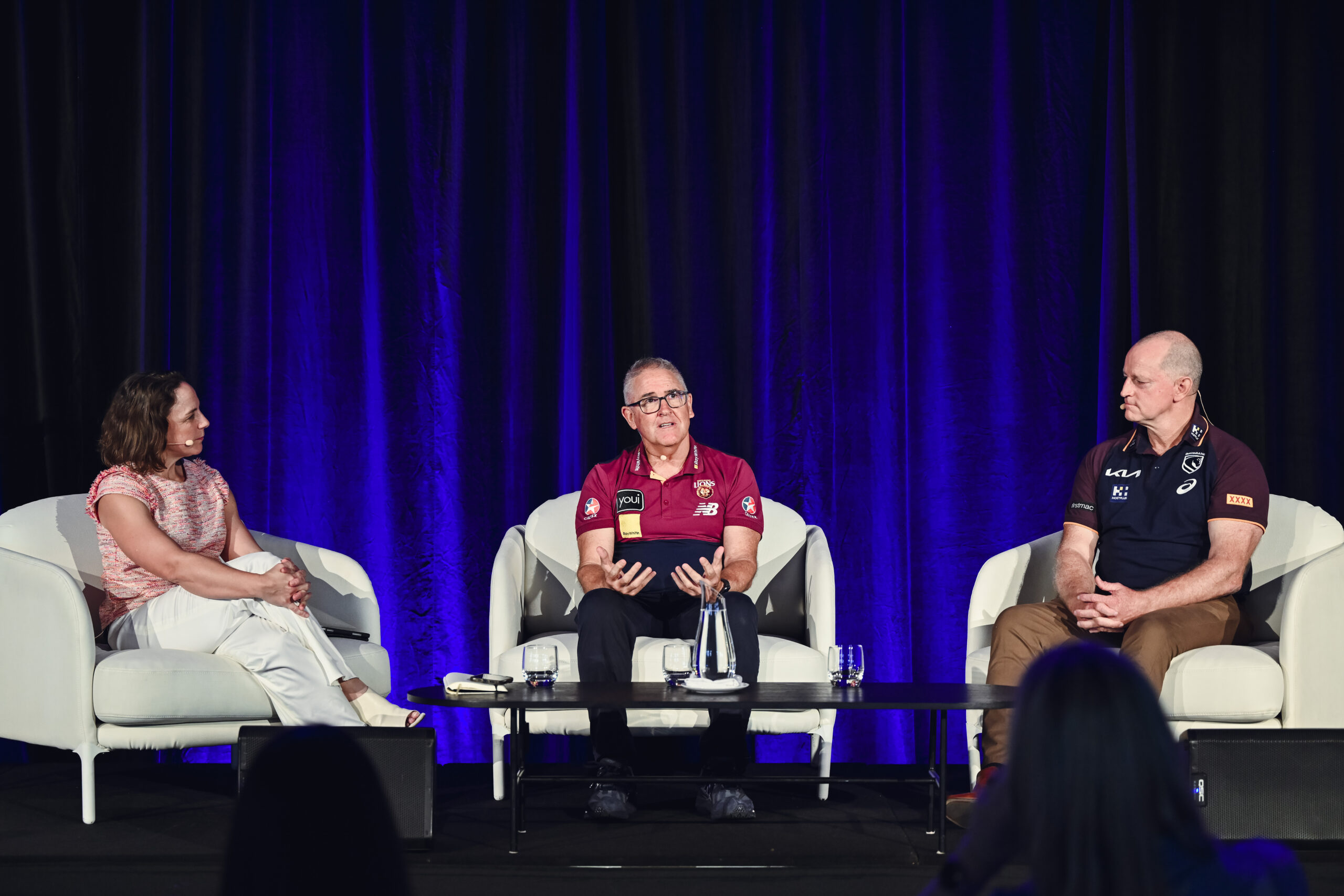
Chris Fagan (centre) in conversation with Michael Maguire (right) and moderator Rachel Vickery. Photo: Albert Perez
2. They seek ‘spine alignment’ too
While coaches can do what they can to ensure information is flowing in all directions, there is a role for both board members and heads of performance on the sports science side too.
Onstage, Peter Horne, the Performance Director at Rugby Australia, made the case for “spine alignment”, of which he said, “if we get true spine alignment of what we’re trying to achieve from a strategy, business and the deliverables [perspective] then we’re more likely to be able to execute.”
Crucially, as he admitted, it is not about agreement on every decision.
Peter Horne
“For the spine to work, you need everyone operating at the right level,” said Brett Robinson, the Chair of World Rugby, who joined Horne for the session. He included himself in that assessment.
Brett Robinson
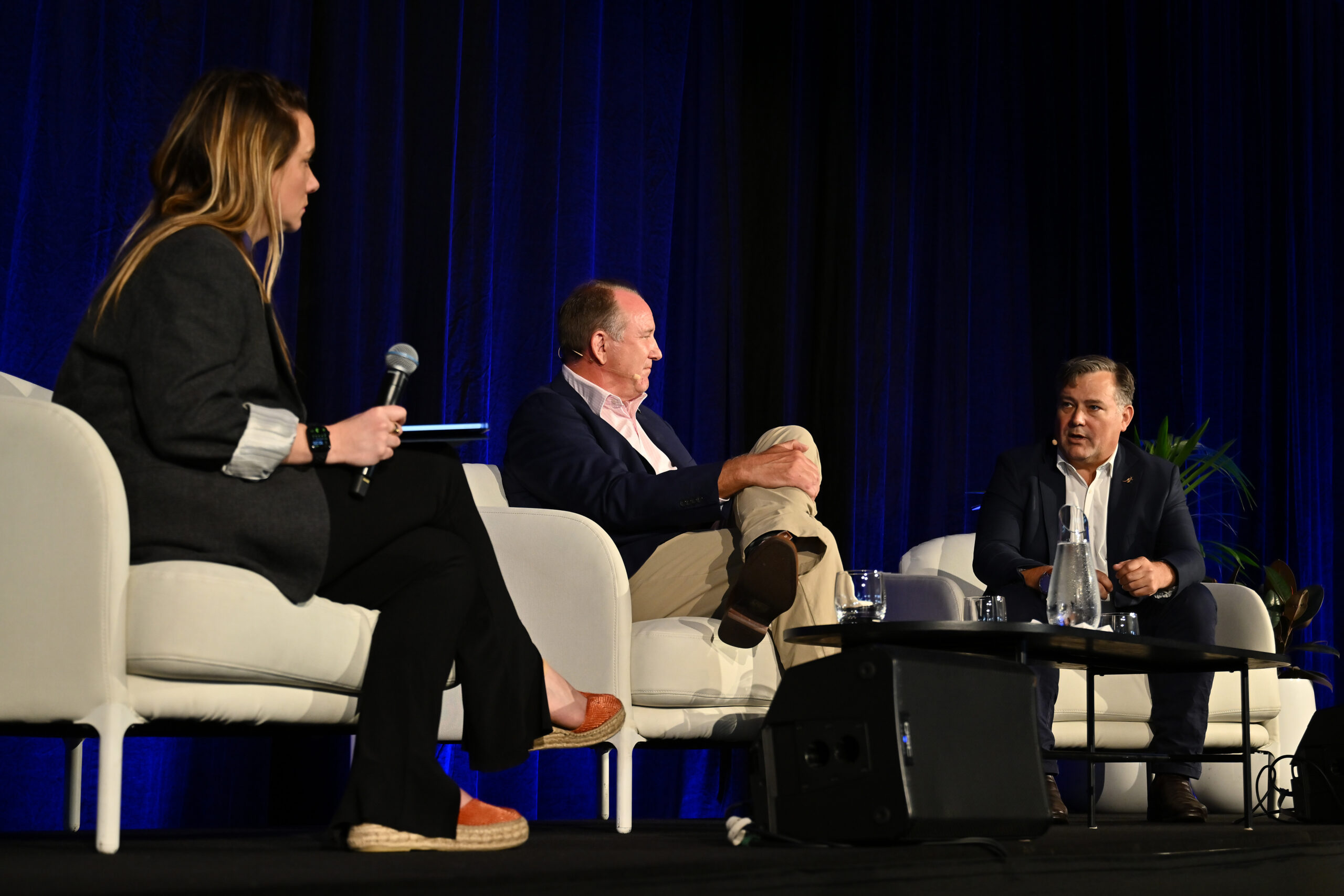
Peter Horne (right) makes his point onstage with Brett Robinson (centre) and Leaders’ Laura McQueen. Photo: Albert Perez
3. They bring their frontline people onboard
Few individuals are as well placed to discuss the concept of a culture driven by a shared purpose than Dr Stephen Rashford, the Medical Director of the Queensland Ambulance Service.
He is proud of his team’s “no excuses” approach too. “When we do our audits, everyone’s in the room, and there’s no making fun of anyone, there’s no bullying. We have honest, open discussions because we all just want to get better.”
Critically, their culture starts with their paramedics.
Dr Stephen Rashford

Dr Stephen Rashford mid presentation. Photo: Albert Perez
4. They have leaders who give their people psychological safety
Australian all-rounder Ellyse Perry is one of the greatest female cricketers of all time (then there’s her career as an international football player to consider). Her career has been underpinned by psychological safety. “When there’s a lot of support around that and real alignment on wanting to grow and improve, that makes a big difference,” she said.
Ellyse Perry
“No matter the position you hold, you don’t know everything, so be open-minded to learning,” said Anna Meares, the double Olympic gold medal-winning track cyclist who served as the Chef de Mission for the Australian Olympic Committee at the Paris Games. She spoke onstage alongside Perry and fellow Olympic gold medallist, the BMX cyclist Saya Sakakibara.
As Chef, Meares decided that open displays of vulnerability from early in the cycle would help to bring athletes and their coaches onboard.
Anna Meares
Psychological safety is just as important in individual sports, as Sakakibara told the audience. The Red Bull athlete won gold in Paris but recounted the story of her awful crash three years earlier in Tokyo and how it encouraged her to start placing her trust in others.
Saya Sakakibara

Anna Meares (second from left) makes her point to session moderator Fabio Serpiello in the company of Ellyse Perry (second from right) and Saya Sakakibara (first on the right). Photo: Albert Perez
5. They use process as a tool of alignment
In his presentation, Scott McLean, an associate professor at the University of the Sunshine Coast, explained that leaders must be aware of how things are connected in the complex systems of sports performance.
Scott McLean

Scott McLean from stage right. Photo: Albert Perez
Interventions should be governed by the performance need rather than results, according to James Thomas, the Performance Director at Warwickshire CCC, who made this case when he spoke onstage.
James Thomas
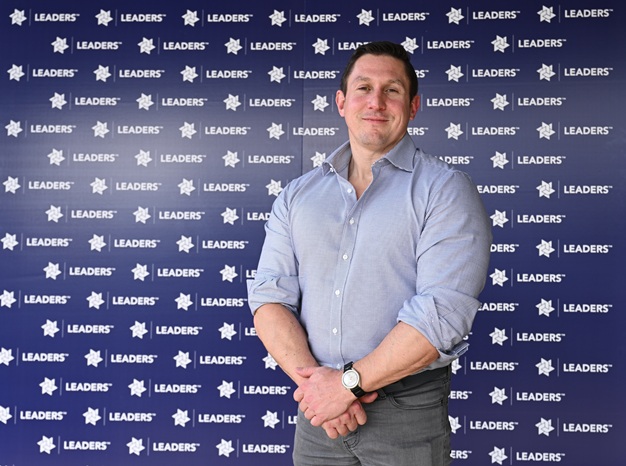
James Thomas onsite at Leaders Meet: Australia. Photo: Albert Perez
Where we’re going next
Emily Scarratt and John Mitchell knew their England team could be world champions, they just needed the right environment to be able to prove it.
The centre had just competed in her fifth tournament (a joint record in the women’s game), claimed her second winner’s medal, and helped to complete an 11-year quest to bring the World Cup trophy back to England. It was almost the perfect way to bow out after 17 years as an international, 115 caps and a world record 754 points.
Yet she had only played 19 minutes of England’s campaign – all as a second half substitute in the Red Roses’ opening pool match; a 69-7 defeat of the United States in Sunderland.
“I’ve definitely been part of environments before where that kind of non-playing player can become quite negative and toxic,” she told an audience at the 2025 Leaders Sport Performance Summit in London.
“For a large part of my career, I was starting and therefore it’s very easy to say the right things and present in that way when you’re not under the stress of not being selected or not playing as much as you would like.”
Scarratt was joined onstage by England Head Coach John Mitchell, who in early February extended his contract until the 2029 World Cup and added Scarratt to his coaching staff.
The session moderator, Rachel Vickery, asked him what it meant to see Scarratt and her other non-playing teammates (known within the Red Roses setup as “pillar” players) celebrating with such vigour.
“I reflected that we actually hit the sweet spot with the culture,” said Mitchell. “Sometimes you don’t get that sweet spot and we might not get it again.”
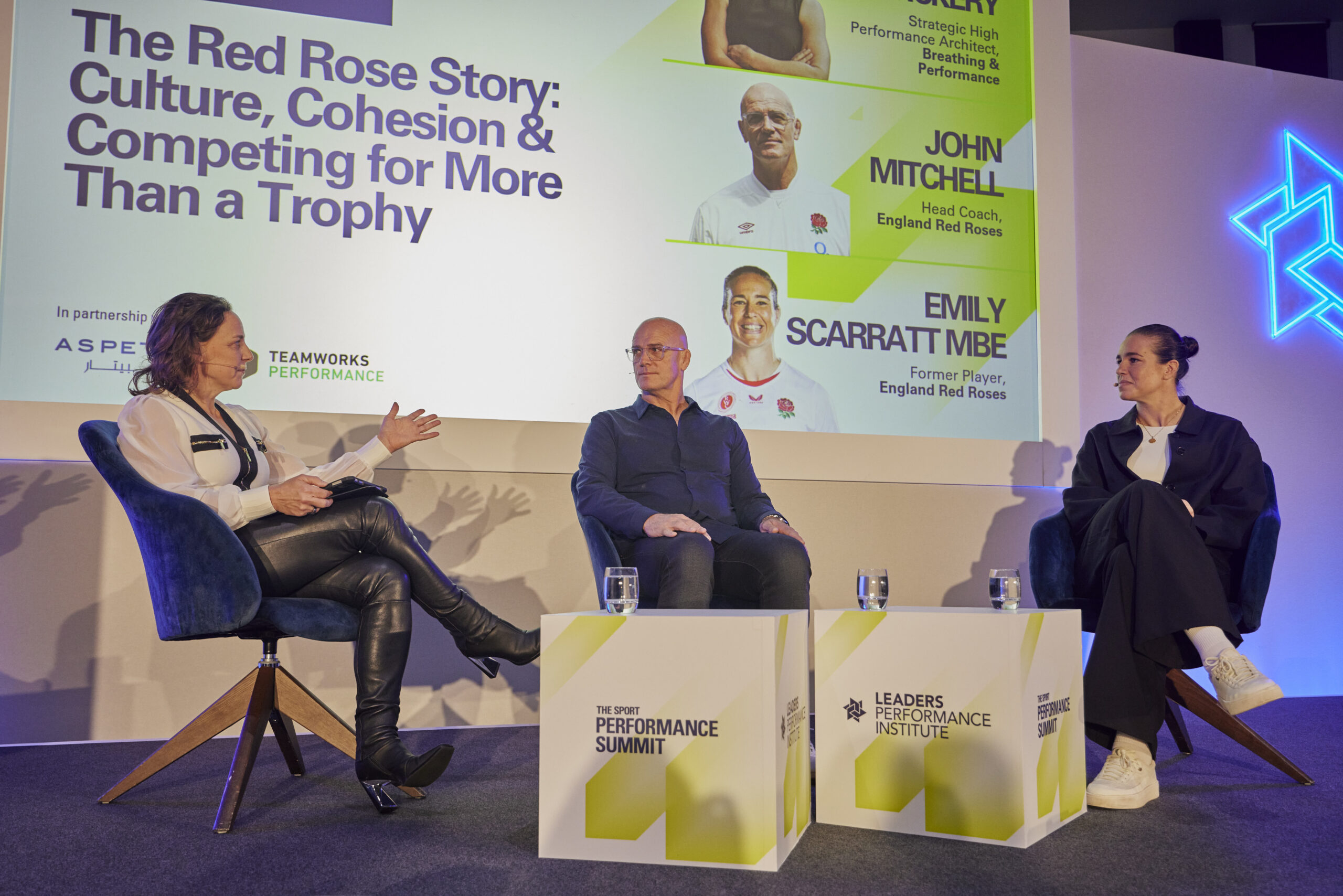
Rachel Vickery (left) talks to John Mitchell (middle) and Emily Scarratt (right) onstage at the 2025 Leaders Sport Performance Summit.
Here we reflect on what Mitchell and the Red Roses got right for 2025.
He spoke up when something wasn’t quite right
When Mitchell signed up to become England Head Coach in 2023, his remit was to win the World Cup. He was a coach with a proven track record in the men’s game who had now been handed the resources and the players to deliver the Women’s World Cup on home soil.
But in 2018 and 2022 England had lost World Cup finals they could, or perhaps should, have won.
“The leading question was how do we get done what we haven’t through the years?” said Mitchell.
It involved integrating young talent (eight players made their World Cup debuts against the US) and tactical tweaks (they had been too reliant on their maul). Both required an environment that enabled the best team on paper to prove they were the best team on grass.
To deliver on that front, Mitchell and the team’s leaders landed on three guiding values: ‘courage’, ‘take the handbrake off’ and ‘be all in’.
These values inspired England’s veterans and new internationals alike. “If the top person genuinely believes that culture is important it makes a difference,” said Scarratt. “Potentially in previous campaigns that hasn’t been the case and culture could get a little bit sidetracked or lost along the way.”
Mitchell even spoke up when he spied a shortcoming in the players’ well-meaning desire to ‘do it for the girls’.
“My thinking was that emphasis might be slightly calibrated towards ‘me’ – not intentionally – but how do I get the girls to calibrate towards ‘we’?” he said. “Because if I inspire you and I’m inspired by you, isn’t that more important, more inspiring to the person next to you? We get the job done and then our voice around our individual ‘why’ will be far greater.”
The cultural tweaking never stopped
“It’s very easy to just pick values, put them somewhere and hope that people live by them,” said Scarratt. “Our values were genuinely threaded through a lot of what we did, whether it was medical presenting or S&C presenting” and, when you witness that, “it’s very easy to buy-in”.
Mitchell held difficult conversations when necessary, but all players and staff, Scarratt said, were expected to speak up when necessary “to nip things in the bud before they became potentially bigger.”
At the suggestion of leadership consultant Patrick Marr, Mitchell would ask his player leadership group and support staff on the eve of each international camp to tell him “who’s going to pull the cart forward? Who’s going to sit on the cart? Who’s going to hold up the cart?”
After an hour he would “come back and I’d see two or three players, plus a couple of staff, where our priority needs to go,” he said, adding “we would then decide on who I would speak to and who they would speak to.” For every player or member of staff, there would be someone who could bridge that gap and “communicate around standards of behaviour”.
Mitchell even danced on TikTok when duty called
If you’re an England supporter, you may have seen the TikTok video of Mitchell dancing with his players.
“I needed to show vulnerability,” he said of such moments, which was not something he considered as a younger coach. “I had to do things that I probably don’t normally do and join in with the girls on certain things.”
Psychological safety may start with players or their head coach dancing in the dressing room, but it ultimately manifests on the pitch during tricky spells or in performance meetings when a staff member has the courage to raise a performance issue.
Mitchell knew he had to lead from the front. “Sometimes you’ve got to be the leader of those actions before somebody else does them.”
That said, his belief in the power of the head coach has been softened (and his self-awareness amplified) by three decades in the sport. “You learn through emotional intelligence that you don’t have to be absolute or right when making decisions. Just use your people. Listen to your people.”
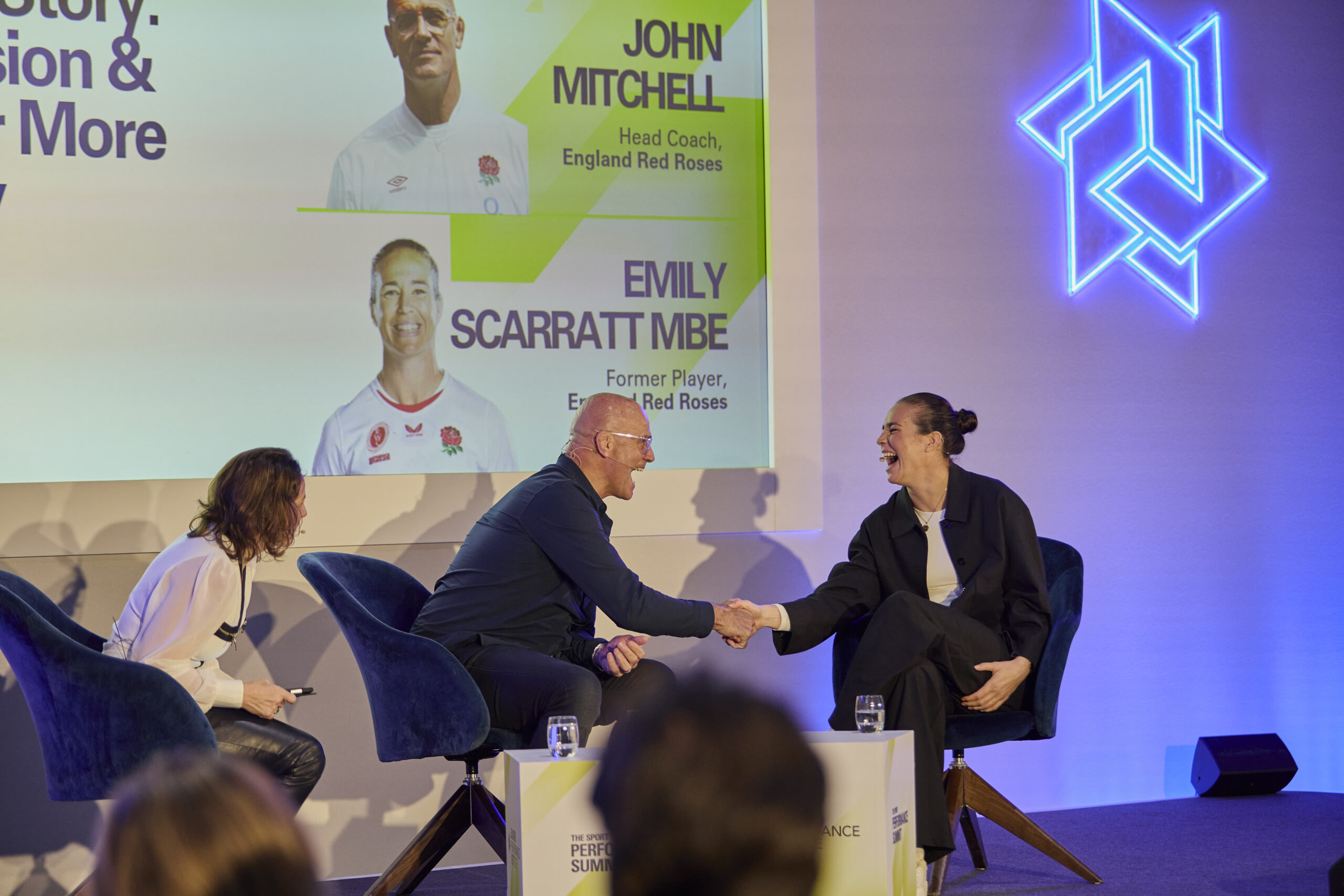
John Mitchell and Emily Scarratt shake hands as their session draws to a close at the 2025 Leaders Sport Performance Summit in London.
The team talked about the pressure they felt
For the first time, England openly spoke about winning the World Cup. It served as a pressure valve and, again, gave voice to their values.
“It might sound a bit silly but we hadn’t done that before,” said Scarratt, implicitly acknowledging how awkward the group felt at first about such an “un-English” sentiment.
As the English media and public latched onto the team ahead of the US match, the pressure grew. The players trained poorly on one occasion but, instead of dismissing it, they discussed it openly.
“I think we did a really good job of dampening it down by not not speaking about it,” Scarratt added. “By actually putting it out there and allowing people to know that other people felt like that.”
And Mitchell’s words after England eased through the gears on the opening night set the tone. He said: “There’s bigger games coming where teams will put even more pressure on us, so let’s take confidence from what we’re building and stacking as we’re going along. Our game doesn’t need to be perfect, it just needs to be effective, and that will win us the tournament.”
He was right and, looking to 2029, their goal is to win back-to-back World Cups, establish a legacy as one of women’s sports greatest teams, and to further grow the women’s game.
These lofty goals provoke three questions that Mitchell and England must answer: “What will earn the right? What will we keep and take forward with us? And then, thirdly, is what we what will we need to start again?”
What to read next
Meaning Does Not Guarantee Medals, But it Strengthens the Behaviours that Make Medals Possible
As Jamie Taylor of Dublin City University and the CoEx|Lab explains, the university’s master’s and doctorate programmes are designed to help coaches and other high-performance practitioners embed research into their daily practice – a habit that is sometimes overlooked in sport.
Additionally, one of the key challenges in coaching is that there is a world of evidence that can help practice, but most do not know about it.
At Dublin City University we are trying to subvert that attitude through our online doctorate and MSc programmes, which are aimed specifically at coaches and practitioners in high performance sport.
We have a community of around 100 coaches and practitioners who appreciate the capacity for research to enhance both theirs and their organisation’s practice in ways that have long been transformational in, say, S&C or medical.
In many respects, coaching is a discipline apart, yet sports performance has long-been reliant on other domains to pick up and apply research. More research can and should be done.
Below, I explore – drawing on insights from students across the doctorate and MSc programmes – the common barriers in coaching, before making the case for evidence-informed research that can meaningfully support practice. The programmes are delivered by a team of practitioner-researchers, including Áine MacNamara, Dean Clark, Robin Taylor, Rosie Collins, Stephen Behan and myself.
The common barriers
As a coach, you should be weaving research into your practice – it should not be additional.
“Last Friday, we protected two hours for some internal professional development with a group of practitioners,” says Ian Costello, the General Manager of Munster Rugby. “There’s 20 reasons not to do it, but if it’s important, it’s protecting the time in your diary, no matter how busy you are.”
Ian believes the programme has opened up new career options, potentially even beyond professional rugby union. He has now got into the habit of writing in his diary in three colours: black for operational matters; green for strategic issues; and blue for learning and personal development.
“Someone gave me one of those multicoloured pens – I hate them because of my bad handwriting and these don’t help – but it’s brilliant for my diary,” he continues. “Learning and personal development can be anything from podcasts to light reading or heavy reading. It can be writing too – that was a good life skill and practical skill that a mentor shared with me.”
Additionally, coaches have not often been shown how to critically organise their thinking, even when they thought they were doing so.
Ian has been coaching for more than two decades, but still wouldn’t describe himself as the finished article.
“The first year broke me down in terms of questioning everything I know around critical thinking and reflective practice,” he says. “What the doctorate does is give you more structure to that process. It provides you with a more robust and applicable skillset to be accurate in research terms and then to think critically about the information you’re absorbing. As time goes on, you’re able to transfer that to your practice more readily and with a lot more clarity.”
He is not the only one to find the first year challenging. “It was quite confronting and shocking,” says Jamilon Mülders, the Performance Manager at the Royal Dutch Hockey Association. “You try to present where you’re coming from, what you have achieved, what you have done and why you have done things, and the staff at DCU will pose little questions like ‘where’s the evidence?’”
Jamilon has won Olympic and world championship medals as a coach, and yet, as he says, “I have to acknowledge that nine out of ten things we did worked for whatever reason at that stage, but there was no underlying theory, no evidence. There was nothing you could fall back on where you can explain it or also just make sure that you detect possible mistakes, issues, challenges, hurdles which might have happened or occurred in other areas.”
He sensed that something was absent. “I felt that something was missing in my personal education and growth,” he continues, further reflecting on that induction period at DCU.
Some coaches may never have set foot in an academic setting but, whether it’s our doctorate or MSc programme, we don’t need to simplify course material for coaches. We just need to make sure we are providing the right provocation.
“When we’re asked better questions it causes us to say ‘actually, I took that situation for granted, but I need to peel that back a little bit more’,” says Rachael Mulligan, the Athlete Support Manager at the Federation of Irish Sport. “It forces you to go ‘what is the best question to ask in order to get to a better outcome?’”

The most recent cohort of students on DCU’s professional doctorate and MSc programmes lines up for a group shot at DCU in Dublin.
The case for evidence-informed – not evidence-based – research
I hear all the time that ‘we need to quantify this’. It leads us to measure things that don’t really matter simply because we can count them.
There are different ways of seeing this and my view is that evidence should inform coaching, working alongside professional experience, theory, and context, rather than being treated as something on which coaching can be straightforwardly evidence-based.
“For anybody to be genuinely comfortable about their view of the world or their view on practice, it should be research-informed,” says Scott McNeill, the Head of Coach Development at the Premier League. “The risk and challenge of research is that sometimes things can go out of date very quickly. A body of research can be nearly out of date the day that it’s printed. So to keep that as a consistent and live way of engaging in practice would make sense to me, that suggestion that knowledge isn’t fixed, that these things keep evolving.”
“The first thing I said was my issue with research is I sometimes think researchers are almost in an ivory tower and very much removed from what goes on in the day-to-day field of performance sport,” says Rachael of the topic.
“That perception was completely quashed after a couple of weeks in the programme because there’s so much emphasis in terms of, yes, this is fantastic in the academia space, but how do we move this into real-life practice?”
“I used to always say I was evidence-based and a lot of coaches will pride themselves on that,” says Christoph Wyss, the Lead Physical Performance Coach at Red Bull. “But I think evidence-informed makes more sense because if a research paper comes out, being evidence-informed is taking that research, reading it, critiquing it, seeing what’s good and what’s not, and then applying that to your setting, because every setting is different.”
As he says, “with evidence-based you’re just transplanting it, doing exactly what they did, but then evidence-informed is more translating it.”
“There’s not necessarily one solution,” says Eilish Ward, the Head of Player Development at the Ladies Gaelic Football Association. “There’s no one way to learn anything or to gain experience or expertise.” The key for Eilish in her work is to ensure she and her colleagues are “making as informed decisions as possible when we’re designing learning activities” because “not everything from research may be transferable into a practical environment and, equally, every practical environment is going to be hugely different.”
“Being evidence-informed is probably more aligned with what we do on a day-to-day basis,” says Niall O’Regan, the Head of Education & Development at the Football Association of Ireland (FAI). “It is something that has helped me to understand how to be authentic, how to be creative in adapting what the research is saying is to suit the needs and the context and the environment that you’re in.”
Plus, as Scott says, “people sniff you out pretty quickly whenever there’s a gap between what you’re saying and what might feel real to them. Our job as people that work in this space is to either translate the messaging in a more accessible way or to admit that there probably still is a gap.”
And therein lies the opportunity to ask better questions.
Research should never be far from practice
While the programmes can be intimidating for coaches, we’re here to help in any way we can because it is important that research is not too far from practice. When they are close, the research finds practical application.
“This was a part I enjoyed from day one because you could immediately see the practical implications and make an impact,” says Jamilon of his coaching in field hockey. “So if I were talking with S&Cs about load management around our training, my new way of approaching them and asking questions really helped me to have a clearer view on the team and the environment.”
In some cases, research can help to highlight the current inadequacies in a high performance programme.
Niall, for one, thinks differently these days about coach development structures at the FAI; and it feeds into his practice.
“There are some experienced coaches that have so much knowledge and so much expertise in their fields that they may not need to go systematically through a certain set of steps,” he says. “They may have the ability to effectively communicate, empower others or share knowledge in a way which doesn’t require them to go through a checklist. They can get to the end with the exact same learning and sometimes even more learning.”
Such an approach doesn’t necessarily sit right with the coach and it wouldn’t necessarily sit right with the coach developer. “There’s a grappling effect where those people probably feel like, ‘well, I’m being rigidly pushed into a checklist of things and being asked to do things that I naturally wouldn’t do myself’.”
It comes back to being research-informed. “The person in front of you is the actual start point, and then it’s up to us as the educators and developers to be able to link it into research. The practice comes first and then it’s a matter of layering in what research is out there that can inform the decisions that that person is making.”
If you would like to know more about the professional doctorate and MSc programmes at DCU please email Jamie Taylor at:
At the 2025 Leaders Sport Performance Summit, some of the most respected leaders in high performance set out their plans to build the winning teams of the future.
The South African, then with Munster, had agreed to become the Head Coach at struggling Bath in December 2021.
A few days later, he switched on the TV only to see Bath go 0-28 down after just 25 minutes of their Champions Cup tie with Leinster.
It prompted the Everest comment, as Van Graan told an audience at the 2025 Leaders Sport Performance Summit at the Kia Oval in London.
He eventually took the reins at Bath’s Recreation Ground in July 2022 and, over the next three years, led one of the most remarkable transformations in English rugby history.
In May, Bath lifted the European Challenge Cup, Premiership and Premiership Rugby Cup.
The tale of Van Graan’s ‘Rec Revolution’ set the tone for an international gathering of over 300 high-performance leaders to share knowledge, best practice and inspiration.
The agenda took its lead from our Trend Report in which more than 200 performance leaders from almost 40 sports told us how they expect the industry to develop in the years ahead.
Five trends stood out:
Van Graan is at the vanguard of several of these trends and, across both days, the Leaders Performance Institute delivered a range of guest speakers from organisations including England Rugby, the Royal Air Force, and the Haas F1 team to speak to each trend.
The following is a snapshot of what they said.
1. Alignment is now a competitive advantage
For evidence of the stock placed in being aligned, look no further than Bath’s transformation from a rabble to the best team in England in just three years.
Van Graan said: “I put up a picture of Twickenham on the very first day. I said ‘I can’t tell you how we’re going to get there, but we will get there.”
He wanted his playing group, coaches and other performance staff to coalesce around three values: connection, clarity and commitment. The trick was then bringing those to life.
Johann van Graan
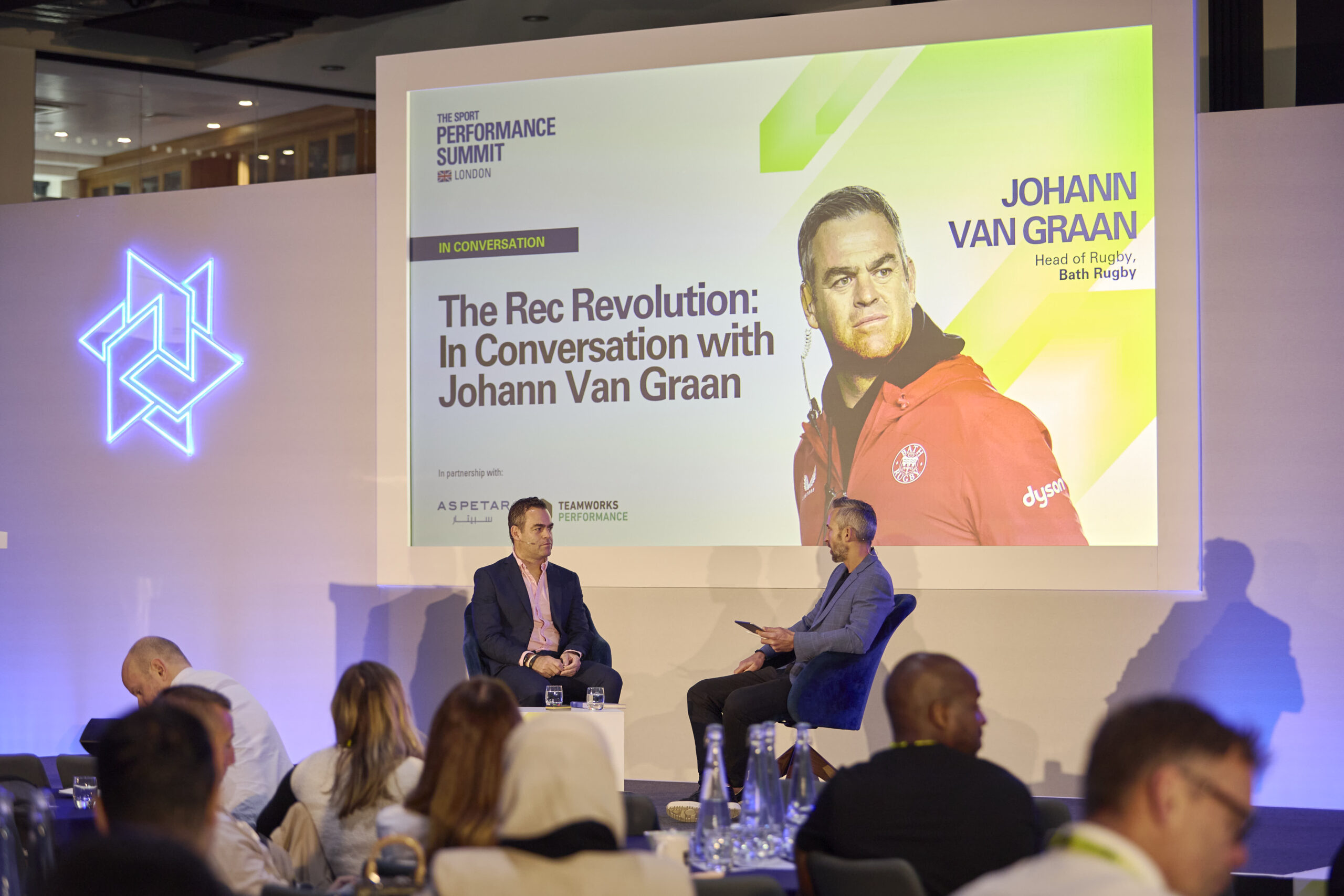
Bath Head Coach Johann van Graan in conversation with host Iain Brunnschweiler.
2. Leaders increasingly seek to empower and collaborate
John Mitchell offered another inspiring story from the world of rugby union.
In 2023, when he signed on as Head Coach of the England women’s national team, it was Mitchell’s first time coaching a women’s team.
The Red Roses had a genuine shot at winning the Women’s Rugby World Cup on home soil in 2025, but a talented team needed an experienced guiding hand.
The team delivered, with Mitchell receiving plaudits for his role as England secured their first world title in 11 years.
Two months on from that achievement, the audience found Mitchell (affectionately known to his peers as ‘Mitch’) in typically reflective mood alongside the recently retired Emily Scarratt, who was part of the Red Roses’ winning squad.
Sport (and rugby union) grows ever more complex and yet, after 30 years, Mitchell feels he has never been better equipped to coach.
“You don’t have the full scope,” he says of his early coaching days in the mid-90s. “You have strengths early on that are recognised but then also you sometimes don’t know the whole of yourself. So you take the time to understand the whole of yourself.”
He came to a critical understanding. “When I was younger, I was going to try and be right. Maybe I was trying to prove myself as a coach.”
John Mitchell

England Red Roses Head Coach John Mitchell shakes hands with former England fullback Emily Scarratt at the conclusion of their panel session.
Emma Keith built on the theme of empowerment in her presentation on officer training in the Royal Air Force.
“Cultures and environments can only grow when everybody takes accountability,” said the Commandant of the RAF’s Tedder Academy of Leadership. Keith, a group captain, is the first female to run RAF officer training.
Emma Keith
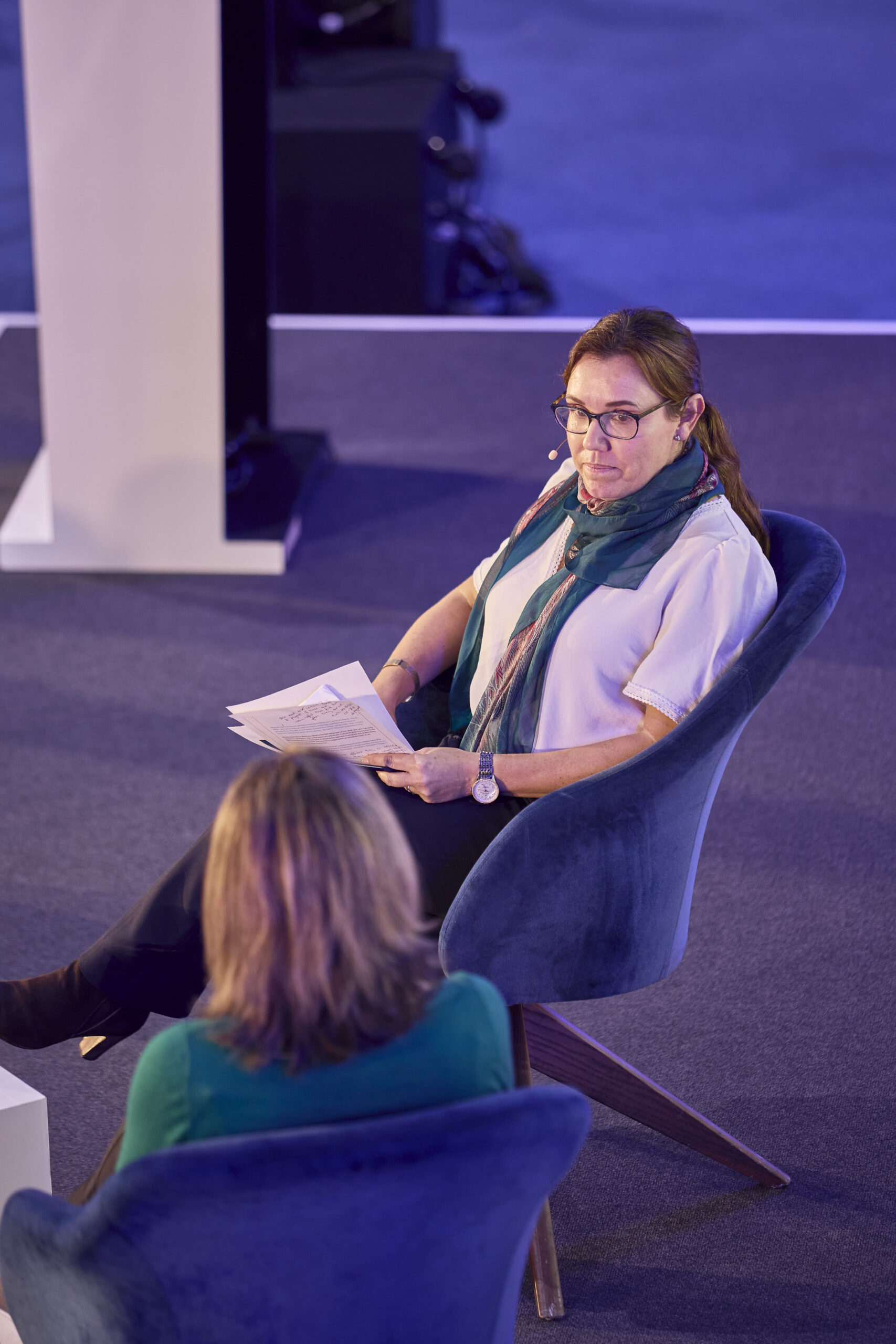
Group Captain Emma Keith talks to UK Sport’s Alex Stacey following her presentation on officer training in the Royal Air Force.
3. Teams are prioritising resourcefulness over resources
As Team Principal of MoneyGram Haas F1, Ayao Komatsu knows as well as anyone that his team is competing with better resourced and more illustrious teams.
The team has 375 staff members, which may sound like a lot, but it pales in comparison to the likes of Ferrari, Red Bull and McLaren.
“If we cannot work together, if you’re not supporting each other, if you’re not aligned, we’ve got zero chance against organisations minimum three times our size,” said Komatsu, who had just flown in from the Brazilian Grand Prix in São Paulo where Haas’ Oliver Bearman achieved a creditable top-six finish the weekend before the summit.
Ayao Komatsu

Ayao Komatsu, the Team Principal of Haas F1, shares insights into life in the pitlane.
Similarly, albeit in vastly different circumstances, the Red Cross must make the most of its limited resources when emergencies strike.
Chris Davies, the Director of Crisis Response and Community Resilience at The British Red Cross, cited his team’s core operational process:
Chris Davies

Chris Davies of the British Red Cross in full presentation mode.
4. Psychology will be a game-changer
The mental and behavioural side of performance was an ever-present topic on both days of the summit. Our guests discussed several elements:
The importance of individual expression and acceptance
Johann van Graan
Belonging as a contributor to wellbeing (and performance)
Emily Scarratt
Psychological safety
Ayao Komatsu
5. Teams are engaging in a tech arms race
Professor Tom Crick spoke in his capacity as Chief Scientific Adviser at the UK Government’s Department for Culture, Media and Sport.
He presented on the growth of AI and continually stressed how important it is to keep “the human in the loop” regardless of whatever advances are coming.
To this end he offered Leaders Performance Institute members a series of recommendations.
You must be able to explain why you are using an AI tool…
“You can’t just say ‘the computer says so.’ There has to be some understanding and explainability, and there has to be trust.”
An AI tool should not replace your people…
“AI should not erode or disempower or remove agency for people within your domain. It should augment human capability, not replace it,” said Crick. He added: “It is about co-design, co-decisions and co-evolution as we go forwards – keeping humans embedded in the process.”
Don’t assume your AI tool is right…
“Don’t automatically trust the system. Always ask: is that the right data? Does that feel right? Can we verify and validate it another way?”
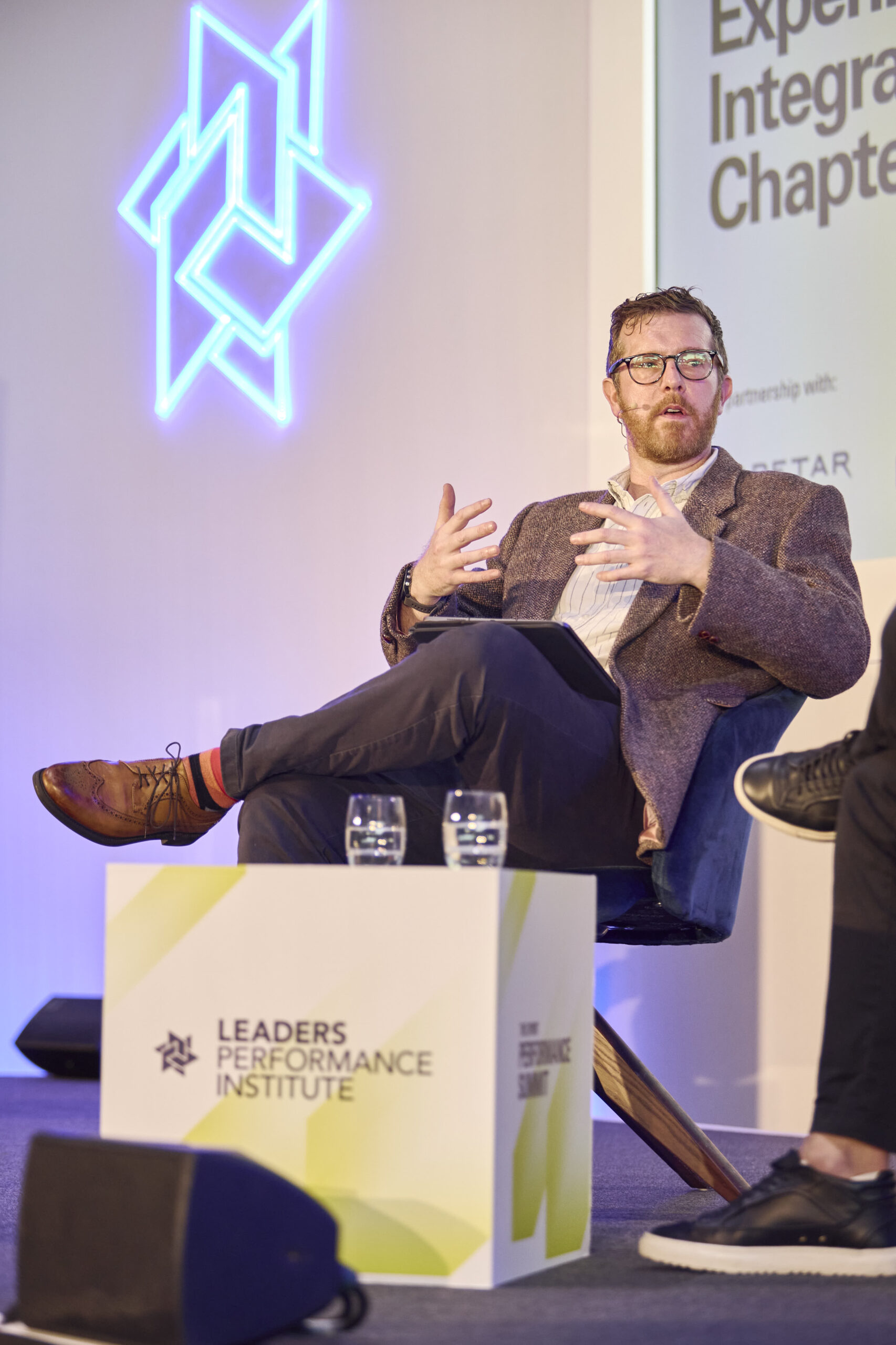
Tom Crick, the Chief Scientific Adviser at the UK Government’s Department for Culture, Media and Sport, answers questions from Leaders Performance Institute members.
Next stop for the Leaders Performance Institute
In the first session of our latest three-part Learning Series, Darren Devaney of Ulster and Daniel Ransom of Manchester United discuss the steps psychologists can take to ensure their smoother – and smarter – integration in a sporting environment.
An article brought to you in partnership with

More than 80 per cent of respondents feel that psychology is ‘very important’ in the enhancement of human performance, yet 43 per cent also feel that psychology is the most ‘underserved’ area of human performance.
The discrepancy chimed with Darren Devaney. “It’s like people know they want it, but they’re not quite sure how to make it happen,” said the Lead Performance Psychologist at Ulster Rugby.
Devaney was co-presenting at the first session of a three-part Leaders Virtual Roundtable Learning Series in partnership with the Chartered Association of Sport & Exercise Science.
The series is entitled ‘How Do we Enhance the Impact of Psychology in Performance Environments?’
His co-presenter Daniel Ransom, the Head of Psychology and Performance Lifestyle at the Manchester United Academy, offered his analysis of the report’s findings.
“What it perhaps highlights is the gap between research and application, as well as the immaturity of psychology as an applied discipline,” he said while also noting the appetite in the sports performance community for psychological services.
When session attendees, many of whom had a background in psychology, were invited to rate their own effectiveness, most answers were grouped in the middle.
“It probably just reflects that it’s not fixed,” said Ransom of the results. “That level of effectiveness will change throughout seasons or cycles, and, I guess we’re hoping to be at the top end but we know at times it’s going to move up and down a little bit.”
Over the course of an hour, the duo discussed the role of the psychologist and the ways they can develop and sustain their work in sporting environments.
The requirements of the psychologist
Together, Devaney and Ransom drew up a list of requisites for a practising psychologist in sport:
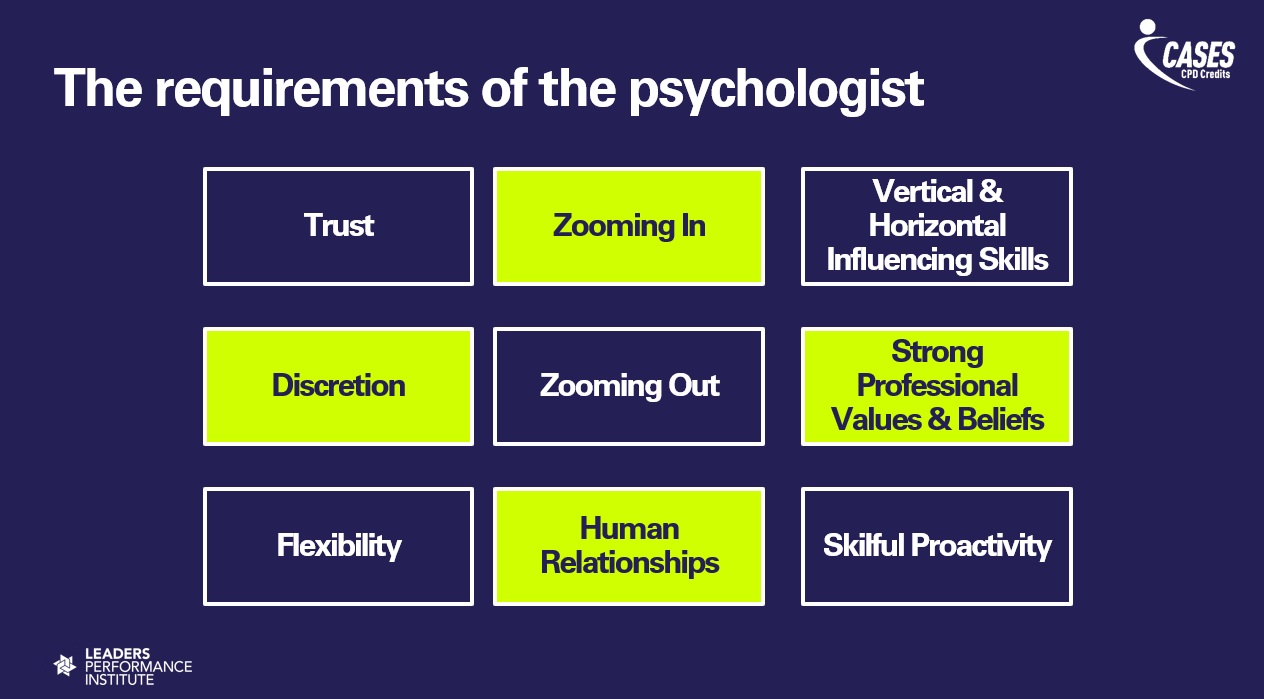
They then homed in on a selection:
Zooming in and out
According to Devaney, the psychologist must “get away from the assumption that we work with the individual athlete only”. Instead, they should ask themselves “is my intervention best targeted at an individual or is this more systemic? And if I’m going to be here for the next five or six years, what’s the most useful way of spending one or two hours on this? Is it working with a head coach? Is it working with all the staff? Is it working with a group of players, or is it the one-to-one with the athlete?”
Vertical and horizontal influencing skills
Psychology is not just the work of the psychologist. “An hour spent with one individual athlete is very well spent,” said Devaney, “but an hour spent with somebody that upskills or shapes them”, such as a coach, brings your work into “exponential territory”. He continued: “it changes how they do their work with 20 or 25 people over the course of the week”.
Ransom added: “If we really want to embed and integrate psychology what we require is other people to take on our ideas and work in ways that are psychologically-informed.”
Skilful proactivity
“We can’t sit still and wait for work to walk in the door,” said Devaney. “I’ve often reflected that this organisation functioned for decades without me in the building, so if I’m not here, this place can keep going. I need to recognise the fact that it might not be every day the main thing that everybody’s thinking about, so how can I do that in a way that doesn’t produce scepticism or kickback?” Nevertheless, “you must be proactive in trying to have an impact.”
Ransom has advice for anyone encountering scepticism. “If people are ready for more in-depth and focused work, then let’s meet them there. If they’re not, and they’re at that sceptical end, how do we try and offer them something which is appropriate to the needs of what they might be open to? If we pitch that wrong and we try and go too hard or move too quickly with those people, I think you can get caught in a potential tug of war where we don’t really make much progress and people hold their position.” With skilful guidance, people can “see the value that other people have, and that can be a way of opening a few windows and doors to them.”
The foundations
Devaney and Ransom set out four foundations:
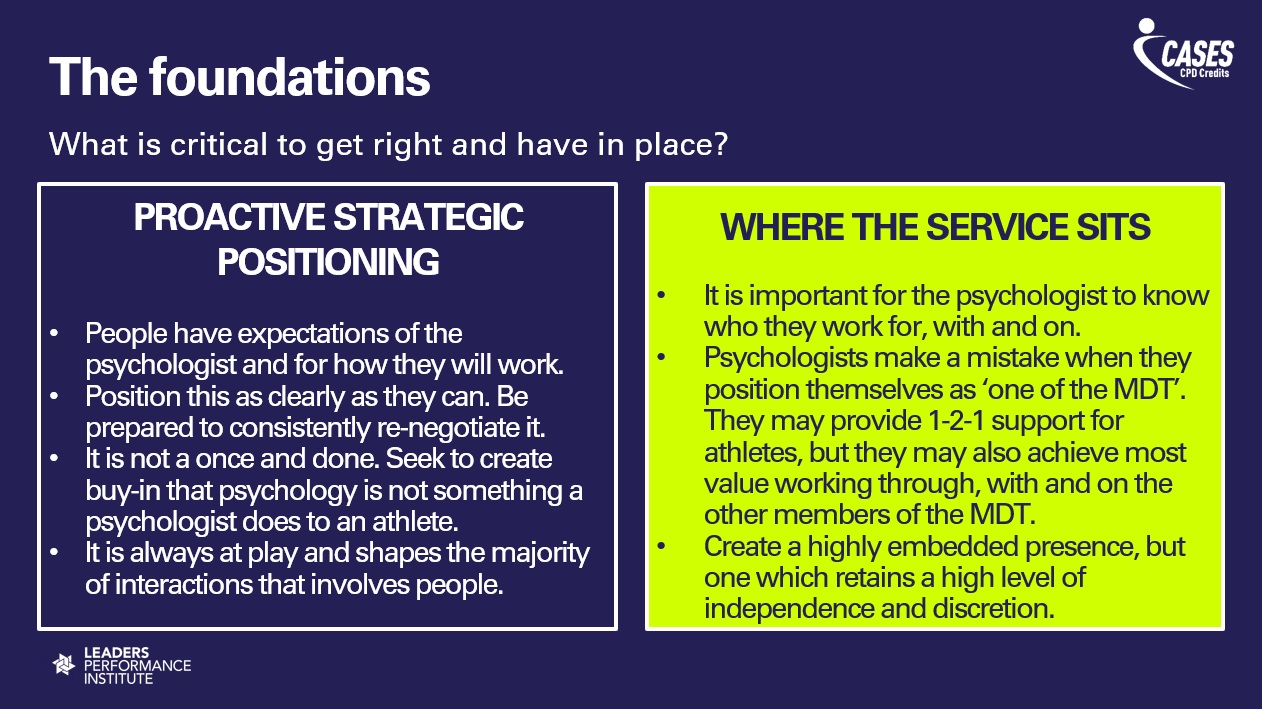
Devaney argued that in professional sport at least, a psychologist’s job can be harder if the head coach is not one of those key stakeholders. “They can really shape what the role can be,” he said. “Like whose priorities do I need to be trying to align with? If I’m running into time demands, and we’re trying to figure out where and when I’m going to do work, who actually has the best steer on that?”
Whether you’re preparing for success today or down the line, the priority needs to be clear. But that’s not always the case. “It sounds pretty straightforward, but you’d be surprised how often those ideas can be misaligned,” said Ransom. “It makes it really difficult for you to work in an integrated, embedded way, with a long-term focus if other people are perhaps expecting immediate impact on individuals when you have a more systemic, broader focus.”
A psychologist’s positioning is not fixed. Ransom argued they must be “prepared to renegotiate the position time and time again”. He has had to “go through a process of having to establish, clarify and communicate boundaries in terms of what my role is.”
“The need to renegotiate is just so consistent,” added Devaney, “and I think there’s a bit of me sometimes that thinks that there’s an arrogance that if I’ve explained it once, everybody will get it and know it all the time and keep it at the forefront of their mind.”
The duo’s point about intentionally stepping away from being part of an MDT, to not be “boxed in”, raised a concern from one attendee about the potential negative impact on the sport psychologists as the conduit into clinical psychology. Ransom and Devaney took the point.
Ransom, who clarified that it was more about not being aligned to a single department of the MDT than not being a member per se. “As practitioners, we have to be flexible,” he said. “So there’d be times where, in my role, I would be positioned as part of an MDT. There’s times where I’d be positioned closer to some of the coaching staff.”
This takes skill, as Devaney said: “If I’m going to sit somewhat outside of the MDT and start to bring suggestions to them about how I can be supportive of their process, I’m going to have to do so very delicately and skilfully to get the impact that I want.”
Keep building
Both men had some advice for the table:
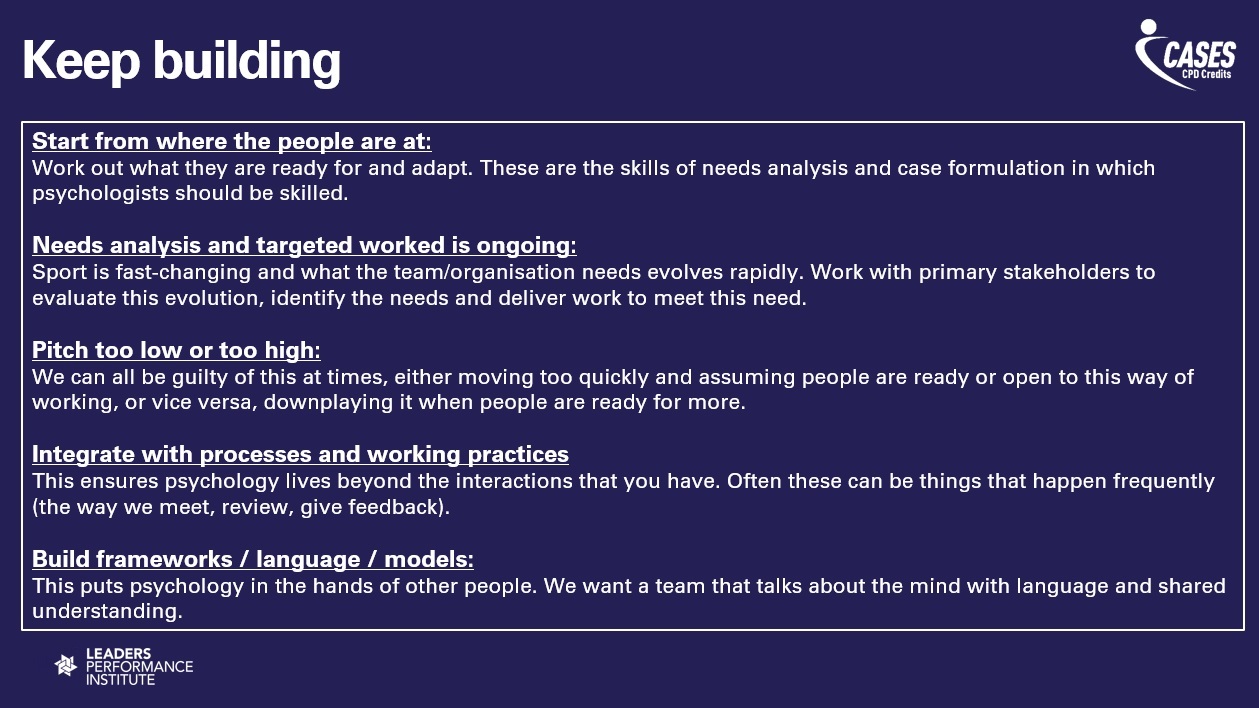
In reflecting, Devaney spoke of a personal experience: “The best question I’ve ever been asked by a head coach that I worked with was ‘what rooms and meetings do you need to be in to be able to be more effective in your job? Tell me, and I’ll make it happen’. That’s such an empowering position.
“He was basically offering an open invite to integrate what psychology is into the different practices of the organisation.”
Devaney also spoke about the importance of maintaining a shared lexicon, particularly in sports with regular athlete and staff turnover.
The finishing touches
Of the finishing touches, Ransom said: “If we think about the foundations through to the building blocks, which were more around the processes, the ways of working, the frameworks, then this bit is more around the actual skills of the practitioner and the key relationships that they have.”
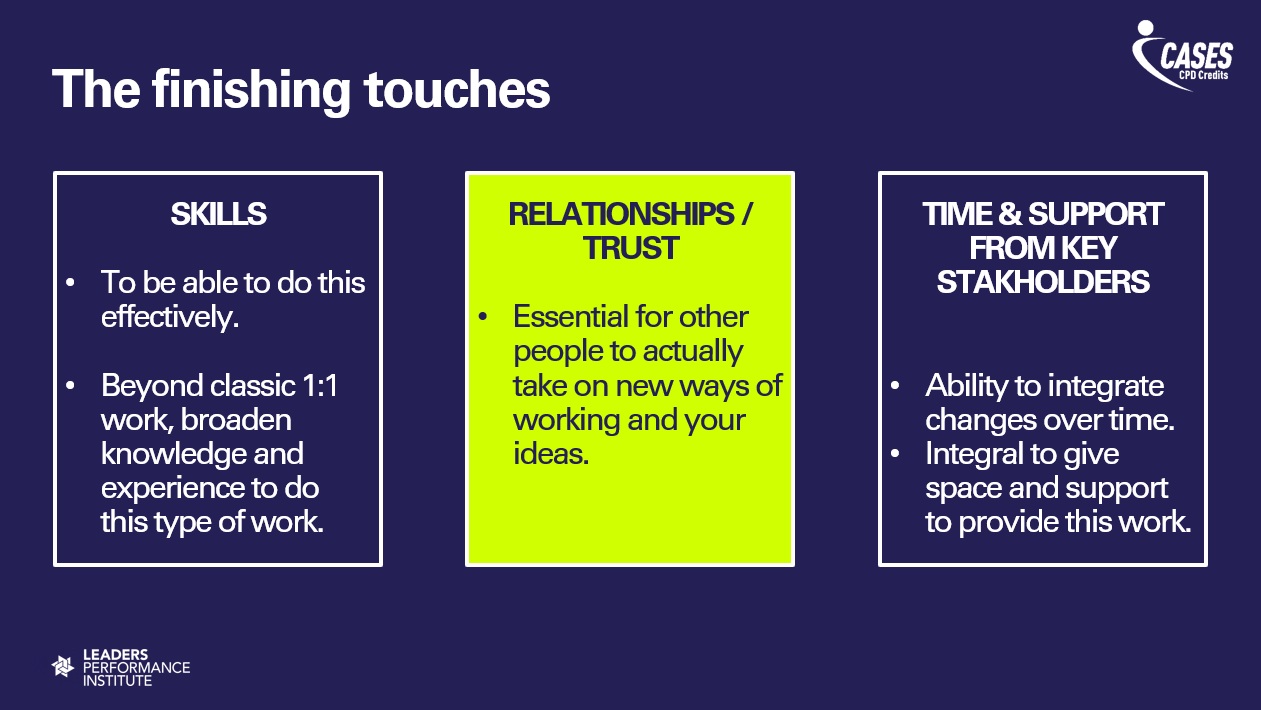
“Here,” Ransom continued, “we’re talking about the importance of having skills beyond the classic ability to do individual one-to-one work, which people might associate with psychologists. So we have the ability to carry out discussions among teams of staff and hold those types of collaborative conversations, which is a skill in and of itself. Do we have the confidence and competence to sit with a team of experts and navigate a conversation in a way, which is encouraging different people to contribute, which is embedding or weaving in some psychology input into that without dominating that conversation?”
Session 2 of ‘How Do We Enhance the Impact of Psychology in Performance Environments?’ is on 2 October. You can sign up to be part of this Learning Series here.
As Harlequins’ lock Stephan Lewies explains, the key lies in collaboration – bring your athletes into the fold.
Quins’ 17-10 victory at the Twickenham Stoop ended five years of frustration and marked a complete turnaround from the 2023-24 Premiership Rugby season when they conceded 90 points in losing both home and away to Saracens.
Stephan Lewies, the lock who captained Quins to their long-awaited victory, had also endured every one of those losses. The run was particularly galling given the relative parity between the teams during that period. Quins were themselves Premiership champions in 2021.
So what was different this time? “Coming off a record like that in your derby game, in a way you go looking for answers in the wrong places,” Lewies told an audience several weeks later at the Leaders Sport Performance Summit in London.
“In the past, we’d review what’d gone wrong, and the coaches – who often feel pressure in a different way to the players – would go ‘let’s change this and let’s add that’ because Saracens are brilliant.”
It took eight reverses for Lewies and his team to work out why. “We’d always changed our tactics for Saracens,” he continued. “We would change how we structured our week.”
Quins, he explained, usually worked off an 80:20 game model where it is “80 per cent us and 20 per cent we change for the other team”. However, “we often went 50:50 against Saracens; training 50 per cent on us and 50 per cent on them.”
They did things differently ahead of the October 2024 match. Firstly, the players and coaches met independently before convening to discuss what was needed. The club had adopted a similar approach in their successful quest for the Premiership title in 2021. Their director of rugby [the de facto head coach] departed mid-season and the players worked with the remaining coaches to devise a winning formula after the club decided to wait until the off-season to appoint a replacement.
Once again it gave the team clarity in their convictions. “We said we’ve been constantly changing for this opposition because of the pressure that’s mounting on us,” said Lewies, “and we agreed that we should go back to what we do and just try to do that better.” That meant “doubling down” and going almost “90:10” in the week building up to the match. “That created clarity and alignment from the coaches to the players. And when the pressure came in this game, we could turn to something we’d done for the whole season, and basically for years, versus something new in a pressured moment.
“It’s much easier to stuff up something new under pressure versus something you’ve done for a long time because it’s already second nature.”
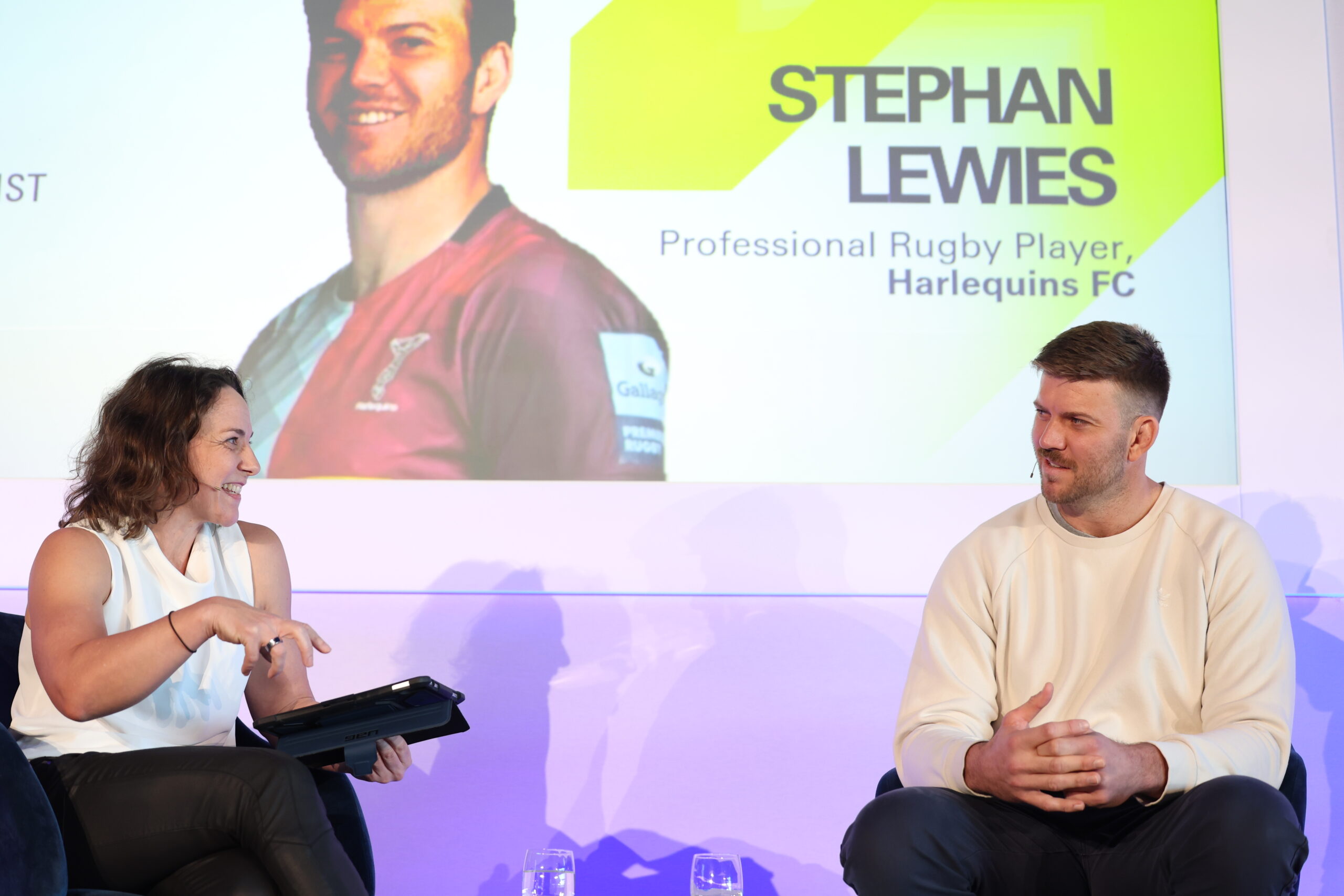
Stephan Lewies in conversation with Rachel Vickery onstage at the 2024 Leaders Sport Performance Summit at the Kia Oval.
Lewies’ reflections chimed with session moderator Rachel Vickery, a high-performance specialist helping teams in the worlds of sport, business and the military perform under pressure.
“So much of pressure is what happens off the pitch. When you’re on the pitch that’s actually your comfort zone in many ways and so you’re more prepared for that,” she said.
“Many teams have a monkey on their back around a particular opponent and that can change how the game is approached, which adds a lot of pressure.”
Lewies agreed and felt that being process rather than results-driven was ultimately what led to the result that day.
“It gives you freedom on the pitch to just go out and play,” he said. “You know your prep is done. Go out and express yourself. When you have clarity and alignment with the coaches you’re not asking yourself on the pitch ‘what’s the coach thinking?’ whenever there’s a tough decision. You almost know the answer to the question before it happens because you’re totally aligned in what you want to achieve in the game and at different stages of the game.”
It is an attitude Lewies takes into difficult conversations, which he faced often during his four years as Quins captain. The key was to be well prepared and, more often than not, those conversations would not be as tough as anticipated.
“If you kick the can down the road it can become a bigger problem. It can be scary to have that tough conversation in the moment, but that’s where growth happens, in that adversity. You grow closer as people and as teams.”
He recounted the story of a teammate who once skipped training and was suspended. Lewies endorsed the punishment but was labelled a ‘Judas’ by the player in question. The pair eventually made up after a frank exchange of views when it was clear that Lewies would listen to what his teammate had to say. It stopped matters escalating further and, as Lewies happily explained, made their relationship stronger.
“Getting him back on board and understanding him was critical for us.”
It was in such moments that the bonds, self-belief and confidence were forged that would eventually see off Saracens.
“There is so much value in creating opportunities to collaborate.”
What to read next
How Do you Develop the Most Expert Coaching Workforce in World Football?
In the final session of ESSA’s ‘The Future of Sport’ virtual roundtable series, Dr Alex Roberts of the Queensland Academy of Sport and former All Blacks Manager Darren Shand discuss talent identification, development and management. ‘Fit’ is less valued in World Cup-winning dressing room than you might think.
An article brought to you by

“It is only a really small part,” said Dr Alex Roberts. “We need to make sure we’re putting those strong development environments around athletes because it doesn’t matter if we pick 100 per cent of the right athletes if we’re not putting them in the right environment.”
Roberts, the Talent Identification & Development Lead at the Queensland Academy of Sport [QAS], is speaking at the third and final session of ‘The Future of Performance Sport’, a three-part Virtual Roundtable series brought to you by the Leaders Performance Institute and Exercise & Sports Science Australia. The focus for the concluding conversation was talent identification, development and management.
She was joined on the virtual stage by Darren Shand, the former Manager of the New Zealand All Blacks, who offered perspectives from the senior end.
Firstly, Roberts outlined talent identification and development at QAS.
QAS offers opportunities, but not guarantees
Above all else, you must provide young athletes with a good experience, which QAS seeks to do through its YouFor2032 talent identification programme. Their goal is to discover and develop athletes with the potential to achieve medal success at the 2032 Olympic and Paralympic Games in Brisbane. At the time of writing, approximately 6,000 young Queenslanders have entered the programme.
“We can’t guarantee that athletes are going to succeed,” said Roberts, “but we want to make sure that they’ve got every opportunity to find the sport that they could be successful in, and that they have the appropriate education and development that will allow them to succeed.”
They have adopted the ‘principle of sports orientation’
Youngsters’ skills will be assessed to enable placement in a sport they may not have tried. “We see if their skills, their backgrounds, their traits, might fit a different sport,” said Roberts. Once assigned to a sport, the athlete will enter a three-month confirmation phase where they will learn the fundamental skills and get to know their coaches.
The physical is the starting point
Without the right physical characteristics mindset counts for little. “If you’re 160cm [5′ 2″] tall, you’re probably not going to be a rower, no matter how badly you want it,” said Roberts. “We match physical traits to where people are genetically predisposed to have more success.”
QAS also looks for elite behaviours
During the three-month confirmation phase, QAS will look for evidence of the behavioural patterns that denote elite performers (“We look at things like: do they show up on time? Do they put the effort into their warm up and cool down? Do they bring a water bottle?”). QAS does not, however, undertake formal psychological profiling at any stage. “As far as we know, the evidence isn’t there to support specific psychological profiles for long-term success in sport, particularly within the age groups we’re working with.”
Social support underpins the QAS approach
Social support is particularly important when athletes progress to the more intense 12-month development phase. It is a critical element of balancing challenge and support. Roberts said: “When we do our athlete development camps, we bring all of the athletes from all the sports in at once, so they can get cross-sport friendships. They can see what other sports look like. They can see that it’s not just them that are going through this. They’ve got that in-built support network that they can lean on.”
Additionally, “if we’re picking an athlete in Cairns for beach volleyball, we will take a few athletes to make sure that there’s a training squad up there; that they’ve got some other friends that are learning the same sport, that are progressing through the same system.”
The role of sports scientists
The sports scientists of QAS serve as educators, not only of coaches on state or national programmes, but further down to the grassroots. For young athletes it is, as Roberts said, about “early education; not waiting until they are moving through the system”. As for coaches, “they are the ones who are face to face with these athletes at every stage of their development.” Therefore she and her colleagues will work with coaches at different levels of the pathway and make sure that “they have that clear and consistent messaging, making sure that they understand what it looks like for the athletes, making sure that they understand the value of athlete wellbeing.”
The YouFor2032 app
As Roberts explained, the YouFor2032 app is helping QAS to find talent across the state of Queensland. Youngsters can download the app and test themselves in a home setting, with in-built AI enabling them to do it alone. Roberts said: “You don’t need an expert to hold the phone and get the angles right. You don’t need someone to sit down and analyse the joint movements. It does all of that for us.” Results are sent to QAS, who then begin the initial screening.
The app means fewer missed athletes during regional visits. “If you miss out, it used to mean you had to wait until next year,” added Roberts. “The app is going to remove a lot of those barriers for people.”
It was then Shand’s turn to provide an insight into the All Blacks’ double Rugby World Cup-winning environment, of which he was part for 18 years.
The All Blacks detest the term ‘fit’
The All Blacks’ maxim ‘you join us, we don’t join you’ is as true today as it has ever been. Yes, the team prizes hard work, self-driven individuals, and a willingness to learn – these help to set the standards that all players must meet – but there is also room for individuality.
“One of the things that annoys me in environments is when people say ‘we just want to get people that fit in’. I detest that,” said Shand. “I’m not after fit. I want people that are going to add.” He believes that diversity of personality and the very idea of complex individuals are something to be embraced.
“Saying you want someone to fit is a cop-out. You’re not really aiming high enough. You’re certainly not aiming at the world-class level,” he continued. “I reflect back on some of the players that we had whose high end was unbelievable, but their bottom end was a real nightmare, but they just added so much richness to the guys that perhaps sat in the middle. Across team sports, particularly that richness and what they can offer in terms of growth, outweighs what can happen at the bottom end.”
They create a home on the road
The All Blacks spent much of their time on tour, including at four overseas Rugby World Cups during Shand’s tenure. They quickly realised the performance benefit to making camps in France, Britain or Japan feel as much like home as possible, which meant including families at opportune moments. The penny dropped for Shand at a training session on the eve of a World Cup quarter-final in Cardiff.
“We finished the session and all the kids ran out into the field, and I just looked at it, and I just saw something I hadn’t really noticed before: the connection and the energy. I said to myself: ‘this is why they play’.”
Non-playing All Blacks are heavily involved
The All Blacks value their non-playing squad members and, once selection decisions have been clearly and respectfully explained, ensure their continued involvement throughout a game week.
“It’s an opportunity for them to coach,” said Shand. “So there might be three of them playing for the same position, but only two play, with the third becoming a coach. We often get our greatest learnings when we coach. It’s an opportunity to share the leadership without the pressure; how can I lead some of the things off field to take the pressure off those preparing to go on field?
“It’s also an opportunity to be the opposition and to learn and help our guys prepare because, at the end of the day, you’re never going to outperform your preparation. So the preparation has to be your best.”
In the future
Athletes will…
Enjoy longer careers. “It’s great to see that your age is not as much of a barrier anymore, that we’re not burning athletes out as early. They’re not getting injured and having to retire early,” said Roberts.
Not specialise as early. “In most of our sports we’re starting to see athletes have that much longer trajectory, which means we can wait to specialise.”
Take further ownership of their career trajectory, striking a balance between individual and team goals. Practitioners must “keep bringing the frame back to what do we need on Saturday and how do we best embrace that,” said Shand.
Practitioners will need to…
Further adapt to athletes’ needs. “I see it more in the work I’m doing now with sports, that real drive for life beyond sport, particularly as influencers,” said Shand. “It’s just trying to find the right marriage and the right method for letting people do that, but also realising that when they come back inside the walls and they fit with the behaviours and non-negotiables that we want.”
What to read next