In the first of a three-part virtual roundtable examining tech-focused innovation, Leaders Performance Institute members discussed how to turn creative thinking into tangible outcomes.
The figure surprised both the Leaders team and Professor Fabio Serpiello, the Director of Sport Strategy at Central Queensland University, because most of the survey’s respondents work for well-resourced professional teams. It was reasonable, we felt, to assume that they’ve progressed beyond such concerns.
“We thought this warranted further discussion,” said Serpiello, who led the first of a three-part virtual roundtable series aimed at exploring the dynamics of tech-supported innovation in sport.
We must point out that none of the Leaders Performance Institute members in attendance contradicted the survey’s findings (which you can read in our Trend Report). Some recounted the type of problems they encounter when it comes to innovation.
“Some problems can definitely be too big,” said one experienced high performance specialist working with military units in the US.
“You may not get support because of the priorities of the major decision makers that control the purse strings.”
What is ‘innovation’?
Serpiello believes the first step is simply to define ‘innovation’.
Even more importantly, he argues that teams should alight on a shared definition; one that does not conflate the concept with ‘creativity’. (Creativity, as Serpiello explained, is the outcome of an ideation phase, while innovation covers the execution and eventual impact of an idea.)
He makes the case that when teams have an agreed definition of what ‘innovation’ means to them then it offers a “clear way to approach and analyse whether the innovation processes in your organisations work or not.”
Serpiello himself likes the definition proffered by Scott Anthony in his 2011 Little Black Book of Innovation: ‘Innovation is something different that has impact’.
He then asked the practitioners and coaches at the table for their definitions. Answers ranged from the refinement and optimisation of processes to the value of novelty and pursuit of greater efficiency.
“These are all linked to a practical outcome,” said Serpiello.
Greg Satell’s Model of Innovation
Innovation, Serpiello argues, comes in several shapes and forms depending on the nature of the problem. To make his point, he introduced renowned change management specialist Greg Satell’s Model of Innovation, which provides a practical framework for introducing innovative practices, encourages strategic thinking about problems and helps to facilitate better collaboration.
He presented a diagram of Satell’s model to the table:
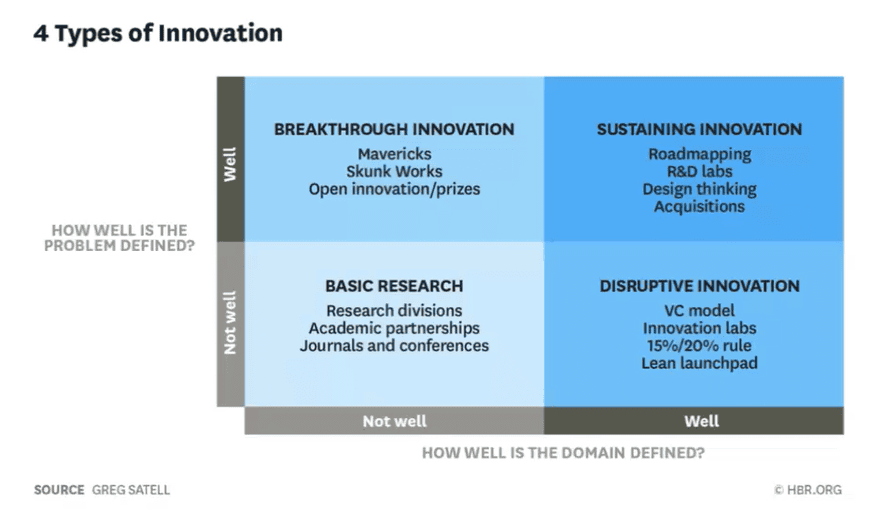
Serpiello then shared his thoughts on each quadrant:
Basic research – a low understanding of both domain and problem: “We don’t really know what the problem is and we don’t really know in which field or area it happens.”
Disruptive innovation – a well-understood domain but poorly understood problem: “In this area you may need something like innovation labs or launch pads.”
Breakthrough innovation – a poorly understood domain but well-defined problem: “This is the reverse of disruptive innovation… the classic example of open innovation.”
Sustaining innovation – a well-understood domain and problem: “The most common form in sport [and often the subject of] continuous research, design thinking or road mapping.”
There were three areas in particular where the table thought Satell’s model could prove useful:
As Serpiello wrapped up proceedings, he set the scene for session two, which will focus on decision-making frameworks in the context of technology-driven innovation.
What to read next
Wars, Pandemics and Brexit. How the European Space Agency Manages Uncertainty
In the first part of a miniseries exploring complexity in sport, Everton’s Head of Sport Science Jack Nayler explains how a watershed moment transformed his approach to his work.
However, in a truly complex manner, it was the combination of my lived experience to that point, my educational background and the reading I was doing in my own time around the subject that led to my appreciation of complexity and its implications for those concerned with sporting performance.
Over the course of four articles, I want to explain how I see the world of elite sport, the complex system at its heart, and the most effective way I currently see of managing performance within that context.
I will delve into the implications for sports and the operations within teams before outlining what this all means for leaders in this space.
But first, I want define what a complex system actually is and set out its characteristics.
Learning from failure
My real understanding came, inevitably, in learning from failure.
The white paper by the late Dr Richard Cook of the University of Chicago entitled How Complex Systems Fail was instrumental in helping me to understand the ramifications of complexity on the undertaking of performance in a sports setting.
Dr Cook was an anaesthetist and simultaneously and internationally respected researcher. His short treatise is regarded as one of the most influential works in the field of patient medical safety. It was this understanding of how systems fail that brought together everything else I had seen and learnt and began to change the way I saw performance management in professional sports.
Around this time, I was challenged by a friend in the industry to put together my thoughts on building a performance department for a sports team. I found it challenging just to make an org chart and list positions without giving the background and rationale for why and how the department existed in that structure as well as its philosophical construct. This exercise of transferring ideas from my head on to paper forced me to critically confront my assumptions and crystallised my thoughts on how I believe we need to operate in the complex environment of elite professional team sports (specifically football as this has been my professional experience).
So, what do we mean by complex?
Dave Snowden is a researcher in the field of knowledge management and is the creator of the Cynefin Framework that helps us to make sense of the different types of environments in which we operate.
‘Cynefin’, which is pronounced ‘ku-nev-in’, is a Welsh word explaining there are multiple factors in our environment and our experience that influence us in ways we can never understand.
The model contains five domains, all of which can exist at any given moment, and we move between them:

Source: HBR
The clear domain has obvious cause and effect and well-established best practice. There are many examples of this in elite sports, for instance, data hygiene when downloading and analysing GPS data or packing medical equipment for an away match.
In the complicated domain, there are correct answers to problems, but they may take some expertise or understanding to deliver and there are governing constraints within which the answer will lie.
An example from sport would be developing a fuelling strategy for a player in a match. We need learned expertise in nutrition and we need to do some analysis on the demands that player faces in match play, as well as understand how their physiology responds to those demands. There are then governing constraints (carbohydrate is the main fuel source in performance) but within those constraints, the solution will be different depending on the sport and the athlete, but the solution can be determined.
I find the easiest way to consider the difference between a complicated and a complex environment is by using the analogy of a car.
A car is an extremely complicated piece of technology. The first practical automobile was invented by Karl Benz in 1885 and had several hundred components. The modern family car by comparison contains over 30,000 parts on average.
Despite this huge number of component parts, should one of them fail and the car stop working, the defective component can be replaced and the performance of the car restored. The performance of the car in this case is its ability to move with you on board and there is a linear process from depressing your foot on the accelerator to make that car move. A skilled technician should be able to completely take the car apart, rebuild it and restore its performance.
Take that same car and ask it to transport you across a city such as London and it enters a complex system where the performance of the car (the time it takes to transport you from point A to point B) is no longer determined by the car itself (it would make little difference if you drove a Ferrari or a Fiat), but in the interaction of the inter-connected parts that make up the complex system. These include the status of the driver (in how much of a hurry they are and their relative stress level), the other cars and their respective drivers, traffic signals, roadworks, cyclists, pedestrians, emergency services, major events going on that day, the time of day and the weather etc. There are many other potential components to the system, not all of which are obvious when sat in the car itself.
The performance of the car (how quickly it reaches its destination) will emerge from the interaction of all these components and each one is concurrently performing at the centre of their own complex system.
So, the first thing to know is that in a complex environment, performance emerges from between the components an in inter-dependent manner, and not from the summation of the performance of each component in isolation.
The next part to understand about complexity is that it is fractal. Fractals are geometric shapes that contain the same detailed structure at ever smaller scales. This means that complex systems exist at smaller and larger scales and nest within one another. They simultaneously are affected by the scale below and affect the scale above.
Below the scale of our car, the driver is their own complex system, and their performance is determined by (amongst other things) their genetics, upbringing, education, wellbeing, as well as how well they have slept last night, what they had for breakfast and whether they are running late or not.
At a larger scale, the performance of the traffic system designed by city planners is affected by the performance of all the cars on the roads.
The person closest to the action in the complex system has the greatest chance to affect it at any given moment, in this example it is the driver of the car. Each decision they make will create a new reality and alter the course of the complex system (for reference see the film Sliding Doors). The decision to put your foot down to get through an amber light rather than braking in anticipation of a red light will affect the course of the complex system and other components within it.
This person closest to the action may have the greatest chance to influence the performance of the system, but they also have the narrowest focus and least ability to see the big picture. This is where external information can help inform their decision (SatNav, Waze or radio traffic reports). Ultimately though, it remains their decision.
Because performance emerges in real time as we navigate through the city and react to what we encounter in front of us, we cannot with complete accuracy predict what will happen in the future as we set out on the journey, or how good our performance (the journey time) will be.
All decisions taken by the driver therefore contain an element of risk and are (hopefully educated) gambles. These decisions are being made on a moment-by-moment basis are determined in part by what has already happened and will influence what is to come.
As all the components in the system are simultaneously operating in their own individual complex system, agreement between them isn’t perfect. Thus, complex systems are never perfect, they operate in a sub-optimal mode. No route across London provides a perfect path where you will be able to drive without braking or even coming to a stop. The challenge is that we cannot know exactly where the imperfections will lie.
Once we have finished our journey and the performance is determined, the impact of all our decisions is laid bare. With hindsight our choices take on a sequential profile and we can fall victim to a narrative fallacy, where each decision makes sense in context of what came after it. What we need to remember is that at the time we made each decision, we were blind to the future and couldn’t know exactly the outcome. That left turn that led to roadworks suddenly becomes a disaster that caused all our problems, whilst the decision to cut through the backstreets, a moment of genius. However, we will never know the alternate realities of the other options we could have selected.
The last part of complex systems I wish to convey is that the more we try to control the system, the more we leave ourselves open to system errors adversely affecting our progress in the long-term.
By control I mean to attempt to force or determine an outcome. The decision to jump a red light or speed along a section of road can lead to being pulled over by the police, which will cause a delay that greatly outweighs the seconds saved through our actions. The right way to operate in the system will emerge by experimentation, trying different routes, times of day or even modes of transport to complete the journey.
To bring us out of an over-extended analogy and back into the real world I want to emphasise that we should not be fatalistic about complexity. I don’t want to come across like the system will determine the outcome, regardless of what we do to affect it. I believe we are an integral component in any system with the chance to affect its direction and outcomes (just remember they might not be perfect).
If we are also able to step back and appreciate the interaction between systems at larger and smaller scales than that in which we are currently operating, we can be very powerful.
Chaos and Confusion
The final two domains in the Cynefin framework are Chaos and Confusion. Chaos is where there are no clear rules or cause and effect at all, even with hindsight, and it is better to act now and think later, shooting more from the hip.
Confusion is the dark centre of the framework, when you aren’t sure which of the other four domains you are currently in.
Most of the time in elite sports I believe we deal with complexity and thus I think it is the most important to try and understand. In the next two parts I will go on to discuss the implications of operating in this domain for sporting organisations, and what that means for leaders in this space.
Summary
References
Cook, R.I., 2000. How Complex Systems Fail. [online] Available at: https://how.complexsystems.fail/ [Accessed 29 September 2025]
The Cynefin Company (n.d.) The Cynefin Framework. The Cynefin Co. Available at: https://thecynefin.co/about-us/about-cynefin-framework/ (Accessed: 1 October 2025)
Patrick Mannix, the federation’s Sports Science Senior Manager, shared his insights with Leaders Performance Institute members at a recent virtual roundtable.
Eisenhower liked the sentiment enough to repeat variations during his time in the White House and the appeal to people working in elite sport is obvious.
In fact, Patrick Mannix, the Sports Science Senior Manager at US Soccer, began his recent presentation to Leaders Performance Institute members with that very line.
“The idea behind this quote is that high-performance teams don’t necessarily have a static plan,” said Mannix.
“The plan is constantly evolving as new information comes to light, whether that’s in relation to the tournament that we’re playing in, the players that we’re working with, and a variety of other contexts that are relevant to the world of international soccer.”
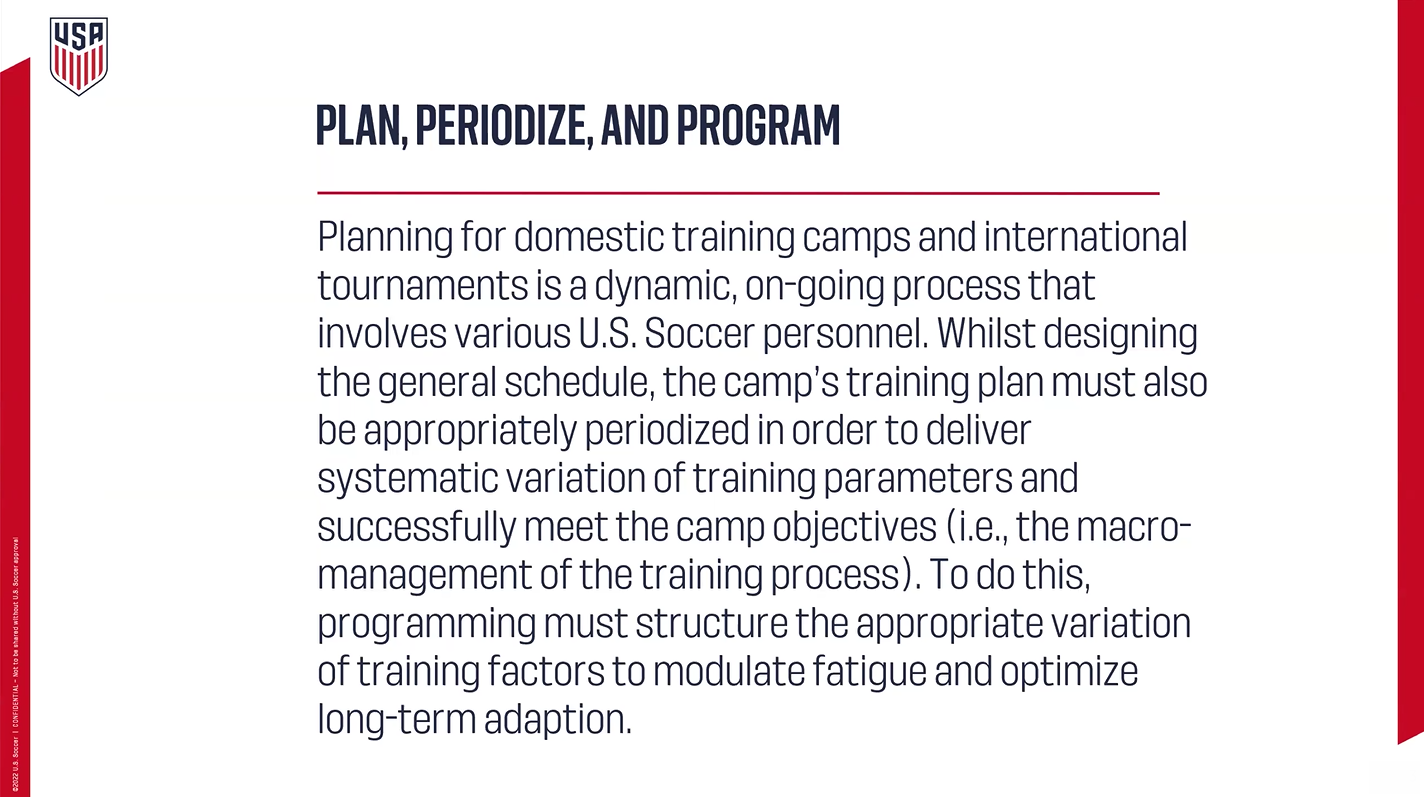
With those words, Mannix set the scene for a discussion that centered on performance planning in the international game, specifically the development of camp training plans for players who join up from their respective clubs in the US and beyond.
First, he offered a summary:
Mannix then shared how he and his colleagues approach international training camps from a sports science and medicine perspective with the help of this cycle:
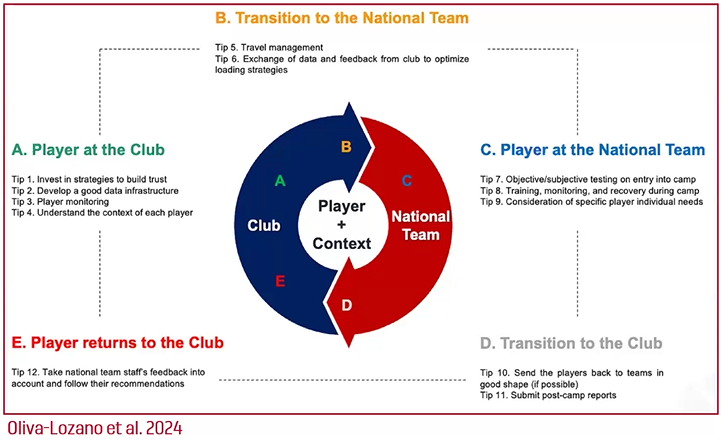
“Building rapport and trust with those clubs is massively important,” said Mannix, “because that helps us drive a lot of the exchange of information.”
He then outlined the common challenges he and his team face in the realms of communication, health & safety and load management:
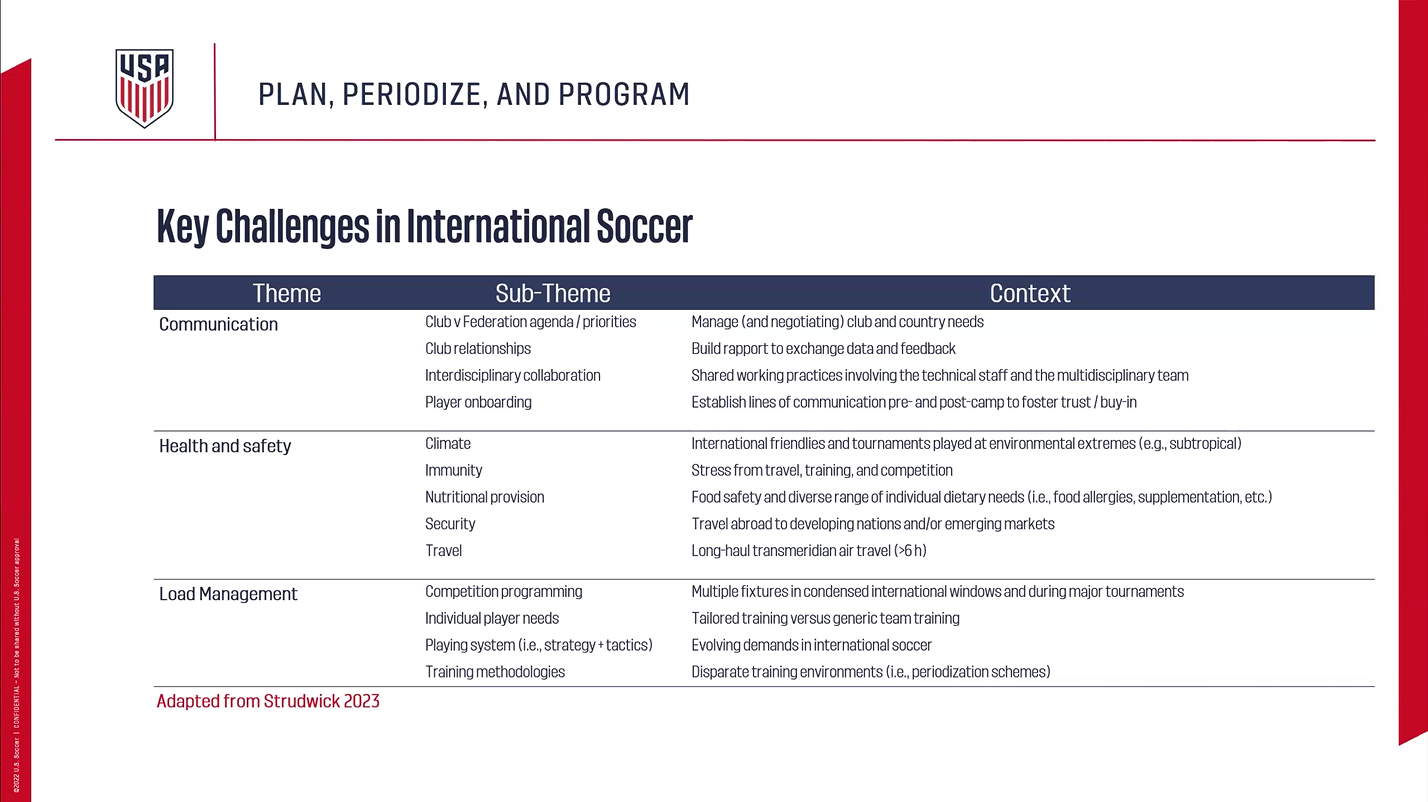
In explaining how they meet those challenges, Mannix focused on three areas in particular:
1. Club and country alignment
The US national teams draw on players from across the globe and, even for matches in the US itself, such is the size of the country that most personnel will have made a long-haul journey.
This map, which depicts the travel schedule of the US men’s team during the 2025 Concacaf Gold Cup, provides some idea of the challenges present even in a domestic setting:

“We need to know when our equipment and staff are arriving and where our players are coming from,” said Mannix in reflection on this map. It calls for close collaboration between the technical/coaching staff, the high performance team and the operations team.
“When a coach is trying to build out the session plan, the right hand is a good sports scientist or a performance coach, and the left hand is the first assistant, and those three individuals are working very closely to ensure that there’s a good plan in place for every training session,” Mannix continued.
“There’s good understanding as to what the availability of the players is going to be, particularly in the first two days of training, because what we’ve found through communication with clubs is we sometimes have to be flexible when players are coming into our environment simply because although Europe observes FIFA windows, we have to work with our partners in MLS on when players are released to come and join our environment.”
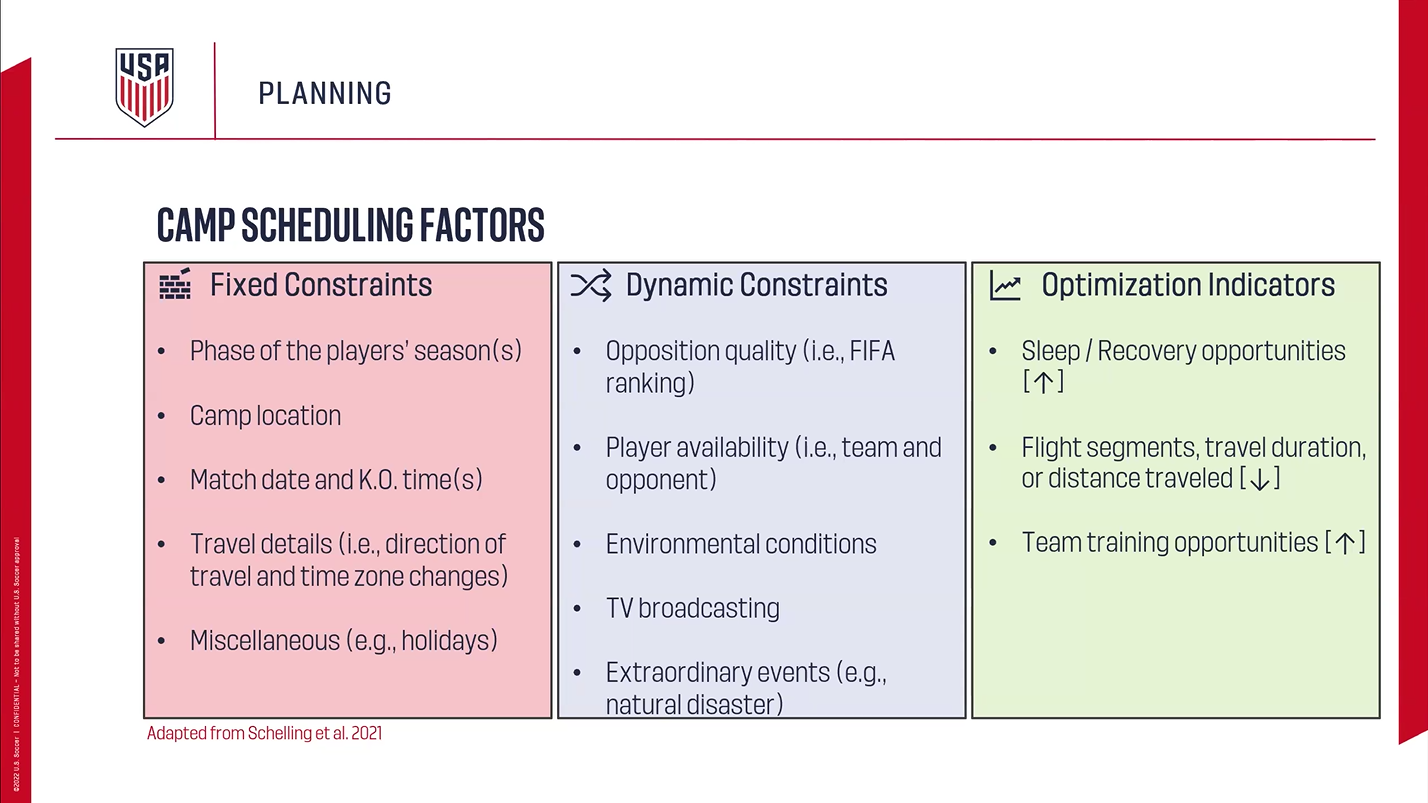
Mannix and his colleagues understand the range of fixed and dynamic constraints they face. They use that understanding to find optimization indicators.
2. Time of year
The leagues of North America operate on a different seasonal calendar to their European counterparts, which requires tailored approaches to preparation and recovery for each player.
Staggered arrivals in camp is a prime example. Players may be excluded from certain match days depending on their status.
Additionally, the federation will try to use domestic camps “to address the identity of the team” and “hybrid camps where we look to go abroad, ideally to play opponents from Africa, Asia, and Europe so we get a variety of different opponents of the kind that we could potentially face in a World Cup.”
Travel logistics are a focus too. “We try to increase our sleep and recovery opportunities, decrease the number of flights to hopefully avoid a situation where the players have to get up at the crack of dawn to hop on a plane,” said Mannix.
Then there are cultural considerations. “The November window for the women’s national team will overlap with the Thanksgiving holiday,” he said, adding, “we’re working with chefs to ensure that we can put together a really creative Thanksgiving meal so the team feel like they have that communal or family experience.”
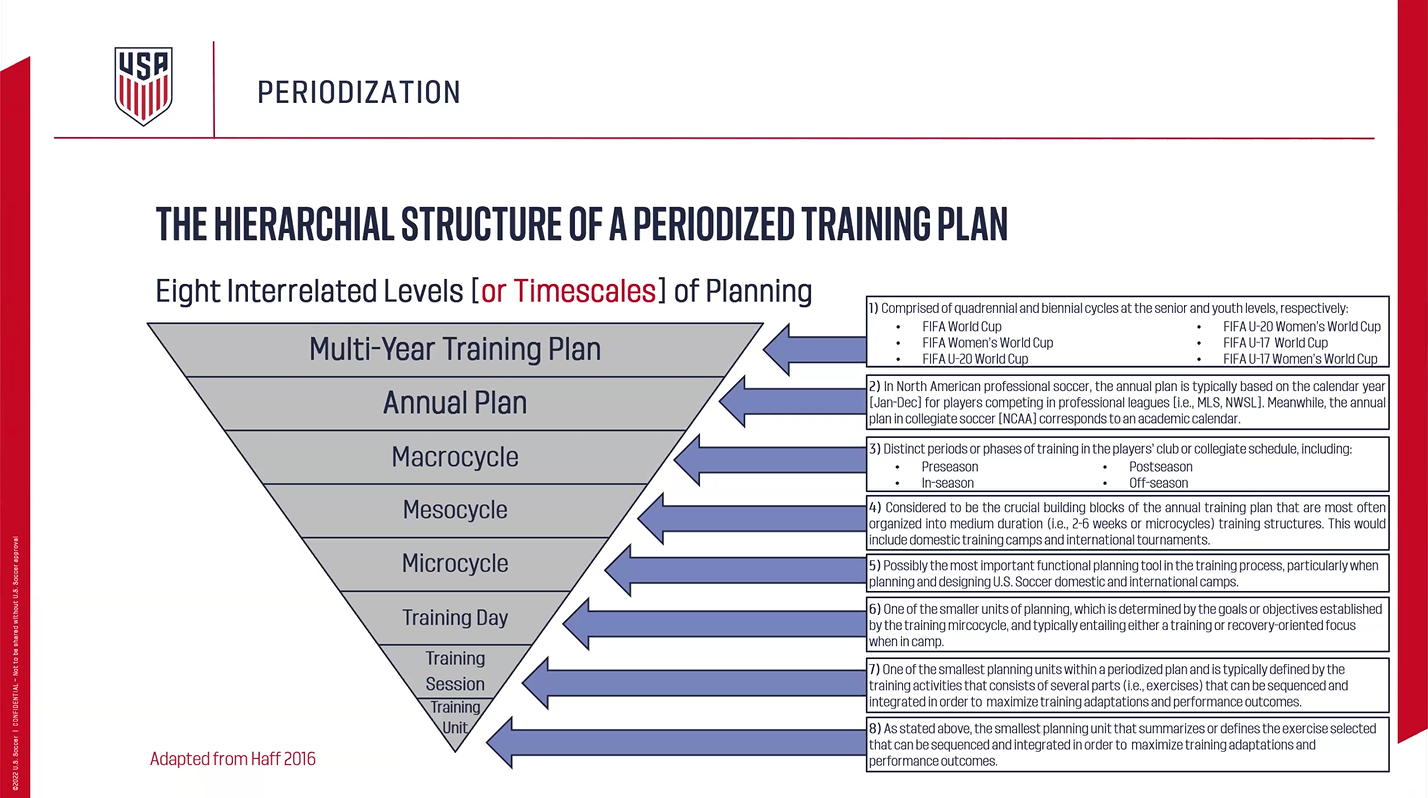
Ultimately, when it comes to periodizing camps, US teams have eight time scales to consider:
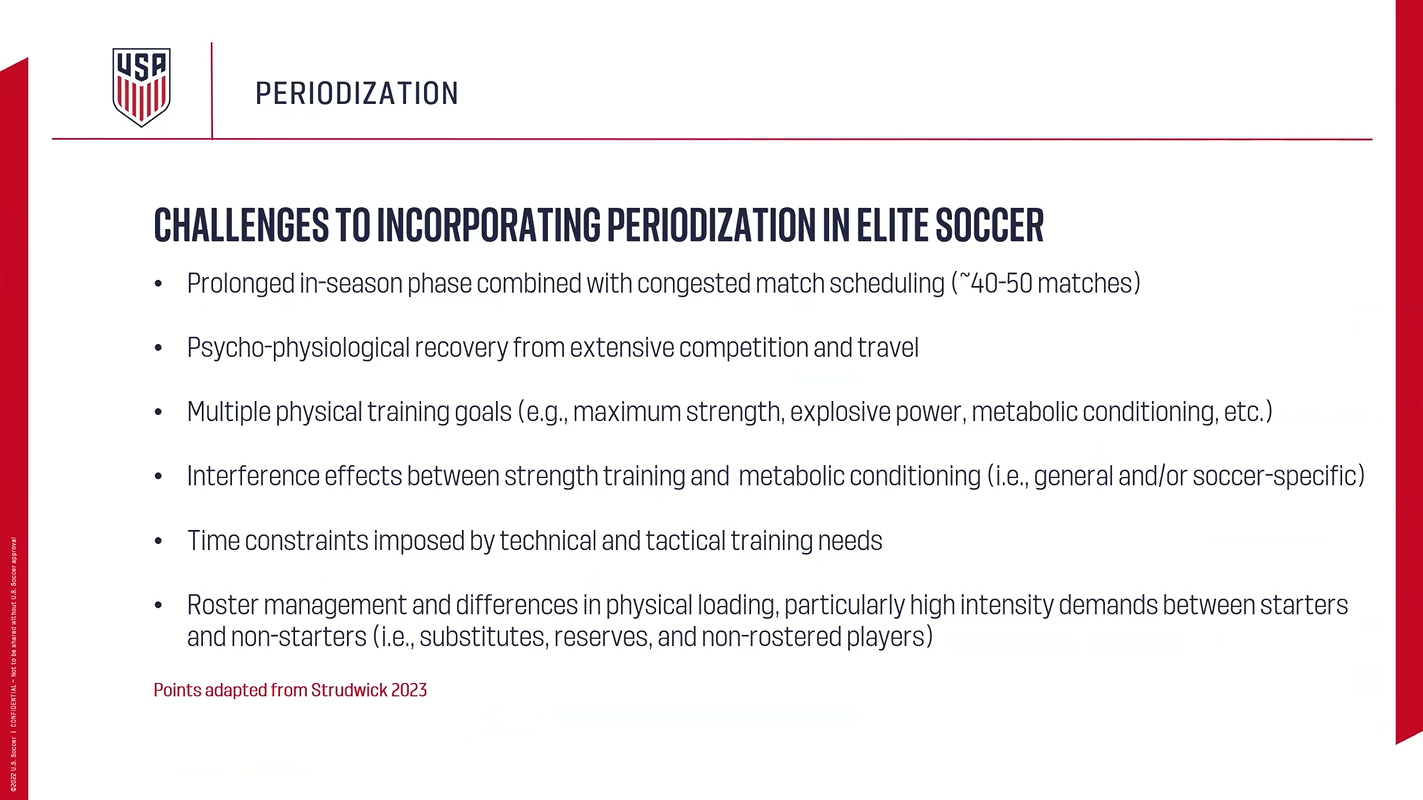
These come with several potential challenges:
Mannix shared the example of a convalescing player joining the men’s national team for the 2024 Olympic football tournament. “In close collaboration with the club, we mapped out the tissue healing process, what the rehab was going to look like and then also what his reintegration into his team training back in his club environment would be,” he said.
“Then we had to negotiate if he were to join us in the Olympics what his match exposure would look like once he joined us, because his first time competing in official competition following the injury would be under our care. So it was super important for US Soccer that this individual was included in the roster because of his long-term trajectory within the national team.”
The coaches and support staff at US Soccer develop training plans three weeks prior to a camp, with session plans devised two weeks out once player arrival times are confirmed.
“We will design things from a team level, but then we also have to look at matters very closely at an individual level when we’re trying to safely integrate players into our national team environments.”
Mannix also spoke of periodization (the macro-level planning of when and why) and programming (the micro-level execution of what and how). He explained the distinction using the following table:
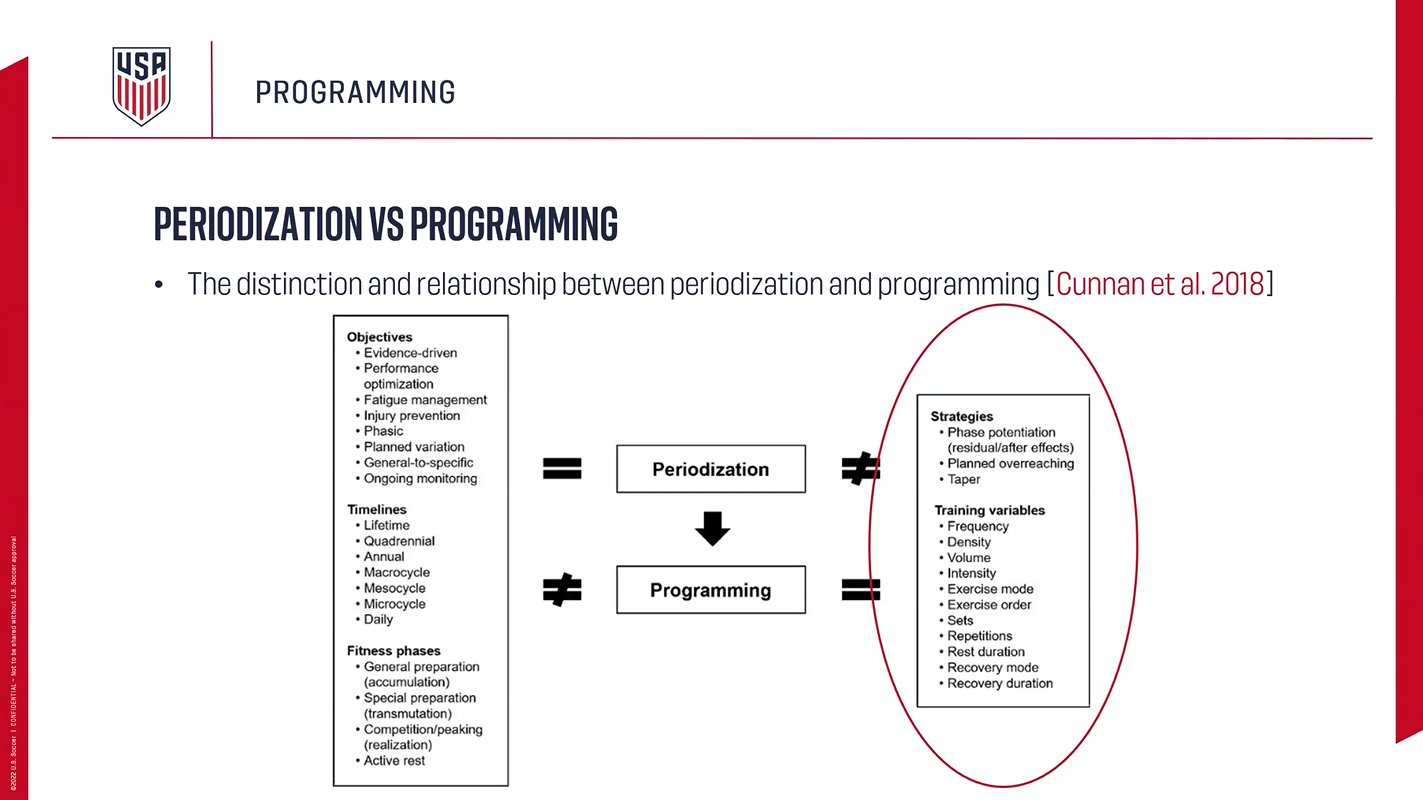
“Most of the time, we are dealing with tapering strategies and figuring out how can we optimize players’ readiness going into competition,” he said. “So it’s often an exercise in fatigue management when they’re coming into our environment and not necessarily trying to drive fitness adaptations, but, on the flip side, we’re also there to potentially facilitate a lot of those long-term physiological adaptations that are occurring.
“When it comes to planning, some of these training variables are super important. Things like training frequency, density, volume, and intensity, ensuring that those are squared away and, with our coaching staff, exercise order. So when it comes to building out session plans, making sure that the sessions are sequenced in the correct fashion.
“Again, I think that’s a lot of close communication and collaboration with primarily our head coach and our first assistant.”
What to read next
Transparency, Empathy and Empowerment: Five Ways Teams Are Serving their People in 2025
In this Virtual Roundtable, brought to you in partnership with ESSA, Jason Berry and Kenneth Graham discussed what research is required to support the future practitioner and athletes.
An article brought to you by

Berry, the Director of Sport Science, Research & Innovation at IMG Academy, was discussing the increasing tendency of some sports organisations keep sports science research in-house – a practice that does little to help the wider sports community.
“Over here in the United States, we’re in a spring training camp area around Tampa, so there’s a lot of baseball teams and facilities in the area. They are doing in-house research.”
This isn’t new. Berry explained that there were professional teams in Australia in the 1990s conducting research independently of the Australian Institute of Sport, which had been the leader in sports science research initiatives (and one of the chief disseminators) across the Australian sports system for more than a decade.
He is speaking at the second session of ‘The Future of Performance Sport’, a three-part Virtual Roundtable series brought to you by the Leaders Performance Institute and Exercise & Sports Science Australia. This session explored ‘what research is required to support the future practitioner and athletes’.
Berry was joined on the virtual stage by Kenneth Graham, a member of the AIS’s Research Review Committee and the Principal Scientist and Co-Founder of sports technology lab, eo.
Together they delivered a state of play on the industry and the obstacles it faces while also explaining how organisations can bridge the gap between research and its application in an increasingly complex performance landscape.
The strengths and weaknesses of current approaches to research in sports science
The strengths:
The weaknesses:
How to bridge the gap between research and real-world application
How can sports science practitioners do a better job of translating their research findings to athletes, coaches and other stakeholders?
Graham and Berry shared five tips:
It helps to build relationships with coaches and athletes. Not only does this engender trust, but it ensures greater applicability to research findings. “By always giving information that is contextually useful for that time of the year or by understanding the training cycle, you get more engagement,” said Graham. “You do need that time to build up the credibility and the acceptance of the coach to take on information from you; and over time that becomes a faster process. It can be done over a cup of coffee, you may not need a formal presentation, but being part of the process, seeing the development of the training programmes, being at the training sessions, being at the competitions, looking for the gaps where the information you’re giving is seen as valuable.”
When asked how a sports scientist might increase their networking and collaboration efforts, Graham suggested to “get a table, some whiteboards, a pizza, and time.” He said: “Spend time discussing, explaining, and exploring what the different people in the group know and what they’re interested in helping create. And it’s doing this iteratively. You have the discussion, you may then go away to do more reading, and then you come back. You do that two or three times, but what you’re doing is you’re getting closer and closer to a high quality question; or you’ve actually generated the answer that can then be used. But that time, that collaboration – it’s not play time, it’s about people getting excited and bouncing ideas and information off each other.”
A sports scientist does not have infinite time to share their research findings throughout an organisation. It requires collaboration, as Berry explained. He said: “We’ve got our research publications, but who in that wider collaboration is going to then attack the social media side of it? And who’s going to do some posts there? And who’s going to do the community coach education?” The message need not be complicated. “You might say: ‘We’re just down the road at Victoria University, we’re doing all this research, but here’s some stuff that can actually help the grassroots’. It’s just the collaboration spreading the load, not expecting one researcher or one practitioner to cover everything.”
A common fear is that a tech solution becomes redundant. IMG Academy, as Berry explained, tries to avoid this through rigorous vetting. “One of the first couple of questions we ask as part of the innovation process is: what type of relationship are you after? Is it strictly vendor, some sort of partnership, or is it a sponsorship? We have variations of all those three at the academy. The second thing we typically ask is ‘send us your research packet, we want to see the validation, we want to see what you’ve done, we don’t just want testimonials from a star athlete that this changed their game – we actually want the evidence’.”
Artificial intelligence will have its uses, but as Graham said: “Make sure that your AI model isn’t giving you the answer that you want because of the way you’ve trained it”. When that information has been curated carefully, Graham finds that it “dramatically shortens the development time and improves the quality information.”
Future areas of enquiry: the technical, tactical and psychological
Berry believes there are gains to be made in the technical and tactical realms. “That whole perceptual cognitive decision making component of performance, which typically separates those expert performers,” he said, while also alluding to the psychological elements, such as performance under pressure. “The physical part is not a separator anymore.” It is, however, tricky to find the measurables to support holistic athlete development. “I guess that’s the elusive one at the moment,” he added, “but there’s people working towards that”.
Further reading:
Soft Skills, AI, and Psychology: the Skills that Will Define the Practitioner of the Future
John Wagle of Notre Dame explains how the question of sleep enabled true interdisciplinary work to emerge at the school’s athletic department.
As you reflect on your team or department, you may be moved to ask a question of your own: what’s the difference?
According to John Wagle, in a ‘team of experts’, “everyone has their job, they do it well, and the execution of their role doesn’t directly impact another person”. He cited a Formula 1 pit crew as an example.
An ‘expert team’, on the other hand, refers to groups where “the work of an individual may directly impact that of another person”. Wagle’s example was a US Navy SEALs team.
In illustrating this distinction onstage at November’s Leaders Sport Performance Summit in London, Wagle, the Senior Athletics Director for Sports Performance at the University of Notre Dame, highlighted the distinction between multidisciplinary and interdisciplinary.
Wagle was hired by Notre Dame in 2022 to lead an athletic department that was unable to consistently deliver an interdisciplinary approach despite the best intentions of all staff members.
“We needed a catalyst,” he continued. “The challenge as a performance director is to set the stage to solve a problem at scale in your environment.”
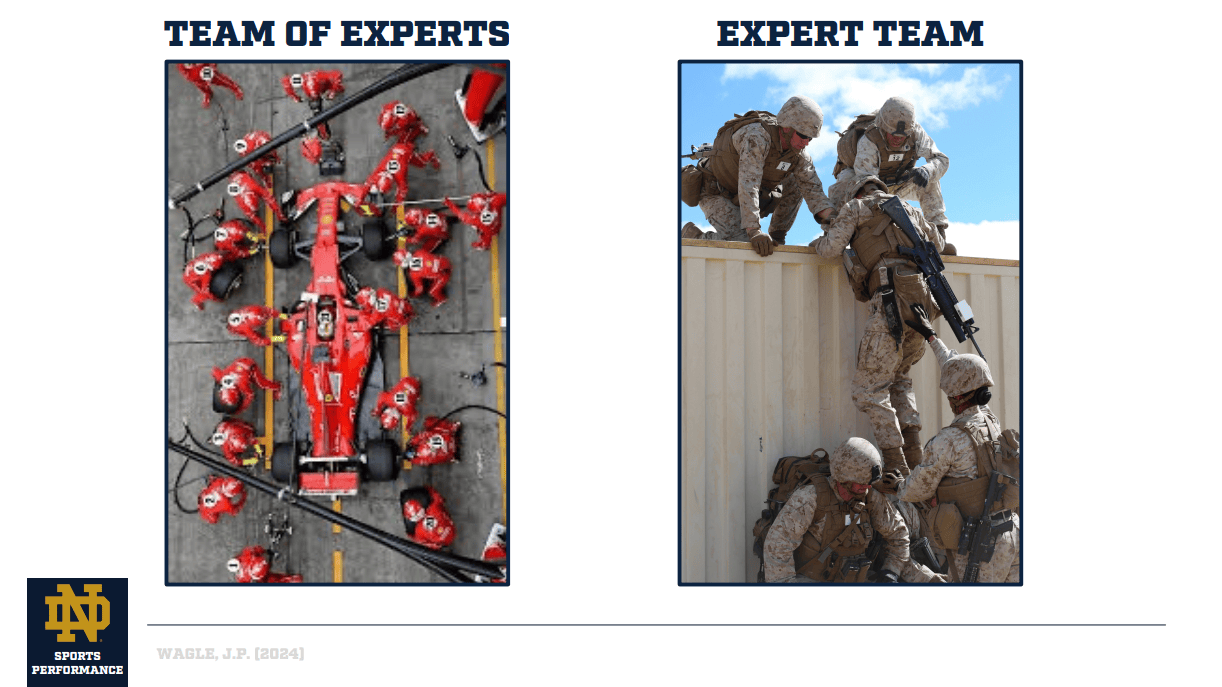
‘Constraints push you into new places’
Student-athletes continuously juggle their sport, academic studies and lives on campus – a situation Wagle described as “suboptimal”.
However, as he said, “these operational constraints push us into new places. They push our boundaries of how we can create solutions and I believe the best way to do that is to bring together two largely opposed ideals: knowledge and belief.”
Knowledge v belief
Knowledge, as Wagle explained, stems from a practitioner’s formal training as well as any external and internal research. He said: “the more common terminology for people in this room is evidence-based practice”.
Belief is different. It is an aggregate of a practitioner’s experiences from working in the field, athlete values and preferences, and the matter of risk tolerance and uncertainty management. “There is an element in belief that you’ve got to harness and steer into uncertainty.”
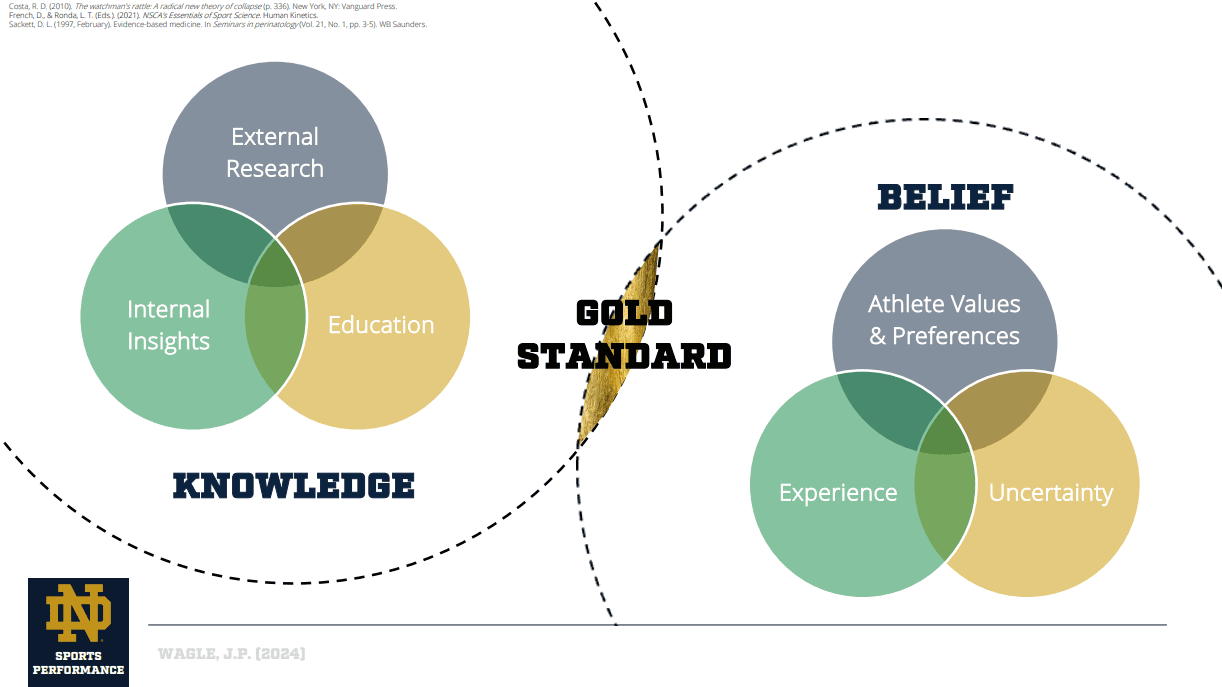
“These don’t need to be opposing viewpoints,” Wagle added, despite admitting that people “gravitate towards their tendency”.
“This is the true power of interdisciplinarity and, if we don’t bring these pieces together, we run the risk of being blind to what a lot of our athletes are experiencing.”
He spoke of the student-athlete being in a “complex adaptive system” where the interaction of different elements leads to either a health or a performance outcome, with the ‘gold standard’ somewhere in the middle.
Sleep = the catalyst
Wagle admitted that Notre Dame’s athletic department oscillated between knowledge and belief despite concerted efforts to bring both together.
“There were members of our team that no matter what the problem was were always on the knowledge side and there were members of our team who were always on the belief side,” he said. “It did not necessarily manifest in conflict – it manifested in avoidance – because I think every problem we tried to solve was inherently biased towards a discipline and it was easier to run away from that problem.”
They needed a catalyst to underline the power of interdisciplinary work and alighted upon sleep.
“We chose sleep because it is inherently lacking a discipline,” Wagle continued. “It can be owned by psychology, by nutrition, by strength & conditioning, by medical. There’s no obvious lead person in that.”
Everyone was able to meet the challenge that Wagle set: to be the best sleep support ecosystem in the whole of college sports. The knowledge people combined their data-driven approaches and devised a sleep screening tool. “We were able to get more granularity on our sleep habits and behaviours.” The belief people “brought to the table the ebbs and flows of the academic year.”
Remember: you could be part of the problem
Notre Dame’s approach to sleep has proven a game-changer in their approach to interdisciplinary work. Staff members recognised their biases, let go when necessary, and committed to collaboration.
Wagle said: “If we don’t acknowledge that ‘we could be part of the problem’, that’s where culture and alignment suffer; and resources fail to be allocated properly.”
Ellie Maybury of Soccer Herformance discusses the obstacles that face females in high performance in the second episode of the latest People Behind the Tech series podcast. For all the issues, she remains optimistic about the steps that can be taken.
A Data & Innovation podcast brought to you in collaboration with

At least part of their success in claiming back to back World Cup titles in 2019 was attributed to the fact they could adjust individual training plans and nutrition based on the data.
Ellie Maybury was part of the USWNT backroom team that introduced this initiative and, more than half a decade on, tech support for female athletes doesn’t seem to have progressed as much as she’d have hoped. At least in soccer.
“A lot of the technology we have absorbed into the women’s game has come from the men’s game or men’s sports environments,” she tells the People Behind the Tech podcast.
“And maybe some of the processes and metrics that come with that get transferred as well.”
Maybury, who recently founded Soccer Herformance, a performance consultancy for female soccer players, is in the hotseat on episode two of this series.
She addressed the issues that hold back female high performance, from managing the lack of objective datapoints [4:50] and the importance of education for athletes who often misunderstand their own bodies through no fault of their own [26:20], to the need to take athletes on a journey while remaining honest about the limitations of research at the present time [17:00].
Check out episode one:
Paige Bueckers Proved Her ACL Injury Was Behind her at March Madness, but, as Andrea Hudy tells us, Questions Must Still Be Asked about the Injuries that Afflict Female Athletes
Listen above and subscribe today on iTunes, Spotify, Stitcher and Overcast, or your chosen podcast platform.
‘In interdisciplinary work, conflict only shows you care. However, it is important to work out the areas where you agree’.
A podcast brought to you by our Main Partners

The Head of Strength & Conditioning at Red Bull’s Athlete Performance Center in Salzburg is describing the learning opportunity provided by the interdisciplinary work that goes on around the organisation’s 850-plus athletes across four football clubs, two hockey teams, and approximately 250 sporting disciplines.
“The unstructured way is almost like a child and you are learning just by being there from practitioners who are better [in their field] than you,” he says.
“Then there’s this more structured approach where you actively seek opportunities to observe and have questions asked of you; and I think with that understanding it makes that interdisciplinary work easier.”
Conor is the first guest on this three-part series looking at Strength & Conditioning through a leadership lens.
On the conversational agenda were:
Listen above and subscribe today on iTunes, Spotify, Stitcher and Overcast, or your chosen podcast platform.