27 Jan 2026
ArticlesIn the first of two articles on the topic, the British Olympic Association’s Paul Ford explains that comfort, familiarity and safety are not nice to haves, but essentials to help people thrive when it matters most.
We have long since secured Stanford University as our main team preparation base for Los Angeles 2028. We did the groundwork starting in 2023, and planning is well underway with our sports to do warm weather camps there this year. Likewise, we are on the cusp of announcing our in-competition High Performance Centre in LA to support us at Games-time as well.
We believe that securing the best multi-sport facilities is an essential component of helping British Olympians to perform at their best, as I hope to explain below. And its importance is why we’re already underway on Brisbane 2032!
Creating a home from home
Much has been written and said about British athletes enjoying their tea, baked beans and tomato ketchup in Rio de Janeiro, Tokyo and Paris outside of the Olympic Village bubble within our Team GB exclusive Preparation Camp and in-competition High Performance Centres, but there is a clear performance benefit in having access to these bare necessities.
The media understandably focus on those elements because it forges a connection between the athletes and the public they represent. These may be highly skilled performers, but they are regular human beings too; and if people feel safe, happy and comfortable, they tend to perform better when it matters most. Support staff just as much as the athletes. Everyone on our team has a role to play, and we need them to all perform their best.
It dawned on us ahead of the 2012 London Games, where we, as hosts, were afforded a huge opportunity, but equally given a broader challenge too. We took 541 athletes, which was approximately two-thirds more than we would normally take. We had to find a way of uniting this extended team above and beyond what we would normally do.
One element is our belief that all our athletes and sports come together as ‘One Team GB’ (which conceptually we’ll explore in the second article). Another element is more structural: we needed to find a space where we could be exclusively just who we were: Team GB. Extending our normal multi-sport pre-Games Preparation Camp at Loughborough University was one thing, but we needed an exclusive in-competition hub as well beyond just our residential space in the Olympic Village during competition.
It is still largely unknown that we were able to build our own hub within the London Olympic Village (very much a host nation benefit) as we traded off space for our full bed allocation within the main accommodation blocks. So while we were able to pull strings with the Organising Committee (as all host nations do) when we finished in London we looked and thought: ‘it’s not home advantage necessarily, we just need to be more creative’.
It provoked a question: how do we create an optimal physical way of uniting the team within the Games environment? Part of it was using our Olympic Village residential space smarter. But you can’t expect this of the local organising committee to do on our behalf, since their brief is so vast. Instead, we decided to take it out of their hands. And for each of the subsequent Summer Olympics we have found an out-of-village space exclusively for our use.
The benefits are significant. When athletes arrive in the Olympic Village, they are greeted by chaos. With all those different nations in the same place at the same time, it is not conducive to rest and relaxation. Our in-competition High-Performance Centres in Rio, Tokyo and Paris provided a stress valve; a haven that removed British athletes from the chaos and the noise. Our ‘Performance Lodge’.
At each of those games we set up the Performance Lodge in local schools, near the Village. These are multi-purpose spaces that no-one is using in the periods in with the Games take place, as it’s the summer holidays. We can effectively go in and do a ‘DIY SOS’ for 72 hours and flip around several classrooms into, say, medical spaces, lounges or meeting areas for family and friends; we can build boxing rings in their sports gymnasium; we can install our own catering services for the team. It creates an in-competition environment to support performance readiness for GBR athletes and staff only. It complements and cultivates the team feel and supports optimal recovery & regeneration at the same time.
Nothing left to chance
We go by the name British Olympic Association most of the time as the National Olympic Committee for Great Britain & Northern Ireland, but when it comes to competition we flip into Team GB mode.
We know our place in the congested British sporting landscape: we are solely concerned with delivering the team to the Games. We try to take the other stakeholders on a journey, including the National Governing Bodies, UK Sport as the funding agency, the UK Sports Institute and home countries sports institutes. To ensure everyone is clear what the plan will be. Crucially, we aim for no surprises at the Games.
We plan and deliver nine Games and Youth Festivals every four years. As illuded to above, whilst we could just plan one at a time, in chronological order, we do it concurrently, as to achieve what we want to we need to work ahead of our competitors.
As mentioned, we have secured Stanford University as our primary preparation base for the 2028 Olympics. We believe this is a massive coup, again, because we’re going to be able to transition our athletes through the nine-hour time zone shift, get over the 12-hour flight fatigue, adapt to the California summer heat, and do final technical training in a world class environment. They’re going to be able to do that in our exclusive controlled bubble and be forged as a united team. Critically, they’ll be comfortable and familiar by the time they go into the Olympic Village with being around each other from other sports, which only happens once every four years. For many this, if not planned for, can be a massive derailer, a shock to the system, and scupper performance.
But for us to have confidence in that Preparation Camp, we must test it. We must run that Camp environment multiple times as best we can beforehand because we’re working with a university that has never hosted an Olympic team before and new hotels who have never had such an array of requirements. The Camp alone in 2028 will be a five-week performance operation. We’ll have individual sports go there this summer, and in 2027 where we’ll run a bespoke multisport camp too. We don’t leave anything to chance. We simulate and test. Hopefully we flush out as many things that could go wrong as possible. The east coast of Australia will get the same treatment ahead of 2032.
‘The most-local non-local team’
Yet things can and do go wrong, which is where our planning and diligent solutions-oriented mindset comes into its own. In Paris, there was, as widely publicised, some challenges with the athlete dining experience in the Olympic Village. It’s complicated to cater for ~16,000 people in one dining hall. Local Organising Committees are almost setup to break at points given the enormity of the task they are given. Yet it’s the most important moment for an Olympian to have everything just perfect. That’s where we must be solutions based and see the opportunities, have the Plan B and C ready. So, in Paris, when this became tricky, rather than just moaning and complaining, we went into action, and that’s where our Plan B came in. We worked with the affected sports and transported athletes to our Performance Lodge and double our services covers to supplement the affected athletes performance nutrition to aid recovery. It came at a significant additional cost to us, but we had to do it.
Though not the same issues, this was not a first. There is always a curve ball at a Games. And truth be told we like it. As we have always thrived in adversity and used it as a performance opportunity. In Tokyo, the obvious one, we had to manage the pandemic and layered COVID complications at the Games. It remains a point of pride that we were the only ‘big’ nation to get every athlete who travelled to the Games to make the start line of their event, and to perform. The results spoke for themselves.
As an example, there were restrictions on numbers in the Olympic Village, and a limitation on how early teams could bring athletes into the Olympic Village. For nations travelling across multiple time zones, from climates not like the intense heat and humidity of a Japanese summer this was a performance inhibitor. But we did get in early. That’s because of some solid groundwork and efforts with the locals in the years in advance. We achieved special dispensation and were able to bring the Team into country to acclimatise and prepare in our own unique bubble in the city of Yokohama, just south of Tokyo. It gave us, again, a massive performance advantage. It was not by chance (though we couldn’t predict the pandemic obviously), but we achieved this exemption because we had worked so hard in advance to win the hearts and minds of our hosts beforehand. They saw us as their local team.
In 2019, a year before the originally planned Tokyo Games, we held a series of community engagements at our Preparation Camp base in Yokohama, to test things, and connect with the locals. Swimmers Adam Peaty and Duncan Scott, for example, brought their medals from Rio and put them around kids’ necks at an open swim session. That was a ‘money can’t buy moment’. We are incredibly privileged with what we represent and are custodians of the Olympic values. Bringing it to the communities that the Games affect is so important. Yokohama city officials saw and truly felt this, which is why they were so supportive of us still going through the Preparation Camp in 2021, ahead of the rescheduled COVID Games. That’s not something we had planned for but was a consequence of undertaking that process properly.
Similarly in Rio, we set ourselves a challenge: when Brazil isn’t cheering for Brazil, how can we encourage Brazil to cheer for Team GB? Again, this was off the back of a Home Games and seeing the power of what having loud and enthused crowds could do for our athletes. We approached that in two ways. At our Preparation Camp in Belo Horizonte, one hour north of Rio, we invited local children to Athletics and Rugby 7s training sessions prior to the Games. It built that connection and was reported in the local media. We were seen as ‘the most local non-local team’. We also did a series of community engagements, including sending our boxing, judo and taekwondo athletes into favelas within the greater Rio area. It carried an element of risk, but we had the mindset of this work being the right thing to do. When adversity ensued in Rio as the system creaked during the Olympic Games, the locals supported us with whatever we needed.
And so, wherever Team GB athletes go, whenever they attend an Olympics, we plan, prepare and deliver an all-encompassing home from home model. Everything is centred on the athletes.
Through following the principles above, all the athletes need to do is arrive and execute their best performances when it matters most. The results take care of themselves.
Paul Ford is the Head of Sport at the British Olympic Association. If you would like to speak to Paul, please contact a member of the Leaders Performance Institute team.
In the first of a three-part virtual roundtable examining tech-focused innovation, Leaders Performance Institute members discussed how to turn creative thinking into tangible outcomes.
The figure surprised both the Leaders team and Professor Fabio Serpiello, the Director of Sport Strategy at Central Queensland University, because most of the survey’s respondents work for well-resourced professional teams. It was reasonable, we felt, to assume that they’ve progressed beyond such concerns.
“We thought this warranted further discussion,” said Serpiello, who led the first of a three-part virtual roundtable series aimed at exploring the dynamics of tech-supported innovation in sport.
We must point out that none of the Leaders Performance Institute members in attendance contradicted the survey’s findings (which you can read in our Trend Report). Some recounted the type of problems they encounter when it comes to innovation.
“Some problems can definitely be too big,” said one experienced high performance specialist working with military units in the US.
“You may not get support because of the priorities of the major decision makers that control the purse strings.”
What is ‘innovation’?
Serpiello believes the first step is simply to define ‘innovation’.
Even more importantly, he argues that teams should alight on a shared definition; one that does not conflate the concept with ‘creativity’. (Creativity, as Serpiello explained, is the outcome of an ideation phase, while innovation covers the execution and eventual impact of an idea.)
He makes the case that when teams have an agreed definition of what ‘innovation’ means to them then it offers a “clear way to approach and analyse whether the innovation processes in your organisations work or not.”
Serpiello himself likes the definition proffered by Scott Anthony in his 2011 Little Black Book of Innovation: ‘Innovation is something different that has impact’.
He then asked the practitioners and coaches at the table for their definitions. Answers ranged from the refinement and optimisation of processes to the value of novelty and pursuit of greater efficiency.
“These are all linked to a practical outcome,” said Serpiello.
Greg Satell’s Model of Innovation
Innovation, Serpiello argues, comes in several shapes and forms depending on the nature of the problem. To make his point, he introduced renowned change management specialist Greg Satell’s Model of Innovation, which provides a practical framework for introducing innovative practices, encourages strategic thinking about problems and helps to facilitate better collaboration.
He presented a diagram of Satell’s model to the table:
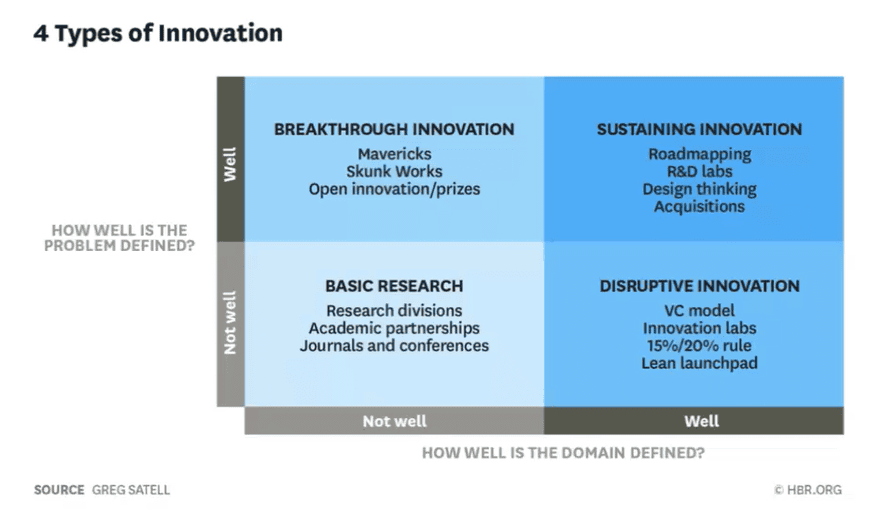
Serpiello then shared his thoughts on each quadrant:
Basic research – a low understanding of both domain and problem: “We don’t really know what the problem is and we don’t really know in which field or area it happens.”
Disruptive innovation – a well-understood domain but poorly understood problem: “In this area you may need something like innovation labs or launch pads.”
Breakthrough innovation – a poorly understood domain but well-defined problem: “This is the reverse of disruptive innovation… the classic example of open innovation.”
Sustaining innovation – a well-understood domain and problem: “The most common form in sport [and often the subject of] continuous research, design thinking or road mapping.”
There were three areas in particular where the table thought Satell’s model could prove useful:
As Serpiello wrapped up proceedings, he set the scene for session two, which will focus on decision-making frameworks in the context of technology-driven innovation.
What to read next
Wars, Pandemics and Brexit. How the European Space Agency Manages Uncertainty
In the second part of a miniseries exploring complexity in sport, Everton’s Head of Sport Science Jack Nayler outlines how performance emerges in complex situations and how coaches and practitioners can respond to the needs of the athlete and their environment.
As our metaphorical car entered the complexity of a city, a player enters a match. All team sports are complex in nature. The degree of complexity in each sport varies depending on the number of players and the structures inherent through the laws of each game. Football is one of the most complex of team sports. Whilst it is continuous like basketball, it has more players. And although rugby and American football have as many or more players, there are fewer set plays in football, so it flows more. Couple this complexity with the low scoring and there is more uncertainty over results in football than in other sports; a factor that contributes to its global popularity.
The complex nature of team sports means that the generalities of complex systems also exist within the game. The player on the ball is closest to the action so has the greatest chance to influence the game at that moment. As the ball moves, so does the influence of each player, in proximity to the ball.
The future is also uncertain. Once the referee has blown the whistle to start the match, we have no idea what will happen next or even how long exactly the game will last.
Team sports: a microcosm of life
Team sports are all extremely popular as their complexity creates a microcosm of life. The tactical, technical, physical and cognitive demands are all wrapped up together and it is difficult to break them down into discrete buckets. The performance of each individual player will emerge from the interaction of all these components.
Remember that complexity is fractal, so whilst the performance of each player on the team will emerge from the interactions of these four components, the performance of the team will emerge from the interactions between each player, and the outcome of the match will emerge from the interactions between the teams, the fans, officials, weather etc.
This has implications for how we prepare our teams to perform. Once a player sets foot on the field of play, our ability to influence the outcome as coaching and support staff diminishes. We need to provide our players with the skillset to deal with whatever emerges in the game. Because the game is constantly evolving in real time, our players need to be able to make sense of what is happening in front of them and find solutions to the puzzles presented within the game.
Remember that the more we try to control a complex system and add safety, the more we can leave ourselves open to bigger problems. Coaches of all levels appreciate this. If all training consisted of each week was the starting line-up vs an opposition with the coach dictating 90 minutes of match play pass-by-pass, the team would very quickly come unstuck in the game at the weekend.
Nassim Taleb talks of Fragility, Robustness and Antifragility (1). Whilst the robust team is able to repel the challenge posed by another team, an anti-fragile team will have the toolkit to assess their opponent in real-time and exploit their weaknesses.
This is one of the reasons why we now recognise the power of games-based approaches in skill acquisition and developing fitness (2, 3, 4). I have seen through in-house research over the years the more beneficial hormonal response of games and competition for adaptation in players.
This does not mean that there isn’t space for isolated physical and skill-based training in sport. Developing running technique can positively alter factors associated with increased injury risk (5) and High Intensity Interval Training (HIIT) has a beneficial effect on a variety of underpinning physical performance factors in football (6). These are key pieces of the performance puzzle. The art comes in how and when they are deployed as well as how they are blended together effectively with the technical and tactical training, to greatest effect.
Raising a player’s ceiling
What we need is a variety of complementary practice spaces to allow players (as individual complex entities) to develop capabilities themselves before then applying them in context.
In complex environments, we want to try and expand the ceiling of a player’s capabilities, so as the vast majority of the fluctuations in the system (the game) come within their physical limits. Hamstrings are the most injured area of the body in football, and most hamstring injuries occur during sprinting. It would be tempting therefore to try to reduce risk by minimising the exposure a player has to sprinting. However, as soon as the game demands that the player sprints, their risk is much greater as we haven’t prepared them properly to do that. We believe now that regular sprinting exposure (appropriately placed in the training week) will confer protection from hamstring injuries (7).
As discussed, an individual player is their own complex system. Their performance will emerge from the interaction of their technical, tactical, physical and cognitive capabilities, which are all intertwined. We need to treat each player within our squad as an individual and design their training programme accordingly. This should develop their capabilities in line with the demands that will be placed upon them by the playing style/game model and the competition, whilst considering their own personal history (injuries, training age, maturation status etc).
The on-field training should then reflect the game model, and competition demands sufficiently to allow the player to apply, develop and exhibit these physical capabilities in context of, and interwoven with, the cognitive, technical and tactical demands. Again, through research conducted in-house, I have seen the importance of training at match intensity during the week for reducing risk of injury and increasing performance; come the weekend and the research shows that maintaining higher chronic loading will help to reduce injury risk (8).
The growing appreciation of these factors have led to moves away from more traditional periodisation models first developed in individual Olympic sports where physical qualities were trained in an isolated but sequential manner. The rise of Tactical Periodisation models (9) has attempted to address team preparation holistically during the on-field training itself. Different constraints are placed upon the design of the practice on a day-by-day and week-to-week basis that provide affordances for technical, tactical, psychological and physical attributes to be overloaded on any given day.
When sports science and performance blur together
The support staff around the players need to understand this process and the underlying motivation for it each day from the coaching staff. Physical preparation, therapeutic work, psychological skills training all need to be complementary to this process and not detrimental.
As each player is their own complex system, they are themselves closest to the action. No one should know the player’s body and how it feels better than them, though admittedly this takes time to learn as a professional athlete.
I believe that a player-involved as opposed to player-centred approach is vital in developing this knowledge. Although the difference is subtle, it is an important distinction to make. In a player-centred model, the team of practitioners, ologists and experts discuss the player and develop a plan, drawing on all their expertise. A player-involved model brings the player into that process, involving them in the decision making and design of their training. The player needs respecting as a key member of the interdisciplinary team. Not only will this help to develop the player’s understanding of their body and the training process, but also their investment and trust in the programme. This is key in a sport such as football where the link between doing physical work and performance isn’t always immediately obvious and the talent pool is global; from different cultures and backgrounds.
The whole programme therefore needs careful management in a trans-disciplinary manner. When sports science first entered football around 30 years ago it was perceived as a standalone service where players spent time separately to the coaching team. This then developed into larger multidisciplinary teams of practitioners working within their field of expertise, but they were still often siloed. The rise of the Head of Performance brought distinct disciplines together to form interdisciplinary teams operating in a more integrated manner.
These lines are now blurring further. Technology has allowed S&C coaches to do many of the things that were previously the domain of the sports scientist (e.g. analysing jump tests). The rehabilitation process starts with the doctor or physio but ends with technical coaches delivering elements. Analysts and sports scientists co-create drills that match the technical, tactical and physical demands for a player completing some additional conditioning work.
What needs placing around a complex system, as a way of helping to manage and steer it in the direction we need, is a framework that guides those within the system in their decision making.
Psychology is a case in point. There is a clear need for performance psychology to help develop the toolkit of capabilities that players have at their disposal, and the wider training should help to develop and test these capabilities in a realistic manner. However, everyone in the organisation has a brain between their ears and is interacting with one another so is, to a greater or lesser extent, doing psychology in some way. A framework, or Psychologically Informed Environment (PIE) is essential to ensure that as far as possible all the interactions happening within an organisation are in service of the performance (and I would consider wellbeing intrinsic to performance) and not detrimental to it.
So, we return to the fractal nature of complexity and the different scales at which complexity exists. The sporting organisation itself is a complex entity and each person within it will exert different levels of control at different times.
This has implications for the way that we lead these environments, and this is what I want to delve into in the third and fourth parts of this series.
Summary
References
In the first part of a miniseries exploring complexity in sport, Everton’s Head of Sport Science Jack Nayler explains how a watershed moment transformed his approach to his work.
However, in a truly complex manner, it was the combination of my lived experience to that point, my educational background and the reading I was doing in my own time around the subject that led to my appreciation of complexity and its implications for those concerned with sporting performance.
Over the course of four articles, I want to explain how I see the world of elite sport, the complex system at its heart, and the most effective way I currently see of managing performance within that context.
I will delve into the implications for sports and the operations within teams before outlining what this all means for leaders in this space.
But first, I want define what a complex system actually is and set out its characteristics.
Learning from failure
My real understanding came, inevitably, in learning from failure.
The white paper by the late Dr Richard Cook of the university of Chicago entitled How Complex Systems Fail was instrumental in helping me to understand the ramifications of complexity on the undertaking of performance in a sports setting.
Dr Cook was an anaesthetist and simultaneously and internationally respected researcher. His short treatise is regarded as one of the most influential works in the field of patient medical safety. It was this understanding of how systems fail that brought together everything else I had seen and learnt and began to change the way I saw performance management in professional sports.
Around this time, I was challenged by a friend in the industry to put together my thoughts on building a performance department for a sports team. I found it challenging just to make an org chart and list positions without giving the background and rationale for why and how the department existed in that structure as well as its philosophical construct. This exercise of transferring ideas from my head on to paper forced me to critically confront my assumptions and crystallised my thoughts on how I believe we need to operate in the complex environment of elite professional team sports (specifically football as this has been my professional experience).
So, what do we mean by complex?
Dave Snowden is a researcher in the field of knowledge management and is the creator of the Cynefin Framework that helps us to make sense of the different types of environments in which we operate.
‘Cynefin’, which is pronounced ‘ku-nev-in’, is a Welsh word explaining there are multiple factors in our environment and our experience that influence us in ways we can never understand.
The model contains five domains, all of which can exist at any given moment, and we move between them:

Source: HBR
The clear domain has obvious cause and effect and well-established best practice. There are many examples of this in elite sports, for instance, data hygiene when downloading and analysing GPS data or packing medical equipment for an away match.
In the complicated domain, there are correct answers to problems, but they may take some expertise or understanding to deliver and there are governing constraints within which the answer will lie.
An example from sport would be developing a fuelling strategy for a player in a match. We need learned expertise in nutrition and we need to do some analysis on the demands that player faces in match play, as well as understand how their physiology responds to those demands. There are then governing constraints (carbohydrate is the main fuel source in performance) but within those constraints, the solution will be different depending on the sport and the athlete, but the solution can be determined.
I find the easiest way to consider the difference between a complicated and a complex environment is by using the analogy of a car.
A car is an extremely complicated piece of technology. The first practical automobile was invented by Karl Benz in 1885 and had several hundred components. The modern family car by comparison contains over 30,000 parts on average.
Despite this huge number of component parts, should one of them fail and the car stop working, the defective component can be replaced and the performance of the car restored. The performance of the car in this case is its ability to move with you on board and there is a linear process from depressing your foot on the accelerator to make that car move. A skilled technician should be able to completely take the car apart, rebuild it and restore its performance.
Take that same car and ask it to transport you across a city such as London and it enters a complex system where the performance of the car (the time it takes to transport you from point A to point B) is no longer determined by the car itself (it would make little difference if you drove a Ferrari or a Fiat), but in the interaction of the inter-connected parts that make up the complex system. These include the status of the driver (in how much of a hurry they are and their relative stress level), the other cars and their respective drivers, traffic signals, roadworks, cyclists, pedestrians, emergency services, major events going on that day, the time of day and the weather etc. There are many other potential components to the system, not all of which are obvious when sat in the car itself.
The performance of the car (how quickly it reaches its destination) will emerge from the interaction of all these components and each one is concurrently performing at the centre of their own complex system.
So, the first thing to know is that in a complex environment, performance emerges from between the components an in inter-dependent manner, and not from the summation of the performance of each component in isolation.
The next part to understand about complexity is that it is fractal. Fractals are geometric shapes that contain the same detailed structure at ever smaller scales. This means that complex systems exist at smaller and larger scales and nest within one another. They simultaneously are affected by the scale below and affect the scale above.
Below the scale of our car, the driver is their own complex system, and their performance is determined by (amongst other things) their genetics, upbringing, education, wellbeing, as well as how well they have slept last night, what they had for breakfast and whether they are running late or not.
At a larger scale, the performance of the traffic system designed by city planners is affected by the performance of all the cars on the roads.
The person closest to the action in the complex system has the greatest chance to affect it at any given moment, in this example it is the driver of the car. Each decision they make will create a new reality and alter the course of the complex system (for reference see the film Sliding Doors). The decision to put your foot down to get through an amber light rather than braking in anticipation of a red light will affect the course of the complex system and other components within it.
This person closest to the action may have the greatest chance to influence the performance of the system, but they also have the narrowest focus and least ability to see the big picture. This is where external information can help inform their decision (SatNav, Waze or radio traffic reports). Ultimately though, it remains their decision.
Because performance emerges in real time as we navigate through the city and react to what we encounter in front of us, we cannot with complete accuracy predict what will happen in the future as we set out on the journey, or how good our performance (the journey time) will be.
All decisions taken by the driver therefore contain an element of risk and are (hopefully educated) gambles. These decisions are being made on a moment-by-moment basis are determined in part by what has already happened and will influence what is to come.
As all the components in the system are simultaneously operating in their own individual complex system, agreement between them isn’t perfect. Thus, complex systems are never perfect, they operate in a sub-optimal mode. No route across London provides a perfect path where you will be able to drive without braking or even coming to a stop. The challenge is that we cannot know exactly where the imperfections will lie.
Once we have finished our journey and the performance is determined, the impact of all our decisions is laid bare. With hindsight our choices take on a sequential profile and we can fall victim to a narrative fallacy, where each decision makes sense in context of what came after it. What we need to remember is that at the time we made each decision, we were blind to the future and couldn’t know exactly the outcome. That left turn that led to roadworks suddenly becomes a disaster that caused all our problems, whilst the decision to cut through the backstreets, a moment of genius. However, we will never know the alternate realities of the other options we could have selected.
The last part of complex systems I wish to convey is that the more we try to control the system, the more we leave ourselves open to system errors adversely affecting our progress in the long-term.
By control I mean to attempt to force or determine an outcome. The decision to jump a red light or speed along a section of road can lead to being pulled over by the police, which will cause a delay that greatly outweighs the seconds saved through our actions. The right way to operate in the system will emerge by experimentation, trying different routes, times of day or even modes of transport to complete the journey.
To bring us out of an over-extended analogy and back into the real world I want to emphasise that we should not be fatalistic about complexity. I don’t want to come across like the system will determine the outcome, regardless of what we do to affect it. I believe we are an integral component in any system with the chance to affect its direction and outcomes (just remember they might not be perfect).
If we are also able to step back and appreciate the interaction between systems at larger and smaller scales than that in which we are currently operating, we can be very powerful.
Chaos and Confusion
The final two domains in the Cynefin framework are Chaos and Confusion. Chaos is where there are no clear rules or cause and effect at all, even with hindsight, and it is better to act now and think later, shooting more from the hip.
Confusion is the dark centre of the framework, when you aren’t sure which of the other four domains you are currently in.
Most of the time in elite sports I believe we deal with complexity and thus I think it is the most important to try and understand. In the next two parts I will go on to discuss the implications of operating in this domain for sporting organisations, and what that means for leaders in this space.
Summary
References
Cook, R.I., 2000. How Complex Systems Fail. [online] Available at: https://how.complexsystems.fail/ [Accessed 29 September 2025]
The Cynefin Company (n.d.) The Cynefin Framework. The Cynefin Co. Available at: https://thecynefin.co/about-us/about-cynefin-framework/ (Accessed: 1 October 2025)
Patrick Mannix, the federation’s Sports Science Senior Manager, shared his insights with Leaders Performance Institute members at a recent virtual roundtable.
Eisenhower liked the sentiment enough to repeat variations during his time in the White House and the appeal to people working in elite sport is obvious.
In fact, Patrick Mannix, the Sports Science Senior Manager at US Soccer, began his recent presentation to Leaders Performance Institute members with that very line.
“The idea behind this quote is that high-performance teams don’t necessarily have a static plan,” said Mannix.
“The plan is constantly evolving as new information comes to light, whether that’s in relation to the tournament that we’re playing in, the players that we’re working with, and a variety of other contexts that are relevant to the world of international soccer.”
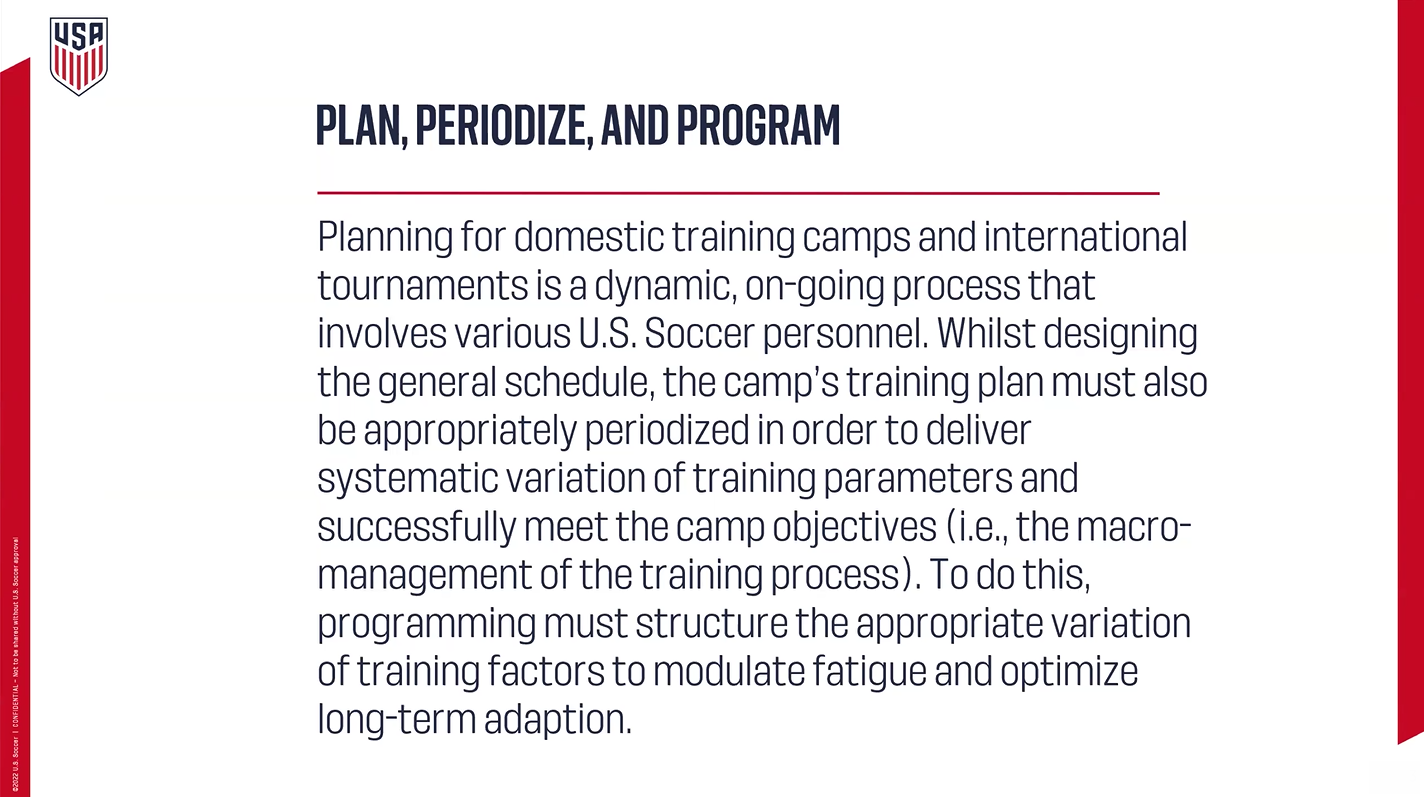
With those words, Mannix set the scene for a discussion that centered on performance planning in the international game, specifically the development of camp training plans for players who join up from their respective clubs in the US and beyond.
First, he offered a summary:
Mannix then shared how he and his colleagues approach international training camps from a sports science and medicine perspective with the help of this cycle:
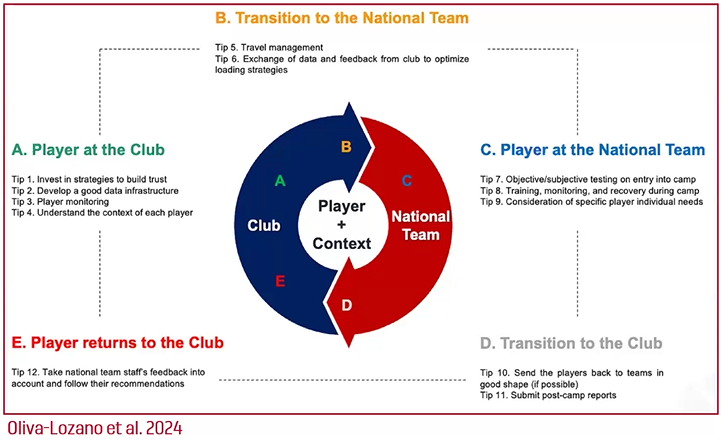
“Building rapport and trust with those clubs is massively important,” said Mannix, “because that helps us drive a lot of the exchange of information.”
He then outlined the common challenges he and his team face in the realms of communication, health & safety and load management:
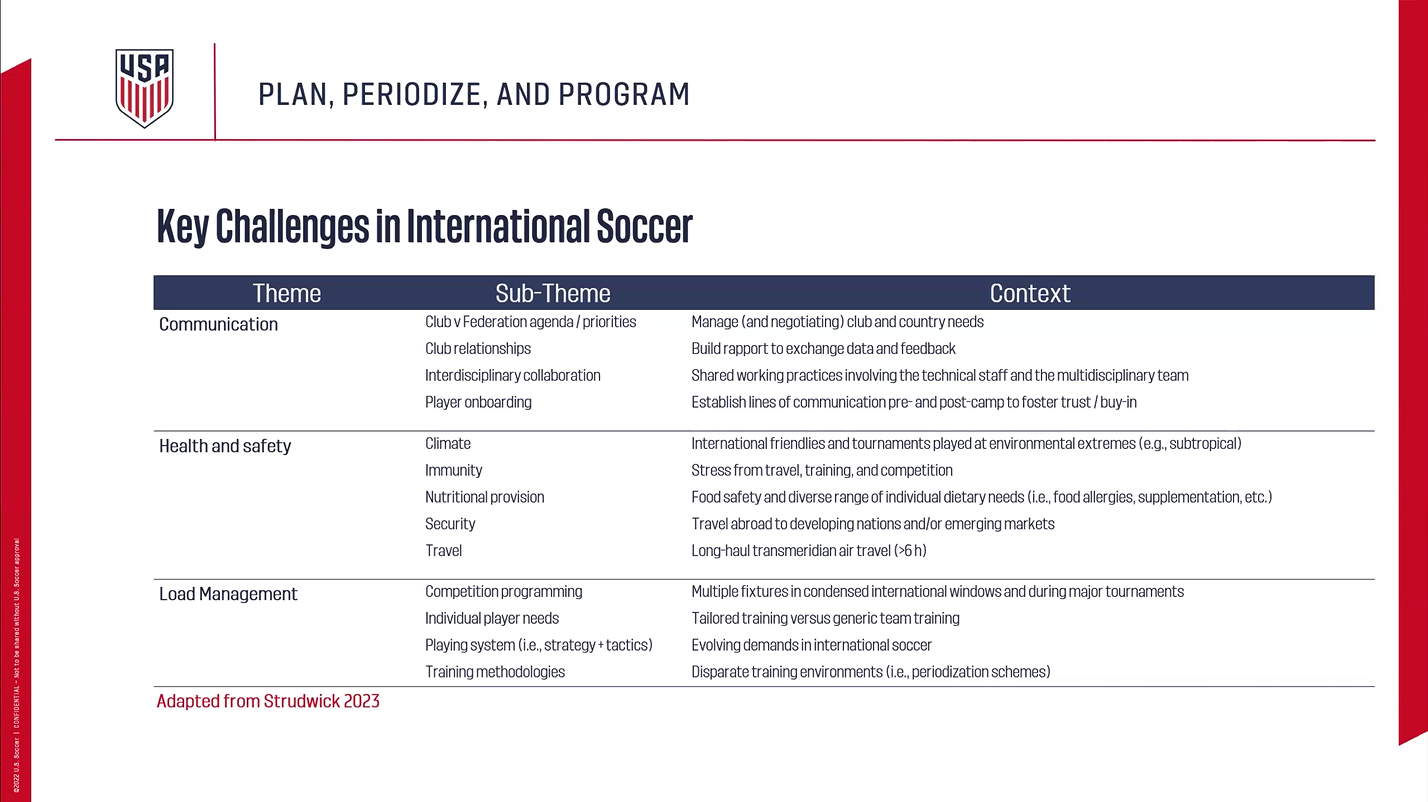
In explaining how they meet those challenges, Mannix focused on three areas in particular:
1. Club and country alignment
The US national teams draw on players from across the globe and, even for matches in the US itself, such is the size of the country that most personnel will have made a long-haul journey.
This map, which depicts the travel schedule of the US men’s team during the 2025 Concacaf Gold Cup, provides some idea of the challenges present even in a domestic setting:

“We need to know when our equipment and staff are arriving and where our players are coming from,” said Mannix in reflection on this map. It calls for close collaboration between the technical/coaching staff, the high performance team and the operations team.
“When a coach is trying to build out the session plan, the right hand is a good sports scientist or a performance coach, and the left hand is the first assistant, and those three individuals are working very closely to ensure that there’s a good plan in place for every training session,” Mannix continued.
“There’s good understanding as to what the availability of the players is going to be, particularly in the first two days of training, because what we’ve found through communication with clubs is we sometimes have to be flexible when players are coming into our environment simply because although Europe observes FIFA windows, we have to work with our partners in MLS on when players are released to come and join our environment.”
Mannix and his colleagues understand the range of fixed and dynamic constraints they face. They use that understanding to find optimization indicators.
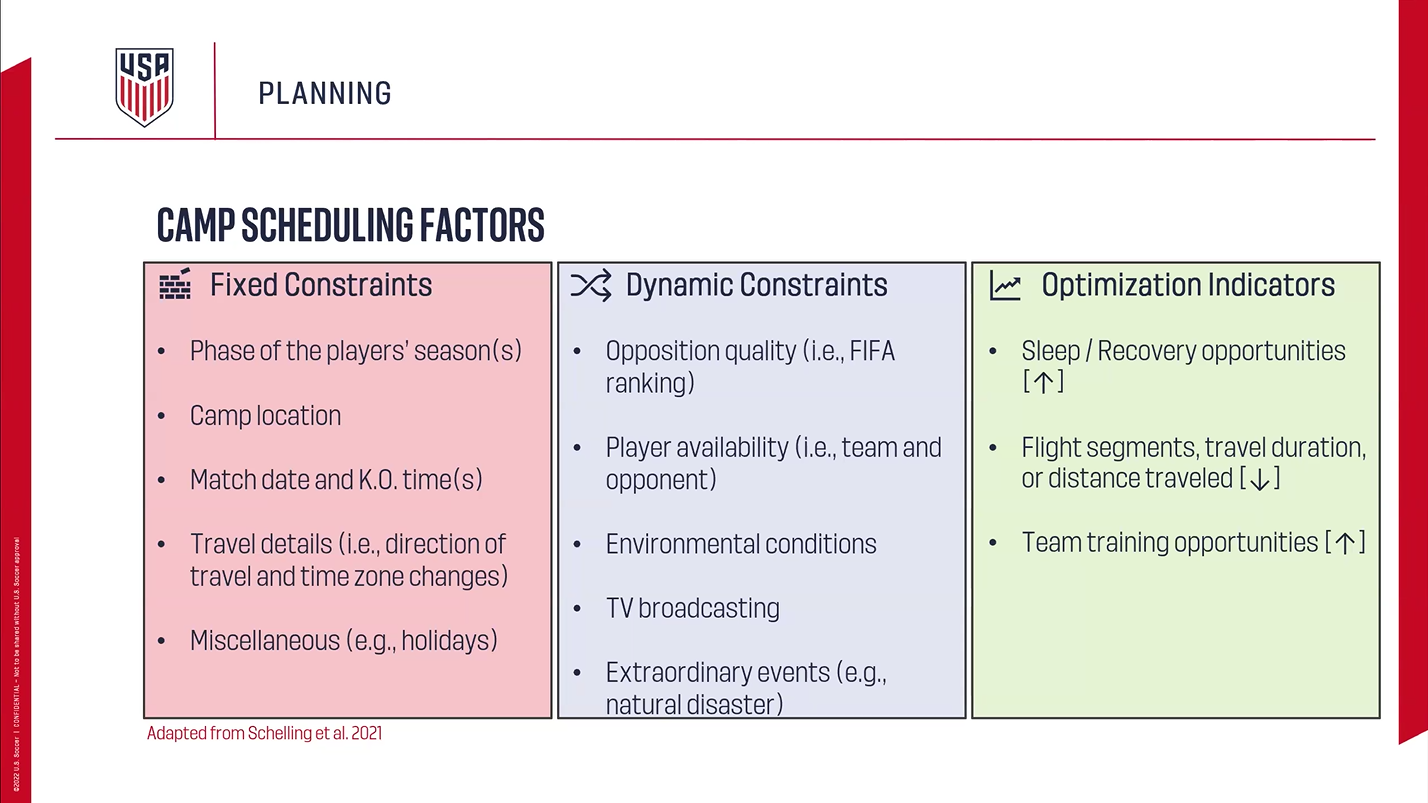
2. Time of year
The leagues of North America operate on a different seasonal calendar to their European counterparts, which requires tailored approaches to preparation and recovery for each player.
Staggered arrivals in camp is a prime example. Players may be excluded from certain match days depending on their status.
Additionally, the federation will try to use domestic camps “to address the identity of the team” and “hybrid camps where we look to go abroad, ideally to play opponents from Africa, Asia, and Europe so we get a variety of different opponents of the kind that we could potentially face in a World Cup.”
Travel logistics are a focus too. “We try to increase our sleep and recovery opportunities, decrease the number of flights to hopefully avoid a situation where the players have to get up at the crack of dawn to hop on a plane,” said Mannix.
Then there are cultural considerations. “The November window for the women’s national team will overlap with the Thanksgiving holiday,” he said, adding, “we’re working with chefs to ensure that we can put together a really creative Thanksgiving meal so the team feel like they have that communal or family experience.”
Ultimately, when it comes to periodizing camps, US teams have eight time scales to consider:
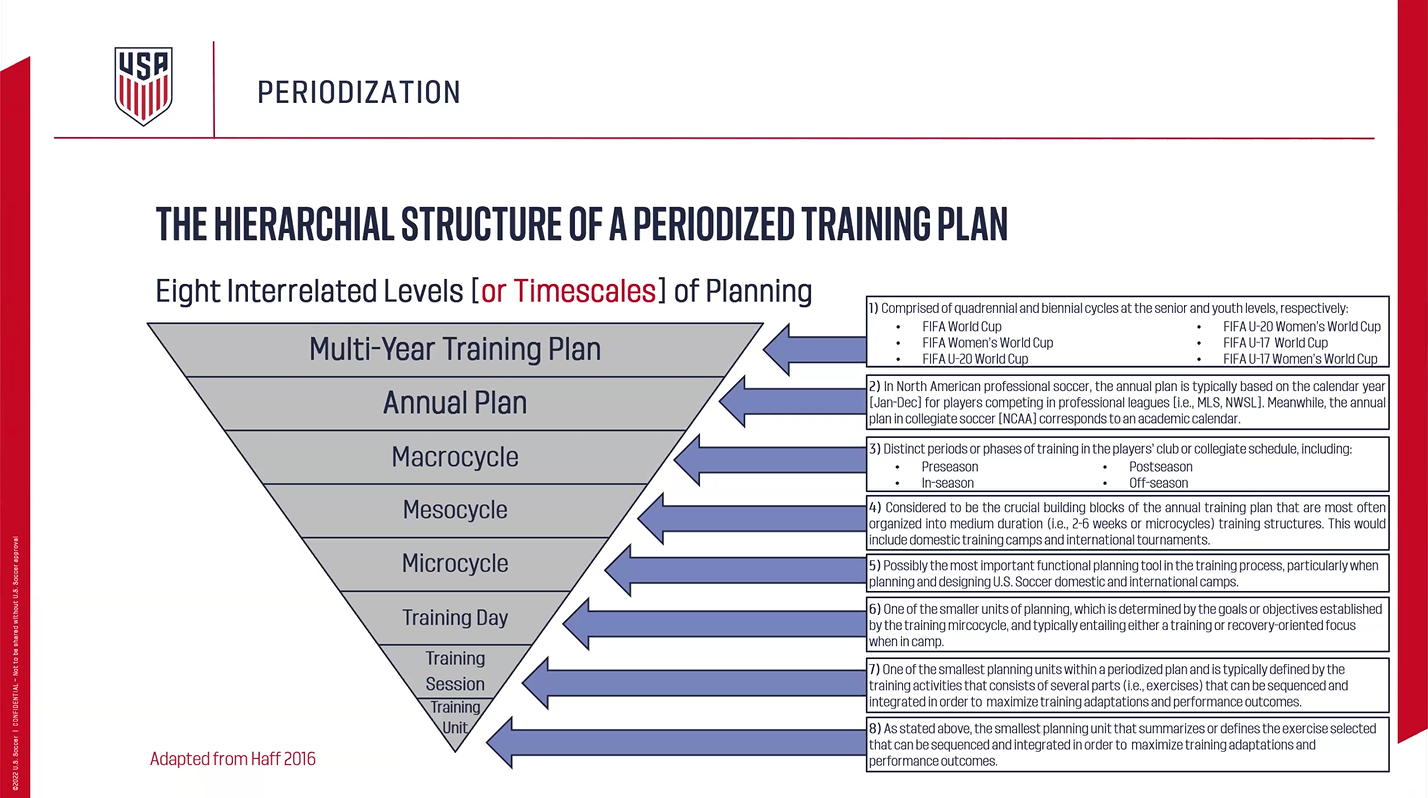
These come with several potential challenges:
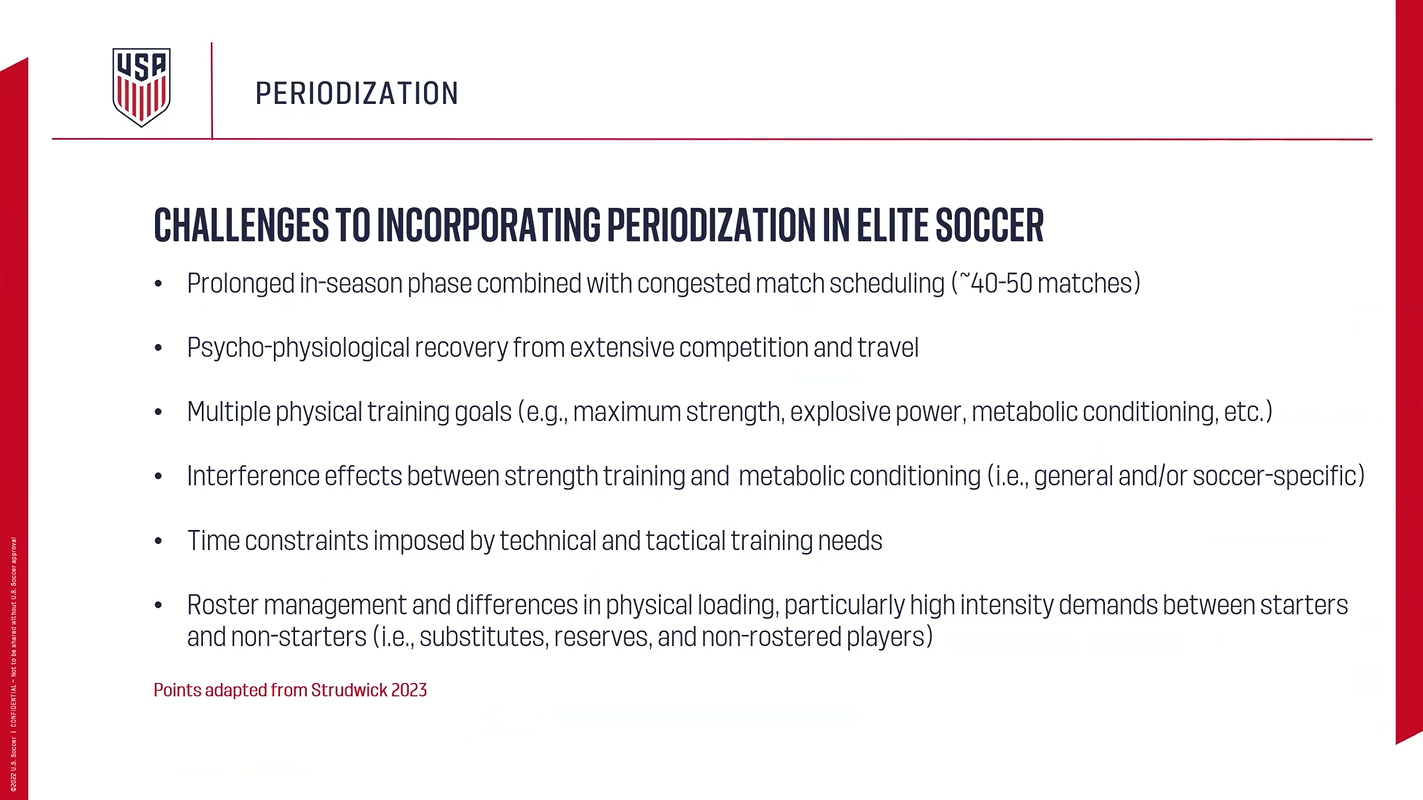
Mannix shared the example of a convalescing player joining the men’s national team for the 2024 Olympic football tournament. “In close collaboration with the club, we mapped out the tissue healing process, what the rehab was going to look like and then also what his reintegration into his team training back in his club environment would be,” he said.
“Then we had to negotiate if he were to join us in the Olympics what his match exposure would look like once he joined us, because his first time competing in official competition following the injury would be under our care. So it was super important for US Soccer that this individual was included in the roster because of his long-term trajectory within the national team.”
The coaches and support staff at US Soccer develop training plans three weeks prior to a camp, with session plans devised two weeks out once player arrival times are confirmed.
“We will design things from a team level, but then we also have to look at matters very closely at an individual level when we’re trying to safely integrate players into our national team environments.”
Mannix also spoke of periodization (the macro-level planning of when and why) and programming (the micro-level execution of what and how). He explained the distinction using the following table:
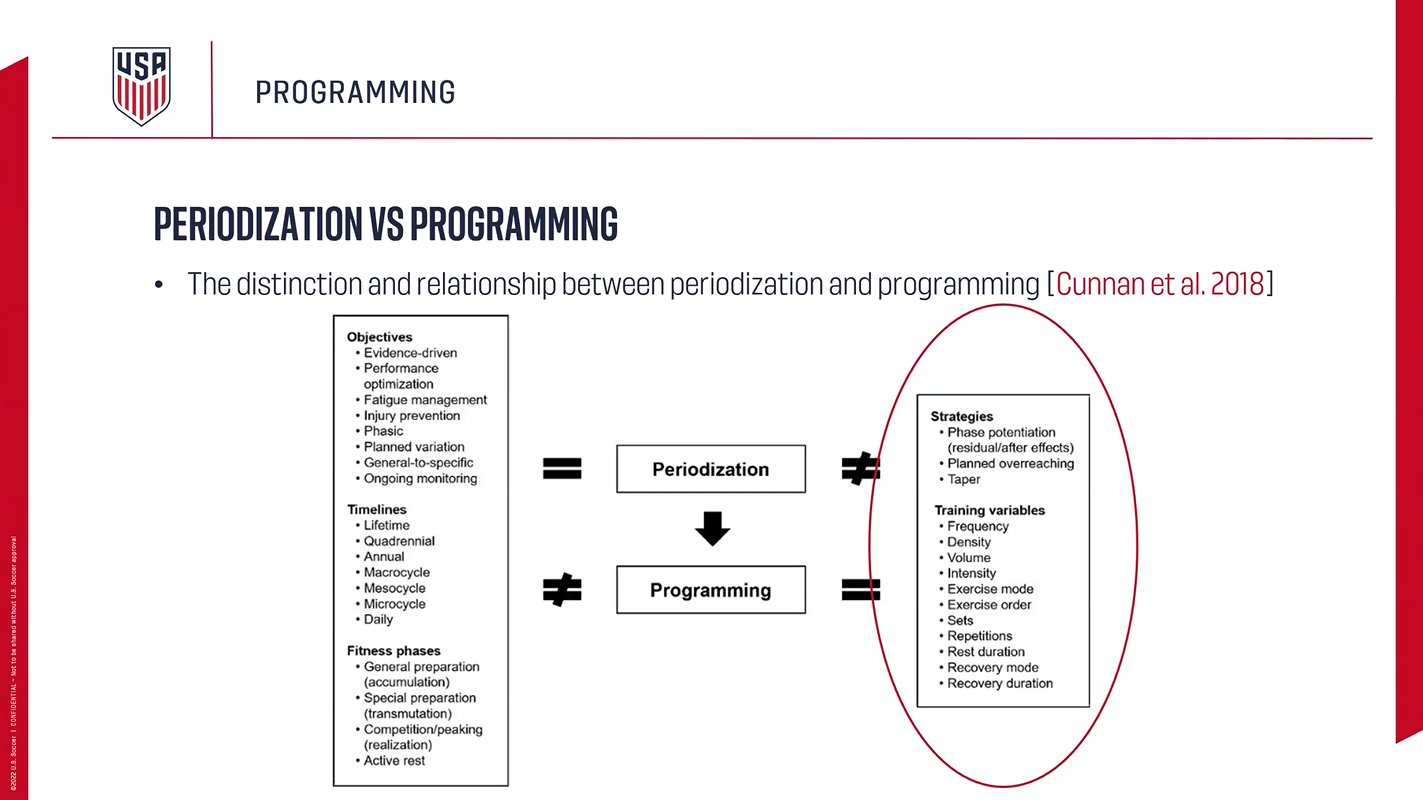
“Most of the time, we are dealing with tapering strategies and figuring out how can we optimize players’ readiness going into competition,” he said. “So it’s often an exercise in fatigue management when they’re coming into our environment and not necessarily trying to drive fitness adaptations, but, on the flip side, we’re also there to potentially facilitate a lot of those long-term physiological adaptations that are occurring.
“When it comes to planning, some of these training variables are super important. Things like training frequency, density, volume, and intensity, ensuring that those are squared away and, with our coaching staff, exercise order. So when it comes to building out session plans, making sure that the sessions are sequenced in the correct fashion.
“Again, I think that’s a lot of close communication and collaboration with primarily our head coach and our first assistant.”
What to read next
Transparency, Empathy and Empowerment: Five Ways Teams Are Serving their People in 2025
10 Apr 2025
ArticlesHead of Learning & Development Christian Luthardt discusses the psychosocial work of his new department.
Yet 43 per cent also believe psychology to be the most under-served area of human performance.
There is a nagging sense in the sports performance community that while psychology has been in sport for decades, team have never fully integrated psychological services as part of their performance offering.
A desire for such integration lies at the heart FC Bayern Munich’s Department for Learning & Development, which was established for youth players at the FC Bayern Campus in July 2024.
The department’s first Head of Learning & Development, Christian Luthardt, is a psychologist by trade who now oversees areas including education, safeguarding and sports psychology at the 30-hectare site in north Munich.
His department is one of three (the other two are the Department of Football and the Department of Administration) that answer to Bayern’s Director of Youth Development, Jochen Sauer.
“Of course, we were all working together before July, there was a lot of mutual support, but hopefully are efforts are now integrated,” says Luthardt, who was the Campus’ only psychologist when he joined at its inception in 2017. Today he leads a team of two full-time and two part-time psychologists.
The work of the collective is informed by the club’s mission, which, as Luthardt explains, is “to create autonomous, resilient and ‘switched-on’ players who are open to new experiences, who are learners, intrinsically motivated, and who enjoy their journey.”
In delivering on their mission, Bayern have three areas of focus. The Department of Learning & Development will feed into each:
Luthardt and his department are on hand from the moment a player is approached. “We try to psychologically inform the process of scouting,” says Luthardt. The club talks to players and parents, and when they are interested in recruiting the youngster, they will conduct a psychosocial interview. Campus staff members will travel to “see the family and get a feel for the player’s environment and the challenges that will accompany their transition if they move into our residence”. When players leave, they are not instantly discarded. “We have an off-boarding and aftercare process too,” says Luthardt. “It is about putting the human being first.”
“Learning environments need to be psychologically safe and healthy,” says Luthardt. Much of the work in this area is done by the team’s psychologists in conjunction with the coaches. “We are fortunate that we have a really good coaching group that want to support the players and reflect on the way they relate to the players and the kind of climate they create within their training environment.” As Luthardt explains, that might mean starting with feedback or it may mean giving the player a question on which to self-reflect. The aim is to “help players to feel that they are totally appreciated and accepted independently of their sporting performances, where they feel a sense of belonging.” Luthardt and his colleagues ultimately want the Campus to feel like a home from home. “It’s difficult, but we want to create a family atmosphere within the walls of our building.”
Such are the demands on the players’ time that Luthardt’s department has also created digital learning resources that enable players to learn on their own time in an autonomous fashion that complements their technical, tactical and physical development.
From Under-11 to Under-15, Luthardt and his colleagues will deliver 30-minute workshops every two or three weeks rooted in “social projects”. He says: “Every team has a different kind of social project where they go and get some experience outside the football bubble.”
Schedules can be tight, but Bayern want players that are “not just not mentally ill, but actually flourishing and enjoying their journey”. The club wants to see “young people who, wherever they go, will be curious to learn and to also not see themselves just as football players.”
‘We now know our priorities’
One of Luthardt’s colleagues, a sports psychologist, joined the Campus from the world of aviation. “He came with some principles from aviation and one of which is ‘take off is optional but landing is mandatory’,” says Luthardt. “Previously, we had a lot of initiatives and projects and sometimes we wouldn’t land them properly because priorities changed.” Now, “there is a clear objective of what ‘done’ looks like at the end.”
Long gone are the days where three different practitioners would ask a coach to find time for a workshop in the same week because they hadn’t spoken to each other first. “We are now clear on what we are doing and with what age group, what are focus should be and where we will place our priorities.” At Under-12, for example, the focus may be on safeguarding topics or education around social media. It will be differ depending on the cohort and different people will take the lead.
“It will always be a question of ‘can we work together on this?’ Before July there were some processes where five people felt responsible and the project would not advance because no-one felt fully accountable for that process.”
Now, the Department of Learning & Development, as a multidisciplinary team, know who leads what. “We know where our priorities are, who needs to be consulted [in other departments], who needs to be informed, and who needs to be part of the project.
“Every person in our department knows, say, the five areas for which they have responsibility and this is what ‘done’ looks like.”
Catch Christian Luthardt speaking on 24 April at…
13 Feb 2025
ArticlesIn the final instalment of his series, mental skills coach Aaron Walsh sets out some questions to consider when looking to find the candidate with the right fit.
The first questions is often: how do we find the right person to lead that programme?
Before we proceed, I want to review the previous articles and examine why this question has proved challenging.
Finding the right person is difficult without the structure of a strategic program. The following quote is from a coach I interviewed while conducting my research. It perfectly captures the essence of the challenge:
“In other areas of performance, we give a clear mandate of what we want to happen in the programme, there are regular checkpoints to ensure we are on track, and we review the work after the season, with the mental stuff [skills] we tend to find a person and just let them loose, we don’t follow best practice.”
To prepare the provider for success, we need to view the work through the right lens. Rather than offering a reactive service, we aim to create a strategic program. We want to anchor the work in the foundations established throughout this series. Here are five crucial actions we can take:
1. Define the approach: Unless we define the scope of the work and set clear expectations regarding the time needed to achieve the desired outcomes, measuring the effectiveness of the work becomes impossible. For example, if we expect the team to have a fully integrated program while only employing someone for a few days each month, that goal is unachievable. Both the team and the provider will be left feeling disappointed by the gap between the intended impact and the actual results. Being realistic and resisting the urge to over-promise allows the program to be built at the right pace and in the right way.
Key questions:
2. Have a clear framework: With the range of subjects and focus areas in sports psychology, it can feel overwhelming for providers and teams to determine where to begin. However, a straightforward framework can offer a strategic approach that brings clarity and direction to their work. This helps prevent providers from jumping between various topics each week without achieving anything meaningful.
Key questions:
3. Have the right content: Mental skills are often presented in a generalised manner that overlooks the specific needs of athletes. My research found that “lack of relevance” was identified as one of the primary reasons teams struggled to see the impact of the work. If we can collaborate with the provider and clearly outline the challenges the athletes face, we can deliver a programme they can connect with.
Key questions:
4. Nail the delivery: For the programme’s success, it’s crucial to define how the work will be delivered. We need to align with the provider on the execution. The brief can incorporate a blend of group work, one-on-one sessions, and support for coaches. Additionally, we must discuss and agree on the provider’s presentation format and session duration.
Key questions:
Once the foundations mentioned earlier are set and the key questions have been tackled, you’ll be in a good position to identify who would be the best fit for the team and the programme.
Here are some questions to consider with potential candidates to help you find the right fit. I’ll take a practical approach, as the qualifications and experience required will differ based on each team’s needs.
The final aspect I want to explore is how we can integrate them after we’ve identified the person we think is suitable for the team.
As this series draws to a close, I believe that this important yet overlooked aspect of performance will become a key differentiator for teams that choose to engage. Considerable investment has gone into the physical and skills components of performance. While there are still gains to be made, these will be marginal. The mental performance of teams is a sleeping giant that has yet to be fully unleashed. Teams that dedicate time and resources will see the benefits.
7 Jan 2025
ArticlesFemale athlete health, mental performance, data-informed recruitment and leadership were foremost in conversations across the Leaders Performance Institute in December.
There was plenty on offer on our Intelligence Hub in December and here we bring you four key thoughts from the final weeks of 2024 to set you up for success in the months ahead.
Before we get into it, remember our first summit of the year takes place at Melbourne’s Glasshouse in just under four weeks’ time. More info here. We hope to see as many of you there as possible.
If there’s an upcoming virtual learning session that takes your fancy, please let a member of the Leaders Performance Institute team know.
Right, back to the matter at hand. Here are four themes that stood out in December.
That’s not really news and, to be fair, is not entirely representative either. We have sought to address the fine work being done (as well as the enduring iniquities) in our latest Performance Special Report, titled A Female Lens on Performance: what it takes to help women and girls thrive in elite sport.
The report, which is brought to you by our Partners Keiser, features Garga Caserta, the Head of Performance at NWSL side the Kansas City Current, who discusses the best ways to balance challenge and support for players.
He also touched upon his reluctance to chase ‘low-hanging fruit’ in women’s sport performance, particularly where data is lacking:
Elsewhere in the report, we spoke to:
We also pondered the potential implications of the gendered environment for female athletes and coaches.
Download A Female Lens on Performance now.
Be careful how you answer that question. If you feel that your mental performance coach never quite fulfils their remit, perhaps you’re not setting them up to be successful. It could be, as mental performance coach Aaron Walsh argues in this exclusive column, that you’re viewing their work from the wrong angle.
Walsh wrote:
Read the full article here.
Even if you are, you probably feel that you can tighten up processes here or look at things through a different lens there.
It was a theme that ran through our Kitman Labs podcast series where the Leaders Performance Institute was joined by Kitman Founder Stephen Smith to chat to a range of guests from across the world of soccer.
These included Dr Karl-Heinrich Dittmar, the Head of Medical at German Bundesliga champions Bayer Leverkusen. He spoke at length about the club’s efforts to use data to outmanoeuvre their rivals when recruiting:
During the course of this Kitman Labs series, we also spoke to:
It’s an age-old question, but no-one has really nailed it. Dan Jackson, the General Manager of Player Development & Leadership at the Adelaide Football Club is no exception.
“I can’t teach leadership,” he told the Leaders Performance Podcast. “I can help unlock what’s already in there.”
Jackson feels that leaders can be created. “Leadership is 100 per cent made, but it’s made from a very young age.”
Beyond the origins of leadership, Jackson also spoke about the importance of prioritising others in a team environment.
“Great sustainable teams are built in environments where everyone’s looking to help someone else out,” he adds. “When you fill someone else’s bucket, it fills yours.”
It’s well worth your time. The same can also be said for these other guests, who all joined our three-part Keiser Series podcast in December:
When it comes to untapped performance potential, female athletes and coaches often have the most to gain. And as we’ve tried to demonstrate across this Special Report, produced with the support of our partners at Keiser, there are significant strides being made towards those gains at various elite sports organisations across the world.
With contributions from practitioners in American soccer, at High Performance Sport New Zealand and England Rugby, as well as research from the Universities of Nottingham and Manitoba, this report identifies best-in-class work being done in the fields of S&C for female soccer players; maternity and motherhood in English rugby; coach development across New Zealand sport; and the injury risks posed by gendered environments.
Complete this form to access your free copy of A Female Lens on Performance and see for yourself how the performance ceiling for women athletes and coaches can be raised.
9 Dec 2024
PodcastsWe spoke to Arianna Criscione of Como Women, Sarah Smith of Angel City FC, and Kitman Founder Stephen Smith about the most pressing issues in women’s football.
A podcast brought to you by our Partners
That is the view of Arianna Criscione, the Head of Football Operations at Mercury/13 and Como Women. “It’s not enough,” she tells this Kitman Labs podcast. She explains that there are a range of services, from nutrition to psychology, that need to be tailored to women players.
Criscione continues: “You also have to have access to medical [support], but a lot of clubs don’t have access to a gynaecologist, which is a major part of the female body and really needs to be addressed a lot more.”
Dentistry is another area of oft-neglected consideration. “If you have an off-bite, that can actually affect your structure and how you’re running, which could cause injury.”
It is, as Sarah Smith says, about “making sure that we have a good foundation of support around our athletes.” Smith, who is the Director of Medical and Performance at Angel City FC in the NWSL, joins the conversation alongside Stephen Smith, the Founder of Kitman Labs.
In addition to discussing holistic female player development [10:45], the trio delve into bridging the gap in data and understanding in women’s football [15:45]; how talent identification is evolving [20:15]; as well as the existing disparities in data collection [28:10] from club to club and league to league.
This is episode two of a three-part series. Please go back and check out episode one, where the Leaders Performance Institute and Stephen Smith spoke to Paul Prescott of the International Football Group and Morten Larsen of Danish Superliga side Aarhus discussing talent pathways in the Premier League and beyond.
Further listening:
Kitman Labs Podcast: What Factors Drive Talent Development in the Premier League and Beyond?
Listen above and subscribe today on iTunes, Spotify, Stitcher and Overcast, or your chosen podcast platform.
