Patrick Mannix, the federation’s Sports Science Senior Manager, shared his insights with Leaders Performance Institute members at a recent virtual roundtable.
Eisenhower liked the sentiment enough to repeat variations during his time in the White House and the appeal to people working in elite sport is obvious.
In fact, Patrick Mannix, the Sports Science Senior Manager at US Soccer, began his recent presentation to Leaders Performance Institute members with that very line.
“The idea behind this quote is that high-performance teams don’t necessarily have a static plan,” said Mannix.
“The plan is constantly evolving as new information comes to light, whether that’s in relation to the tournament that we’re playing in, the players that we’re working with, and a variety of other contexts that are relevant to the world of international soccer.”
With those words, Mannix set the scene for a discussion that centered on performance planning in the international game, specifically the development of camp training plans for players who join up from their respective clubs in the US and beyond.
First, he offered a summary:
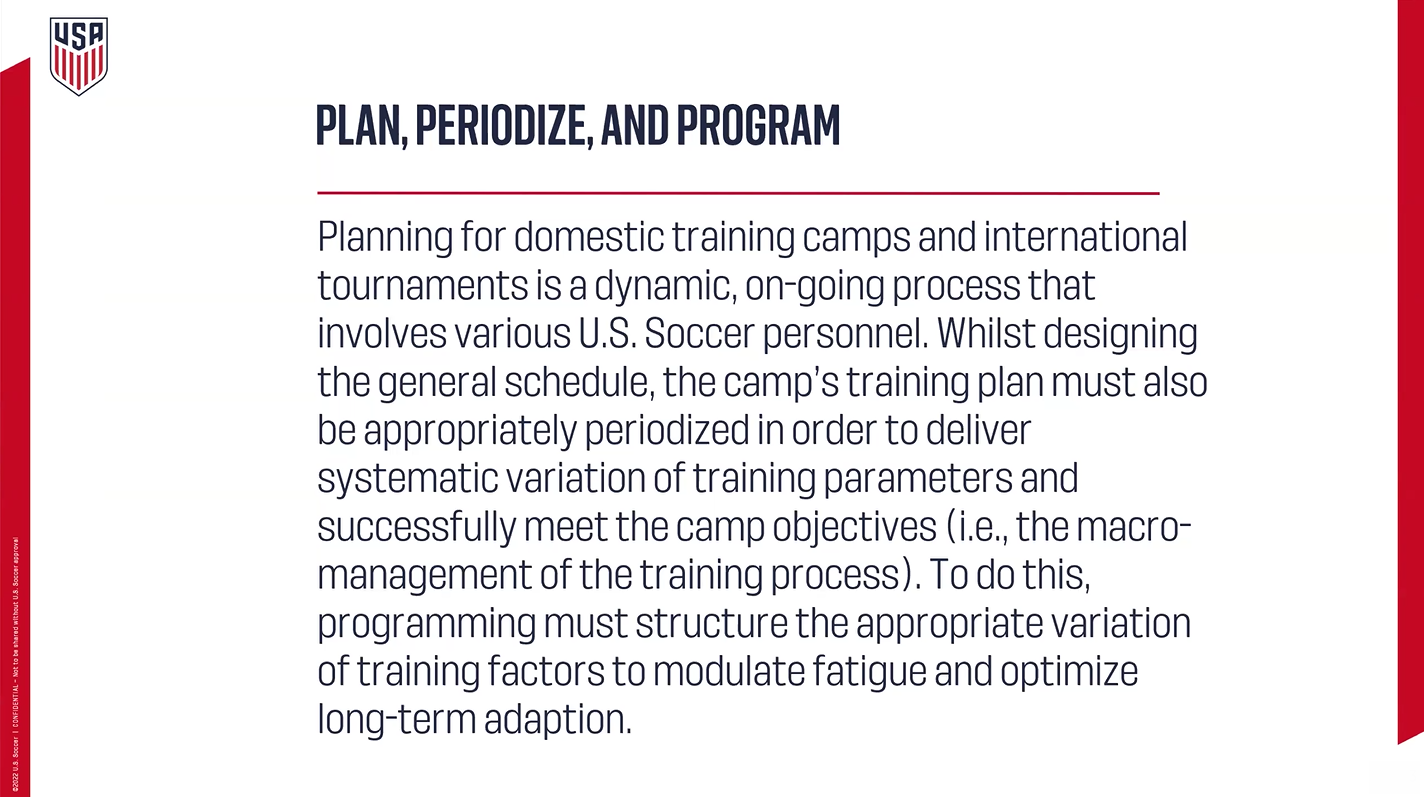
Mannix then shared how he and his colleagues approach international training camps from a sports science and medicine perspective with the help of this cycle:
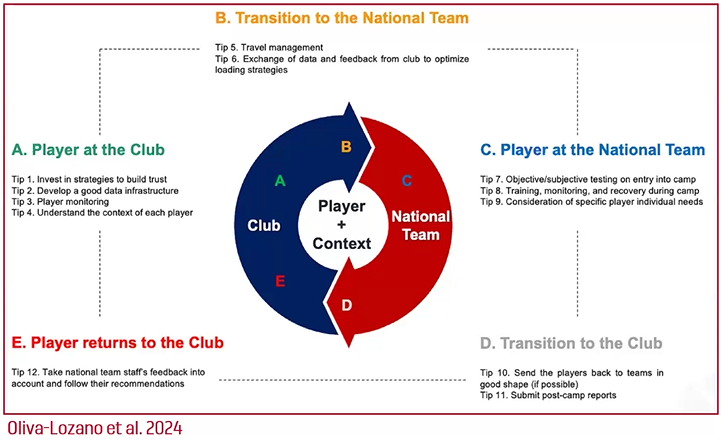
“Building rapport and trust with those clubs is massively important,” said Mannix, “because that helps us drive a lot of the exchange of information.”
He then outlined the common challenges he and his team face in the realms of communication, health & safety and load management:
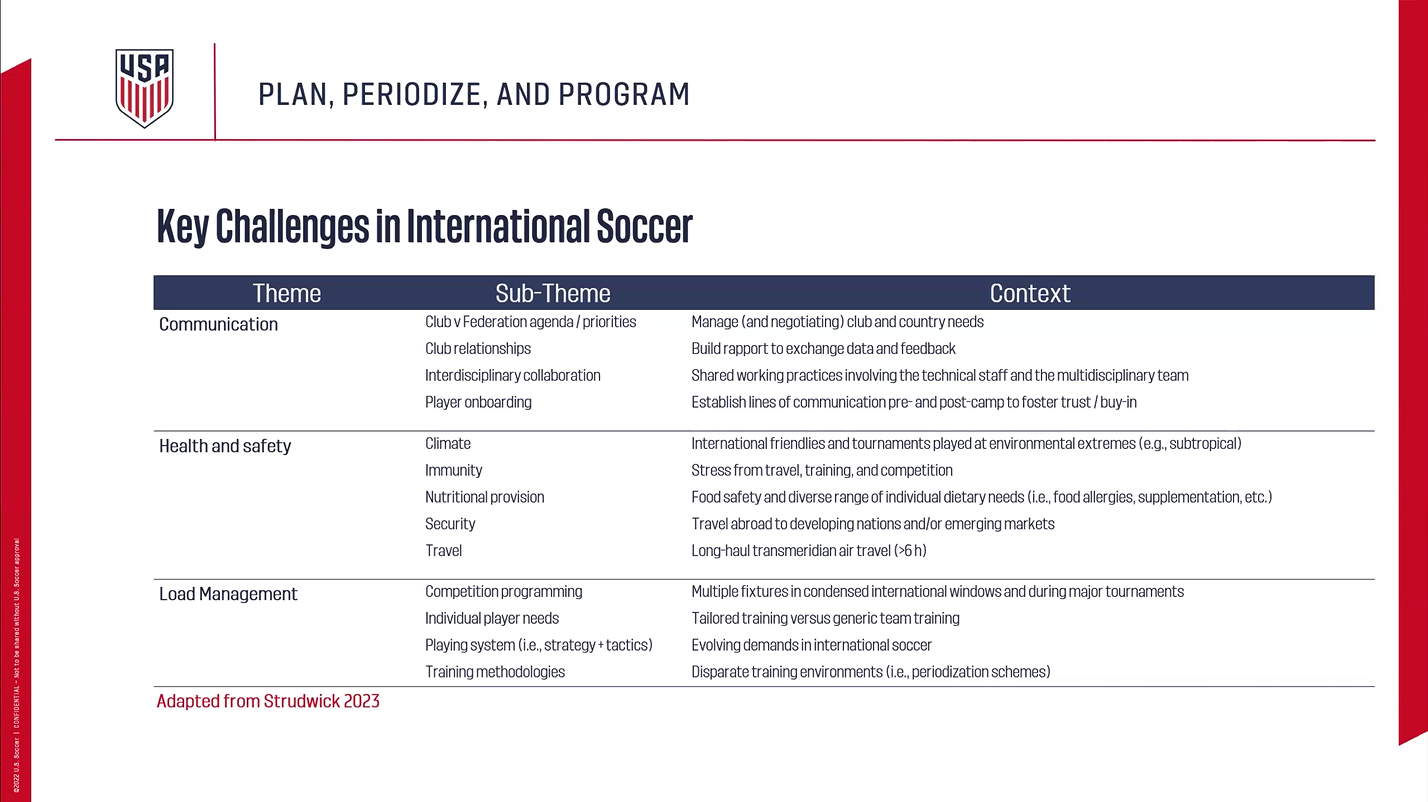
In explaining how they meet those challenges, Mannix focused on three areas in particular:
1. Club and country alignment
The US national teams draw on players from across the globe and, even for matches in the US itself, such is the size of the country that most personnel will have made a long-haul journey.
This map, which depicts the travel schedule of the US men’s team during the 2025 Concacaf Gold Cup, provides some idea of the challenges present even in a domestic setting:

“We need to know when our equipment and staff are arriving and where our players are coming from,” said Mannix in reflection on this map. It calls for close collaboration between the technical/coaching staff, the high performance team and the operations team.
“When a coach is trying to build out the session plan, the right hand is a good sports scientist or a performance coach, and the left hand is the first assistant, and those three individuals are working very closely to ensure that there’s a good plan in place for every training session,” Mannix continued.
“There’s good understanding as to what the availability of the players is going to be, particularly in the first two days of training, because what we’ve found through communication with clubs is we sometimes have to be flexible when players are coming into our environment simply because although Europe observes FIFA windows, we have to work with our partners in MLS on when players are released to come and join our environment.”
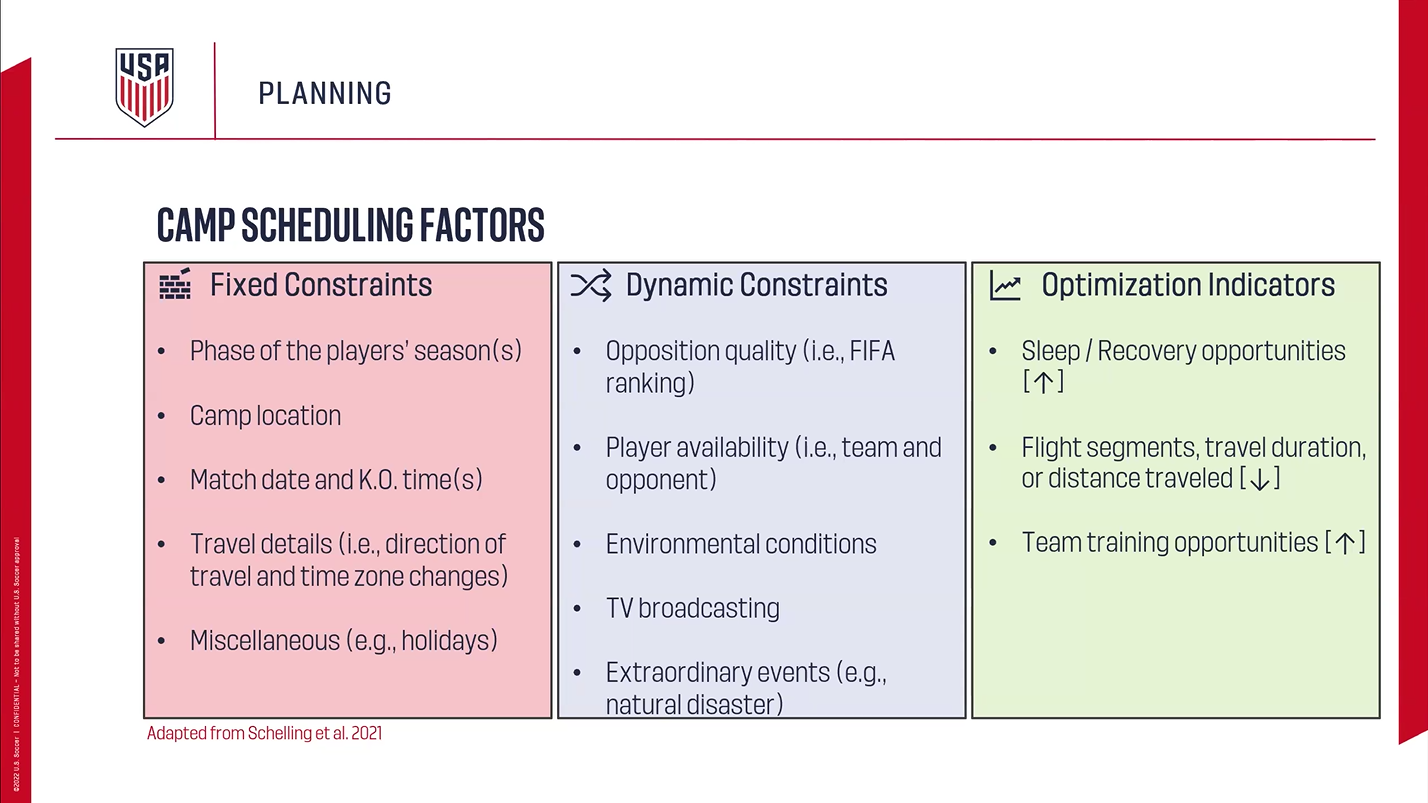
Mannix and his colleagues understand the range of fixed and dynamic constraints they face. They use that understanding to find optimization indicators.
2. Time of year
The leagues of North America operate on a different seasonal calendar to their European counterparts, which requires tailored approaches to preparation and recovery for each player.
Staggered arrivals in camp is a prime example. Players may be excluded from certain match days depending on their status.
Additionally, the federation will try to use domestic camps “to address the identity of the team” and “hybrid camps where we look to go abroad, ideally to play opponents from Africa, Asia, and Europe so we get a variety of different opponents of the kind that we could potentially face in a World Cup.”
Travel logistics are a focus too. “We try to increase our sleep and recovery opportunities, decrease the number of flights to hopefully avoid a situation where the players have to get up at the crack of dawn to hop on a plane,” said Mannix.
Then there are cultural considerations. “The November window for the women’s national team will overlap with the Thanksgiving holiday,” he said, adding, “we’re working with chefs to ensure that we can put together a really creative Thanksgiving meal so the team feel like they have that communal or family experience.”
Ultimately, when it comes to periodizing camps, US teams have eight time scales to consider:
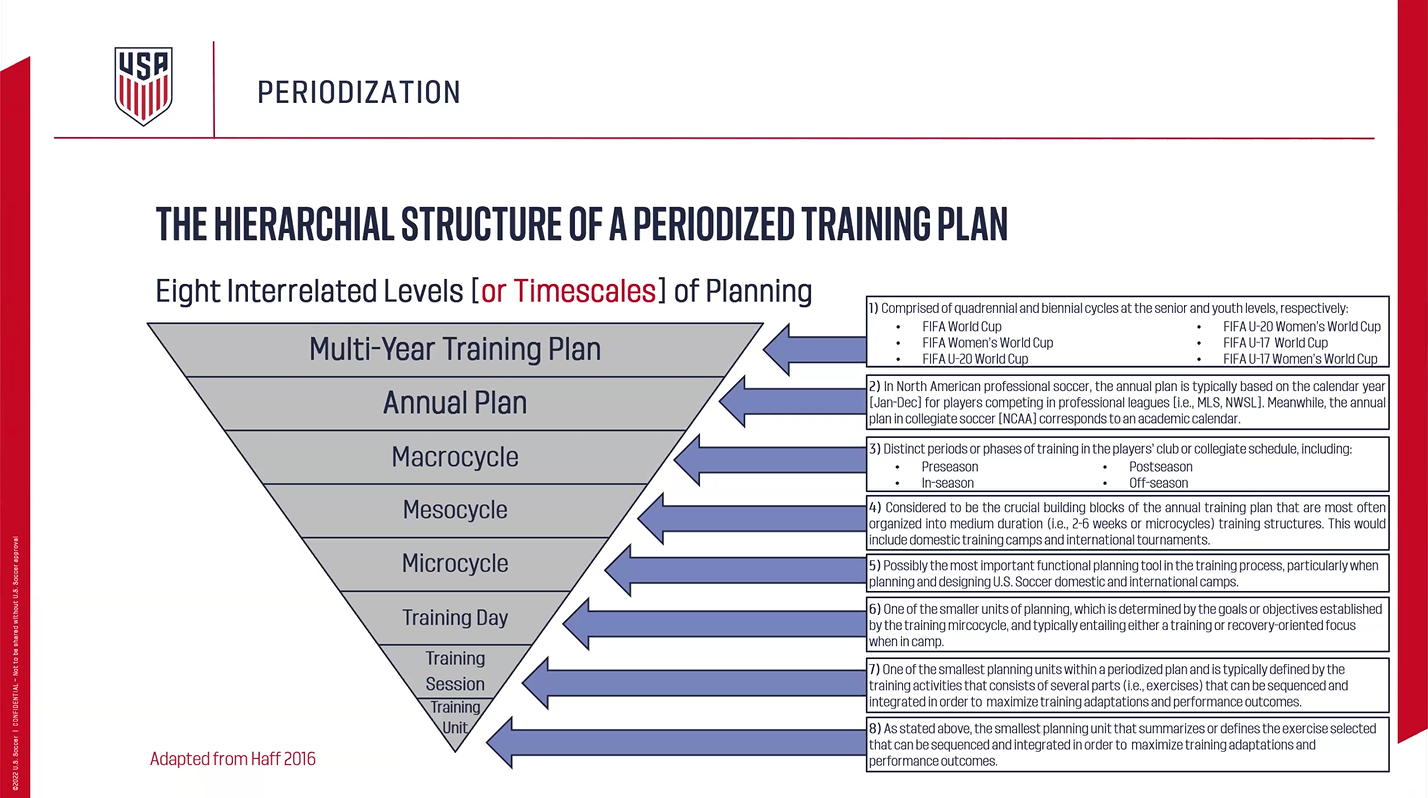
These come with several potential challenges:
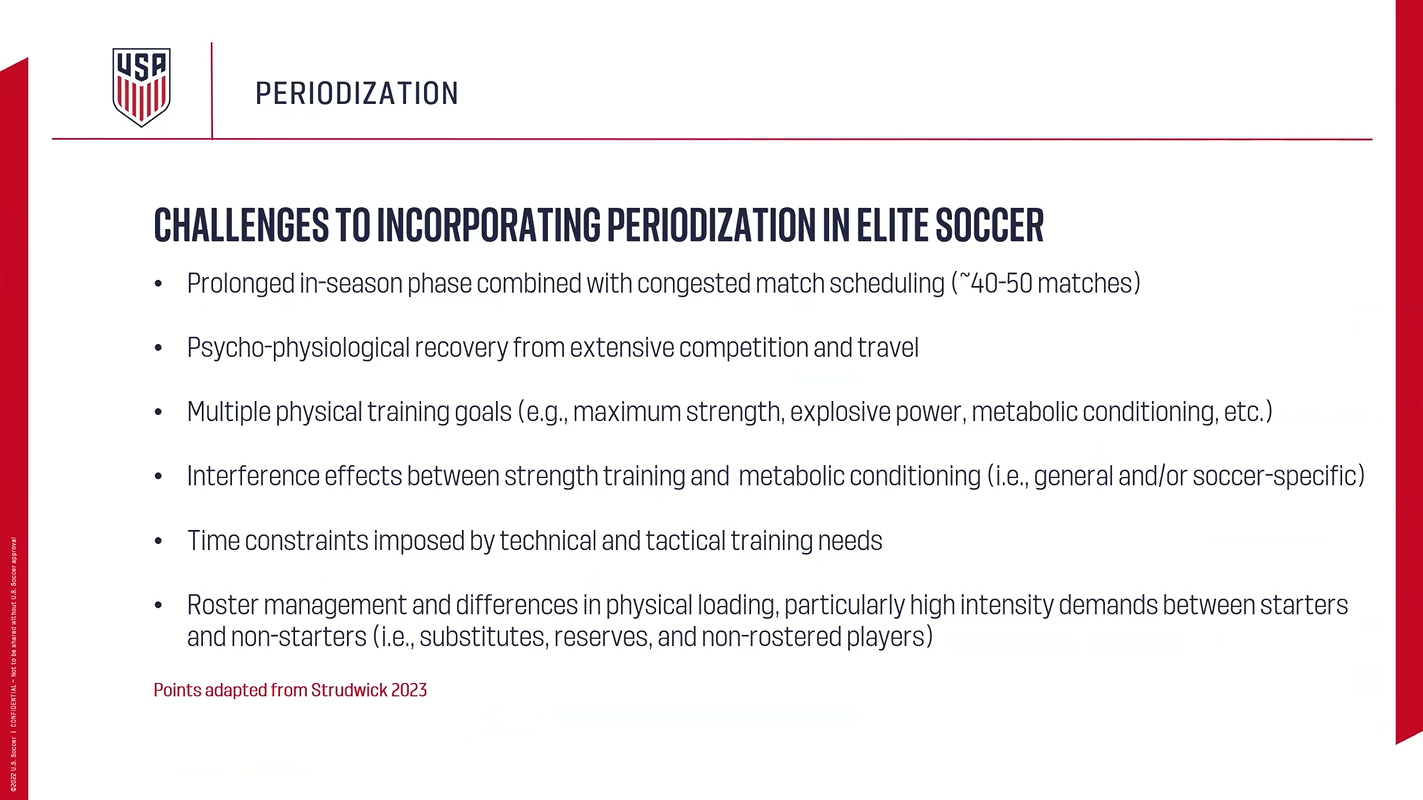
Mannix shared the example of a convalescing player joining the men’s national team for the 2024 Olympic football tournament. “In close collaboration with the club, we mapped out the tissue healing process, what the rehab was going to look like and then also what his reintegration into his team training back in his club environment would be,” he said.
“Then we had to negotiate if he were to join us in the Olympics what his match exposure would look like once he joined us, because his first time competing in official competition following the injury would be under our care. So it was super important for US Soccer that this individual was included in the roster because of his long-term trajectory within the national team.”
The coaches and support staff at US Soccer develop training plans three weeks prior to a camp, with session plans devised two weeks out once player arrival times are confirmed.
“We will design things from a team level, but then we also have to look at matters very closely at an individual level when we’re trying to safely integrate players into our national team environments.”
Mannix also spoke of periodization (the macro-level planning of when and why) and programming (the micro-level execution of what and how). He explained the distinction using the following table:
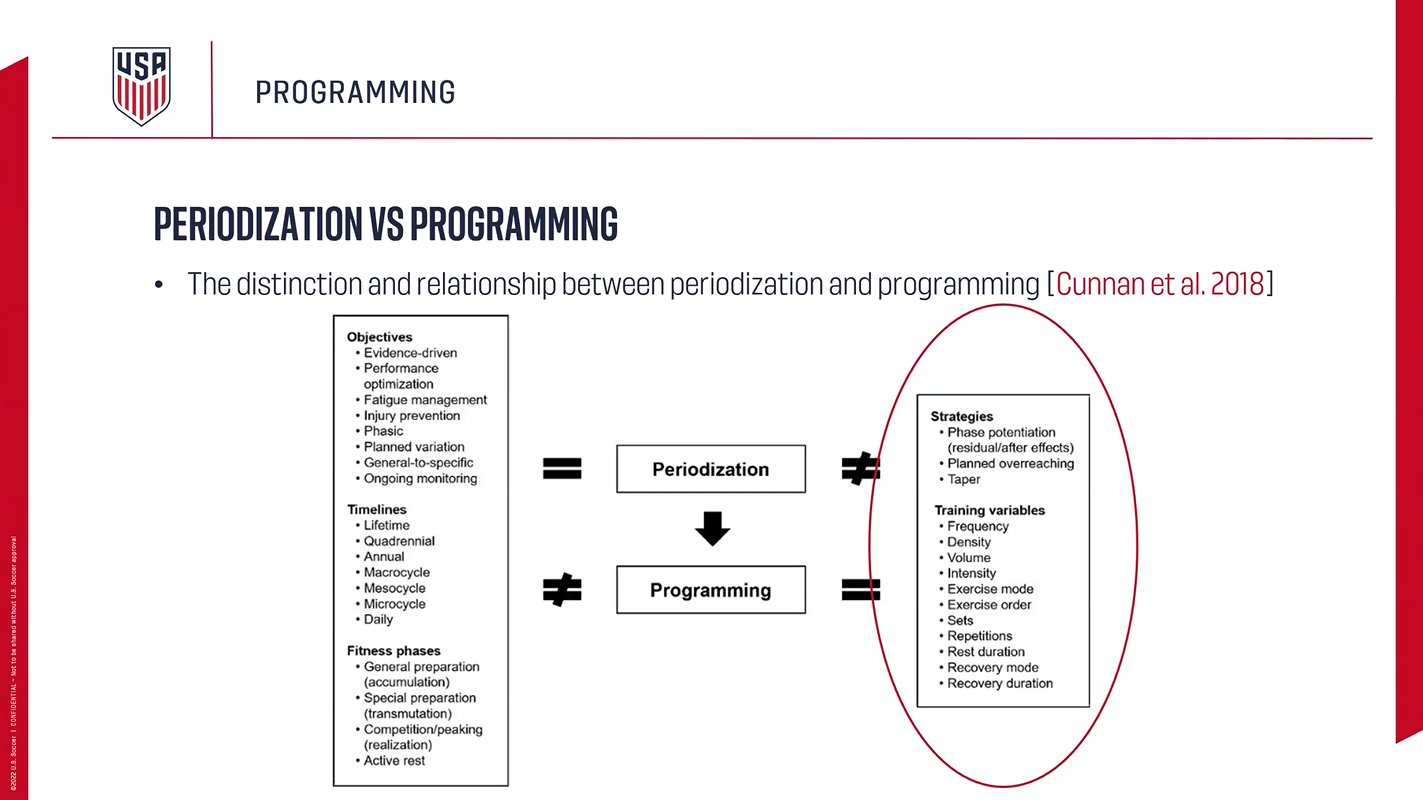
“Most of the time, we are dealing with tapering strategies and figuring out how can we optimize players’ readiness going into competition,” he said. “So it’s often an exercise in fatigue management when they’re coming into our environment and not necessarily trying to drive fitness adaptations, but, on the flip side, we’re also there to potentially facilitate a lot of those long-term physiological adaptations that are occurring.
“When it comes to planning, some of these training variables are super important. Things like training frequency, density, volume, and intensity, ensuring that those are squared away and, with our coaching staff, exercise order. So when it comes to building out session plans, making sure that the sessions are sequenced in the correct fashion.
“Again, I think that’s a lot of close communication and collaboration with primarily our head coach and our first assistant.”
What to read next
Transparency, Empathy and Empowerment: Five Ways Teams Are Serving their People in 2025
23 Apr 2025
ArticlesIn a recent Women’s High Performance Sport Community Group call, former GB Hockey players Giselle Ansley and Emily Defroand discussed their experience of working with Performance Lifestyle Advisor Emma Mitchell.
Main image: Dean Mouhtaropoulos/Getty Images for FIH
Since its inception, and through conversations across sports and nations, we’ve noted the importance of transitions in women’s sport, particularly as athletes come to the end of their professional careers.
The topic of transitions formed the basis of our first group conversation of the year, with the conversation led by former athletes Giselle Ansley, a Senior Account Executive with Specialist Sports; Emily Defroand, the Football Communications Lead at West Ham United; and Emma Mitchell, who recently left her position as a Performance Lifestyle Advisor at the UK Sports Institute and who worked directly with the duo during their playing careers.
Ansley and Defroand are former GB Hockey players, who won a wealth of medals between them. Ansley won Olympic gold and bronze, as well as Commonwealth gold, silver, and bronze. Defroand won a European bronze, as well as a Commonwealth bronze. Both have won many a domestic title too.
Mitchell, who won a PLx Award in 2023, won the 1994 Women’s Rugby World Cup playing for England and helped set up the Saracens women’s team.
Over the course of the conversation, we delved into Mitchell’s work and the realities for Ansley and Defroand as they began to transition in their careers.
Why it’s valued
Ansley knew she was aiming to leave post-Paris (2024) and began working with Mitchell post-Tokyo (2021). For her part, Defroand suffered multiple injuries where her body almost told her she needed to plan ahead.
In reflecting on her playing days, Ansley said: “In fact, Emma Mitchell’s role in Great Britain hockey and the impact that she had on me personally effectively changed my life.”
Mitchell had experiences from a different sport, which helped her leverage her expertise around coaching the person. She became immersed in the team behind the team and working with the wider staff and athlete squad in the pursuit of a common goal. “I don’t think there’s anything more powerful than that in sport because everyone is committed to the same thing,” she said. “It’s not necessarily a medal or winning a World Cup. It’s bigger than that and it’s something that’s so unifying. It’s quite incredible in terms of engagement levels.”
The realisation that playing a sport as a professional won’t be an option forever meant it wasn’t taken for granted. It also meant that they wanted to make the most of the opportunity and soak up learnings and conversations with practitioners.
This is how it works:
What’s missing?
“I really don’t think we should underestimate the impact that this sort of support during and after each transition can have,” said Ansley. Not all sports get the excellent support that Mitchell has provided at GB Hockey. Providing the opportunity from an early stage of an athlete’s career is critical, even if they don’t engage with it immediately.
With more athletes not postponing starting a family until the end of their athletic careers it’s important to support this transition too.
Support must be there for athletes so that when they do enter the working world they’re not starting from the bottom again. Support must also be there for businesses to understand the transferability of an athlete’s skills, as well as the fact that female athletes are coming from a very different context to male athletes.
What can be done when resources are limited?
What does it mean for others in roles supporting athletes?
Even thinking about it shows a level of care that will be appreciated by athletes. Showing understanding, but also being accepting of each athlete being in their own place with their own mindset, especially when dealing with injuries. Some might want to make the best use of that time, whatever it may be. With others believing that the best use of their time and energy is to focus solely on recovering. Some roles are in a great place to have regular check-ins, with a different bond to that of a coach. A chat can go a very long way.
Make it stick to ensure it delivers an ROI
From Mitchell’s perspective, part of the key to her success in her role came from GB Hockey choosing to embed the service within its programme philosophy. The original hire for the role came from GB Hockey’s programme budget rather than UK Sport funding for the role, a true reflection of how much they valued the work.
She also spoke about head coaches who didn’t see the work as duty of care, but as performance enhancing if done well. It’s helped extend careers, and support players enjoy an extra Olympic cycle because they dealt with what was coming next and the anxiety that can lead to.
The impact of these conversations, and the work being done by performance lifestyle advisors, has on culture shouldn’t go amiss, especially when the culture directly impacts performance in the view of the athletes.
For the athletes, the work with Mitchell helped with their motivation and longevity. Both Defroand and Ansley shared that by completing exercises like the values one elevated their appreciation for their sport and the level they were competing at. It motivated them to train their best and unlocked new levels of effort to give. It helped refine their athletic goals, but also their goals beyond that. In early days working with Mitchell, former GB Hockey player Sarah Evans [who also joined us on the call], found that there was real benefit to doing the work on herself, to help with her confidence if dropped, and to ensure that she was working to get selected knowing how she could help the squad whether or not she was on the pitch.
Mitchell said: “My feeling is that we all need a purpose and the type of people who are in sport at the elite level are incredibly driven so they will want to find something. It may never be quite the same as putting on a GB Hockey vest, but they want something that is fulfilling in a similar way. So helping them with that. And there’s research now that that actually demonstrates that athletes who engage in this type of work are likely to become the leaders in their sport and they are also likely to extend their careers, so it is actually seen as one of those that has a performance impact as well.”
Mitchell also signposted Professor David Lavallee from University of Stirling, specifically his research on transition support and measuring impact. She said: “We now capture everything we do on one database and part of that is the numbers bit. To just demonstrate, the Paris cycle was three years. I think my colleague working with the men and I had approximately 3,000 interactions across the two squads. It’s a big time sync recording all of this, yeah. It’s almost not justifying our existence, but it’s at least capturing some of that.”
Finally, we also spoke about supporting athletes to stay in sport when their playing careers come to an end. Whilst there are all sorts of initiatives to try and encourage athletes into coaching positions and gaining coaching qualifications, or staying within sports (for example, UK Sport’s Athlete to Coach programme), the reality is that even at international level coaching renumeration can be relatively low, and is naturally all consuming. For Mitchell, her role as a Performance Lifestyle Advisor was another way of deploying her coaching skills.
10 Apr 2025
ArticlesHead of Learning & Development Christian Luthardt discusses the psychosocial work of his new department.
Yet 43 per cent also believe psychology to be the most under-served area of human performance.
There is a nagging sense in the sports performance community that while psychology has been in sport for decades, team have never fully integrated psychological services as part of their performance offering.
A desire for such integration lies at the heart FC Bayern Munich’s Department for Learning & Development, which was established for youth players at the FC Bayern Campus in July 2024.
The department’s first Head of Learning & Development, Christian Luthardt, is a psychologist by trade who now oversees areas including education, safeguarding and sports psychology at the 30-hectare site in north Munich.
His department is one of three (the other two are the Department of Football and the Department of Administration) that answer to Bayern’s Director of Youth Development, Jochen Sauer.
“Of course, we were all working together before July, there was a lot of mutual support, but hopefully are efforts are now integrated,” says Luthardt, who was the Campus’ only psychologist when he joined at its inception in 2017. Today he leads a team of two full-time and two part-time psychologists.
The work of the collective is informed by the club’s mission, which, as Luthardt explains, is “to create autonomous, resilient and ‘switched-on’ players who are open to new experiences, who are learners, intrinsically motivated, and who enjoy their journey.”
In delivering on their mission, Bayern have three areas of focus. The Department of Learning & Development will feed into each:
Luthardt and his department are on hand from the moment a player is approached. “We try to psychologically inform the process of scouting,” says Luthardt. The club talks to players and parents, and when they are interested in recruiting the youngster, they will conduct a psychosocial interview. Campus staff members will travel to “see the family and get a feel for the player’s environment and the challenges that will accompany their transition if they move into our residence”. When players leave, they are not instantly discarded. “We have an off-boarding and aftercare process too,” says Luthardt. “It is about putting the human being first.”
“Learning environments need to be psychologically safe and healthy,” says Luthardt. Much of the work in this area is done by the team’s psychologists in conjunction with the coaches. “We are fortunate that we have a really good coaching group that want to support the players and reflect on the way they relate to the players and the kind of climate they create within their training environment.” As Luthardt explains, that might mean starting with feedback or it may mean giving the player a question on which to self-reflect. The aim is to “help players to feel that they are totally appreciated and accepted independently of their sporting performances, where they feel a sense of belonging.” Luthardt and his colleagues ultimately want the Campus to feel like a home from home. “It’s difficult, but we want to create a family atmosphere within the walls of our building.”
Such are the demands on the players’ time that Luthardt’s department has also created digital learning resources that enable players to learn on their own time in an autonomous fashion that complements their technical, tactical and physical development.
From Under-11 to Under-15, Luthardt and his colleagues will deliver 30-minute workshops every two or three weeks rooted in “social projects”. He says: “Every team has a different kind of social project where they go and get some experience outside the football bubble.”
Schedules can be tight, but Bayern want players that are “not just not mentally ill, but actually flourishing and enjoying their journey”. The club wants to see “young people who, wherever they go, will be curious to learn and to also not see themselves just as football players.”
‘We now know our priorities’
One of Luthardt’s colleagues, a sports psychologist, joined the Campus from the world of aviation. “He came with some principles from aviation and one of which is ‘take off is optional but landing is mandatory’,” says Luthardt. “Previously, we had a lot of initiatives and projects and sometimes we wouldn’t land them properly because priorities changed.” Now, “there is a clear objective of what ‘done’ looks like at the end.”
Long gone are the days where three different practitioners would ask a coach to find time for a workshop in the same week because they hadn’t spoken to each other first. “We are now clear on what we are doing and with what age group, what are focus should be and where we will place our priorities.” At Under-12, for example, the focus may be on safeguarding topics or education around social media. It will be differ depending on the cohort and different people will take the lead.
“It will always be a question of ‘can we work together on this?’ Before July there were some processes where five people felt responsible and the project would not advance because no-one felt fully accountable for that process.”
Now, the Department of Learning & Development, as a multidisciplinary team, know who leads what. “We know where our priorities are, who needs to be consulted [in other departments], who needs to be informed, and who needs to be part of the project.
“Every person in our department knows, say, the five areas for which they have responsibility and this is what ‘done’ looks like.”
Catch Christian Luthardt speaking on 24 April at…
In this Virtual Roundtable, brought to you in partnership with ESSA, Jason Berry and Kenneth Graham discussed what research is required to support the future practitioner and athletes.
An article brought to you by

Berry, the Director of Sport Science, Research & Innovation at IMG Academy, was discussing the increasing tendency of some sports organisations keep sports science research in-house – a practice that does little to help the wider sports community.
“Over here in the United States, we’re in a spring training camp area around Tampa, so there’s a lot of baseball teams and facilities in the area. They are doing in-house research.”
This isn’t new. Berry explained that there were professional teams in Australia in the 1990s conducting research independently of the Australian Institute of Sport, which had been the leader in sports science research initiatives (and one of the chief disseminators) across the Australian sports system for more than a decade.
He is speaking at the second session of ‘The Future of Performance Sport’, a three-part Virtual Roundtable series brought to you by the Leaders Performance Institute and Exercise & Sports Science Australia. This session explored ‘what research is required to support the future practitioner and athletes’.
Berry was joined on the virtual stage by Kenneth Graham, a member of the AIS’s Research Review Committee and the Principal Scientist and Co-Founder of sports technology lab, eo.
Together they delivered a state of play on the industry and the obstacles it faces while also explaining how organisations can bridge the gap between research and its application in an increasingly complex performance landscape.
The strengths and weaknesses of current approaches to research in sports science
The strengths:
The weaknesses:
How to bridge the gap between research and real-world application
How can sports science practitioners do a better job of translating their research findings to athletes, coaches and other stakeholders?
Graham and Berry shared five tips:
It helps to build relationships with coaches and athletes. Not only does this engender trust, but it ensures greater applicability to research findings. “By always giving information that is contextually useful for that time of the year or by understanding the training cycle, you get more engagement,” said Graham. “You do need that time to build up the credibility and the acceptance of the coach to take on information from you; and over time that becomes a faster process. It can be done over a cup of coffee, you may not need a formal presentation, but being part of the process, seeing the development of the training programmes, being at the training sessions, being at the competitions, looking for the gaps where the information you’re giving is seen as valuable.”
When asked how a sports scientist might increase their networking and collaboration efforts, Graham suggested to “get a table, some whiteboards, a pizza, and time.” He said: “Spend time discussing, explaining, and exploring what the different people in the group know and what they’re interested in helping create. And it’s doing this iteratively. You have the discussion, you may then go away to do more reading, and then you come back. You do that two or three times, but what you’re doing is you’re getting closer and closer to a high quality question; or you’ve actually generated the answer that can then be used. But that time, that collaboration – it’s not play time, it’s about people getting excited and bouncing ideas and information off each other.”
A sports scientist does not have infinite time to share their research findings throughout an organisation. It requires collaboration, as Berry explained. He said: “We’ve got our research publications, but who in that wider collaboration is going to then attack the social media side of it? And who’s going to do some posts there? And who’s going to do the community coach education?” The message need not be complicated. “You might say: ‘We’re just down the road at Victoria University, we’re doing all this research, but here’s some stuff that can actually help the grassroots’. It’s just the collaboration spreading the load, not expecting one researcher or one practitioner to cover everything.”
A common fear is that a tech solution becomes redundant. IMG Academy, as Berry explained, tries to avoid this through rigorous vetting. “One of the first couple of questions we ask as part of the innovation process is: what type of relationship are you after? Is it strictly vendor, some sort of partnership, or is it a sponsorship? We have variations of all those three at the academy. The second thing we typically ask is ‘send us your research packet, we want to see the validation, we want to see what you’ve done, we don’t just want testimonials from a star athlete that this changed their game – we actually want the evidence’.”
Artificial intelligence will have its uses, but as Graham said: “Make sure that your AI model isn’t giving you the answer that you want because of the way you’ve trained it”. When that information has been curated carefully, Graham finds that it “dramatically shortens the development time and improves the quality information.”
Future areas of enquiry: the technical, tactical and psychological
Berry believes there are gains to be made in the technical and tactical realms. “That whole perceptual cognitive decision making component of performance, which typically separates those expert performers,” he said, while also alluding to the psychological elements, such as performance under pressure. “The physical part is not a separator anymore.” It is, however, tricky to find the measurables to support holistic athlete development. “I guess that’s the elusive one at the moment,” he added, “but there’s people working towards that”.
Further reading:
Soft Skills, AI, and Psychology: the Skills that Will Define the Practitioner of the Future
13 Feb 2025
ArticlesIn the final instalment of his series, mental skills coach Aaron Walsh sets out some questions to consider when looking to find the candidate with the right fit.
The first questions is often: how do we find the right person to lead that programme?
Before we proceed, I want to review the previous articles and examine why this question has proved challenging.
Finding the right person is difficult without the structure of a strategic program. The following quote is from a coach I interviewed while conducting my research. It perfectly captures the essence of the challenge:
“In other areas of performance, we give a clear mandate of what we want to happen in the programme, there are regular checkpoints to ensure we are on track, and we review the work after the season, with the mental stuff [skills] we tend to find a person and just let them loose, we don’t follow best practice.”
To prepare the provider for success, we need to view the work through the right lens. Rather than offering a reactive service, we aim to create a strategic program. We want to anchor the work in the foundations established throughout this series. Here are five crucial actions we can take:
1. Define the approach: Unless we define the scope of the work and set clear expectations regarding the time needed to achieve the desired outcomes, measuring the effectiveness of the work becomes impossible. For example, if we expect the team to have a fully integrated program while only employing someone for a few days each month, that goal is unachievable. Both the team and the provider will be left feeling disappointed by the gap between the intended impact and the actual results. Being realistic and resisting the urge to over-promise allows the program to be built at the right pace and in the right way.
Key questions:
2. Have a clear framework: With the range of subjects and focus areas in sports psychology, it can feel overwhelming for providers and teams to determine where to begin. However, a straightforward framework can offer a strategic approach that brings clarity and direction to their work. This helps prevent providers from jumping between various topics each week without achieving anything meaningful.
Key questions:
3. Have the right content: Mental skills are often presented in a generalised manner that overlooks the specific needs of athletes. My research found that “lack of relevance” was identified as one of the primary reasons teams struggled to see the impact of the work. If we can collaborate with the provider and clearly outline the challenges the athletes face, we can deliver a programme they can connect with.
Key questions:
4. Nail the delivery: For the programme’s success, it’s crucial to define how the work will be delivered. We need to align with the provider on the execution. The brief can incorporate a blend of group work, one-on-one sessions, and support for coaches. Additionally, we must discuss and agree on the provider’s presentation format and session duration.
Key questions:
Once the foundations mentioned earlier are set and the key questions have been tackled, you’ll be in a good position to identify who would be the best fit for the team and the programme.
Here are some questions to consider with potential candidates to help you find the right fit. I’ll take a practical approach, as the qualifications and experience required will differ based on each team’s needs.
The final aspect I want to explore is how we can integrate them after we’ve identified the person we think is suitable for the team.
As this series draws to a close, I believe that this important yet overlooked aspect of performance will become a key differentiator for teams that choose to engage. Considerable investment has gone into the physical and skills components of performance. While there are still gains to be made, these will be marginal. The mental performance of teams is a sleeping giant that has yet to be fully unleashed. Teams that dedicate time and resources will see the benefits.
John Wagle of Notre Dame explains how the question of sleep enabled true interdisciplinary work to emerge at the school’s athletic department.
As you reflect on your team or department, you may be moved to ask a question of your own: what’s the difference?
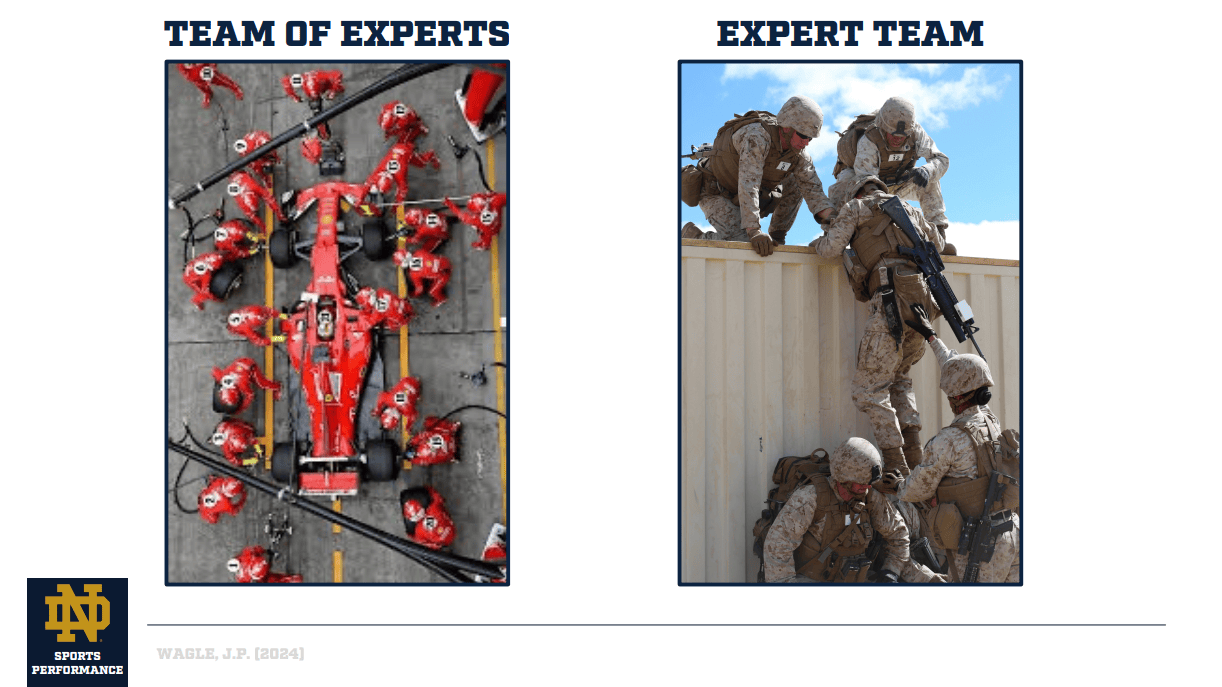
According to John Wagle, in a ‘team of experts’, “everyone has their job, they do it well, and the execution of their role doesn’t directly impact another person”. He cited a Formula 1 pit crew as an example.
An ‘expert team’, on the other hand, refers to groups where “the work of an individual may directly impact that of another person”. Wagle’s example was a US Navy SEALs team.
In illustrating this distinction onstage at November’s Leaders Sport Performance Summit in London, Wagle, the Senior Athletics Director for Sports Performance at the University of Notre Dame, highlighted the distinction between multidisciplinary and interdisciplinary.
Wagle was hired by Notre Dame in 2022 to lead an athletic department that was unable to consistently deliver an interdisciplinary approach despite the best intentions of all staff members.
“We needed a catalyst,” he continued. “The challenge as a performance director is to set the stage to solve a problem at scale in your environment.”
‘Constraints push you into new places’
Student-athletes continuously juggle their sport, academic studies and lives on campus – a situation Wagle described as “suboptimal”.
However, as he said, “these operational constraints push us into new places. They push our boundaries of how we can create solutions and I believe the best way to do that is to bring together two largely opposed ideals: knowledge and belief.”
Knowledge v belief
Knowledge, as Wagle explained, stems from a practitioner’s formal training as well as any external and internal research. He said: “the more common terminology for people in this room is evidence-based practice”.
Belief is different. It is an aggregate of a practitioner’s experiences from working in the field, athlete values and preferences, and the matter of risk tolerance and uncertainty management. “There is an element in belief that you’ve got to harness and steer into uncertainty.”
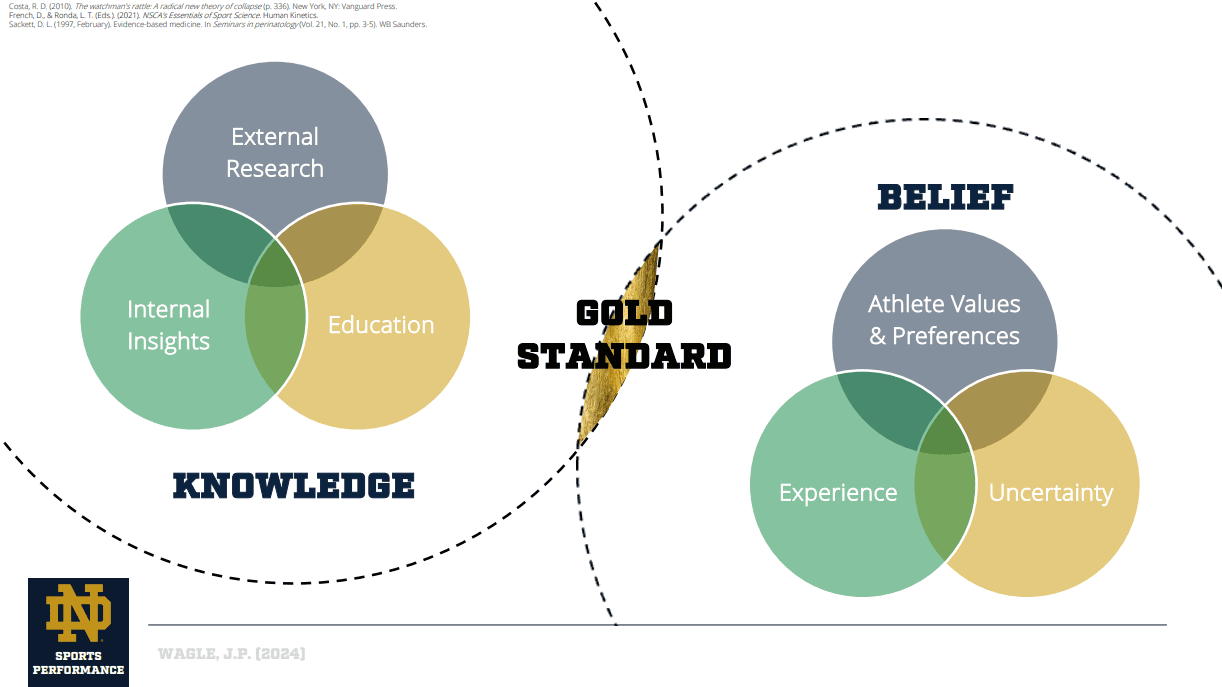
“These don’t need to be opposing viewpoints,” Wagle added, despite admitting that people “gravitate towards their tendency”.
“This is the true power of interdisciplinarity and, if we don’t bring these pieces together, we run the risk of being blind to what a lot of our athletes are experiencing.”
He spoke of the student-athlete being in a “complex adaptive system” where the interaction of different elements leads to either a health or a performance outcome, with the ‘gold standard’ somewhere in the middle.
Sleep = the catalyst
Wagle admitted that Notre Dame’s athletic department oscillated between knowledge and belief despite concerted efforts to bring both together.
“There were members of our team that no matter what the problem was were always on the knowledge side and there were members of our team who were always on the belief side,” he said. “It did not necessarily manifest in conflict – it manifested in avoidance – because I think every problem we tried to solve was inherently biased towards a discipline and it was easier to run away from that problem.”
They needed a catalyst to underline the power of interdisciplinary work and alighted upon sleep.
“We chose sleep because it is inherently lacking a discipline,” Wagle continued. “It can be owned by psychology, by nutrition, by strength & conditioning, by medical. There’s no obvious lead person in that.”
Everyone was able to meet the challenge that Wagle set: to be the best sleep support ecosystem in the whole of college sports. The knowledge people combined their data-driven approaches and devised a sleep screening tool. “We were able to get more granularity on our sleep habits and behaviours.” The belief people “brought to the table the ebbs and flows of the academic year.”
Remember: you could be part of the problem
Notre Dame’s approach to sleep has proven a game-changer in their approach to interdisciplinary work. Staff members recognised their biases, let go when necessary, and committed to collaboration.
Wagle said: “If we don’t acknowledge that ‘we could be part of the problem’, that’s where culture and alignment suffer; and resources fail to be allocated properly.”
7 Jan 2025
ArticlesFemale athlete health, mental performance, data-informed recruitment and leadership were foremost in conversations across the Leaders Performance Institute in December.
There was plenty on offer on our Intelligence Hub in December and here we bring you four key thoughts from the final weeks of 2024 to set you up for success in the months ahead.
Before we get into it, remember our first summit of the year takes place at Melbourne’s Glasshouse in just under four weeks’ time. More info here. We hope to see as many of you there as possible.
If there’s an upcoming virtual learning session that takes your fancy, please let a member of the Leaders Performance Institute team know.
Right, back to the matter at hand. Here are four themes that stood out in December.
That’s not really news and, to be fair, is not entirely representative either. We have sought to address the fine work being done (as well as the enduring iniquities) in our latest Performance Special Report, titled A Female Lens on Performance: what it takes to help women and girls thrive in elite sport.
The report, which is brought to you by our Partners Keiser, features Garga Caserta, the Head of Performance at NWSL side the Kansas City Current, who discusses the best ways to balance challenge and support for players.
He also touched upon his reluctance to chase ‘low-hanging fruit’ in women’s sport performance, particularly where data is lacking:
Elsewhere in the report, we spoke to:
We also pondered the potential implications of the gendered environment for female athletes and coaches.
Download A Female Lens on Performance now.
Be careful how you answer that question. If you feel that your mental performance coach never quite fulfils their remit, perhaps you’re not setting them up to be successful. It could be, as mental performance coach Aaron Walsh argues in this exclusive column, that you’re viewing their work from the wrong angle.
Walsh wrote:
Read the full article here.
Even if you are, you probably feel that you can tighten up processes here or look at things through a different lens there.
It was a theme that ran through our Kitman Labs podcast series where the Leaders Performance Institute was joined by Kitman Founder Stephen Smith to chat to a range of guests from across the world of soccer.
These included Dr Karl-Heinrich Dittmar, the Head of Medical at German Bundesliga champions Bayer Leverkusen. He spoke at length about the club’s efforts to use data to outmanoeuvre their rivals when recruiting:
During the course of this Kitman Labs series, we also spoke to:
It’s an age-old question, but no-one has really nailed it. Dan Jackson, the General Manager of Player Development & Leadership at the Adelaide Football Club is no exception.
“I can’t teach leadership,” he told the Leaders Performance Podcast. “I can help unlock what’s already in there.”
Jackson feels that leaders can be created. “Leadership is 100 per cent made, but it’s made from a very young age.”
Beyond the origins of leadership, Jackson also spoke about the importance of prioritising others in a team environment.
“Great sustainable teams are built in environments where everyone’s looking to help someone else out,” he adds. “When you fill someone else’s bucket, it fills yours.”
It’s well worth your time. The same can also be said for these other guests, who all joined our three-part Keiser Series podcast in December:
When it comes to untapped performance potential, female athletes and coaches often have the most to gain. And as we’ve tried to demonstrate across this Special Report, produced with the support of our partners at Keiser, there are significant strides being made towards those gains at various elite sports organisations across the world.
With contributions from practitioners in American soccer, at High Performance Sport New Zealand and England Rugby, as well as research from the Universities of Nottingham and Manitoba, this report identifies best-in-class work being done in the fields of S&C for female soccer players; maternity and motherhood in English rugby; coach development across New Zealand sport; and the injury risks posed by gendered environments.
Complete this form to access your free copy of A Female Lens on Performance and see for yourself how the performance ceiling for women athletes and coaches can be raised.
The UFC’s Duncan French reflects on his challenges and lessons in 2024 before casting his eye towards the future.
A podcast brought to you by our Main Partners

“If an athlete has gone through the fight pretty well and won, then it might be a very simple kind of cool down in one of the back rooms in the locker room and just do some light work to bring themselves back down again,” he says of the victor.
“If an athlete’s had a pretty significant amount of trouble, that’s a very different strategy.”
Mixed martial arts is, as he adds, “a sport of consequences”.
It’s all in a day’s work for French, who oversees the UFC’s Performance Institutes based in Las Vegas, Shanghai and, most recently, Mexico City.
There have been some teething troubles with the Mexican facility [4:40], but French took it all in his stride, as he tells us in the first of this three-part Keiser Series Podcast focused on some of the challenges faced and lessons learned by members of the Leaders Performance Institute during 2024.
French also discussed his evolving leadership style [6:20]; the personalisation of fight preparation plans [19:30]; and his use of data to inform those strategies [28:30].
Listen above and subscribe today on iTunes, Spotify, Stitcher and Overcast, or your chosen podcast platform.

12 Dec 2024
ArticlesIn the fourth part of his ongoing miniseries, mental performance coach Aaron Walsh says that your mental performance coach can only be a facilitator – it takes everyone within a team to deliver a mental performance program.
To successfully integrate the work, teams need to understand what a mental performance coach can do to elevate performance and how to deliver that work most effectively. Traditionally, the delivery model has involved one person attempting to meet the needs of everyone in the environment. This often leads to frustration for both the team and the provider. The team feels like the demands are only sometimes met, while the provider feels more time is needed.
A more effective model is viewing the provider as a facilitator, where they engage the key leaders in the environment and help drive the work. Yes, contexts will be provided for the provider to deliver critical messages and practices directly. Still, as we know, the mental side of performance happens every day and all the time.
To clarify this, I will examine four specific areas related to team performance where the mental skills coach can support key individuals and deliver crucial work.
Coach support
The coaching group, particularly the head coach, will have the most significant influence on any team environment. Their messages shape the players’ mindsets, and if they have the tools, they can be effective real-time psychologists for the playing group.
They must also navigate the pressure of working in a results-based business as a group. Recent research has revealed that the coach’s well-being is a genuine concern. The hours they work, the consistently tough decisions they make, and the lack of ongoing job security create a recipe that challenges and, at times, compromises their mental health.
What this looks like day to day
Player leadership group
An additional key group that drives the work is the senior playing group. We know that high-performing teams require high-performing leaders. These individuals wield significant influence and are often the “gatekeepers” who determine the rest of the team’s engagement. Their role is pivotal, and their impact is substantial. Without their “buy-in,” the work will fail to embed as it will depend on one individual driving everything.
What this looks like day to day
Creating and maintaining an environment that empowers performance
Anyone involved in a team recognises the connection between environment and performance. Group dynamics and how people feel within a team have the most significant effect on mindset. We are hardwired to seek belonging and need to be connected to the team’s purpose, the people we work with, and what our role is that helps performance.
When these realities are met, people can pour their energy and focus into the team’s shared mission. They can lock into their role and the tasks they are asked to deliver. They can be themselves, feel respected and know that they matter. By feeling included, they become better teammates and performers.
We can provide all the tools, such as breathing, meditation, and visualisation, but we won’t get the most out of our people if we neglect these core needs.
What this looks like day to day
Mental performance training
The final aspect to examine is mental skills training. I have written extensively about this in previous articles. However, we have a simple goal with this work: We want our athletes to be able to deliver their best when it matters most. Typically, this work has been viewed through the lens of one-on-one work. These are important, but there is also value in delivering group sessions.
I prefer to periodise these sessions, similar to preparing the body for a season. We can use The pre-season aims to build foundational mental principles and skills. Subjects like understanding pressure, where it comes from, and how it affects us are good starting points. The goal is to have everyone aligned and create clarity around what messages will be Important during the season. I like to keep these sessions to 10-15 minutes and create some. level of introspection and interaction. During the season, we can refer back to this foundation and make it relevant to what happens in any given week. This prevents us from flooding the players with new and unnecessary information.
I use the mental skills framework discussed in the second article for the one-on-one work. I go through this with each player each preseason and ask them to identify some areas they believe will be critical to their performance that year. This keeps the one-on-one focused and purposeful, avoiding another meaningless “catch-up” during the season’s business. We can adjust as needs arise, but the work is mainly strategic and avoids bouncing around subjects as a reaction to any given week.
What this looks like day to day
Reflection questions
Further reading:
Your Mental Skills Work Must Be Simple, Relevant and Applicable